Microbiological Principles of Food Preservation
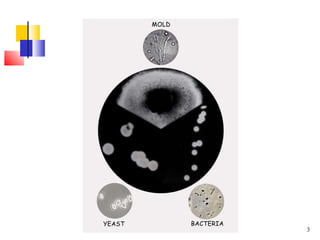
Types of Microbes on Food Bacteria – one celled, Procaryotic  Molds – Threadlike Fungi  Yeasts –  Usually creamy Fungi
Other microorganisms of concern Viruses  – protein packet of genes Protozoa  –Complex cell - Eucaryotic Do not multiply in foods Contaminate food  Humans Contaminated water
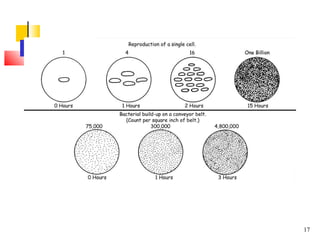
Bacterial Cells? Contain Genes that Program the Cell and Help It Survive Reproduction Binary Fission – One Cells Splits in Two 1 cell > 65,000 cells in ~4 hours Cause Illness or Disease - Pathogens Cause Deterioration of  Foods – Spoilage Useful - fermentation
Some Microorganisms Cause Disease Microorganisms that cause disease referred to as  pathogens Few of the known microorganisms are harmful to humans Many diseases can be transmitted from person to person or from animals to humans Very few transmitted via foods
Some Microorganisms Cause Disease Majority of bacterial foodborne illnesses are caused few microorganisms Salmonella Campylobacter Shigella Clostridium perfringens Staphylococcus aureus Listeria monocytogenes Clostridium botulinum
Pathogenic Microorganisms and toxins http://www.fda.gov/Food/FoodSafety/FoodborneIllness/FoodborneIllnessFoodbornePathogensNaturalToxins/BadBugBook/default.htm
Food Spoilage and  Food Safety Not the Same! Reducing spoilage can actually  increase  the risk of a harmful bacterium being present Both Preservation and Safety must be ensured by the processor. Processors use the “hurdles” concept to preserve foods and create safe foods.
Useful Functions of Microorganisms Food Fermentations Bread, cheese, wine, beer, sauerkraut, sausages, and other fermented foods Enzymes, antibiotics Degrade organic matter
Bacteria The most important and troublesome microorganisms for the food processor Bacteria are single-celled living bodies so small that individually they can be seen only with the aid of a powerful microscope
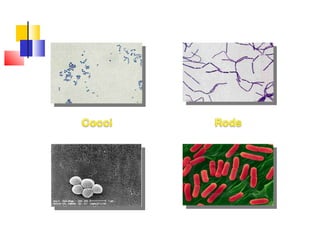
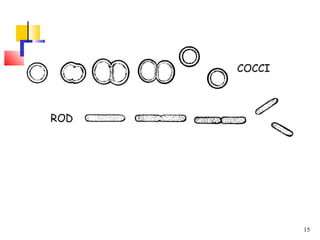
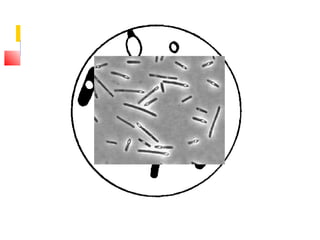
Bacteria Bacteria have several shapes or forms Spherical called  “cocci” Rod-shaped called  “rods”
 
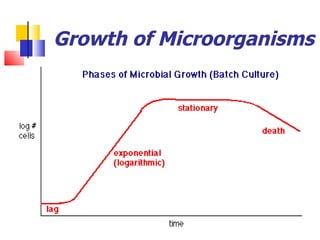
Reproduction of Bacterial Cells Bacteria reproduce by division “ Fission” Called  “growth” Cells in the active stage of growth and metabolism are referred to as  vegetative cells
Reproduction of Bacterial Cells Under favorable conditions, each cell divides on average about once every 15 or 30 minutes
Growth of Microorganisms
Molds Multicellular organisms Form tubular filaments or  “mycelia” Branched Reproduction Fruiting bodies or spores On aerial structures Larger than bacteria Longer than yeasts
Molds Widely distributed in nature Soil and in the dust Will grow on almost any food or substance Pastes, paper, plastics, paint Tolerant to cold
Molds Little heat resistance Require oxygen to grow No growth in canned foods unless Air remaining in container Loss of vacuum
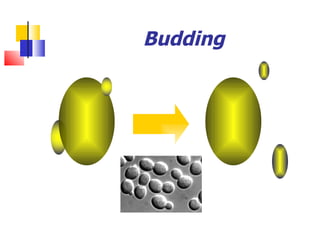
Yeasts Single cell microscopic living bodies Often oval or egg-shaped Smaller than molds but larger than bacteria Reproduce mainly by budding
Budding
Yeasts Widely found in nature Often associated with liquid foods containing sugars and acids More tolerant of cold than of heat Most yeast are destroyed by heating to 170F
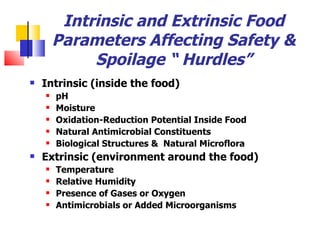
Intrinsic and Extrinsic Food Parameters Affecting Safety & Spoilage “ Hurdles” Intrinsic (inside the food) pH Moisture Oxidation-Reduction Potential Inside Food Natural Antimicrobial Constituents Biological Structures &  Natural Microflora Extrinsic (environment around the food) Temperature Relative Humidity Presence of Gases or Oxygen Antimicrobials or Added Microorganisms
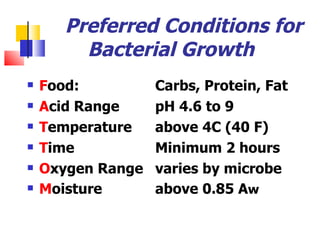
Preferred Conditions for Bacterial Growth F ood: Carbs, Protein, Fat A cid Range pH 4.6 to 9 T emperature above 4C (40 F) T ime Minimum 2 hours O xygen Range varies by microbe M oisture above 0.85 A w
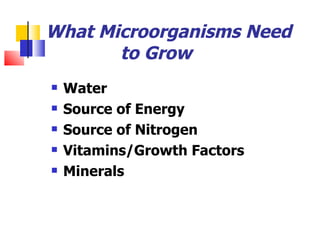
What Microorganisms Need to Grow Water Source of Energy Source of Nitrogen Vitamins/Growth Factors Minerals
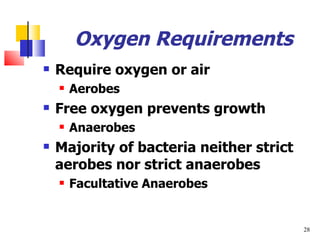
Oxygen Requirements Require oxygen or air Aerobes Free oxygen prevents growth Anaerobes Majority of bacteria neither strict aerobes nor strict anaerobes Facultative Anaerobes
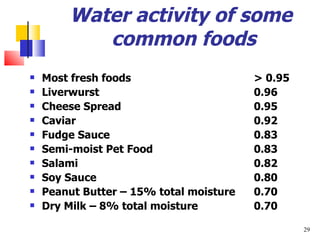
Water activity of some  common foods Most fresh foods > 0.95 Liverwurst 0.96 Cheese Spread 0.95 Caviar 0.92 Fudge Sauce 0.83 Semi-moist Pet Food 0.83 Salami 0.82 Soy Sauce 0.80 Peanut Butter – 15% total moisture 0.70 Dry Milk – 8% total moisture 0.70
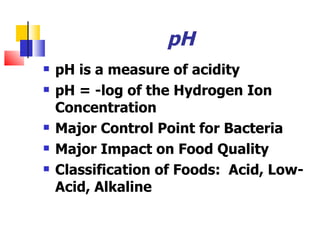
pH  pH is a measure of acidity  pH = -log of the Hydrogen Ion Concentration Major Control Point for Bacteria Major Impact on Food Quality Classification of Foods:  Acid, Low-Acid, Alkaline
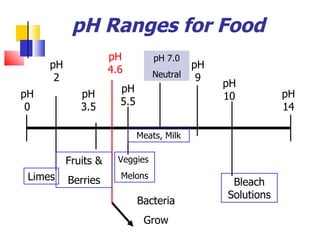
pH Ranges for Food pH 7.0 Neutral pH 0 pH 14 pH 2 pH 3.5 pH 9 pH 4.6 pH 5.5 pH 10 Limes Fruits & Berries Veggies  Melons Meats, Milk Bleach Solutions Bacteria Grow
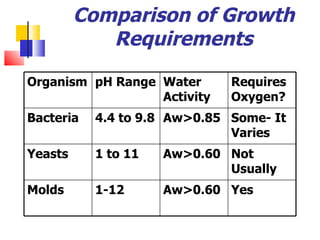
Comparison of Growth Requirements Organism pH Range Water Activity Requires Oxygen? Bacteria 4.4 to 9.8 Aw>0.85 Some- It Varies Yeasts 1 to 11 Aw>0.60 Not Usually Molds 1-12 Aw>0.60 Yes
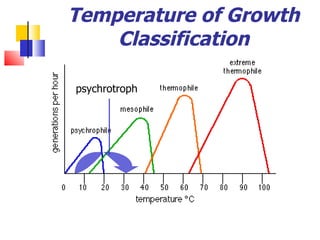
Temperature of Growth Classification psychrotroph
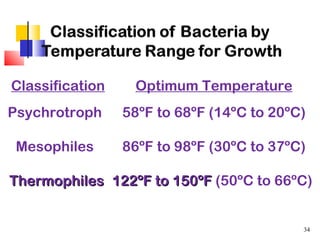
Classification Optimum Temperature Psychrotroph Mesophiles Thermophiles     58ºF to 68ºF (14ºC to 20ºC) 86ºF to 98ºF (30ºC to 37ºC) 122ºF to 150ºF  (50ºC to 66ºC)
Sporeforming and  Non-Sporeforming Bacteria Most bacteria exist only as vegetative cells All cocci and some rods NON-SPOREFORMERS Some groups of rod-shaped bacteria produce spores SPOREFORMERS Exist as both vegetative cell and spores
 
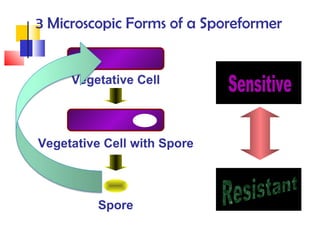
Sporeforming and  Non-Sporeforming Bacteria Bacterial spores Dormant stage in normal growth cycle Can germinate and produce new vegetative cell Ability to survive a wide range of unfavorable conditions Spores in molds and yeasts Generally not resistant
Vegetative Cell Vegetative Cell with Spore Spore 3 Microscopic Forms of a Sporeformer Sensitive Resistant
Resistance of Spores to Environment In general, bacterial spores are extremely resistant to heat, cold and chemical agents Survive in boiling water > 16 hours
Temperature Requirements Every microorganisms has an optimum (most favorable) temperature range Microorganisms grouped to indicate their relationships to temperature
The Psychrotrophic Group Psychrotrophs ( “psychro” for cold and “trophs” for growing) Optimum of 58F-68F  Grow slowly on food at refrigerator temperatures 40F Primarily spoilage microorganisms Few pathogens
The Mesophilic Group Mesophiles ( “meso” for middle and “phile” for love) Optimum 86F-98F All microorganisms that affect food safety can grow in this temperature range Clostridium botulinum   is a mesophile
The Thermophilic Group Thermophiles ( “thermo” for heat, “phile” for love) Many are sporeforming bacteria Obligate thermophiles Spores will not germinate and grow below 122F Facultative thermophiles Growth occurs at 122F to 150F
The Thermophilic Group Spores of these bacteria are so heat-resistant that they can survive for more than 60 minutes at temperatures of 250F Thermophilic bacteria are not pathogenic and do not affect food safety

Food Microbiological principles FST 241

  • 1.
  • 2.
    Types of Microbeson Food Bacteria – one celled, Procaryotic Molds – Threadlike Fungi Yeasts – Usually creamy Fungi
  • 4.
    Other microorganisms ofconcern Viruses – protein packet of genes Protozoa –Complex cell - Eucaryotic Do not multiply in foods Contaminate food Humans Contaminated water
  • 5.
    Bacterial Cells? ContainGenes that Program the Cell and Help It Survive Reproduction Binary Fission – One Cells Splits in Two 1 cell > 65,000 cells in ~4 hours Cause Illness or Disease - Pathogens Cause Deterioration of Foods – Spoilage Useful - fermentation
  • 6.
    Some Microorganisms CauseDisease Microorganisms that cause disease referred to as pathogens Few of the known microorganisms are harmful to humans Many diseases can be transmitted from person to person or from animals to humans Very few transmitted via foods
  • 7.
    Some Microorganisms CauseDisease Majority of bacterial foodborne illnesses are caused few microorganisms Salmonella Campylobacter Shigella Clostridium perfringens Staphylococcus aureus Listeria monocytogenes Clostridium botulinum
  • 8.
    Pathogenic Microorganisms andtoxins http://www.fda.gov/Food/FoodSafety/FoodborneIllness/FoodborneIllnessFoodbornePathogensNaturalToxins/BadBugBook/default.htm
  • 9.
    Food Spoilage and Food Safety Not the Same! Reducing spoilage can actually increase the risk of a harmful bacterium being present Both Preservation and Safety must be ensured by the processor. Processors use the “hurdles” concept to preserve foods and create safe foods.
  • 10.
    Useful Functions ofMicroorganisms Food Fermentations Bread, cheese, wine, beer, sauerkraut, sausages, and other fermented foods Enzymes, antibiotics Degrade organic matter
  • 11.
    Bacteria The mostimportant and troublesome microorganisms for the food processor Bacteria are single-celled living bodies so small that individually they can be seen only with the aid of a powerful microscope
  • 12.
    Bacteria Bacteria haveseveral shapes or forms Spherical called “cocci” Rod-shaped called “rods”
  • 13.
  • 14.
    Reproduction of BacterialCells Bacteria reproduce by division “ Fission” Called “growth” Cells in the active stage of growth and metabolism are referred to as vegetative cells
  • 16.
    Reproduction of BacterialCells Under favorable conditions, each cell divides on average about once every 15 or 30 minutes
  • 18.
  • 19.
    Molds Multicellular organismsForm tubular filaments or “mycelia” Branched Reproduction Fruiting bodies or spores On aerial structures Larger than bacteria Longer than yeasts
  • 20.
    Molds Widely distributedin nature Soil and in the dust Will grow on almost any food or substance Pastes, paper, plastics, paint Tolerant to cold
  • 21.
    Molds Little heatresistance Require oxygen to grow No growth in canned foods unless Air remaining in container Loss of vacuum
  • 22.
    Yeasts Single cellmicroscopic living bodies Often oval or egg-shaped Smaller than molds but larger than bacteria Reproduce mainly by budding
  • 23.
  • 24.
    Yeasts Widely foundin nature Often associated with liquid foods containing sugars and acids More tolerant of cold than of heat Most yeast are destroyed by heating to 170F
  • 25.
    Intrinsic and ExtrinsicFood Parameters Affecting Safety & Spoilage “ Hurdles” Intrinsic (inside the food) pH Moisture Oxidation-Reduction Potential Inside Food Natural Antimicrobial Constituents Biological Structures & Natural Microflora Extrinsic (environment around the food) Temperature Relative Humidity Presence of Gases or Oxygen Antimicrobials or Added Microorganisms
  • 26.
    Preferred Conditions forBacterial Growth F ood: Carbs, Protein, Fat A cid Range pH 4.6 to 9 T emperature above 4C (40 F) T ime Minimum 2 hours O xygen Range varies by microbe M oisture above 0.85 A w
  • 27.
    What Microorganisms Needto Grow Water Source of Energy Source of Nitrogen Vitamins/Growth Factors Minerals
  • 28.
    Oxygen Requirements Requireoxygen or air Aerobes Free oxygen prevents growth Anaerobes Majority of bacteria neither strict aerobes nor strict anaerobes Facultative Anaerobes
  • 29.
    Water activity ofsome common foods Most fresh foods > 0.95 Liverwurst 0.96 Cheese Spread 0.95 Caviar 0.92 Fudge Sauce 0.83 Semi-moist Pet Food 0.83 Salami 0.82 Soy Sauce 0.80 Peanut Butter – 15% total moisture 0.70 Dry Milk – 8% total moisture 0.70
  • 30.
    pH pHis a measure of acidity pH = -log of the Hydrogen Ion Concentration Major Control Point for Bacteria Major Impact on Food Quality Classification of Foods: Acid, Low-Acid, Alkaline
  • 31.
    pH Ranges forFood pH 7.0 Neutral pH 0 pH 14 pH 2 pH 3.5 pH 9 pH 4.6 pH 5.5 pH 10 Limes Fruits & Berries Veggies Melons Meats, Milk Bleach Solutions Bacteria Grow
  • 32.
    Comparison of GrowthRequirements Organism pH Range Water Activity Requires Oxygen? Bacteria 4.4 to 9.8 Aw>0.85 Some- It Varies Yeasts 1 to 11 Aw>0.60 Not Usually Molds 1-12 Aw>0.60 Yes
  • 33.
    Temperature of GrowthClassification psychrotroph
  • 34.
    Classification Optimum TemperaturePsychrotroph Mesophiles Thermophiles 58ºF to 68ºF (14ºC to 20ºC) 86ºF to 98ºF (30ºC to 37ºC) 122ºF to 150ºF (50ºC to 66ºC)
  • 35.
    Sporeforming and Non-Sporeforming Bacteria Most bacteria exist only as vegetative cells All cocci and some rods NON-SPOREFORMERS Some groups of rod-shaped bacteria produce spores SPOREFORMERS Exist as both vegetative cell and spores
  • 36.
  • 37.
    Sporeforming and Non-Sporeforming Bacteria Bacterial spores Dormant stage in normal growth cycle Can germinate and produce new vegetative cell Ability to survive a wide range of unfavorable conditions Spores in molds and yeasts Generally not resistant
  • 38.
    Vegetative Cell VegetativeCell with Spore Spore 3 Microscopic Forms of a Sporeformer Sensitive Resistant
  • 39.
    Resistance of Sporesto Environment In general, bacterial spores are extremely resistant to heat, cold and chemical agents Survive in boiling water > 16 hours
  • 40.
    Temperature Requirements Everymicroorganisms has an optimum (most favorable) temperature range Microorganisms grouped to indicate their relationships to temperature
  • 41.
    The Psychrotrophic GroupPsychrotrophs ( “psychro” for cold and “trophs” for growing) Optimum of 58F-68F Grow slowly on food at refrigerator temperatures 40F Primarily spoilage microorganisms Few pathogens
  • 42.
    The Mesophilic GroupMesophiles ( “meso” for middle and “phile” for love) Optimum 86F-98F All microorganisms that affect food safety can grow in this temperature range Clostridium botulinum is a mesophile
  • 43.
    The Thermophilic GroupThermophiles ( “thermo” for heat, “phile” for love) Many are sporeforming bacteria Obligate thermophiles Spores will not germinate and grow below 122F Facultative thermophiles Growth occurs at 122F to 150F
  • 44.
    The Thermophilic GroupSpores of these bacteria are so heat-resistant that they can survive for more than 60 minutes at temperatures of 250F Thermophilic bacteria are not pathogenic and do not affect food safety