Food Labeling
Chapter 10
Lecture
Food labeling
• The goal of food labeling is to provide consumers with information
that is factual and relevant about the products they consume. Certain
label information, such as the responsible firm's name and address
and ingredient declaration, is required. Other label information, such
as health claims and nutrient content claims, is voluntary.
Label panel
• A food package usually has at least two distinct areas: the Principal
Display Panel and the Information Panel.
• All required information on the label must be presented in a legible
manner. It cannot be concealed in any manner such that it is unlikely
that the consumer will read it.
Conti……..
• The size of the lettering, unless stated, must be at least 1/16 inch in
height. Labels must be made of materials that do not contaminate
the food.
• If there is likelihood that the paper, ink or adhesive of a label will
touch the product or penetrate the packaging, these materials must
be safe for food use.
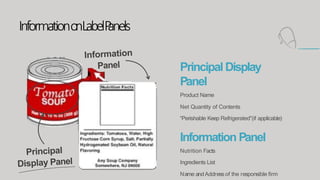
InformationonLabelP
anels
Principal Display
Panel
Product Name
Net Quantity of Contents
“Perishable Keep Refrigerated”(if applicable)
Information Panel
Nutrition Facts
Ingredients List
Name andAddress of the responsible firm
Food name
• All foods must be named. This name, which is often called the
"Statement of Identity," can be either the "common name" or a
"fanciful name" of the food. If a fanciful name is used, it must be
accompanied by a descriptive phrase at least 1⁄2 the type size of the
product name. The name has to be truthful and must be presented in
bold type on the Principal Display Panel.
Conti….
• If it is a "flavored" product, it must state so (e.g., "cherry flavored"
pie). If the flavor is not derived from a natural source, then it must
indicate so (e.g., "artificial cherry flavored" pie).
Responsible firm
• There must be a firm (manufacturer, packer or distributor) identified
on the label as a responsible party. Unless the name given is the
actual manufacturer, it must be accompanied by a qualifying phrase
which states the firm’s relation to the product (e.g., “manufactured
for” or “distributed by”).
• The firm's name, city, state and zip code must be declared. If the firm
is not listed in the current telephone guide for that city, the street
address must also be listed.
•
Conti…
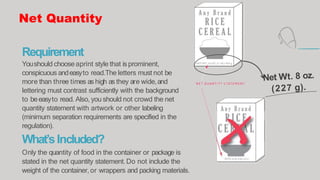
Net Quantity
Requirement
Youshould chooseaprint style that isprominent,
conspicuous andeasyto read.The letters must not be
more than three times as high as they are wide,and
lettering must contrast sufficiently with the background
to beeasyto read. Also, you should not crowd the net
quantity statement with artwork or other labeling
(minimum separation requirements are specified in the
regulation).
What’sIncluded?
Only the quantity of food in the container or package is
stated in the net quantity statement.Do not include the
weight of the container, or wrappers and packing materials.
• All packaged foods composed of two or more ingredients are required
to include an ingredient list.
• The ingredient statement must be legible and be correctly listed in
descending order of predominance by weight. Ingredients must be
listed by their common or usual names (e.g., sugar instead of
sucrose).
Ingredient List
Conti….
• Certain ingredients require special declaration. The sub-ingredients of
a food that is an ingredient in another food may be declared
following the name of the ingredient. For example: enriched flour
(wheat flour, niacin, reduced iron, riboflavin and folic acid).
Conti….
Foods with two or more discrete components (e.g., cherry pie that
has filling and pie crust) may have a separate ingredient list for each
of the components, or list all of them together under one list.
For foods that are sold in bulk, a list of ingredients must be stated on
a sign or on the food's original container.
Food Allergen Labeling
• The Food Allergen Labeling and Consumer Protection Act (FALCPA) is
an amendment to the Federal Food, Drug, and Cosmetic Act and
requires that the label of a food that contains an ingredient that is or
contains protein from a "major food allergen " declare the presence
of the allergen in the manner described by the law. FALCPA applies to
both domestically manufactured and imported packaged foods that
are subject to FDA regulation.
Conti…
• "Major Food Allergen" refers to an ingredient that is one of the
following eight foods or food groups or an ingredient that contains
protein derived from one of them: (1) Milk (2) Eggs (3) Fish (e.g.,
bass, flounder, cod) (4) Crustacean shellfish (e.g. crab, lobster,
shrimp) (5) Tree nuts (e.g., almonds, walnuts, pecans)(6) Peanuts (7)
Wheat (8) Soybeans
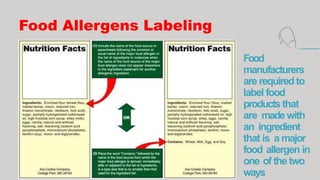
Food Allergens Labeling
Food
manufacturers
are requiredto
label food
productsthat
are madewith
an ingredient
that is a major
food allergen in
one of the two
ways
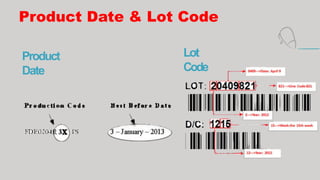
• Product dating is optional for most food products.There are two types
of dating on food packaging:
• Lot Coding
• When manufacturers produce a product, they do so in batches. Each
batch is assigned a unique series of numbers that makes it possible
for manufacturers to track exactly when a problem occurred and
which products need to be recalled.
Product Date and Lot Coding
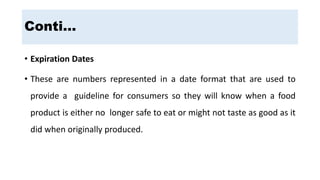
• Expiration Dates
• These are numbers represented in a date format that are used to
provide a guideline for consumers so they will know when a food
product is either no longer safe to eat or might not taste as good as it
did when originally produced.
Conti…
Product Date & Lot Code
Product
Date
Lot
Code
Most processed and packaged foods (except exempt foods) must
declare information about the foods' nutritional content using the
correct typeface, font size, and formats approved by FDA for the
"Nutrition Facts" panel.
A simplified format is allowed when the food contains insignificant
amounts of eight or more of the mandatory nutrients (Calories, total
fat, saturated fat, trans fat, cholesterol,
Nutrition Facts
sodium, total carbohydrate, dietary fiber, sugar, protein, vitamin A,
vitamin, calcium, and iron)
The five core nutrients (Calories, total fat, sodium, total
carbohydrate, and protein) must appear on all “Nutrition Facts”
panels regardless of the amount present in the food or the format
used.
Conti…
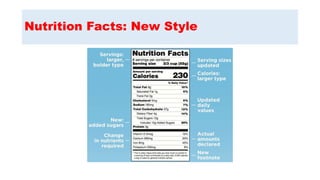
Nutrition Facts: New Style
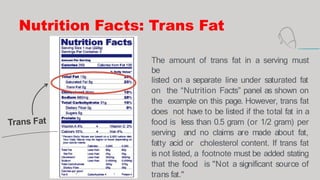
Nutrition Facts: Trans Fat
The amount of trans fat in a serving must
be
listed on a separate line under saturated fat
on the “Nutrition Facts” panel as shown on
the example on this page. However, trans fat
does not have to be listed if the total fat in a
food is less than 0.5 gram (or 1/2 gram) per
serving and no claims are made about fat,
fatty acid or cholesterol content. If trans fat
is not listed, a footnote must be added stating
that the food is "Not a significant source of
trans fat."
• A “Nutrient Content Claim” is a word or phrase on a food package that makes a
comment about the nutritional value of the food. Eleven (11) basic terms have
been defined for several nutrients, and FDA has set conditions for the use of
these terms:-
• Free low reduced
• Fewer high less more lean
• Extra lean
• good source light
Nutrient Content Claims
• A “Health Claim” is a food label message that describes the
relationship between a food component, such as fat, calcium, or fiber,
and a disease or health-related condition.
• *Nutrient Content Claim indicates the nutritional value of the food.
• *Health Claim describes the relationship between a food component
and a disease or health-related condition.
Health Claims
• The regulations define the term “gluten-containing grain” to mean
any one of the following grains (e.g., wheat, rye, barley) or their
crossbred hybrids (e.g. triticale, which is a cross between wheat and
rye). Under the regulation, a “gluten- free” label claim means:
• A) That the food bearing the “gluten free” claim does not contain any
of the following:
Gluten-Free Regulations
Conti….
• An ingredient that is a gluten- containing grain (e.g. spelt wheat) An
ingredient derived from a gluten-containing grain and that has not
been processed to remove gluten (e.g. wheat flour)
• An ingredient that is derived from a gluten-containing grain and that
has been processed to remove gluten (e.g. wheat starch), if the use
of that ingredient results in the presence of 20 parts per million or
more gluten in the food
• B) The product inherently does not contain gluten; and any
unavoidable presence of gluten in the food bearing the claim in its
labeling is below 20 parts per million gluten.
Conti….
Refrigerated Foods
• California law requires that all Potentially Hazardous Foods* have the
statement "Perishable Keep Refrigerated" on the label in a conspicuous
location, normally on the Principal Display Panel. The statement
"Perishable Keep Frozen" is also acceptable on the label of foods that are
kept frozen.
• *Food that is capable of supporting growth of infectious or toxigenic
microorganisms when held at temperatures above 45°°F.
Organic Foods
• Foods represented as “organic” must meet the requirements of the USDA
National Organic Program (NOP) Regulations and the California Organic Products
Act of 2003.
• Products may be
• 100% Organic: 100% certified organic ingredients Organic:
• 95% certified organic ingredients
• Made with Organic: 70% and 95% certified organic ingredients
Safe Handling Statements
• Raw meat and poultry products (e.g., fresh and frozen) including
shell eggs must display safe handling instructions, as shown below,
on their labels. The handling instructions should address safe storage
of raw product, prevention of cross contamination, cooking of raw
product, and/or handling of leftovers.
•
Safe Handling Statements
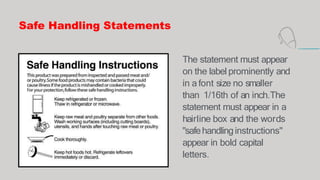
The statement must appear
on the label prominently and
in a font size no smaller
than 1/16th of an inch.The
statement must appear in a
hairline box and the words
"safehandlinginstructions"
appear in bold capital
letters.
Warning Notice
• Protein product that derives more than 50 percent of total caloric
value from either whole protein, protein hydrolysates, and/or amino
acid mixtures, and that is represented for use in reducing weight;
• Dietary supplements containing iron or iron salts;
• Foods containing psyllium husk; Self-pressured containers or self-
pressured containers with halocarbon or hydrocarbon propellants;
• Products containing substances that have stimulant laxative effects
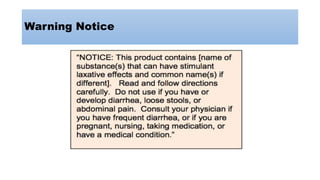
• Federal and state labeling regulations require certain foods and
packages to declare warning notices. Examples of such products
required by the federal regulation (21 CFR § 101.17) include:
•
Conti….
Warning Notice
Thank You.

Food Labeling chapter 10.pptx

  • 1.
  • 2.
    Food labeling • Thegoal of food labeling is to provide consumers with information that is factual and relevant about the products they consume. Certain label information, such as the responsible firm's name and address and ingredient declaration, is required. Other label information, such as health claims and nutrient content claims, is voluntary.
  • 3.
    Label panel • Afood package usually has at least two distinct areas: the Principal Display Panel and the Information Panel. • All required information on the label must be presented in a legible manner. It cannot be concealed in any manner such that it is unlikely that the consumer will read it.
  • 4.
    Conti…….. • The sizeof the lettering, unless stated, must be at least 1/16 inch in height. Labels must be made of materials that do not contaminate the food. • If there is likelihood that the paper, ink or adhesive of a label will touch the product or penetrate the packaging, these materials must be safe for food use.
  • 5.
    InformationonLabelP anels Principal Display Panel Product Name NetQuantity of Contents “Perishable Keep Refrigerated”(if applicable) Information Panel Nutrition Facts Ingredients List Name andAddress of the responsible firm
  • 6.
    Food name • Allfoods must be named. This name, which is often called the "Statement of Identity," can be either the "common name" or a "fanciful name" of the food. If a fanciful name is used, it must be accompanied by a descriptive phrase at least 1⁄2 the type size of the product name. The name has to be truthful and must be presented in bold type on the Principal Display Panel.
  • 7.
    Conti…. • If itis a "flavored" product, it must state so (e.g., "cherry flavored" pie). If the flavor is not derived from a natural source, then it must indicate so (e.g., "artificial cherry flavored" pie).
  • 8.
    Responsible firm • Theremust be a firm (manufacturer, packer or distributor) identified on the label as a responsible party. Unless the name given is the actual manufacturer, it must be accompanied by a qualifying phrase which states the firm’s relation to the product (e.g., “manufactured for” or “distributed by”).
  • 9.
    • The firm'sname, city, state and zip code must be declared. If the firm is not listed in the current telephone guide for that city, the street address must also be listed. • Conti…
  • 10.
    Net Quantity Requirement Youshould chooseaprintstyle that isprominent, conspicuous andeasyto read.The letters must not be more than three times as high as they are wide,and lettering must contrast sufficiently with the background to beeasyto read. Also, you should not crowd the net quantity statement with artwork or other labeling (minimum separation requirements are specified in the regulation). What’sIncluded? Only the quantity of food in the container or package is stated in the net quantity statement.Do not include the weight of the container, or wrappers and packing materials.
  • 11.
    • All packagedfoods composed of two or more ingredients are required to include an ingredient list. • The ingredient statement must be legible and be correctly listed in descending order of predominance by weight. Ingredients must be listed by their common or usual names (e.g., sugar instead of sucrose). Ingredient List
  • 12.
    Conti…. • Certain ingredientsrequire special declaration. The sub-ingredients of a food that is an ingredient in another food may be declared following the name of the ingredient. For example: enriched flour (wheat flour, niacin, reduced iron, riboflavin and folic acid).
  • 13.
    Conti…. Foods with twoor more discrete components (e.g., cherry pie that has filling and pie crust) may have a separate ingredient list for each of the components, or list all of them together under one list. For foods that are sold in bulk, a list of ingredients must be stated on a sign or on the food's original container.
  • 14.
    Food Allergen Labeling •The Food Allergen Labeling and Consumer Protection Act (FALCPA) is an amendment to the Federal Food, Drug, and Cosmetic Act and requires that the label of a food that contains an ingredient that is or contains protein from a "major food allergen " declare the presence of the allergen in the manner described by the law. FALCPA applies to both domestically manufactured and imported packaged foods that are subject to FDA regulation.
  • 15.
    Conti… • "Major FoodAllergen" refers to an ingredient that is one of the following eight foods or food groups or an ingredient that contains protein derived from one of them: (1) Milk (2) Eggs (3) Fish (e.g., bass, flounder, cod) (4) Crustacean shellfish (e.g. crab, lobster, shrimp) (5) Tree nuts (e.g., almonds, walnuts, pecans)(6) Peanuts (7) Wheat (8) Soybeans
  • 16.
    Food Allergens Labeling Food manufacturers arerequiredto label food productsthat are madewith an ingredient that is a major food allergen in one of the two ways
  • 17.
    • Product datingis optional for most food products.There are two types of dating on food packaging: • Lot Coding • When manufacturers produce a product, they do so in batches. Each batch is assigned a unique series of numbers that makes it possible for manufacturers to track exactly when a problem occurred and which products need to be recalled. Product Date and Lot Coding
  • 18.
    • Expiration Dates •These are numbers represented in a date format that are used to provide a guideline for consumers so they will know when a food product is either no longer safe to eat or might not taste as good as it did when originally produced. Conti…
  • 19.
    Product Date &Lot Code Product Date Lot Code
  • 20.
    Most processed andpackaged foods (except exempt foods) must declare information about the foods' nutritional content using the correct typeface, font size, and formats approved by FDA for the "Nutrition Facts" panel. A simplified format is allowed when the food contains insignificant amounts of eight or more of the mandatory nutrients (Calories, total fat, saturated fat, trans fat, cholesterol, Nutrition Facts
  • 21.
    sodium, total carbohydrate,dietary fiber, sugar, protein, vitamin A, vitamin, calcium, and iron) The five core nutrients (Calories, total fat, sodium, total carbohydrate, and protein) must appear on all “Nutrition Facts” panels regardless of the amount present in the food or the format used. Conti…
  • 22.
  • 23.
    Nutrition Facts: TransFat The amount of trans fat in a serving must be listed on a separate line under saturated fat on the “Nutrition Facts” panel as shown on the example on this page. However, trans fat does not have to be listed if the total fat in a food is less than 0.5 gram (or 1/2 gram) per serving and no claims are made about fat, fatty acid or cholesterol content. If trans fat is not listed, a footnote must be added stating that the food is "Not a significant source of trans fat."
  • 24.
    • A “NutrientContent Claim” is a word or phrase on a food package that makes a comment about the nutritional value of the food. Eleven (11) basic terms have been defined for several nutrients, and FDA has set conditions for the use of these terms:- • Free low reduced • Fewer high less more lean • Extra lean • good source light Nutrient Content Claims
  • 25.
    • A “HealthClaim” is a food label message that describes the relationship between a food component, such as fat, calcium, or fiber, and a disease or health-related condition. • *Nutrient Content Claim indicates the nutritional value of the food. • *Health Claim describes the relationship between a food component and a disease or health-related condition. Health Claims
  • 26.
    • The regulationsdefine the term “gluten-containing grain” to mean any one of the following grains (e.g., wheat, rye, barley) or their crossbred hybrids (e.g. triticale, which is a cross between wheat and rye). Under the regulation, a “gluten- free” label claim means: • A) That the food bearing the “gluten free” claim does not contain any of the following: Gluten-Free Regulations
  • 27.
    Conti…. • An ingredientthat is a gluten- containing grain (e.g. spelt wheat) An ingredient derived from a gluten-containing grain and that has not been processed to remove gluten (e.g. wheat flour) • An ingredient that is derived from a gluten-containing grain and that has been processed to remove gluten (e.g. wheat starch), if the use of that ingredient results in the presence of 20 parts per million or more gluten in the food
  • 28.
    • B) Theproduct inherently does not contain gluten; and any unavoidable presence of gluten in the food bearing the claim in its labeling is below 20 parts per million gluten. Conti….
  • 29.
    Refrigerated Foods • Californialaw requires that all Potentially Hazardous Foods* have the statement "Perishable Keep Refrigerated" on the label in a conspicuous location, normally on the Principal Display Panel. The statement "Perishable Keep Frozen" is also acceptable on the label of foods that are kept frozen. • *Food that is capable of supporting growth of infectious or toxigenic microorganisms when held at temperatures above 45°°F.
  • 30.
    Organic Foods • Foodsrepresented as “organic” must meet the requirements of the USDA National Organic Program (NOP) Regulations and the California Organic Products Act of 2003. • Products may be • 100% Organic: 100% certified organic ingredients Organic: • 95% certified organic ingredients • Made with Organic: 70% and 95% certified organic ingredients
  • 31.
    Safe Handling Statements •Raw meat and poultry products (e.g., fresh and frozen) including shell eggs must display safe handling instructions, as shown below, on their labels. The handling instructions should address safe storage of raw product, prevention of cross contamination, cooking of raw product, and/or handling of leftovers. •
  • 32.
    Safe Handling Statements Thestatement must appear on the label prominently and in a font size no smaller than 1/16th of an inch.The statement must appear in a hairline box and the words "safehandlinginstructions" appear in bold capital letters.
  • 33.
    Warning Notice • Proteinproduct that derives more than 50 percent of total caloric value from either whole protein, protein hydrolysates, and/or amino acid mixtures, and that is represented for use in reducing weight; • Dietary supplements containing iron or iron salts; • Foods containing psyllium husk; Self-pressured containers or self- pressured containers with halocarbon or hydrocarbon propellants;
  • 34.
    • Products containingsubstances that have stimulant laxative effects • Federal and state labeling regulations require certain foods and packages to declare warning notices. Examples of such products required by the federal regulation (21 CFR § 101.17) include: • Conti….
  • 35.
  • 36.