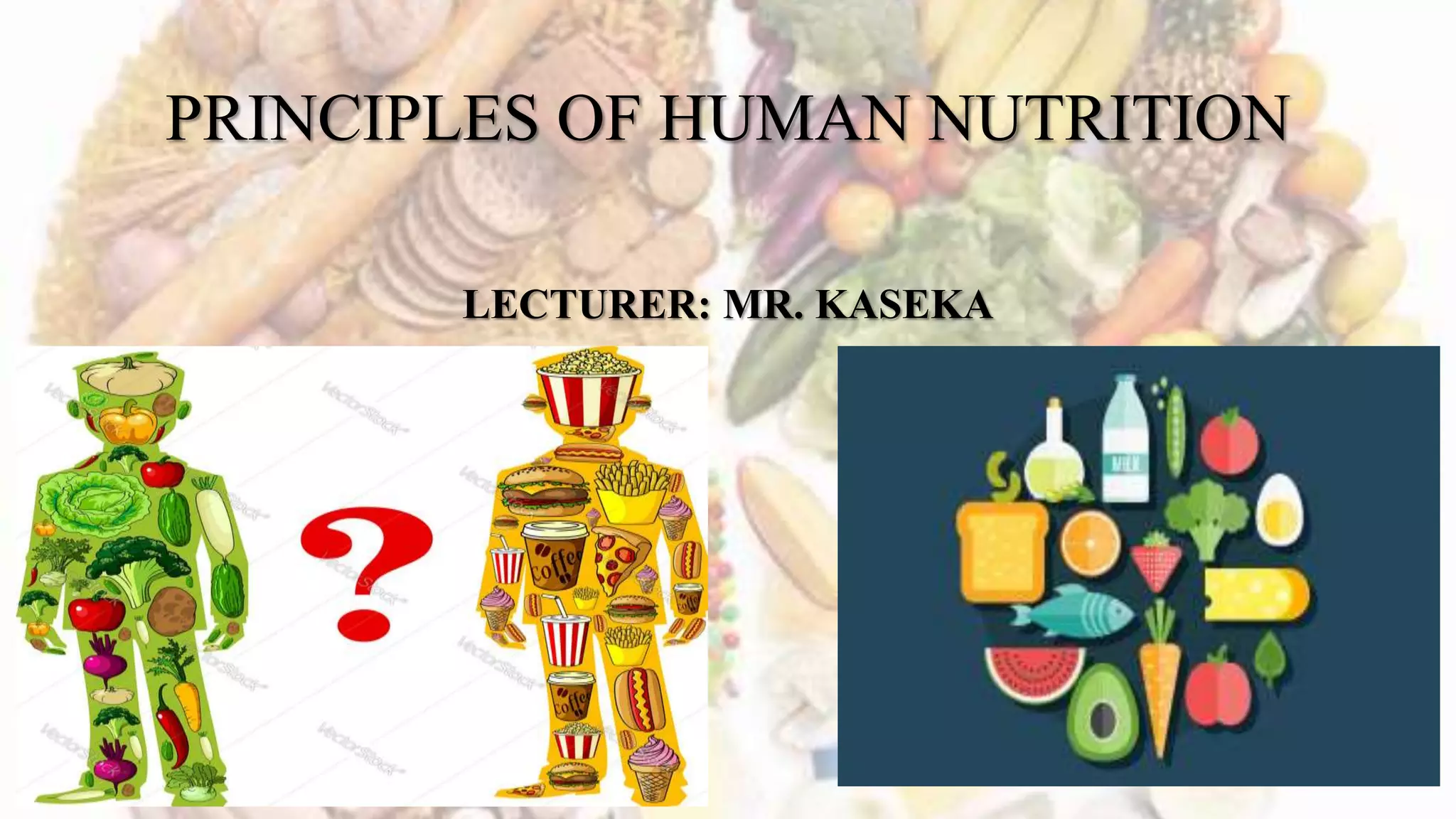
PRINCIPLES OF HUMAN NUTRITION
LECTURER: MR. KASEKA
PRINCIPLES OF HUMAN NUTRITION
COURSE CONTENT
• History of human nutrition
• Food groups
• Balance diet
• Nutrient groups
• Digestion and absorption
• Energy Balance and Body
Weight Control
• Nutrition status of special group
• Assessment of human nutrition
• Three periods per week
• 6 hrs 45mins
• Two tests
• Several quizzes
• Individual assignment
• Group assignment
• Makeup test where possible
Nutrition and Human Nutrition
• Nutrition is the process of taking in food and using it for growth,
metabolism, and repair.
• Human nutrition describes the processes whereby cellular organelles,
cells, tissues, organs, systems, and the body as a whole obtain and use
necessary substances obtained from foods (nutrients) to maintain
structural and functional integrity.
Food and Nutrients
• People eat food, not nutrients; however, it is the combination and
amounts of nutrients in consumed foods that determine health. Food is
any material consisting essentially of nutrients used in the body of an
organism to sustain growth, repair, and vital processes and to furnish
energy.
FUNCTIONS OF FOOD
• Food gives us energy to work
• Food helps in the growth and repair of tissues
• Food gives strength to fight against diseases
• Food helps the body to function normally
• Food satisfies hunger
• Social functions
• Psychological functions
FOOD GROUPS
• Cereals
Wheat, rice, and maize are currently the predominant cereals in terms of both
the land devoted to them and their consumption.
The nutritional values of all cereal grains are essentially similar, with some
variation due to genetic factors and environmental conditions such as soil type
and temperature.
Cereals provide starch and dietary fibre (soluble and insoluble) which together
comprise 70–77% of the grain.
Cereals Cont..
• Protein accounts for 6–15% and the limiting amino acid is lysine, with maize
additionally low in tryptophan. Gluten is the major protein in wheat and rye and
oryzenin the major protein in rice.
• All cereals are low in fat, oats have slightly more; most of the fat is
polyunsaturated. Whole grains are a good source of thiamin, their germ is rich in
vitamin E and they contain significant amounts of minerals especially potassium,
phosphorus, magnesium, iron, and zinc.
Meat and Poultry and Eggs
• The term ‘meat’ encompasses not only the muscle tissues but also
organs like liver, kidneys, and pancreas (termed offal).
• The major animals nowadays produced for human consumption are
pigs, cattle, and sheep, and birds like chicken and turkey
• Muscle meat is generally a good source of protein and minerals while
offal meats offer a rich source of vitamins
Meat and Poultry and Eggs…
• Meat is a major source of readily available iron and zinc, and a good source of
magnesium. Liver and kidney are richer in iron and zinc than muscle, and pig
liver contains more than that from sheep or beef.
• Meat provides a valuable source of thiamin, niacin and riboflavin, with pork
higher in thiamin than the other meats
• Meat has a short shelf-life and must be kept at low temperatures and be cooked
adequately to prevent microbial growth.
Meat and Poultry and Eggs…
• Chicken and turkey meats are consumed in growing amounts in countries like
the United States and Australia
• Like red meat, poultry is a good source of protein and minerals including iron
and zinc
• Eggs are a central ingredient in many cuisines but they have received adverse
publicity in recent years, mainly centred around the high cholesterol content of
the yolk
Meat and Poultry and Eggs…
• However, it is frequently forgotten that hen’s eggs have the highest
quality dietary protein for nutrition and are a relatively inexpensive
source.
• Eggs also contribute calcium, B vitamins, and vitamins A and B12.
The fat, cholesterol, and micronutrients are confined to the yolk while
the white contains mainly protein.
Milk and Milk Products
• All mammals produce milk and man consumes a variety of milks from cows,
sheep, goats, horses, reindeer, yaks, water buffalos, and camels
• Milk Cow’s milk is about 88% water and 3% protein. The two main proteins
are casein and whey proteins which include lactalbumin and lactoglobulin.
• Casein comprises about 82% of the total protein. This is of high nutritional
value and contains all the essential amino acids with relatively high amounts
of the amino acid, lysine.
Milk and Milk Products…
• Milk is an excellent source of readily absorbable calcium and phosphorus and
milk and milk products provide over 75% of the calcium in the human diet in
Western countries
• Milk also contains moderate amounts of potassium, sodium, magnesium, and
zinc but is low in iron.
• Milk carries B group vitamins, particularly riboflavin and vitamin B12, and the
fat-soluble vitamins A and D
Milk and Milk Products…
• Lactose is the principal sugar in milk, and milk is the only source of lactose in
nature. The lactose enhances the absorption of calcium and phosphorus from the
intestine.
• Milk is pasteurized to destroy any disease-causing bacteria, particularly
tuberculosis and brucellosis bacteria
• Milk is available in different forms. Skim milks have all the fat taken out and do
not contain the fat-soluble, vitamins A and D; reduced fat milks generally have
50–60% of the fat removed. Fortified milks are also becoming popular
Milk and Milk Products…
• Yoghurt One of the most popular fermented foods is yoghurt
• Yoghurt is made by warming milk of various fat levels and introducing a special
culture of bacteria: Lactobacillus acidophilus or L. bulgaricus.
• Milk sugars are broken down, releasing lactic acid which acts to coagulate the
milk into a curd consistency.
• Yoghurt offers all the nutrients in milk, but has less lactose. Full cream yoghurt
made from whole milk contains around 4% fat; reduced fat yoghurt has 1–2% fat;
and low-fat yoghurt has less than 0.2% fat
Legumes
• Legumes are the edible seed from the Leguminosae family (Fabaceae) and
include dried peas, beans, lentils, and dhal. Peanuts are also legumes.
• Of all foods, legumes most adequately meet the recommended dietary
guidelines for healthful eating.
• They are high in carbohydrate and dietary fibre, mostly low in fat, supply
adequate protein while being a good source of vitamins and minerals.
Legumes…
• Legumes also contain oligosaccharides which escape digestion in the gut to be
fermented by bacteria in the large bowel.
• This is responsible for the abdominal discomfort and flatulence often
experienced and is perhaps the factor limiting consumption
• Legumes are low in fat (∼2.5%) but soybeans and peanuts contain 8% and
47% fat respectively. This fat is mostly monounsaturated or polyunsaturated.
Soybeans contain the ω3 fatty acid, alpha-linolenic acid.
Legumes…
• Legumes supply vitamins and minerals including thiamin, niacin, iron, zinc,
calcium, and magnesium .
• Soybeans contain the phytoestrogenic compounds known as isoflavones and
lignans.
• These compounds may have a role to play in the prevention of certain cancers
and coronary heart disease
• It is reported that phytoestrogens may be a useful treatment for menopausal
symptoms including maintenance of bone density
Fruits and Vegetables
• In its strict botanical sense, a ‘fruit’ is the fleshy or dry ripened ovary of a
plant enclosing the seed and so includes corn grains, bean pods, tomatoes,
olives, cucumbers, and malmonds and pecans
• Fruits generally provide useful amounts of potassium, carotenoids, vitamin
C, and folate. Avocados are unusual because they have a high content of
fat (mostly monounsaturated) and contain a 7-carbon sugar.
Fruits and Vegetables….
• Fruits are preserved in jams by boiling with sugar; the pectin (soluble dietary
fibre) they contain makes a gel. Some fruits are dried: especially grapes,
plums, dates, bananas, apricots (dried fruits do not contain vitamin C).
• Quite large amounts of some fruits, especially citrus and apples, are consumed
in the form of fruit juices, which contain most of the nutrients but less of the
fibre, and give less satiety.
Fruits and Vegetables….
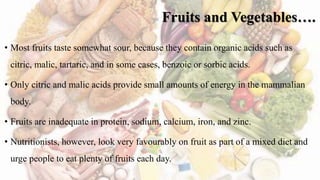
• Most fruits taste somewhat sour, because they contain organic acids such as
citric, malic, tartaric, and in some cases, benzoic or sorbic acids.
• Only citric and malic acids provide small amounts of energy in the mammalian
body.
• Fruits are inadequate in protein, sodium, calcium, iron, and zinc.
• Nutritionists, however, look very favourably on fruit as part of a mixed diet and
urge people to eat plenty of fruits each day.
Fruits and Vegetables….
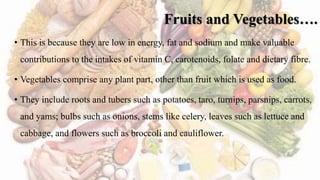
• This is because they are low in energy, fat and sodium and make valuable
contributions to the intakes of vitamin C, carotenoids, folate and dietary fibre.
• Vegetables comprise any plant part, other than fruit which is used as food.
• They include roots and tubers such as potatoes, taro, turnips, parsnips, carrots,
and yams; bulbs such as onions, stems like celery, leaves such as lettuce and
cabbage, and flowers such as broccoli and cauliflower.
Fruits and Vegetables….
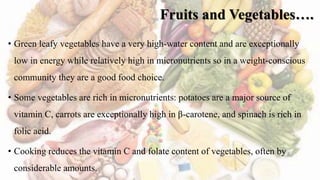
• Green leafy vegetables have a very high-water content and are exceptionally
low in energy while relatively high in micronutrients so in a weight-conscious
community they are a good food choice.
• Some vegetables are rich in micronutrients: potatoes are a major source of
vitamin C, carrots are exceptionally high in β-carotene, and spinach is rich in
folic acid.
• Cooking reduces the vitamin C and folate content of vegetables, often by
considerable amounts.
Fruits and Vegetables….
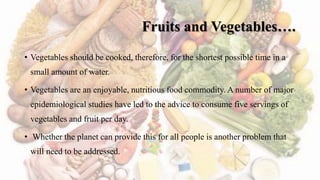
• Vegetables should be cooked, therefore, for the shortest possible time in a
small amount of water.
• Vegetables are an enjoyable, nutritious food commodity. A number of major
epidemiological studies have led to the advice to consume five servings of
vegetables and fruit per day.
• Whether the planet can provide this for all people is another problem that
will need to be addressed.
Fish
• Fish, like meat, contains protein of high biological value. The recent nutritional
interest in fish, however, is the fat content which ranges from 0.5% to 15%.
• Fish oils contain long-chain ω3-polyunsaturated fatty acids, mainly
eicosapentaenoic acid and docosahexaenoic acid.
• It is, however, a source of vitamin B6, B12, riboflavin, folate, and most inorganic
nutrients including iodine, selenium, and fluoride. Calcium, although not found in
high amounts in the fish flesh, can be eaten as part of the edible soft bones (as in
sardines).
Fish…
• The health benefits of fish consumption are considerable. Long-term fish
consumption may reduce death from heart disease.
• Fatty fish appears to be the most protective and benefits are most obvious in
high-risk populations.
• These effects may be attributable to the ω3-fatty acids in the fatty fish flesh
which may reduce thrombotic tendency.
Nuts and Seeds
• Nuts and seeds have been valued for their oils as much as for a food in itself
and were an important source of nutrients and energy since the earliest
civilizations.
• Common types of nuts include almonds, walnuts, pecans, cashew, Brazil nuts,
macadamias, and hazelnuts.
• Sunflower, sesame, and pumpkin are the most common seeds eaten as foods.
Caraway and poppy seeds are used as seasonings.
Nuts and Seeds…
• Nuts and seeds have similar nutritional qualities; their high content of energy,
protein, vitamins, and minerals makes them a very nutritious food.
• The energy content of nuts is mostly due to their high fat content. The fat in
nuts varies in both quantity and type. Chestnuts are low in fat, but other nuts
contain from 45–75% fat.
• The majority of nuts contain unsaturated fatty acids either polyunsaturated
(walnut) or monounsaturated (macadamia).
Nuts and Seeds…
• The protein content of nuts ranges from 2–25%; lysine is the limiting amino
acid. They are good sources of dietary fibre, B vitamins (thiamin, riboflavin
and niacin), vitamin E, and iron, zinc, magnesium, potassium, and calcium.
• Nut consumption is protective against coronary heart disease with the
following constituents likely conferring these properties: arginine, vitamin E,
and/or unsaturated fat.
End of lecture 1

Food groups

  • 1.
    PRINCIPLES OF HUMANNUTRITION LECTURER: MR. KASEKA
  • 2.
    PRINCIPLES OF HUMANNUTRITION COURSE CONTENT • History of human nutrition • Food groups • Balance diet • Nutrient groups • Digestion and absorption • Energy Balance and Body Weight Control • Nutrition status of special group • Assessment of human nutrition • Three periods per week • 6 hrs 45mins • Two tests • Several quizzes • Individual assignment • Group assignment • Makeup test where possible
  • 3.
    Nutrition and HumanNutrition • Nutrition is the process of taking in food and using it for growth, metabolism, and repair. • Human nutrition describes the processes whereby cellular organelles, cells, tissues, organs, systems, and the body as a whole obtain and use necessary substances obtained from foods (nutrients) to maintain structural and functional integrity.
  • 4.
    Food and Nutrients •People eat food, not nutrients; however, it is the combination and amounts of nutrients in consumed foods that determine health. Food is any material consisting essentially of nutrients used in the body of an organism to sustain growth, repair, and vital processes and to furnish energy.
  • 5.
    FUNCTIONS OF FOOD •Food gives us energy to work • Food helps in the growth and repair of tissues • Food gives strength to fight against diseases • Food helps the body to function normally • Food satisfies hunger • Social functions • Psychological functions
  • 6.
    FOOD GROUPS • Cereals Wheat,rice, and maize are currently the predominant cereals in terms of both the land devoted to them and their consumption. The nutritional values of all cereal grains are essentially similar, with some variation due to genetic factors and environmental conditions such as soil type and temperature. Cereals provide starch and dietary fibre (soluble and insoluble) which together comprise 70–77% of the grain.
  • 7.
    Cereals Cont.. • Proteinaccounts for 6–15% and the limiting amino acid is lysine, with maize additionally low in tryptophan. Gluten is the major protein in wheat and rye and oryzenin the major protein in rice. • All cereals are low in fat, oats have slightly more; most of the fat is polyunsaturated. Whole grains are a good source of thiamin, their germ is rich in vitamin E and they contain significant amounts of minerals especially potassium, phosphorus, magnesium, iron, and zinc.
  • 8.
    Meat and Poultryand Eggs • The term ‘meat’ encompasses not only the muscle tissues but also organs like liver, kidneys, and pancreas (termed offal). • The major animals nowadays produced for human consumption are pigs, cattle, and sheep, and birds like chicken and turkey • Muscle meat is generally a good source of protein and minerals while offal meats offer a rich source of vitamins
  • 9.
    Meat and Poultryand Eggs… • Meat is a major source of readily available iron and zinc, and a good source of magnesium. Liver and kidney are richer in iron and zinc than muscle, and pig liver contains more than that from sheep or beef. • Meat provides a valuable source of thiamin, niacin and riboflavin, with pork higher in thiamin than the other meats • Meat has a short shelf-life and must be kept at low temperatures and be cooked adequately to prevent microbial growth.
  • 10.
    Meat and Poultryand Eggs… • Chicken and turkey meats are consumed in growing amounts in countries like the United States and Australia • Like red meat, poultry is a good source of protein and minerals including iron and zinc • Eggs are a central ingredient in many cuisines but they have received adverse publicity in recent years, mainly centred around the high cholesterol content of the yolk
  • 11.
    Meat and Poultryand Eggs… • However, it is frequently forgotten that hen’s eggs have the highest quality dietary protein for nutrition and are a relatively inexpensive source. • Eggs also contribute calcium, B vitamins, and vitamins A and B12. The fat, cholesterol, and micronutrients are confined to the yolk while the white contains mainly protein.
  • 12.
    Milk and MilkProducts • All mammals produce milk and man consumes a variety of milks from cows, sheep, goats, horses, reindeer, yaks, water buffalos, and camels • Milk Cow’s milk is about 88% water and 3% protein. The two main proteins are casein and whey proteins which include lactalbumin and lactoglobulin. • Casein comprises about 82% of the total protein. This is of high nutritional value and contains all the essential amino acids with relatively high amounts of the amino acid, lysine.
  • 13.
    Milk and MilkProducts… • Milk is an excellent source of readily absorbable calcium and phosphorus and milk and milk products provide over 75% of the calcium in the human diet in Western countries • Milk also contains moderate amounts of potassium, sodium, magnesium, and zinc but is low in iron. • Milk carries B group vitamins, particularly riboflavin and vitamin B12, and the fat-soluble vitamins A and D
  • 14.
    Milk and MilkProducts… • Lactose is the principal sugar in milk, and milk is the only source of lactose in nature. The lactose enhances the absorption of calcium and phosphorus from the intestine. • Milk is pasteurized to destroy any disease-causing bacteria, particularly tuberculosis and brucellosis bacteria • Milk is available in different forms. Skim milks have all the fat taken out and do not contain the fat-soluble, vitamins A and D; reduced fat milks generally have 50–60% of the fat removed. Fortified milks are also becoming popular
  • 15.
    Milk and MilkProducts… • Yoghurt One of the most popular fermented foods is yoghurt • Yoghurt is made by warming milk of various fat levels and introducing a special culture of bacteria: Lactobacillus acidophilus or L. bulgaricus. • Milk sugars are broken down, releasing lactic acid which acts to coagulate the milk into a curd consistency. • Yoghurt offers all the nutrients in milk, but has less lactose. Full cream yoghurt made from whole milk contains around 4% fat; reduced fat yoghurt has 1–2% fat; and low-fat yoghurt has less than 0.2% fat
  • 16.
    Legumes • Legumes arethe edible seed from the Leguminosae family (Fabaceae) and include dried peas, beans, lentils, and dhal. Peanuts are also legumes. • Of all foods, legumes most adequately meet the recommended dietary guidelines for healthful eating. • They are high in carbohydrate and dietary fibre, mostly low in fat, supply adequate protein while being a good source of vitamins and minerals.
  • 17.
    Legumes… • Legumes alsocontain oligosaccharides which escape digestion in the gut to be fermented by bacteria in the large bowel. • This is responsible for the abdominal discomfort and flatulence often experienced and is perhaps the factor limiting consumption • Legumes are low in fat (∼2.5%) but soybeans and peanuts contain 8% and 47% fat respectively. This fat is mostly monounsaturated or polyunsaturated. Soybeans contain the ω3 fatty acid, alpha-linolenic acid.
  • 18.
    Legumes… • Legumes supplyvitamins and minerals including thiamin, niacin, iron, zinc, calcium, and magnesium . • Soybeans contain the phytoestrogenic compounds known as isoflavones and lignans. • These compounds may have a role to play in the prevention of certain cancers and coronary heart disease • It is reported that phytoestrogens may be a useful treatment for menopausal symptoms including maintenance of bone density
  • 19.
    Fruits and Vegetables •In its strict botanical sense, a ‘fruit’ is the fleshy or dry ripened ovary of a plant enclosing the seed and so includes corn grains, bean pods, tomatoes, olives, cucumbers, and malmonds and pecans • Fruits generally provide useful amounts of potassium, carotenoids, vitamin C, and folate. Avocados are unusual because they have a high content of fat (mostly monounsaturated) and contain a 7-carbon sugar.
  • 20.
    Fruits and Vegetables…. •Fruits are preserved in jams by boiling with sugar; the pectin (soluble dietary fibre) they contain makes a gel. Some fruits are dried: especially grapes, plums, dates, bananas, apricots (dried fruits do not contain vitamin C). • Quite large amounts of some fruits, especially citrus and apples, are consumed in the form of fruit juices, which contain most of the nutrients but less of the fibre, and give less satiety.
  • 21.
    Fruits and Vegetables…. •Most fruits taste somewhat sour, because they contain organic acids such as citric, malic, tartaric, and in some cases, benzoic or sorbic acids. • Only citric and malic acids provide small amounts of energy in the mammalian body. • Fruits are inadequate in protein, sodium, calcium, iron, and zinc. • Nutritionists, however, look very favourably on fruit as part of a mixed diet and urge people to eat plenty of fruits each day.
  • 22.
    Fruits and Vegetables…. •This is because they are low in energy, fat and sodium and make valuable contributions to the intakes of vitamin C, carotenoids, folate and dietary fibre. • Vegetables comprise any plant part, other than fruit which is used as food. • They include roots and tubers such as potatoes, taro, turnips, parsnips, carrots, and yams; bulbs such as onions, stems like celery, leaves such as lettuce and cabbage, and flowers such as broccoli and cauliflower.
  • 23.
    Fruits and Vegetables…. •Green leafy vegetables have a very high-water content and are exceptionally low in energy while relatively high in micronutrients so in a weight-conscious community they are a good food choice. • Some vegetables are rich in micronutrients: potatoes are a major source of vitamin C, carrots are exceptionally high in β-carotene, and spinach is rich in folic acid. • Cooking reduces the vitamin C and folate content of vegetables, often by considerable amounts.
  • 24.
    Fruits and Vegetables…. •Vegetables should be cooked, therefore, for the shortest possible time in a small amount of water. • Vegetables are an enjoyable, nutritious food commodity. A number of major epidemiological studies have led to the advice to consume five servings of vegetables and fruit per day. • Whether the planet can provide this for all people is another problem that will need to be addressed.
  • 25.
    Fish • Fish, likemeat, contains protein of high biological value. The recent nutritional interest in fish, however, is the fat content which ranges from 0.5% to 15%. • Fish oils contain long-chain ω3-polyunsaturated fatty acids, mainly eicosapentaenoic acid and docosahexaenoic acid. • It is, however, a source of vitamin B6, B12, riboflavin, folate, and most inorganic nutrients including iodine, selenium, and fluoride. Calcium, although not found in high amounts in the fish flesh, can be eaten as part of the edible soft bones (as in sardines).
  • 26.
    Fish… • The healthbenefits of fish consumption are considerable. Long-term fish consumption may reduce death from heart disease. • Fatty fish appears to be the most protective and benefits are most obvious in high-risk populations. • These effects may be attributable to the ω3-fatty acids in the fatty fish flesh which may reduce thrombotic tendency.
  • 27.
    Nuts and Seeds •Nuts and seeds have been valued for their oils as much as for a food in itself and were an important source of nutrients and energy since the earliest civilizations. • Common types of nuts include almonds, walnuts, pecans, cashew, Brazil nuts, macadamias, and hazelnuts. • Sunflower, sesame, and pumpkin are the most common seeds eaten as foods. Caraway and poppy seeds are used as seasonings.
  • 28.
    Nuts and Seeds… •Nuts and seeds have similar nutritional qualities; their high content of energy, protein, vitamins, and minerals makes them a very nutritious food. • The energy content of nuts is mostly due to their high fat content. The fat in nuts varies in both quantity and type. Chestnuts are low in fat, but other nuts contain from 45–75% fat. • The majority of nuts contain unsaturated fatty acids either polyunsaturated (walnut) or monounsaturated (macadamia).
  • 29.
    Nuts and Seeds… •The protein content of nuts ranges from 2–25%; lysine is the limiting amino acid. They are good sources of dietary fibre, B vitamins (thiamin, riboflavin and niacin), vitamin E, and iron, zinc, magnesium, potassium, and calcium. • Nut consumption is protective against coronary heart disease with the following constituents likely conferring these properties: arginine, vitamin E, and/or unsaturated fat.
  • 30.