Balanced diet
• The food is required by all living organisms, for the following
purposes;
• For energy -- Food is used by the body, as a ſuel to work our
muscles and other body organs.
• • For growth and repair - nutrients present in the food, are
used by the body to make new cells,growth and to replace
damaged cells.
• • To stay healthy - food, is used in the cellular reactions in
our body, to produce energy
. to maintain healthy body, we must eat a healthy and
balanced diet,
• It also means matching the amount of energy (calories)
intake with the amount of energy output, for daily activities
and exercise
• The quantity of food needed, to meet the requirements of
various nutrients, varies with age, gender, physiological
status and physical activities.
Balanced diet
• A balanced diet is the food which provides all the
nutrients in required amounts and proper
proportions.
• A balanced diet is defined as the food which provides,
quantitatively and qualitatively, required amounts
and proper proportions of all the nutrients for
maintaining a good health and physiological
efficiency.
ELEMENTS OF BALANCED DIET
• A balanced diet have macro- and micro-nutrients
• Which include:
• Carbohydrates,Proteins,Fat.,Vitamins, Minerals,Water these
nutrients are essential for daily life.
• All these nutrients can be obtained from different food
groups.
FOOD GROUPS
• A food group is a collection of foods that share similar
nutritional properties or biological specifications
• . they provide similar amounts and types of nutrients
• eg nutrients of the milk, yogurt, cheese and alternatives
food group, include calcium and protein,
• the fruit group is a good source of vitamins, especially,
vitamin C.
• balanced diet can be obtained from four basic food groups
•
• .1. Cereals, millets and pulses
• 2. Vegetables and fruits
• 3. Milk and milk products, eggs, meat and fish,
• 4. Oils
• according to their origin
• Plant origin
• Animal origin
• Food groups according to the predominant functions
• according to their predominant functions.
• Body-building foods, e.g. milk, meat, fish, eggs,
• .Energy-giving foods, e.g. cereals, roots and tubers, fats
and oils, etc.,
• .Protective foods, e.g. vegetables, fruits, milk, etc
OTHER FOOD GROUPS
• Instant foods
• Instant foods are those which undergo special processing,
designed to dissolve or to disperse particles, more rapidly in
a liquid e.g. instant noodles, soup powders, cornflakes, etc
•
• high calorie ,high salt content , presence of additives like
monosodium glutamate increases sodium intake from the
food
• Fast foods
• Fast foods are the foods that are already made or
cooked to order, within minutes for consumption,
• noodles, burgers, fried fish, milk shakes, chips, salads,
pizzas, sandwiches,
• . Storage, handling and microbial contaminations
• , calorie dense foods.
• Street foods
• Street foods comprise of a wide range of readyto-eat
foods and beverages, prepared and/or sold by the
vendors and hawkers, on streets and other public
places,
• e.g. idly, wada, dosa, chat items,
• . They may be contaminated with pathogenic
organisms, unless hygienically prepared.
• Junk foods
• Junk (unhealthy) foods are those foods containing little or
no proteins, vitamins and minerals, but are rich in salt,
sugar, fat and energy (empty calories)
• . Some examples are chocolates, artificially-flavored
aerated drinks, potato chips, ice creams, french fries, etc.
• They are not only calorigenic, but also leads to obesity, rise
of low density lipids (LDL or bad cholesterol), and fall of
high density lipids
•Sometimes foods
•Sometimes food, have very little nutritional value
and are often processed and packaged.
• They are high in fat, sugar and salt, should not be
taken by children on a regular basis.
•Examples ,
•Chocolates, and confectionary
•Sweet biscuits, chips and high-fat savoury biscuits
• Fried foods
• Pastry-based foods, sausage rolls
• Cakes, and ice creams
• Soft drinks, fruit juices, fruit drinks, Sports drinks,
energy drinks, flavoured milk and flavoured mineral
water
DIETARY SUPPLEMENTS
• Dietary supplement is the product that is intended to
supplement the diet.
• These are neither drugs nor food or food additives
• Their manufacture and sale is also not regulated,
• The word supplement, should be clearly stated on the
label.
•ANTIOXIDANTS
• Antioxidants are present in green-leafy vegetables and plant
foods, like papaya, turmeric, palm oil, amla and guava.
•
• The dietary antioxidants include nutrients, such as Bcarotene
(provitamin A), ascorbic acid (vitamin C), tocopherols,
tocotrienols, riboflavin, sulfur-containing amino acids
(cysteine and methionine) and selenium
• Vegetarianism and vegan eating practices
• this means avoiding animal products, such as meat,
poultry and fish.
• some vegetarians eat animal-related products, such
as eggs, milk, cheese and yoghurt.
• vegetarians eat a variety of legumes, nuts, seeds and
grainbased foods, to gain the same nutrients that
meat, poultry and fish provide.
• . It is very difficult to meet children's nutritional needs
with a vegan diet, because the amount of food
needed for sufficient nutrients may be too large for
the child to manage.
NUTRIENT PROFILES OF FOOD GROUPS
• .Whole grain ,cereals and millets
• Cereals, such as rice and wheat, and millets like jowar, bajra,
ragi, etc., are the cheapest sources of calories
• 70-80% of the calories in the diet
• majority of population, in our country depends on these
foods
• Most cereal grains contain 6-12% proteins.
• cereal proteins are deficient in essential amino acid
• Whole grain cereals are important sources of B-
vitamins, thiamin and niacin ,present in the outer
bran layer of the grain.
• Excessive milling and polishing of rice removes the
outer covering and, , decreases thiamin content.
• • Total fat content, in cereals is 2-5%
• .400 g of cereals are consumed per person, per day, in
India.
• pulses and legumes
• legumes include grams, peas and beans
• Dried are rich in proteins
• Legumes are good sources of Bvitamins and
minerals, such as thiamin, riboflavin and
phosphorus.
• Legumes, contain some natural toxins, which can be
removed by soaking and normal cooking
• procedures result in loss of some Bvitamins.
• Legumes are good for young children.cooked, mashed and
mixed with other food items. .
• • Germination or sprouting increases vitamin C, riboflavin
and niacin contents of legumes.
• Nuts and oilseeds
• Nuts and oilseeds, such as peanut ,groundnut soybean
and oilseeds, are rich sources of proteins
• . They contain 18-40% protein.
• They are rich sources of fat, Bvitamins and vitamin E.•
Groundnut contains 20-30% proteins and 40-50% fat.
• groundnut is a good source of thiamin, niacin, pantothenic
acid and phosphorus.
• When harvested under moist conditions, groundnut may get
contaminated with Aspergillus flavus, produce aflatoxin.
• Roasting improves its nutritive value.
• Soybeans contain nearly 35-45% proteins and 15-20% fat.
and vitamins , thiamin and niacin.
Vegetables
•Vegetables classified into 3 groups
• green leafy vegetables,
• roots and tubers,
• other vegetables.
•Green leafy vegetables –
• Many types of green leaves, such as spinach (palak),
amaranth, fenugreek leaves (methi), drumstick leaves,
mint, coriander, mustard leaves, colocasia leaves,
radish and turnip leaves, are rich sources of iron, B-
carotene, vitamin C, riboflavin, folic acid and
calcium.
• They also provide dietary fiber , antioxidants, and
proteins
Roots and tubers –
• Roots and tubers, such as potatoes, sweet potatoes,
carrots, etc., are good sources of starch.
• contain small amount of proteins, B-vitamins and vitamin
C.
• Yellow sweet potatoes and carrots are rich sources of
carotene.
• Other vegetables
• - These include green peas and beans, pumpkin, gourds,
ladies finger, brinjal, etc.
• Green peas and beans are good sources of protein
,Bvitamins. vitamin C and minerals. .
Fruits
• Fruits are good sources of different carbohydrates, vitamins
and minerals
• Fresh fruits are, good sources of vitamins.
• Amla rich in vitamin C..
• Yellow fruits, like mango and papaya, contain ß-carotene.
• • Dried fruits, like dates and raisins, are rich sources of iron.
• Banana is rich in carbohydrates. fruits contain glucose,
fructose or pentoses
• Most of the fruits are good sources of potassium.
• Drying of fruits results in loss of carotene.
• Canning of fruit juices results in loss of vitamin C.
• a variety of fruits and vegetables should be included
in meals and snacks each day. to provide vitamins and
minerals
Milk and milk products
• Milk is used in the preparation of curd, cheese, icecream,
butter, ghee and a variety of sweets.
• an ideal food for infants and children.
• good supplementary food for adults.
• Milk contains good quality proteins
• It is also rich in calcium and other nutrients
• milk is considered as a complete food.
• Milk is, deficient in vitamin C and iron.
• Milk, yoghurt and cheese are the most common dairy
foods, and main dietary sources of calcium.
• Fullcream milk is recommended for children aged one
to two years, reduced-fat milk is suitable for adults.
• Pasteurization and prolonged boiling results in loss of
thiamin, vitamin B6 and vitamin B12.
Eggs and poultry
• Eggs contain proteins and fat
• Egg proteins are good sources of all essential amino
acids and have high nutritive value.
• Egg is also a rich in vitamin A and Bvitamins.
• Egg, , does not contain vitamin C and is a poor source
of calcium.
• Egg white contains proteins, mainly albumin. And
good source of riboflavin
•Raw egg white contains a heat labile factor, called
avidin, which binds biotin and makes it unavailable
•.Egg yolk contains about 15% of proteins and 30% of
fat.
•It is a rich source of riboflavin, vitamin A, iron ,
phosphorus and is rich in cholesterol.
•It is used as a supplement to the diet of infants.
•Poultry meat is a good source of proteins, containing
all essential amino acids. .
Meat and fish
• This group includes red meat (such as beef and lamb),
white meat (such as pork and chicken) and fish.
• They are rich in proteins, iron and zinc.
• Proteins content of flesh foods is around 20%.
• Meat is also a good source of vitamin B12, iron and
phosphorus.
• liver, is very rich in vitamins and iron.
• Fish is rich in proteins and source of B-vitamins.
• Fatty fish contains vitamins A and D.
• Small fishes, are good source of calcium if eaten with
bones.Large fishes are rich in phosphorus.
• Canning of meat and poultry results loss of vitamins.
Fat and oils
• Fat and oils are the main sources of energy as well as
essential fatty acids and fat soluble vitamins.
•Fat of animal origin contains cholesterol, but is a poor
source of vitamin E and essential fatty acids.
•• fat of vegetable origin, such as sunflower oil,
soybeans oil, cottonseed oil, etc., is good source of
essential fatty acids and vitamin E.
• : Frying destroys vitamin A, vitamin E and essential
fatty acids.
• acidity results in the formation of peroxides, affect
intestinal flora and have irritating effects on the
intestine. ,
• : Sugar
• Sugar and other carbohydrate-rich foods serve as a
source of energy.
• Honey and jaggery contain vitamins and minerals
•Condiments and spices
• Condiments and spices are used as seasoning or
flavoring agents in food
• condiments and spices are used in small quantities,
improve taste and flavor of the cooked food.
• They also act on the mucous membranes of mouth,
stomach and intestine, and stimulate secretion of
digestive juices.
• : Some of the condiments, like chilies and coriander,
are good sources of carotene.
• Green chilies supply vitamin C.
• • Turmeric and tamarind are sources of antioxidants
and iron
• .• garlic have effect on intestinal flora and prevent
flatulence
• .chilies and black pepper., are very pungent.cause
irritation of the mucous membrane,, resulting in
peptic and duodenal ulcers.
Beverages
• beverages have different effects..
• Coffee and tea contain caffeine, which stimulates
gastric secretion and aid in the digestion.
• Excess of caffeine produces insomnia, causes
irritability and rapid heart action, and increases
excitability of the nervous system.
• Tea, is a rich source of oxalic acid., excessive
consumption of tea may lead to renal calculi.
• Fruit juices contain sugar, vitamin C, small amounts of
other vitamins B and minerals.sugarcane juice,
contain 9% sugar,
• sweetened carbonated beverages contain about 10
to 15% sugar
• Alcohol in moderate doses stimulates gastric
secretion
• Excessive consumption of alcohol causes severe
depression and incoordination of movements, and
loss of consciousness
•COMPOSITION OF A BALANCED DIET
• • A balanced diet should provide, nearly, 50-60% of
the total required calories from carbohydrates, about
10-15% from proteins and 20-30% from fats
•
•.• a balanced diet should also provide other non-
nutrients, such as dietary fibre, antioxidants and
phytochemicals
•Dietary fibre, includes complex carbohydrates
obtained from whole grains, fruits, vegetables, beans
and legumes. They are low or moderate in calories,
and are devoid of refined grains and sugar.
• Dietary fiber promotes healthy bowel movement
and decreases the risk of chronic diseases, such as
coronary heart disease and diabetes.
• Antioxidants, such as vitamins C and E, beta-
carotene, riboflavin and selenium, protect the body
from free radical damage
•
• . Spices, like turmeric, ginger, garlic, cumin and
cloves, are rich in antioxidants protect against
oxidative damage
DIETARY GUIDELINES FOR INDIANS
• Widespread malnutrition is due to dietary inadequacy and
unhealthy lifestyle.
• factors are poor purchasing , faulty feeding habits, large
family size, frequent infections, poor health care, inadequate
sanitation and low agriculture production.
• longterm solution to the problem of malnutrition is ensuring
availability, accessbility and consumption of adequate
amount of food.
• Dietary guidelines help to achieve the objective of
providing optimal nutrition to the population.
• 1,Eat a variety of foods, to ensure a balanced diet.
• 2. Ensure provision of extra food and health care to
pregnant and lactating women.
• 3. Promote exclusive breastfeeding for 6 months and
encourage breastfeeding until 2 years, or as long as
possible
• .4. Feed home-based semi-solid foods to the infants after 6
months
• .5. Ensure adequate and appropriate diets, for children and
adolescents, both, in health and sickness
• .6. Eat plenty of vegetables and fruits
• .7. Ensure moderate use of edible oils and animal foods, and
use a minimum of ghee butter/vanaspati
• .8. Avoid overeating, to prevent overweight and obesity
• .9. Exercise regularly, and be physically active, to maintain
ideal body weight.
• 10. Restrict salt intake to a minimum.
• 11. Ensure the use of safe and clean foods.
• 12. Adopt the right pre-cooking processes and appropriate
cooking methods.
• 13. Drink plenty of water and take beverages in moderation
• .14. Minimize the use of processed foods rich in salt, sugar
and fat
• .15. Include micronutrient-rich foods in the diets of elderly
people, to enable them to be fit and active.
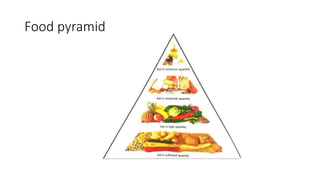
FOOD PYRAMID
• Food pyramid (Food guide pyramid) is a graphic
representation of the number of servings from the
four major food groups, needed daily, to form a
healthful diet.
•The pyramid is divided into four levels of foods,
according to recommended consumption,
•.• At the base, the group of cereals and legumes/
beans, which should be eaten in sufficient quantity.
•Foods in this group are the sources of complex
carbohydrates and vitamins, minerals and fibre
•. Dietary fibre delays and retards absorption of
carbohydrates and fats, and increases the satiety
value.
• Diets rich in fibre also reduce glucose and lipids in
blood, and increase the bulk of the stools.
• •On the second level (going up the pyramid)
• vegetables and fruits
• Vegetables provide vitamins (such as vitamin A,
vitamin C and folate) and the minerals (like iron and
magnesium) and carbohydrates, including fiber.
•the third level, are dairy foods ,meat and meat
alternatives
• meat and meat alternatives e.g. nuts, eggs and legumes),
i.e. foods and oils from the animal sources, which should
be eaten moderately.
• Dairy products provide proteins, vitamins and minerals
• Meat and meat substitutes are good sources of proteins,
Bvitamins, iron and zinc
• combination of cereals, millets and pulses provides most of
the amino acids and provide better quality protein
•
•The upper part of the pyramid contains fat and
sweets
• . the highly processed foods, which should be eaten
sparingly
• .Excess of these substances could lead to obesity, diabetes,
cardiovascular disease and cancer.
Food pyramid
BALANCED DIET FOR INDIANS
• diet must provide adequate calories, proteins and
micronutrients to achieve maximum growth potential.
• appropriate diet during different stages of life is important,
• Breast milk and energy-rich foods for growth and
appropriate milestones.
• Energy-rich body building and protective foods for
growth and development, and to fight infections for
growth spurt, maturation and bone development
•
• .Nutritionally adequate diet, with extra food for child
bearing and rearing for maintaining health, to prevent
diet-related diseases, and to support pregnancy and
lactation.
• .• Nutrients-dense low fat foods for being physically
active and healthy.
• For planning the menu for balanced diets, following points
should be considered:
• 1.) For all nutrients, minimum recommended dietary
allowance must be met
• Energy derived from cereals should not be more than 75
per cent
• include two cereals in one meal, , like rice and wheat, or
millets and rice.
• Whole grain cereals, par-boiled grains give higher
nutritive value
• . Flour should not be sieved, as it reduces bran
content.
• Minimize the use of refined cereals, like white flour
(maida).
• 2. )Variety of foods should be used in the menu. No
single food has all the nutrients.
• , each meal should consist of all the food groups.
• 3.) To improve the protein quality from plant sources,
ratio of proteins from cereal to pulse should be eight
parts of cereals and one part of pulses.
.
• Two to three servings of pulses should be taken every
day. Germinated pulses are more nutritious.
• One egg can be served along with cereals and pulses,
to improve the quality of proteins.
• , one serving of poultry/fish can be included
•4. Choose a diet low in fat, 15-20 percent of the total
calories (energy) should be derived from fat and oils,
and 5 percent from sugar and jaggery.
• It is better to use more than one type of oil.
Combination of oils should be there to have proper
balance of 0-3 and 0-6 fatty acids.avoid Fried food
• 5. Food rich in fiber should be included in the diet. Green-
leafy vegetables should be taken more than one serving
• Five servings of fruits and vegetables should be included
in a day's diet to meet the requirement of antioxidants
•
• ,6. Every meal should contain at least one medium size raw
fruit. Taking juice out of it may cause loss of some
nutrients, like vitamin C
• 7. About two glasses of low-fat milk should be
included. Curd should be consumed to provide
probiotics
• 8. Use salt and sugar in moderation
• 9. Water should be taken in adequate quantity.
• 10. the number of meals should four. For very young
children and patients, number of meals can be more
• 11. One-third of the nutritional requirement of
calories and proteins, should be met by lunch and
dinner.
•12. For quick calculations, food exchange list can be
used. If possible, meals should be planned, at a time,
for several days.
•13. reduce use of processed and ready to eat foods
as it food contains a variety of food additives.
• 14. To children and patients, whose nutritional
requirements are high, supplementary foods can be
given

Presentation%20(3)balanced%20diet.pptxbalanced dier

  • 1.
  • 2.
    • The foodis required by all living organisms, for the following purposes; • For energy -- Food is used by the body, as a ſuel to work our muscles and other body organs. • • For growth and repair - nutrients present in the food, are used by the body to make new cells,growth and to replace damaged cells. • • To stay healthy - food, is used in the cellular reactions in our body, to produce energy
  • 3.
    . to maintainhealthy body, we must eat a healthy and balanced diet, • It also means matching the amount of energy (calories) intake with the amount of energy output, for daily activities and exercise • The quantity of food needed, to meet the requirements of various nutrients, varies with age, gender, physiological status and physical activities.
  • 4.
    Balanced diet • Abalanced diet is the food which provides all the nutrients in required amounts and proper proportions. • A balanced diet is defined as the food which provides, quantitatively and qualitatively, required amounts and proper proportions of all the nutrients for maintaining a good health and physiological efficiency.
  • 5.
    ELEMENTS OF BALANCEDDIET • A balanced diet have macro- and micro-nutrients • Which include: • Carbohydrates,Proteins,Fat.,Vitamins, Minerals,Water these nutrients are essential for daily life. • All these nutrients can be obtained from different food groups.
  • 6.
    FOOD GROUPS • Afood group is a collection of foods that share similar nutritional properties or biological specifications • . they provide similar amounts and types of nutrients • eg nutrients of the milk, yogurt, cheese and alternatives food group, include calcium and protein, • the fruit group is a good source of vitamins, especially, vitamin C.
  • 7.
    • balanced dietcan be obtained from four basic food groups • • .1. Cereals, millets and pulses • 2. Vegetables and fruits • 3. Milk and milk products, eggs, meat and fish, • 4. Oils
  • 8.
    • according totheir origin • Plant origin • Animal origin • Food groups according to the predominant functions • according to their predominant functions. • Body-building foods, e.g. milk, meat, fish, eggs, • .Energy-giving foods, e.g. cereals, roots and tubers, fats and oils, etc., • .Protective foods, e.g. vegetables, fruits, milk, etc
  • 9.
    OTHER FOOD GROUPS •Instant foods • Instant foods are those which undergo special processing, designed to dissolve or to disperse particles, more rapidly in a liquid e.g. instant noodles, soup powders, cornflakes, etc • • high calorie ,high salt content , presence of additives like monosodium glutamate increases sodium intake from the food
  • 10.
    • Fast foods •Fast foods are the foods that are already made or cooked to order, within minutes for consumption, • noodles, burgers, fried fish, milk shakes, chips, salads, pizzas, sandwiches, • . Storage, handling and microbial contaminations • , calorie dense foods.
  • 11.
    • Street foods •Street foods comprise of a wide range of readyto-eat foods and beverages, prepared and/or sold by the vendors and hawkers, on streets and other public places, • e.g. idly, wada, dosa, chat items, • . They may be contaminated with pathogenic organisms, unless hygienically prepared.
  • 12.
    • Junk foods •Junk (unhealthy) foods are those foods containing little or no proteins, vitamins and minerals, but are rich in salt, sugar, fat and energy (empty calories) • . Some examples are chocolates, artificially-flavored aerated drinks, potato chips, ice creams, french fries, etc. • They are not only calorigenic, but also leads to obesity, rise of low density lipids (LDL or bad cholesterol), and fall of high density lipids
  • 13.
    •Sometimes foods •Sometimes food,have very little nutritional value and are often processed and packaged. • They are high in fat, sugar and salt, should not be taken by children on a regular basis. •Examples , •Chocolates, and confectionary •Sweet biscuits, chips and high-fat savoury biscuits
  • 14.
    • Fried foods •Pastry-based foods, sausage rolls • Cakes, and ice creams • Soft drinks, fruit juices, fruit drinks, Sports drinks, energy drinks, flavoured milk and flavoured mineral water
  • 15.
    DIETARY SUPPLEMENTS • Dietarysupplement is the product that is intended to supplement the diet. • These are neither drugs nor food or food additives • Their manufacture and sale is also not regulated, • The word supplement, should be clearly stated on the label.
  • 16.
    •ANTIOXIDANTS • Antioxidants arepresent in green-leafy vegetables and plant foods, like papaya, turmeric, palm oil, amla and guava. • • The dietary antioxidants include nutrients, such as Bcarotene (provitamin A), ascorbic acid (vitamin C), tocopherols, tocotrienols, riboflavin, sulfur-containing amino acids (cysteine and methionine) and selenium
  • 17.
    • Vegetarianism andvegan eating practices • this means avoiding animal products, such as meat, poultry and fish. • some vegetarians eat animal-related products, such as eggs, milk, cheese and yoghurt. • vegetarians eat a variety of legumes, nuts, seeds and grainbased foods, to gain the same nutrients that meat, poultry and fish provide. • . It is very difficult to meet children's nutritional needs with a vegan diet, because the amount of food needed for sufficient nutrients may be too large for the child to manage.
  • 18.
    NUTRIENT PROFILES OFFOOD GROUPS • .Whole grain ,cereals and millets • Cereals, such as rice and wheat, and millets like jowar, bajra, ragi, etc., are the cheapest sources of calories • 70-80% of the calories in the diet • majority of population, in our country depends on these foods • Most cereal grains contain 6-12% proteins. • cereal proteins are deficient in essential amino acid
  • 19.
    • Whole graincereals are important sources of B- vitamins, thiamin and niacin ,present in the outer bran layer of the grain. • Excessive milling and polishing of rice removes the outer covering and, , decreases thiamin content. • • Total fat content, in cereals is 2-5% • .400 g of cereals are consumed per person, per day, in India.
  • 20.
    • pulses andlegumes • legumes include grams, peas and beans • Dried are rich in proteins • Legumes are good sources of Bvitamins and minerals, such as thiamin, riboflavin and phosphorus.
  • 21.
    • Legumes, containsome natural toxins, which can be removed by soaking and normal cooking • procedures result in loss of some Bvitamins. • Legumes are good for young children.cooked, mashed and mixed with other food items. . • • Germination or sprouting increases vitamin C, riboflavin and niacin contents of legumes.
  • 22.
    • Nuts andoilseeds • Nuts and oilseeds, such as peanut ,groundnut soybean and oilseeds, are rich sources of proteins • . They contain 18-40% protein. • They are rich sources of fat, Bvitamins and vitamin E.• Groundnut contains 20-30% proteins and 40-50% fat. • groundnut is a good source of thiamin, niacin, pantothenic acid and phosphorus.
  • 23.
    • When harvestedunder moist conditions, groundnut may get contaminated with Aspergillus flavus, produce aflatoxin. • Roasting improves its nutritive value. • Soybeans contain nearly 35-45% proteins and 15-20% fat. and vitamins , thiamin and niacin.
  • 24.
    Vegetables •Vegetables classified into3 groups • green leafy vegetables, • roots and tubers, • other vegetables.
  • 25.
    •Green leafy vegetables– • Many types of green leaves, such as spinach (palak), amaranth, fenugreek leaves (methi), drumstick leaves, mint, coriander, mustard leaves, colocasia leaves, radish and turnip leaves, are rich sources of iron, B- carotene, vitamin C, riboflavin, folic acid and calcium. • They also provide dietary fiber , antioxidants, and proteins
  • 26.
    Roots and tubers– • Roots and tubers, such as potatoes, sweet potatoes, carrots, etc., are good sources of starch. • contain small amount of proteins, B-vitamins and vitamin C. • Yellow sweet potatoes and carrots are rich sources of carotene. • Other vegetables • - These include green peas and beans, pumpkin, gourds, ladies finger, brinjal, etc. • Green peas and beans are good sources of protein ,Bvitamins. vitamin C and minerals. .
  • 27.
    Fruits • Fruits aregood sources of different carbohydrates, vitamins and minerals • Fresh fruits are, good sources of vitamins. • Amla rich in vitamin C.. • Yellow fruits, like mango and papaya, contain ß-carotene. • • Dried fruits, like dates and raisins, are rich sources of iron. • Banana is rich in carbohydrates. fruits contain glucose, fructose or pentoses
  • 28.
    • Most ofthe fruits are good sources of potassium. • Drying of fruits results in loss of carotene. • Canning of fruit juices results in loss of vitamin C. • a variety of fruits and vegetables should be included in meals and snacks each day. to provide vitamins and minerals
  • 29.
    Milk and milkproducts • Milk is used in the preparation of curd, cheese, icecream, butter, ghee and a variety of sweets. • an ideal food for infants and children. • good supplementary food for adults. • Milk contains good quality proteins • It is also rich in calcium and other nutrients • milk is considered as a complete food. • Milk is, deficient in vitamin C and iron.
  • 30.
    • Milk, yoghurtand cheese are the most common dairy foods, and main dietary sources of calcium. • Fullcream milk is recommended for children aged one to two years, reduced-fat milk is suitable for adults. • Pasteurization and prolonged boiling results in loss of thiamin, vitamin B6 and vitamin B12.
  • 31.
    Eggs and poultry •Eggs contain proteins and fat • Egg proteins are good sources of all essential amino acids and have high nutritive value. • Egg is also a rich in vitamin A and Bvitamins. • Egg, , does not contain vitamin C and is a poor source of calcium. • Egg white contains proteins, mainly albumin. And good source of riboflavin
  • 32.
    •Raw egg whitecontains a heat labile factor, called avidin, which binds biotin and makes it unavailable •.Egg yolk contains about 15% of proteins and 30% of fat. •It is a rich source of riboflavin, vitamin A, iron , phosphorus and is rich in cholesterol. •It is used as a supplement to the diet of infants. •Poultry meat is a good source of proteins, containing all essential amino acids. .
  • 33.
    Meat and fish •This group includes red meat (such as beef and lamb), white meat (such as pork and chicken) and fish. • They are rich in proteins, iron and zinc. • Proteins content of flesh foods is around 20%. • Meat is also a good source of vitamin B12, iron and phosphorus. • liver, is very rich in vitamins and iron.
  • 34.
    • Fish isrich in proteins and source of B-vitamins. • Fatty fish contains vitamins A and D. • Small fishes, are good source of calcium if eaten with bones.Large fishes are rich in phosphorus. • Canning of meat and poultry results loss of vitamins.
  • 35.
    Fat and oils •Fat and oils are the main sources of energy as well as essential fatty acids and fat soluble vitamins. •Fat of animal origin contains cholesterol, but is a poor source of vitamin E and essential fatty acids. •• fat of vegetable origin, such as sunflower oil, soybeans oil, cottonseed oil, etc., is good source of essential fatty acids and vitamin E.
  • 36.
    • : Fryingdestroys vitamin A, vitamin E and essential fatty acids. • acidity results in the formation of peroxides, affect intestinal flora and have irritating effects on the intestine. , • : Sugar • Sugar and other carbohydrate-rich foods serve as a source of energy. • Honey and jaggery contain vitamins and minerals
  • 37.
    •Condiments and spices •Condiments and spices are used as seasoning or flavoring agents in food • condiments and spices are used in small quantities, improve taste and flavor of the cooked food. • They also act on the mucous membranes of mouth, stomach and intestine, and stimulate secretion of digestive juices.
  • 38.
    • : Someof the condiments, like chilies and coriander, are good sources of carotene. • Green chilies supply vitamin C. • • Turmeric and tamarind are sources of antioxidants and iron • .• garlic have effect on intestinal flora and prevent flatulence • .chilies and black pepper., are very pungent.cause irritation of the mucous membrane,, resulting in peptic and duodenal ulcers.
  • 39.
    Beverages • beverages havedifferent effects.. • Coffee and tea contain caffeine, which stimulates gastric secretion and aid in the digestion. • Excess of caffeine produces insomnia, causes irritability and rapid heart action, and increases excitability of the nervous system. • Tea, is a rich source of oxalic acid., excessive consumption of tea may lead to renal calculi.
  • 40.
    • Fruit juicescontain sugar, vitamin C, small amounts of other vitamins B and minerals.sugarcane juice, contain 9% sugar, • sweetened carbonated beverages contain about 10 to 15% sugar • Alcohol in moderate doses stimulates gastric secretion • Excessive consumption of alcohol causes severe depression and incoordination of movements, and loss of consciousness
  • 41.
    •COMPOSITION OF ABALANCED DIET • • A balanced diet should provide, nearly, 50-60% of the total required calories from carbohydrates, about 10-15% from proteins and 20-30% from fats • •.• a balanced diet should also provide other non- nutrients, such as dietary fibre, antioxidants and phytochemicals
  • 42.
    •Dietary fibre, includescomplex carbohydrates obtained from whole grains, fruits, vegetables, beans and legumes. They are low or moderate in calories, and are devoid of refined grains and sugar. • Dietary fiber promotes healthy bowel movement and decreases the risk of chronic diseases, such as coronary heart disease and diabetes.
  • 43.
    • Antioxidants, suchas vitamins C and E, beta- carotene, riboflavin and selenium, protect the body from free radical damage • • . Spices, like turmeric, ginger, garlic, cumin and cloves, are rich in antioxidants protect against oxidative damage
  • 44.
    DIETARY GUIDELINES FORINDIANS • Widespread malnutrition is due to dietary inadequacy and unhealthy lifestyle. • factors are poor purchasing , faulty feeding habits, large family size, frequent infections, poor health care, inadequate sanitation and low agriculture production. • longterm solution to the problem of malnutrition is ensuring availability, accessbility and consumption of adequate amount of food.
  • 45.
    • Dietary guidelineshelp to achieve the objective of providing optimal nutrition to the population. • 1,Eat a variety of foods, to ensure a balanced diet. • 2. Ensure provision of extra food and health care to pregnant and lactating women. • 3. Promote exclusive breastfeeding for 6 months and encourage breastfeeding until 2 years, or as long as possible
  • 46.
    • .4. Feedhome-based semi-solid foods to the infants after 6 months • .5. Ensure adequate and appropriate diets, for children and adolescents, both, in health and sickness • .6. Eat plenty of vegetables and fruits • .7. Ensure moderate use of edible oils and animal foods, and use a minimum of ghee butter/vanaspati • .8. Avoid overeating, to prevent overweight and obesity • .9. Exercise regularly, and be physically active, to maintain ideal body weight.
  • 47.
    • 10. Restrictsalt intake to a minimum. • 11. Ensure the use of safe and clean foods. • 12. Adopt the right pre-cooking processes and appropriate cooking methods. • 13. Drink plenty of water and take beverages in moderation • .14. Minimize the use of processed foods rich in salt, sugar and fat • .15. Include micronutrient-rich foods in the diets of elderly people, to enable them to be fit and active.
  • 48.
    FOOD PYRAMID • Foodpyramid (Food guide pyramid) is a graphic representation of the number of servings from the four major food groups, needed daily, to form a healthful diet.
  • 49.
    •The pyramid isdivided into four levels of foods, according to recommended consumption, •.• At the base, the group of cereals and legumes/ beans, which should be eaten in sufficient quantity. •Foods in this group are the sources of complex carbohydrates and vitamins, minerals and fibre •. Dietary fibre delays and retards absorption of carbohydrates and fats, and increases the satiety value.
  • 50.
    • Diets richin fibre also reduce glucose and lipids in blood, and increase the bulk of the stools. • •On the second level (going up the pyramid) • vegetables and fruits • Vegetables provide vitamins (such as vitamin A, vitamin C and folate) and the minerals (like iron and magnesium) and carbohydrates, including fiber.
  • 51.
    •the third level,are dairy foods ,meat and meat alternatives • meat and meat alternatives e.g. nuts, eggs and legumes), i.e. foods and oils from the animal sources, which should be eaten moderately. • Dairy products provide proteins, vitamins and minerals • Meat and meat substitutes are good sources of proteins, Bvitamins, iron and zinc
  • 52.
    • combination ofcereals, millets and pulses provides most of the amino acids and provide better quality protein • •The upper part of the pyramid contains fat and sweets • . the highly processed foods, which should be eaten sparingly • .Excess of these substances could lead to obesity, diabetes, cardiovascular disease and cancer.
  • 53.
  • 54.
    BALANCED DIET FORINDIANS • diet must provide adequate calories, proteins and micronutrients to achieve maximum growth potential. • appropriate diet during different stages of life is important, • Breast milk and energy-rich foods for growth and appropriate milestones.
  • 55.
    • Energy-rich bodybuilding and protective foods for growth and development, and to fight infections for growth spurt, maturation and bone development • • .Nutritionally adequate diet, with extra food for child bearing and rearing for maintaining health, to prevent diet-related diseases, and to support pregnancy and lactation. • .• Nutrients-dense low fat foods for being physically active and healthy.
  • 56.
    • For planningthe menu for balanced diets, following points should be considered: • 1.) For all nutrients, minimum recommended dietary allowance must be met • Energy derived from cereals should not be more than 75 per cent • include two cereals in one meal, , like rice and wheat, or millets and rice.
  • 57.
    • Whole graincereals, par-boiled grains give higher nutritive value • . Flour should not be sieved, as it reduces bran content. • Minimize the use of refined cereals, like white flour (maida).
  • 58.
    • 2. )Varietyof foods should be used in the menu. No single food has all the nutrients. • , each meal should consist of all the food groups. • 3.) To improve the protein quality from plant sources, ratio of proteins from cereal to pulse should be eight parts of cereals and one part of pulses. .
  • 59.
    • Two tothree servings of pulses should be taken every day. Germinated pulses are more nutritious. • One egg can be served along with cereals and pulses, to improve the quality of proteins. • , one serving of poultry/fish can be included
  • 60.
    •4. Choose adiet low in fat, 15-20 percent of the total calories (energy) should be derived from fat and oils, and 5 percent from sugar and jaggery. • It is better to use more than one type of oil. Combination of oils should be there to have proper balance of 0-3 and 0-6 fatty acids.avoid Fried food
  • 61.
    • 5. Foodrich in fiber should be included in the diet. Green- leafy vegetables should be taken more than one serving • Five servings of fruits and vegetables should be included in a day's diet to meet the requirement of antioxidants • • ,6. Every meal should contain at least one medium size raw fruit. Taking juice out of it may cause loss of some nutrients, like vitamin C
  • 62.
    • 7. Abouttwo glasses of low-fat milk should be included. Curd should be consumed to provide probiotics • 8. Use salt and sugar in moderation • 9. Water should be taken in adequate quantity. • 10. the number of meals should four. For very young children and patients, number of meals can be more • 11. One-third of the nutritional requirement of calories and proteins, should be met by lunch and dinner.
  • 63.
    •12. For quickcalculations, food exchange list can be used. If possible, meals should be planned, at a time, for several days. •13. reduce use of processed and ready to eat foods as it food contains a variety of food additives. • 14. To children and patients, whose nutritional requirements are high, supplementary foods can be given