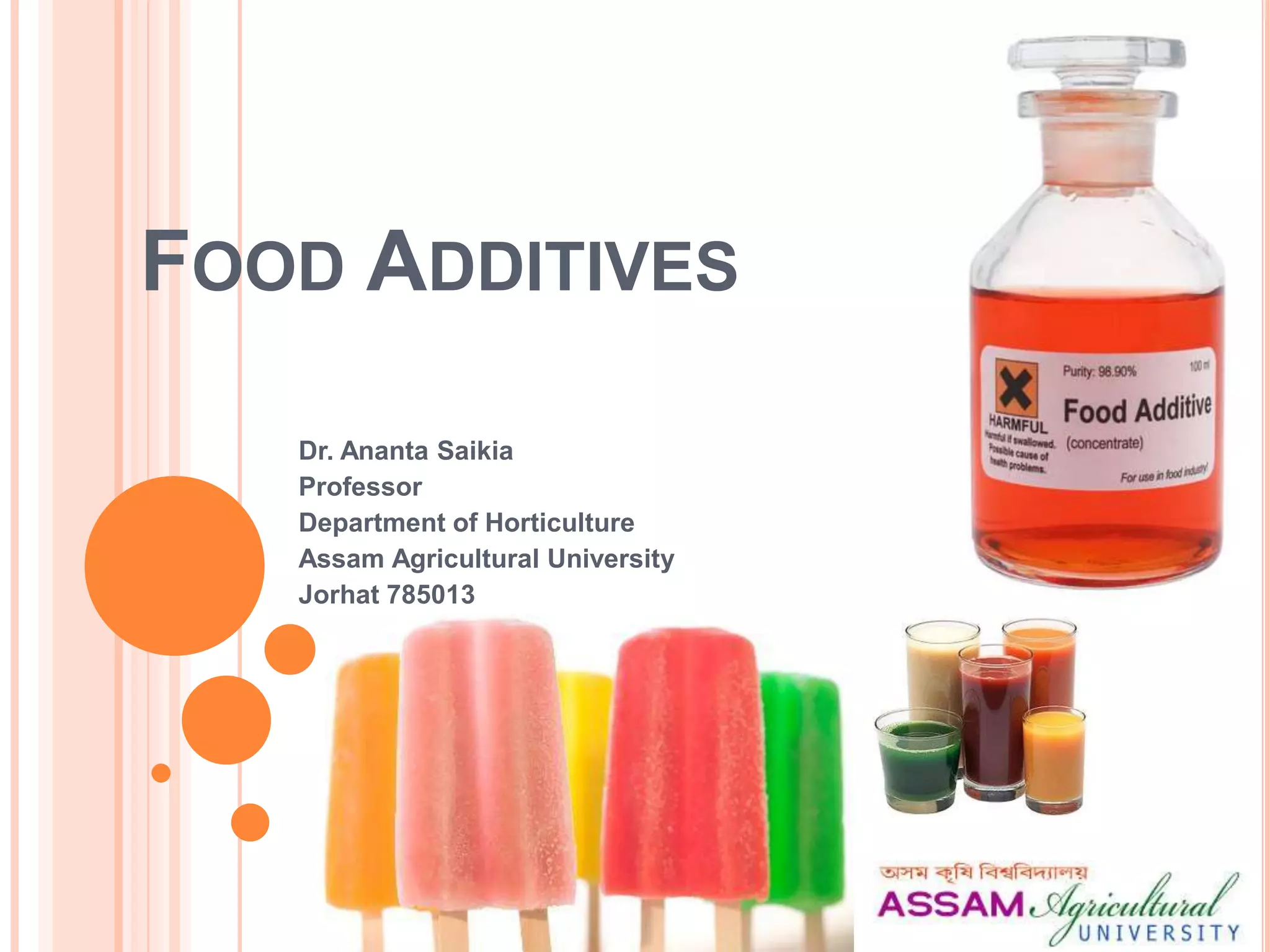
FOOD ADDITIVES
Dr. Ananta Saikia
Professor
Department of Horticulture
Assam Agricultural University
Jorhat 785013
Why do we
use additives
more now
than we did in
the past?
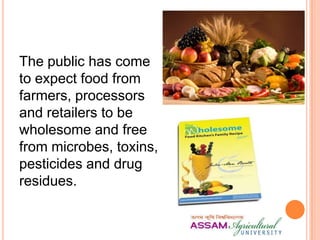
The public has come
to expect food from
farmers, processors
and retailers to be
wholesome and free
from microbes, toxins,
pesticides and drug
residues.
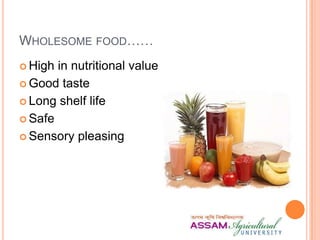
WHOLESOME FOOD……
 High in nutritional value
 Good taste
 Long shelf life
 Safe
 Sensory pleasing
CONDITIONS THAT AFFECT WHOLESOMENESS
 Temperature
 Sanitation
 Storage
 Packaging
 Age
 Preservation techniques
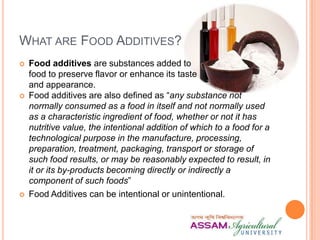
WHAT ARE FOOD ADDITIVES?
 Food additives are substances added to
food to preserve flavor or enhance its taste
and appearance.
 Food additives are also defined as “any substance not
normally consumed as a food in itself and not normally used
as a characteristic ingredient of food, whether or not it has
nutritive value, the intentional addition of which to a food for a
technological purpose in the manufacture, processing,
preparation, treatment, packaging, transport or storage of
such food results, or may be reasonably expected to result, in
it or its by-products becoming directly or indirectly a
component of such foods”
 Food Additives can be intentional or unintentional.
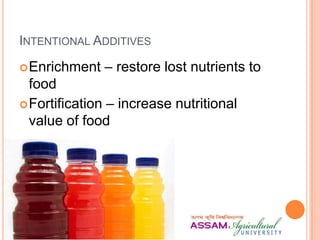
INTENTIONAL ADDITIVES
Enrichment – restore lost nutrients to
food
Fortification – increase nutritional
value of food
UNINTENTIONAL ADDITIVES
Insecticides
Fungicides
Herbicides
Plant Growth Regulators
Hormones and Antibiotics
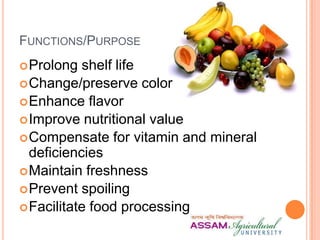
FUNCTIONS/PURPOSE
Prolong shelf life
Change/preserve color
Enhance flavor
Improve nutritional value
Compensate for vitamin and mineral
deficiencies
Maintain freshness
Prevent spoiling
Facilitate food processing
DELANEY CLAUSE, 1958
No substance known to cause cancer
in animals or humans at any dose
level shall be purposefully added to
food.
IMPROPER USE
To cover up faulty or inferior products
To deceive consumers
To produce effects that can not be
otherwise be achieved safely
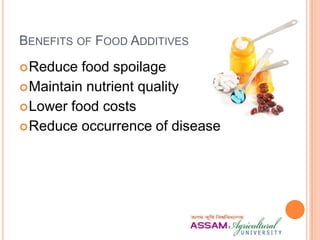
BENEFITS OF FOOD ADDITIVES
Reduce food spoilage
Maintain nutrient quality
Lower food costs
Reduce occurrence of disease
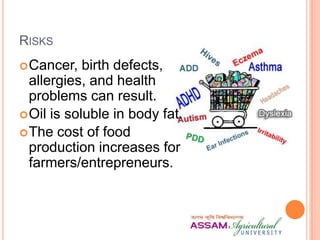
RISKS
Cancer, birth defects,
allergies, and health
problems can result.
Oil is soluble in body fat.
The cost of food
production increases for
farmers/entrepreneurs.
WHY NOT KEEP TO NATURAL ADDITIVES?
 Some artificial colours have almost disappeared
from foods being identified as harmful.
 No sufficient variety of natural additives required to
perform all the required functions of additives.
 Manmade additives may prove more efficient at
preserving
 Some natural colours fade in some products.
Source: Food, a fact of life 2009
NUMBERING OF ADDITIVES
 Each additive is assigned a unique number, termed
as "E numbers“ which is used in Europe for all
approved additives. This numbering scheme has
now been adopted and extended by the Codex
Alimentarius Commission
E 100 – Curcumin, turmeric
E 123 – Amaranth
E 140 – Chlorophylls, Chlorophyllin
E 210 – Benzoic acid
E 224 – Potassium metabisulphite
E 300 – Ascorbic acid
E 330 – Citric acid
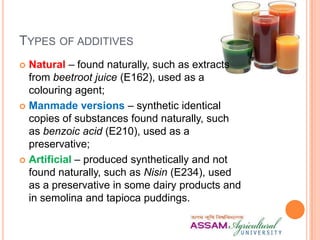
TYPES OF ADDITIVES
 Natural – found naturally, such as extracts
from beetroot juice (E162), used as a
colouring agent;
 Manmade versions – synthetic identical
copies of substances found naturally, such
as benzoic acid (E210), used as a
preservative;
 Artificial – produced synthetically and not
found naturally, such as Nisin (E234), used
as a preservative in some dairy products and
in semolina and tapioca puddings.
CATEGORIES OF FOOD ADDITIVES
ACIDS
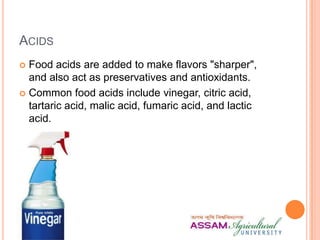
 Food acids are added to make flavors "sharper",
and also act as preservatives and antioxidants.
 Common food acids include vinegar, citric acid,
tartaric acid, malic acid, fumaric acid, and lactic
acid.
ACIDITY REGULATORS
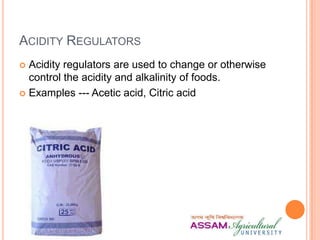
 Acidity regulators are used to change or otherwise
control the acidity and alkalinity of foods.
 Examples --- Acetic acid, Citric acid
ANTIFOAMING AGENTS
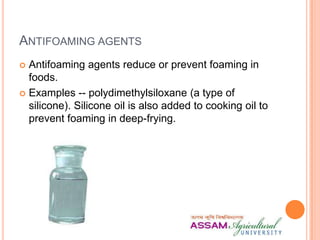
 Antifoaming agents reduce or prevent foaming in
foods.
 Examples -- polydimethylsiloxane (a type of
silicone). Silicone oil is also added to cooking oil to
prevent foaming in deep-frying.
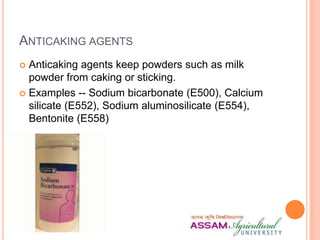
ANTICAKING AGENTS
 Anticaking agents keep powders such as milk
powder from caking or sticking.
 Examples -- Sodium bicarbonate (E500), Calcium
silicate (E552), Sodium aluminosilicate (E554),
Bentonite (E558)
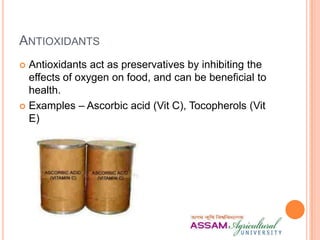
ANTIOXIDANTS
 Antioxidants act as preservatives by inhibiting the
effects of oxygen on food, and can be beneficial to
health.
 Examples – Ascorbic acid (Vit C), Tocopherols (Vit
E)
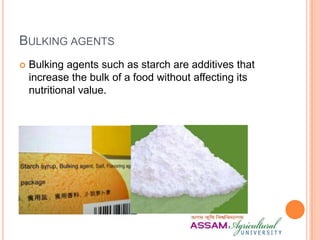
BULKING AGENTS
 Bulking agents such as starch are additives that
increase the bulk of a food without affecting its
nutritional value.
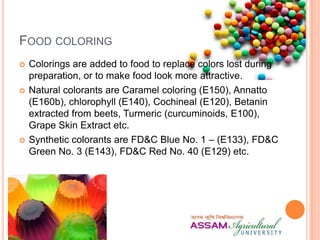
FOOD COLORING
 Colorings are added to food to replace colors lost during
preparation, or to make food look more attractive.
 Natural colorants are Caramel coloring (E150), Annatto
(E160b), chlorophyll (E140), Cochineal (E120), Betanin
extracted from beets, Turmeric (curcuminoids, E100),
Grape Skin Extract etc.
 Synthetic colorants are FD&C Blue No. 1 – (E133), FD&C
Green No. 3 (E143), FD&C Red No. 40 (E129) etc.
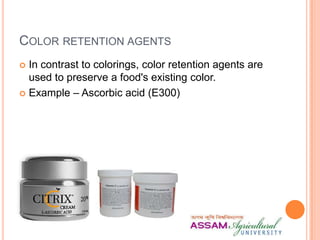
COLOR RETENTION AGENTS
 In contrast to colorings, color retention agents are
used to preserve a food's existing color.
 Example – Ascorbic acid (E300)
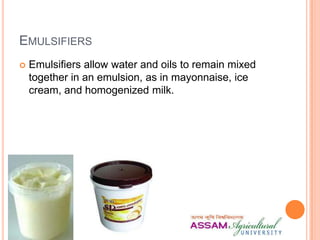
EMULSIFIERS
 Emulsifiers allow water and oils to remain mixed
together in an emulsion, as in mayonnaise, ice
cream, and homogenized milk.
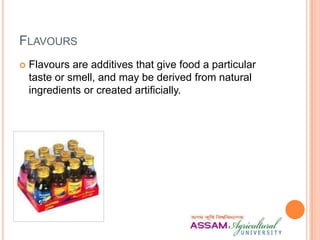
FLAVOURS
 Flavours are additives that give food a particular
taste or smell, and may be derived from natural
ingredients or created artificially.
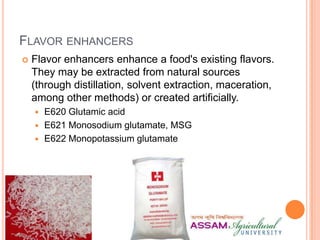
FLAVOR ENHANCERS
 Flavor enhancers enhance a food's existing flavors.
They may be extracted from natural sources
(through distillation, solvent extraction, maceration,
among other methods) or created artificially.
 E620 Glutamic acid
 E621 Monosodium glutamate, MSG
 E622 Monopotassium glutamate
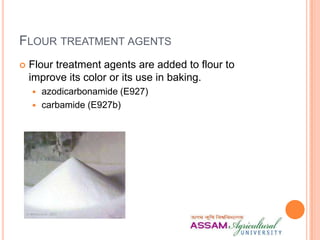
FLOUR TREATMENT AGENTS
 Flour treatment agents are added to flour to
improve its color or its use in baking.
 azodicarbonamide (E927)
 carbamide (E927b)
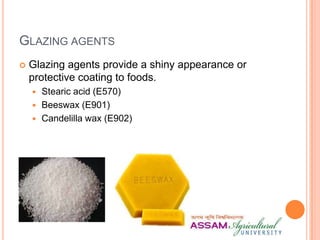
GLAZING AGENTS
 Glazing agents provide a shiny appearance or
protective coating to foods.
 Stearic acid (E570)
 Beeswax (E901)
 Candelilla wax (E902)
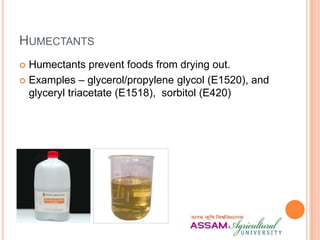
HUMECTANTS
 Humectants prevent foods from drying out.
 Examples – glycerol/propylene glycol (E1520), and
glyceryl triacetate (E1518), sorbitol (E420)
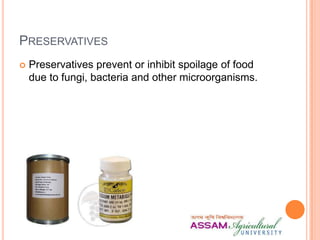
PRESERVATIVES
 Preservatives prevent or inhibit spoilage of food
due to fungi, bacteria and other microorganisms.
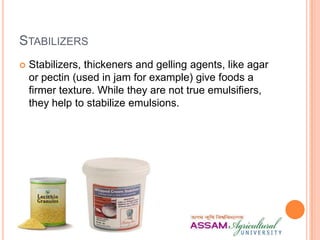
STABILIZERS
 Stabilizers, thickeners and gelling agents, like agar
or pectin (used in jam for example) give foods a
firmer texture. While they are not true emulsifiers,
they help to stabilize emulsions.
SWEETENERS
 Sweeteners are added to foods for flavoring.
Sweeteners other than sugar are added to keep the
food energy (calories) low, or because they have
beneficial effects for diabetes mellitus and tooth
decay and diarrhea.
 Some sugar substitutes are natural and some are
synthetic. Those that are not natural are, in general,
called artificial sweeteners.
 Examples -- stevia, aspartame, sucralose,
neotame, acesulfame potassium, and saccharin
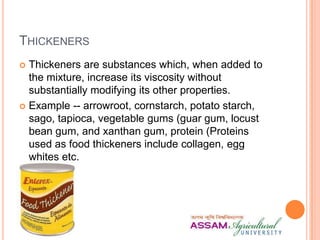
THICKENERS
 Thickeners are substances which, when added to
the mixture, increase its viscosity without
substantially modifying its other properties.
 Example -- arrowroot, cornstarch, potato starch,
sago, tapioca, vegetable gums (guar gum, locust
bean gum, and xanthan gum, protein (Proteins
used as food thickeners include collagen, egg
whites etc.
ACKNOWLEDGEMENT
All the photographs and graphics used in the slides are downloaded versions
from web. Thanks to those creators for their brilliant works
Addtives in Food

Addtives in Food

  • 1.
    FOOD ADDITIVES Dr. AnantaSaikia Professor Department of Horticulture Assam Agricultural University Jorhat 785013
  • 2.
    Why do we useadditives more now than we did in the past?
  • 3.
    The public hascome to expect food from farmers, processors and retailers to be wholesome and free from microbes, toxins, pesticides and drug residues.
  • 4.
    WHOLESOME FOOD……  Highin nutritional value  Good taste  Long shelf life  Safe  Sensory pleasing
  • 5.
    CONDITIONS THAT AFFECTWHOLESOMENESS  Temperature  Sanitation  Storage  Packaging  Age  Preservation techniques
  • 6.
    WHAT ARE FOODADDITIVES?  Food additives are substances added to food to preserve flavor or enhance its taste and appearance.  Food additives are also defined as “any substance not normally consumed as a food in itself and not normally used as a characteristic ingredient of food, whether or not it has nutritive value, the intentional addition of which to a food for a technological purpose in the manufacture, processing, preparation, treatment, packaging, transport or storage of such food results, or may be reasonably expected to result, in it or its by-products becoming directly or indirectly a component of such foods”  Food Additives can be intentional or unintentional.
  • 7.
    INTENTIONAL ADDITIVES Enrichment –restore lost nutrients to food Fortification – increase nutritional value of food
  • 8.
  • 9.
    FUNCTIONS/PURPOSE Prolong shelf life Change/preservecolor Enhance flavor Improve nutritional value Compensate for vitamin and mineral deficiencies Maintain freshness Prevent spoiling Facilitate food processing
  • 10.
    DELANEY CLAUSE, 1958 Nosubstance known to cause cancer in animals or humans at any dose level shall be purposefully added to food.
  • 11.
    IMPROPER USE To coverup faulty or inferior products To deceive consumers To produce effects that can not be otherwise be achieved safely
  • 12.
    BENEFITS OF FOODADDITIVES Reduce food spoilage Maintain nutrient quality Lower food costs Reduce occurrence of disease
  • 13.
    RISKS Cancer, birth defects, allergies,and health problems can result. Oil is soluble in body fat. The cost of food production increases for farmers/entrepreneurs.
  • 14.
    WHY NOT KEEPTO NATURAL ADDITIVES?  Some artificial colours have almost disappeared from foods being identified as harmful.  No sufficient variety of natural additives required to perform all the required functions of additives.  Manmade additives may prove more efficient at preserving  Some natural colours fade in some products. Source: Food, a fact of life 2009
  • 15.
    NUMBERING OF ADDITIVES Each additive is assigned a unique number, termed as "E numbers“ which is used in Europe for all approved additives. This numbering scheme has now been adopted and extended by the Codex Alimentarius Commission E 100 – Curcumin, turmeric E 123 – Amaranth E 140 – Chlorophylls, Chlorophyllin E 210 – Benzoic acid E 224 – Potassium metabisulphite E 300 – Ascorbic acid E 330 – Citric acid
  • 16.
    TYPES OF ADDITIVES Natural – found naturally, such as extracts from beetroot juice (E162), used as a colouring agent;  Manmade versions – synthetic identical copies of substances found naturally, such as benzoic acid (E210), used as a preservative;  Artificial – produced synthetically and not found naturally, such as Nisin (E234), used as a preservative in some dairy products and in semolina and tapioca puddings.
  • 17.
  • 18.
    ACIDS  Food acidsare added to make flavors "sharper", and also act as preservatives and antioxidants.  Common food acids include vinegar, citric acid, tartaric acid, malic acid, fumaric acid, and lactic acid.
  • 19.
    ACIDITY REGULATORS  Acidityregulators are used to change or otherwise control the acidity and alkalinity of foods.  Examples --- Acetic acid, Citric acid
  • 20.
    ANTIFOAMING AGENTS  Antifoamingagents reduce or prevent foaming in foods.  Examples -- polydimethylsiloxane (a type of silicone). Silicone oil is also added to cooking oil to prevent foaming in deep-frying.
  • 21.
    ANTICAKING AGENTS  Anticakingagents keep powders such as milk powder from caking or sticking.  Examples -- Sodium bicarbonate (E500), Calcium silicate (E552), Sodium aluminosilicate (E554), Bentonite (E558)
  • 22.
    ANTIOXIDANTS  Antioxidants actas preservatives by inhibiting the effects of oxygen on food, and can be beneficial to health.  Examples – Ascorbic acid (Vit C), Tocopherols (Vit E)
  • 23.
    BULKING AGENTS  Bulkingagents such as starch are additives that increase the bulk of a food without affecting its nutritional value.
  • 24.
    FOOD COLORING  Coloringsare added to food to replace colors lost during preparation, or to make food look more attractive.  Natural colorants are Caramel coloring (E150), Annatto (E160b), chlorophyll (E140), Cochineal (E120), Betanin extracted from beets, Turmeric (curcuminoids, E100), Grape Skin Extract etc.  Synthetic colorants are FD&C Blue No. 1 – (E133), FD&C Green No. 3 (E143), FD&C Red No. 40 (E129) etc.
  • 25.
    COLOR RETENTION AGENTS In contrast to colorings, color retention agents are used to preserve a food's existing color.  Example – Ascorbic acid (E300)
  • 26.
    EMULSIFIERS  Emulsifiers allowwater and oils to remain mixed together in an emulsion, as in mayonnaise, ice cream, and homogenized milk.
  • 27.
    FLAVOURS  Flavours areadditives that give food a particular taste or smell, and may be derived from natural ingredients or created artificially.
  • 28.
    FLAVOR ENHANCERS  Flavorenhancers enhance a food's existing flavors. They may be extracted from natural sources (through distillation, solvent extraction, maceration, among other methods) or created artificially.  E620 Glutamic acid  E621 Monosodium glutamate, MSG  E622 Monopotassium glutamate
  • 29.
    FLOUR TREATMENT AGENTS Flour treatment agents are added to flour to improve its color or its use in baking.  azodicarbonamide (E927)  carbamide (E927b)
  • 30.
    GLAZING AGENTS  Glazingagents provide a shiny appearance or protective coating to foods.  Stearic acid (E570)  Beeswax (E901)  Candelilla wax (E902)
  • 31.
    HUMECTANTS  Humectants preventfoods from drying out.  Examples – glycerol/propylene glycol (E1520), and glyceryl triacetate (E1518), sorbitol (E420)
  • 32.
    PRESERVATIVES  Preservatives preventor inhibit spoilage of food due to fungi, bacteria and other microorganisms.
  • 33.
    STABILIZERS  Stabilizers, thickenersand gelling agents, like agar or pectin (used in jam for example) give foods a firmer texture. While they are not true emulsifiers, they help to stabilize emulsions.
  • 34.
    SWEETENERS  Sweeteners areadded to foods for flavoring. Sweeteners other than sugar are added to keep the food energy (calories) low, or because they have beneficial effects for diabetes mellitus and tooth decay and diarrhea.  Some sugar substitutes are natural and some are synthetic. Those that are not natural are, in general, called artificial sweeteners.  Examples -- stevia, aspartame, sucralose, neotame, acesulfame potassium, and saccharin
  • 35.
    THICKENERS  Thickeners aresubstances which, when added to the mixture, increase its viscosity without substantially modifying its other properties.  Example -- arrowroot, cornstarch, potato starch, sago, tapioca, vegetable gums (guar gum, locust bean gum, and xanthan gum, protein (Proteins used as food thickeners include collagen, egg whites etc.
  • 36.
    ACKNOWLEDGEMENT All the photographsand graphics used in the slides are downloaded versions from web. Thanks to those creators for their brilliant works