Food Safety Officer Exam- Kerala
Food Technology
Topic: Food Additives.
Subith C
Faculty of Food Process Technology, VKIDFT
Kerala Veterinary and Animal Sciences University
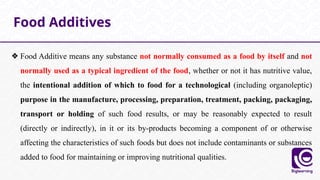
❖ Food Additive means any substance not normally consumed as a food by itself and not
normally used as a typical ingredient of the food, whether or not it has nutritive value,
the intentional addition of which to food for a technological (including organoleptic)
purpose in the manufacture, processing, preparation, treatment, packing, packaging,
transport or holding of such food results, or may be reasonably expected to result
(directly or indirectly), in it or its by-products becoming a component of or otherwise
affecting the characteristics of such foods but does not include contaminants or substances
added to food for maintaining or improving nutritional qualities.
Food Additives
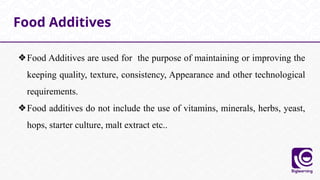
❖Food Additives are used for the purpose of maintaining or improving the
keeping quality, texture, consistency, Appearance and other technological
requirements.
❖Food additives do not include the use of vitamins, minerals, herbs, yeast,
hops, starter culture, malt extract etc..
Food Additives
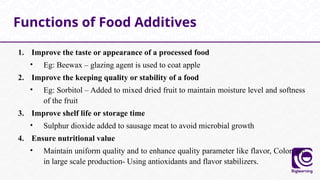
1. Improve the taste or appearance of a processed food
• Eg: Beewax – glazing agent is used to coat apple
2. Improve the keeping quality or stability of a food
• Eg: Sorbitol – Added to mixed dried fruit to maintain moisture level and softness
of the fruit
3. Improve shelf life or storage time
• Sulphur dioxide added to sausage meat to avoid microbial growth
4. Ensure nutritional value
• Maintain uniform quality and to enhance quality parameter like flavor, Color, etc
in large scale production- Using antioxidants and flavor stabilizers.
Functions of Food Additives
❖Direct or intentional food additives.
• Direct food additives are those that are added to a food for a specific purpose in
that food
• Eg: xanthan gum- Used in salad, chocolate milk, bakery filling, pudding etc- to
add texture- is direct food additives..
• It can be identified on the ingredient label- of the packaging..
 Indirect additives or unintentional food additives
• Indirect food additives are those that become part of the food in trace amount due
to its packaging, storage or other handling.
• For instance, minute amounts of packaging substances may find their way into
foods during storage.
• Antioxidants, for example, used in edible oil may be found in chips or any food
item prepared with this oil. This is known as the carry over principle..
Types of food additives
❖Direct food additives are often added during processing to: aid the
process, or prepare the food, keep the product fresh, make the food
more appealing.
❖Direct food additives may be man made or natural.
❖Natural food additives include:
 Herb or spices to add flavor to foods.
 Vinegar for pickling foods salt,
 To preserve meats.
Functions of direct food additives
❖Indirect Food additives are substances that may be found in food during
or after it is processed.
❖They were not used in the food on purpose.
❖These additives are present in small amount in the final product.
❖Alternative names additives in food; Artificial flavor and color
❖Leaching of antioxidants from biodegradable packaging, and cardboard
flavor of food, which is packed in cardboard.
Functions of Indirect Food Additives
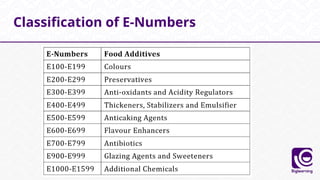
❖ Foods sold throughout the EU have had full ingredient labelling since the mid-
1980s.
❖ These include standard codes (E numbers) that accurately describe additives.
❖ These numbers are also used in other regions such as Australia and New
Zealand, without the E (‘Europe’).
❖ The ‘E’ Indicate the European Union approved food additives.
❖ In India INS number is used instead of E number.
E- codes numbers – Group of food
ingredients
Classification of E-Numbers
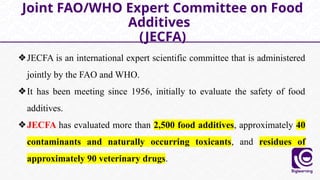
❖JECFA is an international expert scientific committee that is administered
jointly by the FAO and WHO.
❖It has been meeting since 1956, initially to evaluate the safety of food
additives.
❖JECFA has evaluated more than 2,500 food additives, approximately 40
contaminants and naturally occurring toxicants, and residues of
approximately 90 veterinary drugs.
Joint FAO/WHO Expert Committee on Food
Additives
(JECFA)
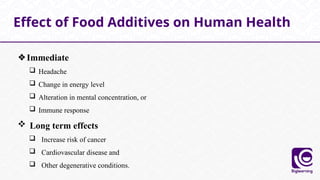
❖Immediate
 Headache
 Change in energy level
 Alteration in mental concentration, or
 Immune response
 Long term effects
 Increase risk of cancer
 Cardiovascular disease and
 Other degenerative conditions.
Effect of Food Additives on Human Health
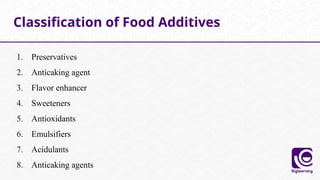
1. Preservatives
2. Anticaking agent
3. Flavor enhancer
4. Sweeteners
5. Antioxidants
6. Emulsifiers
7. Acidulants
8. Anticaking agents
Classification of Food Additives
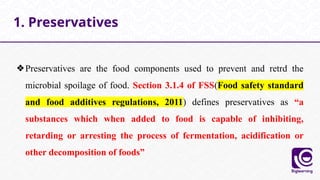
❖Preservatives are the food components used to prevent and retrd the
microbial spoilage of food. Section 3.1.4 of FSS(Food safety standard
and food additives regulations, 2011) defines preservatives as “a
substances which when added to food is capable of inhibiting,
retarding or arresting the process of fermentation, acidification or
other decomposition of foods”
1. Preservatives
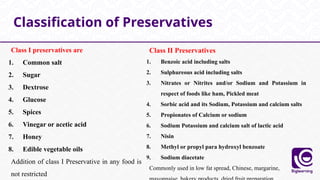
Class I preservatives are
1. Common salt
2. Sugar
3. Dextrose
4. Glucose
5. Spices
6. Vinegar or acetic acid
7. Honey
8. Edible vegetable oils
Addition of class I Preservative in any food is
not restricted
Classification of Preservatives
Class II Preservatives
1. Benzoic acid including salts
2. Sulphureous acid including salts
3. Nitrates or Nitrites and/or Sodium and Potassium in
respect of foods like ham, Pickled meat
4. Sorbic acid and its Sodium, Potassium and calcium salts
5. Propionates of Calcium or sodium
6. Sodium Potassium and calcium salt of lactic acid
7. Nisin
8. Methyl or propyl para hydroxyl benzoate
9. Sodium diacetate
Commonly used in low fat spread, Chinese, margarine,
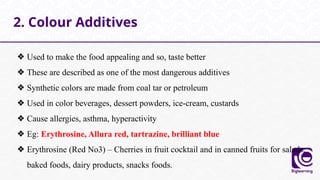
❖ Used to make the food appealing and so, taste better
❖ These are described as one of the most dangerous additives
❖ Synthetic colors are made from coal tar or petroleum
❖ Used in color beverages, dessert powders, ice-cream, custards
❖ Cause allergies, asthma, hyperactivity
❖ Eg: Erythrosine, Allura red, tartrazine, brilliant blue
❖ Erythrosine (Red No3) – Cherries in fruit cocktail and in canned fruits for salads,
baked foods, dairy products, snacks foods.
2. Colour Additives
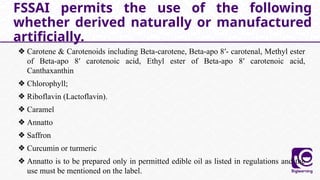
❖ Carotene & Carotenoids including Beta-carotene, Beta-apo 8′- carotenal, Methyl ester
of Beta-apo 8′ carotenoic acid, Ethyl ester of Beta-apo 8′ carotenoic acid,
Canthaxanthin
❖ Chlorophyll;
❖ Riboflavin (Lactoflavin).
❖ Caramel
❖ Annatto
❖ Saffron
❖ Curcumin or turmeric
❖ Annatto is to be prepared only in permitted edible oil as listed in regulations and the
use must be mentioned on the label.
FSSAI permits the use of the following
whether derived naturally or manufactured
artificially.
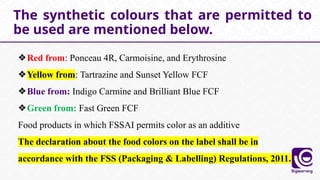
❖Red from: Ponceau 4R, Carmoisine, and Erythrosine
❖Yellow from: Tartrazine and Sunset Yellow FCF
❖Blue from: Indigo Carmine and Brilliant Blue FCF
❖Green from: Fast Green FCF
Food products in which FSSAI permits color as an additive
The declaration about the food colors on the label shall be in
accordance with the FSS (Packaging & Labelling) Regulations, 2011.
The synthetic colours that are permitted to
be used are mentioned below.
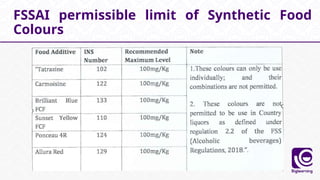
FSSAI permissible limit of Synthetic Food
Colours
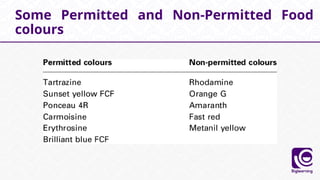
Some Permitted and Non-Permitted Food
colours
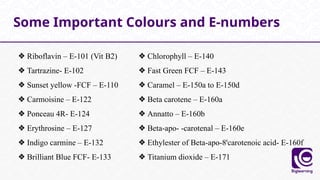
❖ Riboflavin – E-101 (Vit B2)
❖ Tartrazine- E-102
❖ Sunset yellow -FCF – E-110
❖ Carmoisine – E-122
❖ Ponceau 4R- E-124
❖ Erythrosine – E-127
❖ Indigo carmine – E-132
❖ Brilliant Blue FCF- E-133
Some Important Colours and E-numbers
❖ Chlorophyll – E-140
❖ Fast Green FCF – E-143
❖ Caramel – E-150a to E-150d
❖ Beta carotene – E-160a
❖ Annatto – E-160b
❖ Beta-apo- -carotenal – E-160e
❖ Ethylester of Beta-apo-8'carotenoic acid- E-160f
❖ Titanium dioxide – E-171
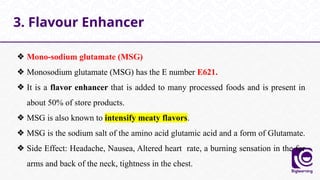
❖ Mono-sodium glutamate (MSG)
❖ Monosodium glutamate (MSG) has the E number E621.
❖ It is a flavor enhancer that is added to many processed foods and is present in
about 50% of store products.
❖ MSG is also known to intensify meaty flavors.
❖ MSG is the sodium salt of the amino acid glutamic acid and a form of Glutamate.
❖ Side Effect: Headache, Nausea, Altered heart rate, a burning sensation in the for
arms and back of the neck, tightness in the chest.
3. Flavour Enhancer
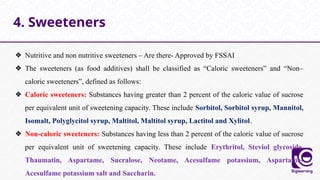
❖ Nutritive and non nutritive sweeteners – Are there- Approved by FSSAI
❖ The sweeteners (as food additives) shall be classified as “Caloric sweeteners” and “Non–
caloric sweeteners”, defined as follows:
❖ Caloric sweeteners: Substances having greater than 2 percent of the caloric value of sucrose
per equivalent unit of sweetening capacity. These include Sorbitol, Sorbitol syrup, Mannitol,
Isomalt, Polyglycitol syrup, Maltitol, Maltitol syrup, Lactitol and Xylitol.
❖ Non-caloric sweeteners: Substances having less than 2 percent of the caloric value of sucrose
per equivalent unit of sweetening capacity. These include Erythritol, Steviol glycoside,
Thaumatin, Aspartame, Sucralose, Neotame, Acesulfame potassium, Aspartame-
Acesulfame potassium salt and Saccharin.
4. Sweeteners
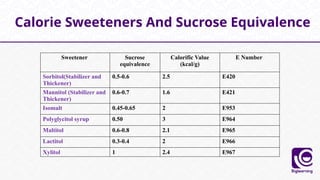
Calorie Sweeteners And Sucrose Equivalence
Sweetener Sucrose
equivalence
Calorific Value
(kcal/g)
E Number
Sorbitol(Stabilizer and
Thickener)
0.5-0.6 2.5 E420
Mannitol (Stabilizer and
Thickener)
0.6-0.7 1.6 E421
Isomalt 0.45-0.65 2 E953
Polyglycitol syrup 0.50 3 E964
Maltitol 0.6-0.8 2.1 E965
Lactitol 0.3-0.4 2 E966
Xylitol 1 2.4 E967
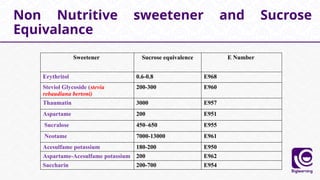
Non Nutritive sweetener and Sucrose
Equivalance
Sweetener Sucrose equivalence E Number
Erythritol 0.6-0.8 E968
Steviol Glycoside (stevia
rebaudiana bertoni)
200-300 E960
Thaumatin 3000 E957
Aspartame 200 E951
Sucralose 450–650 E955
Neotame 7000-13000 E961
Acesulfame potassium 180-200 E950
Aspartame-Acesulfame potassium 200 E962
Saccharin 200-700 E954
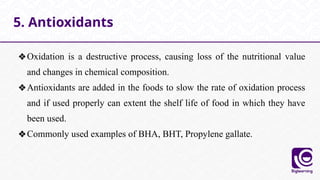
❖Oxidation is a destructive process, causing loss of the nutritional value
and changes in chemical composition.
❖Antioxidants are added in the foods to slow the rate of oxidation process
and if used properly can extent the shelf life of food in which they have
been used.
❖Commonly used examples of BHA, BHT, Propylene gallate.
5. Antioxidants
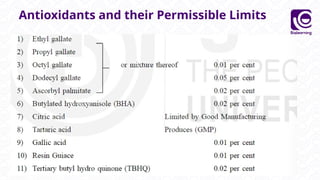
Antioxidants and their Permissible Limits
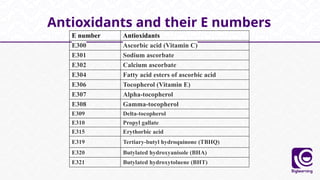
Antioxidants and their E numbers
E number Antioxidants
E300 Ascorbic acid (Vitamin C)
E301 Sodium ascorbate
E302 Calcium ascorbate
E304 Fatty acid esters of ascorbic acid
E306 Tocopherol (Vitamin E)
E307 Alpha-tocopherol
E308 Gamma-tocopherol
E309 Delta-tocopherol
E310 Propyl gallate
E315 Erythorbic acid
E319 Tertiary-butyl hydroquinone (TBHQ)
E320 Butylated hydroxyanisole (BHA)
E321 Butylated hydroxytoluene (BHT)
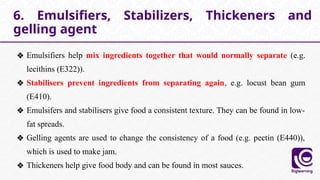
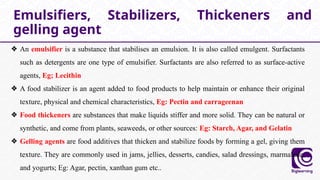
❖ Emulsifiers help mix ingredients together that would normally separate (e.g.
lecithins (E322)).
❖ Stabilisers prevent ingredients from separating again, e.g. locust bean gum
(E410).
❖ Emulsifers and stabilisers give food a consistent texture. They can be found in low-
fat spreads.
❖ Gelling agents are used to change the consistency of a food (e.g. pectin (E440)),
which is used to make jam.
❖ Thickeners help give food body and can be found in most sauces.
6. Emulsifiers, Stabilizers, Thickeners and
gelling agent
❖ An emulsifier is a substance that stabilises an emulsion. It is also called emulgent. Surfactants
such as detergents are one type of emulsifier. Surfactants are also referred to as surface-active
agents, Eg; Lecithin
❖ A food stabilizer is an agent added to food products to help maintain or enhance their original
texture, physical and chemical characteristics, Eg: Pectin and carrageenan
❖ Food thickeners are substances that make liquids stiffer and more solid. They can be natural or
synthetic, and come from plants, seaweeds, or other sources: Eg: Starch, Agar, and Gelatin
❖ Gelling agents are food additives that thicken and stabilize foods by forming a gel, giving them
texture. They are commonly used in jams, jellies, desserts, candies, salad dressings, marmalade,
and yogurts; Eg: Agar, pectin, xanthan gum etc..
Emulsifiers, Stabilizers, Thickeners and
gelling agent
Emulsifiers, Stabilizers, Thickeners and
gelling agent
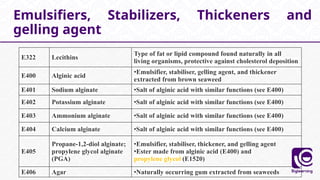
E322 Lecithins
Type of fat or lipid compound found naturally in all
living organisms, protective against cholesterol deposition
E400 Alginic acid
•Emulsifier, stabiliser, gelling agent, and thickener
extracted from brown seaweed
E401 Sodium alginate •Salt of alginic acid with similar functions (see E400)
E402 Potassium alginate •Salt of alginic acid with similar functions (see E400)
E403 Ammonium alginate •Salt of alginic acid with similar functions (see E400)
E404 Calcium alginate •Salt of alginic acid with similar functions (see E400)
E405
Propane-1,2-diol alginate;
propylene glycol alginate
(PGA)
•Emulsifier, stabiliser, thickener, and gelling agent
•Ester made from alginic acid (E400) and
propylene glycol (E1520)
E406 Agar •Naturally occurring gum extracted from seaweeds
Emulsifiers, Stabilizers, Thickeners and
gelling agent
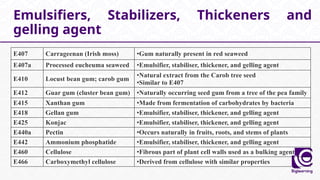
E407 Carrageenan (Irish moss) •Gum naturally present in red seaweed
E407a Processed eucheuma seaweed •Emulsifier, stabiliser, thickener, and gelling agent
E410 Locust bean gum; carob gum
•Natural extract from the Carob tree seed
•Similar to E407
E412 Guar gum (cluster bean gum) •Naturally occurring seed gum from a tree of the pea family
E415 Xanthan gum •Made from fermentation of carbohydrates by bacteria
E418 Gellan gum •Emulsifier, stabiliser, thickener, and gelling agent
E425 Konjac •Emulsifier, stabiliser, thickener, and gelling agent
E440a Pectin •Occurs naturally in fruits, roots, and stems of plants
E442 Ammonium phosphatide •Emulsifier, stabiliser, thickener, and gelling agent
E460 Cellulose •Fibrous part of plant cell walls used as a bulking agent
E466 Carboxymethyl cellulose •Derived from cellulose with similar properties
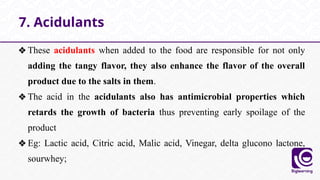
❖These acidulants when added to the food are responsible for not only
adding the tangy flavor, they also enhance the flavor of the overall
product due to the salts in them.
❖The acid in the acidulants also has antimicrobial properties which
retards the growth of bacteria thus preventing early spoilage of the
product
❖Eg: Lactic acid, Citric acid, Malic acid, Vinegar, delta glucono lactone,
sourwhey;
7. Acidulants
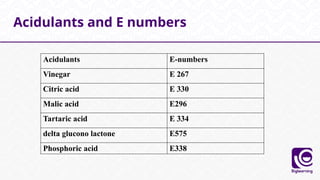
Acidulants and E numbers
Acidulants E-numbers
Vinegar E 267
Citric acid E 330
Malic acid E296
Tartaric acid E 334
delta glucono lactone E575
Phosphoric acid E338
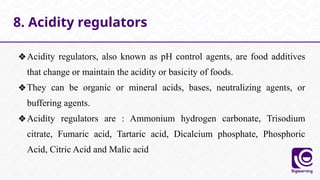
❖Acidity regulators, also known as pH control agents, are food additives
that change or maintain the acidity or basicity of foods.
❖They can be organic or mineral acids, bases, neutralizing agents, or
buffering agents.
❖Acidity regulators are : Ammonium hydrogen carbonate, Trisodium
citrate, Fumaric acid, Tartaric acid, Dicalcium phosphate, Phosphoric
Acid, Citric Acid and Malic acid
8. Acidity regulators
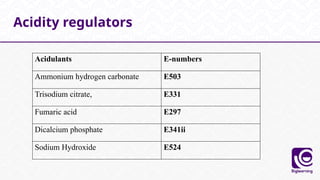
Acidity regulators
Acidulants E-numbers
Ammonium hydrogen carbonate E503
Trisodium citrate, E331
Fumaric acid E297
Dicalcium phosphate E341ii
Sodium Hydroxide E524
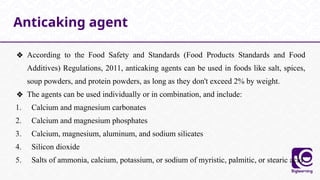
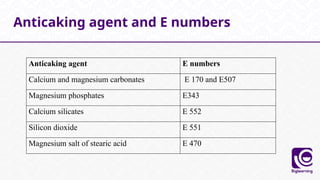
❖ According to the Food Safety and Standards (Food Products Standards and Food
Additives) Regulations, 2011, anticaking agents can be used in foods like salt, spices,
soup powders, and protein powders, as long as they don't exceed 2% by weight.
❖ The agents can be used individually or in combination, and include:
1. Calcium and magnesium carbonates
2. Calcium and magnesium phosphates
3. Calcium, magnesium, aluminum, and sodium silicates
4. Silicon dioxide
5. Salts of ammonia, calcium, potassium, or sodium of myristic, palmitic, or stearic acid
Anticaking agent
Anticaking agent and E numbers
Anticaking agent E numbers
Calcium and magnesium carbonates E 170 and E507
Magnesium phosphates E343
Calcium silicates E 552
Silicon dioxide E 551
Magnesium salt of stearic acid E 470
❖Olestra is a fat substitute made from sucrose and vegetable oil.
❖Olestra is neither digested nor absorbed, and therefore adds no calories or
fat to the diet.
❖Olestra is a non-caloric fat substitute that is made from sucrose and long-
chain fatty acids from edible oils.
❖It is a mixture of hexa-, hepta-, and octa-esters, and has properties similar
to triglycerides.
Olestra

Lecture 8 chemical engineering thermodynamics

  • 1.
    Food Safety OfficerExam- Kerala Food Technology Topic: Food Additives. Subith C Faculty of Food Process Technology, VKIDFT Kerala Veterinary and Animal Sciences University
  • 2.
    ❖ Food Additivemeans any substance not normally consumed as a food by itself and not normally used as a typical ingredient of the food, whether or not it has nutritive value, the intentional addition of which to food for a technological (including organoleptic) purpose in the manufacture, processing, preparation, treatment, packing, packaging, transport or holding of such food results, or may be reasonably expected to result (directly or indirectly), in it or its by-products becoming a component of or otherwise affecting the characteristics of such foods but does not include contaminants or substances added to food for maintaining or improving nutritional qualities. Food Additives
  • 3.
    ❖Food Additives areused for the purpose of maintaining or improving the keeping quality, texture, consistency, Appearance and other technological requirements. ❖Food additives do not include the use of vitamins, minerals, herbs, yeast, hops, starter culture, malt extract etc.. Food Additives
  • 4.
    1. Improve thetaste or appearance of a processed food • Eg: Beewax – glazing agent is used to coat apple 2. Improve the keeping quality or stability of a food • Eg: Sorbitol – Added to mixed dried fruit to maintain moisture level and softness of the fruit 3. Improve shelf life or storage time • Sulphur dioxide added to sausage meat to avoid microbial growth 4. Ensure nutritional value • Maintain uniform quality and to enhance quality parameter like flavor, Color, etc in large scale production- Using antioxidants and flavor stabilizers. Functions of Food Additives
  • 5.
    ❖Direct or intentionalfood additives. • Direct food additives are those that are added to a food for a specific purpose in that food • Eg: xanthan gum- Used in salad, chocolate milk, bakery filling, pudding etc- to add texture- is direct food additives.. • It can be identified on the ingredient label- of the packaging..  Indirect additives or unintentional food additives • Indirect food additives are those that become part of the food in trace amount due to its packaging, storage or other handling. • For instance, minute amounts of packaging substances may find their way into foods during storage. • Antioxidants, for example, used in edible oil may be found in chips or any food item prepared with this oil. This is known as the carry over principle.. Types of food additives
  • 6.
    ❖Direct food additivesare often added during processing to: aid the process, or prepare the food, keep the product fresh, make the food more appealing. ❖Direct food additives may be man made or natural. ❖Natural food additives include:  Herb or spices to add flavor to foods.  Vinegar for pickling foods salt,  To preserve meats. Functions of direct food additives
  • 7.
    ❖Indirect Food additivesare substances that may be found in food during or after it is processed. ❖They were not used in the food on purpose. ❖These additives are present in small amount in the final product. ❖Alternative names additives in food; Artificial flavor and color ❖Leaching of antioxidants from biodegradable packaging, and cardboard flavor of food, which is packed in cardboard. Functions of Indirect Food Additives
  • 8.
    ❖ Foods soldthroughout the EU have had full ingredient labelling since the mid- 1980s. ❖ These include standard codes (E numbers) that accurately describe additives. ❖ These numbers are also used in other regions such as Australia and New Zealand, without the E (‘Europe’). ❖ The ‘E’ Indicate the European Union approved food additives. ❖ In India INS number is used instead of E number. E- codes numbers – Group of food ingredients
  • 9.
  • 10.
    ❖JECFA is aninternational expert scientific committee that is administered jointly by the FAO and WHO. ❖It has been meeting since 1956, initially to evaluate the safety of food additives. ❖JECFA has evaluated more than 2,500 food additives, approximately 40 contaminants and naturally occurring toxicants, and residues of approximately 90 veterinary drugs. Joint FAO/WHO Expert Committee on Food Additives (JECFA)
  • 11.
    ❖Immediate  Headache  Changein energy level  Alteration in mental concentration, or  Immune response  Long term effects  Increase risk of cancer  Cardiovascular disease and  Other degenerative conditions. Effect of Food Additives on Human Health
  • 12.
    1. Preservatives 2. Anticakingagent 3. Flavor enhancer 4. Sweeteners 5. Antioxidants 6. Emulsifiers 7. Acidulants 8. Anticaking agents Classification of Food Additives
  • 13.
    ❖Preservatives are thefood components used to prevent and retrd the microbial spoilage of food. Section 3.1.4 of FSS(Food safety standard and food additives regulations, 2011) defines preservatives as “a substances which when added to food is capable of inhibiting, retarding or arresting the process of fermentation, acidification or other decomposition of foods” 1. Preservatives
  • 14.
    Class I preservativesare 1. Common salt 2. Sugar 3. Dextrose 4. Glucose 5. Spices 6. Vinegar or acetic acid 7. Honey 8. Edible vegetable oils Addition of class I Preservative in any food is not restricted Classification of Preservatives Class II Preservatives 1. Benzoic acid including salts 2. Sulphureous acid including salts 3. Nitrates or Nitrites and/or Sodium and Potassium in respect of foods like ham, Pickled meat 4. Sorbic acid and its Sodium, Potassium and calcium salts 5. Propionates of Calcium or sodium 6. Sodium Potassium and calcium salt of lactic acid 7. Nisin 8. Methyl or propyl para hydroxyl benzoate 9. Sodium diacetate Commonly used in low fat spread, Chinese, margarine,
  • 15.
    ❖ Used tomake the food appealing and so, taste better ❖ These are described as one of the most dangerous additives ❖ Synthetic colors are made from coal tar or petroleum ❖ Used in color beverages, dessert powders, ice-cream, custards ❖ Cause allergies, asthma, hyperactivity ❖ Eg: Erythrosine, Allura red, tartrazine, brilliant blue ❖ Erythrosine (Red No3) – Cherries in fruit cocktail and in canned fruits for salads, baked foods, dairy products, snacks foods. 2. Colour Additives
  • 16.
    ❖ Carotene &Carotenoids including Beta-carotene, Beta-apo 8′- carotenal, Methyl ester of Beta-apo 8′ carotenoic acid, Ethyl ester of Beta-apo 8′ carotenoic acid, Canthaxanthin ❖ Chlorophyll; ❖ Riboflavin (Lactoflavin). ❖ Caramel ❖ Annatto ❖ Saffron ❖ Curcumin or turmeric ❖ Annatto is to be prepared only in permitted edible oil as listed in regulations and the use must be mentioned on the label. FSSAI permits the use of the following whether derived naturally or manufactured artificially.
  • 17.
    ❖Red from: Ponceau4R, Carmoisine, and Erythrosine ❖Yellow from: Tartrazine and Sunset Yellow FCF ❖Blue from: Indigo Carmine and Brilliant Blue FCF ❖Green from: Fast Green FCF Food products in which FSSAI permits color as an additive The declaration about the food colors on the label shall be in accordance with the FSS (Packaging & Labelling) Regulations, 2011. The synthetic colours that are permitted to be used are mentioned below.
  • 18.
    FSSAI permissible limitof Synthetic Food Colours
  • 19.
    Some Permitted andNon-Permitted Food colours
  • 20.
    ❖ Riboflavin –E-101 (Vit B2) ❖ Tartrazine- E-102 ❖ Sunset yellow -FCF – E-110 ❖ Carmoisine – E-122 ❖ Ponceau 4R- E-124 ❖ Erythrosine – E-127 ❖ Indigo carmine – E-132 ❖ Brilliant Blue FCF- E-133 Some Important Colours and E-numbers ❖ Chlorophyll – E-140 ❖ Fast Green FCF – E-143 ❖ Caramel – E-150a to E-150d ❖ Beta carotene – E-160a ❖ Annatto – E-160b ❖ Beta-apo- -carotenal – E-160e ❖ Ethylester of Beta-apo-8'carotenoic acid- E-160f ❖ Titanium dioxide – E-171
  • 21.
    ❖ Mono-sodium glutamate(MSG) ❖ Monosodium glutamate (MSG) has the E number E621. ❖ It is a flavor enhancer that is added to many processed foods and is present in about 50% of store products. ❖ MSG is also known to intensify meaty flavors. ❖ MSG is the sodium salt of the amino acid glutamic acid and a form of Glutamate. ❖ Side Effect: Headache, Nausea, Altered heart rate, a burning sensation in the for arms and back of the neck, tightness in the chest. 3. Flavour Enhancer
  • 22.
    ❖ Nutritive andnon nutritive sweeteners – Are there- Approved by FSSAI ❖ The sweeteners (as food additives) shall be classified as “Caloric sweeteners” and “Non– caloric sweeteners”, defined as follows: ❖ Caloric sweeteners: Substances having greater than 2 percent of the caloric value of sucrose per equivalent unit of sweetening capacity. These include Sorbitol, Sorbitol syrup, Mannitol, Isomalt, Polyglycitol syrup, Maltitol, Maltitol syrup, Lactitol and Xylitol. ❖ Non-caloric sweeteners: Substances having less than 2 percent of the caloric value of sucrose per equivalent unit of sweetening capacity. These include Erythritol, Steviol glycoside, Thaumatin, Aspartame, Sucralose, Neotame, Acesulfame potassium, Aspartame- Acesulfame potassium salt and Saccharin. 4. Sweeteners
  • 23.
    Calorie Sweeteners AndSucrose Equivalence Sweetener Sucrose equivalence Calorific Value (kcal/g) E Number Sorbitol(Stabilizer and Thickener) 0.5-0.6 2.5 E420 Mannitol (Stabilizer and Thickener) 0.6-0.7 1.6 E421 Isomalt 0.45-0.65 2 E953 Polyglycitol syrup 0.50 3 E964 Maltitol 0.6-0.8 2.1 E965 Lactitol 0.3-0.4 2 E966 Xylitol 1 2.4 E967
  • 24.
    Non Nutritive sweetenerand Sucrose Equivalance Sweetener Sucrose equivalence E Number Erythritol 0.6-0.8 E968 Steviol Glycoside (stevia rebaudiana bertoni) 200-300 E960 Thaumatin 3000 E957 Aspartame 200 E951 Sucralose 450–650 E955 Neotame 7000-13000 E961 Acesulfame potassium 180-200 E950 Aspartame-Acesulfame potassium 200 E962 Saccharin 200-700 E954
  • 25.
    ❖Oxidation is adestructive process, causing loss of the nutritional value and changes in chemical composition. ❖Antioxidants are added in the foods to slow the rate of oxidation process and if used properly can extent the shelf life of food in which they have been used. ❖Commonly used examples of BHA, BHT, Propylene gallate. 5. Antioxidants
  • 26.
    Antioxidants and theirPermissible Limits
  • 27.
    Antioxidants and theirE numbers E number Antioxidants E300 Ascorbic acid (Vitamin C) E301 Sodium ascorbate E302 Calcium ascorbate E304 Fatty acid esters of ascorbic acid E306 Tocopherol (Vitamin E) E307 Alpha-tocopherol E308 Gamma-tocopherol E309 Delta-tocopherol E310 Propyl gallate E315 Erythorbic acid E319 Tertiary-butyl hydroquinone (TBHQ) E320 Butylated hydroxyanisole (BHA) E321 Butylated hydroxytoluene (BHT)
  • 28.
    ❖ Emulsifiers helpmix ingredients together that would normally separate (e.g. lecithins (E322)). ❖ Stabilisers prevent ingredients from separating again, e.g. locust bean gum (E410). ❖ Emulsifers and stabilisers give food a consistent texture. They can be found in low- fat spreads. ❖ Gelling agents are used to change the consistency of a food (e.g. pectin (E440)), which is used to make jam. ❖ Thickeners help give food body and can be found in most sauces. 6. Emulsifiers, Stabilizers, Thickeners and gelling agent
  • 29.
    ❖ An emulsifieris a substance that stabilises an emulsion. It is also called emulgent. Surfactants such as detergents are one type of emulsifier. Surfactants are also referred to as surface-active agents, Eg; Lecithin ❖ A food stabilizer is an agent added to food products to help maintain or enhance their original texture, physical and chemical characteristics, Eg: Pectin and carrageenan ❖ Food thickeners are substances that make liquids stiffer and more solid. They can be natural or synthetic, and come from plants, seaweeds, or other sources: Eg: Starch, Agar, and Gelatin ❖ Gelling agents are food additives that thicken and stabilize foods by forming a gel, giving them texture. They are commonly used in jams, jellies, desserts, candies, salad dressings, marmalade, and yogurts; Eg: Agar, pectin, xanthan gum etc.. Emulsifiers, Stabilizers, Thickeners and gelling agent
  • 30.
    Emulsifiers, Stabilizers, Thickenersand gelling agent E322 Lecithins Type of fat or lipid compound found naturally in all living organisms, protective against cholesterol deposition E400 Alginic acid •Emulsifier, stabiliser, gelling agent, and thickener extracted from brown seaweed E401 Sodium alginate •Salt of alginic acid with similar functions (see E400) E402 Potassium alginate •Salt of alginic acid with similar functions (see E400) E403 Ammonium alginate •Salt of alginic acid with similar functions (see E400) E404 Calcium alginate •Salt of alginic acid with similar functions (see E400) E405 Propane-1,2-diol alginate; propylene glycol alginate (PGA) •Emulsifier, stabiliser, thickener, and gelling agent •Ester made from alginic acid (E400) and propylene glycol (E1520) E406 Agar •Naturally occurring gum extracted from seaweeds
  • 31.
    Emulsifiers, Stabilizers, Thickenersand gelling agent E407 Carrageenan (Irish moss) •Gum naturally present in red seaweed E407a Processed eucheuma seaweed •Emulsifier, stabiliser, thickener, and gelling agent E410 Locust bean gum; carob gum •Natural extract from the Carob tree seed •Similar to E407 E412 Guar gum (cluster bean gum) •Naturally occurring seed gum from a tree of the pea family E415 Xanthan gum •Made from fermentation of carbohydrates by bacteria E418 Gellan gum •Emulsifier, stabiliser, thickener, and gelling agent E425 Konjac •Emulsifier, stabiliser, thickener, and gelling agent E440a Pectin •Occurs naturally in fruits, roots, and stems of plants E442 Ammonium phosphatide •Emulsifier, stabiliser, thickener, and gelling agent E460 Cellulose •Fibrous part of plant cell walls used as a bulking agent E466 Carboxymethyl cellulose •Derived from cellulose with similar properties
  • 32.
    ❖These acidulants whenadded to the food are responsible for not only adding the tangy flavor, they also enhance the flavor of the overall product due to the salts in them. ❖The acid in the acidulants also has antimicrobial properties which retards the growth of bacteria thus preventing early spoilage of the product ❖Eg: Lactic acid, Citric acid, Malic acid, Vinegar, delta glucono lactone, sourwhey; 7. Acidulants
  • 33.
    Acidulants and Enumbers Acidulants E-numbers Vinegar E 267 Citric acid E 330 Malic acid E296 Tartaric acid E 334 delta glucono lactone E575 Phosphoric acid E338
  • 34.
    ❖Acidity regulators, alsoknown as pH control agents, are food additives that change or maintain the acidity or basicity of foods. ❖They can be organic or mineral acids, bases, neutralizing agents, or buffering agents. ❖Acidity regulators are : Ammonium hydrogen carbonate, Trisodium citrate, Fumaric acid, Tartaric acid, Dicalcium phosphate, Phosphoric Acid, Citric Acid and Malic acid 8. Acidity regulators
  • 35.
    Acidity regulators Acidulants E-numbers Ammoniumhydrogen carbonate E503 Trisodium citrate, E331 Fumaric acid E297 Dicalcium phosphate E341ii Sodium Hydroxide E524
  • 36.
    ❖ According tothe Food Safety and Standards (Food Products Standards and Food Additives) Regulations, 2011, anticaking agents can be used in foods like salt, spices, soup powders, and protein powders, as long as they don't exceed 2% by weight. ❖ The agents can be used individually or in combination, and include: 1. Calcium and magnesium carbonates 2. Calcium and magnesium phosphates 3. Calcium, magnesium, aluminum, and sodium silicates 4. Silicon dioxide 5. Salts of ammonia, calcium, potassium, or sodium of myristic, palmitic, or stearic acid Anticaking agent
  • 37.
    Anticaking agent andE numbers Anticaking agent E numbers Calcium and magnesium carbonates E 170 and E507 Magnesium phosphates E343 Calcium silicates E 552 Silicon dioxide E 551 Magnesium salt of stearic acid E 470
  • 38.
    ❖Olestra is afat substitute made from sucrose and vegetable oil. ❖Olestra is neither digested nor absorbed, and therefore adds no calories or fat to the diet. ❖Olestra is a non-caloric fat substitute that is made from sucrose and long- chain fatty acids from edible oils. ❖It is a mixture of hexa-, hepta-, and octa-esters, and has properties similar to triglycerides. Olestra