Josna raj p
Msc EVS
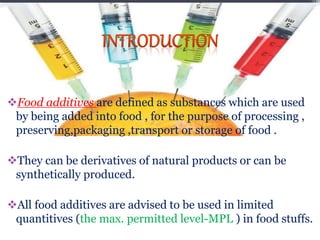
Food additives are defined as substances which are used
by being added into food , for the purpose of processing ,
preserving,packaging ,transport or storage of food .
They can be derivatives of natural products or can be
synthetically produced.
All food additives are advised to be used in limited
quantitives (the max. permitted level-MPL ) in food stuffs.
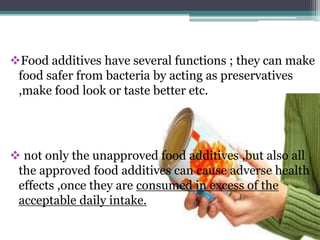
Food additives have several functions ; they can make
food safer from bacteria by acting as preservatives
,make food look or taste better etc.
 not only the unapproved food additives ,but also all
the approved food additives can cause adverse health
effects ,once they are consumed in excess of the
acceptable daily intake.
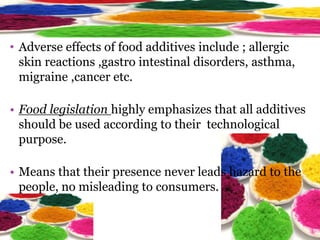
• Adverse effects of food additives include ; allergic
skin reactions ,gastro intestinal disorders, asthma,
migraine ,cancer etc.
• Food legislation highly emphasizes that all additives
should be used according to their technological
purpose.
• Means that their presence never leads hazard to the
people, no misleading to consumers.
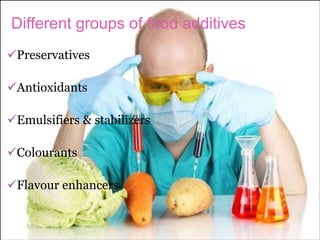
Different groups of food additives
Preservatives
Antioxidants
Emulsifiers & stabilizers
Colourants
Flavour enhancers
Safety evaluation of food
additives…
 saftey evaluation involves examination of the
chemical structure , and chemical characteristics ,of
the additives, it’s impurities and potential breakdown
products in its intended use toxicological data.
These are essential to identify and characterise any
possible health hazards with the additive.
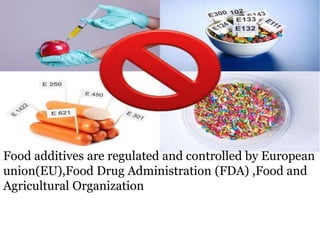
Food additives are regulated and controlled by European
union(EU),Food Drug Administration (FDA) ,Food and
Agricultural Organization
Food additive regulations…
EU on food additives…
• The relevent directives states that food additives are
allowded only if ;
They present no hazard to health at the level
proposed.
They do not mislead the consumer .
They must be re-evaluated whenever necessary in the
light of changing conditions of use and new scientific
observations.
 a total of 297 additives are now approved for use in
food across union(43 colours,12 sweetners,242
miscellaneous additives).
Synthetic colours are allowed at typical
concentrations of o.o1 g/kg to 0.02g/kg.
Levels of natural identical colours are from o.o5 -10
g/kg
Important principle established in food additive
regulation is that food additives should be kept under
continous observation and must be re-evaluated .
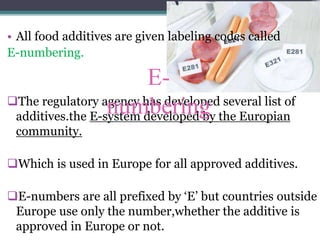
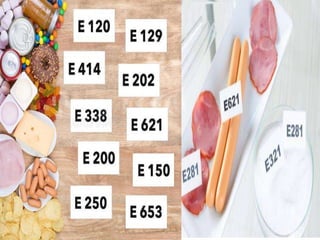
• All food additives are given labeling codes called
E-numbering.
The regulatory agency has developed several list of
additives.the E-system developed by the Europian
community.
Which is used in Europe for all approved additives.
E-numbers are all prefixed by ‘E’ but countries outside
Europe use only the number,whether the additive is
approved in Europe or not.
E-
numbering
EFSA regulation on food additives…
 Following are not considered to be food additives;
Monosaccharides ,disaccharides or
oligosaccharides
Substances used in covering or coating materials
,which do not form a part of food and are not
intended to be consumed together with those food.
Chewing gum bases,ammonium chloride,blood
plasma,edible gelatin,milk protein etc
Specific conditions for sweetners..
• Replacing sugars for the production of energy
reduced food,non carcinogenic food or food with no
added sugars.
• Replacing sugars where this permits an increasing in
the shelf lifeof the food.
Specific conditions for colours..
 Restoring the original appearence of food of which
the colour has been affected by
processing,storage,packaging and distribution.
• The united states Food and Drug Administration lists these
items as Generally Recognized As Safe (GRAS).
United States regulation on food additives..
 U.S definition on food additives
Specifically includes so –called
Indirect additives and excluded
So-called ‘colour additives’.
 the unique of U.S Regulatory frame work
For food additives is the existance of
The GRAS for food additives ,so
Premarket approval requirements
For uses of food ingredients is not needed.
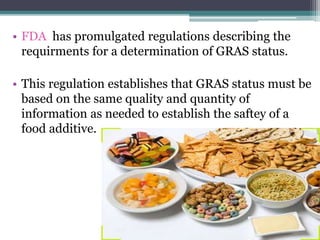
• FDA has promulgated regulations describing the
requirments for a determination of GRAS status.
• This regulation establishes that GRAS status must be
based on the same quality and quantity of
information as needed to establish the saftey of a
food additive.
• The law and regulations of FDA & FAO of food
additives prohibits the use of any additive that
has been found to cause health problems .
• Such as cancer,in humans or animals.
• To market any food additive ,a manufacture
must first petition the FAO for it’s approval.
• The saftey evaluation short and long term effects
are the main criteria for approval food additives.
• Some food additives like boric acid ,citric acid
,sodium metabisulphite have potential risk for
human health.
• Boric acid was widely used as a food preservative
from 1870 to 1920s , but was banned after worldwar
second due to its toxicity.
• Federal food, drug, cosmeticts Act of 1938 stating
that no carcinogenic substances may be used as food
additives.
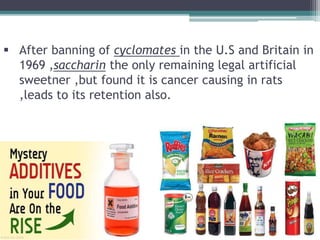
 After banning of cyclomates in the U.S and Britain in
1969 ,saccharin the only remaining legal artificial
sweetner ,but found it is cancer causing in rats
,leads to its retention also.
Positive and negative lists of food
additives..
• Categorized in two systems according to the
regulation; positive list system and negative list
system.
• Positive list- toxicologicallly cleared.
Negative list- prohibited to use either absolutely
,max.content or with certain conditions ,according to
their effects to the people.
 Additives which do not have any adverse effect after
consumption are being listed under the positive list.
• Food additives which does adverse health effect for
human consumption are listed under the negative list
and should not be marketed.
• Approval and tolerence level should be established
on product base.
Thank you…

food additive regulations

  • 1.
  • 2.
    Food additives aredefined as substances which are used by being added into food , for the purpose of processing , preserving,packaging ,transport or storage of food . They can be derivatives of natural products or can be synthetically produced. All food additives are advised to be used in limited quantitives (the max. permitted level-MPL ) in food stuffs.
  • 3.
    Food additives haveseveral functions ; they can make food safer from bacteria by acting as preservatives ,make food look or taste better etc.  not only the unapproved food additives ,but also all the approved food additives can cause adverse health effects ,once they are consumed in excess of the acceptable daily intake.
  • 4.
    • Adverse effectsof food additives include ; allergic skin reactions ,gastro intestinal disorders, asthma, migraine ,cancer etc. • Food legislation highly emphasizes that all additives should be used according to their technological purpose. • Means that their presence never leads hazard to the people, no misleading to consumers.
  • 5.
    Different groups offood additives Preservatives Antioxidants Emulsifiers & stabilizers Colourants Flavour enhancers
  • 6.
    Safety evaluation offood additives…  saftey evaluation involves examination of the chemical structure , and chemical characteristics ,of the additives, it’s impurities and potential breakdown products in its intended use toxicological data. These are essential to identify and characterise any possible health hazards with the additive.
  • 7.
    Food additives areregulated and controlled by European union(EU),Food Drug Administration (FDA) ,Food and Agricultural Organization
  • 8.
    Food additive regulations… EUon food additives… • The relevent directives states that food additives are allowded only if ; They present no hazard to health at the level proposed. They do not mislead the consumer . They must be re-evaluated whenever necessary in the light of changing conditions of use and new scientific observations.
  • 9.
     a totalof 297 additives are now approved for use in food across union(43 colours,12 sweetners,242 miscellaneous additives). Synthetic colours are allowed at typical concentrations of o.o1 g/kg to 0.02g/kg. Levels of natural identical colours are from o.o5 -10 g/kg Important principle established in food additive regulation is that food additives should be kept under continous observation and must be re-evaluated .
  • 10.
    • All foodadditives are given labeling codes called E-numbering. The regulatory agency has developed several list of additives.the E-system developed by the Europian community. Which is used in Europe for all approved additives. E-numbers are all prefixed by ‘E’ but countries outside Europe use only the number,whether the additive is approved in Europe or not. E- numbering
  • 12.
    EFSA regulation onfood additives…  Following are not considered to be food additives; Monosaccharides ,disaccharides or oligosaccharides Substances used in covering or coating materials ,which do not form a part of food and are not intended to be consumed together with those food. Chewing gum bases,ammonium chloride,blood plasma,edible gelatin,milk protein etc
  • 13.
    Specific conditions forsweetners.. • Replacing sugars for the production of energy reduced food,non carcinogenic food or food with no added sugars. • Replacing sugars where this permits an increasing in the shelf lifeof the food. Specific conditions for colours..  Restoring the original appearence of food of which the colour has been affected by processing,storage,packaging and distribution.
  • 14.
    • The unitedstates Food and Drug Administration lists these items as Generally Recognized As Safe (GRAS). United States regulation on food additives..  U.S definition on food additives Specifically includes so –called Indirect additives and excluded So-called ‘colour additives’.  the unique of U.S Regulatory frame work For food additives is the existance of The GRAS for food additives ,so Premarket approval requirements For uses of food ingredients is not needed.
  • 15.
    • FDA haspromulgated regulations describing the requirments for a determination of GRAS status. • This regulation establishes that GRAS status must be based on the same quality and quantity of information as needed to establish the saftey of a food additive.
  • 16.
    • The lawand regulations of FDA & FAO of food additives prohibits the use of any additive that has been found to cause health problems . • Such as cancer,in humans or animals. • To market any food additive ,a manufacture must first petition the FAO for it’s approval. • The saftey evaluation short and long term effects are the main criteria for approval food additives.
  • 17.
    • Some foodadditives like boric acid ,citric acid ,sodium metabisulphite have potential risk for human health. • Boric acid was widely used as a food preservative from 1870 to 1920s , but was banned after worldwar second due to its toxicity. • Federal food, drug, cosmeticts Act of 1938 stating that no carcinogenic substances may be used as food additives.
  • 18.
     After banningof cyclomates in the U.S and Britain in 1969 ,saccharin the only remaining legal artificial sweetner ,but found it is cancer causing in rats ,leads to its retention also.
  • 19.
    Positive and negativelists of food additives.. • Categorized in two systems according to the regulation; positive list system and negative list system. • Positive list- toxicologicallly cleared. Negative list- prohibited to use either absolutely ,max.content or with certain conditions ,according to their effects to the people.  Additives which do not have any adverse effect after consumption are being listed under the positive list.
  • 20.
    • Food additiveswhich does adverse health effect for human consumption are listed under the negative list and should not be marketed. • Approval and tolerence level should be established on product base.
  • 24.