Food Additives
Food additives are substances which are added to food which either improve the
flavor, texture, colour or chemical preservatives, taste, appearance or function
as processing aid.
They are various chemical substances added to foods to producespecific
desirable effects. Additives such as salt, spices, and sulfites have been used
since ancient times to preserve foods and make them more palatable. With the
increased processing of foods in the 20th century, there came a need for both the
greater use of and new types of food additives. Many modern products, suchas
low-calorie, snack, and ready-to-eat convenience foods, would not be possible
without food additives.
Needfor FoodAdditives
1. Additives provide protection against food spoilage during storage
transportation, distribution or processing.
2. Additives are used to colour foods, add flavor, impart firmness, and retard
or hasten chemical reaction in food.
3. Now a days, chemical additives can be manufactured so that foods can be
“fortified” or “enriched”. Potassium iodide, for instance, added to
common salt can eliminate goiter,
4. Foods,particularly, Fats or oily foods with high moisture contents
become rancid, when exposed to humid air. The conversation of the
quality of foods against agents causing such deterioration of food requires
the addition of preservatives.
5. The use of food additives is to maintain the nutritional quality of food, to
enhance stability with resulting reduction in waste, to make food more
attractive, and to provide efficient aids in processing, packaging and
transport.
FoodAdditives: Directand Indirect
A broad definition of “food additive” is any substancethe intended use of which
results, directly or indirectly, in it’s becoming a component of or otherwise
affecting the characteristic of any food, and which is safe under the condition of
its use.
 Direct Food Additives are those substances that are added directly to food
for human consumption. Such substances include food preservatives such
as BHT (butylated hydroxy toulene) and flavouring agents.
 Indirect Food Additives are substances used as component of articles that
come into contactof food, and most commonly include the substances
used in food packaging.
TYPES OF ADDITIVES:
• Natural FoodAdditives
In General, these food additives are found naturally such as extracts from
beetroot juice used as a colouring agent.
• Man-made FoodAdditives
They are actually synthetic identical copies of substances found naturally
such as benzoic acid which is used as a preservative.
• Artificial FoodAdditives
Artificial food additives are produced synthetically such as Nisin, used as
preservative in some dairy products.
Over 3,000 different chemical compounds are used as food additives.
They are categorized into different groups. A few types of additives are
indicated below.
 Anti-caking Agents
 Anti-oxidants
 Anti-oxidants
 Chelating Agents
 Colouring Agents
 Curing Agents
 Emulsifiers
 Flavours and Flavour Enhancers
 Flour Improvers
 Humectants
 Leavening Agents
 Non-nutritive Sweeteners
 Nutrient Supplements
 pH Control Agents
 Preservatives
 Stabilizers and Thickeners
 Other Additives (that includes Clarifying agents like bentonite, gelatins,
synthetic resins (polyamides and poly vinyl pyrrolidone) are used to
remove haziness or sediments and oxidative deterioration products in
fruit juices, beers and wines)
 Agricultural Contaminants Chemicals in the form of insecticides, fungicides,
herbicides (in general biocides), growth promoting substances, and pollutants etc.,
 Animal Food Additives such as synthetic female hormone, diethylstilbesteril
(DES),
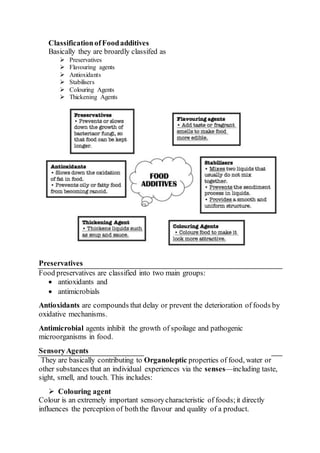
ClassificationofFoodadditives
Basically they are broardly classifed as
 Preservatives
 Flavouring agents
 Antioxidants
 Stabilisers
 Colouring Agents
 Thickening Agents
Preservatives
Food preservatives are classified into two main groups:
 antioxidants and
 antimicrobials
Antioxidants are compounds that delay or prevent the deterioration of foods by
oxidative mechanisms.
Antimicrobial agents inhibit the growth of spoilage and pathogenic
microorganisms in food.
SensoryAgents
They are basically contributing to Organoleptic properties of food, water or
other substances that an individual experiences via the senses—including taste,
sight, smell, and touch. This includes:
 Colouring agent
Colour is an extremely important sensorycharacteristic of foods;it directly
influences the perception of boththe flavour and quality of a product.
The processingof food can cause degradation or loss of natural pigments in the
raw materials. Colouring agent (or Colorants) are necessary to producea
uniform productfrom raw materials that vary in colour intensity. Colorants
used as food additives are classified as natural or synthetic.
Most natural colorants are extracts derived from plant tissues. The use of these
extracts in the food industry has certain problems associated with it, including
the lack of consistent colour intensities, instability upon exposure to light and
heat, variability of supply, reactivity with other food components, and addition
of secondary flavours and odours. In addition, many are insoluble in water and
therefore must be added with an emulsifier in order to achieve an even
distribution throughout the food product.
Synthetic colorants are water-soluble and are available commercially as
powders, pastes, granules, or solutions. Special preparations called lakes are
formulated by treating the colorants with aluminum hydroxide. They contain
approximately 10 to 40 percent of the synthetic dye and are
insoluble in water and organic solvents.
Flavouring agents
The flavour of food results from the stimulation of the chemical senses of taste
and smell by specific food molecules.
In addition to the four basic tastes(sweet, salty, bitter, and sour), the flavouring
molecules, or flavourings in food stimulate specific olfactory (smell) cells in the
nasal cavity. These cells can detect more than 10,000 different stimuli, thus
fine-tuning the flavour sensation of a food.
Natural flavourings are derived or extracted from plants, spices, herbs, animals,
or microbial fermentations. Artificial flavourings are mixtures of synthetic
compounds that may be chemically identical to natural flavourings.
Artificial flavourings are often used in food products becauseof the high cost,
lack ofavailability, or insufficient potencyof natural flavourings.
Stabilisers
Stabilisers/Emulsifiers are a group of substances used to obtain a stable mixture
of liquids that otherwise would not or would separate quickly. They stabilize
gas-in-liquid and gas –in-solid mixtures.
Thickening agents
These compounds function to improve the texture of foods, inhibit
crystallization (sugar, ice), stabilize emulsions and foams, reduce the stickiness
of icings on baked products, and encapsulate flavours. Substances used as
thickeners are polysaccharides, such as gum Arabic, guar gum, carrageenan,
agar-agar, alginic acids, starch and its derivatives, carboxymethylcellulose and
pectin.
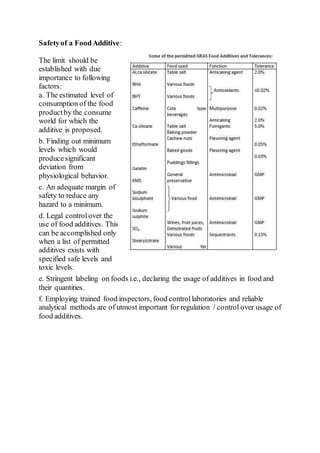
Safetyof a FoodAdditive:
The limit should be
established with due
importance to following
factors:
a. The estimated level of
consumption of the food
productby the consume
world for which the
additive is proposed.
b. Finding out minimum
levels which would
producesignificant
deviation from
physiological behavior.
c. An adequate margin of
safety to reduce any
hazard to a minimum.
d. Legal controlover the
use of food additives. This
can be accomplished only
when a list of permitted
additives exists with
specified safe levels and
toxic levels.
e. Stringent labeling on foods i.e., declaring the usage of additives in food and
their quantities.
f. Employing trained food inspectors, food controllaboratories and reliable
analytical methods are of utmost important for regulation / control over usage of
food additives.
References:
1. Chaudhary Narendra Kumar, Food Additives (04 May 2015)
https://www.researchgate.net/publication/275828599
2. Dr. Sunitha J., Lecture Notes, Food Additives , Acharya N. G. Ranga
Agricultural University
3. Goldberg Israel, Williams Richard; Relative aspects of Biotechnology-
Produced Ingredients, Biotechnology and Food Ingredients, Van
Nostrand Reinhold, New York ISBN 0-442-00272-6
4. Jyoti Divya, Food Additives, Food Biotechnology
5. P. Fellows, Food Processing Technology: Principles and Practices (1988)

Food additives

  • 1.
    Food Additives Food additivesare substances which are added to food which either improve the flavor, texture, colour or chemical preservatives, taste, appearance or function as processing aid. They are various chemical substances added to foods to producespecific desirable effects. Additives such as salt, spices, and sulfites have been used since ancient times to preserve foods and make them more palatable. With the increased processing of foods in the 20th century, there came a need for both the greater use of and new types of food additives. Many modern products, suchas low-calorie, snack, and ready-to-eat convenience foods, would not be possible without food additives. Needfor FoodAdditives 1. Additives provide protection against food spoilage during storage transportation, distribution or processing. 2. Additives are used to colour foods, add flavor, impart firmness, and retard or hasten chemical reaction in food. 3. Now a days, chemical additives can be manufactured so that foods can be “fortified” or “enriched”. Potassium iodide, for instance, added to common salt can eliminate goiter, 4. Foods,particularly, Fats or oily foods with high moisture contents become rancid, when exposed to humid air. The conversation of the quality of foods against agents causing such deterioration of food requires the addition of preservatives. 5. The use of food additives is to maintain the nutritional quality of food, to enhance stability with resulting reduction in waste, to make food more attractive, and to provide efficient aids in processing, packaging and transport. FoodAdditives: Directand Indirect A broad definition of “food additive” is any substancethe intended use of which results, directly or indirectly, in it’s becoming a component of or otherwise affecting the characteristic of any food, and which is safe under the condition of its use.  Direct Food Additives are those substances that are added directly to food for human consumption. Such substances include food preservatives such as BHT (butylated hydroxy toulene) and flavouring agents.  Indirect Food Additives are substances used as component of articles that come into contactof food, and most commonly include the substances used in food packaging.
  • 2.
    TYPES OF ADDITIVES: •Natural FoodAdditives In General, these food additives are found naturally such as extracts from beetroot juice used as a colouring agent. • Man-made FoodAdditives They are actually synthetic identical copies of substances found naturally such as benzoic acid which is used as a preservative. • Artificial FoodAdditives Artificial food additives are produced synthetically such as Nisin, used as preservative in some dairy products. Over 3,000 different chemical compounds are used as food additives. They are categorized into different groups. A few types of additives are indicated below.  Anti-caking Agents  Anti-oxidants  Anti-oxidants  Chelating Agents  Colouring Agents  Curing Agents  Emulsifiers  Flavours and Flavour Enhancers  Flour Improvers  Humectants  Leavening Agents  Non-nutritive Sweeteners  Nutrient Supplements  pH Control Agents  Preservatives  Stabilizers and Thickeners  Other Additives (that includes Clarifying agents like bentonite, gelatins, synthetic resins (polyamides and poly vinyl pyrrolidone) are used to remove haziness or sediments and oxidative deterioration products in fruit juices, beers and wines)  Agricultural Contaminants Chemicals in the form of insecticides, fungicides, herbicides (in general biocides), growth promoting substances, and pollutants etc.,  Animal Food Additives such as synthetic female hormone, diethylstilbesteril (DES),
  • 3.
    ClassificationofFoodadditives Basically they arebroardly classifed as  Preservatives  Flavouring agents  Antioxidants  Stabilisers  Colouring Agents  Thickening Agents Preservatives Food preservatives are classified into two main groups:  antioxidants and  antimicrobials Antioxidants are compounds that delay or prevent the deterioration of foods by oxidative mechanisms. Antimicrobial agents inhibit the growth of spoilage and pathogenic microorganisms in food. SensoryAgents They are basically contributing to Organoleptic properties of food, water or other substances that an individual experiences via the senses—including taste, sight, smell, and touch. This includes:  Colouring agent Colour is an extremely important sensorycharacteristic of foods;it directly influences the perception of boththe flavour and quality of a product.
  • 4.
    The processingof foodcan cause degradation or loss of natural pigments in the raw materials. Colouring agent (or Colorants) are necessary to producea uniform productfrom raw materials that vary in colour intensity. Colorants used as food additives are classified as natural or synthetic. Most natural colorants are extracts derived from plant tissues. The use of these extracts in the food industry has certain problems associated with it, including the lack of consistent colour intensities, instability upon exposure to light and heat, variability of supply, reactivity with other food components, and addition of secondary flavours and odours. In addition, many are insoluble in water and therefore must be added with an emulsifier in order to achieve an even distribution throughout the food product. Synthetic colorants are water-soluble and are available commercially as powders, pastes, granules, or solutions. Special preparations called lakes are formulated by treating the colorants with aluminum hydroxide. They contain approximately 10 to 40 percent of the synthetic dye and are insoluble in water and organic solvents. Flavouring agents The flavour of food results from the stimulation of the chemical senses of taste and smell by specific food molecules. In addition to the four basic tastes(sweet, salty, bitter, and sour), the flavouring molecules, or flavourings in food stimulate specific olfactory (smell) cells in the nasal cavity. These cells can detect more than 10,000 different stimuli, thus fine-tuning the flavour sensation of a food. Natural flavourings are derived or extracted from plants, spices, herbs, animals, or microbial fermentations. Artificial flavourings are mixtures of synthetic compounds that may be chemically identical to natural flavourings. Artificial flavourings are often used in food products becauseof the high cost, lack ofavailability, or insufficient potencyof natural flavourings. Stabilisers Stabilisers/Emulsifiers are a group of substances used to obtain a stable mixture of liquids that otherwise would not or would separate quickly. They stabilize gas-in-liquid and gas –in-solid mixtures. Thickening agents These compounds function to improve the texture of foods, inhibit crystallization (sugar, ice), stabilize emulsions and foams, reduce the stickiness of icings on baked products, and encapsulate flavours. Substances used as thickeners are polysaccharides, such as gum Arabic, guar gum, carrageenan, agar-agar, alginic acids, starch and its derivatives, carboxymethylcellulose and pectin.
  • 5.
    Safetyof a FoodAdditive: Thelimit should be established with due importance to following factors: a. The estimated level of consumption of the food productby the consume world for which the additive is proposed. b. Finding out minimum levels which would producesignificant deviation from physiological behavior. c. An adequate margin of safety to reduce any hazard to a minimum. d. Legal controlover the use of food additives. This can be accomplished only when a list of permitted additives exists with specified safe levels and toxic levels. e. Stringent labeling on foods i.e., declaring the usage of additives in food and their quantities. f. Employing trained food inspectors, food controllaboratories and reliable analytical methods are of utmost important for regulation / control over usage of food additives.
  • 6.
    References: 1. Chaudhary NarendraKumar, Food Additives (04 May 2015) https://www.researchgate.net/publication/275828599 2. Dr. Sunitha J., Lecture Notes, Food Additives , Acharya N. G. Ranga Agricultural University 3. Goldberg Israel, Williams Richard; Relative aspects of Biotechnology- Produced Ingredients, Biotechnology and Food Ingredients, Van Nostrand Reinhold, New York ISBN 0-442-00272-6 4. Jyoti Divya, Food Additives, Food Biotechnology 5. P. Fellows, Food Processing Technology: Principles and Practices (1988)