Financial Analysis
•   Process of identifying
                      y g
•   Financial strengths and weaknesses
•   By establishing relationships
•   Between the items of
•   B/S, P/L and CFS

                      narain@fms.edu
Users of Financial Analysis
•   Trade creditors
•   Lenders
•   Investors
    I    t
•   Management


                      narain@fms.edu
Techniques of Financial
          Statement A l i
          St t     t Analysis
1.   Horizontal Analysis
                     y
2.   Trend Analysis
3.
3    Vertical Analysis
4.   Ratio Analysis


                     narain@fms.edu
Nature of Ratio Analysis
• A financial ratio is a relationship between
                                    p
  two accounting numbers.
• Ratios help to make a qualitative judgement
  about the firm’s financial performance.


                   narain@fms.edu
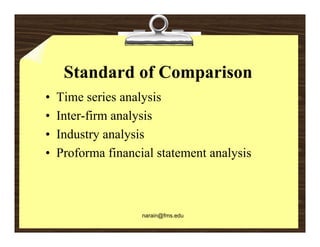
Standard of Comparison
•   Time series analysis
•   Inter-firm analysis
•   Industry analysis
            y    y
•   Proforma financial statement analysis


                    narain@fms.edu
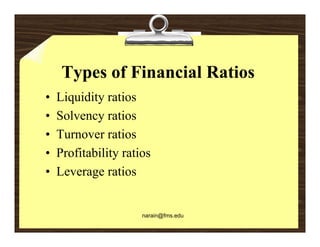
Types of Financial Ratios
•   Liquidity ratios
•   Solvency ratios
•   Turnover ratios
•   Profitability ratios
•   Leverage ratios


                      narain@fms.edu
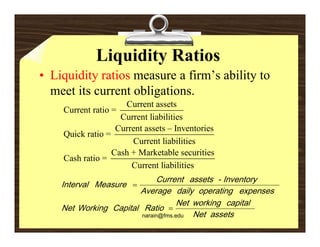
Liquidity Ratios
• Liquidity ratios measure a firm’s ability to
                             firm s
  meet its current obligations.
                     Current assets
    Current ratio =
    C     t ti
                    Current liabilities
                   Current assets – Inventories
    Quick ratio =
                       Current liabilities
                       C       t li biliti
                  Cash + Marketable securities
    Cash ratio =
                       Current liabilities
                                          C u rr e n t a s s e t s - I n v e n t o r y
    I n t e r v al M e a s u r e 
                                   A v e r a g e d a ily o p e r a ti n g e x p e n s e s
                                                   N e t w o r ki n g c a p it a l
    N e t W o r ki n g C a p it a l R a ti o   
                                   narain@fms.edu        N e t a s s e ts
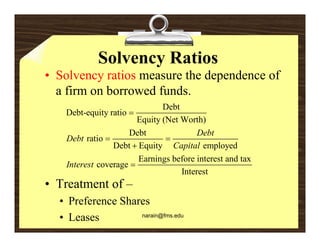
Solvency Ratios
• Solvency ratios measure the dependence of
  a firm on borrowed funds.
                              Debt
   Debt-equity ratio 
                       Equity (Net Worth)
                     Debt               Debt
   Debt ratio                 
                Debt  Equity Capital employed
                       Earnings before interest and tax
   Interest coverage 
                                   Interest
                                   I t    t
• Treatment of –
  • Preference Shares
  • Leases         narain@fms.edu
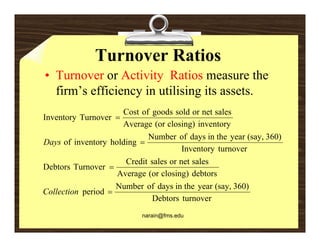
Turnover Ratios
• Turnover or Activity Ratios measure the
  firm’s efficiency in utilising its assets.
                      Cost of goods sold or net sales
Inventory Turnover 
                      Average (or closing) inventory
                             Number of days in the year (say, 360)
       f inventory h ldi 
Days of i          holding
                                        Inventory turnover
                       Credit sales or net sales
Debtors Turnover 
                     Average (or closing) debtors
                    Number of days in the year (say, 360)
Collection period 
                              Debtors turnover
                           narain@fms.edu
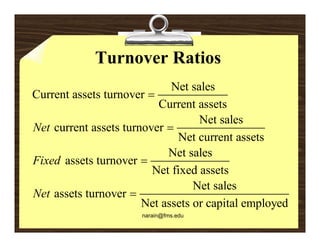
Turnover Ratios
                             Net sales
Current assets turnover 
                           Cu e t
                           Current assets
                                   Net sales
Net current assets turnover 
                               Net current assets
                            Net sales
Fixed assets turnover 
                         Net fixed assets
                                  Net sales
Net assets turnover 
                       Net
                       N t assets or capital employed
                               t        it l    l d
                      narain@fms.edu
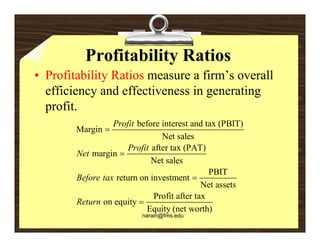
Profitability Ratios
• Profitability Ratios measure a firm’s overall
                                 firm s
  efficiency and effectiveness in generating
  profit.
  profit
                  Profit before interest and tax (PBIT)
        Margin 
                                Net sales
                      Profit after tax (PAT)
        Net margin 
                             Net sales
                                               PBIT
        Before tax return on investment 
                                             Net assets
                              Profit after tax
        Return on equity 
                            Equity (net worth)
                          narain@fms.edu
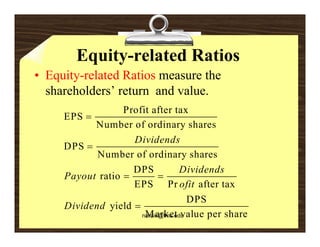
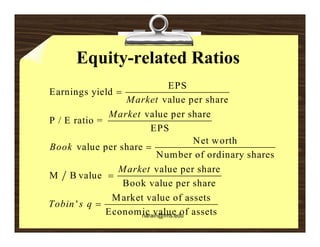
Equity-related Ratios
• Equity-related Ratios measure the
  shareholders’ return and value.
                  Profit ft t
                  P fit after tax
     EPS 
           Number of ordinary shares
                    Dividends
     DPS 
            Number of ordinary shares
                    DPS            Dividends
     Payout ratio          
                    EPS Pr ofit after tax
                                     DPS
     Dividend yield 
                       Market value per share
                      narain@fms.edu
Equity-related Ratios
                                EPS
Earnings yield 
                  M arket value per share
              M arket value per share
P / E ratio =
                          EPS
                                      Net
                                      N t worth
                                             th
Book value per share 
                             Number of ordinary shares
                M arket value per share
M B value 
                 Book value per share
               M ar ket value of assets
T bi ' s q 
Tobin
              Economic value of assets
                       narain@fms.edu
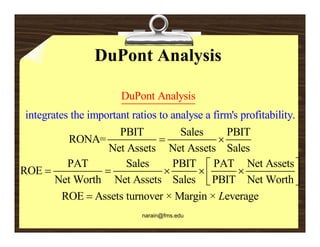
DuPont Analysis

                       DuPont Analysis
integrates the important ratios to analyse a firm's profitability.
                  PBIT          Sales     PBIT
        RONA=                          
                Net Assets Net Assets Sales
        PAT         Sales     PBIT  PAT Net Assets 
ROE                                    
      Net Worth Net Assets Sales  PBIT Net Worth  
       ROE  Assets turnover × Margin × Leverage
                                   g          g
                            narain@fms.edu
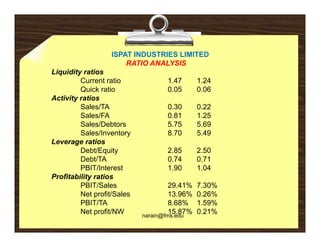
ISPAT INDUSTRIES LIMITED
                      RATIO ANALYSIS
Liquidity ratios
         Current ratio             1.47       1.24
         Quick ratio               0.05       0.06
Activity ratios
         Sales/TA                  0.30
                                   0 30       0.22
                                              0 22
         Sales/FA                  0.81       1.25
         Sales/Debtors             5.75       5.69
         Sales/Inventory           8.70       5.49
Leverage ratios
L             i
         Debt/Equity               2.85       2.50
         Debt/TA                   0.74       0.71
         PBIT/Interest             1.90       1.04
Profitability ratios
         PBIT/Sales                  29.41%   7.30%
         Net profit/Sales            13.96%   0.26%
         PBIT/TA                     8.68%
                                     8 68%    1.59%
                                              1 59%
         Net profit/NW               15.87%
                            narain@fms.edu
                                              0.21%
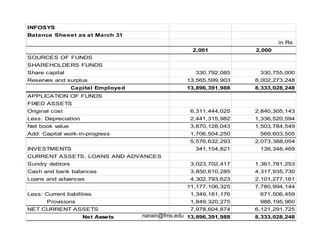
INFOSYS
Balance Sheeet as at March 31
                                                                            in Rs.
                                                    2,001           2,000
SOURCES OF FUNDS
SHAREHOLDERS FUNDS
Share capital                                        330,792,085     330,755,000
Reserves and surplus                              13,565,599,903    8,002,273,248
                 Capital Employed                 13,896,391,988    8,333,028,248
APPLICATION OF FUNDS
FIXED ASSETS
Original cost                                      6,311,444,025    2,840,305,143
Less: Depreciation                                 2,441,315,982    1,336,520,594
Net book value                                     3,870,128,043    1,503,784,549
Add: Capital work-in-progress                      1,706,504,250     569,603,505
                                                   5,576,632,293    2,073,388,054
INVESTMENTS                                          341,154,821     138,348,469
CURRENT ASSETS, LOANS AND ADVANCES
Sundry debtors                                     3,023,702,417    1,361,781,253
Cash
C h and b k b l
      d bank balances                              3,850,610,285
                                                   3 850 610 285    4,317,935,730
                                                                    4 317 935 730
Loans and advances                                 4,302,793,623    2,101,277,161
                                                  11,177,106,325    7,780,994,144
Less: Current liabilities                          1,349,181,176     671,506,459
       Provisions                                  1,849,320,275
                                                   1 849 320 275     988,195,960
                                                                     988 195 960
NET CURRENT ASSETS                                 7,978,604,874    6,121,291,725
                     Net Assets     narain@fms.edu 13,896,391,988   8,333,028,248
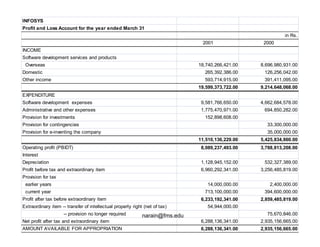
INFOSYS
Profit and Loss Account for the year ended March 31
                                                                                                            in Rs.
                                                                               2001                2000
INCOME
Software development services and products
 Overseas                                                                     18,740,266,421.00   8,696,980,931.00
Domestic                                                                        265,392,386.00     126,256,042.00
Other income                                                                    593,714,915.00     391,411,095.00
                                                                              19,599,373,722.00   9,214,648,068.00
EXPENDITURE
Software development expenses                                                  9,581,766,650.00   4,662,684,578.00
Administrative and other expenses                                              1,775,470,971.00    694,850,282.00
Provision for investments                                                       152,898,608.00
Provision for contingencies                                                                         33,300,000.00
Provision for e-inventing the company                                                               35,000,000.00
                                                                              11,510,136,229.00
                                                                              11 510 136 229 00   5,425,834,860.00
                                                                                                  5 425 834 860 00
Operating profit (PBIDT)                                                       8,089,237,493.00   3,788,813,208.00
Interest
Depreciation                                                                   1,128,945,152.00    532,327,389.00
Profit before tax and extraordinary item                                       6,960,292,341.00
                                                                               6 960 292 341 00   3,256,485,819.00
                                                                                                  3 256 485 819 00
Provision for tax
 earlier years                                                                   14,000,000.00        2,400,000.00
 current year                                                                   713,100,000.00     394,600,000.00
Profit after tax before extraordinary item
                                    y                                          6,233,192,341.00
                                                                                ,   ,   ,         2,859,485,819.00
                                                                                                   ,   ,   ,
Extraordinary item -- transfer of intellectual property right (net of tax)       54,944,000.00
                     -- provision no longer required         narain@fms.edu                         75,670,846.00
Net profit after tax and extraordinary item                                    6,288,136,341.00   2,935,156,665.00
AMOUNT AVAILABLE FOR APPROPRIATION                                             6,288,136,341.00   2,935,156,665.00
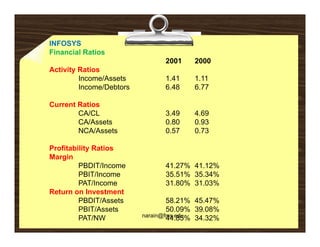
INFOSYS
Financial Ratios
                                2001    2000
Activity Ratios
         Income/Assets
         I      /A  t           1.41
                                1 41    1.11
                                        1 11
         Income/Debtors         6.48    6.77

Current Ratios
        CA/CL                   3.49    4.69
        CA/Assets               0.80    0.93
        NCA/Assets              0.57    0.73

Profitability Ratios
Margin
         PBDIT/Income           41.27% 41.12%
         PBIT/Income            35.51% 35.34%
         PAT/Income             31.80% 31.03%
Return on Investment
         PBDIT/Assets             58.21% 45.47%
                                  58 21% 45 47%
         PBIT/Assets              50.09% 39.08%
                          narain@fms.edu
         PAT/NW                   44.85% 34.32%
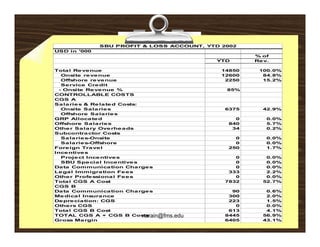
SBU PROFIT & LOSS ACCOUNT, YTD 2002
                                  ACCOUNT
USD in '000
                                                          % of
                                                 YTD      Re v.

Tota l Re ve nue                                  14850    100.0%
  Onsite re ve nue                                12600     84.8%
  Offshore re ve nue                               2250     15.2%
  Se rvice Cre dit
 - Onsite Re ve nue %                              85%
CONTROLLABLE COSTS
CGS A
Sa la rie s & Re la te d Costs:
  Onsite Sa la rie s
  O     it  S l   i                               6375      42.9%
                                                            42 9%
  Offshore Sa la rie s
GRP Alloca te d                                      0        0.0%
Offshore Sa la rie s                               840        5.7%
Othe r Sa la ry Ove rhe a ds                        34        0.2%
Subcontra ctor Costs
  Sa la rie s-Onsite
            s Onsite                                 0        0.0%
  Sa la rie s-Offshore                               0        0.0%
Fore ign Tra ve l                                  250        1.7%
Ince ntive s
  Proje ct Ince ntive s                              0       0.0%
  SBU Spe cia l Ince ntive s                         0       0.0%
Da ta Communica tion Cha rge s                       0       0.0%
Le ga l Immigra tion Fe e s                        333       2.2%
Othe r Profe ssiona l Fe e s                         0       0.0%
Tota l CGS A Cost                                 7832      52.7%
CGS B
Da ta Communica tion Cha rge s                      90       0.6%
Me dica l Insura nce                               300       2.0%
De pre cia tion: CGS                               223       1.5%
                                                             1 5%
Othe rs CGS                                          0       0.0%
Tota l CGS B Cost                                  613       4.1%
TOTAL CGS A + CGS B Costs       narain@fms.edu    8445      56.9%
Gross Ma rgin                                     6405      43.1%
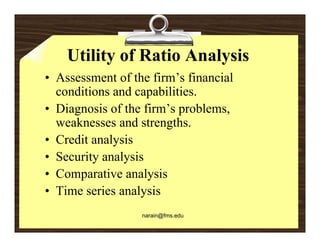
Utility of Ratio Analysis
• Assessment of the firm’s financial
                      firm s
  conditions and capabilities.
• Diagnosis of the firm’s problems
                    firm s problems,
  weaknesses and strengths.
• Credit analysis
• Security analysis
• C
  Comparative analysis
           ti       l i
• Time series analysis
                  narain@fms.edu
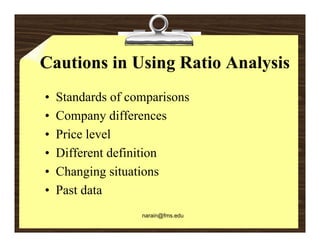
Cautions in Using Ratio Analysis
•   Standards of comparisons
•   Company differences
•   Price level
•   Different definition
•   Changing situations
•   Past data
                   narain@fms.edu

Fma7

  • 1.
    Financial Analysis • Process of identifying y g • Financial strengths and weaknesses • By establishing relationships • Between the items of • B/S, P/L and CFS narain@fms.edu
  • 2.
    Users of FinancialAnalysis • Trade creditors • Lenders • Investors I t • Management narain@fms.edu
  • 3.
    Techniques of Financial Statement A l i St t t Analysis 1. Horizontal Analysis y 2. Trend Analysis 3. 3 Vertical Analysis 4. Ratio Analysis narain@fms.edu
  • 4.
    Nature of RatioAnalysis • A financial ratio is a relationship between p two accounting numbers. • Ratios help to make a qualitative judgement about the firm’s financial performance. narain@fms.edu
  • 5.
    Standard of Comparison • Time series analysis • Inter-firm analysis • Industry analysis y y • Proforma financial statement analysis narain@fms.edu
  • 6.
    Types of FinancialRatios • Liquidity ratios • Solvency ratios • Turnover ratios • Profitability ratios • Leverage ratios narain@fms.edu
  • 7.
    Liquidity Ratios • Liquidityratios measure a firm’s ability to firm s meet its current obligations. Current assets Current ratio = C t ti Current liabilities Current assets – Inventories Quick ratio = Current liabilities C t li biliti Cash + Marketable securities Cash ratio = Current liabilities C u rr e n t a s s e t s - I n v e n t o r y I n t e r v al M e a s u r e  A v e r a g e d a ily o p e r a ti n g e x p e n s e s N e t w o r ki n g c a p it a l N e t W o r ki n g C a p it a l R a ti o  narain@fms.edu N e t a s s e ts
  • 8.
    Solvency Ratios • Solvencyratios measure the dependence of a firm on borrowed funds. Debt Debt-equity ratio  Equity (Net Worth) Debt Debt Debt ratio   Debt  Equity Capital employed Earnings before interest and tax Interest coverage  Interest I t t • Treatment of – • Preference Shares • Leases narain@fms.edu
  • 9.
    Turnover Ratios • Turnoveror Activity Ratios measure the firm’s efficiency in utilising its assets. Cost of goods sold or net sales Inventory Turnover  Average (or closing) inventory Number of days in the year (say, 360) f inventory h ldi  Days of i holding Inventory turnover Credit sales or net sales Debtors Turnover  Average (or closing) debtors Number of days in the year (say, 360) Collection period  Debtors turnover narain@fms.edu
  • 10.
    Turnover Ratios Net sales Current assets turnover  Cu e t Current assets Net sales Net current assets turnover  Net current assets Net sales Fixed assets turnover  Net fixed assets Net sales Net assets turnover  Net N t assets or capital employed t it l l d narain@fms.edu
  • 11.
    Profitability Ratios • ProfitabilityRatios measure a firm’s overall firm s efficiency and effectiveness in generating profit. profit Profit before interest and tax (PBIT) Margin  Net sales Profit after tax (PAT) Net margin  Net sales PBIT Before tax return on investment  Net assets Profit after tax Return on equity  Equity (net worth) narain@fms.edu
  • 12.
    Equity-related Ratios • Equity-relatedRatios measure the shareholders’ return and value. Profit ft t P fit after tax EPS  Number of ordinary shares Dividends DPS  Number of ordinary shares DPS Dividends Payout ratio   EPS Pr ofit after tax DPS Dividend yield  Market value per share narain@fms.edu
  • 13.
    Equity-related Ratios EPS Earnings yield  M arket value per share M arket value per share P / E ratio = EPS Net N t worth th Book value per share  Number of ordinary shares M arket value per share M B value  Book value per share M ar ket value of assets T bi ' s q  Tobin Economic value of assets narain@fms.edu
  • 14.
    DuPont Analysis DuPont Analysis integrates the important ratios to analyse a firm's profitability. PBIT Sales PBIT RONA=   Net Assets Net Assets Sales PAT Sales PBIT  PAT Net Assets  ROE      Net Worth Net Assets Sales  PBIT Net Worth   ROE  Assets turnover × Margin × Leverage g g narain@fms.edu
  • 15.
    ISPAT INDUSTRIES LIMITED RATIO ANALYSIS Liquidity ratios Current ratio 1.47 1.24 Quick ratio 0.05 0.06 Activity ratios Sales/TA 0.30 0 30 0.22 0 22 Sales/FA 0.81 1.25 Sales/Debtors 5.75 5.69 Sales/Inventory 8.70 5.49 Leverage ratios L i Debt/Equity 2.85 2.50 Debt/TA 0.74 0.71 PBIT/Interest 1.90 1.04 Profitability ratios PBIT/Sales 29.41% 7.30% Net profit/Sales 13.96% 0.26% PBIT/TA 8.68% 8 68% 1.59% 1 59% Net profit/NW 15.87% narain@fms.edu 0.21%
  • 16.
    INFOSYS Balance Sheeet asat March 31 in Rs. 2,001 2,000 SOURCES OF FUNDS SHAREHOLDERS FUNDS Share capital 330,792,085 330,755,000 Reserves and surplus 13,565,599,903 8,002,273,248 Capital Employed 13,896,391,988 8,333,028,248 APPLICATION OF FUNDS FIXED ASSETS Original cost 6,311,444,025 2,840,305,143 Less: Depreciation 2,441,315,982 1,336,520,594 Net book value 3,870,128,043 1,503,784,549 Add: Capital work-in-progress 1,706,504,250 569,603,505 5,576,632,293 2,073,388,054 INVESTMENTS 341,154,821 138,348,469 CURRENT ASSETS, LOANS AND ADVANCES Sundry debtors 3,023,702,417 1,361,781,253 Cash C h and b k b l d bank balances 3,850,610,285 3 850 610 285 4,317,935,730 4 317 935 730 Loans and advances 4,302,793,623 2,101,277,161 11,177,106,325 7,780,994,144 Less: Current liabilities 1,349,181,176 671,506,459 Provisions 1,849,320,275 1 849 320 275 988,195,960 988 195 960 NET CURRENT ASSETS 7,978,604,874 6,121,291,725 Net Assets narain@fms.edu 13,896,391,988 8,333,028,248
  • 17.
    INFOSYS Profit and LossAccount for the year ended March 31 in Rs. 2001 2000 INCOME Software development services and products Overseas 18,740,266,421.00 8,696,980,931.00 Domestic 265,392,386.00 126,256,042.00 Other income 593,714,915.00 391,411,095.00 19,599,373,722.00 9,214,648,068.00 EXPENDITURE Software development expenses 9,581,766,650.00 4,662,684,578.00 Administrative and other expenses 1,775,470,971.00 694,850,282.00 Provision for investments 152,898,608.00 Provision for contingencies 33,300,000.00 Provision for e-inventing the company 35,000,000.00 11,510,136,229.00 11 510 136 229 00 5,425,834,860.00 5 425 834 860 00 Operating profit (PBIDT) 8,089,237,493.00 3,788,813,208.00 Interest Depreciation 1,128,945,152.00 532,327,389.00 Profit before tax and extraordinary item 6,960,292,341.00 6 960 292 341 00 3,256,485,819.00 3 256 485 819 00 Provision for tax earlier years 14,000,000.00 2,400,000.00 current year 713,100,000.00 394,600,000.00 Profit after tax before extraordinary item y 6,233,192,341.00 , , , 2,859,485,819.00 , , , Extraordinary item -- transfer of intellectual property right (net of tax) 54,944,000.00 -- provision no longer required narain@fms.edu 75,670,846.00 Net profit after tax and extraordinary item 6,288,136,341.00 2,935,156,665.00 AMOUNT AVAILABLE FOR APPROPRIATION 6,288,136,341.00 2,935,156,665.00
  • 18.
    INFOSYS Financial Ratios 2001 2000 Activity Ratios Income/Assets I /A t 1.41 1 41 1.11 1 11 Income/Debtors 6.48 6.77 Current Ratios CA/CL 3.49 4.69 CA/Assets 0.80 0.93 NCA/Assets 0.57 0.73 Profitability Ratios Margin PBDIT/Income 41.27% 41.12% PBIT/Income 35.51% 35.34% PAT/Income 31.80% 31.03% Return on Investment PBDIT/Assets 58.21% 45.47% 58 21% 45 47% PBIT/Assets 50.09% 39.08% narain@fms.edu PAT/NW 44.85% 34.32%
  • 19.
    SBU PROFIT &LOSS ACCOUNT, YTD 2002 ACCOUNT USD in '000 % of YTD Re v. Tota l Re ve nue 14850 100.0% Onsite re ve nue 12600 84.8% Offshore re ve nue 2250 15.2% Se rvice Cre dit - Onsite Re ve nue % 85% CONTROLLABLE COSTS CGS A Sa la rie s & Re la te d Costs: Onsite Sa la rie s O it S l i 6375 42.9% 42 9% Offshore Sa la rie s GRP Alloca te d 0 0.0% Offshore Sa la rie s 840 5.7% Othe r Sa la ry Ove rhe a ds 34 0.2% Subcontra ctor Costs Sa la rie s-Onsite s Onsite 0 0.0% Sa la rie s-Offshore 0 0.0% Fore ign Tra ve l 250 1.7% Ince ntive s Proje ct Ince ntive s 0 0.0% SBU Spe cia l Ince ntive s 0 0.0% Da ta Communica tion Cha rge s 0 0.0% Le ga l Immigra tion Fe e s 333 2.2% Othe r Profe ssiona l Fe e s 0 0.0% Tota l CGS A Cost 7832 52.7% CGS B Da ta Communica tion Cha rge s 90 0.6% Me dica l Insura nce 300 2.0% De pre cia tion: CGS 223 1.5% 1 5% Othe rs CGS 0 0.0% Tota l CGS B Cost 613 4.1% TOTAL CGS A + CGS B Costs narain@fms.edu 8445 56.9% Gross Ma rgin 6405 43.1%
  • 20.
    Utility of RatioAnalysis • Assessment of the firm’s financial firm s conditions and capabilities. • Diagnosis of the firm’s problems firm s problems, weaknesses and strengths. • Credit analysis • Security analysis • C Comparative analysis ti l i • Time series analysis narain@fms.edu
  • 21.
    Cautions in UsingRatio Analysis • Standards of comparisons • Company differences • Price level • Different definition • Changing situations • Past data narain@fms.edu