Financial Ratio A study note prepared by: Prof. V. K. Sapovadia B K School of Business Management Gujarat University AHMEDABAD
…. The Analysis of Financial Statements The Use Of Financial Ratios Analyzing Liquidity Analyzing Activity Analyzing Debt Analyzing Profitability A Complete Ratio Analysis
The Analysis of Financial Statements THE USE OF FINANCIAL RATIOS Financial Ratio are used as a relative measure that facilitates the evaluation of efficiency or condition of a particular aspect  of a firm's operations and status Ratio Analysis involves methods of calculating and interpreting  financial ratios in order to assess a firm's performance and status
Financial Ratio Assessment of the firm’s past, present and future financial conditions Done to find firm’s financial strengths and weaknesses Primary Tools: Financial Statements Comparison of financial ratios to past, industry, sector and all firms
Source? Balance Sheet Income Statement Cash flow Statement Statement of Retained Earnings
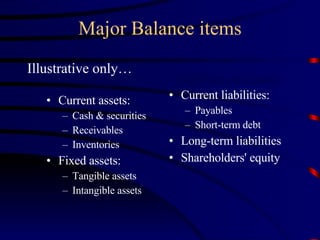
Major Balance items Illustrative only… Assets Current assets: Cash & securities Receivables Inventories Fixed assets: Tangible assets Intangible assets Liabilities and Equity Current liabilities: Payables  Short-term debt Long-term liabilities Shareholders' equity
Objectives Standardize financial information for comparisons Evaluate current operations Compare performance with past performance Compare performance against other firms or industry standards Study the efficiency of operations Study the risk of operations
Rationale..  A firm has resources It converts resources into profits through production of goods and services sales of goods and services Ratios Measure relationships between resources and financial flows Show ways in which firm’s situation deviates from Its own past Other firms The industry All firms-
Financial Ratios represent an attempt to standardize financial information in order to facilitate meaningful comparisons over time (time series) and between firms or firm to industry (cross section). The business is a storehouse of resources (i.e. assets on the balance sheet) which it converts to profit through production and then sales (reported on the income statement).
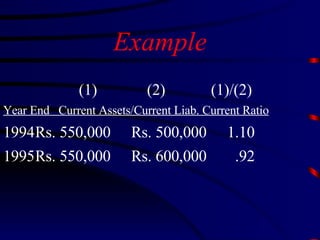
Example (1)   (2)   (1)/(2) Year End  Current Assets/Current Liab. Current Ratio 1994 Rs. 550,000 Rs. 500,000 1.10 1995 Rs. 550,000 Rs. 600,000   .92
Interested Parties Four sets of parties are interested in ratio analysis: Shareholders /Auditor  Creditors Management Government
Types of Ratio Comparisons There are two types of ratio comparisons that can be made: Cross-Sectional Analysis  Time-Series Analysis Combined Analysis uses both types of analysis to assess a  firm's trends versus its competitors or the industry
Words of Caution Regarding Ratio Analysis A single ratio rarely tells enough to make a sound judgment. Financial statements used in ratio analysis must be from similar points in time.  Audited financial statements are more reliable than unaudited statements. The financial data used to compute ratios  must be developed in the same manner.  Inflation can distort comparisons.
Groups of Financial Ratios Liquidity Activity Debt Profitability Valuation  (Assess market price relative to assets or earnings)
Analyzing  Liquidity Liquidity refers to the solvency of the firm's overall financial position, i.e. a "liquid firm" is one that can easily meet its short-term obligations as they come due.  A second meaning includes the concept of converting an asset into cash with little or no loss in value. Measure the ability of a firm to meet its short term financial obligations.
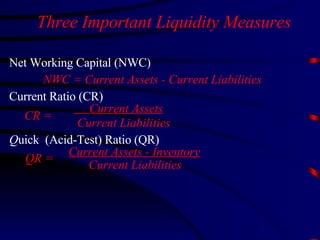
Three Important Liquidity Measures Net Working Capital (NWC) NWC = Current Assets - Current Liabilities Current Ratio (CR) Current Assets CR = Current Liabilities Q uick  (Acid-Test) Ratio (QR) Current Assets - Inventory QR =   Current Liabilities
Analyzing Activity Activity is a more sophisticated analysis of a firm's liquidity, evaluating the speed with which certain accounts are converted into sales or cash; also measures a firm's efficiency
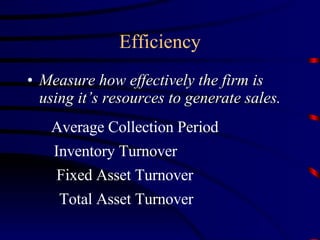
Efficiency Measure how effectively the firm is using it’s resources to generate sales. Average Collection Period Inventory Turnover Fixed Asset Turnover Total Asset Turnover
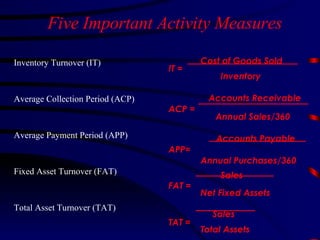
Inventory Turnover (IT) Average Collection Period (ACP) Average Payment Period (APP) Fixed Asset Turnover (FAT) Total Asset Turnover (TAT) Five Important Activity Measures Cost of Goods Sold IT = Inventory Accounts Receivable ACP = Annual Sales/360 Accounts Payable APP=  Annual Purchases/360 Sales  FAT =  Net Fixed Assets Sales TAT =  Total Assets
Analyzing Debt Debt is a true "double-edged" sword as it allows for the generation of profits with the use of other people's (creditors) money, but creates claims on earnings with a higher priority than those of the firm's owners. Financial Leverage is a term used to describe the magnification of risk and return resulting from the use of fixed-cost financing such as debt and preferred stock.
Measures of Debt There are Two General Types of Debt Measures Degree of Indebtedness  Ability to Service Debts
Debt Ratio  (DR) Debt-Equity Ratio  (DER) Times Interest Earned  Ratio (TIE) Fixed Payment Coverage Ratio (FPC) Four Important Debt Measures Total Liabilities DR= Total Assets Long-Term Debt DER= Stockholders’ Equity Earnings Before Interest    & Taxes (EBIT) TIE= Interest Earnings Before Interest & Taxes + Lease Payments FPC=  Interest + Lease Payments +{(Principal Payments + Preferred Stock Dividends) X [1 / (1 -T)]}
Debt vs. Capital? Measure the extent to which non-owner supplied funds have been used to finance the firm’s assets. Debt Ratio Long Term Debt to Total Capitalization Times Interest Earned Cash Flow Overall Coverage
Analyzing Profitability  Profitability Measures assess the firm's ability to operate efficiently and are of concern to owners, creditors, and  management A Common-Size Income Statement, which expresses each  income statement item as a percentage of sales, allows for easy evaluation of the firm’s profitability relative to sales.
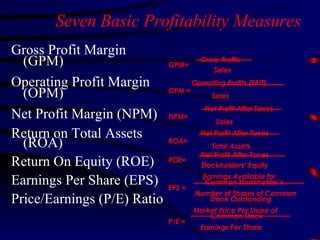
Gross Profit Margin (GPM) Operating Profit Margin (OPM) Net Profit Margin (NPM) Return on Total Assets (ROA) Return On Equity (ROE)  Earnings Per Share (EPS) Price/Earnings (P/E) Ratio Seven Basic Profitability Measures Gross Profits GPM= Sales Operating Profits (EBIT) OPM = Sales Net Profit After Taxes NPM= Sales Net Profit After Taxes ROA=  Total Assets Net Profit After Taxes ROE=  Stockholders’ Equity Earnings Available for  Common Stockholder’s EPS = Number of Shares of Common    Stock Outstanding  Market Price Per Share of  Common Stock P/E = Earnings Per Share
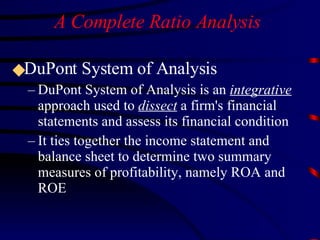
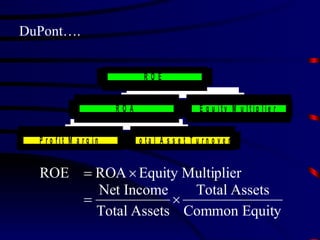
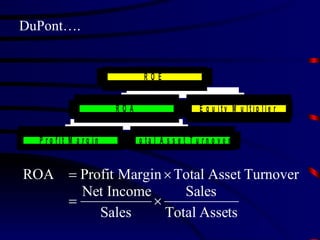
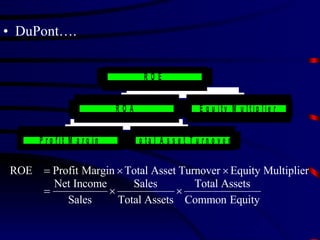
A Complete Ratio Analysis  DuPont System of Analysis DuPont System of Analysis is an  integrative  approach used to  dissect  a firm's financial statements and assess its financial condition It ties together the income statement and balance sheet to determine two summary measures of profitability, namely ROA and ROE
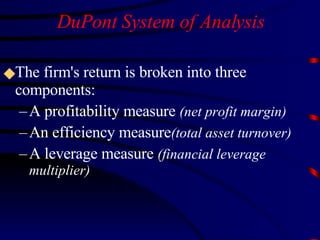
DuPont System of Analysis The firm's return is broken into three components: A profitability measure  (net profit margin) An efficiency measure (total asset turnover) A leverage measure  (financial leverage multiplier)
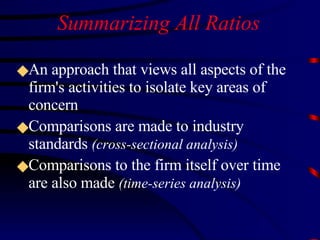
An approach that views all aspects of the firm's activities to isolate key areas of concern  Comparisons are made to industry standards  (cross-sectional analysis) Comparisons to the firm itself over time are also made  (time-series analysis) Summarizing All Ratios
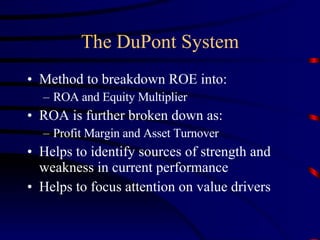
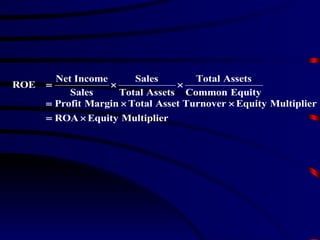
The DuPont System Method to breakdown ROE into: ROA and Equity Multiplier ROA is further broken down as: Profit Margin and Asset Turnover Helps to identify sources of strength and weakness in current performance Helps to focus attention on value drivers
 
DuPont….
DuPont….
DuPont….
 
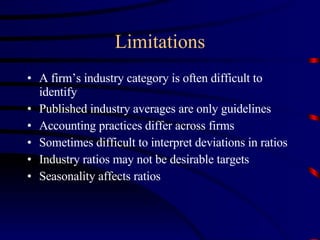
Limitations A firm’s industry category is often difficult to identify Published industry averages are only guidelines Accounting practices differ across firms Sometimes difficult to interpret deviations in ratios Industry ratios may not be desirable targets Seasonality affects ratios
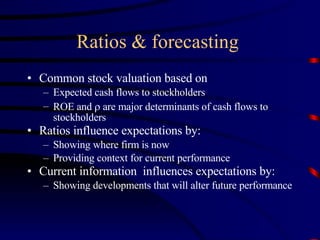
Ratios & forecasting  Common stock valuation based on Expected cash flows to stockholders ROE and    are major determinants of cash flows to stockholders Ratios influence expectations by: Showing where firm is now Providing context for current performance Current information  influences expectations by: Showing developments that will alter future performance
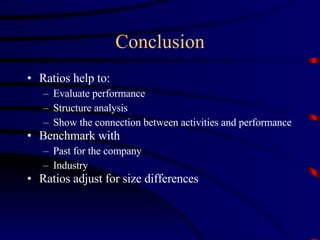
Conclusion Ratios help to: Evaluate performance Structure analysis Show the connection between activities and performance Benchmark with Past for the company Industry Ratios adjust for size differences

gty

  • 1.
    Financial Ratio Astudy note prepared by: Prof. V. K. Sapovadia B K School of Business Management Gujarat University AHMEDABAD
  • 2.
    …. The Analysisof Financial Statements The Use Of Financial Ratios Analyzing Liquidity Analyzing Activity Analyzing Debt Analyzing Profitability A Complete Ratio Analysis
  • 3.
    The Analysis ofFinancial Statements THE USE OF FINANCIAL RATIOS Financial Ratio are used as a relative measure that facilitates the evaluation of efficiency or condition of a particular aspect of a firm's operations and status Ratio Analysis involves methods of calculating and interpreting financial ratios in order to assess a firm's performance and status
  • 4.
    Financial Ratio Assessmentof the firm’s past, present and future financial conditions Done to find firm’s financial strengths and weaknesses Primary Tools: Financial Statements Comparison of financial ratios to past, industry, sector and all firms
  • 5.
    Source? Balance SheetIncome Statement Cash flow Statement Statement of Retained Earnings
  • 6.
    Major Balance itemsIllustrative only… Assets Current assets: Cash & securities Receivables Inventories Fixed assets: Tangible assets Intangible assets Liabilities and Equity Current liabilities: Payables Short-term debt Long-term liabilities Shareholders' equity
  • 7.
    Objectives Standardize financialinformation for comparisons Evaluate current operations Compare performance with past performance Compare performance against other firms or industry standards Study the efficiency of operations Study the risk of operations
  • 8.
    Rationale.. Afirm has resources It converts resources into profits through production of goods and services sales of goods and services Ratios Measure relationships between resources and financial flows Show ways in which firm’s situation deviates from Its own past Other firms The industry All firms-
  • 9.
    Financial Ratios representan attempt to standardize financial information in order to facilitate meaningful comparisons over time (time series) and between firms or firm to industry (cross section). The business is a storehouse of resources (i.e. assets on the balance sheet) which it converts to profit through production and then sales (reported on the income statement).
  • 10.
    Example (1) (2) (1)/(2) Year End Current Assets/Current Liab. Current Ratio 1994 Rs. 550,000 Rs. 500,000 1.10 1995 Rs. 550,000 Rs. 600,000 .92
  • 11.
    Interested Parties Foursets of parties are interested in ratio analysis: Shareholders /Auditor Creditors Management Government
  • 12.
    Types of RatioComparisons There are two types of ratio comparisons that can be made: Cross-Sectional Analysis Time-Series Analysis Combined Analysis uses both types of analysis to assess a firm's trends versus its competitors or the industry
  • 13.
    Words of CautionRegarding Ratio Analysis A single ratio rarely tells enough to make a sound judgment. Financial statements used in ratio analysis must be from similar points in time. Audited financial statements are more reliable than unaudited statements. The financial data used to compute ratios must be developed in the same manner. Inflation can distort comparisons.
  • 14.
    Groups of FinancialRatios Liquidity Activity Debt Profitability Valuation (Assess market price relative to assets or earnings)
  • 15.
    Analyzing LiquidityLiquidity refers to the solvency of the firm's overall financial position, i.e. a "liquid firm" is one that can easily meet its short-term obligations as they come due. A second meaning includes the concept of converting an asset into cash with little or no loss in value. Measure the ability of a firm to meet its short term financial obligations.
  • 16.
    Three Important LiquidityMeasures Net Working Capital (NWC) NWC = Current Assets - Current Liabilities Current Ratio (CR) Current Assets CR = Current Liabilities Q uick (Acid-Test) Ratio (QR) Current Assets - Inventory QR = Current Liabilities
  • 17.
    Analyzing Activity Activityis a more sophisticated analysis of a firm's liquidity, evaluating the speed with which certain accounts are converted into sales or cash; also measures a firm's efficiency
  • 18.
    Efficiency Measure howeffectively the firm is using it’s resources to generate sales. Average Collection Period Inventory Turnover Fixed Asset Turnover Total Asset Turnover
  • 19.
    Inventory Turnover (IT)Average Collection Period (ACP) Average Payment Period (APP) Fixed Asset Turnover (FAT) Total Asset Turnover (TAT) Five Important Activity Measures Cost of Goods Sold IT = Inventory Accounts Receivable ACP = Annual Sales/360 Accounts Payable APP= Annual Purchases/360 Sales FAT = Net Fixed Assets Sales TAT = Total Assets
  • 20.
    Analyzing Debt Debtis a true "double-edged" sword as it allows for the generation of profits with the use of other people's (creditors) money, but creates claims on earnings with a higher priority than those of the firm's owners. Financial Leverage is a term used to describe the magnification of risk and return resulting from the use of fixed-cost financing such as debt and preferred stock.
  • 21.
    Measures of DebtThere are Two General Types of Debt Measures Degree of Indebtedness Ability to Service Debts
  • 22.
    Debt Ratio (DR) Debt-Equity Ratio (DER) Times Interest Earned Ratio (TIE) Fixed Payment Coverage Ratio (FPC) Four Important Debt Measures Total Liabilities DR= Total Assets Long-Term Debt DER= Stockholders’ Equity Earnings Before Interest & Taxes (EBIT) TIE= Interest Earnings Before Interest & Taxes + Lease Payments FPC= Interest + Lease Payments +{(Principal Payments + Preferred Stock Dividends) X [1 / (1 -T)]}
  • 23.
    Debt vs. Capital?Measure the extent to which non-owner supplied funds have been used to finance the firm’s assets. Debt Ratio Long Term Debt to Total Capitalization Times Interest Earned Cash Flow Overall Coverage
  • 24.
    Analyzing Profitability Profitability Measures assess the firm's ability to operate efficiently and are of concern to owners, creditors, and management A Common-Size Income Statement, which expresses each income statement item as a percentage of sales, allows for easy evaluation of the firm’s profitability relative to sales.
  • 25.
    Gross Profit Margin(GPM) Operating Profit Margin (OPM) Net Profit Margin (NPM) Return on Total Assets (ROA) Return On Equity (ROE) Earnings Per Share (EPS) Price/Earnings (P/E) Ratio Seven Basic Profitability Measures Gross Profits GPM= Sales Operating Profits (EBIT) OPM = Sales Net Profit After Taxes NPM= Sales Net Profit After Taxes ROA= Total Assets Net Profit After Taxes ROE= Stockholders’ Equity Earnings Available for Common Stockholder’s EPS = Number of Shares of Common Stock Outstanding Market Price Per Share of Common Stock P/E = Earnings Per Share
  • 26.
    A Complete RatioAnalysis DuPont System of Analysis DuPont System of Analysis is an integrative approach used to dissect a firm's financial statements and assess its financial condition It ties together the income statement and balance sheet to determine two summary measures of profitability, namely ROA and ROE
  • 27.
    DuPont System ofAnalysis The firm's return is broken into three components: A profitability measure (net profit margin) An efficiency measure (total asset turnover) A leverage measure (financial leverage multiplier)
  • 28.
    An approach thatviews all aspects of the firm's activities to isolate key areas of concern Comparisons are made to industry standards (cross-sectional analysis) Comparisons to the firm itself over time are also made (time-series analysis) Summarizing All Ratios
  • 29.
    The DuPont SystemMethod to breakdown ROE into: ROA and Equity Multiplier ROA is further broken down as: Profit Margin and Asset Turnover Helps to identify sources of strength and weakness in current performance Helps to focus attention on value drivers
  • 30.
  • 31.
  • 32.
  • 33.
  • 34.
  • 35.
    Limitations A firm’sindustry category is often difficult to identify Published industry averages are only guidelines Accounting practices differ across firms Sometimes difficult to interpret deviations in ratios Industry ratios may not be desirable targets Seasonality affects ratios
  • 36.
    Ratios & forecasting Common stock valuation based on Expected cash flows to stockholders ROE and  are major determinants of cash flows to stockholders Ratios influence expectations by: Showing where firm is now Providing context for current performance Current information influences expectations by: Showing developments that will alter future performance
  • 37.
    Conclusion Ratios helpto: Evaluate performance Structure analysis Show the connection between activities and performance Benchmark with Past for the company Industry Ratios adjust for size differences