1
◦ Sales Multiple
◦ P/E multiple
◦ Price to Book multiple
◦ Enterprise value to EBIT multiple


                                      2
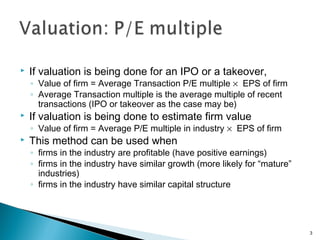
   If valuation is being done for an IPO or a takeover,
    ◦ Value of firm = Average Transaction P/E multiple × EPS of firm
    ◦ Average Transaction multiple is the average multiple of recent
      transactions (IPO or takeover as the case may be)
   If valuation is being done to estimate firm value
    ◦ Value of firm = Average P/E multiple in industry × EPS of firm
   This method can be used when
    ◦ firms in the industry are profitable (have positive earnings)
    ◦ firms in the industry have similar growth (more likely for “mature”
      industries)
    ◦ firms in the industry have similar capital structure


                                                                            3
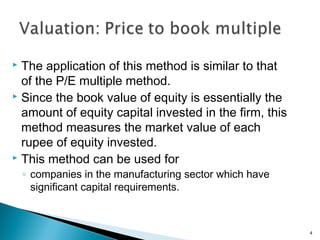
 The application of this method is similar to that
  of the P/E multiple method.
 Since the book value of equity is essentially the

  amount of equity capital invested in the firm, this
  method measures the market value of each
  rupee of equity invested.
 This method can be used for

    ◦ companies in the manufacturing sector which have
      significant capital requirements.


                                                         4
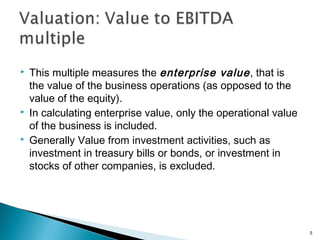
   This multiple measures the enterprise value , that is
    the value of the business operations (as opposed to the
    value of the equity).
   In calculating enterprise value, only the operational value
    of the business is included.
   Generally Value from investment activities, such as
    investment in treasury bills or bonds, or investment in
    stocks of other companies, is excluded.


                                                                  5
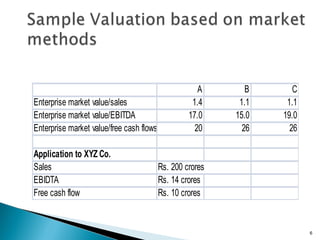
A       B      C
Enterprise market value/sales                       1.4     1.1    1.1
Enterprise market value/EBITDA                     17.0    15.0   19.0
Enterprise market value/free cash flows              20      26     26

Application to XYZ Co.
Sales                                     Rs. 200 crores
EBIDTA                                    Rs. 14 crores
Free cash flow                            Rs. 10 crores


                                                                         6
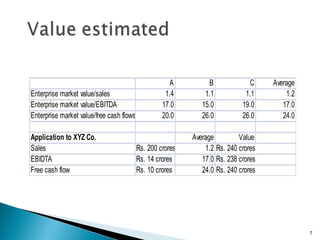
A         B              C    Average
Enterprise market value/sales                       1.4        1.1           1.1        1.2
Enterprise market value/EBITDA                     17.0       15.0          19.0       17.0
Enterprise market value/free cash flows            20.0       26.0          26.0       24.0

Application to XYZ Co.                                     Average         Value
Sales                                     Rs. 200 crores       1.2 Rs. 240 crores
EBIDTA                                    Rs. 14 crores       17.0 Rs. 238 crores
Free cash flow                            Rs. 10 crores       24.0 Rs. 240 crores


                                                                                              7
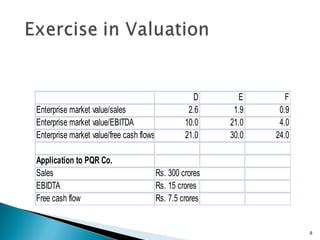
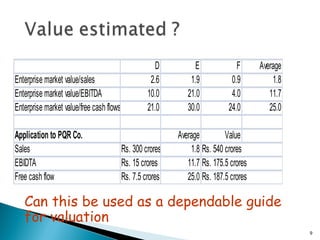
D      E       F
Enterprise market value/sales                       2.6     1.9    0.9
Enterprise market value/EBITDA                     10.0    21.0    4.0
Enterprise market value/free cash flows            21.0    30.0   24.0

Application to PQR Co.
Sales                                     Rs. 300 crores
EBIDTA                                    Rs. 15 crores
Free cash flow                            Rs. 7.5 crores


                                                                         8
D         E              F      Average
Enterprise market value/sales                       2.6        1.9           0.9          1.8
Enterprise market value/EBITDA                     10.0       21.0           4.0         11.7
Enterprise market value/free cash flows            21.0       30.0          24.0         25.0

Application to PQR Co.                                     Average         Value
Sales                                     Rs. 300 crores       1.8 Rs. 540 crores
EBIDTA                                    Rs. 15 crores       11.7 Rs. 175.5 crores
Free cash flow                            Rs. 7.5 crores      25.0 Rs. 187.5 crores

   Can this be used as a dependable guide
   for valuation
                                                                                                9
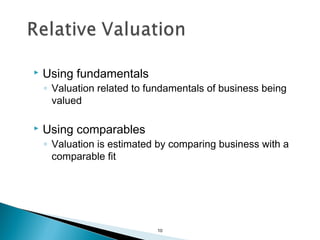
   Using fundamentals
    ◦ Valuation related to fundamentals of business being
      valued

   Using comparables
    ◦ Valuation is estimated by comparing business with a
      comparable fit


                            10
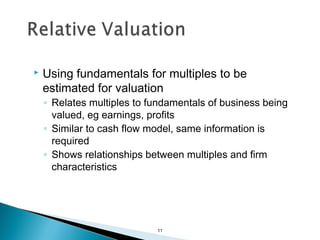
   Using fundamentals for multiples to be
    estimated for valuation
    ◦ Relates multiples to fundamentals of business being
      valued, eg earnings, profits
    ◦ Similar to cash flow model, same information is
      required
    ◦ Shows relationships between multiples and firm
      characteristics


                            11
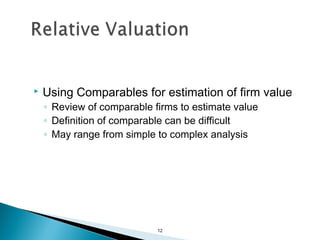
   Using Comparables for estimation of firm value
    ◦ Review of comparable firms to estimate value
    ◦ Definition of comparable can be difficult
    ◦ May range from simple to complex analysis


                            12
 Simple and easy to use
 Useful when data of comparable firms and

  assets are available.
 Require less time and efforts
 Easier to justify and sell.
 Closer to the market value (more value if the

  comparable firm is getting more in the market)


                       13
 Easy to misuse
 Selection of comparable can be subjective
 Errors in comparable firms get factored into

  valuation model
 RGC (Risk, Growth, Cash Flow) may be

  ignored.
 Have a short shelf life (compared to

  fundamentals).


                       14
 I) Select the relevant measure and value drivers.
 II) Identification of the “COMPS”.
 III) Select and calculate appropriate multiple –

  aggregation of multiple into single number through
  analysis of “COMPS”.
 IV) Apply to the company
 V) Make final adjustments for non-operating

  assets, Contingent liabilities and convertibles.


                                                       15
   Equity multiple or entity multiple ?

   Which value driver/ multiple to use?

   Trailing multiple or forward looking multiple?

   More number of multiples vs. less multiples ?


                                                     16
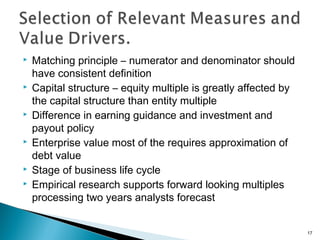
   Matching principle – numerator and denominator should
    have consistent definition
   Capital structure – equity multiple is greatly affected by
    the capital structure than entity multiple
   Difference in earning guidance and investment and
    payout policy
   Enterprise value most of the requires approximation of
    debt value
   Stage of business life cycle
   Empirical research supports forward looking multiples
    processing two years analysts forecast


                                                                 17
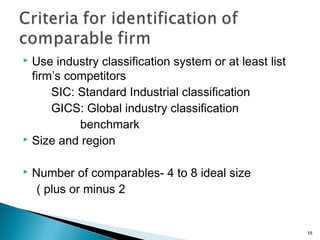
 Use industry classification system or at least list
  firm’s competitors
      SIC: Standard Industrial classification
      GICS: Global industry classification
           benchmark
 Size and region


   Number of comparables- 4 to 8 ideal size
     ( plus or minus 2


                                                        18
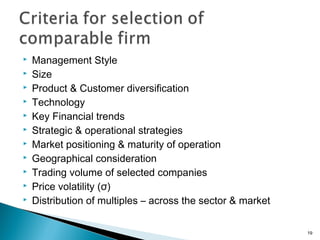
   Management Style
   Size
   Product & Customer diversification
   Technology
   Key Financial trends
   Strategic & operational strategies
   Market positioning & maturity of operation
   Geographical consideration
   Trading volume of selected companies
   Price volatility (σ)
   Distribution of multiples – across the sector & market

                                                             19
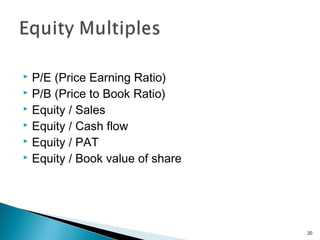
 P/E (Price Earning Ratio)
 P/B (Price to Book Ratio)
 Equity / Sales
 Equity / Cash flow
 Equity / PAT
 Equity / Book value of share


                                 20
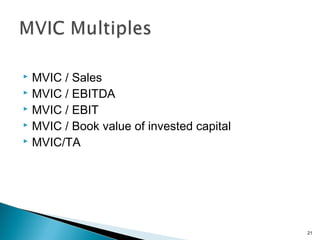
 MVIC / Sales
 MVIC / EBITDA
 MVIC / EBIT
 MVIC / Book value of invested capital
 MVIC/TA


                                          21
   PER – most commonly used multiples
   Make sure definition is consistent & uniform
   PER = MPS / EPS
   Variant of PER
   Current PER = Current MPS / Current EPS
   Some analyst may use average price over last 6m or a year
   Trailing PER = Current MPS / EPS based on last 4 quarters.
   [or, LTM: Last twelve months]
   Forward PER = Current MPS / expected EPS during next F/Y
   EPS may further be based on fully diluted basis or primary basis
   EPS may include or exclude extraordinary items


                                                                       22
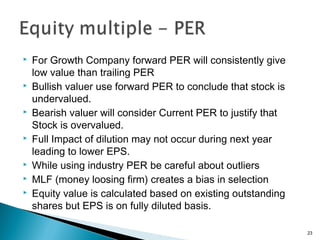
   For Growth Company forward PER will consistently give
    low value than trailing PER
   Bullish valuer use forward PER to conclude that stock is
    undervalued.
   Bearish valuer will consider Current PER to justify that
    Stock is overvalued.
   Full Impact of dilution may not occur during next year
    leading to lower EPS.
   While using industry PER be careful about outliers
   MLF (money loosing firm) creates a bias in selection
   Equity value is calculated based on existing outstanding
    shares but EPS is on fully diluted basis.

                                                               23
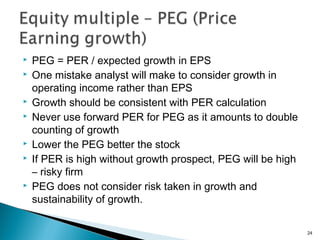
   PEG = PER / expected growth in EPS
   One mistake analyst will make to consider growth in
    operating income rather than EPS
   Growth should be consistent with PER calculation
   Never use forward PER for PEG as it amounts to double
    counting of growth
   Lower the PEG better the stock
   If PER is high without growth prospect, PEG will be high
    – risky firm
   PEG does not consider risk taken in growth and
    sustainability of growth.

                                                               24
   P/B ratio = market value of equity / book value of equity
   Book value is computed from the Financial Statement
   Price of book ratio near to 4 is highly priced stock [mean
    P/B ratio of all listed firm in USA during 2006 was 4]
   Price to Sales ratio
   (Revenue multiple) = market value of equity
                                   Revenue
   The larger the revenue multiple better it is.
   Generally there is no sectoral Revenue multiple.


                                                                 25
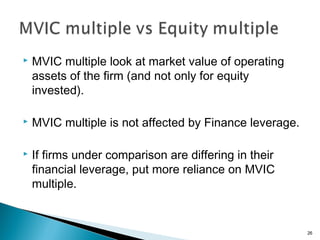
   MVIC multiple look at market value of operating
    assets of the firm (and not only for equity
    invested).

   MVIC multiple is not affected by Finance leverage.

   If firms under comparison are differing in their
    financial leverage, put more reliance on MVIC
    multiple.


                                                         26
   The market approach is especially relevant if standard of value is
    FMV.
   No company is exactly comparable to another, this approach
    requires best of extensive guidance that market can provide.
   The subject company need not be exactly in the similar business
    but should be impacted by the same economic influences.
   Size difference between two companies can be adjusted for:
   Equity or MVIC multiple can be used for valuing either
    controlling or minority interest.
   MVIC multiple is preferable for valuing controlling
    interest
     and equity multiple for minority interest


                                                                         27
   If MVIC is used to value on a minority interest basis, no
    adjustment should be made to the subject company’s
    actual capital structure (since minority shareholders
    cannot force such an adjustment)
   Equity should be taken on a fully diluted basis (For
    options, warrants, convertibles, the no. of equity units
    should be computed as if conversion rights were
    exercised.
    [No. of units of ES O/S = no. of ES after dilution]


                                                                28
   MVIC = Equity + PS + LTD + current portion of LTID
    [or all IBD, i.e. interest bearing debt]
    [may also subtract cash or cash equivalent. Marketable
    securities are included with cash equivalent]
   This is more preferable because different cash mix
    creates problem.


                                                             29
 MVIC should be on M P basis and it is not book
  value.
 Market value of equity multiple can be either on

  per share basis or on a total basis.
 Price per share/ EPS or, MV of Equity/PAT
 Round multiple to one decimal
 MVIC should be on a total company basis rather

  than on a per-share basis


                                                     30
 Conceptually only LTD (including current
  portion of LTD) should be considered.
 Due to practical difficulty we use AIBL
 [ difficult to assess how much interest is

  short term or long term. Some companies
  use ST debt as if it is LTD]


                                               31
Description of the subject Co. in terms of
       Line of business
   ◦ Market served
   ◦ Size: Revenue and Asset
   ◦ Other criteria
I) Then use above information to select guideline Co.
II) Based on definition create a population of companies in similar line of
      business
III) Normalize financials of both subject Co. & guideline Co.
IV) Carryout comparative Financial analysis
V) Identify and list similarities and assess relative strength and weakness.
      [site visit and management interviews helps]


                                                                               32
VI) Gather industry & economic date. Identify positions of
      subject Co. in industry. Assess how economic factor will
      affect both.
   VII) Choose what multiple's to rely on and the appropriate
    value for each multiple.

   Two factors that influence selection of multiples of operating
    variables are
   Growth prospects of subject company relative to guideline
   Risk


                                                                     33
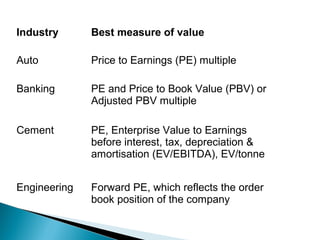
Industry      Best measure of value

Auto          Price to Earnings (PE) multiple

Banking       PE and Price to Book Value (PBV) or
              Adjusted PBV multiple

Cement        PE, Enterprise Value to Earnings
              before interest, tax, depreciation &
              amortisation (EV/EBITDA), EV/tonne


Engineering   Forward PE, which reflects the order
              book position of the company
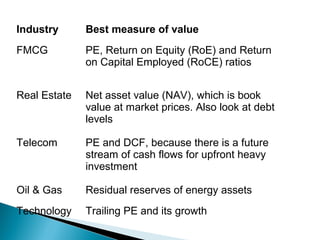
Industry      Best measure of value
FMCG          PE, Return on Equity (RoE) and Return
              on Capital Employed (RoCE) ratios


Real Estate   Net asset value (NAV), which is book
              value at market prices. Also look at debt
              levels

Telecom       PE and DCF, because there is a future
              stream of cash flows for upfront heavy
              investment

Oil & Gas     Residual reserves of energy assets
Technology    Trailing PE and its growth
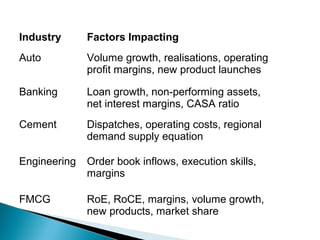
Industry      Factors Impacting
Auto          Volume growth, realisations, operating
              profit margins, new product launches

Banking       Loan growth, non-performing assets,
              net interest margins, CASA ratio
Cement        Dispatches, operating costs, regional
              demand supply equation

Engineering   Order book inflows, execution skills,
              margins

FMCG          RoE, RoCE, margins, volume growth,
              new products, market share
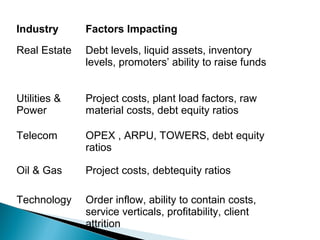
Industry      Factors Impacting
Real Estate   Debt levels, liquid assets, inventory
              levels, promoters’ ability to raise funds


Utilities &   Project costs, plant load factors, raw
Power         material costs, debt equity ratios

Telecom       OPEX , ARPU, TOWERS, debt equity
              ratios

Oil & Gas     Project costs, debtequity ratios

Technology    Order inflow, ability to contain costs,
              service verticals, profitability, client
              attrition

Relative valuation

  • 1.
  • 2.
    ◦ Sales Multiple ◦P/E multiple ◦ Price to Book multiple ◦ Enterprise value to EBIT multiple 2
  • 3.
    If valuation is being done for an IPO or a takeover, ◦ Value of firm = Average Transaction P/E multiple × EPS of firm ◦ Average Transaction multiple is the average multiple of recent transactions (IPO or takeover as the case may be)  If valuation is being done to estimate firm value ◦ Value of firm = Average P/E multiple in industry × EPS of firm  This method can be used when ◦ firms in the industry are profitable (have positive earnings) ◦ firms in the industry have similar growth (more likely for “mature” industries) ◦ firms in the industry have similar capital structure 3
  • 4.
     The applicationof this method is similar to that of the P/E multiple method.  Since the book value of equity is essentially the amount of equity capital invested in the firm, this method measures the market value of each rupee of equity invested.  This method can be used for ◦ companies in the manufacturing sector which have significant capital requirements. 4
  • 5.
    This multiple measures the enterprise value , that is the value of the business operations (as opposed to the value of the equity).  In calculating enterprise value, only the operational value of the business is included.  Generally Value from investment activities, such as investment in treasury bills or bonds, or investment in stocks of other companies, is excluded. 5
  • 6.
    A B C Enterprise market value/sales 1.4 1.1 1.1 Enterprise market value/EBITDA 17.0 15.0 19.0 Enterprise market value/free cash flows 20 26 26 Application to XYZ Co. Sales Rs. 200 crores EBIDTA Rs. 14 crores Free cash flow Rs. 10 crores 6
  • 7.
    A B C Average Enterprise market value/sales 1.4 1.1 1.1 1.2 Enterprise market value/EBITDA 17.0 15.0 19.0 17.0 Enterprise market value/free cash flows 20.0 26.0 26.0 24.0 Application to XYZ Co. Average Value Sales Rs. 200 crores 1.2 Rs. 240 crores EBIDTA Rs. 14 crores 17.0 Rs. 238 crores Free cash flow Rs. 10 crores 24.0 Rs. 240 crores 7
  • 8.
    D E F Enterprise market value/sales 2.6 1.9 0.9 Enterprise market value/EBITDA 10.0 21.0 4.0 Enterprise market value/free cash flows 21.0 30.0 24.0 Application to PQR Co. Sales Rs. 300 crores EBIDTA Rs. 15 crores Free cash flow Rs. 7.5 crores 8
  • 9.
    D E F Average Enterprise market value/sales 2.6 1.9 0.9 1.8 Enterprise market value/EBITDA 10.0 21.0 4.0 11.7 Enterprise market value/free cash flows 21.0 30.0 24.0 25.0 Application to PQR Co. Average Value Sales Rs. 300 crores 1.8 Rs. 540 crores EBIDTA Rs. 15 crores 11.7 Rs. 175.5 crores Free cash flow Rs. 7.5 crores 25.0 Rs. 187.5 crores Can this be used as a dependable guide for valuation 9
  • 10.
    Using fundamentals ◦ Valuation related to fundamentals of business being valued  Using comparables ◦ Valuation is estimated by comparing business with a comparable fit 10
  • 11.
    Using fundamentals for multiples to be estimated for valuation ◦ Relates multiples to fundamentals of business being valued, eg earnings, profits ◦ Similar to cash flow model, same information is required ◦ Shows relationships between multiples and firm characteristics 11
  • 12.
    Using Comparables for estimation of firm value ◦ Review of comparable firms to estimate value ◦ Definition of comparable can be difficult ◦ May range from simple to complex analysis 12
  • 13.
     Simple andeasy to use  Useful when data of comparable firms and assets are available.  Require less time and efforts  Easier to justify and sell.  Closer to the market value (more value if the comparable firm is getting more in the market) 13
  • 14.
     Easy tomisuse  Selection of comparable can be subjective  Errors in comparable firms get factored into valuation model  RGC (Risk, Growth, Cash Flow) may be ignored.  Have a short shelf life (compared to fundamentals). 14
  • 15.
     I) Selectthe relevant measure and value drivers.  II) Identification of the “COMPS”.  III) Select and calculate appropriate multiple – aggregation of multiple into single number through analysis of “COMPS”.  IV) Apply to the company  V) Make final adjustments for non-operating assets, Contingent liabilities and convertibles. 15
  • 16.
    Equity multiple or entity multiple ?  Which value driver/ multiple to use?  Trailing multiple or forward looking multiple?  More number of multiples vs. less multiples ? 16
  • 17.
    Matching principle – numerator and denominator should have consistent definition  Capital structure – equity multiple is greatly affected by the capital structure than entity multiple  Difference in earning guidance and investment and payout policy  Enterprise value most of the requires approximation of debt value  Stage of business life cycle  Empirical research supports forward looking multiples processing two years analysts forecast 17
  • 18.
     Use industryclassification system or at least list firm’s competitors SIC: Standard Industrial classification GICS: Global industry classification benchmark  Size and region  Number of comparables- 4 to 8 ideal size ( plus or minus 2 18
  • 19.
    Management Style  Size  Product & Customer diversification  Technology  Key Financial trends  Strategic & operational strategies  Market positioning & maturity of operation  Geographical consideration  Trading volume of selected companies  Price volatility (σ)  Distribution of multiples – across the sector & market 19
  • 20.
     P/E (PriceEarning Ratio)  P/B (Price to Book Ratio)  Equity / Sales  Equity / Cash flow  Equity / PAT  Equity / Book value of share 20
  • 21.
     MVIC /Sales  MVIC / EBITDA  MVIC / EBIT  MVIC / Book value of invested capital  MVIC/TA 21
  • 22.
    PER – most commonly used multiples  Make sure definition is consistent & uniform  PER = MPS / EPS  Variant of PER  Current PER = Current MPS / Current EPS  Some analyst may use average price over last 6m or a year  Trailing PER = Current MPS / EPS based on last 4 quarters.  [or, LTM: Last twelve months]  Forward PER = Current MPS / expected EPS during next F/Y  EPS may further be based on fully diluted basis or primary basis  EPS may include or exclude extraordinary items 22
  • 23.
    For Growth Company forward PER will consistently give low value than trailing PER  Bullish valuer use forward PER to conclude that stock is undervalued.  Bearish valuer will consider Current PER to justify that Stock is overvalued.  Full Impact of dilution may not occur during next year leading to lower EPS.  While using industry PER be careful about outliers  MLF (money loosing firm) creates a bias in selection  Equity value is calculated based on existing outstanding shares but EPS is on fully diluted basis. 23
  • 24.
    PEG = PER / expected growth in EPS  One mistake analyst will make to consider growth in operating income rather than EPS  Growth should be consistent with PER calculation  Never use forward PER for PEG as it amounts to double counting of growth  Lower the PEG better the stock  If PER is high without growth prospect, PEG will be high – risky firm  PEG does not consider risk taken in growth and sustainability of growth. 24
  • 25.
    P/B ratio = market value of equity / book value of equity  Book value is computed from the Financial Statement  Price of book ratio near to 4 is highly priced stock [mean P/B ratio of all listed firm in USA during 2006 was 4]  Price to Sales ratio  (Revenue multiple) = market value of equity Revenue  The larger the revenue multiple better it is.  Generally there is no sectoral Revenue multiple. 25
  • 26.
    MVIC multiple look at market value of operating assets of the firm (and not only for equity invested).  MVIC multiple is not affected by Finance leverage.  If firms under comparison are differing in their financial leverage, put more reliance on MVIC multiple. 26
  • 27.
    The market approach is especially relevant if standard of value is FMV.  No company is exactly comparable to another, this approach requires best of extensive guidance that market can provide.  The subject company need not be exactly in the similar business but should be impacted by the same economic influences.  Size difference between two companies can be adjusted for:  Equity or MVIC multiple can be used for valuing either controlling or minority interest.  MVIC multiple is preferable for valuing controlling interest and equity multiple for minority interest 27
  • 28.
    If MVIC is used to value on a minority interest basis, no adjustment should be made to the subject company’s actual capital structure (since minority shareholders cannot force such an adjustment)  Equity should be taken on a fully diluted basis (For options, warrants, convertibles, the no. of equity units should be computed as if conversion rights were exercised. [No. of units of ES O/S = no. of ES after dilution] 28
  • 29.
    MVIC = Equity + PS + LTD + current portion of LTID [or all IBD, i.e. interest bearing debt] [may also subtract cash or cash equivalent. Marketable securities are included with cash equivalent]  This is more preferable because different cash mix creates problem. 29
  • 30.
     MVIC shouldbe on M P basis and it is not book value.  Market value of equity multiple can be either on per share basis or on a total basis.  Price per share/ EPS or, MV of Equity/PAT  Round multiple to one decimal  MVIC should be on a total company basis rather than on a per-share basis 30
  • 31.
     Conceptually onlyLTD (including current portion of LTD) should be considered.  Due to practical difficulty we use AIBL  [ difficult to assess how much interest is short term or long term. Some companies use ST debt as if it is LTD] 31
  • 32.
    Description of thesubject Co. in terms of Line of business ◦ Market served ◦ Size: Revenue and Asset ◦ Other criteria I) Then use above information to select guideline Co. II) Based on definition create a population of companies in similar line of business III) Normalize financials of both subject Co. & guideline Co. IV) Carryout comparative Financial analysis V) Identify and list similarities and assess relative strength and weakness. [site visit and management interviews helps] 32
  • 33.
    VI) Gather industry& economic date. Identify positions of subject Co. in industry. Assess how economic factor will affect both.  VII) Choose what multiple's to rely on and the appropriate value for each multiple.  Two factors that influence selection of multiples of operating variables are  Growth prospects of subject company relative to guideline  Risk 33
  • 35.
    Industry Best measure of value Auto Price to Earnings (PE) multiple Banking PE and Price to Book Value (PBV) or Adjusted PBV multiple Cement PE, Enterprise Value to Earnings before interest, tax, depreciation & amortisation (EV/EBITDA), EV/tonne Engineering Forward PE, which reflects the order book position of the company
  • 36.
    Industry Best measure of value FMCG PE, Return on Equity (RoE) and Return on Capital Employed (RoCE) ratios Real Estate Net asset value (NAV), which is book value at market prices. Also look at debt levels Telecom PE and DCF, because there is a future stream of cash flows for upfront heavy investment Oil & Gas Residual reserves of energy assets Technology Trailing PE and its growth
  • 38.
    Industry Factors Impacting Auto Volume growth, realisations, operating profit margins, new product launches Banking Loan growth, non-performing assets, net interest margins, CASA ratio Cement Dispatches, operating costs, regional demand supply equation Engineering Order book inflows, execution skills, margins FMCG RoE, RoCE, margins, volume growth, new products, market share
  • 39.
    Industry Factors Impacting Real Estate Debt levels, liquid assets, inventory levels, promoters’ ability to raise funds Utilities & Project costs, plant load factors, raw Power material costs, debt equity ratios Telecom OPEX , ARPU, TOWERS, debt equity ratios Oil & Gas Project costs, debtequity ratios Technology Order inflow, ability to contain costs, service verticals, profitability, client attrition