By Javier, Pablo, Isabel, Claudia and Sofía
Index:
   1.What´s a tropical rainforest?
   2. Fauna of a tropical rainforest
    -1.1. Golden lion tamarin
    -1.2. Jaguar
    -1.3. Capybara
    -1.4.Poison dart frogs
    -1.5. Monarch Butterfly
   3. Vegetation of the tropical rainforest
    -2.1. Asai
    -2.2. Tabebuia serratifolia
    -2.3 Carniverous Plants
    -2.4 Orchids
    -2.5. Bromeliads
1. What´s a tropical rainforest?
                Tropical rainforests
                are a world like none
                other; and their
                importance to the
                global ecosystem and
                human existence is
                paramount.
   In terms of their biological
    diversity, tropical rainforests are
    a natural reservoir of genetic
    diversity which offers a rich
    source of medicinal
    plants, high-yield foods, and a
    myriad of other useful forest
    products. They are an
    important habitat for migratory
    animals and sustain as much
    as 50 percent of the species on
    Earth, as well as a number of
    diverse and unique indigenous
    cultures.
   Tropical rainforests play
    an elemental role in
    regulating global
    weather in addition to
    maintaining regular
    rainfall, while buffering
    against
    floods, droughts, and
    erosion. They store vast
    quantities of
    carbon, while producing
    a significant amount of
    the world's oxygen.
   Today, more than two-thirds of the world's tropical
    rainforests exist as fragmented remnants. Just a few
    thousand years ago, tropical rainforests covered as
    much as 12 percent of the Earth's land surface, but
    today less than 5 percent of Earth's land is covered
    with these forests.
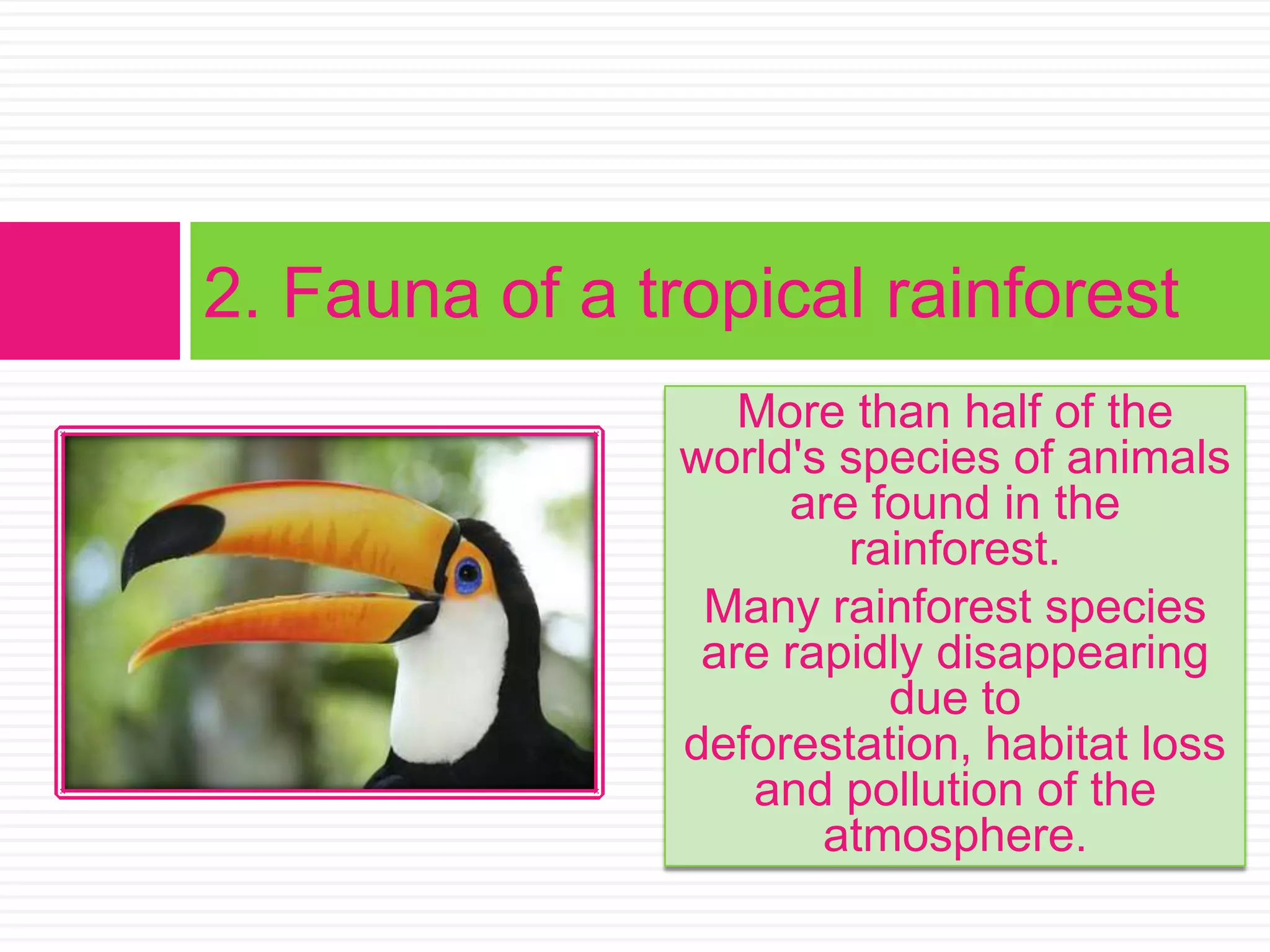
2. Fauna of a tropical rainforest
                   More than half of the
                world's species of animals
                     are found in the
                        rainforest.
                 Many rainforest species
                 are rapidly disappearing
                          due to
                deforestation, habitat loss
                   and pollution of the
                       atmosphere.
1.1 Golden Lion Tamarin

                It´s a small New World
                 monkey of the family
                 Callitrichidae.
                It gets its name from its
                 bright reddish orange
                 pelage and the extra long
                 airs around the face ears
                 which give it distinctive
                 name.
                Its original habitat is Brazil.
                They are social and groups
                 typically consist of 2-8
                 members
1.2 Jaguar

                Panthera is a genus of the family
                 Felidae (cats), which contains four
                 well-known living species: the
                 tiger, the lion, the jaguar, and the
                 leopard.
                Is a big cat, a feline in the Panthera
                 genus, and is the only Panthera
                 species found in the Americas.
                The jaguar is the third-largest feline
                 after the tiger and the lion, and the
                 largest in the Western Hemisphere.
                A study based on mitochondrial
                 genomes suggests that the about 11.3
                 million years ago Panthera separated
                 from other felid species and then
                 evolved into the several species of the
                 genus.
1.3 Capybara
                  Capybaras have heavy, barrel-
                   shaped bodies and short heads with
                   reddish-brown fur on the upper part
                   of their body that turns yellowish-
                   brown underneath.
                  Is the largest extant rodent in the
                   world.
                  It is a highly social species and can
                   be found in groups as large as 100
                   individuals, but usually lives in
                   groups of 10–20 individuals.
                  The capybara is not a threatened
                   species, though it is hunted for its
                   meat and skin.
1.4 Poison Dart Frog

                   Is the common name of a
                    group of frogs in the family
                    Dendrobatidae which are
                    native to Central and South
                    America.
                   These species are diurnal
                    and often have brightly-
                    colored bodies. Although all
                    wild dendrobatids are at least
                    somewhat toxic
                   Levels of toxicity vary
                    considerably from one
                    species to the next and from
                    one population to another.
1.5 Monarch Butterfly
                  It is perhaps the best known of
                   all North American butterflies.
                  Since the 19th century, it has
                   been found in New Zealand, and
                   in Australia since 1871 where it
                   is called the Wanderer.
                  It is resident in the Canary
                   Islands, the Azores, and
                   Madeira, and is found as an
                   occasional migrant in Western
                   Europe and a rare migrant in the
                   United Kingdom.
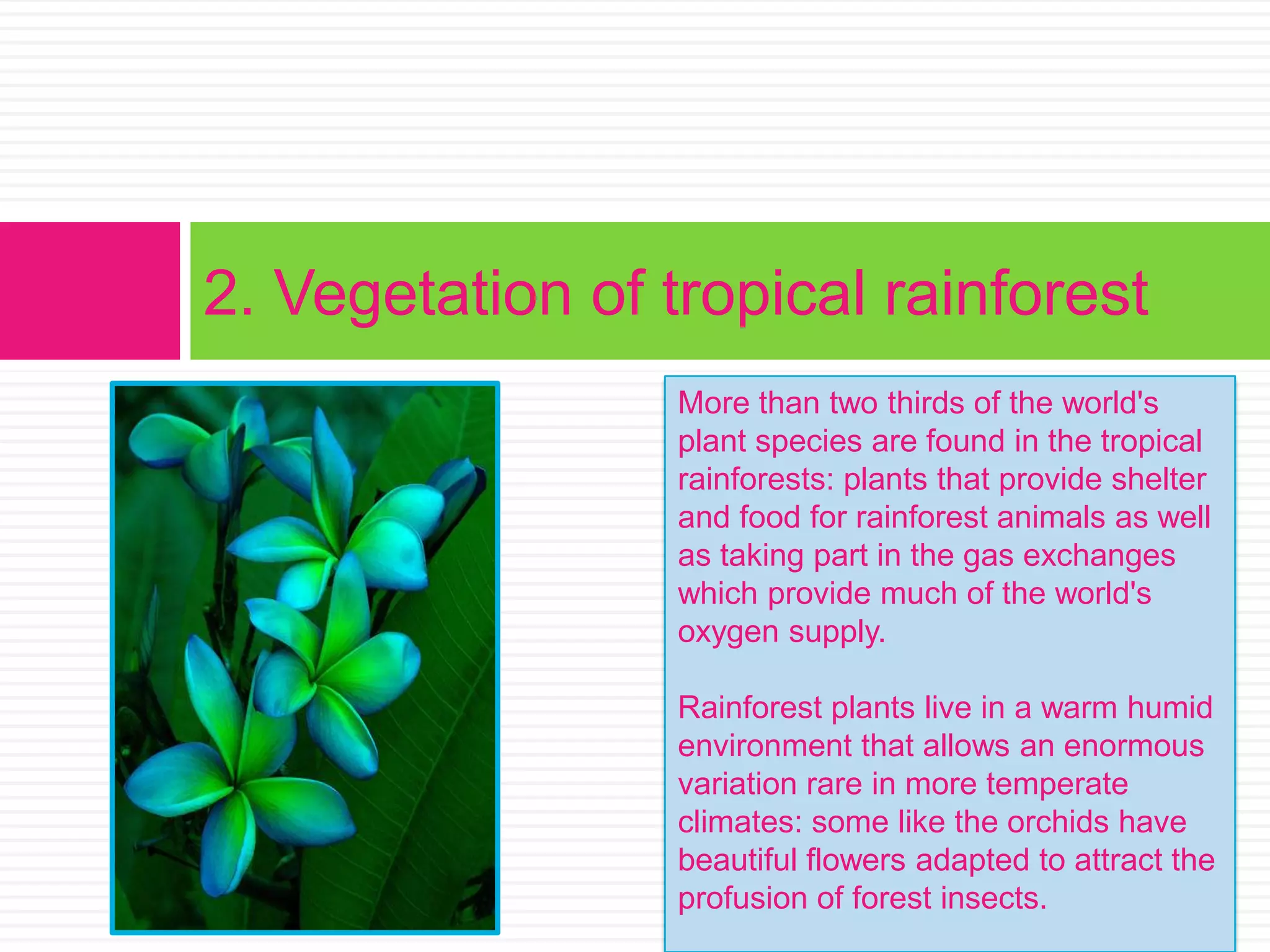
2. Vegetation of tropical rainforest
                  More than two thirds of the world's
                  plant species are found in the tropical
                  rainforests: plants that provide shelter
                  and food for rainforest animals as well
                  as taking part in the gas exchanges
                  which provide much of the world's
                  oxygen supply.

                  Rainforest plants live in a warm humid
                  environment that allows an enormous
                  variation rare in more temperate
                  climates: some like the orchids have
                  beautiful flowers adapted to attract the
                  profusion of forest insects.
2.1. Asai: The prodigy fruit
                  Cientific Name: Euterpe Oleracea
                  Common names: Asaí, Acaí, Acay
                  Usable parts: Fruit
                  What is it?
                   -Is the palm tree´s fruit in the
                   rainforest of the north of Brazil. It´s
                   round, with a diameter of about
                   10mm,
                   -its color is dark purple and it grows
                   with a bunch form. The name of
                   these bunches receives the name
                   of “cacho”.
                   -The Asai has unique properties
                   and there aren´t any natural product
                   that can level them.
2.2 Tabebuia serratifolia
                   This plant grows in the
                    Cerrado vegetation of
                    Brazil, reaching up to
                    French
                    Guiana, Bolivia, Paraguay
                    and Northern Argentina.
                   It is one of the largest and
                    strongest of tropical forest
                    trees, growing up to 150
                    feet tall while the base can
                    be 4 to 7 feet in diameter.
                   It is a commercially farmed
                    hardwood notable for its
                    extreme hardness and
                    resistance to fire and pests.
2.3 Carniverous Plants
                  Some plants are adapted to
                   obtain nutrients from animal
                   matter.
                   The best known of these is
                   probably the Venus fly trap, but
                   more impressive is the pitcher
                   plant Nepenthes
                   rafflesiana, found in southeast
                   Asia.
                  This plant grows to 30 feet tall
                   and may have pitchers 12 inches
                   in length, usually crammed full of
                   digested insects.
                  Pitcher plants also eat small
                   mammals and reptiles that
                   attempt to steal the insects from
                   the pitcher.
2.4 Orchids
                 Orchids comprise one of the most
                  abundant and varied of flowering
                  plant families.
                 There are over 20,000 known
                  species and orchids are especially
                  common in moist tropical regions.
                 Temperate orchids usually grow in
                  the soil, tropical orchids are more
                  often epiphytes which grow non-
                  parasitically on trees.
                 Orchid flowers vary considerably in
                  shape color and size, although they
                  share a common pattern of three
                  petals and three petal-like sepals.
                  The lower petal has a very
                  distinctive appearance.
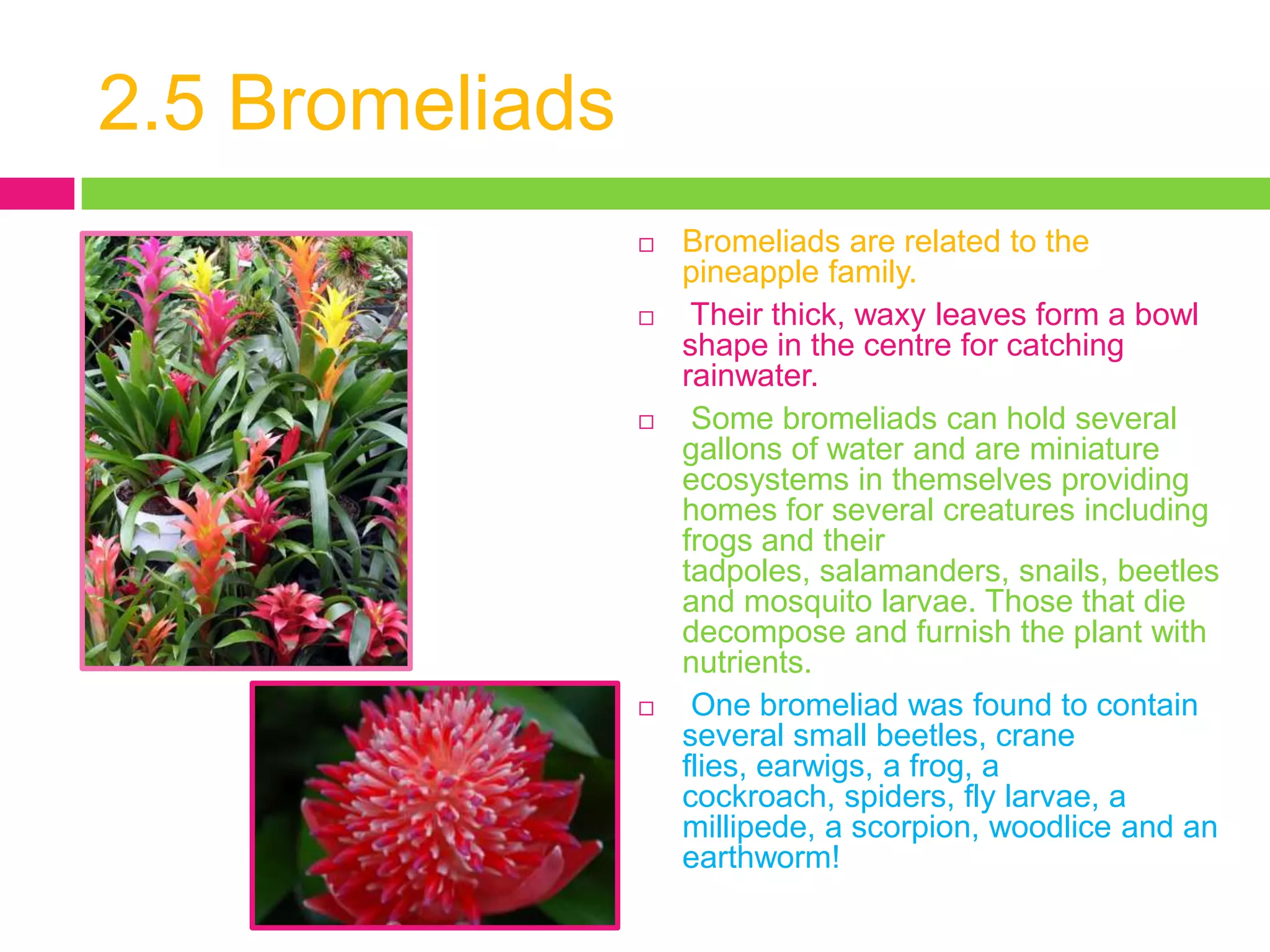
2.5 Bromeliads
                    Bromeliads are related to the
                     pineapple family.
                     Their thick, waxy leaves form a bowl
                     shape in the centre for catching
                     rainwater.
                     Some bromeliads can hold several
                     gallons of water and are miniature
                     ecosystems in themselves providing
                     homes for several creatures including
                     frogs and their
                     tadpoles, salamanders, snails, beetles
                     and mosquito larvae. Those that die
                     decompose and furnish the plant with
                     nutrients.
                     One bromeliad was found to contain
                     several small beetles, crane
                     flies, earwigs, a frog, a
                     cockroach, spiders, fly larvae, a
                     millipede, a scorpion, woodlice and an
                     earthworm!
Fauna and vegetation of a tropical rainforest

Fauna and vegetation of a tropical rainforest

  • 1.
    By Javier, Pablo,Isabel, Claudia and Sofía
  • 2.
    Index:  1.What´s a tropical rainforest?  2. Fauna of a tropical rainforest -1.1. Golden lion tamarin -1.2. Jaguar -1.3. Capybara -1.4.Poison dart frogs -1.5. Monarch Butterfly  3. Vegetation of the tropical rainforest -2.1. Asai -2.2. Tabebuia serratifolia -2.3 Carniverous Plants -2.4 Orchids -2.5. Bromeliads
  • 3.
    1. What´s atropical rainforest? Tropical rainforests are a world like none other; and their importance to the global ecosystem and human existence is paramount.
  • 4.
    In terms of their biological diversity, tropical rainforests are a natural reservoir of genetic diversity which offers a rich source of medicinal plants, high-yield foods, and a myriad of other useful forest products. They are an important habitat for migratory animals and sustain as much as 50 percent of the species on Earth, as well as a number of diverse and unique indigenous cultures.
  • 5.
    Tropical rainforests play an elemental role in regulating global weather in addition to maintaining regular rainfall, while buffering against floods, droughts, and erosion. They store vast quantities of carbon, while producing a significant amount of the world's oxygen.
  • 6.
    Today, more than two-thirds of the world's tropical rainforests exist as fragmented remnants. Just a few thousand years ago, tropical rainforests covered as much as 12 percent of the Earth's land surface, but today less than 5 percent of Earth's land is covered with these forests.
  • 7.
    2. Fauna ofa tropical rainforest More than half of the world's species of animals are found in the rainforest. Many rainforest species are rapidly disappearing due to deforestation, habitat loss and pollution of the atmosphere.
  • 8.
    1.1 Golden LionTamarin  It´s a small New World monkey of the family Callitrichidae.  It gets its name from its bright reddish orange pelage and the extra long airs around the face ears which give it distinctive name.  Its original habitat is Brazil.  They are social and groups typically consist of 2-8 members
  • 9.
    1.2 Jaguar  Panthera is a genus of the family Felidae (cats), which contains four well-known living species: the tiger, the lion, the jaguar, and the leopard.  Is a big cat, a feline in the Panthera genus, and is the only Panthera species found in the Americas.  The jaguar is the third-largest feline after the tiger and the lion, and the largest in the Western Hemisphere.  A study based on mitochondrial genomes suggests that the about 11.3 million years ago Panthera separated from other felid species and then evolved into the several species of the genus.
  • 10.
    1.3 Capybara  Capybaras have heavy, barrel- shaped bodies and short heads with reddish-brown fur on the upper part of their body that turns yellowish- brown underneath.  Is the largest extant rodent in the world.  It is a highly social species and can be found in groups as large as 100 individuals, but usually lives in groups of 10–20 individuals.  The capybara is not a threatened species, though it is hunted for its meat and skin.
  • 11.
    1.4 Poison DartFrog  Is the common name of a group of frogs in the family Dendrobatidae which are native to Central and South America.  These species are diurnal and often have brightly- colored bodies. Although all wild dendrobatids are at least somewhat toxic  Levels of toxicity vary considerably from one species to the next and from one population to another.
  • 12.
    1.5 Monarch Butterfly  It is perhaps the best known of all North American butterflies.  Since the 19th century, it has been found in New Zealand, and in Australia since 1871 where it is called the Wanderer.  It is resident in the Canary Islands, the Azores, and Madeira, and is found as an occasional migrant in Western Europe and a rare migrant in the United Kingdom.
  • 13.
    2. Vegetation oftropical rainforest More than two thirds of the world's plant species are found in the tropical rainforests: plants that provide shelter and food for rainforest animals as well as taking part in the gas exchanges which provide much of the world's oxygen supply. Rainforest plants live in a warm humid environment that allows an enormous variation rare in more temperate climates: some like the orchids have beautiful flowers adapted to attract the profusion of forest insects.
  • 14.
    2.1. Asai: Theprodigy fruit  Cientific Name: Euterpe Oleracea  Common names: Asaí, Acaí, Acay  Usable parts: Fruit  What is it? -Is the palm tree´s fruit in the rainforest of the north of Brazil. It´s round, with a diameter of about 10mm, -its color is dark purple and it grows with a bunch form. The name of these bunches receives the name of “cacho”. -The Asai has unique properties and there aren´t any natural product that can level them.
  • 15.
    2.2 Tabebuia serratifolia  This plant grows in the Cerrado vegetation of Brazil, reaching up to French Guiana, Bolivia, Paraguay and Northern Argentina.  It is one of the largest and strongest of tropical forest trees, growing up to 150 feet tall while the base can be 4 to 7 feet in diameter.  It is a commercially farmed hardwood notable for its extreme hardness and resistance to fire and pests.
  • 16.
    2.3 Carniverous Plants  Some plants are adapted to obtain nutrients from animal matter.  The best known of these is probably the Venus fly trap, but more impressive is the pitcher plant Nepenthes rafflesiana, found in southeast Asia.  This plant grows to 30 feet tall and may have pitchers 12 inches in length, usually crammed full of digested insects.  Pitcher plants also eat small mammals and reptiles that attempt to steal the insects from the pitcher.
  • 17.
    2.4 Orchids  Orchids comprise one of the most abundant and varied of flowering plant families.  There are over 20,000 known species and orchids are especially common in moist tropical regions.  Temperate orchids usually grow in the soil, tropical orchids are more often epiphytes which grow non- parasitically on trees.  Orchid flowers vary considerably in shape color and size, although they share a common pattern of three petals and three petal-like sepals. The lower petal has a very distinctive appearance.
  • 18.
    2.5 Bromeliads  Bromeliads are related to the pineapple family.  Their thick, waxy leaves form a bowl shape in the centre for catching rainwater.  Some bromeliads can hold several gallons of water and are miniature ecosystems in themselves providing homes for several creatures including frogs and their tadpoles, salamanders, snails, beetles and mosquito larvae. Those that die decompose and furnish the plant with nutrients.  One bromeliad was found to contain several small beetles, crane flies, earwigs, a frog, a cockroach, spiders, fly larvae, a millipede, a scorpion, woodlice and an earthworm!