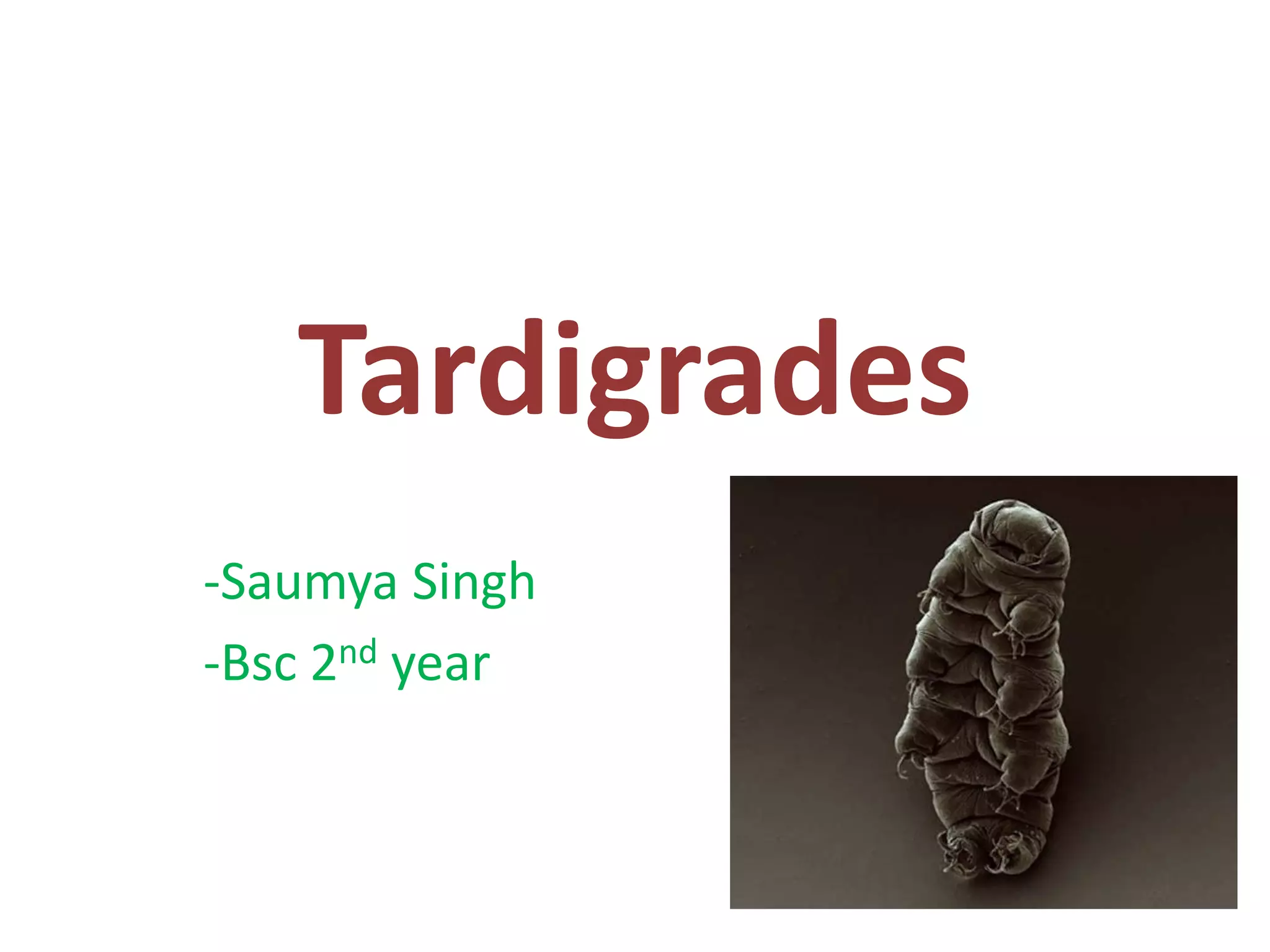
Tardigrades
-Saumya Singh
-Bsc 2nd year
What is a Tardigrade?
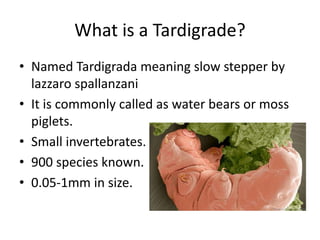
• Named Tardigrada meaning slow stepper by
lazzaro spallanzani
• It is commonly called as water bears or moss
piglets.
• Small invertebrates.
• 900 species known.
• 0.05-1mm in size.
Characters
• 4 pairs of legs , which ends in either 4 to 8
claws.
• Reproduction is either asexual
(parthenogenesis) or sexual.
• It feeds on fluids of plant cells, animal cells
and bacteria.
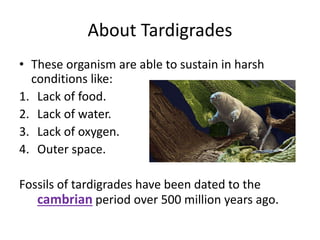
About Tardigrades
• These organism are able to sustain in harsh
conditions like:
1. Lack of food.
2. Lack of water.
3. Lack of oxygen.
4. Outer space.
Fossils of tardigrades have been dated to the
cambrian period over 500 million years ago.
Extreme conditions
• Sent to space while attached to a satellite and
when the satellite returned to earth, these
organisms had survived and even laid eggs.
• They have been discovered 18,000ft up
mountains in the Himalayas.
• In the Japanese hot springs.
• At the bottom of oceans.
• Antarctica.
Conditions experimentally exposed to.
• Temperature ranging as low as -200°C to as high
as 151°C.
• Thawing processes.
• Changes in salinity.
• Lack of oxygen.
• Lack of water.
• Levels of X-ray radiation 1000x the lethal human
dose.
• Boiling alcohol.
• Low pressure of vaccum and high pressure.
How do they do it?
• Cryptobiosis
It is defined as a state in which metabolic activities
come to a reversible standstill.
A death-like state.
Live tardigrades have been regenerated from 120
year old samples!
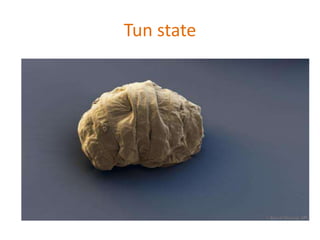
• Tun formation : They curl up into a ball , which
looks like dry husk.
While in Tun their metabolism can be lower than
0.01% !
Tun state
How do they do it?
• Some species show trehalose accumulation
which moves into cells and replaces water, but
not in all tardigrades.
• Trehalose can also wrap itself around any
remaining water molecules, stopping it from
rapidly expanding if the temperature rises.
Rapidly expanding water molecules are
dangerous because they can rupture cells,
which can be fatal.
How do they it?
• When tardigrades start to dry out, they seem
to make a lot of antioxidants. These are
chemicals, like vitamins C and E, that soak up
dangerously reactive chemicals.
• When tardigrades start to dry out, they seem
to make a lot of antioxidants. These are
chemicals, like vitamins C and E, that soak up
dangerously reactive chemicals.
How do they do it?
• They also have the ability to repair their DNA.
• Tardigrades may produce chemicals called ice
nucleating agents. These encourage ice
crystals to form outside their cells rather than
inside, protecting the vital molecules.
• They produce a unique protein which acts like
shield protecting DNA from radiations.
Importance
• Researchers are working towards making
Tardigrades will be the first passengers on a
spacecraft to visit our next closest star
(Proxima B).
• In a recent study, the protein which protected
the DNA of tardigrades from radiation
damage, transplanted this to cultured human
cells, found that the same protection applied
to the DNA.
Importance
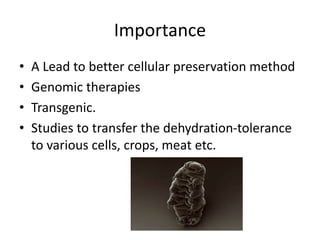
• A Lead to better cellular preservation method
• Genomic therapies
• Transgenic.
• Studies to transfer the dehydration-tolerance
to various cells, crops, meat etc.
Thank you
References
• http://www.bbc.com/earth/story/20150313-
the-toughest-animals-on-earth
• https://www.smithsonianmag.com/science-
nature/how-does-the-tiny-waterbear-survive-
in-outer-space-30891298/
• https://serc.carleton.edu/microbelife/topics/t
ardigrade/index.html

Tardigrades : The water bear

  • 1.
  • 2.
    What is aTardigrade? • Named Tardigrada meaning slow stepper by lazzaro spallanzani • It is commonly called as water bears or moss piglets. • Small invertebrates. • 900 species known. • 0.05-1mm in size.
  • 3.
    Characters • 4 pairsof legs , which ends in either 4 to 8 claws. • Reproduction is either asexual (parthenogenesis) or sexual. • It feeds on fluids of plant cells, animal cells and bacteria.
  • 4.
    About Tardigrades • Theseorganism are able to sustain in harsh conditions like: 1. Lack of food. 2. Lack of water. 3. Lack of oxygen. 4. Outer space. Fossils of tardigrades have been dated to the cambrian period over 500 million years ago.
  • 5.
    Extreme conditions • Sentto space while attached to a satellite and when the satellite returned to earth, these organisms had survived and even laid eggs. • They have been discovered 18,000ft up mountains in the Himalayas. • In the Japanese hot springs. • At the bottom of oceans. • Antarctica.
  • 6.
    Conditions experimentally exposedto. • Temperature ranging as low as -200°C to as high as 151°C. • Thawing processes. • Changes in salinity. • Lack of oxygen. • Lack of water. • Levels of X-ray radiation 1000x the lethal human dose. • Boiling alcohol. • Low pressure of vaccum and high pressure.
  • 7.
    How do theydo it? • Cryptobiosis It is defined as a state in which metabolic activities come to a reversible standstill. A death-like state. Live tardigrades have been regenerated from 120 year old samples! • Tun formation : They curl up into a ball , which looks like dry husk. While in Tun their metabolism can be lower than 0.01% !
  • 8.
  • 9.
    How do theydo it? • Some species show trehalose accumulation which moves into cells and replaces water, but not in all tardigrades. • Trehalose can also wrap itself around any remaining water molecules, stopping it from rapidly expanding if the temperature rises. Rapidly expanding water molecules are dangerous because they can rupture cells, which can be fatal.
  • 10.
    How do theyit? • When tardigrades start to dry out, they seem to make a lot of antioxidants. These are chemicals, like vitamins C and E, that soak up dangerously reactive chemicals. • When tardigrades start to dry out, they seem to make a lot of antioxidants. These are chemicals, like vitamins C and E, that soak up dangerously reactive chemicals.
  • 11.
    How do theydo it? • They also have the ability to repair their DNA. • Tardigrades may produce chemicals called ice nucleating agents. These encourage ice crystals to form outside their cells rather than inside, protecting the vital molecules. • They produce a unique protein which acts like shield protecting DNA from radiations.
  • 12.
    Importance • Researchers areworking towards making Tardigrades will be the first passengers on a spacecraft to visit our next closest star (Proxima B). • In a recent study, the protein which protected the DNA of tardigrades from radiation damage, transplanted this to cultured human cells, found that the same protection applied to the DNA.
  • 13.
    Importance • A Leadto better cellular preservation method • Genomic therapies • Transgenic. • Studies to transfer the dehydration-tolerance to various cells, crops, meat etc.
  • 14.
  • 15.