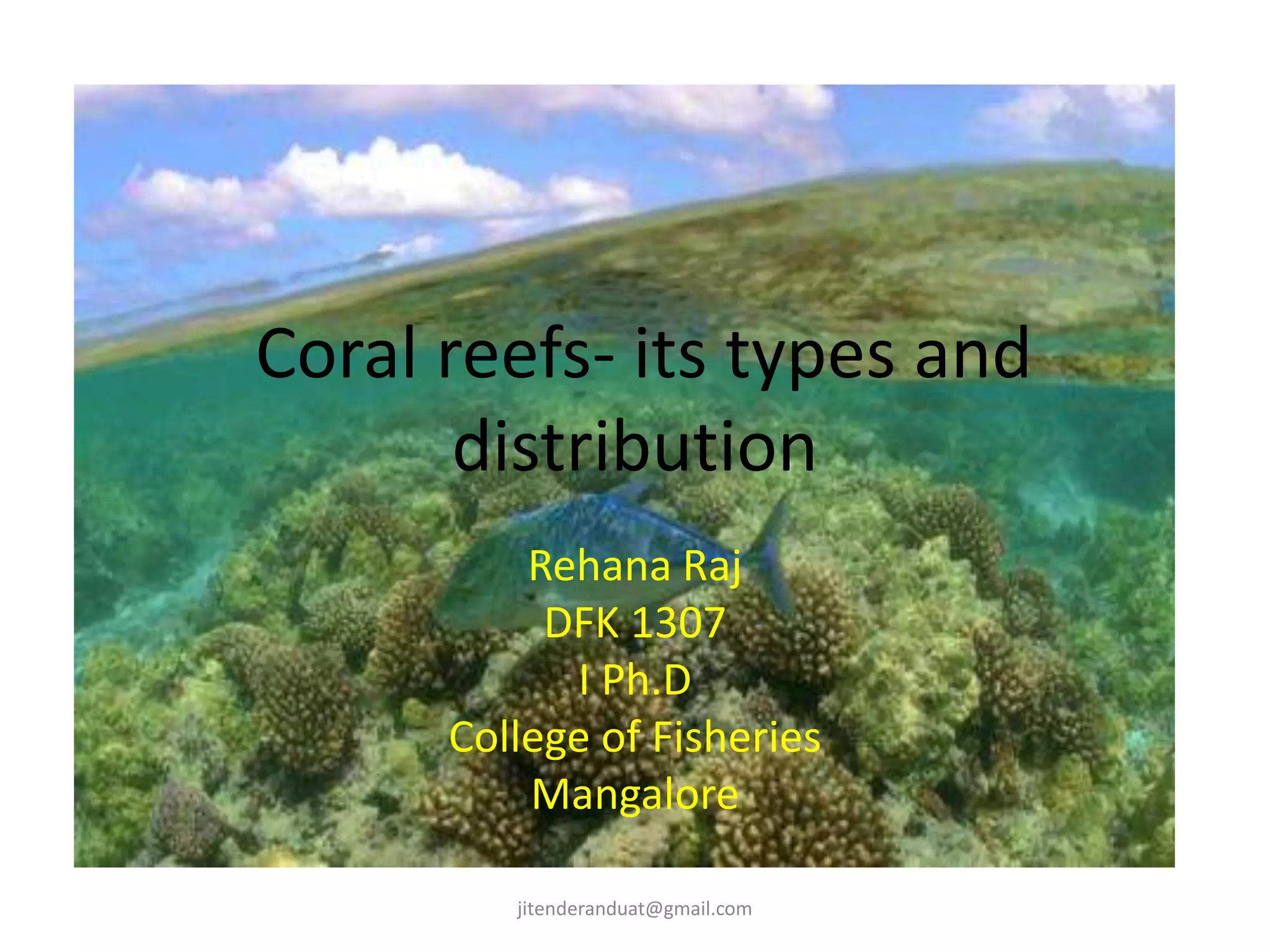
Coral reefs- its types and
distribution
Rehana Raj
DFK 1307
I Ph.D
College of Fisheries
Mangalore
jitenderanduat@gmail.com
Introduction
• Belong to the Phylum: Cnideria, Class: Anthozoa
• Under water structures made from CaCo₃
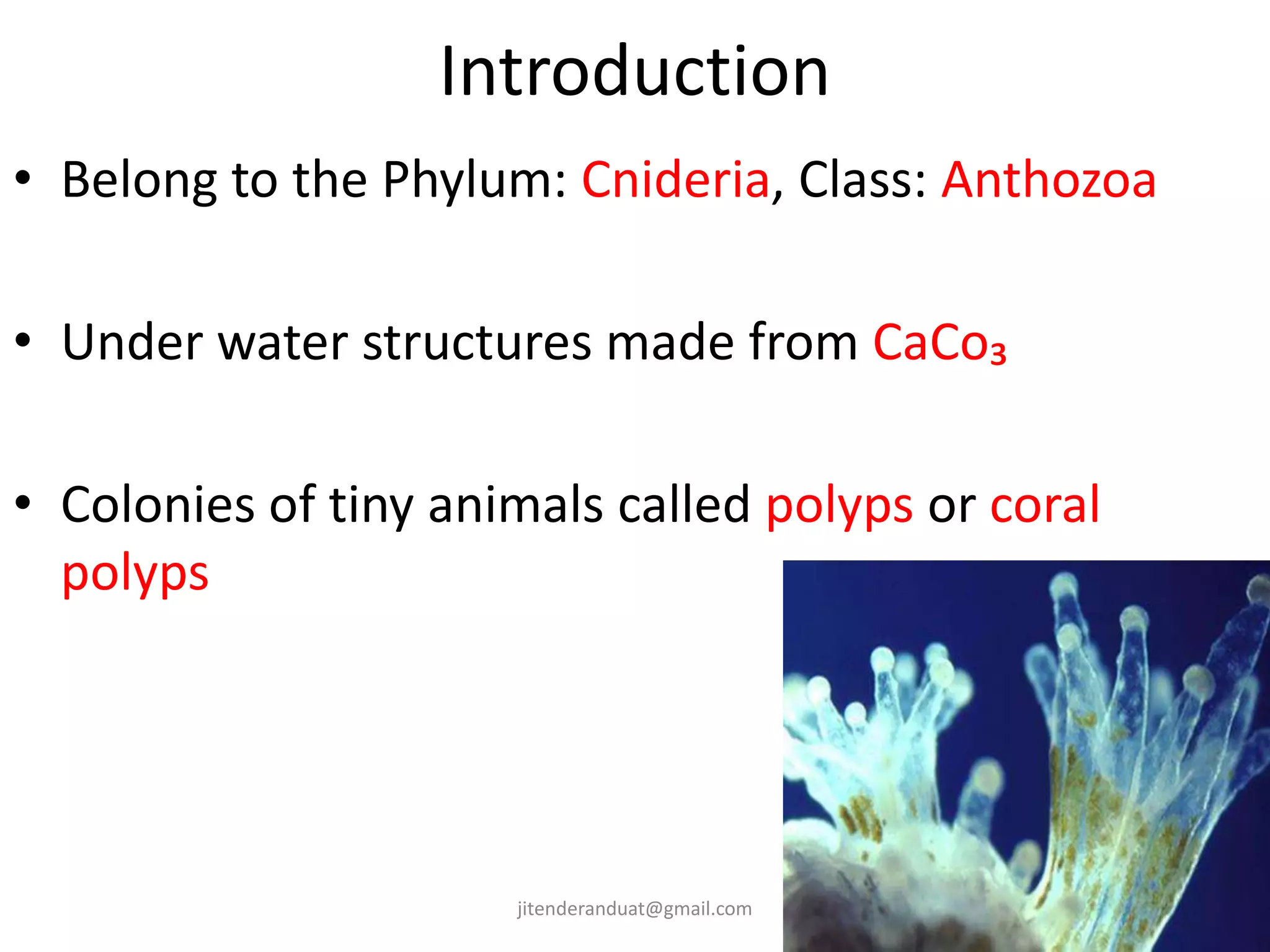
• Colonies of tiny animals called polyps or coral
polyps
jitenderanduat@gmail.com
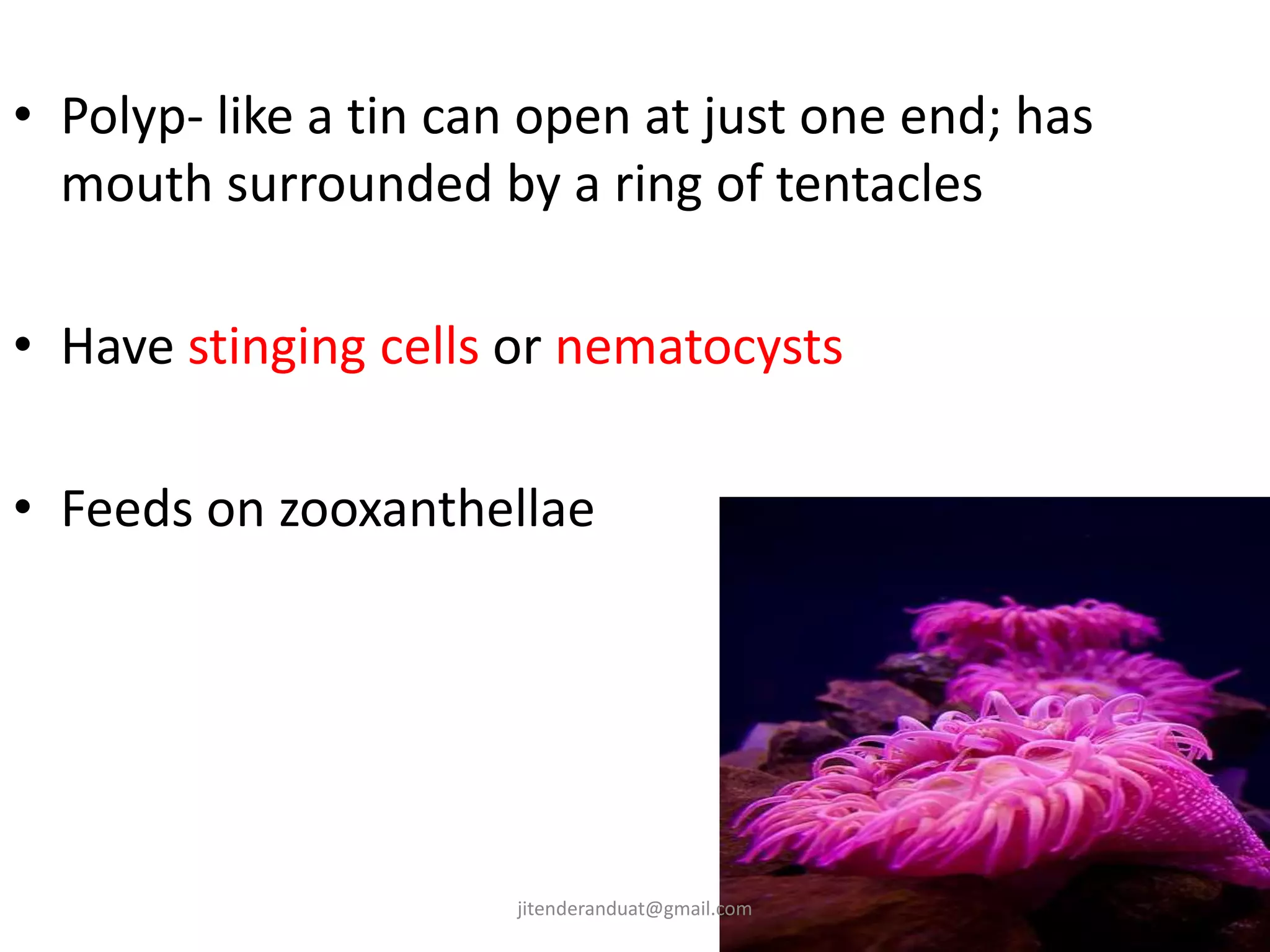
• Polyp- like a tin can open at just one end; has
mouth surrounded by a ring of tentacles
• Have stinging cells or nematocysts
• Feeds on zooxanthellae
jitenderanduat@gmail.com
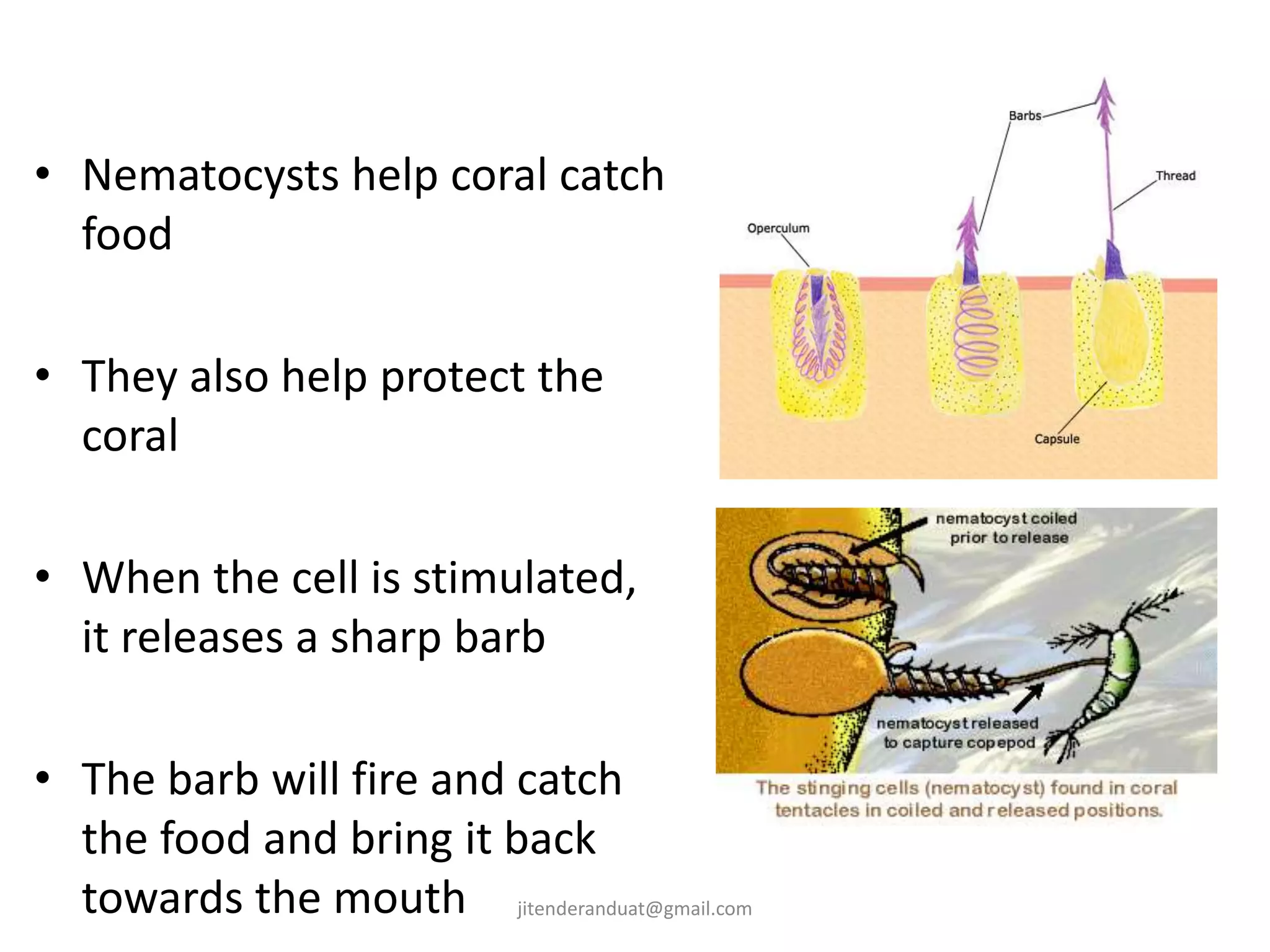
• Nematocysts help coral catch
food
• They also help protect the
coral
• When the cell is stimulated,
it releases a sharp barb
• The barb will fire and catch
the food and bring it back
towards the mouth jitenderanduat@gmail.com
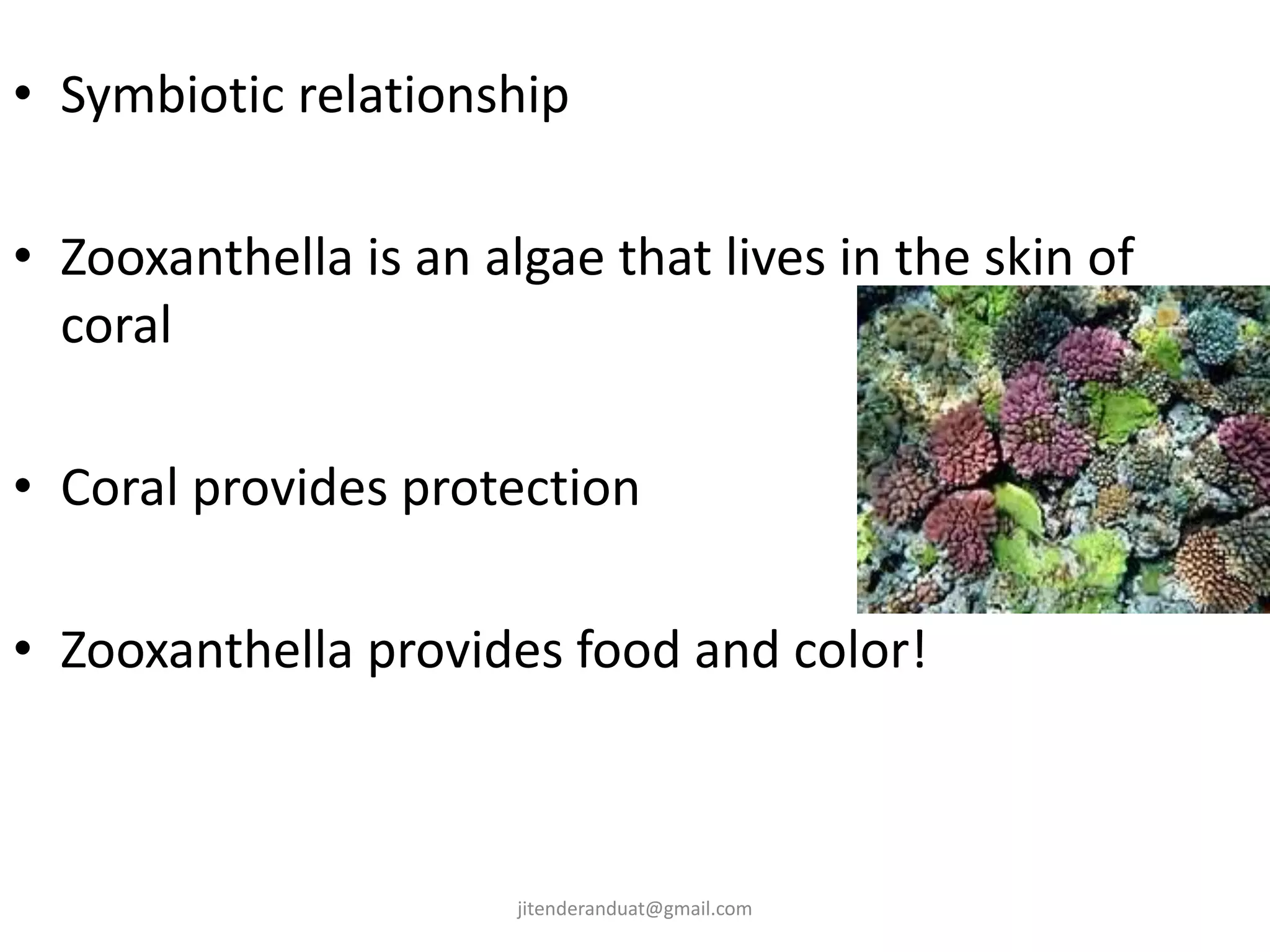
• Symbiotic relationship
• Zooxanthella is an algae that lives in the skin of
coral
• Coral provides protection
• Zooxanthella provides food and color!
jitenderanduat@gmail.com
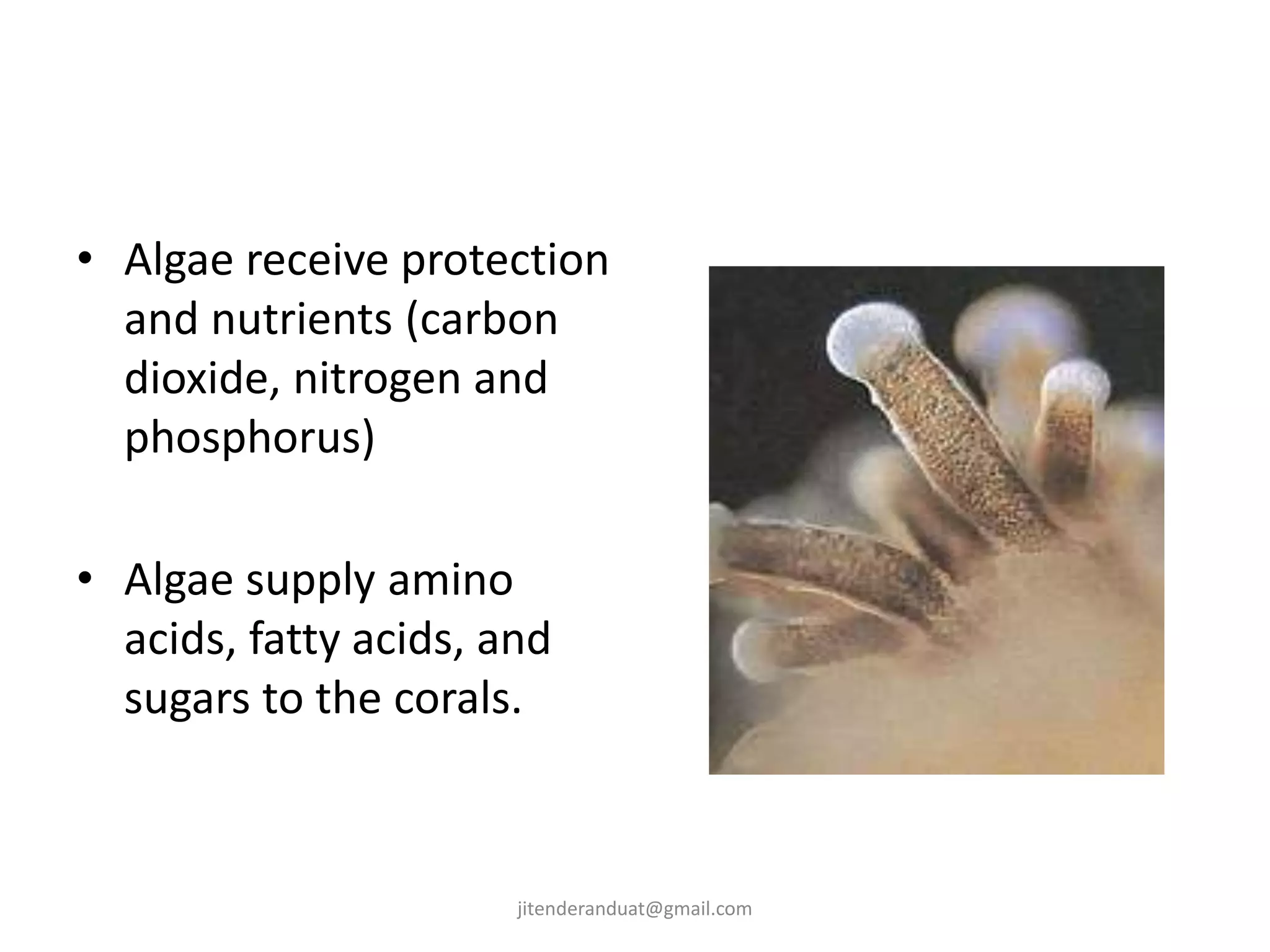
• Algae receive protection
and nutrients (carbon
dioxide, nitrogen and
phosphorus)
• Algae supply amino
acids, fatty acids, and
sugars to the corals.
jitenderanduat@gmail.com
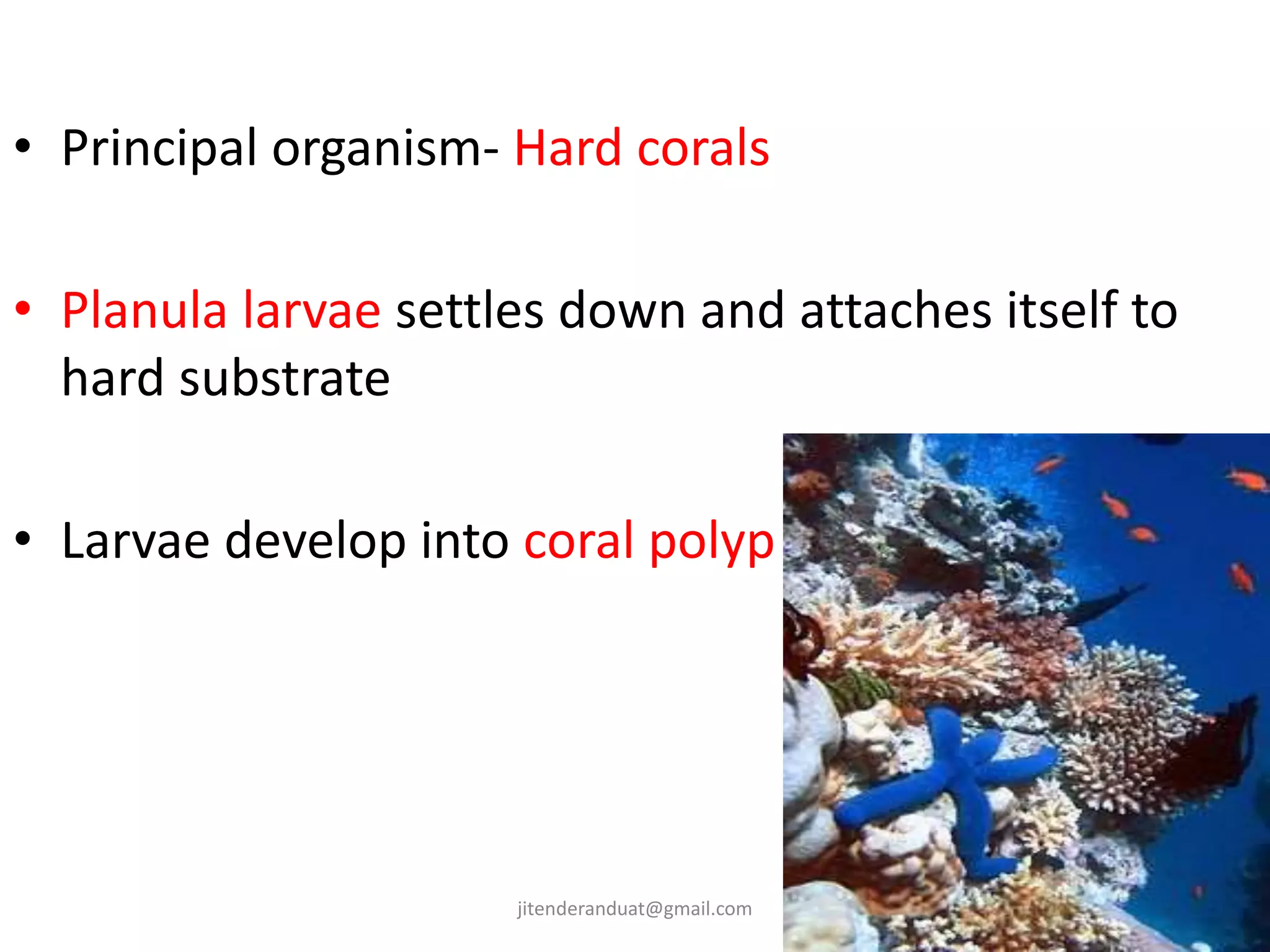
• Principal organism- Hard corals
• Planula larvae settles down and attaches itself to
hard substrate
• Larvae develop into coral polyp
jitenderanduat@gmail.com
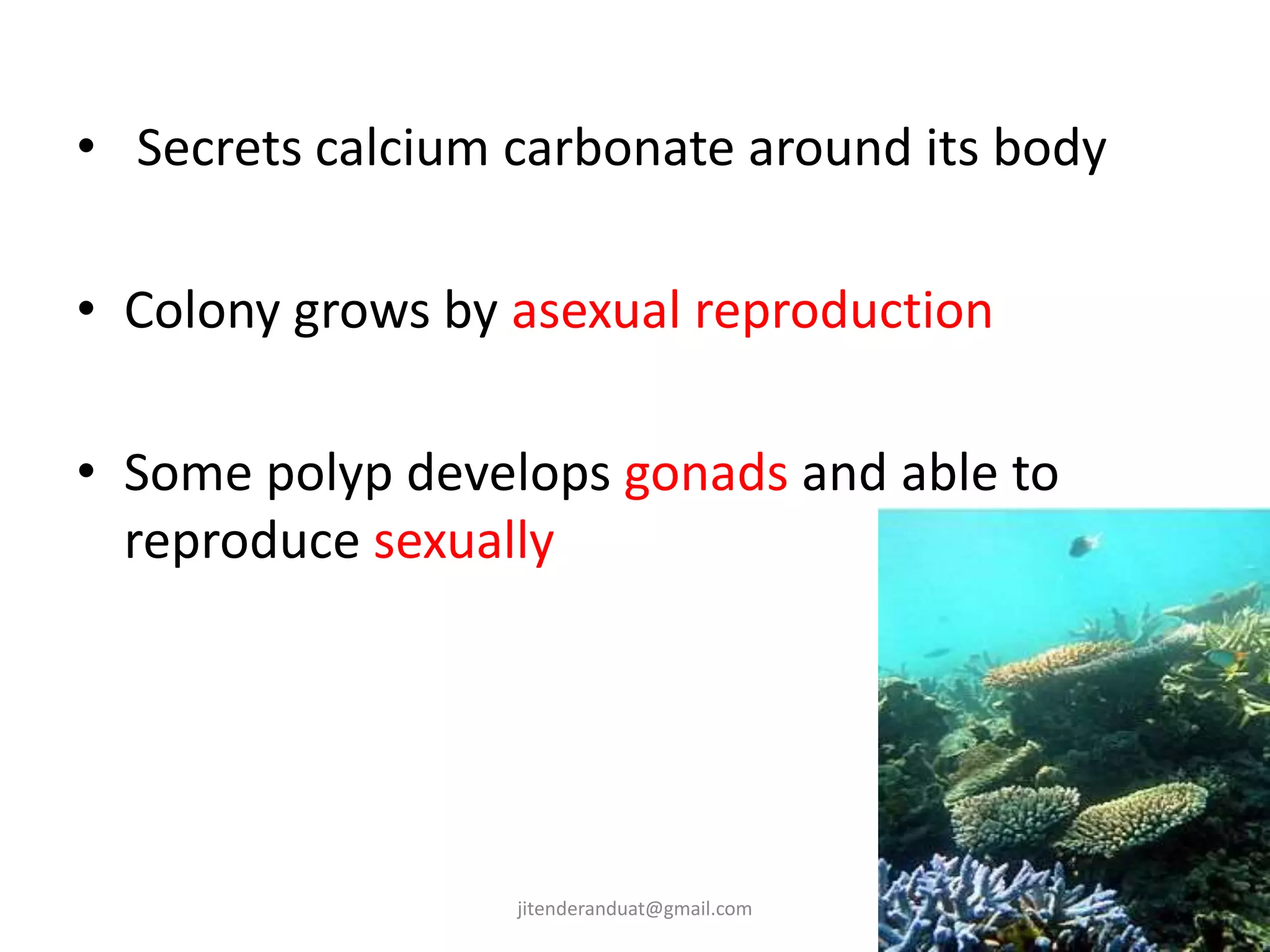
• Secrets calcium carbonate around its body
• Colony grows by asexual reproduction
• Some polyp develops gonads and able to
reproduce sexually
jitenderanduat@gmail.com
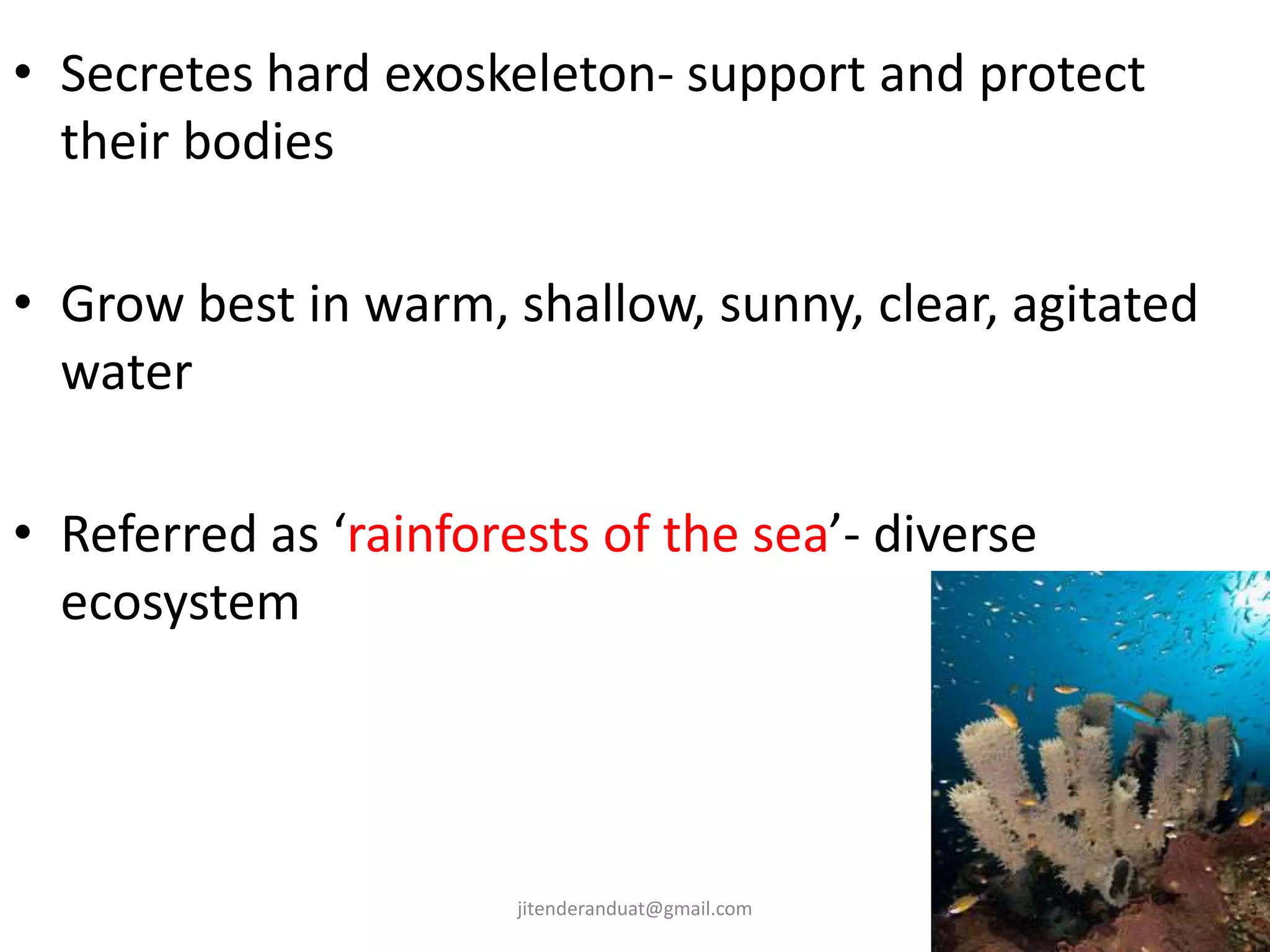
• Secretes hard exoskeleton- support and protect
their bodies
• Grow best in warm, shallow, sunny, clear, agitated
water
• Referred as ‘rainforests of the sea’- diverse
ecosystem
jitenderanduat@gmail.com
• Occupy less than 1% of the world ocean
surface
• Home for 25% of the all marine species
• Annual global economic value- US$ 375 billion
jitenderanduat@gmail.com
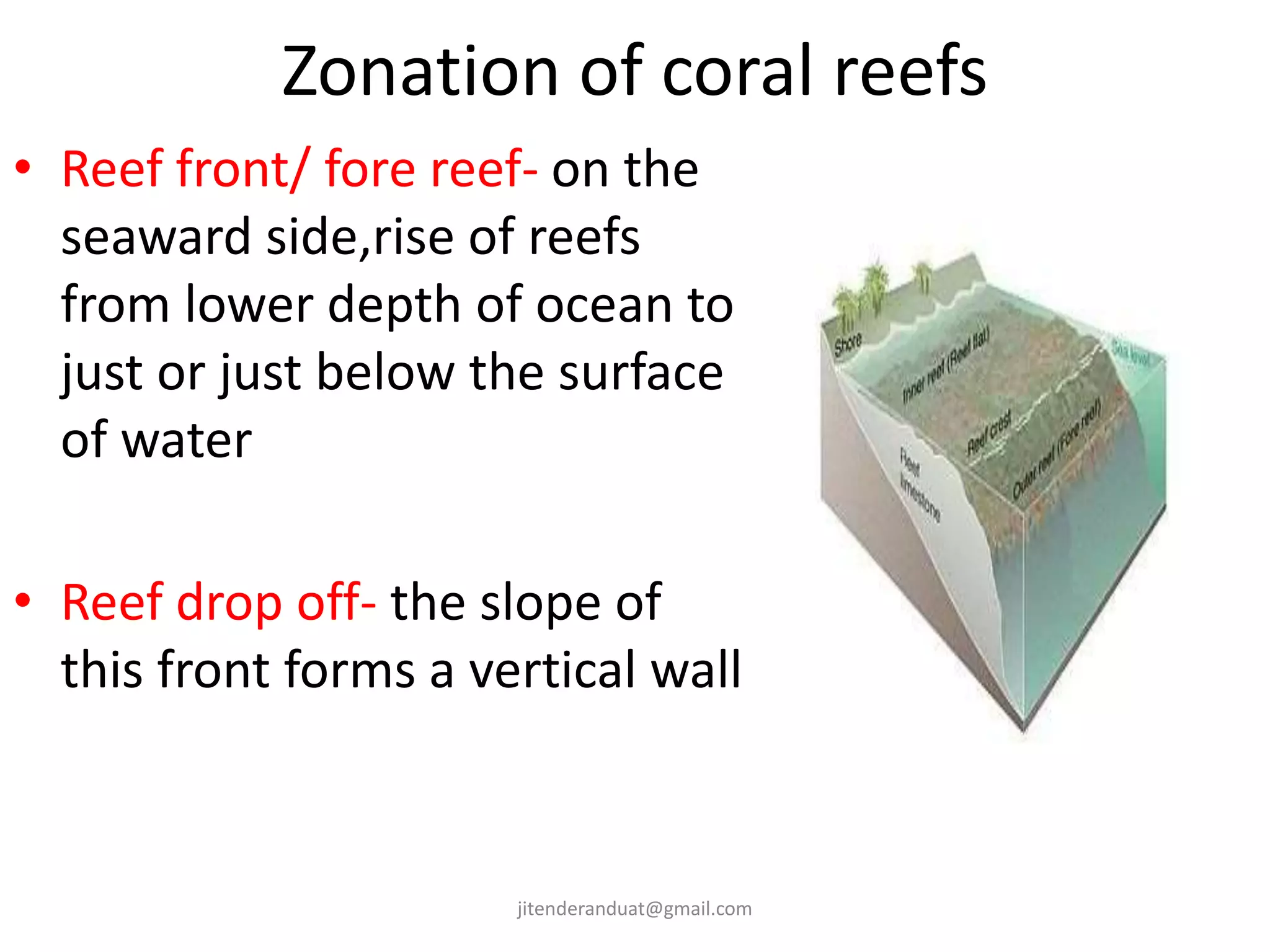
Zonation of coral reefs
• Reef front/ fore reef- on the
seaward side,rise of reefs
from lower depth of ocean to
just or just below the surface
of water
• Reef drop off- the slope of
this front forms a vertical wall
jitenderanduat@gmail.com
• Spur & groove formation-reef front
usually form a finger like arrangements;
breaks the wave energy & prevents the
damage
• Grooves are sand filled; allow sediment
to channel down & away from coral reefs
jitenderanduat@gmail.com
• Reef crest- highest point of reef
• Reef flat/ back reef-portion which is more
inward to land; area is having high variability,
made up of rocks, sand etc
• Reef ends at shoreline or descends into lagoon
jitenderanduat@gmail.com
Specific features
• Temperature: 26-27C
– Depth: Less than 80 ft to
230 feet
– Salinity: Normal salt levels
(35ppt)
– Light: Zooxanthellae need
light to survive
– Sedimentation: Being
covered with silt interferes
with photosynthesis
– Desiccation: being exposed
to air. The corals will die if
exposed too long
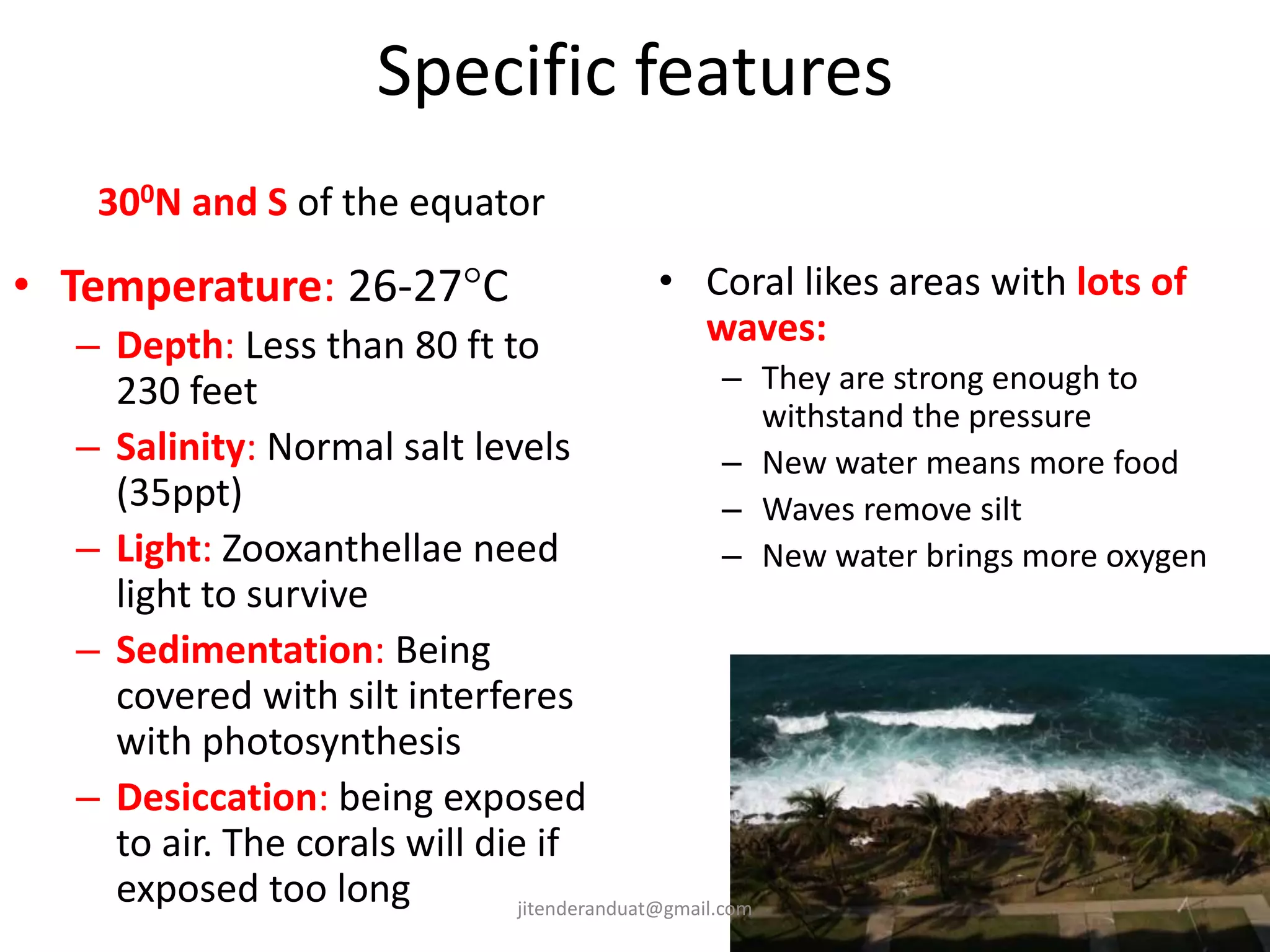
• Coral likes areas with lots of
waves:
– They are strong enough to
withstand the pressure
– New water means more food
– Waves remove silt
– New water brings more oxygen
300N and S of the equator
jitenderanduat@gmail.com
Types of coral reefs
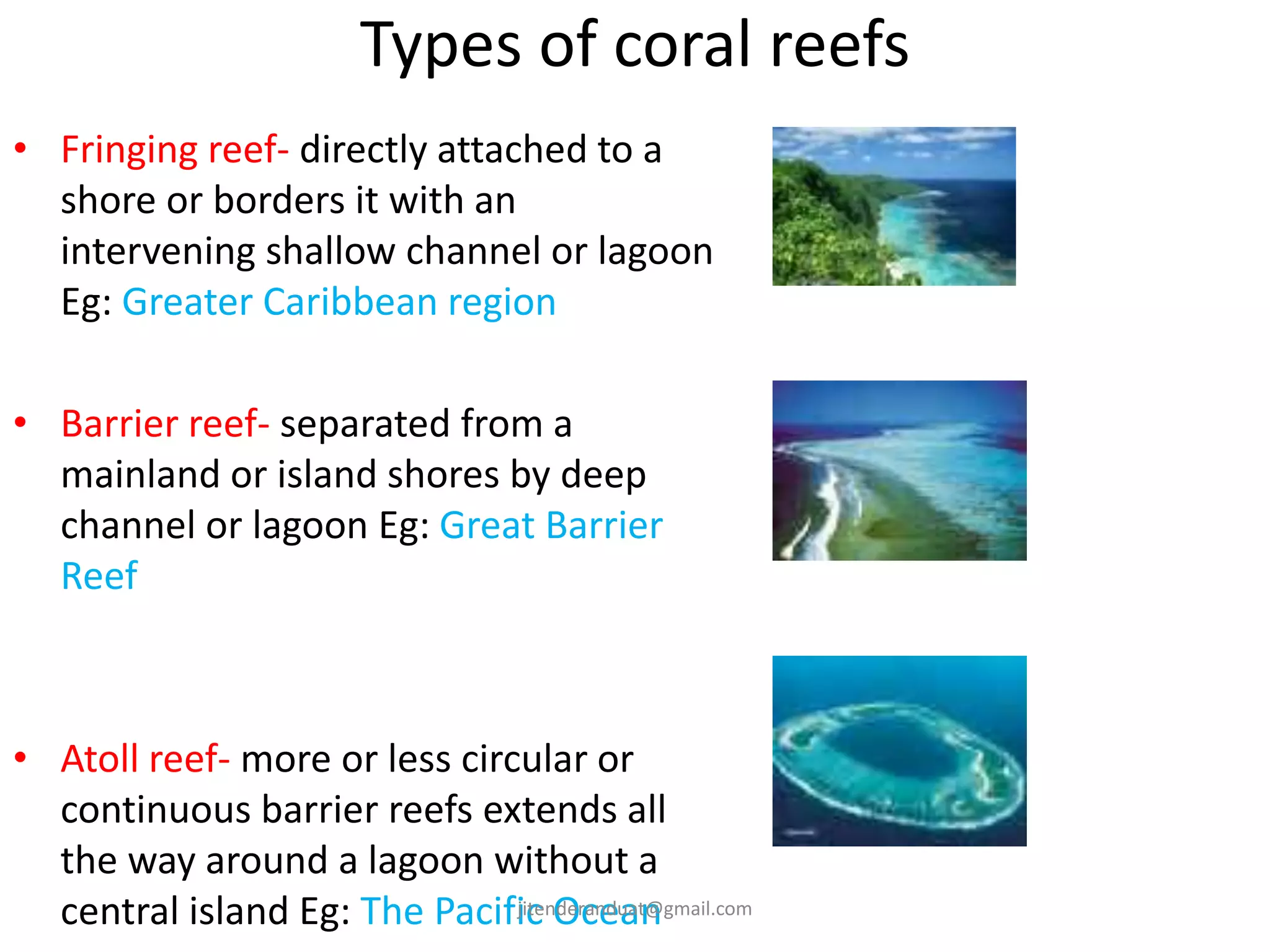
• Fringing reef- directly attached to a
shore or borders it with an
intervening shallow channel or lagoon
Eg: Greater Caribbean region
• Barrier reef- separated from a
mainland or island shores by deep
channel or lagoon Eg: Great Barrier
Reef
• Atoll reef- more or less circular or
continuous barrier reefs extends all
the way around a lagoon without a
central island Eg: The Pacific Oceanjitenderanduat@gmail.com
Other reef types
• Patch reef-common, isolated, comparitively, small
reef usually within a lagoon or embayment; often
circular, surrounded by sand or seagrass
• Apron reef- short reef resembling a fringing reef,
but more sloped, extending out and downward
from a point or peninsular shore
jitenderanduat@gmail.com
• Bank reef- linear or semicircular shaped; larger
than patch reef
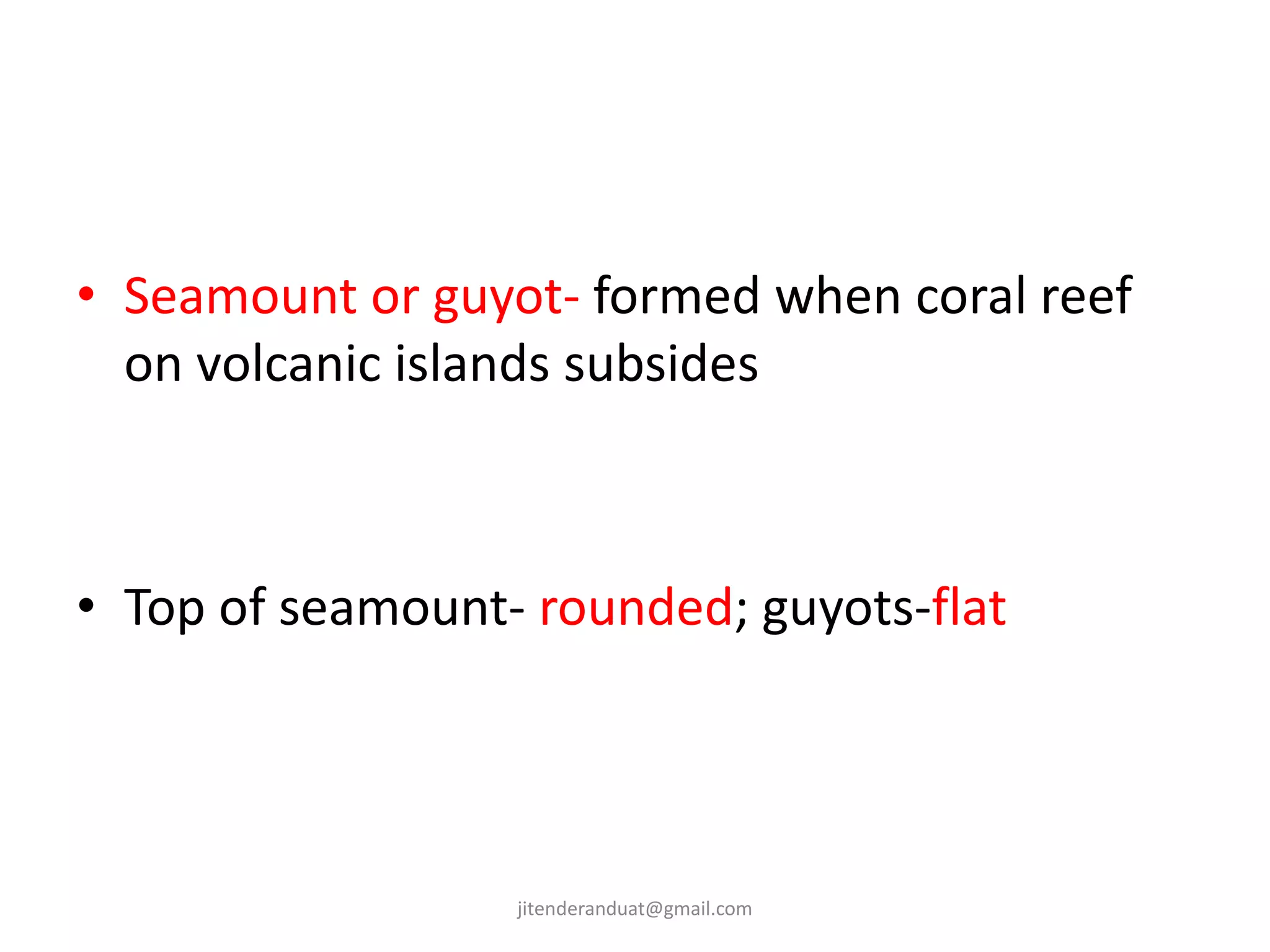
• Ribbon reef- long, narrow, possibly winding reef,
associated with an atoll lagoon
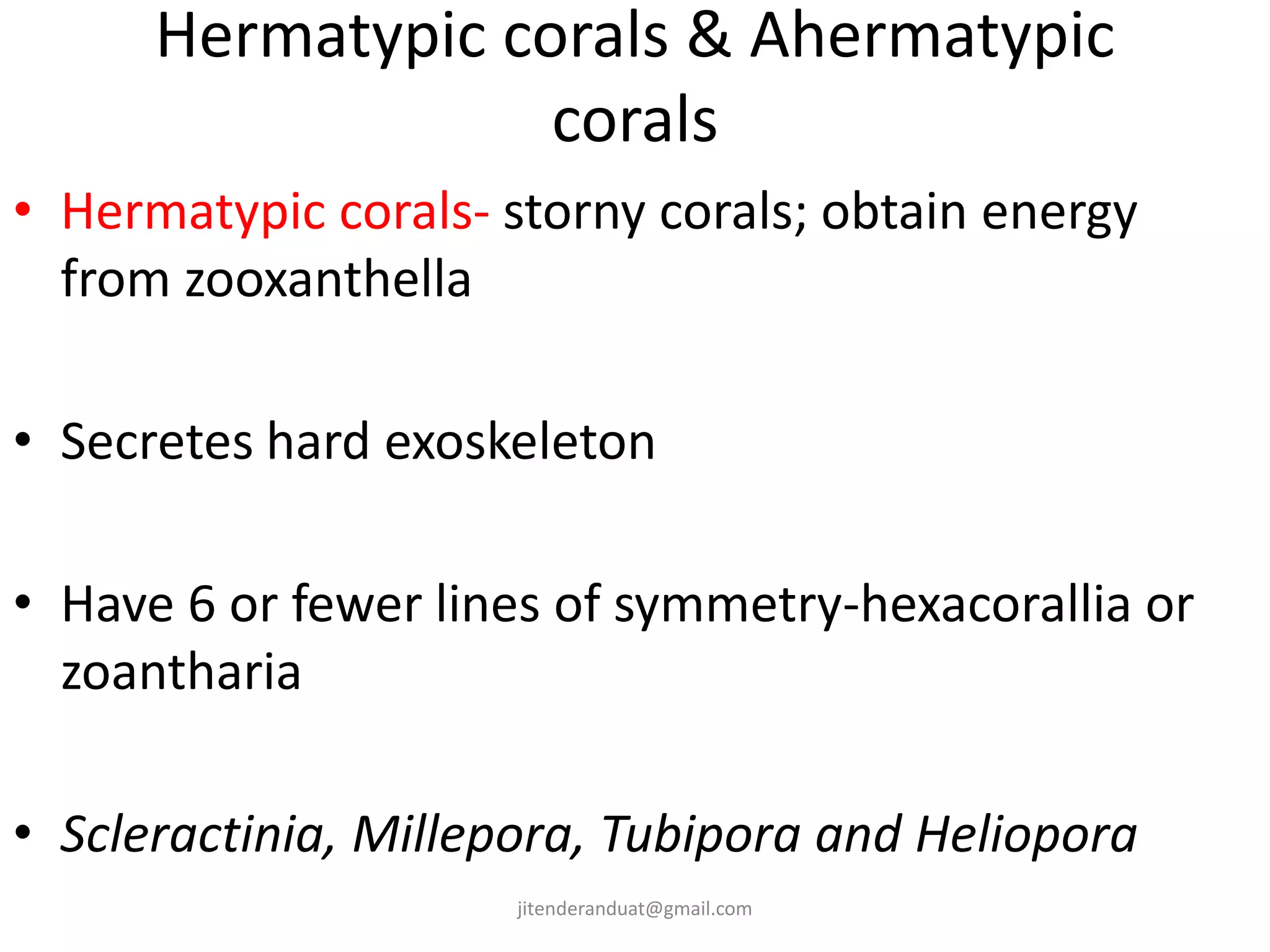
• Table reef-isolated atoll type without a lagoon
jitenderanduat@gmail.com
• Habili- Specific to red sea; does not reach the
surface, near enough to cause visible surf
• Cays- small, low elevation, sandy islands formed on
the surface of coral reefs from eroded material,
forms an area above sealevel
jitenderanduat@gmail.com
• Seamount or guyot- formed when coral reef
on volcanic islands subsides
• Top of seamount- rounded; guyots-flat
jitenderanduat@gmail.com
Hermatypic corals & Ahermatypic
corals
• Hermatypic corals- storny corals; obtain energy
from zooxanthella
• Secretes hard exoskeleton
• Have 6 or fewer lines of symmetry-hexacorallia or
zoantharia
• Scleractinia, Millepora, Tubipora and Heliopora
jitenderanduat@gmail.com
• Ahermatypic corals- have no zooxanthella, soft
corals
• have eight tentacles –octocorallia
• flexible, undulating in the current, and often are
perforated, with a lacy appearance
• skeletons are proteinaceousjitenderanduat@gmail.com
Distribution of coral reefs
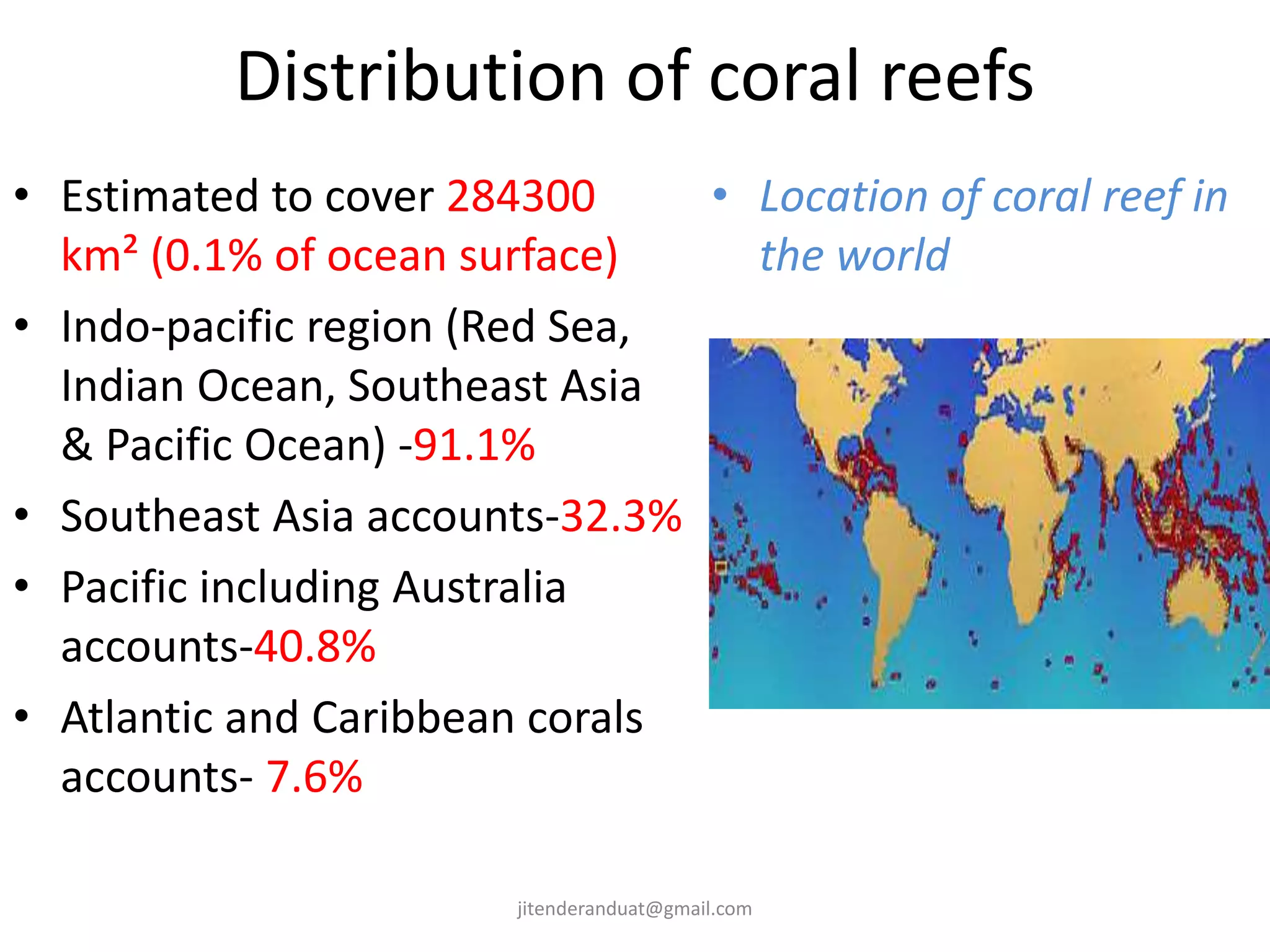
• Estimated to cover 284300
km² (0.1% of ocean surface)
• Indo-pacific region (Red Sea,
Indian Ocean, Southeast Asia
& Pacific Ocean) -91.1%
• Southeast Asia accounts-32.3%
• Pacific including Australia
accounts-40.8%
• Atlantic and Caribbean corals
accounts- 7.6%
• Location of coral reef in
the world
jitenderanduat@gmail.com
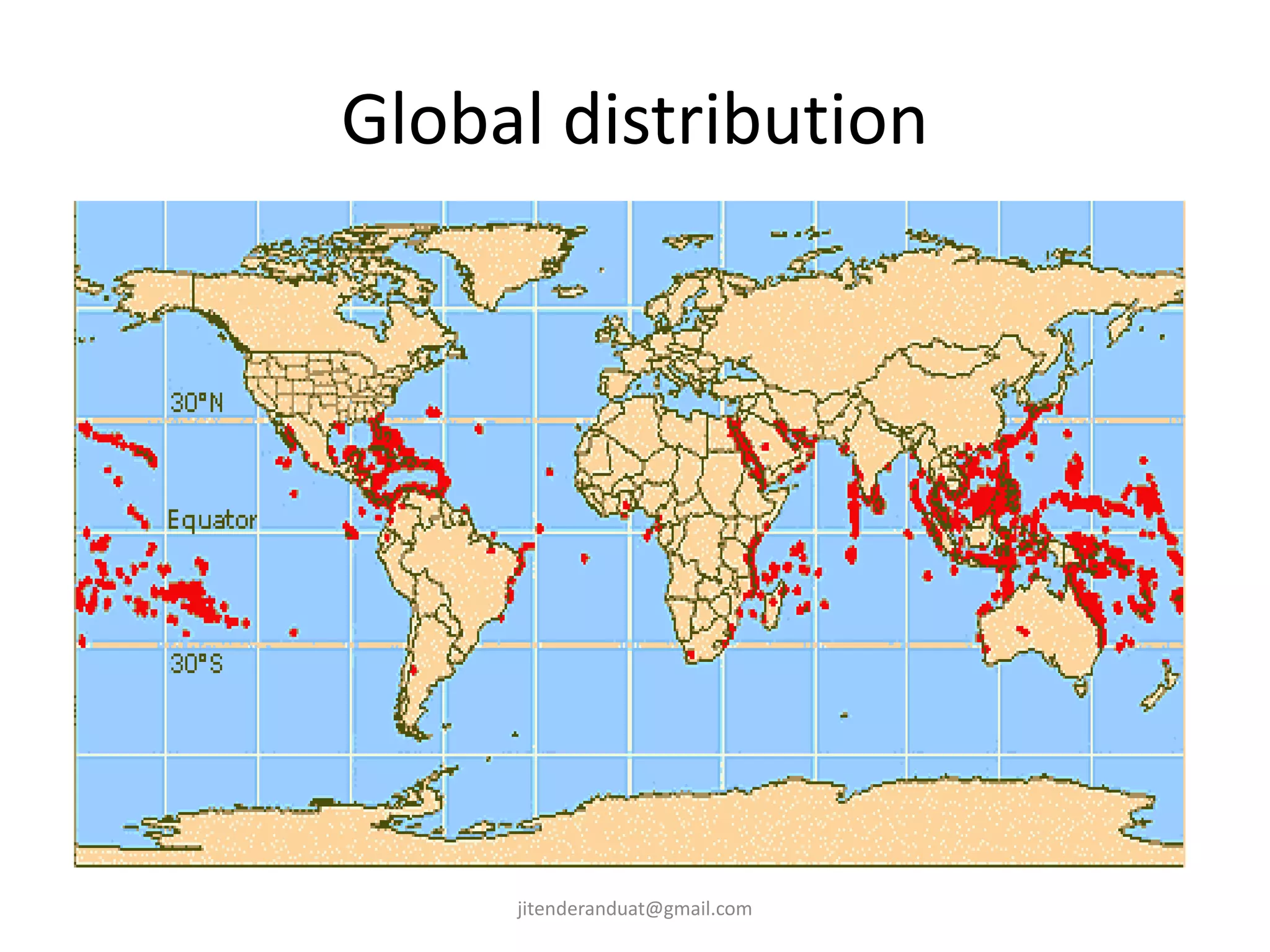
Global distribution
jitenderanduat@gmail.com
Distribution of coral reefs in various
oceans
• Persian Gulf and Red Sea- contain a small
percentage of world’s coral reefs
• Indian Ocean-24% of the world’s coral reefs; occur
between the coastal lines of India and Srilanka
towards north, Thailand, Malaysia and Indonesia to
the NE, entrances to the Red Sea and Persian Gulf,
Yemen, Oman, Somalia northern Kenya and
Madagascar to the west and Australia to the east
jitenderanduat@gmail.com
• Southeast Asia- 30% of the world’s coral reefs;
from Philippines to western Indonesia
• Caribbean- 14% of the world’s coral reefs;
includes Caribbean Sea, Gulf of Mexico, South
Florida, the Bahamas and North Brazil
jitenderanduat@gmail.com
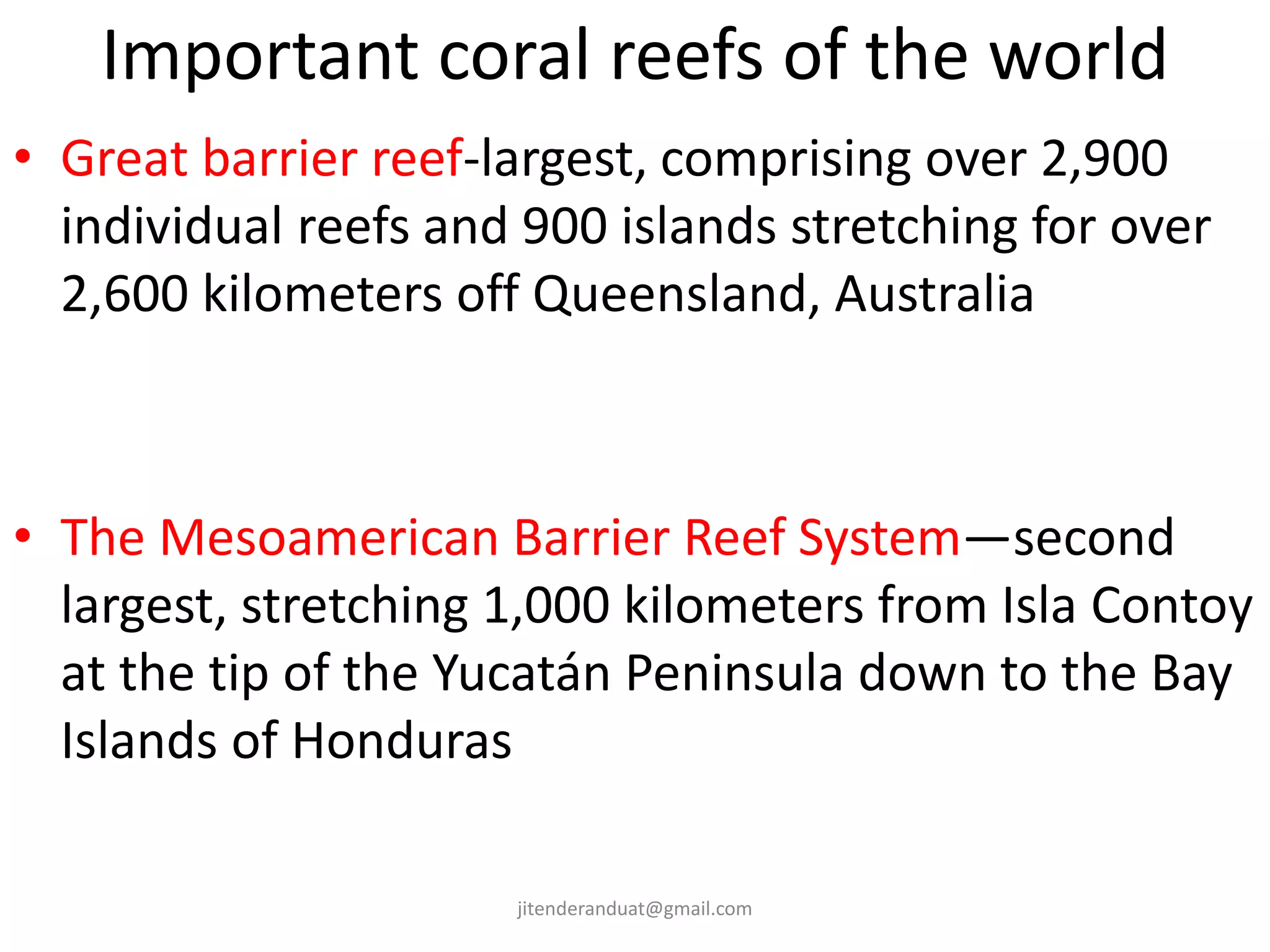
• Pacific Ocean Region- 25%
of the world’s coral reefs;
western Pacific supports
richest reef biota, include
Micronesia, Palau, Papua
New Guinea and Vanuatu
Distribution of coldwater and tropical coral
reefs
jitenderanduat@gmail.com
• Coral reefs are rare along west coast of Americas
and Africa- upwelling & strong cold coastal currents
• Seldom found along the coastline of South Asia
(eastern tip of India, Bangladesh & Myanmar);
northeastern coast of South America
jitenderanduat@gmail.com
Important coral reefs of the world
• Great barrier reef-largest, comprising over 2,900
individual reefs and 900 islands stretching for over
2,600 kilometers off Queensland, Australia
• The Mesoamerican Barrier Reef System—second
largest, stretching 1,000 kilometers from Isla Contoy
at the tip of the Yucatán Peninsula down to the Bay
Islands of Honduras
jitenderanduat@gmail.com
• The New Caledonia Barrier Reef—second
longest double barrier reef, covering 1,500
kilometers
• The Andros, Bahamas Barrier Reef-third
largest, following the east coast of Andros
Island, Bahamas, between Andros and Nassau
jitenderanduat@gmail.com
• The Red Sea-includes 6000-year-old fringing reefs
located around a 2,000 km coastline
• The Florida Reef Tract-largest continental US reef,
extends from Soldier Key, located in Biscayne Bay, to
the Dry Tortugas in the Gulf of Mexico
• Pulley Ridge-deepest photosynthetic coral reef,
Florida
jitenderanduat@gmail.com
• The Philippines coral reef area, the second largest in
Southeast Asia, is estimated at 26,000 square
kilometers and holds an extraordinary diversity of
species.
• The Raja Ampat Islands in Indonesia's West Papua
province offer the highest known marine diversity
jitenderanduat@gmail.com
Coral reefs in India
• Palk Bay
• The Gulf of Mannar
• Andaman and Nicobar Group of Islands.
• The Gulf of Kutch
• The Lakshadweep Islands
jitenderanduat@gmail.com
Importance of coral reefs
• Prevent sediments from washing up & damaging
the shoreline
• Act as physical barrier; creates healthier, protected
coastline habitat
jitenderanduat@gmail.com
• Sequesters CO₂, create an environment which
attract marine biodiversity
• Provides economic benefits
• Harvested for medicinal & jewellery purposes
jitenderanduat@gmail.com
• Critical habitats essential for the maintenance of
biodiversity.
• Tourism (generation of foreign exchange).
• Support fisheries.
jitenderanduat@gmail.com
References
• Biswas, K.P., Corals of Tropical Oceans, Daya
Publishing House 2008, pp 1-13
• www.wikipedia.org
• http://www.oceanworld.tamu
• http://www.com.univ
• http://www.marbef.org
• www.perf.org
jitenderanduat@gmail.com

Types of coral reefs and its distribution

  • 1.
    Coral reefs- itstypes and distribution Rehana Raj DFK 1307 I Ph.D College of Fisheries Mangalore jitenderanduat@gmail.com
  • 2.
    Introduction • Belong tothe Phylum: Cnideria, Class: Anthozoa • Under water structures made from CaCo₃ • Colonies of tiny animals called polyps or coral polyps jitenderanduat@gmail.com
  • 3.
    • Polyp- likea tin can open at just one end; has mouth surrounded by a ring of tentacles • Have stinging cells or nematocysts • Feeds on zooxanthellae jitenderanduat@gmail.com
  • 4.
    • Nematocysts helpcoral catch food • They also help protect the coral • When the cell is stimulated, it releases a sharp barb • The barb will fire and catch the food and bring it back towards the mouth jitenderanduat@gmail.com
  • 5.
    • Symbiotic relationship •Zooxanthella is an algae that lives in the skin of coral • Coral provides protection • Zooxanthella provides food and color! jitenderanduat@gmail.com
  • 6.
    • Algae receiveprotection and nutrients (carbon dioxide, nitrogen and phosphorus) • Algae supply amino acids, fatty acids, and sugars to the corals. jitenderanduat@gmail.com
  • 7.
    • Principal organism-Hard corals • Planula larvae settles down and attaches itself to hard substrate • Larvae develop into coral polyp jitenderanduat@gmail.com
  • 8.
    • Secrets calciumcarbonate around its body • Colony grows by asexual reproduction • Some polyp develops gonads and able to reproduce sexually jitenderanduat@gmail.com
  • 9.
    • Secretes hardexoskeleton- support and protect their bodies • Grow best in warm, shallow, sunny, clear, agitated water • Referred as ‘rainforests of the sea’- diverse ecosystem jitenderanduat@gmail.com
  • 10.
    • Occupy lessthan 1% of the world ocean surface • Home for 25% of the all marine species • Annual global economic value- US$ 375 billion jitenderanduat@gmail.com
  • 11.
    Zonation of coralreefs • Reef front/ fore reef- on the seaward side,rise of reefs from lower depth of ocean to just or just below the surface of water • Reef drop off- the slope of this front forms a vertical wall jitenderanduat@gmail.com
  • 12.
    • Spur &groove formation-reef front usually form a finger like arrangements; breaks the wave energy & prevents the damage • Grooves are sand filled; allow sediment to channel down & away from coral reefs jitenderanduat@gmail.com
  • 13.
    • Reef crest-highest point of reef • Reef flat/ back reef-portion which is more inward to land; area is having high variability, made up of rocks, sand etc • Reef ends at shoreline or descends into lagoon jitenderanduat@gmail.com
  • 14.
    Specific features • Temperature:26-27C – Depth: Less than 80 ft to 230 feet – Salinity: Normal salt levels (35ppt) – Light: Zooxanthellae need light to survive – Sedimentation: Being covered with silt interferes with photosynthesis – Desiccation: being exposed to air. The corals will die if exposed too long • Coral likes areas with lots of waves: – They are strong enough to withstand the pressure – New water means more food – Waves remove silt – New water brings more oxygen 300N and S of the equator jitenderanduat@gmail.com
  • 15.
    Types of coralreefs • Fringing reef- directly attached to a shore or borders it with an intervening shallow channel or lagoon Eg: Greater Caribbean region • Barrier reef- separated from a mainland or island shores by deep channel or lagoon Eg: Great Barrier Reef • Atoll reef- more or less circular or continuous barrier reefs extends all the way around a lagoon without a central island Eg: The Pacific Oceanjitenderanduat@gmail.com
  • 16.
    Other reef types •Patch reef-common, isolated, comparitively, small reef usually within a lagoon or embayment; often circular, surrounded by sand or seagrass • Apron reef- short reef resembling a fringing reef, but more sloped, extending out and downward from a point or peninsular shore jitenderanduat@gmail.com
  • 17.
    • Bank reef-linear or semicircular shaped; larger than patch reef • Ribbon reef- long, narrow, possibly winding reef, associated with an atoll lagoon • Table reef-isolated atoll type without a lagoon jitenderanduat@gmail.com
  • 18.
    • Habili- Specificto red sea; does not reach the surface, near enough to cause visible surf • Cays- small, low elevation, sandy islands formed on the surface of coral reefs from eroded material, forms an area above sealevel jitenderanduat@gmail.com
  • 19.
    • Seamount orguyot- formed when coral reef on volcanic islands subsides • Top of seamount- rounded; guyots-flat jitenderanduat@gmail.com
  • 20.
    Hermatypic corals &Ahermatypic corals • Hermatypic corals- storny corals; obtain energy from zooxanthella • Secretes hard exoskeleton • Have 6 or fewer lines of symmetry-hexacorallia or zoantharia • Scleractinia, Millepora, Tubipora and Heliopora jitenderanduat@gmail.com
  • 21.
    • Ahermatypic corals-have no zooxanthella, soft corals • have eight tentacles –octocorallia • flexible, undulating in the current, and often are perforated, with a lacy appearance • skeletons are proteinaceousjitenderanduat@gmail.com
  • 22.
    Distribution of coralreefs • Estimated to cover 284300 km² (0.1% of ocean surface) • Indo-pacific region (Red Sea, Indian Ocean, Southeast Asia & Pacific Ocean) -91.1% • Southeast Asia accounts-32.3% • Pacific including Australia accounts-40.8% • Atlantic and Caribbean corals accounts- 7.6% • Location of coral reef in the world jitenderanduat@gmail.com
  • 23.
  • 24.
    Distribution of coralreefs in various oceans • Persian Gulf and Red Sea- contain a small percentage of world’s coral reefs • Indian Ocean-24% of the world’s coral reefs; occur between the coastal lines of India and Srilanka towards north, Thailand, Malaysia and Indonesia to the NE, entrances to the Red Sea and Persian Gulf, Yemen, Oman, Somalia northern Kenya and Madagascar to the west and Australia to the east jitenderanduat@gmail.com
  • 25.
    • Southeast Asia-30% of the world’s coral reefs; from Philippines to western Indonesia • Caribbean- 14% of the world’s coral reefs; includes Caribbean Sea, Gulf of Mexico, South Florida, the Bahamas and North Brazil jitenderanduat@gmail.com
  • 26.
    • Pacific OceanRegion- 25% of the world’s coral reefs; western Pacific supports richest reef biota, include Micronesia, Palau, Papua New Guinea and Vanuatu Distribution of coldwater and tropical coral reefs jitenderanduat@gmail.com
  • 27.
    • Coral reefsare rare along west coast of Americas and Africa- upwelling & strong cold coastal currents • Seldom found along the coastline of South Asia (eastern tip of India, Bangladesh & Myanmar); northeastern coast of South America jitenderanduat@gmail.com
  • 28.
    Important coral reefsof the world • Great barrier reef-largest, comprising over 2,900 individual reefs and 900 islands stretching for over 2,600 kilometers off Queensland, Australia • The Mesoamerican Barrier Reef System—second largest, stretching 1,000 kilometers from Isla Contoy at the tip of the Yucatán Peninsula down to the Bay Islands of Honduras jitenderanduat@gmail.com
  • 29.
    • The NewCaledonia Barrier Reef—second longest double barrier reef, covering 1,500 kilometers • The Andros, Bahamas Barrier Reef-third largest, following the east coast of Andros Island, Bahamas, between Andros and Nassau jitenderanduat@gmail.com
  • 30.
    • The RedSea-includes 6000-year-old fringing reefs located around a 2,000 km coastline • The Florida Reef Tract-largest continental US reef, extends from Soldier Key, located in Biscayne Bay, to the Dry Tortugas in the Gulf of Mexico • Pulley Ridge-deepest photosynthetic coral reef, Florida jitenderanduat@gmail.com
  • 31.
    • The Philippinescoral reef area, the second largest in Southeast Asia, is estimated at 26,000 square kilometers and holds an extraordinary diversity of species. • The Raja Ampat Islands in Indonesia's West Papua province offer the highest known marine diversity jitenderanduat@gmail.com
  • 32.
    Coral reefs inIndia • Palk Bay • The Gulf of Mannar • Andaman and Nicobar Group of Islands. • The Gulf of Kutch • The Lakshadweep Islands jitenderanduat@gmail.com
  • 33.
    Importance of coralreefs • Prevent sediments from washing up & damaging the shoreline • Act as physical barrier; creates healthier, protected coastline habitat jitenderanduat@gmail.com
  • 34.
    • Sequesters CO₂,create an environment which attract marine biodiversity • Provides economic benefits • Harvested for medicinal & jewellery purposes jitenderanduat@gmail.com
  • 35.
    • Critical habitatsessential for the maintenance of biodiversity. • Tourism (generation of foreign exchange). • Support fisheries. jitenderanduat@gmail.com
  • 36.
    References • Biswas, K.P.,Corals of Tropical Oceans, Daya Publishing House 2008, pp 1-13 • www.wikipedia.org • http://www.oceanworld.tamu • http://www.com.univ • http://www.marbef.org • www.perf.org jitenderanduat@gmail.com
  • 37.