Dr. Zaib Jahan
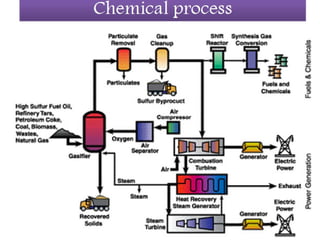
Role of Chemical Engineer
• Chemical engineers translate processes developed in the lab into
practical applications for the commercial production of products
and then work to maintain and improve those processes
• They rely on the main foundations of engineering: math, physics,
and chemistry (though biology is playing an increasing role)
• The main role of chemical engineers is to design and
troubleshoot processes for the production
• They are most often employed by large-scale manufacturing
plants to maximize productivity and product quality while
minimizing costs
Introduction
• Mechanics: The oldest physical science that deals with both
stationary and moving bodies under the influence of forces.
• Statics: The branch of mechanics that deals with bodies at
rest.
• Dynamics: The branch that deals with bodies in motion.
• Fluid mechanics: The science that deals with the behavior of
fluids at rest (fluid statics) or in motion (fluid dynamics), and
the interaction of fluids with solids or other fluids at the
boundaries.
• Fluid dynamics: Fluid mechanics is also referred to as fluid
dynamics by considering fluids at rest as a special case of
motion with zero velocity.
• Hydrodynamics: The study of the motion of fluids that can be
approximated as incompressible (such as liquids, especially water,
and gases at low speeds).
• Hydraulics: A subcategory of hydrodynamics, which deals with
liquid flows in pipes and open channels.
• Gas dynamics: Deals with the flow of fluids that undergo significant
density changes, such as the flow of gases through nozzles at high
speeds.
• Aerodynamics: Deals with the flow of gases (especially air) over
bodies such as aircraft, rockets, and automobiles at high or low
speeds.
• Meteorology, oceanography, and hydrology: Deal with naturally
occurring flows.
Introduction
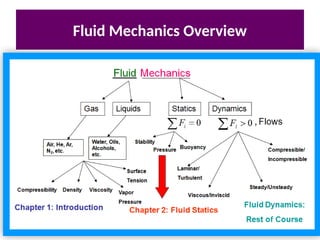
Fluid Mechanics Overview
Fluid Statics & Its Applications
Nature of Fluid
• A fluid is a substance that does not permanently resist
distortion.
• Attempt to change the shape of fluid mass results in layers of
fluid sliding over one another until a new shape is attained.
• Shear stress exists during shape change which depends upon
viscosity of fluid and rate of sliding but when final form is
achieved, all shear stresses disappear.
• There is no shear stress on fluid in equilibrium condition.
• Density depends upon temperature and pressure of fluid.
• Slight change in density with moderate changes in temperature
and pressure is a property of incompressible fluid.
• If the density change is significant, then fluid is said to be
compressible.
• Basic property of static fluid is pressure.
• Pressure is a surface force exerted by a fluid against the
walls of its container.
• Pressure also exerts at every point within a volume of fluid.
Pressure Concept
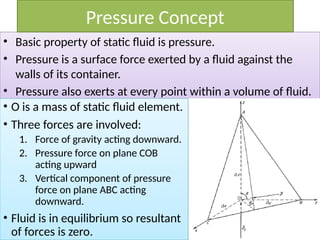
• O is a mass of static fluid element.
• Three forces are involved:
1. Force of gravity acting downward.
2. Pressure force on plane COB
acting upward
3. Vertical component of pressure
force on plane ABC acting
downward.
• Fluid is in equilibrium so resultant
of forces is zero.
Forces on a Fluid Mass
• Body force (gravitational, electric or magnetic
fields).
• Surface force, represents the action of the
surrounding fluid on the element under
consideration(Shear or Normal pressure).
• Pressure force, for a stationary fluid the force
exerted is normal to the surface of the
containing vessel. this normal surface force is
called as pressure force.
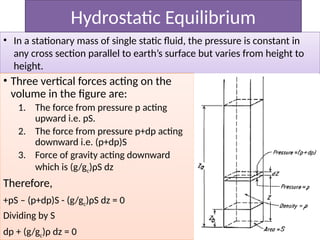
• In a stationary mass of single static fluid, the pressure is constant in
any cross section parallel to earth’s surface but varies from height to
height.
Hydrostatic Equilibrium
• Three vertical forces acting on the
volume in the figure are:
1. The force from pressure p acting
upward i.e. pS.
2. The force from pressure p+dp acting
downward i.e. (p+dp)S
3. Force of gravity acting downward
which is (g/gc)ρS dz
Therefore,
+pS – (p+dp)S - (g/gc)ρS dz = 0
Dividing by S
dp + (g/gc)ρ dz = 0
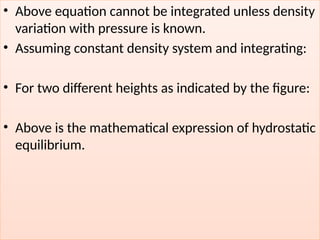
• Above equation cannot be integrated unless density
variation with pressure is known.
• Assuming constant density system and integrating:
• For two different heights as indicated by the figure:
• Above is the mathematical expression of hydrostatic
equilibrium.
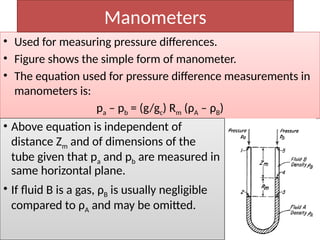
• Used for measuring pressure differences.
• Figure shows the simple form of manometer.
• The equation used for pressure difference measurements in
manometers is:
pa – pb = (g/gc) Rm (ρA – ρB)
Manometers
• Above equation is independent of
distance Zm and of dimensions of the
tube given that pa and pb are measured in
same horizontal plane.
• If fluid B is a gas, ρB is usually negligible
compared to ρA and may be omitted.
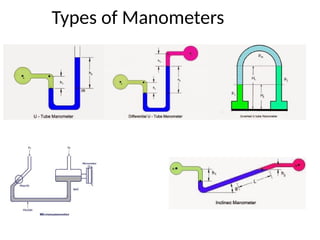
Types of Manometers
Numerical Problems
• A manometer is used to measure the pressure drop across and
orifice. Liquid A is mercury (density = 13,590 kg/m3
) and fluid B
flowing through orifice and filling the manometer leads, is
brine (density = 1260 kg/m3
). When the pressure at taps are
equal, the level of mercury in manometer is 0.9 m below the
orifice taps. Under operating conditions, the upstream tap
gauge pressure is 0.14 bar and downstream tap pressure is 250
mmHg below atmospheric. What is the reading of manometer
in millimeters?
• A simple U-tube manometer is installed across an orifice
meter. The manometer is filled with mercury (specific gravity
13.6) and liquid above mercury is carbon tetrachloride (specific
gravity 1.6). The manometer reads 200mm. What is the
pressure difference over the manometer in newtons per
square meter?
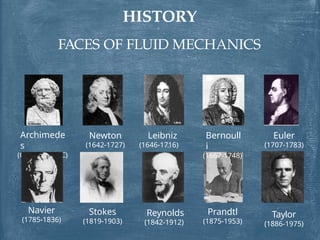
HISTORY
FACES OF FLUID MECHANICS
Archimede
s
(C. 287-212 BC)
Newton
(1642-1727)
Leibniz
(1646-1716)
Euler
(1707-1783)
Navier
(1785-1836)
Stokes
(1819-1903)
Reynolds
(1842-1912)
Prandtl
(1875-1953)
Bernoull
i
(1667-1748)
Taylor
(1886-1975)
Fluids omnipresent
Weather & climate
Vehicles: automobiles, trains, ships & planes, etc.
Environment
Physiology and medicine
Sports & recreation
Many other examples!
SIGNIFICANCE
WEATHER & CLIMATE
Tornadoes Thunderstorm
Global Climate
Hurricanes
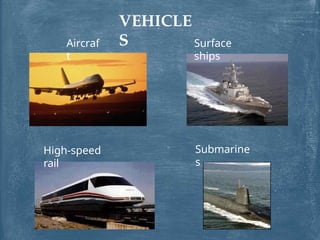
VEHICLE
S
Aircraf
t
Submarine
s
High-speed
rail
Surface
ships
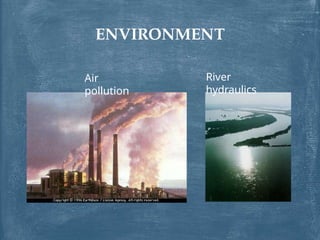
ENVIRONMENT
Air
pollution
River
hydraulics
PHYSIOLOGY & MEDICINE
Blood
pump
Ventricular assist
device
SPORTS & RECREATION
Water
sports
Cyclin
g
Offshore
racing
Auto
racing
Surfin
g
DAMS AND RESERVOIRS
AIRCRAFT & SOUND
BARRIER
WASTEWATER TREATMENT PLANTS
WATER DISTRIBUTION
Fluid
Properties
AND
Units &
Dimensions
DEFINITION
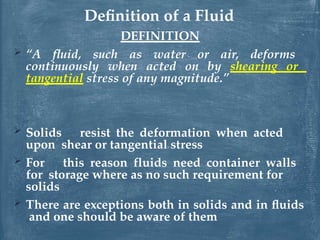
 “A fluid, such as water or air, deforms
continuously when acted on by shearing or
tangential stress of any magnitude.”
 Solids resist the deformation when acted
upon shear or tangential stress
 For this reason fluids need container walls
for storage where as no such requirement for
solids
 There are exceptions both in solids and in fluids
and one should be aware of them
Definition of a Fluid
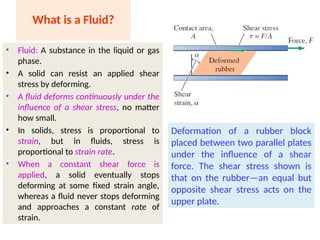
• Fluid: A substance in the liquid or gas
phase.
• A solid can resist an applied shear
stress by deforming.
• A fluid deforms continuously under the
influence of a shear stress, no matter
how small.
• In solids, stress is proportional to
strain, but in fluids, stress is
proportional to strain rate.
• When a constant shear force is
applied, a solid eventually stops
deforming at some fixed strain angle,
whereas a fluid never stops deforming
and approaches a constant rate of
strain.
Deformation of a rubber block
placed between two parallel plates
under the influence of a shear
force. The shear stress shown is
that on the rubber—an equal but
opposite shear stress acts on the
upper plate.
What is a Fluid?
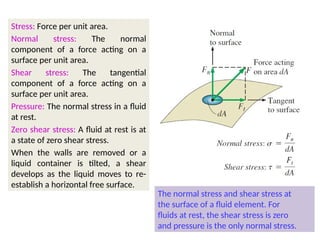
Stress: Force per unit area.
Normal stress: The normal
component of a force acting on a
surface per unit area.
Shear stress: The tangential
component of a force acting on a
surface per unit area.
Pressure: The normal stress in a fluid
at rest.
Zero shear stress: A fluid at rest is at
a state of zero shear stress.
When the walls are removed or a
liquid container is tilted, a shear
develops as the liquid moves to re-
establish a horizontal free surface.
The normal stress and shear stress at
the surface of a fluid element. For
fluids at rest, the shear stress is zero
and pressure is the only normal stress.
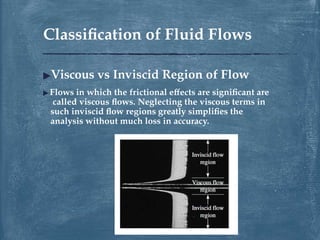
▶Viscous vs Inviscid Region of Flow
▶ Flows in which the frictional effects are significant are
called viscous flows. Neglecting the viscous terms in
such inviscid flow regions greatly simplifies the
analysis without much loss in accuracy.
Classification of Fluid Flows
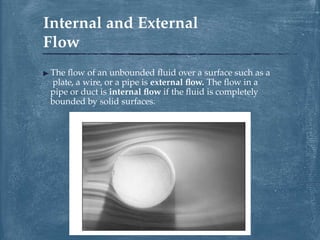
▶ The flow of an unbounded fluid over a surface such as a
plate, a wire, or a pipe is external flow. The flow in a
pipe or duct is internal flow if the fluid is completely
bounded by solid surfaces.
Internal and External
Flow
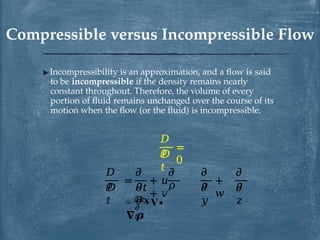
▶ Incompressibility is an approximation, and a flow is said
to be incompressible if the density remains nearly
constant throughout. Therefore, the volume of every
portion of fluid remains unchanged over the course of its
motion when the flow (or the fluid) is incompressible.
Compressible versus Incompressible Flow
𝐷
𝜌
𝐷
𝑡
=
0
𝐷
𝜌
𝐷
𝑡
=
𝜕
𝜌
𝜕
𝜌
𝜕𝑡
𝜕𝑥
+ 𝑢
+ 𝑣
𝜕
𝜌
𝜕
𝑦
+
𝑤
𝜕
𝜌
𝜕
𝑧
𝜕
𝑡
= 𝜕𝜌
+V∙
𝛁𝝆
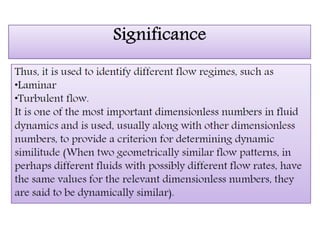
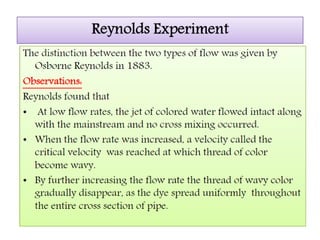
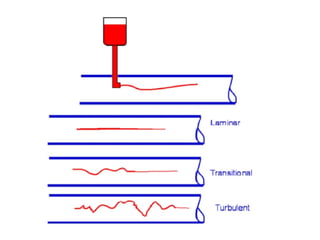
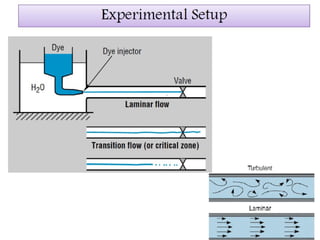
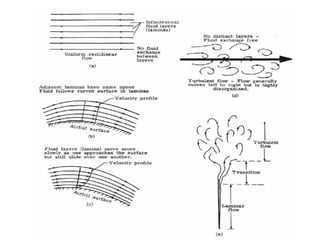
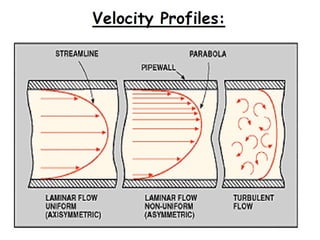
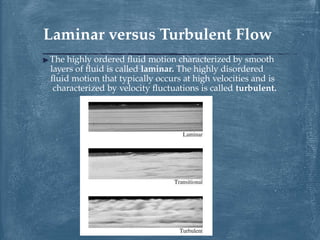
▶ The highly ordered fluid motion characterized by smooth
layers of fluid is called laminar. The highly disordered
fluid motion that typically occurs at high velocities and is
characterized by velocity fluctuations is called turbulent.
Laminar versus Turbulent Flow
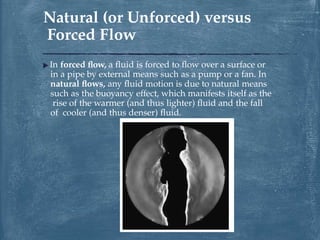
▶ In forced flow, a fluid is forced to flow over a surface or
in a pipe by external means such as a pump or a fan. In
natural flows, any fluid motion is due to natural means
such as the buoyancy effect, which manifests itself as the
rise of the warmer (and thus lighter) fluid and the fall
of cooler (and thus denser) fluid.
Natural (or Unforced) versus
Forced Flow
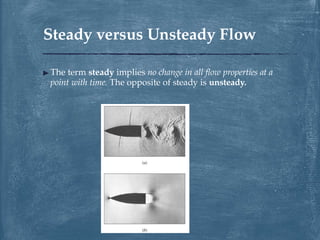
▶ The term steady implies no change in all flow properties at a
point with time. The opposite of steady is unsteady.
Steady versus Unsteady Flow
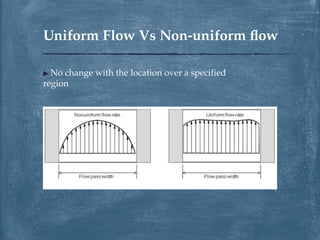
▶ No change with the location over a specified
region
Uniform Flow Vs Non-uniform flow
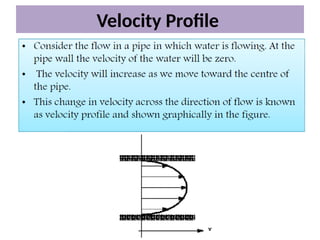
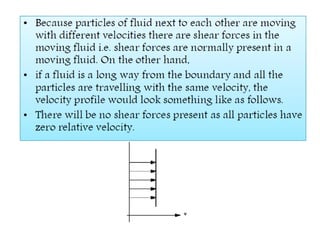
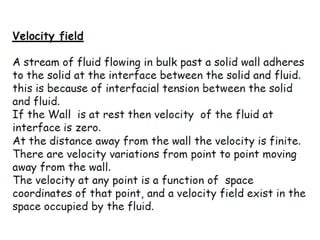
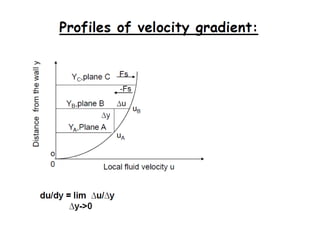
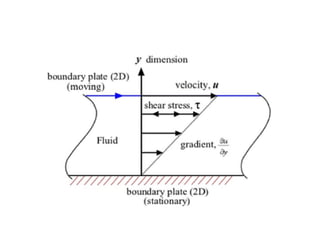
Velocity Profile
Important Parameters
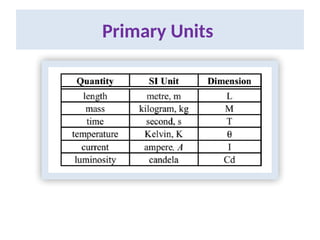
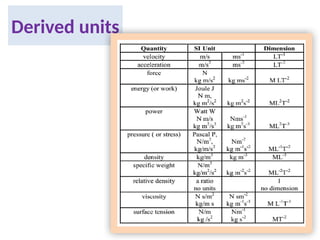
• Mass density
• Specific weight
• Specific volume
• Specific gravity
• Viscosity
– Absolute viscosity
– Dynamic viscosity
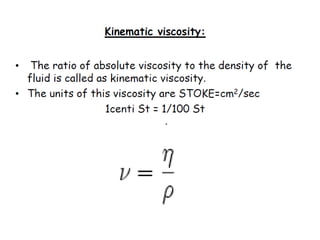
– Kinematic viscosity
Primary Units
Derived units
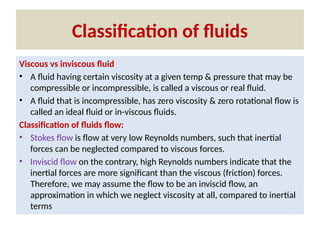
Classification of fluids
Viscous vs inviscous fluid
• A fluid having certain viscosity at a given temp & pressure that may be
compressible or incompressible, is called a viscous or real fluid.
• A fluid that is incompressible, has zero viscosity & zero rotational flow is
called an ideal fluid or in-viscous fluids.
Classification of fluids flow:
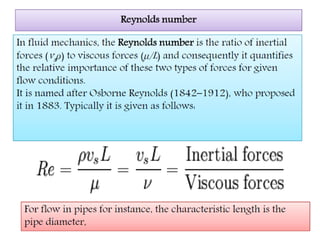
• Stokes flow is flow at very low Reynolds numbers, such that inertial
forces can be neglected compared to viscous forces.
• Inviscid flow on the contrary, high Reynolds numbers indicate that the
inertial forces are more significant than the viscous (friction) forces.
Therefore, we may assume the flow to be an inviscid flow, an
approximation in which we neglect viscosity at all, compared to inertial
terms
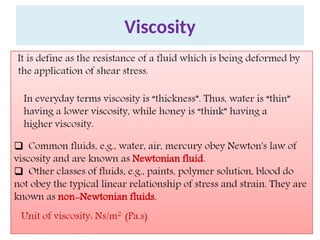
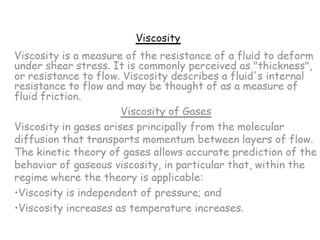
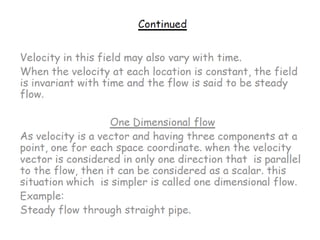
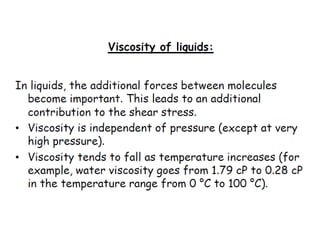
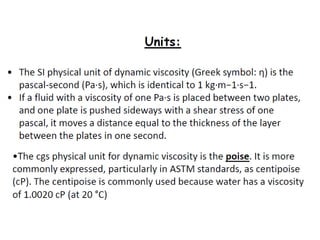
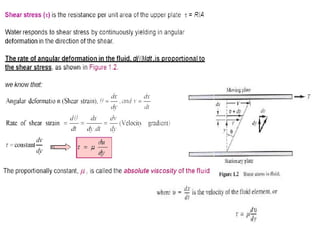
Viscosity
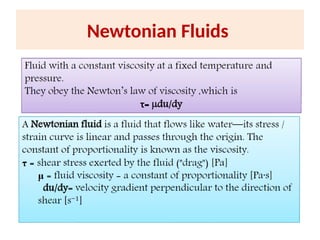
Newtonian Fluids
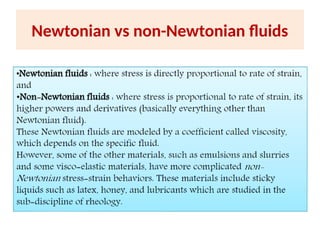
Newtonian vs non-Newtonian fluids
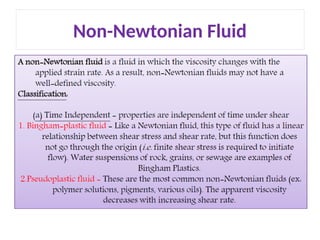
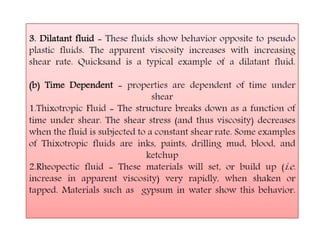
Non-Newtonian Fluid
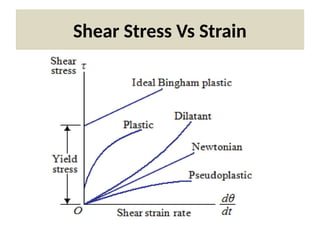
Shear Stress Vs Strain
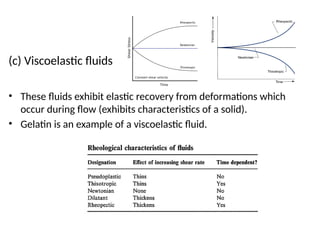
(c) Viscoelastic fluids
• These fluids exhibit elastic recovery from deformations which
occur during flow (exhibits characteristics of a solid).
• Gelatin is an example of a viscoelastic fluid.
fluid mechanics lectures nust university

fluid mechanics lectures nust university

  • 1.
  • 3.
    Role of ChemicalEngineer • Chemical engineers translate processes developed in the lab into practical applications for the commercial production of products and then work to maintain and improve those processes • They rely on the main foundations of engineering: math, physics, and chemistry (though biology is playing an increasing role) • The main role of chemical engineers is to design and troubleshoot processes for the production • They are most often employed by large-scale manufacturing plants to maximize productivity and product quality while minimizing costs
  • 6.
    Introduction • Mechanics: Theoldest physical science that deals with both stationary and moving bodies under the influence of forces. • Statics: The branch of mechanics that deals with bodies at rest. • Dynamics: The branch that deals with bodies in motion. • Fluid mechanics: The science that deals with the behavior of fluids at rest (fluid statics) or in motion (fluid dynamics), and the interaction of fluids with solids or other fluids at the boundaries. • Fluid dynamics: Fluid mechanics is also referred to as fluid dynamics by considering fluids at rest as a special case of motion with zero velocity.
  • 7.
    • Hydrodynamics: Thestudy of the motion of fluids that can be approximated as incompressible (such as liquids, especially water, and gases at low speeds). • Hydraulics: A subcategory of hydrodynamics, which deals with liquid flows in pipes and open channels. • Gas dynamics: Deals with the flow of fluids that undergo significant density changes, such as the flow of gases through nozzles at high speeds. • Aerodynamics: Deals with the flow of gases (especially air) over bodies such as aircraft, rockets, and automobiles at high or low speeds. • Meteorology, oceanography, and hydrology: Deal with naturally occurring flows. Introduction
  • 8.
  • 9.
    Fluid Statics &Its Applications
  • 10.
    Nature of Fluid •A fluid is a substance that does not permanently resist distortion. • Attempt to change the shape of fluid mass results in layers of fluid sliding over one another until a new shape is attained. • Shear stress exists during shape change which depends upon viscosity of fluid and rate of sliding but when final form is achieved, all shear stresses disappear. • There is no shear stress on fluid in equilibrium condition. • Density depends upon temperature and pressure of fluid. • Slight change in density with moderate changes in temperature and pressure is a property of incompressible fluid. • If the density change is significant, then fluid is said to be compressible.
  • 11.
    • Basic propertyof static fluid is pressure. • Pressure is a surface force exerted by a fluid against the walls of its container. • Pressure also exerts at every point within a volume of fluid. Pressure Concept • O is a mass of static fluid element. • Three forces are involved: 1. Force of gravity acting downward. 2. Pressure force on plane COB acting upward 3. Vertical component of pressure force on plane ABC acting downward. • Fluid is in equilibrium so resultant of forces is zero.
  • 12.
    Forces on aFluid Mass • Body force (gravitational, electric or magnetic fields). • Surface force, represents the action of the surrounding fluid on the element under consideration(Shear or Normal pressure). • Pressure force, for a stationary fluid the force exerted is normal to the surface of the containing vessel. this normal surface force is called as pressure force.
  • 13.
    • In astationary mass of single static fluid, the pressure is constant in any cross section parallel to earth’s surface but varies from height to height. Hydrostatic Equilibrium • Three vertical forces acting on the volume in the figure are: 1. The force from pressure p acting upward i.e. pS. 2. The force from pressure p+dp acting downward i.e. (p+dp)S 3. Force of gravity acting downward which is (g/gc)ρS dz Therefore, +pS – (p+dp)S - (g/gc)ρS dz = 0 Dividing by S dp + (g/gc)ρ dz = 0
  • 14.
    • Above equationcannot be integrated unless density variation with pressure is known. • Assuming constant density system and integrating: • For two different heights as indicated by the figure: • Above is the mathematical expression of hydrostatic equilibrium.
  • 15.
    • Used formeasuring pressure differences. • Figure shows the simple form of manometer. • The equation used for pressure difference measurements in manometers is: pa – pb = (g/gc) Rm (ρA – ρB) Manometers • Above equation is independent of distance Zm and of dimensions of the tube given that pa and pb are measured in same horizontal plane. • If fluid B is a gas, ρB is usually negligible compared to ρA and may be omitted.
  • 16.
  • 17.
    Numerical Problems • Amanometer is used to measure the pressure drop across and orifice. Liquid A is mercury (density = 13,590 kg/m3 ) and fluid B flowing through orifice and filling the manometer leads, is brine (density = 1260 kg/m3 ). When the pressure at taps are equal, the level of mercury in manometer is 0.9 m below the orifice taps. Under operating conditions, the upstream tap gauge pressure is 0.14 bar and downstream tap pressure is 250 mmHg below atmospheric. What is the reading of manometer in millimeters? • A simple U-tube manometer is installed across an orifice meter. The manometer is filled with mercury (specific gravity 13.6) and liquid above mercury is carbon tetrachloride (specific gravity 1.6). The manometer reads 200mm. What is the pressure difference over the manometer in newtons per square meter?
  • 20.
    HISTORY FACES OF FLUIDMECHANICS Archimede s (C. 287-212 BC) Newton (1642-1727) Leibniz (1646-1716) Euler (1707-1783) Navier (1785-1836) Stokes (1819-1903) Reynolds (1842-1912) Prandtl (1875-1953) Bernoull i (1667-1748) Taylor (1886-1975)
  • 21.
    Fluids omnipresent Weather &climate Vehicles: automobiles, trains, ships & planes, etc. Environment Physiology and medicine Sports & recreation Many other examples! SIGNIFICANCE
  • 22.
    WEATHER & CLIMATE TornadoesThunderstorm Global Climate Hurricanes
  • 23.
  • 24.
  • 25.
  • 26.
  • 27.
  • 28.
  • 29.
  • 30.
  • 31.
  • 32.
    DEFINITION  “A fluid,such as water or air, deforms continuously when acted on by shearing or tangential stress of any magnitude.”  Solids resist the deformation when acted upon shear or tangential stress  For this reason fluids need container walls for storage where as no such requirement for solids  There are exceptions both in solids and in fluids and one should be aware of them Definition of a Fluid
  • 33.
    • Fluid: Asubstance in the liquid or gas phase. • A solid can resist an applied shear stress by deforming. • A fluid deforms continuously under the influence of a shear stress, no matter how small. • In solids, stress is proportional to strain, but in fluids, stress is proportional to strain rate. • When a constant shear force is applied, a solid eventually stops deforming at some fixed strain angle, whereas a fluid never stops deforming and approaches a constant rate of strain. Deformation of a rubber block placed between two parallel plates under the influence of a shear force. The shear stress shown is that on the rubber—an equal but opposite shear stress acts on the upper plate. What is a Fluid?
  • 34.
    Stress: Force perunit area. Normal stress: The normal component of a force acting on a surface per unit area. Shear stress: The tangential component of a force acting on a surface per unit area. Pressure: The normal stress in a fluid at rest. Zero shear stress: A fluid at rest is at a state of zero shear stress. When the walls are removed or a liquid container is tilted, a shear develops as the liquid moves to re- establish a horizontal free surface. The normal stress and shear stress at the surface of a fluid element. For fluids at rest, the shear stress is zero and pressure is the only normal stress.
  • 35.
    ▶Viscous vs InviscidRegion of Flow ▶ Flows in which the frictional effects are significant are called viscous flows. Neglecting the viscous terms in such inviscid flow regions greatly simplifies the analysis without much loss in accuracy. Classification of Fluid Flows
  • 36.
    ▶ The flowof an unbounded fluid over a surface such as a plate, a wire, or a pipe is external flow. The flow in a pipe or duct is internal flow if the fluid is completely bounded by solid surfaces. Internal and External Flow
  • 37.
    ▶ Incompressibility isan approximation, and a flow is said to be incompressible if the density remains nearly constant throughout. Therefore, the volume of every portion of fluid remains unchanged over the course of its motion when the flow (or the fluid) is incompressible. Compressible versus Incompressible Flow 𝐷 𝜌 𝐷 𝑡 = 0 𝐷 𝜌 𝐷 𝑡 = 𝜕 𝜌 𝜕 𝜌 𝜕𝑡 𝜕𝑥 + 𝑢 + 𝑣 𝜕 𝜌 𝜕 𝑦 + 𝑤 𝜕 𝜌 𝜕 𝑧 𝜕 𝑡 = 𝜕𝜌 +V∙ 𝛁𝝆
  • 38.
    ▶ The highlyordered fluid motion characterized by smooth layers of fluid is called laminar. The highly disordered fluid motion that typically occurs at high velocities and is characterized by velocity fluctuations is called turbulent. Laminar versus Turbulent Flow
  • 39.
    ▶ In forcedflow, a fluid is forced to flow over a surface or in a pipe by external means such as a pump or a fan. In natural flows, any fluid motion is due to natural means such as the buoyancy effect, which manifests itself as the rise of the warmer (and thus lighter) fluid and the fall of cooler (and thus denser) fluid. Natural (or Unforced) versus Forced Flow
  • 40.
    ▶ The termsteady implies no change in all flow properties at a point with time. The opposite of steady is unsteady. Steady versus Unsteady Flow
  • 41.
    ▶ No changewith the location over a specified region Uniform Flow Vs Non-uniform flow
  • 42.
  • 44.
    Important Parameters • Massdensity • Specific weight • Specific volume • Specific gravity • Viscosity – Absolute viscosity – Dynamic viscosity – Kinematic viscosity
  • 45.
  • 46.
  • 47.
    Classification of fluids Viscousvs inviscous fluid • A fluid having certain viscosity at a given temp & pressure that may be compressible or incompressible, is called a viscous or real fluid. • A fluid that is incompressible, has zero viscosity & zero rotational flow is called an ideal fluid or in-viscous fluids. Classification of fluids flow: • Stokes flow is flow at very low Reynolds numbers, such that inertial forces can be neglected compared to viscous forces. • Inviscid flow on the contrary, high Reynolds numbers indicate that the inertial forces are more significant than the viscous (friction) forces. Therefore, we may assume the flow to be an inviscid flow, an approximation in which we neglect viscosity at all, compared to inertial terms
  • 48.
  • 54.
  • 55.
  • 57.
  • 59.
  • 60.
    (c) Viscoelastic fluids •These fluids exhibit elastic recovery from deformations which occur during flow (exhibits characteristics of a solid). • Gelatin is an example of a viscoelastic fluid.