Fluid and Electrolyte
Management of the Surgical
Patient

      Jaffar Alkhuzaie
      M.B.B.Ch, AFRCSI, CABS
Introduction

  Fluid and electrolyte management are
  paramount to the care of the surgical
  patient. Changes in both fluid volume
  and electrolyte composition occur
  preoperatively, intraoperatively, and
  post operatively, as well as in
  response to trauma and sepsis.
Case 1

 40 years old male
 SBO
 NGT 1500 ml
 Na 150
 K 2.9
Total Body Water

 50-60% of total body weight
 Who is having higher proportion of
 body weight as water? And Why?
   Males or Females
   Lean or Obese
   Young or elderly
Muscle and solid organs have higher
water content than fat and bone
Higher proportion of water in:
  Young
  Lean
  Males
Fluid Compartments
Composition of Fluid
Compartments
Classification of Body Fluid
Changes
  Normal Exchange of Fluid and Electrolytes
  Disturbances in Fluid Balance
  Volume Control
  Concentration Changes
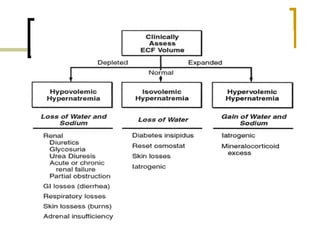
      Hyponatreamia
      Hypernatreamia
  Composition Changes
      Hyperkalemia
      Hypokalemia
      Hypermagnesemia
      Hypomagnesemia
      Hypercalcemia
      Hypocalcemia
      Hyperphosphatemia
      Hypophosphatemia
Case 2

 50 years old female
 Not know to have medical problem
 SBO due to adhesions
 On NGT
 Total intake 2700 ml
 Total out put 2800 ml
Normal Exchange

 Normal person consumes 2000ml of H2O
   75% oral intake
   Rest from solid foods
 Daily water losses
   1L in Urine
   250 ml in stool
   600 insensible losses
      Skin 75%
      Lungs 25%
Disturbances in Fluid Balance

  Extracellular volume deficit: most
  common in surgical patients
    Acute
      Cardiovascular
      Central nervous system
    Chronic
      Decrease skin turgor
      Sunken eyes
      & CVS and CNS
System             Volume Deficit          Volume Excess


Generalized        Weight loss           Weight gain
                   Decreased skin turgor Peripheral edema

Cardiac            *Tachycardia            *Increased cardiac
                   *Orthostasis/           output
                       hypotension         *Increased central
                   *Collapsed neck veins   venous pressure
                                           *Distended neck veins
                                           *Murmur
Renal              Oliguria
                   Azotemia

Gastrointestinal   Ileus                   Bowel edema


Pulmonary                                  Pulmonary edema
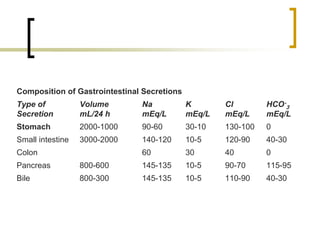
Composition of Gastrointestinal Secretions
Type of           Volume       Na            K       Cl        HCO-3
Secretion         mL/24 h      mEq/L         mEq/L   mEq/L     mEq/L
Stomach           2000-1000    90-60         30-10   130-100   0
Small intestine   3000-2000    140-120       10-5    120-90    40-30
Colon                          60            30      40        0
Pancreas          800-600      145-135       10-5    90-70     115-95
Bile              800-300      145-135       10-5    110-90    40-30
Case 3

 78 years old male
 Not know to have any medical problem
 Had sigmoid colectomy for Ca
 2nd day post op
 Na 130
Hyponatremia

   Causes
     Sodium depletion
     Sodium dilution
Sodium depletion
   Decrease intake
     Low Na diet
     Enteral feeds
   Increase loss
     Gastrointestinal Losses
        Vomiting
        Prolonged NGT suctioning
        Diarrhea
     Renal Losses
        Diuretics
        Primary renal disease
   Depletional hyponatreamia is often
   accompanied by extracellulr volume deficit
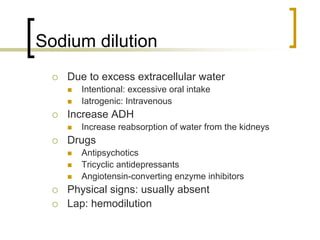
Sodium dilution
   Due to excess extracellular water
     Intentional: excessive oral intake
     Iatrogenic: Intravenous
   Increase ADH
     Increase reabsorption of water from the kidneys
   Drugs
     Antipsychotics
     Tricyclic antidepressants
     Angiotensin-converting enzyme inhibitors
   Physical signs: usually absent
   Lap: hemodilution
Hyperosmolar
  Mannitol
  Hyperglycemia
Pseudohyponatremia
  Plasma lipids
  Plasma proteins
Body System        Hyponatremia
Central            Headache, confusion, hyper- or hypoactive deep
nervous            tendon reflexes, seizures, coma, increased intracranial
system             pressure

Musculoskeletal    Weakness, fatigue, muscle cramps/twitching
Gastrointestinal   Anorexia, nausea, vomiting, watery diarrhea
Cardiovascular     Hypertension and bradycardia if significant increases
                   in intracranial pressure

Tissue             Lacrimation, salivation
Renal              Oliguria
Management of Hyponatremia

 Exclude Hyperosmolar causes
 Depletion versus dilution
 Dehydration or over hydrated
 Normal volume >>evaluate ADH
 Na losses
   Urine Na <20 mEq/L = extrarenal
   Urine Na >20 mEq/L = Renal
Free water restriction
If sever administration Na
If neuralgic symptoms are present
  3% N.S
  No more than 1 mEq/L per hour
  Untill reaches 130 mEq/L or neurological
  symptoms improve
If asymptomatic
  0.5 mEq/L per hour maximum 12 mEq/L per day
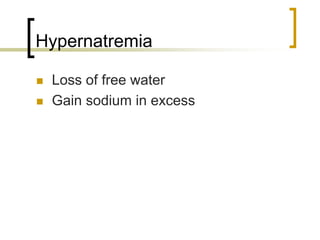
Hypernatremia

 Loss of free water
 Gain sodium in excess
Body System       Hypernatremia

Central nervous   Restlessness, lethargy, ataxia, irritability, tonic spasms,
system            delirium, seizures, coma

Musculoskeletal   Weakness

Cardiovascular    Tachycardia, hypotension, syncope

Tissue            Dry sticky mucous membranes, red swollen tongue,
                  decreased saliva and tears

Renal             Oliguria

Metabolic         Fever
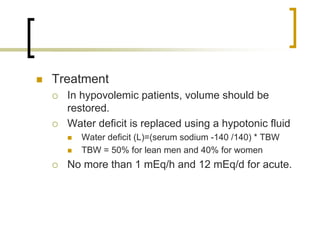
Treatment
  In hypovolemic patients, volume should be
  restored.
  Water deficit is replaced using a hypotonic fluid
     Water deficit (L)=(serum sodium -140 /140) * TBW
     TBW = 50% for lean men and 40% for women
  No more than 1 mEq/h and 12 mEq/d for acute.
Case 4

 40 years old male
 Polytrauma
 # Rt femur and blunt abdominal injury
 K 2.9
Oliguria
And on going blood transfusion
Case 5

 40 year old male
 Case of crohns with entero-cutenous
 fistula
 On TPN
 K 6.5
Potassium

 Average intake of potassium 50-100
 mEq/d
 2% of totall body potassium is located
 within extracellular compartment
 Normal range 3.5-5.0 mEq/L
Hyperkalemia
 Excessive potassium intake
     Oral
     Intravenous
     Blood transfusions
 Increased release of potassium from cells
     Hemolysis
     Rhabdomolysis
     Crush injuries
     Gastrointestinal hemorrhage
     Acidosis
     Rapid increase of extracellular osmolality
 Impaired excretion by the kidneys
     Potassium sparing diuretics
     Angiotensin-Converting enzyme inhibitors
     Nonsteroidal antiinflammatories
     Renal insufficiency and renal failure
Symptoms
   Gastrointestinal
      Nausea
      Vomiting
      Intestinal colic
      Diarrhea
   Neuromuscular
      Weakness
      Ascending paralysis to respiratory failure
   Cardiovascular
      ECG changes
          Peaked T waves
          Flattened P wave
          Prolonged PR interval
          Widened QRS complex
          Ventricular fibrillation
      Cardiac arrhythmias
      Arrest
Discontinue exogenous potassium
Cation-exchange resin, Kayexalate
Glucose
Insulin
Calcium chloride or calcium gluconate
All the above measures are temporary
lasting from 1 to 4 hours
Dialysis should be considered
Hypokalemia
 More common in surgical patient
 Inadequate intake
      Dietary
      Potassium free IV fluids
      Total parenteral nutrition with inadequate potassium replacement
 Excessive renal excretion
      Hyperaldosteronism
      Medications
 Loss in gastrointestinal secreations
      Vomiting
      High NGT output
 Intracellular shift
      Metabolic alkalosis
      Insulin therapy
 Drugs induce magnesium depletion
     Amphotericin
     Aminoglycosides
     Foscarnet
     Cisplatin
     ifosfamide
Symptoms
   Gastrointestinal
      ileus
      Constipation
   Neuromuscular
      Weakness
      Fatigue
      Diminished tendon reflexes
      Paralysis
   Cardiac
      Cardiac arrest
      ECG changes
          U waves
          T wave flattening
          ST segment changes
          Arrhythmias
Potassium repletion
Orally or intravenous
In IV no more than 10 to 20 mEq/h
40 mEq/h when ECG monitoring
Caution with oliguria or impaired renal
function

Fluid And Electrolyte

  • 1.
    Fluid and Electrolyte Managementof the Surgical Patient Jaffar Alkhuzaie M.B.B.Ch, AFRCSI, CABS
  • 2.
    Introduction Fluidand electrolyte management are paramount to the care of the surgical patient. Changes in both fluid volume and electrolyte composition occur preoperatively, intraoperatively, and post operatively, as well as in response to trauma and sepsis.
  • 3.
    Case 1 40years old male SBO NGT 1500 ml Na 150 K 2.9
  • 4.
    Total Body Water 50-60% of total body weight Who is having higher proportion of body weight as water? And Why? Males or Females Lean or Obese Young or elderly
  • 5.
    Muscle and solidorgans have higher water content than fat and bone Higher proportion of water in: Young Lean Males
  • 6.
  • 7.
  • 8.
    Classification of BodyFluid Changes Normal Exchange of Fluid and Electrolytes Disturbances in Fluid Balance Volume Control Concentration Changes Hyponatreamia Hypernatreamia Composition Changes Hyperkalemia Hypokalemia Hypermagnesemia Hypomagnesemia Hypercalcemia Hypocalcemia Hyperphosphatemia Hypophosphatemia
  • 9.
    Case 2 50years old female Not know to have medical problem SBO due to adhesions On NGT Total intake 2700 ml Total out put 2800 ml
  • 10.
    Normal Exchange Normalperson consumes 2000ml of H2O 75% oral intake Rest from solid foods Daily water losses 1L in Urine 250 ml in stool 600 insensible losses Skin 75% Lungs 25%
  • 11.
    Disturbances in FluidBalance Extracellular volume deficit: most common in surgical patients Acute Cardiovascular Central nervous system Chronic Decrease skin turgor Sunken eyes & CVS and CNS
  • 12.
    System Volume Deficit Volume Excess Generalized Weight loss Weight gain Decreased skin turgor Peripheral edema Cardiac *Tachycardia *Increased cardiac *Orthostasis/ output hypotension *Increased central *Collapsed neck veins venous pressure *Distended neck veins *Murmur Renal Oliguria Azotemia Gastrointestinal Ileus Bowel edema Pulmonary Pulmonary edema
  • 13.
    Composition of GastrointestinalSecretions Type of Volume Na K Cl HCO-3 Secretion mL/24 h mEq/L mEq/L mEq/L mEq/L Stomach 2000-1000 90-60 30-10 130-100 0 Small intestine 3000-2000 140-120 10-5 120-90 40-30 Colon 60 30 40 0 Pancreas 800-600 145-135 10-5 90-70 115-95 Bile 800-300 145-135 10-5 110-90 40-30
  • 14.
    Case 3 78years old male Not know to have any medical problem Had sigmoid colectomy for Ca 2nd day post op Na 130
  • 15.
    Hyponatremia Causes Sodium depletion Sodium dilution
  • 16.
    Sodium depletion Decrease intake Low Na diet Enteral feeds Increase loss Gastrointestinal Losses Vomiting Prolonged NGT suctioning Diarrhea Renal Losses Diuretics Primary renal disease Depletional hyponatreamia is often accompanied by extracellulr volume deficit
  • 17.
    Sodium dilution Due to excess extracellular water Intentional: excessive oral intake Iatrogenic: Intravenous Increase ADH Increase reabsorption of water from the kidneys Drugs Antipsychotics Tricyclic antidepressants Angiotensin-converting enzyme inhibitors Physical signs: usually absent Lap: hemodilution
  • 18.
    Hyperosmolar Mannitol Hyperglycemia Pseudohyponatremia Plasma lipids Plasma proteins
  • 19.
    Body System Hyponatremia Central Headache, confusion, hyper- or hypoactive deep nervous tendon reflexes, seizures, coma, increased intracranial system pressure Musculoskeletal Weakness, fatigue, muscle cramps/twitching Gastrointestinal Anorexia, nausea, vomiting, watery diarrhea Cardiovascular Hypertension and bradycardia if significant increases in intracranial pressure Tissue Lacrimation, salivation Renal Oliguria
  • 21.
    Management of Hyponatremia Exclude Hyperosmolar causes Depletion versus dilution Dehydration or over hydrated Normal volume >>evaluate ADH Na losses Urine Na <20 mEq/L = extrarenal Urine Na >20 mEq/L = Renal
  • 22.
    Free water restriction Ifsever administration Na If neuralgic symptoms are present 3% N.S No more than 1 mEq/L per hour Untill reaches 130 mEq/L or neurological symptoms improve If asymptomatic 0.5 mEq/L per hour maximum 12 mEq/L per day
  • 23.
    Hypernatremia Loss offree water Gain sodium in excess
  • 24.
    Body System Hypernatremia Central nervous Restlessness, lethargy, ataxia, irritability, tonic spasms, system delirium, seizures, coma Musculoskeletal Weakness Cardiovascular Tachycardia, hypotension, syncope Tissue Dry sticky mucous membranes, red swollen tongue, decreased saliva and tears Renal Oliguria Metabolic Fever
  • 26.
    Treatment Inhypovolemic patients, volume should be restored. Water deficit is replaced using a hypotonic fluid Water deficit (L)=(serum sodium -140 /140) * TBW TBW = 50% for lean men and 40% for women No more than 1 mEq/h and 12 mEq/d for acute.
  • 27.
    Case 4 40years old male Polytrauma # Rt femur and blunt abdominal injury K 2.9
  • 28.
    Oliguria And on goingblood transfusion
  • 29.
    Case 5 40year old male Case of crohns with entero-cutenous fistula On TPN K 6.5
  • 30.
    Potassium Average intakeof potassium 50-100 mEq/d 2% of totall body potassium is located within extracellular compartment Normal range 3.5-5.0 mEq/L
  • 31.
    Hyperkalemia Excessive potassiumintake Oral Intravenous Blood transfusions Increased release of potassium from cells Hemolysis Rhabdomolysis Crush injuries Gastrointestinal hemorrhage Acidosis Rapid increase of extracellular osmolality Impaired excretion by the kidneys Potassium sparing diuretics Angiotensin-Converting enzyme inhibitors Nonsteroidal antiinflammatories Renal insufficiency and renal failure
  • 32.
    Symptoms Gastrointestinal Nausea Vomiting Intestinal colic Diarrhea Neuromuscular Weakness Ascending paralysis to respiratory failure Cardiovascular ECG changes Peaked T waves Flattened P wave Prolonged PR interval Widened QRS complex Ventricular fibrillation Cardiac arrhythmias Arrest
  • 33.
    Discontinue exogenous potassium Cation-exchangeresin, Kayexalate Glucose Insulin Calcium chloride or calcium gluconate All the above measures are temporary lasting from 1 to 4 hours Dialysis should be considered
  • 34.
    Hypokalemia More commonin surgical patient Inadequate intake Dietary Potassium free IV fluids Total parenteral nutrition with inadequate potassium replacement Excessive renal excretion Hyperaldosteronism Medications Loss in gastrointestinal secreations Vomiting High NGT output Intracellular shift Metabolic alkalosis Insulin therapy Drugs induce magnesium depletion Amphotericin Aminoglycosides Foscarnet Cisplatin ifosfamide
  • 35.
    Symptoms Gastrointestinal ileus Constipation Neuromuscular Weakness Fatigue Diminished tendon reflexes Paralysis Cardiac Cardiac arrest ECG changes U waves T wave flattening ST segment changes Arrhythmias
  • 36.
    Potassium repletion Orally orintravenous In IV no more than 10 to 20 mEq/h 40 mEq/h when ECG monitoring Caution with oliguria or impaired renal function