OPERATIVE INSTRUMENTS IN CRANIOTOMY
Prepared by:
DR.BIPUL THAKUR
INTRODUCTION
 Surgical removal of a section of the skull in order to access the
intracranial compartment.
 “STEREOTACTIC” craniotomies.
That involve the use of a 3-dimensional coordinates system With the aid of
imaging and computer-based navigational software.
 "KEYHOLE” craniotomies are used in situations that require less bony removal.
 The smallest type of craniotomy is referred to as a “burr hole,” also known as
trephination.
Pre Procedural Planning
 Prior to surgery: Imaging
 CT SCAN
 MRI
 Baseline investigations:
 Blood investigation
 ECG
 Chest X-Ray
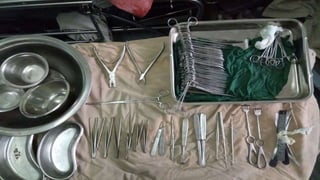
THE ESSENTIAL INSTRUMENTS:
 Scalpel : Number 10
 Suction devices
 Raney clips and tissue retractors
 Monopolar Electrosurgical Unit: Cuts and Coagulates
 Bipolar Electrosurgical Unit
 Periosteal Elevator
 High Speed Air drills
 Bone Flap Elevator
 Craniotomy mini plate and screw set
Positioning
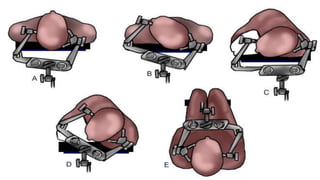
 Head fixation is achieved with 3 skull pins that are situated in a head clamp (eg , Mayfield head-
holder)
 Skull block before application
 Placed in a band like area just above orbits & pinna
 Avoid over thin temporal bone
 Not <3 yrs ; 3-10 yrs paediatrics pins
 Coated with antibiotic ointment
 Clamp squeezed together, allowing gears to slide, until pins are seated in skull
 Each ring 20lbs; adult- 60-80lbs; paediatric : 30-40lbs
 Radiolucent pins if intraoperative CT/MRI used eg: Titanium, Silicon nitride
Complications
 Malposition: Poor fixation-}movement
 Over tightening, Incorrect Pin-Injury, Hematoma, Delayed abscess, Epidural Hematoma
 Skin Necrosis
 Skull Fracture
 Bleeding
Blade
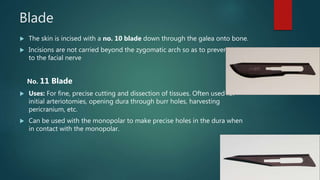
 The skin is incised with a no. 10 blade down through the galea onto bone.
 Incisions are not carried beyond the zygomatic arch so as to prevent injury
to the facial nerve
No. 11 Blade
 Uses: For fine, precise cutting and dissection of tissues. Often used for
initial arteriotomies, opening dura through burr holes, harvesting
pericranium, etc.
 Can be used with the monopolar to make precise holes in the dura when
in contact with the monopolar.
Raney clips
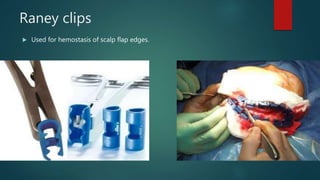
 Used for hemostasis of scalp flap edges.
Fish hook with Songer Cables
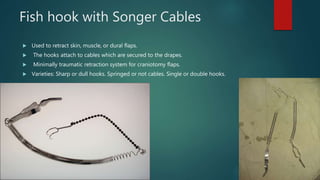
 Used to retract skin, muscle, or dural flaps.
 The hooks attach to cables which are secured to the drapes.
 Minimally traumatic retraction system for craniotomy flaps.
 Varieties: Sharp or dull hooks. Springed or not cables. Single or double hooks.
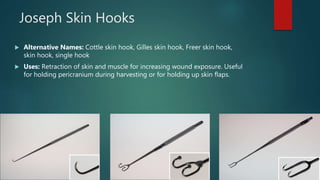
Joseph Skin Hooks
 Alternative Names: Cottle skin hook, Gilles skin hook, Freer skin hook,
skin hook, single hook
 Uses: Retraction of skin and muscle for increasing wound exposure. Useful
for holding pericranium during harvesting or for holding up skin flaps.
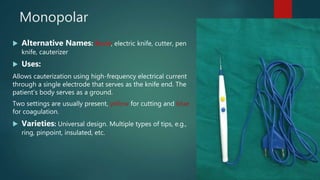
Monopolar
 Alternative Names: Bovie, electric knife, cutter, pen
knife, cauterizer
 Uses:
Allows cauterization using high-frequency electrical current
through a single electrode that serves as the knife end. The
patient’s body serves as a ground.
Two settings are usually present, yellow for cutting and blue
for coagulation.
 Varieties: Universal design. Multiple types of tips, e.g.,
ring, pinpoint, insulated, etc.
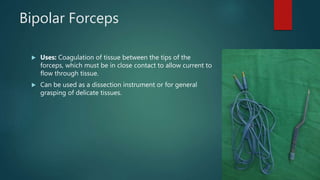
Bipolar Forceps
 Uses: Coagulation of tissue between the tips of the
forceps, which must be in close contact to allow current to
flow through tissue.
 Can be used as a dissection instrument or for general
grasping of delicate tissues.
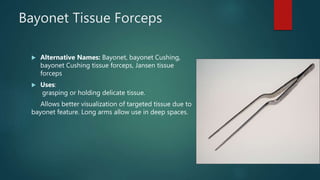
Bayonet Tissue Forceps
 Alternative Names: Bayonet, bayonet Cushing,
bayonet Cushing tissue forceps, Jansen tissue
forceps
 Uses:
grasping or holding delicate tissue.
Allows better visualization of targeted tissue due to
bayonet feature. Long arms allow use in deep spaces.
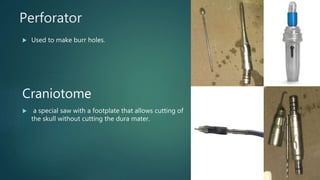
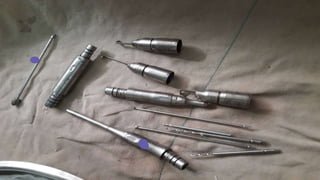
Perforator
 Used to make burr holes.
Craniotome
 a special saw with a footplate that allows cutting of
the skull without cutting the dura mater.
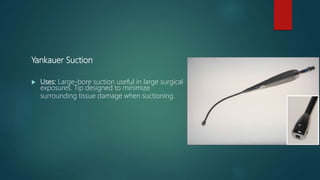
Yankauer Suction
 Uses: Large-bore suction useful in large surgical
exposures. Tip designed to minimize
surrounding tissue damage when suctioning.
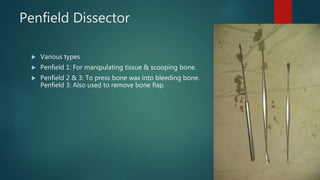
Penfield Dissector
 Various types
 Penfield 1: For manipulating tissue & scooping bone.
 Penfield 2 & 3: To press bone wax into bleeding bone.
Penfield 3: Also used to remove bone flap.
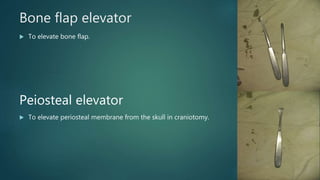
Bone flap elevator
 To elevate bone flap.
Peiosteal elevator
 To elevate periosteal membrane from the skull in craniotomy.
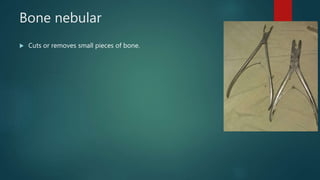
Bone nebular
 Cuts or removes small pieces of bone.
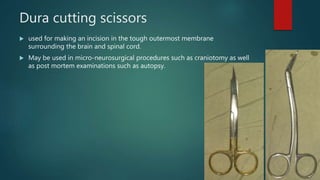
Dura cutting scissors
 used for making an incision in the tough outermost membrane
surrounding the brain and spinal cord.
 May be used in micro-neurosurgical procedures such as craniotomy as well
as post mortem examinations such as autopsy.
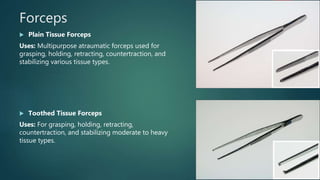
Forceps
 Plain Tissue Forceps
Uses: Multipurpose atraumatic forceps used for
grasping, holding, retracting, countertraction, and
stabilizing various tissue types.
 Toothed Tissue Forceps
Uses: For grasping, holding, retracting,
countertraction, and stabilizing moderate to heavy
tissue types.
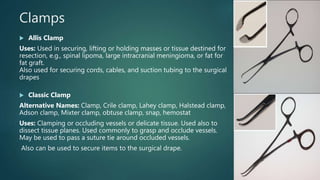
Clamps
 Allis Clamp
Uses: Used in securing, lifting or holding masses or tissue destined for
resection, e.g., spinal lipoma, large intracranial meningioma, or fat for
fat graft.
Also used for securing cords, cables, and suction tubing to the surgical
drapes
 Classic Clamp
Alternative Names: Clamp, Crile clamp, Lahey clamp, Halstead clamp,
Adson clamp, Mixter clamp, obtuse clamp, snap, hemostat
Uses: Clamping or occluding vessels or delicate tissue. Used also to
dissect tissue planes. Used commonly to grasp and occlude vessels.
May be used to pass a suture tie around occluded vessels.
Also can be used to secure items to the surgical drape.
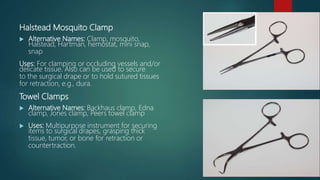
Halstead Mosquito Clamp
 Alternative Names: Clamp, mosquito,
Halstead, Hartman, hemostat, mini snap,
snap
Uses: For clamping or occluding vessels and/or
delicate tissue. Also can be used to secure
to the surgical drape or to hold sutured tissues
for retraction, e.g., dura.
Towel Clamps
 Alternative Names: Backhaus clamp, Edna
clamp, Jones clamp, Peers towel clamp
 Uses: Multipurpose instrument for securing
items to surgical drapes, grasping thick
tissue, tumor, or bone for retraction or
countertraction.
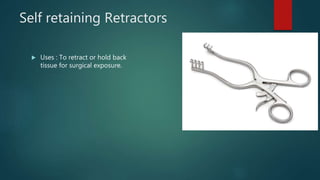
Self retaining Retractors
 Uses : To retract or hold back
tissue for surgical exposure.
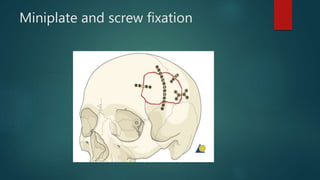
Miniplate and screw fixation
Thank you…

Operative instruments in Craniotomy

  • 1.
    OPERATIVE INSTRUMENTS INCRANIOTOMY Prepared by: DR.BIPUL THAKUR
  • 3.
    INTRODUCTION  Surgical removalof a section of the skull in order to access the intracranial compartment.  “STEREOTACTIC” craniotomies. That involve the use of a 3-dimensional coordinates system With the aid of imaging and computer-based navigational software.  "KEYHOLE” craniotomies are used in situations that require less bony removal.  The smallest type of craniotomy is referred to as a “burr hole,” also known as trephination.
  • 4.
    Pre Procedural Planning Prior to surgery: Imaging  CT SCAN  MRI  Baseline investigations:  Blood investigation  ECG  Chest X-Ray
  • 5.
    THE ESSENTIAL INSTRUMENTS: Scalpel : Number 10  Suction devices  Raney clips and tissue retractors  Monopolar Electrosurgical Unit: Cuts and Coagulates  Bipolar Electrosurgical Unit  Periosteal Elevator  High Speed Air drills  Bone Flap Elevator  Craniotomy mini plate and screw set
  • 6.
    Positioning  Head fixationis achieved with 3 skull pins that are situated in a head clamp (eg , Mayfield head- holder)  Skull block before application  Placed in a band like area just above orbits & pinna  Avoid over thin temporal bone  Not <3 yrs ; 3-10 yrs paediatrics pins  Coated with antibiotic ointment  Clamp squeezed together, allowing gears to slide, until pins are seated in skull  Each ring 20lbs; adult- 60-80lbs; paediatric : 30-40lbs  Radiolucent pins if intraoperative CT/MRI used eg: Titanium, Silicon nitride Complications  Malposition: Poor fixation-}movement  Over tightening, Incorrect Pin-Injury, Hematoma, Delayed abscess, Epidural Hematoma  Skin Necrosis  Skull Fracture  Bleeding
  • 8.
    Blade  The skinis incised with a no. 10 blade down through the galea onto bone.  Incisions are not carried beyond the zygomatic arch so as to prevent injury to the facial nerve No. 11 Blade  Uses: For fine, precise cutting and dissection of tissues. Often used for initial arteriotomies, opening dura through burr holes, harvesting pericranium, etc.  Can be used with the monopolar to make precise holes in the dura when in contact with the monopolar.
  • 9.
    Raney clips  Usedfor hemostasis of scalp flap edges.
  • 10.
    Fish hook withSonger Cables  Used to retract skin, muscle, or dural flaps.  The hooks attach to cables which are secured to the drapes.  Minimally traumatic retraction system for craniotomy flaps.  Varieties: Sharp or dull hooks. Springed or not cables. Single or double hooks.
  • 11.
    Joseph Skin Hooks Alternative Names: Cottle skin hook, Gilles skin hook, Freer skin hook, skin hook, single hook  Uses: Retraction of skin and muscle for increasing wound exposure. Useful for holding pericranium during harvesting or for holding up skin flaps.
  • 12.
    Monopolar  Alternative Names:Bovie, electric knife, cutter, pen knife, cauterizer  Uses: Allows cauterization using high-frequency electrical current through a single electrode that serves as the knife end. The patient’s body serves as a ground. Two settings are usually present, yellow for cutting and blue for coagulation.  Varieties: Universal design. Multiple types of tips, e.g., ring, pinpoint, insulated, etc.
  • 13.
    Bipolar Forceps  Uses:Coagulation of tissue between the tips of the forceps, which must be in close contact to allow current to flow through tissue.  Can be used as a dissection instrument or for general grasping of delicate tissues.
  • 14.
    Bayonet Tissue Forceps Alternative Names: Bayonet, bayonet Cushing, bayonet Cushing tissue forceps, Jansen tissue forceps  Uses: grasping or holding delicate tissue. Allows better visualization of targeted tissue due to bayonet feature. Long arms allow use in deep spaces.
  • 15.
    Perforator  Used tomake burr holes. Craniotome  a special saw with a footplate that allows cutting of the skull without cutting the dura mater.
  • 17.
    Yankauer Suction  Uses:Large-bore suction useful in large surgical exposures. Tip designed to minimize surrounding tissue damage when suctioning.
  • 18.
    Penfield Dissector  Varioustypes  Penfield 1: For manipulating tissue & scooping bone.  Penfield 2 & 3: To press bone wax into bleeding bone. Penfield 3: Also used to remove bone flap.
  • 19.
    Bone flap elevator To elevate bone flap. Peiosteal elevator  To elevate periosteal membrane from the skull in craniotomy.
  • 20.
    Bone nebular  Cutsor removes small pieces of bone.
  • 21.
    Dura cutting scissors used for making an incision in the tough outermost membrane surrounding the brain and spinal cord.  May be used in micro-neurosurgical procedures such as craniotomy as well as post mortem examinations such as autopsy.
  • 22.
    Forceps  Plain TissueForceps Uses: Multipurpose atraumatic forceps used for grasping, holding, retracting, countertraction, and stabilizing various tissue types.  Toothed Tissue Forceps Uses: For grasping, holding, retracting, countertraction, and stabilizing moderate to heavy tissue types.
  • 23.
    Clamps  Allis Clamp Uses:Used in securing, lifting or holding masses or tissue destined for resection, e.g., spinal lipoma, large intracranial meningioma, or fat for fat graft. Also used for securing cords, cables, and suction tubing to the surgical drapes  Classic Clamp Alternative Names: Clamp, Crile clamp, Lahey clamp, Halstead clamp, Adson clamp, Mixter clamp, obtuse clamp, snap, hemostat Uses: Clamping or occluding vessels or delicate tissue. Used also to dissect tissue planes. Used commonly to grasp and occlude vessels. May be used to pass a suture tie around occluded vessels. Also can be used to secure items to the surgical drape.
  • 24.
    Halstead Mosquito Clamp Alternative Names: Clamp, mosquito, Halstead, Hartman, hemostat, mini snap, snap Uses: For clamping or occluding vessels and/or delicate tissue. Also can be used to secure to the surgical drape or to hold sutured tissues for retraction, e.g., dura. Towel Clamps  Alternative Names: Backhaus clamp, Edna clamp, Jones clamp, Peers towel clamp  Uses: Multipurpose instrument for securing items to surgical drapes, grasping thick tissue, tumor, or bone for retraction or countertraction.
  • 25.
    Self retaining Retractors Uses : To retract or hold back tissue for surgical exposure.
  • 26.
  • 27.