http://www.iaeme.com/IJMET/index.asp 168 editor@iaeme.com
International Journal of Mechanical Engineering and Technology (IJMET)
Volume 8, Issue 3, March 2017, pp. 168–174 Article ID: IJMET_08_03_019
Available online at http://www.iaeme.com/IJMET/issues.asp?JType=IJMET&VType=8&IType=3
ISSN Print: 0976-6340 and ISSN Online: 0976-6359
© IAEME Publication Scopus Indexed
FLUID FLOW ANALYSIS IN AIR DUCT FLOW
WITH AND WITHOUT INTERNAL THREADS
USING COMPUTATIONAL FLUID DYNAMICS
(CFD)
Pankaj N. Shrirao, Sachin S. Pente, Sagar S. Gaddamwar
Assistant Professor, Mechanical Engineering,
Jawaharlal Darda Institute of Engineering and Technology,
Yavatmal, Maharashtra, India
ABSTRACT
Computational heat transfer flow modeling is one of the great challenges in the
classical sciences. As with most problems in engineering, the interest in the heat transfer
augmentation is increasing due to its extreme importance in various industrial
applications. This paper deals with the analysis of heat transfer for fluid flowing
through the pipe with and without internal threads using CFD. Using CFD codes for
modeling the heat and fluid flow is an efficient tool for predicting equipment
performance. CFD offers a convenient means to study the detailed flows and heat
exchange processes, which take place inside the tube. Simulations were carried out
using commercial CFD software ANSYS Fluent version 14.5. Friction factor and
Nusselt number for air flowing through the specified tube (internal diameter = 0.005 m,
length = 0.1 m) were obtained first for the plain tube and then for the tube with internal
threads with pitch 5mm in the Reynolds number range of 2000 to 5000. Finally results
will be compared to available experimental and analytical calculations. The data
obtained by simulation are matching with the literature value for a plain tube with the
discrepancy of less than plus or minus 5% for Nusselt number and for the friction factor.
Enhanced heat transfer for the tube with internal threads has been observed. Heat flux
is more uniform all along the tube and decreases uniformly towards the center.
Key words: CFD, Internal threads, Enhancement, heat transfer and turbulent flow.
Cite this Article: Pankaj N. Shrirao, Sachin S. Pente and Sagar S. Gaddamwar, Fluid
Flow Analysis In Air Duct Flow with and Without Internal Threads Using
Computational Fluid Dynamics (CFD), International Journal of Mechanical
Engineering and Technology, 8(3), 2017, pp. 168–174.
http://www.iaeme.com/IJMET/issues.asp?JType=IJMET&VType=8&IType=3
Pankaj N. Shrirao, Sachin S. Pente and Sagar S. Gaddamwar
http://www.iaeme.com/IJMET/index.asp 169 editor@iaeme.com
1. INTRODUCTION
Heat exchangers are used in different processes ranging from conversion, utilization & recovery
of thermal energy in various industrial, commercial & domestic applications. Some common
examples include steam generation & condensation in power & cogeneration plants; sensible
heating & cooling in thermal processing of chemical, pharmaceutical & agricultural products;
fluid heating in manufacturing & waste heat recovery etc. Increase in Heat exchanger’s
performance can lead to more economical design of heat exchanger which can help to make
energy, material & cost savings related to a heat exchange process. The need to increase the
thermal performance of heat exchangers, thereby effecting energy, material & cost savings have
led to development & use of many techniques termed as Heat transfer Augmentation. These
techniques are also referred as Heat transfer Enhancement or Intensification. Augmentation
techniques increase convective heat transfer by reducing the thermal resistance in a heat
exchanger. Use of Heat transfer enhancement techniques lead to increase in heat transfer
coefficient but at the cost of increase in pressure drop. So, while designing a heat exchanger
using any of these techniques, analysis of heat transfer rate & pressure drop has to be done.
Apart from this, issues like long-term performance & detailed economic analysis of heat
exchanger has to be studied. To achieve high heat transfer rate in an existing or new heat
exchanger while taking care of the increased pumping power, several techniques have been
proposed in recent years.
Generally, heat transfer augmentation techniques are classified in three broad categories:
active methods, passive method and compound method. A compound method is a hybrid
method in which both active and passive methods are used in combination. The compound
method involves complex design and hence has limited applications.
M. Sozen and T.M. Kuzay [1] numerically studied the enhanced heat transfer in round tubes
filled with rolled copper mesh at Reynolds number range of 5,000-19,000. With water as the
energy transport fluid and the tube being subjected to uniform heat flux, they reported up to ten
fold increase in heat transfer coefficient with brazed porous inserts relative to plain tube at the
expense of highly increased pressure drop. Q. Liao and M.D. Xin [2] carried out experiments
to study the heat transfer and friction characteristics for water, ethylene glycol and ISOVG46
turbine oil flowing inside four tubes with three dimensional internal extended surfaces and
copper continuous or segmented twisted tape inserts within Prandtl number range from 5.5 to
590 and Reynolds numbers from 80 to 50,000. They found that for laminar flow of VG46
turbine oil, the average Stanton number could be enhanced up to 5.8 times with friction factor
increase of 6.5 fold compared to plain tube. D. Angirasa [3] performed experiments that proved
augmentation of heat transfer by using metallic fibrous materials with two different porosities
namely 97% and 93%. The experiments were carried out for different Reynolds numbers
(17,000-29,000) and power inputs (3.7 and 9.2 W). The improvement in the average Nusselt
number was about 3-6 times in comparison with the case when no porous material was used.
Fu et al. [4] experimentally demonstrated that a channel filled with high conductivity porous
material subjected to oscillating flow is a new and effective method of cooling electronic
devices. The experimental investigations of Hsieh and Liu [5] reported that Nusselt numbers
were between four and two times the bare values at low Re and high Re respectively. Bogdan
and Abdulmajeed et al. [6] numerically investigated the effect of metallic porous materials,
inserted in a pipe, on the rate of heat transfer. The pipe was subjected to a constant and uniform
heat flux. The effects of porosity, porous material diameter and thermal conductivity as well as
Reynolds number on the heat transfer rate and pressure drop were investigated. The results were
compared with the clear flow case where no porous material was used. The results obtained
lead to the conclusion that higher heat transfer rates can be achieved using porous inserts at the
expense of a reasonable pressure drop. Smith et. al. [7] investigated the heat transfer
Fluid Flow Analysis In Air Duct Flow with and without Internal Threads Using Computational Fluid
Dynamics (CFD)
http://www.iaeme.com/IJMET/index.asp 170 editor@iaeme.com
enhancement and pressure loss by insertion of single twisted tape, full length dual and regularly
spaced dual twisted tapes as swirl generators in round tube under axially uniform wall heat flux
conditions. Chinaruk Thianpong et.al. [8] experimentally investigated the friction and
compound heat transfer behavior in dimpled tube fitted with twisted tape swirl generator for a
fully developed flow for Reynolds number in the range of 12000 to 44000. Whitham [9] studied
heat transfer enhancement by means of a twisted tape insert way back at the end of the
nineteenth century. Date and Singham [10] numerically investigated heat transfer enhancement
in laminar, viscous liquid flows in a tube with a uniform heat flux boundary condition. They
idealized the flow conditions by assuming zero tape thickness, but the twist and fin effects of
the twisted tape
were included in their analysis. Saha et al. [11] have shown that, for a constant heat flux
boundary condition, regularly spaced twisted tape elements do not perform better than full-
length twisted tape because the swirl breaks down in-between the spacing of a regularly twisted
tape. Rao and Sastri [12], while working with a rotating tube with a twisted tape insert, observed
that the enhancement of heat transfer offsets the rise in the friction factor owing to rotation.
Sivashanmugam and Sundaram [13] and Agarwal and Rao [14] studied the thermohydraulic
characteristics of tape-generated swirl flow. Peterson et al. [15] experimented with high-
pressure (8–16 MPa) water as the test liquid in turbulent flow with low heat fluxes and low
wall–fluid temperature differences typical of a liquid–liquid heat exchanger.
2. SEQUENCE OF OPERATION
2.1. Without Internal threads
Initially the CFD analysis is carried out with air as the working fluid through tube section
without internal threads.
2.2. With Internal threads
Secondly the CFD analysis is carried out with air as the working fluid through tube section with
internal threads.
3. COMPUTATIONAL FLUID DYNAMICS MODELING
CFD provides numerical approximation to the equations that govern fluid motion. Application
of the CFD to analyze a fluid problem requires the following steps. First, the mathematical
equations describing the fluid flow are written. These are usually a set of partial differential
equations. These equations are then discretized to produce a numerical analogue of the
equations. The domain is then divided into small grids or elements. Finally, the initial
conditions and the boundary conditions of the specific problem are used to solve these
equations. The solution method can be direct or iterative. In addition, certain control parameters
are used to control the convergence, stability, and accuracy of the method. All CFD codes
contain three main elements: (1) A pre-processor, which is used to input the problem geometry,
generate the grid, and define the flow parameter and the boundary conditions to the code. (2) A
flow solver, which is used to solve the governing equations of the flow subject to the conditions
provided. (3) A post-processor, which is used to massage the data and show the results in
graphical and easy to read format.
Pankaj N. Shrirao, Sachin S. Pente and Sagar S. Gaddamwar
http://www.iaeme.com/IJMET/index.asp 171 editor@iaeme.com
3.1. Geometry Description and Meshing
Geometry of the tube with inserts is modelled in ICEM CFD (Integrated computer aided
Engineering and Manufacturing) software. This tool is an advanced pre-processor tool which
is used to meet the specific geometry and meshing needs. ICEM CFD is used in order to mesh
the components.
Geometric Model is created in ANSYS Design modeller which is shown in Fig.1. and Fig.
2.
Fig 1 shows CFD Model of Plain tube Fig 2 shows CFD Model of Internally
Threaded tube
Fig 3 Shows CFD Meshing of Plain tube Figure 4 shows CFD Meshing of
Internally threaded tube
4. RESULTS AND DISCUSSIONS
4.1. Plain tube Results
Prior to the simulations using with the internally threaded tube, the Nusselt number and the
friction factor in a plain tube were calculated. The CFD data were, and then compared with the
results given by the well-known correlations under a similar condition, in order to evaluate the
validity of the plain tube.
Figure 5 shows Pressure contours smooth tube velocity Re=2300
Fluid Flow Analysis In Air Duct Flow with and without Internal Threads Using Computational Fluid
Dynamics (CFD)
http://www.iaeme.com/IJMET/index.asp 172 editor@iaeme.com
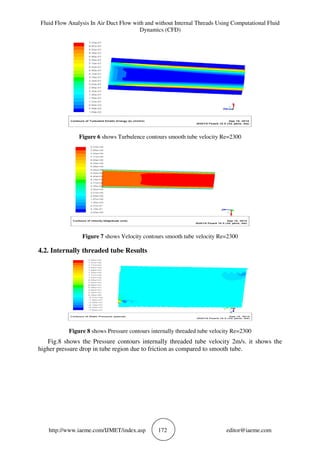
Figure 6 shows Turbulence contours smooth tube velocity Re=2300
Figure 7 shows Velocity contours smooth tube velocity Re=2300
4.2. Internally threaded tube Results
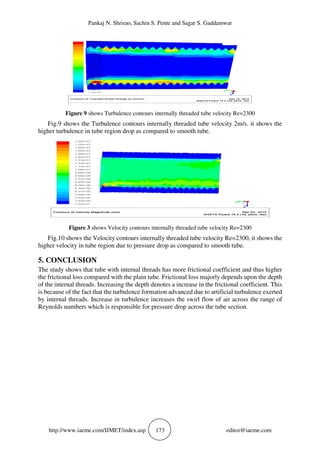
Figure 8 shows Pressure contours internally threaded tube velocity Re=2300
Fig.8 shows the Pressure contours internally threaded tube velocity 2m/s. it shows the
higher pressure drop in tube region due to friction as compared to smooth tube.
Pankaj N. Shrirao, Sachin S. Pente and Sagar S. Gaddamwar
http://www.iaeme.com/IJMET/index.asp 173 editor@iaeme.com
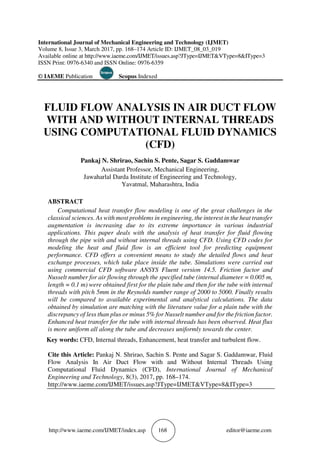
Figure 9 shows Turbulence contours internally threaded tube velocity Re=2300
Fig.9 shows the Turbulence contours internally threaded tube velocity 2m/s. it shows the
higher turbulence in tube region drop as compared to smooth tube.
Figure 3 shows Velocity contours internally threaded tube velocity Re=2300
Fig.10 shows the Velocity contours internally threaded tube velocity Re=2300, it shows the
higher velocity in tube region due to pressure drop as compared to smooth tube.
5. CONCLUSION
The study shows that tube with internal threads has more frictional coefficient and thus higher
the frictional loss compared with the plain tube. Frictional loss majorly depends upon the depth
of the internal threads. Increasing the depth denotes a increase in the frictional coefficient. This
is because of the fact that the turbulence formation advanced due to artificial turbulence exerted
by internal threads. Increase in turbulence increases the swirl flow of air across the range of
Reynolds numbers which is responsible for pressure drop across the tube section.
Fluid Flow Analysis In Air Duct Flow with and without Internal Threads Using Computational Fluid
Dynamics (CFD)
http://www.iaeme.com/IJMET/index.asp 174 editor@iaeme.com
REFERENCES
[1] M. Sozen, T M. Kuzay, Enhanced heat transfer in round tubes with porous inserts, Int. J.
Heat and Fluid Flow 17 (1996) 124-129.
[2] Q. Liao, M.D. Xin, Augmentation of convective heat transfer inside tubes with three-
dimensional internal extended surfaces and twisted-tape inserts, Chemical Engineering
Journal 78 (2000) 95-105.
[3] D.Angirasa, Experimental investigation of forced convection heat transfer augmentation
with metallic porous materials, Int. J. Heat Mass Transfer (2001) 919-922.
[4] H.L. Fu, K.C. Leong, X.Y. Huang, C.Y. Liu, An experimental study of heat transfer of a
porous channel subjected to oscillating flow, ASME J. Heat Transfer 123 (2001) 162-170.
[5] S.S Hsieh, M.H. Liu, H.H. Tsai, Turbulent heat transfer and flow characteristic in a
horizontal circular tube with strip-type inserts part-II (heat transfer), International Journal
of Heat and Mass Transfer 46 (2003) 837-849.
[6] B.I. Pavel, A.A. Mohamad, An experimental and numerical study on heat transfer
enhancement for gas heat exchangers fitted with porous media, International Journal of Heat
and Mass Transfer 47 (2004) 4939-4952.
[7] Smith Eiamsa-ard, Chinaruk Thianpong, Petpices Eiamsa-ard, Pongjet Promvonge,
Convective heat transfer in a circular tube with short-length twisted tape insert, Int.
communications in heat and mass transfer (2009).
[8] Chinaruk Thianpong, Petpices Eiamsa-ard, Khwanchit Wongcharee, Smith Eiamsaard,
Compound heat transfer enhancement of a dimpled tube with a twisted tape swirl generator.
International Communications in Heat and Mass Heat and Mass Transfer 36 (2009)698-
704.
[9] Whitham, J. M. The effects of retarders in fire tubes of steam boilers. Street Railway. 1896,
12(6), 374.
[10] Date, A. W. and Singham, J. R. Numerical prediction of friction and heat transfer
characteristics of fully developed laminar flow in tubes containing twisted tapes. Trans.
ASME, J. Heat Transfer, 1972, 17, 72
[11] S.K.Saha,U.N.Gaitonde and A.W. Date,“Heat transfer and pressure drop characteristics of
laminar flow in a circular tube fitted with regularly spaced twisted-tape elements” J. Exp.
Thermal Fluid Sci., 2,1989, 310-322.
[12] Rao, M. M. and Sastri, V. M. K. Experimental investigation for fluid flow and heat transfer
in a rotating tube twisted tape inserts. Int. J. Heat and Mass Transfer, 1995, 16, 19–28.
[13] Sivashanmugam, P. and Suresh, S., Experimental studies on heat transfer and friction factor
characteristics of turbulent flow through a circular tube fitted with regularly spaced helical
screw tape inserts‖, Experimental Thermal and Fluid Science 31 (2007).301-308.
[14] N. Bhagat and Shashi Kant, Amit Tiwari, Advanced Tool for Fluid Dynamics-CFD and its
applications in Automotive, Aerodynamics and Machine Industry. International Journal of
Mechanical Engineering and Technology, 7(2), 2016, pp. 177–186.
[15] Shekhar Dinkar Thakre, Jayashree P. Zope, Nilima A. Bachchuwar and Sourabh S.
Kulkarni, Analysis of Straight Microchannel Heat Sink Using Computational Fluid
Dynamics. International Journal of Mechanical Engineering and Technology, 7(4), 2016,
pp. 234–242.
[16] Agarwal, S. K. and Raja Rao, M. Heat transfer augmentation for flow of viscous liquid in
circular tubes using twisted tape inserts. Int. J. Heat Mass Transfer, 1996, 99, 3547–3557.
[17] Peterson, S. C., France, D. M. and Carlson, R. D. Experiments in high-pressure turbulent
swirl flow. Trans. ASME, J. Heat Transfer, 1989, 108, 215–218.

FLUID FLOW ANALYSIS IN AIR DUCT FLOW WITH AND WITHOUT INTERNAL THREADS USING COMPUTATIONAL FLUID DYNAMICS (CFD)

  • 1.
    http://www.iaeme.com/IJMET/index.asp 168 editor@iaeme.com InternationalJournal of Mechanical Engineering and Technology (IJMET) Volume 8, Issue 3, March 2017, pp. 168–174 Article ID: IJMET_08_03_019 Available online at http://www.iaeme.com/IJMET/issues.asp?JType=IJMET&VType=8&IType=3 ISSN Print: 0976-6340 and ISSN Online: 0976-6359 © IAEME Publication Scopus Indexed FLUID FLOW ANALYSIS IN AIR DUCT FLOW WITH AND WITHOUT INTERNAL THREADS USING COMPUTATIONAL FLUID DYNAMICS (CFD) Pankaj N. Shrirao, Sachin S. Pente, Sagar S. Gaddamwar Assistant Professor, Mechanical Engineering, Jawaharlal Darda Institute of Engineering and Technology, Yavatmal, Maharashtra, India ABSTRACT Computational heat transfer flow modeling is one of the great challenges in the classical sciences. As with most problems in engineering, the interest in the heat transfer augmentation is increasing due to its extreme importance in various industrial applications. This paper deals with the analysis of heat transfer for fluid flowing through the pipe with and without internal threads using CFD. Using CFD codes for modeling the heat and fluid flow is an efficient tool for predicting equipment performance. CFD offers a convenient means to study the detailed flows and heat exchange processes, which take place inside the tube. Simulations were carried out using commercial CFD software ANSYS Fluent version 14.5. Friction factor and Nusselt number for air flowing through the specified tube (internal diameter = 0.005 m, length = 0.1 m) were obtained first for the plain tube and then for the tube with internal threads with pitch 5mm in the Reynolds number range of 2000 to 5000. Finally results will be compared to available experimental and analytical calculations. The data obtained by simulation are matching with the literature value for a plain tube with the discrepancy of less than plus or minus 5% for Nusselt number and for the friction factor. Enhanced heat transfer for the tube with internal threads has been observed. Heat flux is more uniform all along the tube and decreases uniformly towards the center. Key words: CFD, Internal threads, Enhancement, heat transfer and turbulent flow. Cite this Article: Pankaj N. Shrirao, Sachin S. Pente and Sagar S. Gaddamwar, Fluid Flow Analysis In Air Duct Flow with and Without Internal Threads Using Computational Fluid Dynamics (CFD), International Journal of Mechanical Engineering and Technology, 8(3), 2017, pp. 168–174. http://www.iaeme.com/IJMET/issues.asp?JType=IJMET&VType=8&IType=3
  • 2.
    Pankaj N. Shrirao,Sachin S. Pente and Sagar S. Gaddamwar http://www.iaeme.com/IJMET/index.asp 169 editor@iaeme.com 1. INTRODUCTION Heat exchangers are used in different processes ranging from conversion, utilization & recovery of thermal energy in various industrial, commercial & domestic applications. Some common examples include steam generation & condensation in power & cogeneration plants; sensible heating & cooling in thermal processing of chemical, pharmaceutical & agricultural products; fluid heating in manufacturing & waste heat recovery etc. Increase in Heat exchanger’s performance can lead to more economical design of heat exchanger which can help to make energy, material & cost savings related to a heat exchange process. The need to increase the thermal performance of heat exchangers, thereby effecting energy, material & cost savings have led to development & use of many techniques termed as Heat transfer Augmentation. These techniques are also referred as Heat transfer Enhancement or Intensification. Augmentation techniques increase convective heat transfer by reducing the thermal resistance in a heat exchanger. Use of Heat transfer enhancement techniques lead to increase in heat transfer coefficient but at the cost of increase in pressure drop. So, while designing a heat exchanger using any of these techniques, analysis of heat transfer rate & pressure drop has to be done. Apart from this, issues like long-term performance & detailed economic analysis of heat exchanger has to be studied. To achieve high heat transfer rate in an existing or new heat exchanger while taking care of the increased pumping power, several techniques have been proposed in recent years. Generally, heat transfer augmentation techniques are classified in three broad categories: active methods, passive method and compound method. A compound method is a hybrid method in which both active and passive methods are used in combination. The compound method involves complex design and hence has limited applications. M. Sozen and T.M. Kuzay [1] numerically studied the enhanced heat transfer in round tubes filled with rolled copper mesh at Reynolds number range of 5,000-19,000. With water as the energy transport fluid and the tube being subjected to uniform heat flux, they reported up to ten fold increase in heat transfer coefficient with brazed porous inserts relative to plain tube at the expense of highly increased pressure drop. Q. Liao and M.D. Xin [2] carried out experiments to study the heat transfer and friction characteristics for water, ethylene glycol and ISOVG46 turbine oil flowing inside four tubes with three dimensional internal extended surfaces and copper continuous or segmented twisted tape inserts within Prandtl number range from 5.5 to 590 and Reynolds numbers from 80 to 50,000. They found that for laminar flow of VG46 turbine oil, the average Stanton number could be enhanced up to 5.8 times with friction factor increase of 6.5 fold compared to plain tube. D. Angirasa [3] performed experiments that proved augmentation of heat transfer by using metallic fibrous materials with two different porosities namely 97% and 93%. The experiments were carried out for different Reynolds numbers (17,000-29,000) and power inputs (3.7 and 9.2 W). The improvement in the average Nusselt number was about 3-6 times in comparison with the case when no porous material was used. Fu et al. [4] experimentally demonstrated that a channel filled with high conductivity porous material subjected to oscillating flow is a new and effective method of cooling electronic devices. The experimental investigations of Hsieh and Liu [5] reported that Nusselt numbers were between four and two times the bare values at low Re and high Re respectively. Bogdan and Abdulmajeed et al. [6] numerically investigated the effect of metallic porous materials, inserted in a pipe, on the rate of heat transfer. The pipe was subjected to a constant and uniform heat flux. The effects of porosity, porous material diameter and thermal conductivity as well as Reynolds number on the heat transfer rate and pressure drop were investigated. The results were compared with the clear flow case where no porous material was used. The results obtained lead to the conclusion that higher heat transfer rates can be achieved using porous inserts at the expense of a reasonable pressure drop. Smith et. al. [7] investigated the heat transfer
  • 3.
    Fluid Flow AnalysisIn Air Duct Flow with and without Internal Threads Using Computational Fluid Dynamics (CFD) http://www.iaeme.com/IJMET/index.asp 170 editor@iaeme.com enhancement and pressure loss by insertion of single twisted tape, full length dual and regularly spaced dual twisted tapes as swirl generators in round tube under axially uniform wall heat flux conditions. Chinaruk Thianpong et.al. [8] experimentally investigated the friction and compound heat transfer behavior in dimpled tube fitted with twisted tape swirl generator for a fully developed flow for Reynolds number in the range of 12000 to 44000. Whitham [9] studied heat transfer enhancement by means of a twisted tape insert way back at the end of the nineteenth century. Date and Singham [10] numerically investigated heat transfer enhancement in laminar, viscous liquid flows in a tube with a uniform heat flux boundary condition. They idealized the flow conditions by assuming zero tape thickness, but the twist and fin effects of the twisted tape were included in their analysis. Saha et al. [11] have shown that, for a constant heat flux boundary condition, regularly spaced twisted tape elements do not perform better than full- length twisted tape because the swirl breaks down in-between the spacing of a regularly twisted tape. Rao and Sastri [12], while working with a rotating tube with a twisted tape insert, observed that the enhancement of heat transfer offsets the rise in the friction factor owing to rotation. Sivashanmugam and Sundaram [13] and Agarwal and Rao [14] studied the thermohydraulic characteristics of tape-generated swirl flow. Peterson et al. [15] experimented with high- pressure (8–16 MPa) water as the test liquid in turbulent flow with low heat fluxes and low wall–fluid temperature differences typical of a liquid–liquid heat exchanger. 2. SEQUENCE OF OPERATION 2.1. Without Internal threads Initially the CFD analysis is carried out with air as the working fluid through tube section without internal threads. 2.2. With Internal threads Secondly the CFD analysis is carried out with air as the working fluid through tube section with internal threads. 3. COMPUTATIONAL FLUID DYNAMICS MODELING CFD provides numerical approximation to the equations that govern fluid motion. Application of the CFD to analyze a fluid problem requires the following steps. First, the mathematical equations describing the fluid flow are written. These are usually a set of partial differential equations. These equations are then discretized to produce a numerical analogue of the equations. The domain is then divided into small grids or elements. Finally, the initial conditions and the boundary conditions of the specific problem are used to solve these equations. The solution method can be direct or iterative. In addition, certain control parameters are used to control the convergence, stability, and accuracy of the method. All CFD codes contain three main elements: (1) A pre-processor, which is used to input the problem geometry, generate the grid, and define the flow parameter and the boundary conditions to the code. (2) A flow solver, which is used to solve the governing equations of the flow subject to the conditions provided. (3) A post-processor, which is used to massage the data and show the results in graphical and easy to read format.
  • 4.
    Pankaj N. Shrirao,Sachin S. Pente and Sagar S. Gaddamwar http://www.iaeme.com/IJMET/index.asp 171 editor@iaeme.com 3.1. Geometry Description and Meshing Geometry of the tube with inserts is modelled in ICEM CFD (Integrated computer aided Engineering and Manufacturing) software. This tool is an advanced pre-processor tool which is used to meet the specific geometry and meshing needs. ICEM CFD is used in order to mesh the components. Geometric Model is created in ANSYS Design modeller which is shown in Fig.1. and Fig. 2. Fig 1 shows CFD Model of Plain tube Fig 2 shows CFD Model of Internally Threaded tube Fig 3 Shows CFD Meshing of Plain tube Figure 4 shows CFD Meshing of Internally threaded tube 4. RESULTS AND DISCUSSIONS 4.1. Plain tube Results Prior to the simulations using with the internally threaded tube, the Nusselt number and the friction factor in a plain tube were calculated. The CFD data were, and then compared with the results given by the well-known correlations under a similar condition, in order to evaluate the validity of the plain tube. Figure 5 shows Pressure contours smooth tube velocity Re=2300
  • 5.
    Fluid Flow AnalysisIn Air Duct Flow with and without Internal Threads Using Computational Fluid Dynamics (CFD) http://www.iaeme.com/IJMET/index.asp 172 editor@iaeme.com Figure 6 shows Turbulence contours smooth tube velocity Re=2300 Figure 7 shows Velocity contours smooth tube velocity Re=2300 4.2. Internally threaded tube Results Figure 8 shows Pressure contours internally threaded tube velocity Re=2300 Fig.8 shows the Pressure contours internally threaded tube velocity 2m/s. it shows the higher pressure drop in tube region due to friction as compared to smooth tube.
  • 6.
    Pankaj N. Shrirao,Sachin S. Pente and Sagar S. Gaddamwar http://www.iaeme.com/IJMET/index.asp 173 editor@iaeme.com Figure 9 shows Turbulence contours internally threaded tube velocity Re=2300 Fig.9 shows the Turbulence contours internally threaded tube velocity 2m/s. it shows the higher turbulence in tube region drop as compared to smooth tube. Figure 3 shows Velocity contours internally threaded tube velocity Re=2300 Fig.10 shows the Velocity contours internally threaded tube velocity Re=2300, it shows the higher velocity in tube region due to pressure drop as compared to smooth tube. 5. CONCLUSION The study shows that tube with internal threads has more frictional coefficient and thus higher the frictional loss compared with the plain tube. Frictional loss majorly depends upon the depth of the internal threads. Increasing the depth denotes a increase in the frictional coefficient. This is because of the fact that the turbulence formation advanced due to artificial turbulence exerted by internal threads. Increase in turbulence increases the swirl flow of air across the range of Reynolds numbers which is responsible for pressure drop across the tube section.
  • 7.
    Fluid Flow AnalysisIn Air Duct Flow with and without Internal Threads Using Computational Fluid Dynamics (CFD) http://www.iaeme.com/IJMET/index.asp 174 editor@iaeme.com REFERENCES [1] M. Sozen, T M. Kuzay, Enhanced heat transfer in round tubes with porous inserts, Int. J. Heat and Fluid Flow 17 (1996) 124-129. [2] Q. Liao, M.D. Xin, Augmentation of convective heat transfer inside tubes with three- dimensional internal extended surfaces and twisted-tape inserts, Chemical Engineering Journal 78 (2000) 95-105. [3] D.Angirasa, Experimental investigation of forced convection heat transfer augmentation with metallic porous materials, Int. J. Heat Mass Transfer (2001) 919-922. [4] H.L. Fu, K.C. Leong, X.Y. Huang, C.Y. Liu, An experimental study of heat transfer of a porous channel subjected to oscillating flow, ASME J. Heat Transfer 123 (2001) 162-170. [5] S.S Hsieh, M.H. Liu, H.H. Tsai, Turbulent heat transfer and flow characteristic in a horizontal circular tube with strip-type inserts part-II (heat transfer), International Journal of Heat and Mass Transfer 46 (2003) 837-849. [6] B.I. Pavel, A.A. Mohamad, An experimental and numerical study on heat transfer enhancement for gas heat exchangers fitted with porous media, International Journal of Heat and Mass Transfer 47 (2004) 4939-4952. [7] Smith Eiamsa-ard, Chinaruk Thianpong, Petpices Eiamsa-ard, Pongjet Promvonge, Convective heat transfer in a circular tube with short-length twisted tape insert, Int. communications in heat and mass transfer (2009). [8] Chinaruk Thianpong, Petpices Eiamsa-ard, Khwanchit Wongcharee, Smith Eiamsaard, Compound heat transfer enhancement of a dimpled tube with a twisted tape swirl generator. International Communications in Heat and Mass Heat and Mass Transfer 36 (2009)698- 704. [9] Whitham, J. M. The effects of retarders in fire tubes of steam boilers. Street Railway. 1896, 12(6), 374. [10] Date, A. W. and Singham, J. R. Numerical prediction of friction and heat transfer characteristics of fully developed laminar flow in tubes containing twisted tapes. Trans. ASME, J. Heat Transfer, 1972, 17, 72 [11] S.K.Saha,U.N.Gaitonde and A.W. Date,“Heat transfer and pressure drop characteristics of laminar flow in a circular tube fitted with regularly spaced twisted-tape elements” J. Exp. Thermal Fluid Sci., 2,1989, 310-322. [12] Rao, M. M. and Sastri, V. M. K. Experimental investigation for fluid flow and heat transfer in a rotating tube twisted tape inserts. Int. J. Heat and Mass Transfer, 1995, 16, 19–28. [13] Sivashanmugam, P. and Suresh, S., Experimental studies on heat transfer and friction factor characteristics of turbulent flow through a circular tube fitted with regularly spaced helical screw tape inserts‖, Experimental Thermal and Fluid Science 31 (2007).301-308. [14] N. Bhagat and Shashi Kant, Amit Tiwari, Advanced Tool for Fluid Dynamics-CFD and its applications in Automotive, Aerodynamics and Machine Industry. International Journal of Mechanical Engineering and Technology, 7(2), 2016, pp. 177–186. [15] Shekhar Dinkar Thakre, Jayashree P. Zope, Nilima A. Bachchuwar and Sourabh S. Kulkarni, Analysis of Straight Microchannel Heat Sink Using Computational Fluid Dynamics. International Journal of Mechanical Engineering and Technology, 7(4), 2016, pp. 234–242. [16] Agarwal, S. K. and Raja Rao, M. Heat transfer augmentation for flow of viscous liquid in circular tubes using twisted tape inserts. Int. J. Heat Mass Transfer, 1996, 99, 3547–3557. [17] Peterson, S. C., France, D. M. and Carlson, R. D. Experiments in high-pressure turbulent swirl flow. Trans. ASME, J. Heat Transfer, 1989, 108, 215–218.