A Presentation for:
     The 30th National Conference for
Paraeducators & Related Service Providers

                  Presented by:
         Tracy Knickerbocker, Ed.D.


          The E2 Group, Inc.
               7714 Silent Forest Drive
          Houston. TX 77479 • 800.282.5491


              tknick@theE2group.com
                www.theE2group.com
Workshop Objectives!
         !  Todescribe the rational behind using
           fluency building;!
         !  Tolist the five implementation steps for
           constructing fluency sheets; and!
         !  Toapply fluency building to one content
           area in your classroom.!


         Rationale and Definition


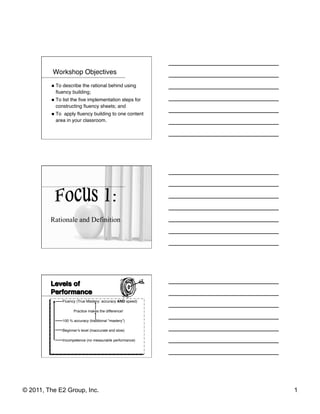
          !      !Fluency (True Mastery: accuracy AND speed)!

          !      !     !Practice makes the difference!!

          !      !100 % accuracy (traditional “mastery”)!

          !      !Beginnerʼs level (inaccurate and slow)!

          !      !Incompetence (no measurable performance)!


© 2011, The E2 Group, Inc.                                      1
Why is Fluency Important?!
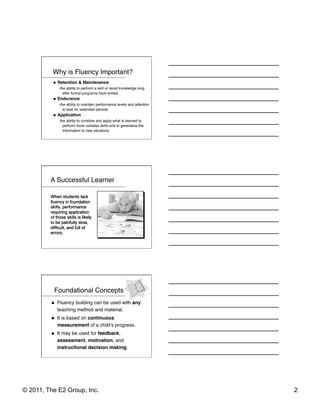
          !    Retention & Maintenance!
               -the ability to perform a skill or recall knowledge long
                  after formal programs have ended.!
          !    Endurance!
               -the ability to maintain performance levels and attention
                  to task for extended periods.!
          !    Application!
               -the ability to combine and apply what is learned to
                  perform more complex skills and to generalize the
                  information to new situations.!


         A Successful Learner!

         When students lack!
         fluency in foundation!
         skills, performance!
         requiring application !
         of those skills is likely!
         to be painfully slow,!
         difficult, and full of!
         errors.!


           Foundational Concepts!
         !     Fluency building can be used with any
               teaching method and material.!
         !     It is based on continuous
               measurement of a childʼs progress.!
         !     It may be used for feedback,
               assessment, motivation, and
               instructional decision making.!


© 2011, The E2 Group, Inc.                                                 2
Foundational Concepts !
          !    Fluency building assists students in
               retaining and organizing information.!
          !    Keeps students actively involved.!
          !    Helps students perform better on tests.!
          !    Students can develop their own practice
               sheets for other classes.!
          !    Students like using them.!


          Five Implementation Steps


          Implementation Steps!
          !    Step 1: Pinpoint!
          !    Step 2: Practice!
          !    Step 3: Chart!
          !    Step 4: Decide!
          !    Step 5: Manage!


© 2011, The E2 Group, Inc.                                3
Step 1: Pinpoint!
        !    Describe behavior.!
             -What is it that you want the students to learn?!
        !    Determine placement.!
             -Students must be placed within the curriculum in accord
               with instructional objectives.!
        !    Set aim.!
             -What should the students shoot for?!


             Characteristics of a
             Pinpoint!
        !     Precise.!
             !-Specific target behavior.!
             !-Describes specific action & outcome: learning channel!
             !-Is consistent.!
        !     Countable.!
             !-Has an observable beginning & end.!
             !-Is repeatable within the length of the timing.!
        !     Fair Pair.!
             !-Collect both correct and incorrect responses.!
        !     Relevant part of Curriculum.!


                             Step 2: Practice!
        !    Timeframe.!
             -Determine an appropriate time for the skill (e.g. minute,
               minutes, etc.).!
        !    Select practice method.!
             -How do you want students to practice (practice sheets,
               SAFMEDS, paired practice, etc.)!
        !    Conduct daily timings.!
             -Conduct timings on pinpoint skill to monitor progress
               and give practice.!


© 2011, The E2 Group, Inc.                                                4
Creating Practice Sheets!
        1.    Select content material (subject, unit);!
        2.    Determine the objective (what do you want to
              measure?);!
        3.    Choose key items or vocabulary;!
        4.    Select 5-8 items for repeated practice;!
        5.    Prepare student practice
              sheets.!


              Practice Sheet Tips!
        !     Label the sheet. Include the objective.!
        !     Include only 5-8 different items. Repeat two or three
              times in random order.!
        !     Determine the length of your timing.!
        !     Donʼt overcrowd - leave space to write answers.!
        !     Provide more items than the students can complete
              during the timing period.!
        !     Develop an answer key.!
        !     Provide prompts if necessary.!
        !     Check the readability level.!


              Partner Practice!
         !    Pair students with a partner for oral timed drill.!
         !    One student reads one from one column and the other
              student supplies the missing element.!
         !    Remind partners to provide immediate feedback to the other
              student (when correct, praise; if incorrect or hesitant, provide
              the answer immediately).!
         !    After two minutes, partners switch roles. The practice
              session is started again for two minutes to allow the other
              student timed practice.!
         !    If the page is finished before the two minutes are up, then
              the student should start over from the top.!
         !    Conduct timed practices on previous practice sheets for
              review.!


© 2011, The E2 Group, Inc.                                                       5
Other Uses of 

         Practice Sheets!

                                         !  Homework!
                                         !  Pre & Post Tests!
                                         !  Group Games!
                                         !  Independent
                                            Practice at
                                            Centers!


                               Step 3: Chart!
        !    Count responses.!
              -Count both corrects and incorrects.!
        !    Record.!
              -Record responses per minute.!
        !    Display.!
              -Display responses on academic chart for student.!


         Purpose of Charting!
         "      To obtain an accurate measure of the
                rate of movement you have
                pinpointed;!
         "      To display the rate obtained
                graphically so that both the general
                trends and smallest change in rates
                will be easily observed.!


© 2011, The E2 Group, Inc.                                         6
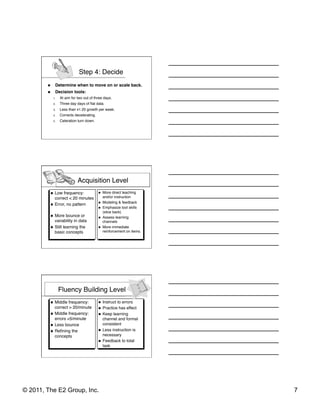
Step 4: Decide!
        !      Determine when to move on or scale back.!
        !      Decision tools:!
             1.    At aim for two out of three days.!
             2.    Three day days of flat data.!
             3.    Less than x1.25 growth per week.!
             4.    Corrects decelerating.!
             5.    Celeration turn down.!


                              Acquisition Level!
         !  Low frequency:                   !    More direct teaching
            correct < 20 minutes!                 and/or instruction!
                                             !    Modeling & feedback!
         !  Error, no pattern
                                             !    Emphasize tool skills
                                                  (slice back)!
         !  More bounce or                   !    Assess learning
            variability in data!                  channels!
         !  Still learning the               !    More immediate
            basic concepts!!                      reinforcement on items.!


                   Fluency Building Level!
         !  Middle frequency:                !    Instruct to errors!
            correct > 20/minute!             !    Practice has effect!
         !  Middle frequency:                !    Keep learning
            errors <5/minute!                     channel and format
         !  Less bounce!                          consistent!
         !  Refining the                      !    Less instruction is
            concepts!                             necessary!
                                             !    Feedback to total
                                                  task!


© 2011, The E2 Group, Inc.                                                   7
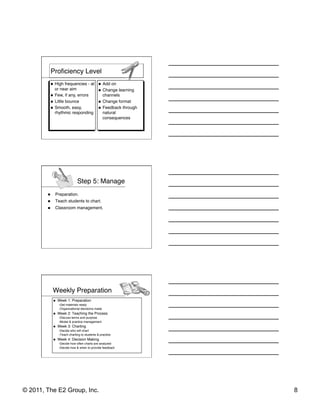
Proficiency Level!
         !  High frequencies - at              !  Add on!
            or near aim!                       !  Change learning
         !  Few, if any, errors!                  channels!
         !  Little bounce!                     !  Change format!
         !  Smooth, easy,                      !  Feedback through
            rhythmic responding!                  natural
                                                  consequences!


                               Step 5: Manage!
        !     Preparation.!
        !     Teach students to chart.!
        !     Classroom management.!


             Weekly Preparation!
             !    Week 1: Preparation!
                  -Get materials ready!
                  -Organizational decisions made!
             !    Week 2: Teaching the Process!
                  -Discuss terms and purpose!
                  -Model & practice management!
             !    Week 3: Charting!
                  -Decide who will chart!
                  -Teach charting to students & practice!
             !    Week 4: Decision Making!
                  -Decide how often charts are analyzed!
                  -Decide how & when to provide feedback!


© 2011, The E2 Group, Inc.                                           8
Management Tips!
          !    Organize directions & materials well.!
          !    Assign all possible tasks to students.!
          !    Establish a routine.!
          !    Establish partners.!
          !    Designate a place for all materials.!
          !    Practice, practice, practice.!
          !    Establish a time to check charts.!
          !    Have a backup for uncooperative students.!
          !    Use positive reinforcement.!
          !    Have students use pencils to chart.!
          !    Select initial pinpoints that will be likely to ensure success.!


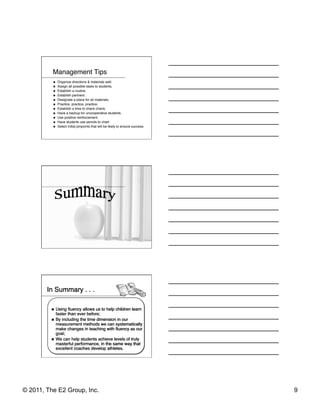
        In Summary . . .!

         !  Using fluency allows us to help children learn
            faster than ever before;!
         !  By including the time dimension in our
            measurement methods we can systematically
            make changes in teaching with fluency as our
            goal;!
         !  We can help students achieve levels of truly
            masterful performance, in the same way that
            excellent coaches develop athletes.!


© 2011, The E2 Group, Inc.                                                        9

Tracy Knickerbocker, Ed.D.

  • 1.
    A Presentation for: The 30th National Conference for Paraeducators & Related Service Providers Presented by: Tracy Knickerbocker, Ed.D. The E2 Group, Inc. 7714 Silent Forest Drive Houston. TX 77479 • 800.282.5491 tknick@theE2group.com www.theE2group.com
  • 2.
    Workshop Objectives! !  Todescribe the rational behind using fluency building;! !  Tolist the five implementation steps for constructing fluency sheets; and! !  Toapply fluency building to one content area in your classroom.! Rationale and Definition ! !Fluency (True Mastery: accuracy AND speed)! ! ! !Practice makes the difference!! ! !100 % accuracy (traditional “mastery”)! ! !Beginnerʼs level (inaccurate and slow)! ! !Incompetence (no measurable performance)! © 2011, The E2 Group, Inc. 1
  • 3.
    Why is FluencyImportant?! !  Retention & Maintenance! -the ability to perform a skill or recall knowledge long after formal programs have ended.! !  Endurance! -the ability to maintain performance levels and attention to task for extended periods.! !  Application! -the ability to combine and apply what is learned to perform more complex skills and to generalize the information to new situations.! A Successful Learner! When students lack! fluency in foundation! skills, performance! requiring application ! of those skills is likely! to be painfully slow,! difficult, and full of! errors.! Foundational Concepts! !  Fluency building can be used with any teaching method and material.! !  It is based on continuous measurement of a childʼs progress.! !  It may be used for feedback, assessment, motivation, and instructional decision making.! © 2011, The E2 Group, Inc. 2
  • 4.
    Foundational Concepts ! !  Fluency building assists students in retaining and organizing information.! !  Keeps students actively involved.! !  Helps students perform better on tests.! !  Students can develop their own practice sheets for other classes.! !  Students like using them.! Five Implementation Steps Implementation Steps! !  Step 1: Pinpoint! !  Step 2: Practice! !  Step 3: Chart! !  Step 4: Decide! !  Step 5: Manage! © 2011, The E2 Group, Inc. 3
  • 5.
    Step 1: Pinpoint! !  Describe behavior.! -What is it that you want the students to learn?! !  Determine placement.! -Students must be placed within the curriculum in accord with instructional objectives.! !  Set aim.! -What should the students shoot for?! Characteristics of a Pinpoint! !  Precise.! !-Specific target behavior.! !-Describes specific action & outcome: learning channel! !-Is consistent.! !  Countable.! !-Has an observable beginning & end.! !-Is repeatable within the length of the timing.! !  Fair Pair.! !-Collect both correct and incorrect responses.! !  Relevant part of Curriculum.! Step 2: Practice! !  Timeframe.! -Determine an appropriate time for the skill (e.g. minute, minutes, etc.).! !  Select practice method.! -How do you want students to practice (practice sheets, SAFMEDS, paired practice, etc.)! !  Conduct daily timings.! -Conduct timings on pinpoint skill to monitor progress and give practice.! © 2011, The E2 Group, Inc. 4
  • 6.
    Creating Practice Sheets! 1.  Select content material (subject, unit);! 2.  Determine the objective (what do you want to measure?);! 3.  Choose key items or vocabulary;! 4.  Select 5-8 items for repeated practice;! 5.  Prepare student practice sheets.! Practice Sheet Tips! !  Label the sheet. Include the objective.! !  Include only 5-8 different items. Repeat two or three times in random order.! !  Determine the length of your timing.! !  Donʼt overcrowd - leave space to write answers.! !  Provide more items than the students can complete during the timing period.! !  Develop an answer key.! !  Provide prompts if necessary.! !  Check the readability level.! Partner Practice! !  Pair students with a partner for oral timed drill.! !  One student reads one from one column and the other student supplies the missing element.! !  Remind partners to provide immediate feedback to the other student (when correct, praise; if incorrect or hesitant, provide the answer immediately).! !  After two minutes, partners switch roles. The practice session is started again for two minutes to allow the other student timed practice.! !  If the page is finished before the two minutes are up, then the student should start over from the top.! !  Conduct timed practices on previous practice sheets for review.! © 2011, The E2 Group, Inc. 5
  • 7.
    Other Uses of
 Practice Sheets! !  Homework! !  Pre & Post Tests! !  Group Games! !  Independent Practice at Centers! Step 3: Chart! !  Count responses.! -Count both corrects and incorrects.! !  Record.! -Record responses per minute.! !  Display.! -Display responses on academic chart for student.! Purpose of Charting! "  To obtain an accurate measure of the rate of movement you have pinpointed;! "  To display the rate obtained graphically so that both the general trends and smallest change in rates will be easily observed.! © 2011, The E2 Group, Inc. 6
  • 8.
    Step 4: Decide! !  Determine when to move on or scale back.! !  Decision tools:! 1.  At aim for two out of three days.! 2.  Three day days of flat data.! 3.  Less than x1.25 growth per week.! 4.  Corrects decelerating.! 5.  Celeration turn down.! Acquisition Level! !  Low frequency: !  More direct teaching correct < 20 minutes! and/or instruction! !  Modeling & feedback! !  Error, no pattern !  Emphasize tool skills (slice back)! !  More bounce or !  Assess learning variability in data! channels! !  Still learning the !  More immediate basic concepts!! reinforcement on items.! Fluency Building Level! !  Middle frequency: !  Instruct to errors! correct > 20/minute! !  Practice has effect! !  Middle frequency: !  Keep learning errors <5/minute! channel and format !  Less bounce! consistent! !  Refining the !  Less instruction is concepts! necessary! !  Feedback to total task! © 2011, The E2 Group, Inc. 7
  • 9.
    Proficiency Level! !  High frequencies - at !  Add on! or near aim! !  Change learning !  Few, if any, errors! channels! !  Little bounce! !  Change format! !  Smooth, easy, !  Feedback through rhythmic responding! natural consequences! Step 5: Manage! !  Preparation.! !  Teach students to chart.! !  Classroom management.! Weekly Preparation! !  Week 1: Preparation! -Get materials ready! -Organizational decisions made! !  Week 2: Teaching the Process! -Discuss terms and purpose! -Model & practice management! !  Week 3: Charting! -Decide who will chart! -Teach charting to students & practice! !  Week 4: Decision Making! -Decide how often charts are analyzed! -Decide how & when to provide feedback! © 2011, The E2 Group, Inc. 8
  • 10.
    Management Tips! !  Organize directions & materials well.! !  Assign all possible tasks to students.! !  Establish a routine.! !  Establish partners.! !  Designate a place for all materials.! !  Practice, practice, practice.! !  Establish a time to check charts.! !  Have a backup for uncooperative students.! !  Use positive reinforcement.! !  Have students use pencils to chart.! !  Select initial pinpoints that will be likely to ensure success.! In Summary . . .! !  Using fluency allows us to help children learn faster than ever before;! !  By including the time dimension in our measurement methods we can systematically make changes in teaching with fluency as our goal;! !  We can help students achieve levels of truly masterful performance, in the same way that excellent coaches develop athletes.! © 2011, The E2 Group, Inc. 9