



Illustrations of
flow nets
3D6 Environmental Engineering II
Dr Gopal Madabhushi
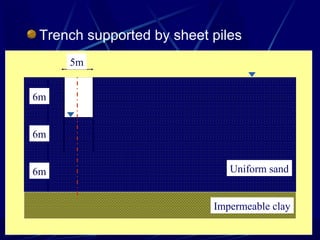
Trench supported by sheet piles
Impermeable clay
Uniform sand
5m
6m
6m
6m
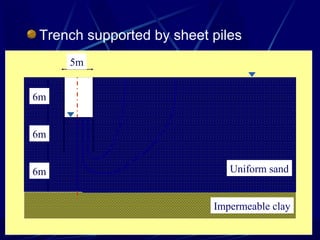
Trench supported by sheet piles
Impermeable clay
Uniform sand
5m
6m
6m
6m
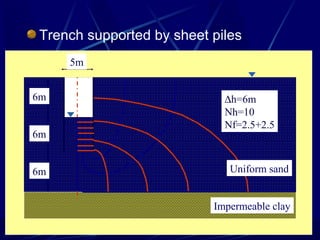
Trench supported by sheet piles
Impermeable clay
5m
6m
6m
6m
∆h=6m
Nh=10
Nf=2.5+2.5
Uniform sand
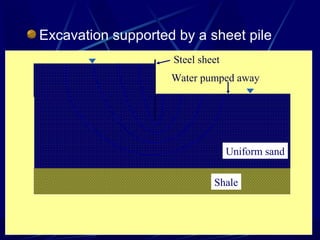
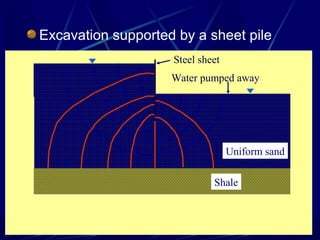
Excavation supported by a sheet pile
Shale
Uniform sand
Water pumped away
Steel sheet
Excavation supported by a sheet pile
Shale
Uniform sand
Water pumped away
Steel sheet
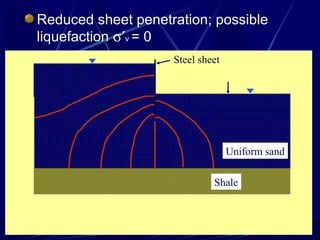
Reduced sheet penetration; possible
liquefaction σ′v = 0
Shale
Uniform sand
Steel sheet
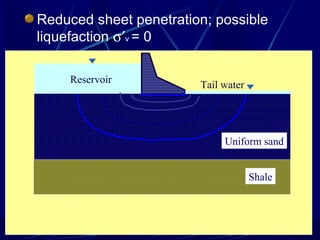
Reduced sheet penetration; possible
liquefaction σ′v = 0
Uniform sand
Reservoir Tail water
Shale
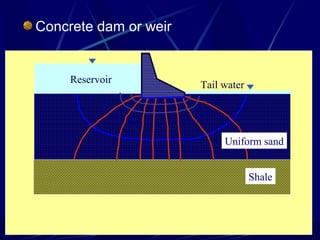
Concrete dam or weir
Reservoir Tail water
Shale
Uniform sand
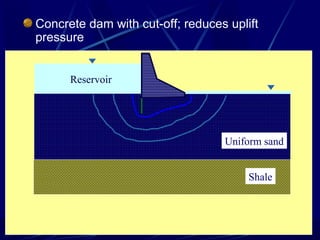
Concrete dam with cut-off; reduces uplift
pressure
Reservoir
Shale
Uniform sand
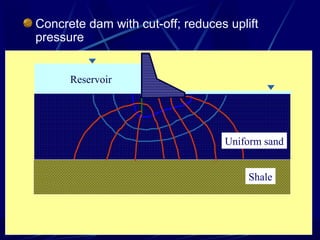
Concrete dam with cut-off; reduces uplift
pressure
Reservoir
Shale
Uniform sand
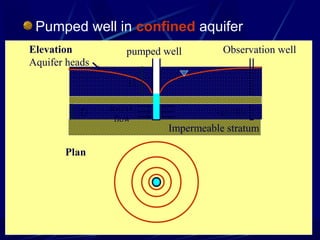
Pumped well in confined aquifer
Observation wellpumped wellElevation
Aquifer heads
H
D aquiferRadial
flow
Impermeable stratum
Plan
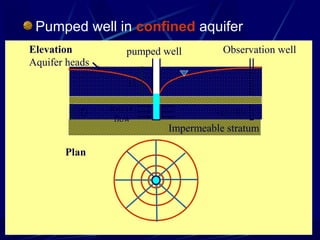
Pumped well in confined aquifer
Observation wellpumped wellElevation
Aquifer heads
H
D aquiferRadial
flow
Impermeable stratum
Plan
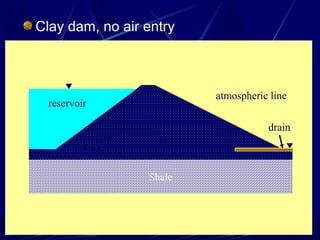
Clay dam, no air entry
Shale
clay
reservoir
atmospheric line
drain
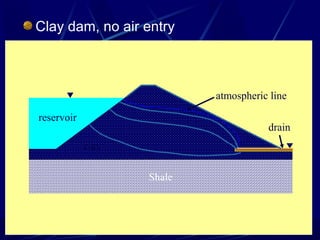
Clay dam, no air entry
Shale
clay
atmospheric line
drain
reservoir
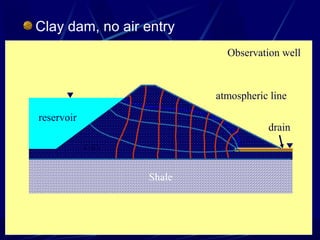
Clay dam, no air entry
Observation well
Shale
clay
atmospheric line
drain
reservoir
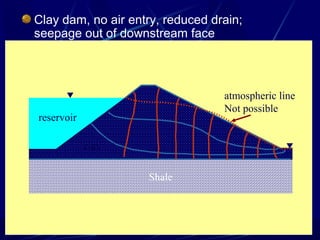
Clay dam, no air entry, reduced drain;
seepage out of downstream face
Shale
clay
atmospheric line
Not possible
reservoir
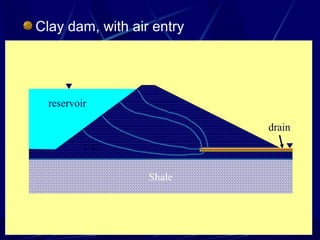
Clay dam, with air entry
Shale
clay
reservoir
drain
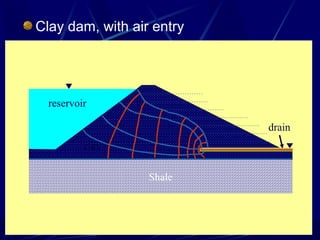
Clay dam, with air entry
Shale
clay
reservoir
drain
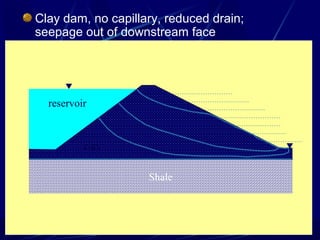
Clay dam, no capillary, reduced drain;
seepage out of downstream face
Shale
clay
reservoir
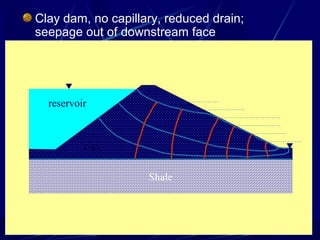
Clay dam, no capillary, reduced drain;
seepage out of downstream face
Shale
clay
reservoir
Flow of water in earth dams
The drain in a rolled clay dam will be
made of gravel, which has an effectively
infinite hydraulic conductivity compared
to that of the clay, so far a finite quantity
of flow in the drain and a finite area of
drain the hydraulic gradient is effectively
zero, i.e. the drain is an equipotential
The phreatic surface connects points at which
the pressure head is zero. Above the phreatic
surface the soil is in suction, so we can see
how much capillarity is needed for the
material to be saturated. If there is insufficient
capillarity, we might discard the solution and
try again. Alternatively: assume there is zero
capillarity, the top water boundary is now
atmospheric so along it and the flow
net has to be adjusted within an unknown top
boundary as the phreatic surface is a flow line
if there is no capillarity.
Flow of water in earth dams
yh =
If then in the flow net,
so once we have the phreatic surface
we can put on the starting points of the
equipotentials on the phreatic surface
directly
Flow of water in earth dams
yh = consyh == δδ
Unsteady flow effects
Consolidation of matrix
Change in pressure head within the soil due to
changes in the boundary water levels may
cause soil to deform, especially in
compressible clays. The soil may undergo
consolidation, a process in which the voids
ratio changes over time at a rate determined
by the pressure variation and the hydraulic
conductivity, which may in turn depend on the
voids ratio.
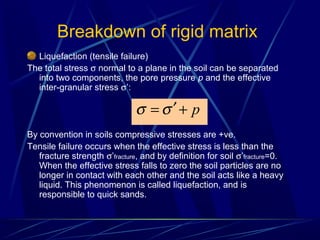
Liquefaction (tensile failure)
The total stress σ normal to a plane in the soil can be separated
into two components, the pore pressure p and the effective
inter-granular stress σ’:
By convention in soils compressive stresses are +ve.
Tensile failure occurs when the effective stress is less than the
fracture strength σ’fracture, and by definition for soil σ’fracture=0.
When the effective stress falls to zero the soil particles are no
longer in contact with each other and the soil acts like a heavy
liquid. This phenomenon is called liquefaction, and is
responsible to quick sands.
Breakdown of rigid matrix
p+′= σσ
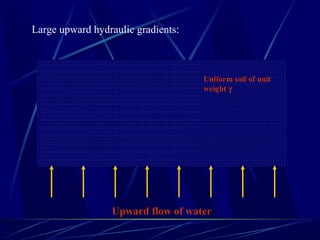
Uniform soil of unit
weight γ
Upward flow of water
Large upward hydraulic gradients:
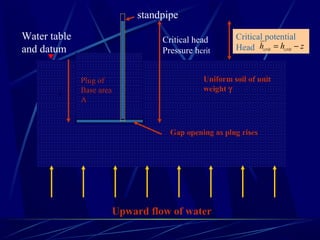
Uniform soil of unit
weight γ
Upward flow of water
Plug of
Base area
A
Water table
and datum
standpipe
Gap opening as plug rises
Critical head
Pressure hcrit
Critical potential
Head zhh critcrit −=
z
At the base of the rising plug, if there is no side friction:
wcrit
v
hp
z
γ
γσ
.
.
=
=
So if σv′=0 then σv = p and :
( ) wcritwcrit zhhz γγγ ... +==
w
wcrit
crit
z
h
i
γ
γγ −
== , icrit=0.8~1.0
where icrit is the critical hydraulic gradient for the quick sand
Condition. As γ ≅ 18~20 kN/m3
for many soils (especially sands
and silts) and γw ≅ 10 kN/m3
:
0.1
10
1020
=
−
==
z
h
i crit
crit
Frictional (shear failure)
Sliding failure of a gravity concrete dam due to
insufficient friction along the base:
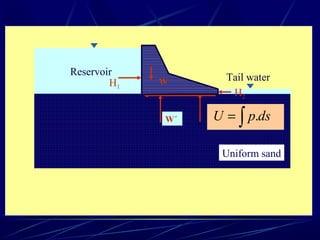
Uniform sand
Reservoir
Tail waterWH1
H2
W´ ∫= dspU .
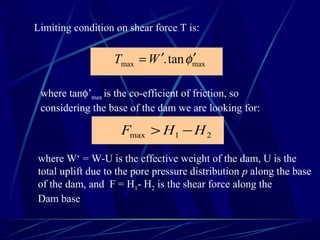
Limiting condition on shear force T is:
maxmax tan. φ′′= WT
where tanφ’max is the co-efficient of friction, so
considering the base of the dam we are looking for:
21max HHF −>
where W‘ = W-U is the effective weight of the dam, U is the
total uplift due to the pore pressure distribution p along the base
of the dam, and F = H1- H2 is the shear force along the
Dam base

Flownets

  • 1.
    Illustrations of flow nets 3D6Environmental Engineering II Dr Gopal Madabhushi
  • 2.
    Trench supported bysheet piles Impermeable clay Uniform sand 5m 6m 6m 6m
  • 3.
    Trench supported bysheet piles Impermeable clay Uniform sand 5m 6m 6m 6m
  • 4.
    Trench supported bysheet piles Impermeable clay 5m 6m 6m 6m ∆h=6m Nh=10 Nf=2.5+2.5 Uniform sand
  • 5.
    Excavation supported bya sheet pile Shale Uniform sand Water pumped away Steel sheet
  • 6.
    Excavation supported bya sheet pile Shale Uniform sand Water pumped away Steel sheet
  • 7.
    Reduced sheet penetration;possible liquefaction σ′v = 0 Shale Uniform sand Steel sheet
  • 8.
    Reduced sheet penetration;possible liquefaction σ′v = 0 Uniform sand Reservoir Tail water Shale
  • 9.
    Concrete dam orweir Reservoir Tail water Shale Uniform sand
  • 10.
    Concrete dam withcut-off; reduces uplift pressure Reservoir Shale Uniform sand
  • 11.
    Concrete dam withcut-off; reduces uplift pressure Reservoir Shale Uniform sand
  • 12.
    Pumped well inconfined aquifer Observation wellpumped wellElevation Aquifer heads H D aquiferRadial flow Impermeable stratum Plan
  • 13.
    Pumped well inconfined aquifer Observation wellpumped wellElevation Aquifer heads H D aquiferRadial flow Impermeable stratum Plan
  • 14.
    Clay dam, noair entry Shale clay reservoir atmospheric line drain
  • 15.
    Clay dam, noair entry Shale clay atmospheric line drain reservoir
  • 16.
    Clay dam, noair entry Observation well Shale clay atmospheric line drain reservoir
  • 17.
    Clay dam, noair entry, reduced drain; seepage out of downstream face Shale clay atmospheric line Not possible reservoir
  • 18.
    Clay dam, withair entry Shale clay reservoir drain
  • 19.
    Clay dam, withair entry Shale clay reservoir drain
  • 20.
    Clay dam, nocapillary, reduced drain; seepage out of downstream face Shale clay reservoir
  • 21.
    Clay dam, nocapillary, reduced drain; seepage out of downstream face Shale clay reservoir
  • 22.
    Flow of waterin earth dams The drain in a rolled clay dam will be made of gravel, which has an effectively infinite hydraulic conductivity compared to that of the clay, so far a finite quantity of flow in the drain and a finite area of drain the hydraulic gradient is effectively zero, i.e. the drain is an equipotential
  • 23.
    The phreatic surfaceconnects points at which the pressure head is zero. Above the phreatic surface the soil is in suction, so we can see how much capillarity is needed for the material to be saturated. If there is insufficient capillarity, we might discard the solution and try again. Alternatively: assume there is zero capillarity, the top water boundary is now atmospheric so along it and the flow net has to be adjusted within an unknown top boundary as the phreatic surface is a flow line if there is no capillarity. Flow of water in earth dams yh =
  • 24.
    If then inthe flow net, so once we have the phreatic surface we can put on the starting points of the equipotentials on the phreatic surface directly Flow of water in earth dams yh = consyh == δδ
  • 25.
    Unsteady flow effects Consolidationof matrix Change in pressure head within the soil due to changes in the boundary water levels may cause soil to deform, especially in compressible clays. The soil may undergo consolidation, a process in which the voids ratio changes over time at a rate determined by the pressure variation and the hydraulic conductivity, which may in turn depend on the voids ratio.
  • 26.
    Liquefaction (tensile failure) Thetotal stress σ normal to a plane in the soil can be separated into two components, the pore pressure p and the effective inter-granular stress σ’: By convention in soils compressive stresses are +ve. Tensile failure occurs when the effective stress is less than the fracture strength σ’fracture, and by definition for soil σ’fracture=0. When the effective stress falls to zero the soil particles are no longer in contact with each other and the soil acts like a heavy liquid. This phenomenon is called liquefaction, and is responsible to quick sands. Breakdown of rigid matrix p+′= σσ
  • 27.
    Uniform soil ofunit weight γ Upward flow of water Large upward hydraulic gradients:
  • 28.
    Uniform soil ofunit weight γ Upward flow of water Plug of Base area A Water table and datum standpipe Gap opening as plug rises Critical head Pressure hcrit Critical potential Head zhh critcrit −= z
  • 29.
    At the baseof the rising plug, if there is no side friction: wcrit v hp z γ γσ . . = = So if σv′=0 then σv = p and : ( ) wcritwcrit zhhz γγγ ... +== w wcrit crit z h i γ γγ − == , icrit=0.8~1.0
  • 30.
    where icrit isthe critical hydraulic gradient for the quick sand Condition. As γ ≅ 18~20 kN/m3 for many soils (especially sands and silts) and γw ≅ 10 kN/m3 : 0.1 10 1020 = − == z h i crit crit
  • 31.
    Frictional (shear failure) Slidingfailure of a gravity concrete dam due to insufficient friction along the base:
  • 32.
  • 33.
    Limiting condition onshear force T is: maxmax tan. φ′′= WT where tanφ’max is the co-efficient of friction, so considering the base of the dam we are looking for: 21max HHF −> where W‘ = W-U is the effective weight of the dam, U is the total uplift due to the pore pressure distribution p along the base of the dam, and F = H1- H2 is the shear force along the Dam base