A Presentation By
N.NAGADATT SHARMA
61% are clueless
about engineering
Why?
 Civil Engineering is a
composite of many
specific disciplines.
◦ Structural
◦ Waste Treatment
◦ Transportation
◦ Geotechnical
◦ Water Management
◦ Construction Management
Civil engineering mainly involves
Buildings & Structures: Cities
Infrastructure: Transportation
Culture: Art: Architecture
The Future: Without Limit!
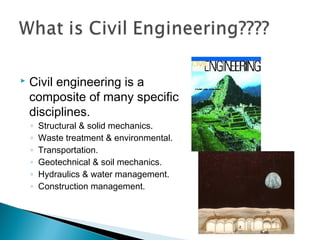
 Civil engineering is a
composite of many specific
disciplines.
◦ Structural & solid mechanics.
◦ Waste treatment & environmental.
◦ Transportation.
◦ Geotechnical & soil mechanics.
◦ Hydraulics & water management.
◦ Construction management.
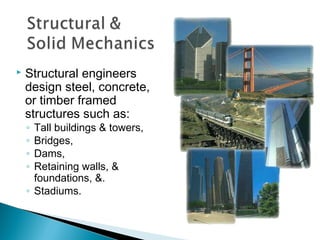
 Structural engineers
design steel, concrete,
or timber framed
structures such as:
◦ Tall buildings & towers,
◦ Bridges,
◦ Dams,
◦ Retaining walls, &
foundations, &.
◦ Stadiums.
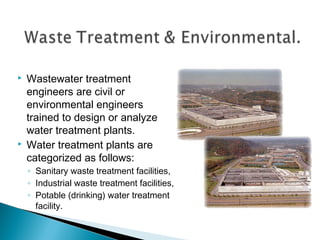
 Wastewater treatment
engineers are civil or
environmental engineers
trained to design or analyze
water treatment plants.
 Water treatment plants are
categorized as follows:
◦ Sanitary waste treatment facilities,
◦ Industrial waste treatment facilities,
◦ Potable (drinking) water treatment
facility.
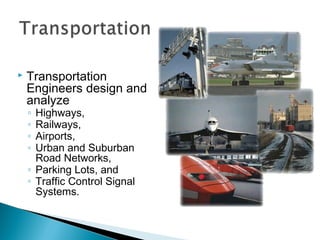
 Transportation
Engineers design and
analyze
◦ Highways,
◦ Railways,
◦ Airports,
◦ Urban and Suburban
Road Networks,
◦ Parking Lots, and
◦ Traffic Control Signal
Systems.
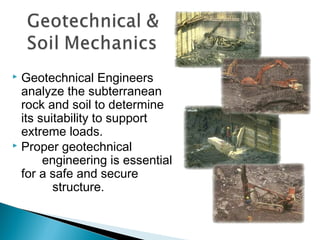
 Geotechnical Engineers
analyze the subterranean
rock and soil to determine
its suitability to support
extreme loads.
 Proper geotechnical
engineering is essential
for a safe and secure
structure.
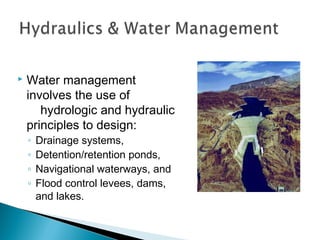
 Water management
involves the use of
hydrologic and hydraulic
principles to design:
◦ Drainage systems,
◦ Detention/retention ponds,
◦ Navigational waterways, and
◦ Flood control levees, dams,
and lakes.
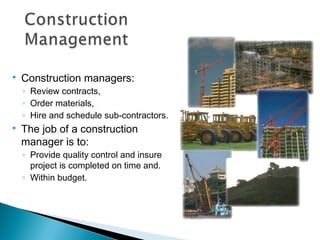
 Construction managers:
◦ Review contracts,
◦ Order materials,
◦ Hire and schedule sub-contractors.
 The job of a construction
manager is to:
◦ Provide quality control and insure
project is completed on time and.
◦ Within budget.

Civil engineering

  • 1.
  • 2.
    61% are clueless aboutengineering Why?  Civil Engineering is a composite of many specific disciplines. ◦ Structural ◦ Waste Treatment ◦ Transportation ◦ Geotechnical ◦ Water Management ◦ Construction Management
  • 3.
    Civil engineering mainlyinvolves Buildings & Structures: Cities Infrastructure: Transportation Culture: Art: Architecture The Future: Without Limit!
  • 4.
     Civil engineeringis a composite of many specific disciplines. ◦ Structural & solid mechanics. ◦ Waste treatment & environmental. ◦ Transportation. ◦ Geotechnical & soil mechanics. ◦ Hydraulics & water management. ◦ Construction management.
  • 5.
     Structural engineers designsteel, concrete, or timber framed structures such as: ◦ Tall buildings & towers, ◦ Bridges, ◦ Dams, ◦ Retaining walls, & foundations, &. ◦ Stadiums.
  • 6.
     Wastewater treatment engineersare civil or environmental engineers trained to design or analyze water treatment plants.  Water treatment plants are categorized as follows: ◦ Sanitary waste treatment facilities, ◦ Industrial waste treatment facilities, ◦ Potable (drinking) water treatment facility.
  • 7.
     Transportation Engineers designand analyze ◦ Highways, ◦ Railways, ◦ Airports, ◦ Urban and Suburban Road Networks, ◦ Parking Lots, and ◦ Traffic Control Signal Systems.
  • 8.
     Geotechnical Engineers analyzethe subterranean rock and soil to determine its suitability to support extreme loads.  Proper geotechnical engineering is essential for a safe and secure structure.
  • 9.
     Water management involvesthe use of hydrologic and hydraulic principles to design: ◦ Drainage systems, ◦ Detention/retention ponds, ◦ Navigational waterways, and ◦ Flood control levees, dams, and lakes.
  • 10.
     Construction managers: ◦Review contracts, ◦ Order materials, ◦ Hire and schedule sub-contractors.  The job of a construction manager is to: ◦ Provide quality control and insure project is completed on time and. ◦ Within budget.