INTRODUCTION
•IN 1975, BLAKE AND MCBRYDE ESTABLISHED THE CONCEPT OF THE
’FLOATING KNEE’ (FK) TO DESCRIBE TRAUMATIC IPSILATERAL
FRACTURES OF THE FEMUR AND TIBIA, WHERE THE KNEE IS
DISCONNECTED FROM THE REST OF THE LIMB.
CLASSIFICATION
• FRASER CLASSIFICATION (1978) OF FLOATING KNEE INJURIES
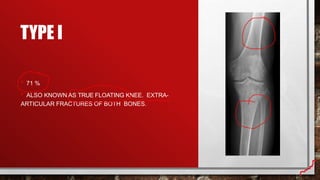
TYPE I
• 71 %
• ALSO KNOWN AS TRUE FLOATING KNEE. EXTRA-
ARTICULAR FRACTURES OF BOTH BONES.
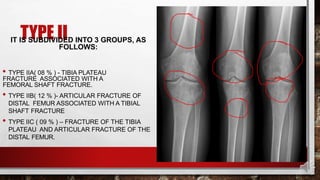
TYPE IIIT IS SUBDIVIDED INTO 3 GROUPS, AS
FOLLOWS:
• TYPE IIA( 08 % ) - TIBIA PLATEAU
FRACTURE ASSOCIATED WITH A
FEMORAL SHAFT FRACTURE.
• TYPE IIB( 12 % )- ARTICULAR FRACTURE OF
DISTAL FEMUR ASSOCIATED WITH A TIBIAL
SHAFT FRACTURE
• TYPE IIC ( 09 % ) – FRACTURE OF THE TIBIA
PLATEAU AND ARTICULAR FRACTURE OF THE
DISTAL FEMUR.
MECHANISM
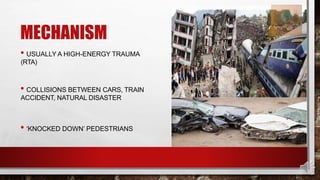
• USUALLY A HIGH-ENERGY TRAUMA
(RTA)
• COLLISIONS BETWEEN CARS, TRAIN
ACCIDENT, NATURAL DISASTER
• ‘KNOCKED DOWN’ PEDESTRIANS
CLINICAL EXAMINATION
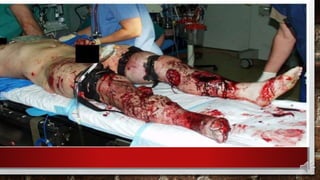
•THE PATIENT WOULD PRESENT WITH INJURY TO THE
LIMB OR THE INJURY MAY BE FOUND ON ASSESSMENT
OF A POLYTRAUMA PATIENT, THEREFORE COMPLETE
LIMB EXAMINATION MUST BE DONE.
•THE NEUROVASCULAR DEFICIT MUST BE SPECIFICALLY
LOOKED FOR AS THESE FRACTURES ARE FREQUENTLY
ASSOCIATED WITH DAMAGE TO THE VESSELS
(POPLITEAL AND POSTERIOR TIBIAL ARTERIES) AND THE
NERVES ( PERONEAL NERVE) ARE COMMON.
• THE INCIDENCE OF OPEN FRACTURES IS 50- 70%, AT SINGLE OR BOTH FRACTURE SITES.
• INJURY TO THE KNEE LIGAMENTS ESPECIALLY ANTEROLATERAL ROTATORY INSTABILITY IS
COMMONLY FOUND.
• KNEE JOINT INJURY IS INDICATED BY SUBSTANTIAL HEMARTHROSIS.
PROGNOSIS
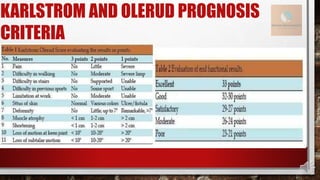
The Karlstrom and Olerud Prognosis criteria are widely accepted
for evaluating functional outcomes in adults.
The following data are recorded and characterized as excellent, good, acceptable, or
poor.
KARLSTROM AND OLERUD PROGNOSIS
CRITERIA
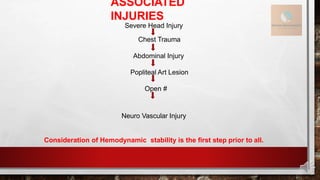
ASSOCIATED
INJURIES
Severe Head Injury
Chest Trauma
Abdominal Injury
Popliteal Art Lesion
Open #
Neuro Vascular Injury
Consideration of Hemodynamic stability is the first step prior to all.
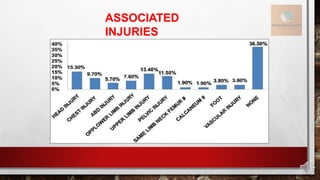
ASSOCIATED
INJURIES
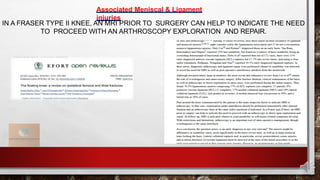
Associated Meniscal & Ligament
injuries
IN A FRASER TYPE II KNEE, AN MRI PRIOR TO SURGERY CAN HELP TO INDICATE THE NEED
TO PROCEED WITH AN ARTHROSCOPY EXPLORATION AND REPAIR.
They found 70.3% ligamentous injuries
comprising:
57% ACL ruptures (6 complete, 15 partial)
8% PCL
27% MCL
19% LCL
A Medial meniscal tear was present in 38%,
And
a Lateral meniscal tear in 30% of cases.
MANAGEMENT
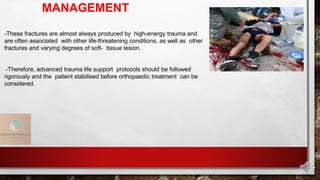
-These fractures are almost always produced by high-energy trauma and
are often associated with other life-threatening conditions, as well as other
fractures and varying degrees of soft- tissue lesion.
-Therefore, advanced trauma life support protocols should be followed
rigorously and the patient stabilised before orthopaedic treatment can be
considered.
CONSIDERATION OF HEMODYNAMIC STABILITY IS THE FIRST STEP PRIOR TO ALL.
The “Triad of Death" is a term coined to describe the decompensation caused by acute blood loss
resulting in
-Hypothermia
-Coagulopathy and
-Acidosis.
The prevention or reversal of these factors may prevent death from exsanguination.
THE USE OF EXTERNAL FIXATION AS AN INITIAL APPROACH AVOIDS THE NEED FOR MORE TIME-
CONSUMING PROCEDURES THAT CAN WORSEN THE "TRIAD OF DEATH".
PROCEDURES LASTING MORE THAN SIX HOURS ARE PARTICULARLY DANGEROUS, AS THEY ARE
ASSOCIATED WITH HIGHER RATES OF ACUTE RESPIRATORY DISTRESS SYNDROME(ARDS) AND
MULTIPLE ORGAN FAILURE.
IT IS ESSENTIAL TO DIAGNOSE THE LESIONS ASSOCIATED WITH FLOATING KNEE BECAUSE THEY MAY
BE LIFE THREATENING.
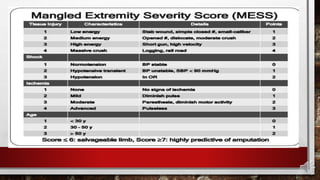
THE MESS (MANGLED EXTREMITY SEVERITY SCORE) SCALE TAKES INTO
ACCOUNT:
(1)Skeletal and soft-tissue injury;
(2)Limb ischaemia;
(3)Shock;
(4)Patient's age.
This tool has proven to be useful in the clinical and legal management of such lesions
ASSOCIATED INJURIES (HEAD, CHEST OR VASCULAR INJURIES AND OTHER FRACTURES)
PLAY A SIGNIFICANT ROLE IN SURGICAL DECISION-MAKING REGARDING THE TIMING AND
SEQUENCE OF SURGERY.
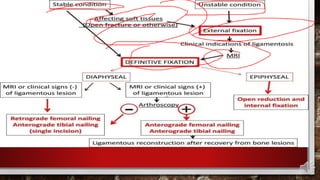
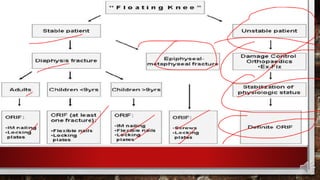
Damage control treatment for floating knee involves not only bone stabilisation using an External
Fixator and the treatment of open fractures by wound cleansing and debridement,but also,
The treatment of associated lesions such as vascular injury or compartment syndrome, in which the
corresponding fasciotomy must be performed.
Fraser type IIb floating knee.
Damage control by External Fixation in each segment.
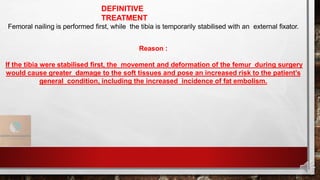
DEFINITIVE
TREATMENT
Femoral nailing is performed first, while the tibia is temporarily stabilised with an external fixator.
Reason :
If the tibia were stabilised first, the movement and deformation of the femur during surgery
would cause greater damage to the soft tissues and pose an increased risk to the patient’s
general condition, including the increased incidence of fat embolism.
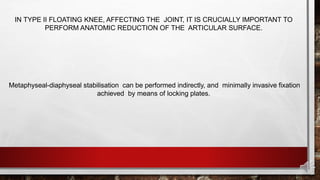
IN TYPE II FLOATING KNEE, AFFECTING THE JOINT, IT IS CRUCIALLY IMPORTANT TO
PERFORM ANATOMIC REDUCTION OF THE ARTICULAR SURFACE.
Metaphyseal-diaphyseal stabilisation can be performed indirectly, and minimally invasive fixation
achieved by means of locking plates.
THANK YOU
For more such videos do subscribe our channel Orthomechanics

Floating knee

  • 2.
    INTRODUCTION •IN 1975, BLAKEAND MCBRYDE ESTABLISHED THE CONCEPT OF THE ’FLOATING KNEE’ (FK) TO DESCRIBE TRAUMATIC IPSILATERAL FRACTURES OF THE FEMUR AND TIBIA, WHERE THE KNEE IS DISCONNECTED FROM THE REST OF THE LIMB.
  • 3.
    CLASSIFICATION • FRASER CLASSIFICATION(1978) OF FLOATING KNEE INJURIES
  • 4.
    TYPE I • 71% • ALSO KNOWN AS TRUE FLOATING KNEE. EXTRA- ARTICULAR FRACTURES OF BOTH BONES.
  • 5.
    TYPE IIIT ISSUBDIVIDED INTO 3 GROUPS, AS FOLLOWS: • TYPE IIA( 08 % ) - TIBIA PLATEAU FRACTURE ASSOCIATED WITH A FEMORAL SHAFT FRACTURE. • TYPE IIB( 12 % )- ARTICULAR FRACTURE OF DISTAL FEMUR ASSOCIATED WITH A TIBIAL SHAFT FRACTURE • TYPE IIC ( 09 % ) – FRACTURE OF THE TIBIA PLATEAU AND ARTICULAR FRACTURE OF THE DISTAL FEMUR.
  • 6.
    MECHANISM • USUALLY AHIGH-ENERGY TRAUMA (RTA) • COLLISIONS BETWEEN CARS, TRAIN ACCIDENT, NATURAL DISASTER • ‘KNOCKED DOWN’ PEDESTRIANS
  • 7.
    CLINICAL EXAMINATION •THE PATIENTWOULD PRESENT WITH INJURY TO THE LIMB OR THE INJURY MAY BE FOUND ON ASSESSMENT OF A POLYTRAUMA PATIENT, THEREFORE COMPLETE LIMB EXAMINATION MUST BE DONE. •THE NEUROVASCULAR DEFICIT MUST BE SPECIFICALLY LOOKED FOR AS THESE FRACTURES ARE FREQUENTLY ASSOCIATED WITH DAMAGE TO THE VESSELS (POPLITEAL AND POSTERIOR TIBIAL ARTERIES) AND THE NERVES ( PERONEAL NERVE) ARE COMMON.
  • 9.
    • THE INCIDENCEOF OPEN FRACTURES IS 50- 70%, AT SINGLE OR BOTH FRACTURE SITES. • INJURY TO THE KNEE LIGAMENTS ESPECIALLY ANTEROLATERAL ROTATORY INSTABILITY IS COMMONLY FOUND. • KNEE JOINT INJURY IS INDICATED BY SUBSTANTIAL HEMARTHROSIS.
  • 10.
    PROGNOSIS The Karlstrom andOlerud Prognosis criteria are widely accepted for evaluating functional outcomes in adults. The following data are recorded and characterized as excellent, good, acceptable, or poor.
  • 11.
    KARLSTROM AND OLERUDPROGNOSIS CRITERIA
  • 12.
    ASSOCIATED INJURIES Severe Head Injury ChestTrauma Abdominal Injury Popliteal Art Lesion Open # Neuro Vascular Injury Consideration of Hemodynamic stability is the first step prior to all.
  • 13.
  • 14.
    Associated Meniscal &Ligament injuries IN A FRASER TYPE II KNEE, AN MRI PRIOR TO SURGERY CAN HELP TO INDICATE THE NEED TO PROCEED WITH AN ARTHROSCOPY EXPLORATION AND REPAIR.
  • 15.
    They found 70.3%ligamentous injuries comprising: 57% ACL ruptures (6 complete, 15 partial) 8% PCL 27% MCL 19% LCL A Medial meniscal tear was present in 38%, And a Lateral meniscal tear in 30% of cases.
  • 16.
    MANAGEMENT -These fractures arealmost always produced by high-energy trauma and are often associated with other life-threatening conditions, as well as other fractures and varying degrees of soft- tissue lesion. -Therefore, advanced trauma life support protocols should be followed rigorously and the patient stabilised before orthopaedic treatment can be considered.
  • 17.
    CONSIDERATION OF HEMODYNAMICSTABILITY IS THE FIRST STEP PRIOR TO ALL. The “Triad of Death" is a term coined to describe the decompensation caused by acute blood loss resulting in -Hypothermia -Coagulopathy and -Acidosis. The prevention or reversal of these factors may prevent death from exsanguination.
  • 18.
    THE USE OFEXTERNAL FIXATION AS AN INITIAL APPROACH AVOIDS THE NEED FOR MORE TIME- CONSUMING PROCEDURES THAT CAN WORSEN THE "TRIAD OF DEATH". PROCEDURES LASTING MORE THAN SIX HOURS ARE PARTICULARLY DANGEROUS, AS THEY ARE ASSOCIATED WITH HIGHER RATES OF ACUTE RESPIRATORY DISTRESS SYNDROME(ARDS) AND MULTIPLE ORGAN FAILURE. IT IS ESSENTIAL TO DIAGNOSE THE LESIONS ASSOCIATED WITH FLOATING KNEE BECAUSE THEY MAY BE LIFE THREATENING.
  • 19.
    THE MESS (MANGLEDEXTREMITY SEVERITY SCORE) SCALE TAKES INTO ACCOUNT: (1)Skeletal and soft-tissue injury; (2)Limb ischaemia; (3)Shock; (4)Patient's age. This tool has proven to be useful in the clinical and legal management of such lesions
  • 21.
    ASSOCIATED INJURIES (HEAD,CHEST OR VASCULAR INJURIES AND OTHER FRACTURES) PLAY A SIGNIFICANT ROLE IN SURGICAL DECISION-MAKING REGARDING THE TIMING AND SEQUENCE OF SURGERY. Damage control treatment for floating knee involves not only bone stabilisation using an External Fixator and the treatment of open fractures by wound cleansing and debridement,but also, The treatment of associated lesions such as vascular injury or compartment syndrome, in which the corresponding fasciotomy must be performed.
  • 22.
    Fraser type IIbfloating knee. Damage control by External Fixation in each segment.
  • 23.
    DEFINITIVE TREATMENT Femoral nailing isperformed first, while the tibia is temporarily stabilised with an external fixator. Reason : If the tibia were stabilised first, the movement and deformation of the femur during surgery would cause greater damage to the soft tissues and pose an increased risk to the patient’s general condition, including the increased incidence of fat embolism.
  • 26.
    IN TYPE IIFLOATING KNEE, AFFECTING THE JOINT, IT IS CRUCIALLY IMPORTANT TO PERFORM ANATOMIC REDUCTION OF THE ARTICULAR SURFACE. Metaphyseal-diaphyseal stabilisation can be performed indirectly, and minimally invasive fixation achieved by means of locking plates.
  • 27.
    THANK YOU For moresuch videos do subscribe our channel Orthomechanics