   Definition              How FMS works
   History of FMS          Advantages
   FMS equipment           Disadvantage
   Types of FMS
   Application of FMS
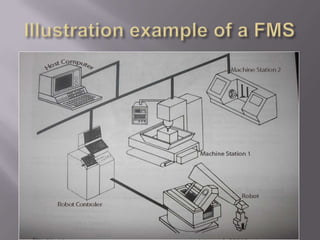
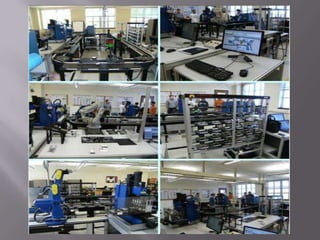
A Flexible Manufacturing System (FMS) is a
production system consisting of a set of identical
and complementary numerically controlled
machine which are connected through an
automated transportation system.
  each process in FMS is controlled by a
dedicated computer (FMS cell computer).
At the turn of the century FMS did not exist. There was not a big
enough need for efficiency because the markets were national and there
was no foreign competition. Manufacturers could tell the consumers
what to buy. Henry Ford is quoted as saying �people can order any
color of car as long as it is black.� This was the thinking of many big
manufacturers of the time. After the Second World War a new era in
manufacturing was to come. The discovery of new materials and
production techniques increased quality and productivity. The wars
end open foreign markets and new competition. Now the market
focused on consumer and not the manufacturer. The first FMS was
patent in 1965 by Theo Williamson who made numerically controlled
equipment. Examples of numerically controlled equipment are like a
CNC lathes or mills which is called varying types of FMS. In the 70�s
manufacturers could not stay to date with the ever-growing
technological knowledge manufacturers competitors have, so FMS
became mainstream in manufacturing.
   In the 80�s for the first time manufacturers had to take in
consideration efficiency, quality, and flexibility to stay in business.
   Primary equipment
    work centers
      • Universal machining centers (prismatic FMSs)
      • Turning centers (rotational FMSs)
      • Grinding machines
      • Nibbling machines
    Process centers
      • Wash machines
      • Coordinate measuring machines
      • Robotic work stations
      • Manual workstations
   Secondary equipment
    Support stations
      • Pallet/fixture load/unload stations
      • Tool commissioning/setting area
    Support equipment
      • Robots
      • Pallet/fixture/stillage stores
      • Pallet buffer stations
      • Tools stores
      • Raw material stores
      • Transport system(AGVs,RGVs,robots)
      • Transport units(pallets/stillages)
   Metal-cutting machining
   Metal forming
   Assembly
   Joining-welding (arc , spot), glueing
   Surface treatment
   Inspection
   Testing
   To reduce set up and queue times
   Improve efficiency
   Reduce time for product completion
   Utilize human workers better
   Improve product routing
   Produce a variety of Items under one roof
   Improve product quality
   Serve a variety of vendors simultaneously
   Produce more product more quickly
   Limited ability to adapt to changes in product
    or product mix (ex:machines are of limited capacity and the tooling
    necessary for products, even of the same family, is not always feasible in a given FMS)

   Substantial pre-planning activity
   Expensive, costing millions of dollars
   Technological problems of exact component
    positioning and precise timing necessary to
    process a component
   Sophisticated manufacturing systems
How Does It Work ?
   By implementing the components of
    robotics, manufacturing technology and computer
    integrated manufacturing in a correct order one can
    achieve a successful Flexible Manufacturing System
ROBOTS
First 5 axis robot is in charge of picking and placing parts which are scanned by the
    barcode reader, and transfer them to the left side for machining or throw it to the
    conveyor for the other operations.
    This robot utilizes a vacuum gripper to pick the parts.
Pneumatic Robot which contained a few reed sensors, used to set the limits for the
    pneumatic cylinder motion. This robot is using a general griper which can be close
    or open in each time.
    This robot just picks the parts which are detected by the Metal Detector sensor,
    placed before it.
    Hence, the duty of this robot is to pick the Metal-Coated parts, chosen by the
    sensor placed near it.
Second Five axis robot which has the same specifications as the former one, used to
    pick the Non-Metal parts (which are detected by non-metal detector sensor on the
    big conveyor) from the flexible conveyor and place them into a rail way for the
    next defined operations.
    This robot placed on a special Nut and Screw system which is connected to a
    Motor using to turning the screw in case of moving the robot across the Big
    conveyor .
COMPUTERS AND SOFTWARES

First Robot is controlled by a General PC, using a visual basic
    program to read the barcodes and also control the robot’s motion.
    For each part the program decide Where to be placed according to
    the parts’ barcode
The second 5-axis robot is controlled by a PC using special software
    which is named “Robotica”.
    Generally, this software has a GIU (Graphical User Interface)
    which can be used for programming the robot remotely. After
    writing the program, by pressing the Run Button on the program
    screen, each line transferred to the robot using a general RS-232
    cable.
Also we have another PC which is used to monitor the Main PlC ,
    placed in an anti dust cabin for safety.
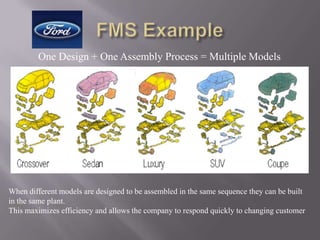
One Design + One Assembly Process = Multiple Models


When different models are designed to be assembled in the same sequence they can be built
in the same plant.
This maximizes efficiency and allows the company to respond quickly to changing customer
Flexible manufacturing

Flexible manufacturing

  • 3.
    Definition  How FMS works  History of FMS  Advantages  FMS equipment  Disadvantage  Types of FMS  Application of FMS
  • 4.
    A Flexible ManufacturingSystem (FMS) is a production system consisting of a set of identical and complementary numerically controlled machine which are connected through an automated transportation system. each process in FMS is controlled by a dedicated computer (FMS cell computer).
  • 5.
    At the turnof the century FMS did not exist. There was not a big enough need for efficiency because the markets were national and there was no foreign competition. Manufacturers could tell the consumers what to buy. Henry Ford is quoted as saying �people can order any color of car as long as it is black.� This was the thinking of many big manufacturers of the time. After the Second World War a new era in manufacturing was to come. The discovery of new materials and production techniques increased quality and productivity. The wars end open foreign markets and new competition. Now the market focused on consumer and not the manufacturer. The first FMS was patent in 1965 by Theo Williamson who made numerically controlled equipment. Examples of numerically controlled equipment are like a CNC lathes or mills which is called varying types of FMS. In the 70�s manufacturers could not stay to date with the ever-growing technological knowledge manufacturers competitors have, so FMS became mainstream in manufacturing. In the 80�s for the first time manufacturers had to take in consideration efficiency, quality, and flexibility to stay in business.
  • 6.
    Primary equipment work centers • Universal machining centers (prismatic FMSs) • Turning centers (rotational FMSs) • Grinding machines • Nibbling machines Process centers • Wash machines • Coordinate measuring machines • Robotic work stations • Manual workstations
  • 7.
    Secondary equipment Support stations • Pallet/fixture load/unload stations • Tool commissioning/setting area Support equipment • Robots • Pallet/fixture/stillage stores • Pallet buffer stations • Tools stores • Raw material stores • Transport system(AGVs,RGVs,robots) • Transport units(pallets/stillages)
  • 8.
    Metal-cutting machining  Metal forming  Assembly  Joining-welding (arc , spot), glueing  Surface treatment  Inspection  Testing
  • 9.
    To reduce set up and queue times  Improve efficiency  Reduce time for product completion  Utilize human workers better  Improve product routing  Produce a variety of Items under one roof  Improve product quality  Serve a variety of vendors simultaneously  Produce more product more quickly
  • 10.
    Limited ability to adapt to changes in product or product mix (ex:machines are of limited capacity and the tooling necessary for products, even of the same family, is not always feasible in a given FMS)  Substantial pre-planning activity  Expensive, costing millions of dollars  Technological problems of exact component positioning and precise timing necessary to process a component  Sophisticated manufacturing systems
  • 12.
  • 13.
    By implementing the components of robotics, manufacturing technology and computer integrated manufacturing in a correct order one can achieve a successful Flexible Manufacturing System
  • 15.
    ROBOTS First 5 axisrobot is in charge of picking and placing parts which are scanned by the barcode reader, and transfer them to the left side for machining or throw it to the conveyor for the other operations. This robot utilizes a vacuum gripper to pick the parts. Pneumatic Robot which contained a few reed sensors, used to set the limits for the pneumatic cylinder motion. This robot is using a general griper which can be close or open in each time. This robot just picks the parts which are detected by the Metal Detector sensor, placed before it. Hence, the duty of this robot is to pick the Metal-Coated parts, chosen by the sensor placed near it. Second Five axis robot which has the same specifications as the former one, used to pick the Non-Metal parts (which are detected by non-metal detector sensor on the big conveyor) from the flexible conveyor and place them into a rail way for the next defined operations. This robot placed on a special Nut and Screw system which is connected to a Motor using to turning the screw in case of moving the robot across the Big conveyor .
  • 16.
    COMPUTERS AND SOFTWARES FirstRobot is controlled by a General PC, using a visual basic program to read the barcodes and also control the robot’s motion. For each part the program decide Where to be placed according to the parts’ barcode The second 5-axis robot is controlled by a PC using special software which is named “Robotica”. Generally, this software has a GIU (Graphical User Interface) which can be used for programming the robot remotely. After writing the program, by pressing the Run Button on the program screen, each line transferred to the robot using a general RS-232 cable. Also we have another PC which is used to monitor the Main PlC , placed in an anti dust cabin for safety.
  • 17.
    One Design +One Assembly Process = Multiple Models When different models are designed to be assembled in the same sequence they can be built in the same plant. This maximizes efficiency and allows the company to respond quickly to changing customer