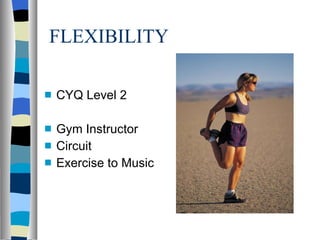
FLEXIBILITY CYQ Level 2 Gym Instructor Circuit Exercise to Music
FLEXIBILITY – What is it? Flexibility can be defined as:  “ A range of movement available at a joint” Bone Structure of Joint Shape of Cartilage within the Joint Surrounding Ligaments Length of Muscles and Tendons
FLEXIBILITY – Why do it? To Improve Physical Fitness . Effective Flexibility will: Improves posture Reduces the risk of Injury Maintains a Healthy Spine Reduces the risk of Back Problems
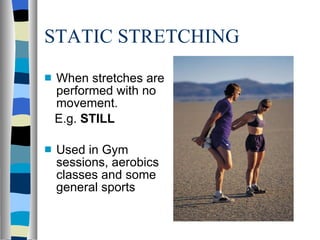
STATIC STRETCHING When stretches are performed with no movement.  E.g.  STILL Used in Gym sessions, aerobics classes and some general sports
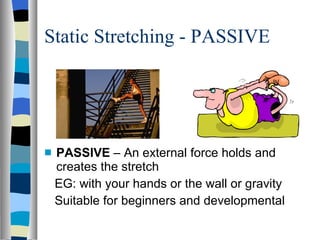
Static Stretching - PASSIVE PASSIVE  – An external force holds and creates the stretch  EG: with your hands or the wall or gravity Suitable for beginners and developmental
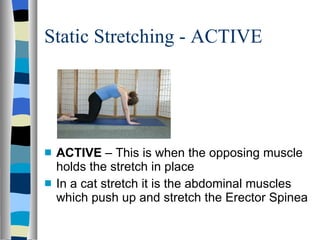
Static Stretching - ACTIVE ACTIVE  – This is when the opposing muscle holds the stretch in place In a cat stretch it is the abdominal muscles which push up and stretch the Erector Spinea
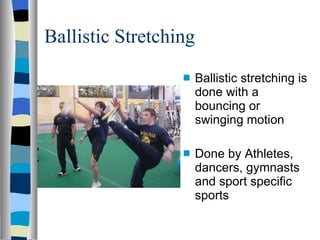
Ballistic Stretching Ballistic stretching is done with a bouncing or swinging motion Done by Athletes, dancers, gymnasts and sport specific sports
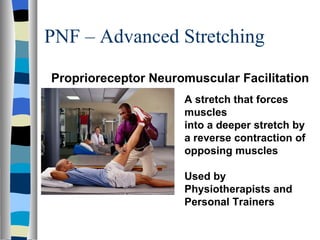
PNF – Advanced Stretching Proprioreceptor Neuromuscular Facilitation A stretch that forces muscles into a deeper stretch by a reverse contraction of opposing muscles Used by Physiotherapists and Personal Trainers
What happens When we Stretch? The body prevents over stretching and tearing of muscles by using a STRETCH REFLEX When the body thinks that the muscle is about to overstretch it causes a big contraction that immediately stops the movement and prevents damage
When do we Stretch? Stretching must only be performed after exercise when the muscles are warm and pliable. Stretching cold muscles can result in tearing and damage. Flexibility requires that you are both warm and relaxed.
Maintenance Stretching Maintenance stretching should always be performed to realign muscle fibres to their original length. This type of stretching maintains flexibility but does not improve it. Maintenance Stretches need to be held for 10 – 12 seconds
Developmental Stretching Developmental stretching is done on specific muscles that may have become short through daily life. This type of stretching lengthens muscle fibres and increases range of movement These types of stretches are held for  15 – 30 seconds.
Developmental Stretching Must be done slowly to avoid a huge Contraction (  STRETCH REFLEX ) After approx 10 – 12 seconds of holding the stretch the brain realises that the muscle ISN’T going to overstretch and then relaxes  (  INVERSE REFLEX ) The stretch can then be developed or increased further.
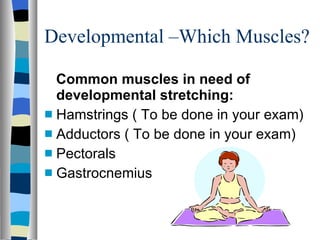
Developmental –Which Muscles? Common muscles in need of developmental stretching: Hamstrings ( To be done in your exam) Adductors ( To be done in your exam) Pectorals Gastrocnemius
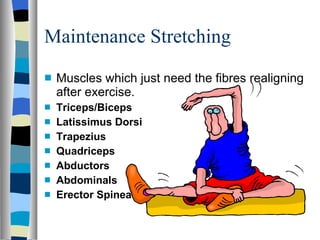
Maintenance Stretching Muscles which just need the fibres realigning after exercise. Triceps/Biceps Latissimus Dorsi Trapezius Quadriceps Abductors Abdominals Erector Spinea

Flexibility theory

  • 1.
    FLEXIBILITY CYQ Level2 Gym Instructor Circuit Exercise to Music
  • 2.
    FLEXIBILITY – Whatis it? Flexibility can be defined as: “ A range of movement available at a joint” Bone Structure of Joint Shape of Cartilage within the Joint Surrounding Ligaments Length of Muscles and Tendons
  • 3.
    FLEXIBILITY – Whydo it? To Improve Physical Fitness . Effective Flexibility will: Improves posture Reduces the risk of Injury Maintains a Healthy Spine Reduces the risk of Back Problems
  • 4.
    STATIC STRETCHING Whenstretches are performed with no movement. E.g. STILL Used in Gym sessions, aerobics classes and some general sports
  • 5.
    Static Stretching -PASSIVE PASSIVE – An external force holds and creates the stretch EG: with your hands or the wall or gravity Suitable for beginners and developmental
  • 6.
    Static Stretching -ACTIVE ACTIVE – This is when the opposing muscle holds the stretch in place In a cat stretch it is the abdominal muscles which push up and stretch the Erector Spinea
  • 7.
    Ballistic Stretching Ballisticstretching is done with a bouncing or swinging motion Done by Athletes, dancers, gymnasts and sport specific sports
  • 8.
    PNF – AdvancedStretching Proprioreceptor Neuromuscular Facilitation A stretch that forces muscles into a deeper stretch by a reverse contraction of opposing muscles Used by Physiotherapists and Personal Trainers
  • 9.
    What happens Whenwe Stretch? The body prevents over stretching and tearing of muscles by using a STRETCH REFLEX When the body thinks that the muscle is about to overstretch it causes a big contraction that immediately stops the movement and prevents damage
  • 10.
    When do weStretch? Stretching must only be performed after exercise when the muscles are warm and pliable. Stretching cold muscles can result in tearing and damage. Flexibility requires that you are both warm and relaxed.
  • 11.
    Maintenance Stretching Maintenancestretching should always be performed to realign muscle fibres to their original length. This type of stretching maintains flexibility but does not improve it. Maintenance Stretches need to be held for 10 – 12 seconds
  • 12.
    Developmental Stretching Developmentalstretching is done on specific muscles that may have become short through daily life. This type of stretching lengthens muscle fibres and increases range of movement These types of stretches are held for 15 – 30 seconds.
  • 13.
    Developmental Stretching Mustbe done slowly to avoid a huge Contraction ( STRETCH REFLEX ) After approx 10 – 12 seconds of holding the stretch the brain realises that the muscle ISN’T going to overstretch and then relaxes ( INVERSE REFLEX ) The stretch can then be developed or increased further.
  • 14.
    Developmental –Which Muscles?Common muscles in need of developmental stretching: Hamstrings ( To be done in your exam) Adductors ( To be done in your exam) Pectorals Gastrocnemius
  • 15.
    Maintenance Stretching Muscleswhich just need the fibres realigning after exercise. Triceps/Biceps Latissimus Dorsi Trapezius Quadriceps Abductors Abdominals Erector Spinea