Exercise and Fitness Lvl 2 Lesson 3  Skeletal System
Session 3 Aims & Objectives Recap of session 2 – Joints in Action Label and explain the functions of the Vertebral Column Identify the long and short term effects of exercise on the skeletal system Skeletal System - Revision Workshop
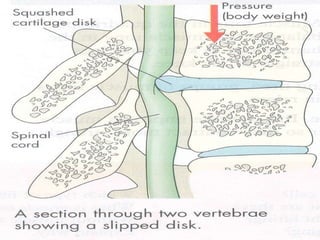
WHAT IS THE VERTEBRAL COLUMN? Also called the  spine , used for  posture ,  movement, stability & protection . Strong  and  flexible  structure and one of its primary roles is to  protect  the spinal cord since any damage can cause considerable problems Made up of  33  bones, some allow for movement at the joints where the bones fit together, some allow for no movement at all Discs  are between these joints and act as shock absorbers
The Vertebral Column  What are the main functions?
Answer: 1. Protection of the spinal chord 2. Attachment of Ribs 3. Attachment of muscles 4. To allow a wide range of movement although each vertebrae only moves a small distance.
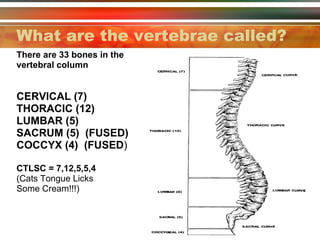
What are the vertebrae called? There are 33 bones in the  vertebral column CERVICAL (7) THORACIC (12) LUMBAR (5) SACRUM (5)  (FUSED)  COCCYX (4)  (FUSED ) CTLSC = 7,12,5,5,4 (Cats Tongue Licks  Some Cream!!!)
 
Vertebral Column  The “S” Shape of the spine allows for  absorption  of impact, e.g. during sport Mainly the  lumbar  region of the spine which absorbs the impact and this area is where many back problems are located
 
Vertebral Column Fused, no movement 4 Coccyx Fused, no movement 5 Sacrum Lumbar vertebrae are moveable 5 Lumbar Limited, creates a stable structure for organs 12 Thoracic Yes  7 Cervical Movement Number of Vertebrae Category
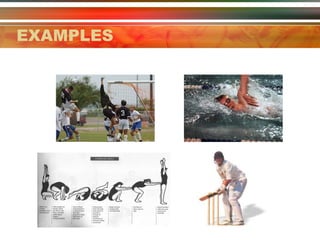
Lets look at this type of vertebrae and think about its use in sport. CERVICAL - THE VERTEBRAE THAT MAKE UP THE NECK REGION (THE TOP TWO ARE THE  ATLAS  AND  AXIS )
EXAMPLES
Look at these vertebrae and recognise the difference.
The Pelvic Girdle The coccyx and sacrum region of the spine sit perfectly within  the pelvic girdle The pelvic girdle is  made up of the illium,  pubis symphysis  & ischium
Activity 1 Now complete the worksheet 5 labelling the 5 regions of the spine, detailing how many vertebrae are in each region.
Short Term Effects of Exercise on the Skeletal Increased production of Synovial fluid Cartilage temporarily swells as it absorbs synovial fluid
Long Term Effects of Exercise Increased bone density – bones get thicker and stronger Reduced risk of Osteoporosis Increased mineral storage Increased red blood cell production Ligaments become stronger Tendons become stronger Increased number of capillaries

Lesson 3 skeletal system

  • 1.
    Exercise and FitnessLvl 2 Lesson 3 Skeletal System
  • 2.
    Session 3 Aims& Objectives Recap of session 2 – Joints in Action Label and explain the functions of the Vertebral Column Identify the long and short term effects of exercise on the skeletal system Skeletal System - Revision Workshop
  • 3.
    WHAT IS THEVERTEBRAL COLUMN? Also called the spine , used for posture , movement, stability & protection . Strong and flexible structure and one of its primary roles is to protect the spinal cord since any damage can cause considerable problems Made up of 33 bones, some allow for movement at the joints where the bones fit together, some allow for no movement at all Discs are between these joints and act as shock absorbers
  • 4.
    The Vertebral Column What are the main functions?
  • 5.
    Answer: 1. Protectionof the spinal chord 2. Attachment of Ribs 3. Attachment of muscles 4. To allow a wide range of movement although each vertebrae only moves a small distance.
  • 6.
    What are thevertebrae called? There are 33 bones in the vertebral column CERVICAL (7) THORACIC (12) LUMBAR (5) SACRUM (5) (FUSED) COCCYX (4) (FUSED ) CTLSC = 7,12,5,5,4 (Cats Tongue Licks Some Cream!!!)
  • 7.
  • 8.
    Vertebral Column The “S” Shape of the spine allows for absorption of impact, e.g. during sport Mainly the lumbar region of the spine which absorbs the impact and this area is where many back problems are located
  • 9.
  • 10.
    Vertebral Column Fused,no movement 4 Coccyx Fused, no movement 5 Sacrum Lumbar vertebrae are moveable 5 Lumbar Limited, creates a stable structure for organs 12 Thoracic Yes 7 Cervical Movement Number of Vertebrae Category
  • 11.
    Lets look atthis type of vertebrae and think about its use in sport. CERVICAL - THE VERTEBRAE THAT MAKE UP THE NECK REGION (THE TOP TWO ARE THE ATLAS AND AXIS )
  • 12.
  • 13.
    Look at thesevertebrae and recognise the difference.
  • 14.
    The Pelvic GirdleThe coccyx and sacrum region of the spine sit perfectly within the pelvic girdle The pelvic girdle is made up of the illium, pubis symphysis & ischium
  • 15.
    Activity 1 Nowcomplete the worksheet 5 labelling the 5 regions of the spine, detailing how many vertebrae are in each region.
  • 16.
    Short Term Effectsof Exercise on the Skeletal Increased production of Synovial fluid Cartilage temporarily swells as it absorbs synovial fluid
  • 17.
    Long Term Effectsof Exercise Increased bone density – bones get thicker and stronger Reduced risk of Osteoporosis Increased mineral storage Increased red blood cell production Ligaments become stronger Tendons become stronger Increased number of capillaries