APRIMER
The world is,
once again, flat.
What is flat design?
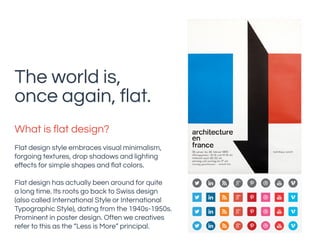
Flat design style embraces visual minimalism,
forgoing textures, drop shadows and lighting
effects for simple shapes and flat colors.
Flat design has actually been around for quite
a long time. Its roots go back to Swiss design
(also called International Style or International
Typographic Style), dating from the 1940s-1950s.
Prominent in poster design. Often we creatives
refer to this as the “Less is More” principal.
Why do designers like it?
Why do we want to start
implementing it?
It’s trend aware.
Fresh design direction, moving away
from skeuomorphic styles that have been
prevalent for years now.
Simple, elegant style that is focused on
stylized pictographs, solid color, no textures
or gradients, and is heavily typography-
driven. Many elements that marry with
modern (as a style) graphic design practices.
How is this different from
skeuomorphic or realism as a
design style? What the heck is
skeuomorphic anyway????
Skeuomorphic elements are graphics/interfaces
that mimic real-world textures, or designed to
look like something from the physical world.
Leather, wood, metal, glass etc. Apple has
been a champion of this design style and for
years now, and many web, mobile and digital
interfaces have incorporated these methods into
their visual aesthetic.
Why are we seeing this
trending in UI?
Two huge influences:
Microsoft’s Metro UI/Windows 8, and the hotly
anticipated and much rumored iOS 7 redesign.
Where else is flat design used?
Flat design has always been a strong principle
in environmental design. Wayfinding signage
(terminal maps, outdoor city directory maps),
public informational signage, billboards, bus
shelter advertising, and museum exhibit signage
are examples of the application of this principle.
This move to flat design makes sense in
some respects. We are seeing an increasing
connection between the digital spaces we
create, and the physical objects already in place
that help people navigate their physical world. It’s
a similar process that involves strategizing the
visualization of information in ways that provide
highly functional, yet easily digestible, content.
Is this really just a designer’s
desire to do something different
or follow a trend?
That is certainly be part of it. Seriously, it’s our
job to be trend-aware. However, the Apple skeuo
model has been around for a while now, and it’s
starting to feel a tad outdated. Change is good!
Ok, Ok, so designers like flat
design. How do developers
feel about it?
There may always be a place, depending on the
project or overall objective, where another design
style will work better than flat design. This is one
of the decisions that are important to strategize
and discuss as we begin each new project.
That said, though, flat design is particularly useful
in a responsive environment. It does alleviate
some challenges (headaches!) that more richly
rendered interfaces can present. Moving from
texture-heavy realism towards the more flexible
and lighter-weight flat style has benefits.
Less loading, can do most with CSS rather than
images and looks classy.
Flat design forces us to really care about
typography and layout, two areas where web
design has traditionally lagged behind its more
established print disciplines.
In mobile UI, flat design can make it easier to
focus on animation and interaction design, as
apps like Google Now and Clear demonstrate.
What are the downsides
of flat design?
The better question here is:
What do we as UX/UI designers
have to understand BEFORE
implementing any design style,
flat or not?
Interface users have come to rely on a lot of
subtle clues to make their way through an
interface: buttons have slight gradients and
rounded corners, form fields have a soft inner
shadow, and navigation bars “float” over the
rest of the content. If ywe remove all these
clues, and we end up with a world where every
element is suddenly placed at the same level,
we potentially lead to confusion: a user may ask
themself, is this a button, or simply a banner?
That’s something we always have to think of.
In order to achieve the flat design aesthetic,
we designers must focus on what things do,
rather than what they will look like. Ornamental
elements can sometimes be a distraction from
the user experience.
What non-designers need to appreciate – or
at least be open to appreciating – is that flat
design does not mean overly simplistic or
boring. The goal is create simple visuals that
convey messages and actions more quickly
than more detailed illustrations, all to serve user
comprehension. Which, by the way, is a huge
part of our job as UX/UI designers.
The big takeaway from all this:
Flat design is awesome!
But… no amount of beautiful
flat design will mask a really
bad UX/UI strategy.
good flat design
!
bad UX/UI
:(
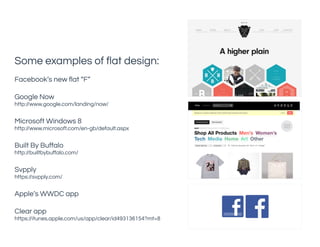
Some examples of flat design:
Facebook’s new flat “F”
Google Now
http://www.google.com/landing/now/
Microsoft Windows 8
http://www.microsoft.com/en-gb/default.aspx
Built By Buffalo
http://builtbybuffalo.com/
Svpply
https://svpply.com/
Apple’s WWDC app
Clear app
https://itunes.apple.com/us/app/clear/id493136154?mt=8

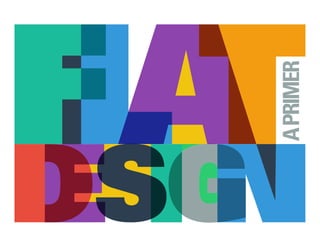
Flat Design - A Primer

  • 1.
  • 2.
    The world is, onceagain, flat. What is flat design? Flat design style embraces visual minimalism, forgoing textures, drop shadows and lighting effects for simple shapes and flat colors. Flat design has actually been around for quite a long time. Its roots go back to Swiss design (also called International Style or International Typographic Style), dating from the 1940s-1950s. Prominent in poster design. Often we creatives refer to this as the “Less is More” principal.
  • 3.
    Why do designerslike it? Why do we want to start implementing it? It’s trend aware. Fresh design direction, moving away from skeuomorphic styles that have been prevalent for years now. Simple, elegant style that is focused on stylized pictographs, solid color, no textures or gradients, and is heavily typography- driven. Many elements that marry with modern (as a style) graphic design practices.
  • 4.
    How is thisdifferent from skeuomorphic or realism as a design style? What the heck is skeuomorphic anyway???? Skeuomorphic elements are graphics/interfaces that mimic real-world textures, or designed to look like something from the physical world. Leather, wood, metal, glass etc. Apple has been a champion of this design style and for years now, and many web, mobile and digital interfaces have incorporated these methods into their visual aesthetic.
  • 5.
    Why are weseeing this trending in UI? Two huge influences: Microsoft’s Metro UI/Windows 8, and the hotly anticipated and much rumored iOS 7 redesign.
  • 6.
    Where else isflat design used? Flat design has always been a strong principle in environmental design. Wayfinding signage (terminal maps, outdoor city directory maps), public informational signage, billboards, bus shelter advertising, and museum exhibit signage are examples of the application of this principle. This move to flat design makes sense in some respects. We are seeing an increasing connection between the digital spaces we create, and the physical objects already in place that help people navigate their physical world. It’s a similar process that involves strategizing the visualization of information in ways that provide highly functional, yet easily digestible, content.
  • 7.
    Is this reallyjust a designer’s desire to do something different or follow a trend? That is certainly be part of it. Seriously, it’s our job to be trend-aware. However, the Apple skeuo model has been around for a while now, and it’s starting to feel a tad outdated. Change is good!
  • 8.
    Ok, Ok, sodesigners like flat design. How do developers feel about it? There may always be a place, depending on the project or overall objective, where another design style will work better than flat design. This is one of the decisions that are important to strategize and discuss as we begin each new project. That said, though, flat design is particularly useful in a responsive environment. It does alleviate some challenges (headaches!) that more richly rendered interfaces can present. Moving from texture-heavy realism towards the more flexible and lighter-weight flat style has benefits.
  • 9.
    Less loading, cando most with CSS rather than images and looks classy. Flat design forces us to really care about typography and layout, two areas where web design has traditionally lagged behind its more established print disciplines. In mobile UI, flat design can make it easier to focus on animation and interaction design, as apps like Google Now and Clear demonstrate.
  • 10.
    What are thedownsides of flat design? The better question here is: What do we as UX/UI designers have to understand BEFORE implementing any design style, flat or not? Interface users have come to rely on a lot of subtle clues to make their way through an interface: buttons have slight gradients and rounded corners, form fields have a soft inner shadow, and navigation bars “float” over the rest of the content. If ywe remove all these clues, and we end up with a world where every
  • 11.
    element is suddenlyplaced at the same level, we potentially lead to confusion: a user may ask themself, is this a button, or simply a banner? That’s something we always have to think of. In order to achieve the flat design aesthetic, we designers must focus on what things do, rather than what they will look like. Ornamental elements can sometimes be a distraction from the user experience. What non-designers need to appreciate – or at least be open to appreciating – is that flat design does not mean overly simplistic or boring. The goal is create simple visuals that convey messages and actions more quickly than more detailed illustrations, all to serve user comprehension. Which, by the way, is a huge part of our job as UX/UI designers.
  • 12.
    The big takeawayfrom all this: Flat design is awesome! But… no amount of beautiful flat design will mask a really bad UX/UI strategy. good flat design ! bad UX/UI :(
  • 13.
    Some examples offlat design: Facebook’s new flat “F” Google Now http://www.google.com/landing/now/ Microsoft Windows 8 http://www.microsoft.com/en-gb/default.aspx Built By Buffalo http://builtbybuffalo.com/ Svpply https://svpply.com/ Apple’s WWDC app Clear app https://itunes.apple.com/us/app/clear/id493136154?mt=8