Recommended
PPTX
PPTX
formativeassessment-150304070309-conversion-gate01.pptx
PPTX
formative assessment Laura Greenstein.pptx
PPTX
Formative assesment Laura Greenstein (1).pptx
DOCX
PPT
PDF
pznNPcPj_ECE_URD_poster_2016__1_
PPT
Formative assessment aicha abidi & mohame nafa
DOC
PPTX
PPTX
formative assessment .pptx
PPT
PPTX
Crafting-Formative-Assessment.pptx
PPTX
Formative Assessment - Laura Greenstein's book
PPTX
What teachers should really know about Formative assessment
PPTX
PPTX
Formative Assessment Instructional Period
PPT
PPTX
PPT
An Introduction to Formative Assessment for School Teachers.ppt
PPTX
PPTX
Assessment Formative vs Summative.pptx
PPTX
PPTX
Language Assessment Types
PPTX
Does Formative Assessments Support Student Achievement?
PPT
Classroom Based Assessment Tools and Techniques 27-09-2022.ppt
PPTX
Formative Assessments SPE 359
PPT
PPTX
Charles_12e_accessible_PowerPoint_01.pptx
PPTX
Charles_12e_accessible_PowerPoint_05.pptx
More Related Content
PPTX
PPTX
formativeassessment-150304070309-conversion-gate01.pptx
PPTX
formative assessment Laura Greenstein.pptx
PPTX
Formative assesment Laura Greenstein (1).pptx
DOCX
PPT
PDF
pznNPcPj_ECE_URD_poster_2016__1_
PPT
Formative assessment aicha abidi & mohame nafa
Similar to assessment slides and formative assessments
DOC
PPTX
PPTX
formative assessment .pptx
PPT
PPTX
Crafting-Formative-Assessment.pptx
PPTX
Formative Assessment - Laura Greenstein's book
PPTX
What teachers should really know about Formative assessment
PPTX
PPTX
Formative Assessment Instructional Period
PPT
PPTX
PPT
An Introduction to Formative Assessment for School Teachers.ppt
PPTX
PPTX
Assessment Formative vs Summative.pptx
PPTX
PPTX
Language Assessment Types
PPTX
Does Formative Assessments Support Student Achievement?
PPT
Classroom Based Assessment Tools and Techniques 27-09-2022.ppt
PPTX
Formative Assessments SPE 359
PPT
More from wenmin7
PPTX
Charles_12e_accessible_PowerPoint_01.pptx
PPTX
Charles_12e_accessible_PowerPoint_05.pptx
PPTX
Introduction of Basic Education abc des
PPTX
Textbooks and Cognitive Demand abc apple tree
PPTX
formative Assessment-and-summative assessment-Presentation
PPT
education with equality purpose money tasks ppt
PPTX
The Historical Foundations of Education a
PPTX
HISTORICAL FOUNDATION OF EDUCATION it‘s good
PPTX
more easily than they can with a table or a tally chart
PPTX
allow your learners to make visual comparisons more easily than they can with...
PPTX
Happy education happy assessment so it is important
PPTX
The assessment in education is very important
PPTX
Selected response assessment multiple assessments
Recently uploaded
PPTX
Powerpoint for testing in embed test with Sway
PPTX
Payment Follow-Up via WhatsApp in Odoo 18.1 Accounting
PDF
Agents in Artificial Intelligence: Types, Architecture and Real-World Examples
PPTX
Ultrasound .pptx by Nagmani ojha (paramedical department)(Radiation technolog...
PDF
Risks and opportunities of artificial intelligence in education: A critical view
PPTX
Setting Up and Processing Down Payments in Odoo 18 Sales
PDF
U.S. Departments of Education and Treasury fact sheet
PPTX
HABIT. Cognitive process. I Semester Shilpa Hotakar pptx
PPTX
OCCULTISM IN JEHOVAH'S WITNESSES' ARTWORK
PPTX
Day 2 ppt english.powerpoint presentation ppt
PDF
GEE 102 - NATURE AND DEPTH OF RELATIONSHIP.pdf
PDF
Problem Solving Agents in Artificial Intelligence with Examples and Water Jug...
PPTX
Nanomaterials and its types - Dr.M.Jothimuniyandi
PPTX
Poster Based Ethical Reflection - Dharma and Values Poster.pptx
PDF
Types of Artificial Intelligence: Capabilities and Functionality Explained
PPTX
YSPH VMOC Special Report - Measles - The Americas 1-18-2026
PPTX
Statistical Data Analysis using R Programming.pptx
PDF
Take This Quirky Quiz! - QGI 1st Anniversary .pdf
DOCX
COMMUNITY HEALTH NURSING OSCE CHECKLIST.docx
PDF
McDowell Technical Community College Early Childhood Program Equitable Workfo...
assessment slides and formative assessments 1. Classroom Assessment: Principles and Practice
That Enhance Student Learning and Motivation
Eighth Edition
Chapter 4
Informal/Embedded
Formative Assessment
Copyright © 2024, 2018, 2014 Pearson Education, Inc. All Rights Reserved
2. Copyright © 2024, 2018, 2014 Pearson Education, Inc. All Rights Reserved
Learning Objectives
4.1 Distinguish key components of formative assessment; understand the
differences between informal/embedded and formal formative assessment;
distinguish low-level formative assessment from high-level formative
assessment.
4.2 Understand how to use observation of student behavior and nonverbal cues
to interpret student engagement and understanding; identify the limitations of
observation and how observations should be combined with other sources of
information to verify conclusions about student understanding; be able to ask
questions that effectively elicit appropriate student responses to engage
students and show understanding.
4.3 Understand how to apply feedback to students during informal/embedded
formative assessment activities; be able to give examples of different types of
feedback; know the differences between effective and ineffective feedback
practices.
3. Copyright © 2024, 2018, 2014 Pearson Education, Inc. All Rights Reserved
Introductory Case Study (1 of 2)
How did Madison Use Informal/Embedded Formative Assessment?
On Thursday, Madison had just started her fifth-grade math block when Tomika,
her assistant principal, entered her room. Madison wasn’t surprised to see
Tomika, as unannounced “walk-through” observations by school administrators
were regular and short in duration. During each observation, data were
collected on a single instructional practice.
Madison regularly used flexible groups to meet student needs. For today’s
class, she had divided her students into two math groupings. Today’s groups
were based on Madison’s observations of student performance from the
previous day. She had noticed some students were accurately measuring
angles with a protractor while others needed more assistance.
At the beginning of the class, Madison reviewed the learning targets with all
students. In the Guided Math center, she was meeting with small
4. Copyright © 2024, 2018, 2014 Pearson Education, Inc. All Rights Reserved
Introductory Case Study (2 of 2)
groups of students. For the struggling learners, Madison began by modeling
how to use a protractor. For this group of students, she had prepared five note
cards with an angle drawn on the front. Students worked independently to
measure each angle and then Madison checked students’ answers. When
students were incorrect, she used questions to help students find and describe
their error. Madison wanted to ensure that she and the student understood their
error. Madison then made a decision for whether to remodel, measure the next
angle collaboratively with the student, or allow the student to measure the next
angle solo. When the other groups of students, those who appeared yesterday
to have a good grasp of how to use a protractor came to the center, Madison
did not model nor have students do the angle note card angles. She instead
had the students work to measure angles in pictures that she had cut from
magazines. She knew this was more challenging. As with the other group,
Madison used questions to provide guidance as students made errors.
5. Copyright © 2024, 2018, 2014 Pearson Education, Inc. All Rights Reserved
What Is Formative Assessment?
• Formative assessment (FA) is a “package deal”
– It’s a purposeful process of
▪ Gathering evidence
▪ Providing feedback
▪ Adjusting instruction to enhance achievement
– FA is not complete unless results are used to improve
instruction
6. Copyright © 2024, 2018, 2014 Pearson Education, Inc. All Rights Reserved
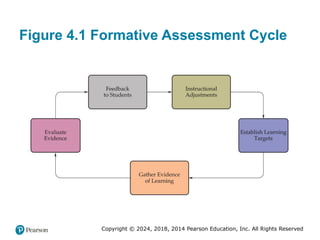
The Process of Formative Assessment
• Formative assessment is a circular, continuing
process (“formative assessment cycle”)
– evaluation of student work and behavior
– feedback
– instructional/learning adjustments
(“instructional correctives”)
– See Figure 4.1
7. Copyright © 2024, 2018, 2014 Pearson Education, Inc. All Rights Reserved
Figure 4.1 Formative Assessment Cycle
8. Copyright © 2024, 2018, 2014 Pearson Education, Inc. All Rights Reserved
Characteristics of Formative Assessment
• Formative assessment, in practice, is complex
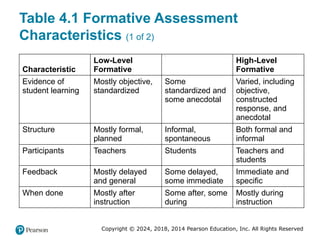
– Table 4.1 summarizes possible characteristics of FA
– FA can differ depending on which characteristics are
emphasized
– The differences reflect a continuum
▪ Low-level to high-level
9. Copyright © 2024, 2018, 2014 Pearson Education, Inc. All Rights Reserved
Table 4.1 Formative Assessment
Characteristics (1 of 2)
Characteristic
Low-Level
Formative
Blank
High-Level
Formative
Evidence of
student learning
Mostly objective,
standardized
Some
standardized and
some anecdotal
Varied, including
objective,
constructed
response, and
anecdotal
Structure Mostly formal,
planned
Informal,
spontaneous
Both formal and
informal
Participants Teachers Students Teachers and
students
Feedback Mostly delayed
and general
Some delayed,
some immediate
Immediate and
specific
When done Mostly after
instruction
Some after, some
during
Mostly during
instruction
10. Copyright © 2024, 2018, 2014 Pearson Education, Inc. All Rights Reserved
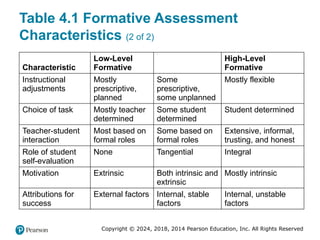
Table 4.1 Formative Assessment
Characteristics (2 of 2)
Characteristic
Low-Level
Formative
Blank
High-Level
Formative
Instructional
adjustments
Mostly
prescriptive,
planned
Some
prescriptive,
some unplanned
Mostly flexible
Choice of task Mostly teacher
determined
Some student
determined
Student determined
Teacher-student
interaction
Most based on
formal roles
Some based on
formal roles
Extensive, informal,
trusting, and honest
Role of student
self-evaluation
None Tangential Integral
Motivation Extrinsic Both intrinsic and
extrinsic
Mostly intrinsic
Attributions for
success
External factors Internal, stable
factors
Internal, unstable
factors
11. Copyright © 2024, 2018, 2014 Pearson Education, Inc. All Rights Reserved
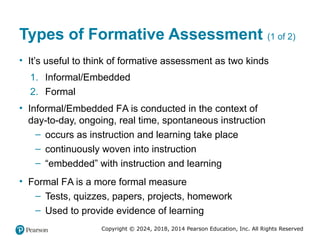
Types of Formative Assessment (1 of 2)
• It’s useful to think of formative assessment as two kinds
1. Informal/Embedded
2. Formal
• Informal/Embedded FA is conducted in the context of
day-to-day, ongoing, real time, spontaneous instruction
– occurs as instruction and learning take place
– continuously woven into instruction
– “embedded” with instruction and learning
• Formal FA is a more formal measure
– Tests, quizzes, papers, projects, homework
– Used to provide evidence of learning
12. Copyright © 2024, 2018, 2014 Pearson Education, Inc. All Rights Reserved
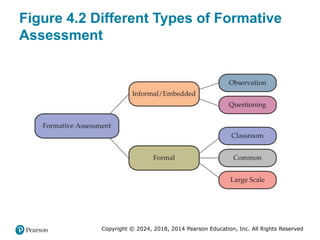
Figure 4.2 Different Types of Formative
Assessment
13. Copyright © 2024, 2018, 2014 Pearson Education, Inc. All Rights Reserved
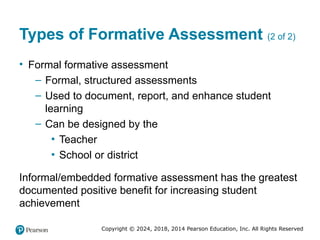
Types of Formative Assessment (2 of 2)
• Formal formative assessment
– Formal, structured assessments
– Used to document, report, and enhance student
learning
– Can be designed by the
▪ Teacher
▪ School or district
Informal/embedded formative assessment has the greatest
documented positive benefit for increasing student
achievement
14. Copyright © 2024, 2018, 2014 Pearson Education, Inc. All Rights Reserved
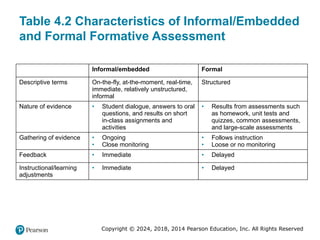
Table 4.2 Characteristics of Informal/Embedded
and Formal Formative Assessment
Blank
Informal/embedded Formal
Descriptive terms On-the-fly, at-the-moment, real-time,
immediate, relatively unstructured,
informal
Structured
Nature of evidence • Student dialogue, answers to oral
questions, and results on short
in-class assignments and
activities
• Results from assessments such
as homework, unit tests and
quizzes, common assessments,
and large-scale assessments
Gathering of evidence • Ongoing
• Close monitoring
• Follows instruction
• Loose or no monitoring
Feedback • Immediate • Delayed
Instructional/learning
adjustments
• Immediate • Delayed
15. Copyright © 2024, 2018, 2014 Pearson Education, Inc. All Rights Reserved
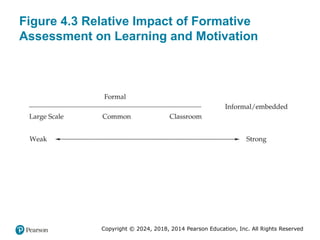
Figure 4.3 Relative Impact of Formative
Assessment on Learning and Motivation
16. Copyright © 2024, 2018, 2014 Pearson Education, Inc. All Rights Reserved
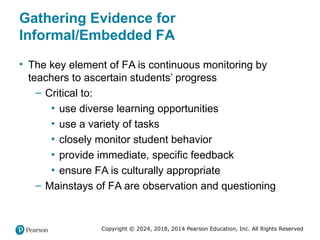
Gathering Evidence for
Informal/Embedded FA
• The key element of FA is continuous monitoring by
teachers to ascertain students’ progress
– Critical to:
▪ use diverse learning opportunities
▪ use a variety of tasks
▪ closely monitor student behavior
▪ provide immediate, specific feedback
▪ ensure FA is culturally appropriate
– Mainstays of FA are observation and questioning
17. Copyright © 2024, 2018, 2014 Pearson Education, Inc. All Rights Reserved
Observation
• Observations of student behavior are made to assess
– Participation in class discussion
– Skills used in cooperative groups
– Correctness of responses to questions
– Verbal skills demonstrated
– Whether more examples are needed
– Which students to call on
– Interest level of students
– Degree of understanding demonstrated in answers
– Emotional and affective responses
18. Copyright © 2024, 2018, 2014 Pearson Education, Inc. All Rights Reserved
Assessing Nonverbal Behavior
• Nonverbal behavior refers to body language, facial
expressions, or eye contact
• Nonverbal behaviors help assess meaning and emotion
• They can be
– Confirming
– Denying
– Strengthening
• Messages are relatively free of distortion and deception
19. Copyright © 2024, 2018, 2014 Pearson Education, Inc. All Rights Reserved
Facial Expressions
• The face is the most important source
– Focus on three areas
▪ Brows and forehead
▪ Eyes, lids, and nose
▪ The lower face
– The upper portion of the face is likely to indicate
concern and anger
– The lower area, particularly the mouth is likely to
indicate happiness and amusement
20. Copyright © 2024, 2018, 2014 Pearson Education, Inc. All Rights Reserved
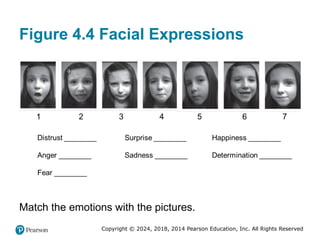
Figure 4.4 Facial Expressions
Match the emotions with the pictures.
21. Copyright © 2024, 2018, 2014 Pearson Education, Inc. All Rights Reserved
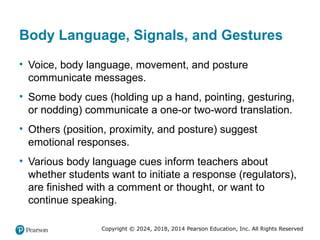
Body Language, Signals, and Gestures
• Voice, body language, movement, and posture
communicate messages.
• Some body cues (holding up a hand, pointing, gesturing,
or nodding) communicate a one-or two-word translation.
• Others (position, proximity, and posture) suggest
emotional responses.
• Various body language cues inform teachers about
whether students want to initiate a response (regulators),
are finished with a comment or thought, or want to
continue speaking.
22. Copyright © 2024, 2018, 2014 Pearson Education, Inc. All Rights Reserved
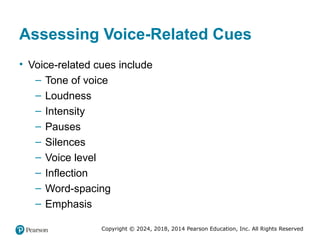
Assessing Voice-Related Cues
• Voice-related cues include
– Tone of voice
– Loudness
– Intensity
– Pauses
– Silences
– Voice level
– Inflection
– Word-spacing
– Emphasis
23. Copyright © 2024, 2018, 2014 Pearson Education, Inc. All Rights Reserved
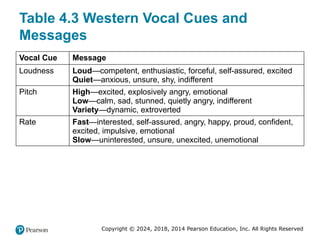
Table 4.3 Western Vocal Cues and
Messages
Vocal Cue Message
Loudness Loud—competent, enthusiastic, forceful, self-assured, excited
Quiet—anxious, unsure, shy, indifferent
Pitch High—excited, explosively angry, emotional
Low—calm, sad, stunned, quietly angry, indifferent
Variety—dynamic, extroverted
Rate Fast—interested, self-assured, angry, happy, proud, confident,
excited, impulsive, emotional
Slow—uninterested, unsure, unexcited, unemotional
24. Copyright © 2024, 2018, 2014 Pearson Education, Inc. All Rights Reserved
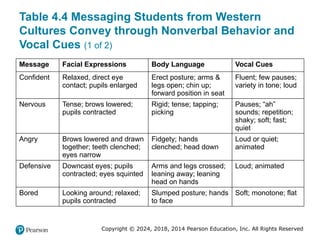
Table 4.4 Messaging Students from Western
Cultures Convey through Nonverbal Behavior and
Vocal Cues (1 of 2)
Message Facial Expressions Body Language Vocal Cues
Confident Relaxed, direct eye
contact; pupils enlarged
Erect posture; arms &
legs open; chin up;
forward position in seat
Fluent; few pauses;
variety in tone; loud
Nervous Tense; brows lowered;
pupils contracted
Rigid; tense; tapping;
picking
Pauses; “ah”
sounds; repetition;
shaky; soft; fast;
quiet
Angry Brows lowered and drawn
together; teeth clenched;
eyes narrow
Fidgety; hands
clenched; head down
Loud or quiet;
animated
Defensive Downcast eyes; pupils
contracted; eyes squinted
Arms and legs crossed;
leaning away; leaning
head on hands
Loud; animated
Bored Looking around; relaxed;
pupils contracted
Slumped posture; hands
to face
Soft; monotone; flat
25. Copyright © 2024, 2018, 2014 Pearson Education, Inc. All Rights Reserved
Table 4.4 Messaging Students from Western
Cultures Convey through Nonverbal Behavior and
Vocal Cues (2 of 2)
Message Facial Expressions Body Language Vocal Cues
Frustrated Brows together; eyes
downcast; squinting
Tense; tapping; picking;
placing fingers or hands
on each side of head
Pauses; low pitch
Happy Smiling, relaxed;
brows natural; pupils
enlarged
Relaxed; head nodding;
leaning forward
Animated; loud; fast
Interested Direct eye contact;
brows uplifted
Leaning forward;
relaxed; opening arms &
legs; nodding; raising
hand or finger
Higher pitch; fast
Not
Understanding
Frowning; biting lower
lip; squinting eyes;
looking away
Leaning back; arms
crossed; hand on
forehead; fidgeting;
scratching chin
Slow; pauses; “ah,”
“um,” “well”
expressions; low
pitch; monotone;
quiet; soft
26. Copyright © 2024, 2018, 2014 Pearson Education, Inc. All Rights Reserved
Teacher Summaries of Nonverbal
Behaviors, Interpretations and Actions
Nonverbal Behavior Interpretation Action
Students start to look
around the room and at
each other.
Some students are not
understanding; some
may be bored.
Refocus students;
review previous lesson;
reteach lesson; regroup
students.
Room quiets; students
are writing in their
notebooks.
Students are motivated
and on task.
Keep going—it may not
last long!
Students squint and
adjust the focus of their
eyes.
Indicates a lack of
understanding,
frustration, or boredom.
Rephrase the question
or ask the students what
it is that they do not
understand.
27. Copyright © 2024, 2018, 2014 Pearson Education, Inc. All Rights Reserved
Sources of Error in Moment-by-Moment
Observation (1 of 2)
• Difficult to make continuous observations that are
accurate
• Be aware of the types of errors that are possible
– Ask
▪ Is the verbal message consistent with the
nonverbal behavior?
▪ Is the behavior normal or unusual?
– Plan time to do an informal observation
– Keep a list of possible errors (Table 4.5)
28. Copyright © 2024, 2018, 2014 Pearson Education, Inc. All Rights Reserved
Sources of Error in Moment-by-Moment
Observation (2 of 2)
• Write down
– Informal observations
– Your interpretations
– The action you took
• Set aside time to record important informal observations
• Check with students when you are unsure
• Consciously think about informal observations in relation
to student understanding
• Don’t be fooled by appearances
29. Copyright © 2024, 2018, 2014 Pearson Education, Inc. All Rights Reserved
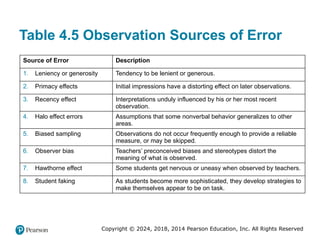
Table 4.5 Observation Sources of Error
Source of Error Description
1. Leniency or generosity Tendency to be lenient or generous.
2. Primacy effects Initial impressions have a distorting effect on later observations.
3. Recency effect Interpretations unduly influenced by his or her most recent
observation.
4. Halo effect errors Assumptions that some nonverbal behavior generalizes to other
areas.
5. Biased sampling Observations do not occur frequently enough to provide a reliable
measure, or may be skipped.
6. Observer bias Teachers’ preconceived biases and stereotypes distort the
meaning of what is observed.
7. Hawthorne effect Some students get nervous or uneasy when observed by teachers.
8. Student faking As students become more sophisticated, they develop strategies to
make themselves appear to be on task.
30. Copyright © 2024, 2018, 2014 Pearson Education, Inc. All Rights Reserved
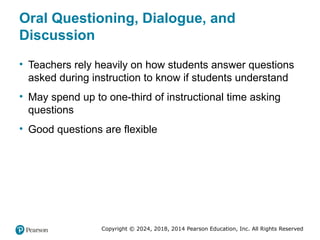
Oral Questioning, Dialogue, and
Discussion
• Teachers rely heavily on how students answer questions
asked during instruction to know if students understand
• May spend up to one-third of instructional time asking
questions
• Good questions are flexible
31. Copyright © 2024, 2018, 2014 Pearson Education, Inc. All Rights Reserved
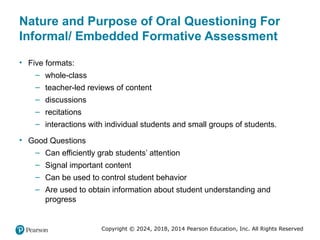
Nature and Purpose of Oral Questioning For
Informal/ Embedded Formative Assessment
• Five formats:
– whole-class
– teacher-led reviews of content
– discussions
– recitations
– interactions with individual students and small groups of students.
• Good Questions
– Can efficiently grab students’ attention
– Signal important content
– Can be used to control student behavior
– Are used to obtain information about student understanding and
progress
32. Copyright © 2024, 2018, 2014 Pearson Education, Inc. All Rights Reserved
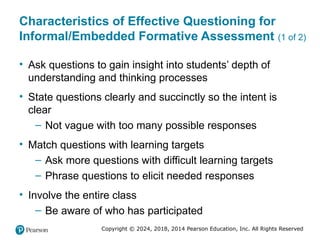
Characteristics of Effective Questioning for
Informal/Embedded Formative Assessment (1 of 2)
• Ask questions to gain insight into students’ depth of
understanding and thinking processes
• State questions clearly and succinctly so the intent is
clear
– Not vague with too many possible responses
• Match questions with learning targets
– Ask more questions with difficult learning targets
– Phrase questions to elicit needed responses
• Involve the entire class
– Be aware of who has participated
33. Copyright © 2024, 2018, 2014 Pearson Education, Inc. All Rights Reserved
Characteristics of Effective Questioning for
Informal/Embedded Formative Assessment (2 of 2)
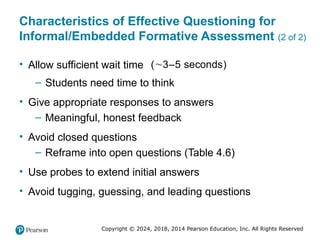
• Allow sufficient wait time )
3–5 se
( conds
– Students need time to think
• Give appropriate responses to answers
– Meaningful, honest feedback
• Avoid closed questions
– Reframe into open questions (Table 4.6)
• Use probes to extend initial answers
• Avoid tugging, guessing, and leading questions
34. Copyright © 2024, 2018, 2014 Pearson Education, Inc. All Rights Reserved
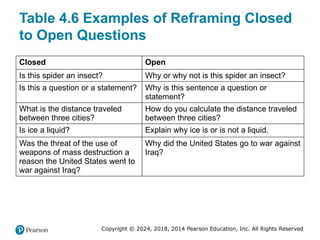
Table 4.6 Examples of Reframing Closed
to Open Questions
Closed Open
Is this spider an insect? Why or why not is this spider an insect?
Is this a question or a statement? Why is this sentence a question or
statement?
What is the distance traveled
between three cities?
How do you calculate the distance traveled
between three cities?
Is ice a liquid? Explain why ice is or is not a liquid.
Was the threat of the use of
weapons of mass destruction a
reason the United States went to
war against Iraq?
Why did the United States go to war against
Iraq?
35. Copyright © 2024, 2018, 2014 Pearson Education, Inc. All Rights Reserved
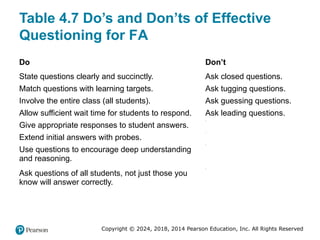
Table 4.7 Do’s and Don’ts of Effective
Questioning for FA
Do Don’t
State questions clearly and succinctly. Ask closed questions.
Match questions with learning targets. Ask tugging questions.
Involve the entire class (all students). Ask guessing questions.
Allow sufficient wait time for students to respond. Ask leading questions.
Give appropriate responses to student answers.
Blank
Extend initial answers with probes.
Blank
Use questions to encourage deep understanding
and reasoning.
Blank
Ask questions of all students, not just those you
know will answer correctly.
Blank
36. Copyright © 2024, 2018, 2014 Pearson Education, Inc. All Rights Reserved
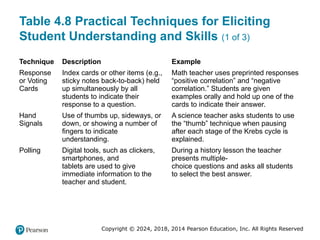
Table 4.8 Practical Techniques for Eliciting
Student Understanding and Skills (1 of 3)
Technique Description Example
Response
or Voting
Cards
Index cards or other items (e.g.,
sticky notes back-to-back) held
up simultaneously by all
students to indicate their
response to a question.
Math teacher uses preprinted responses
“positive correlation” and “negative
correlation.” Students are given
examples orally and hold up one of the
cards to indicate their answer.
Hand
Signals
Use of thumbs up, sideways, or
down, or showing a number of
fingers to indicate
understanding.
A science teacher asks students to use
the “thumb” technique when pausing
after each stage of the Krebs cycle is
explained.
Polling Digital tools, such as clickers,
smartphones, and
tablets are used to give
immediate information to the
teacher and student.
During a history lesson the teacher
presents multiple-
choice questions and asks all students
to select the best answer.
37. Copyright © 2024, 2018, 2014 Pearson Education, Inc. All Rights Reserved
Table 4.8 Practical Techniques for Eliciting
Student Understanding and Skills (2 of 3)
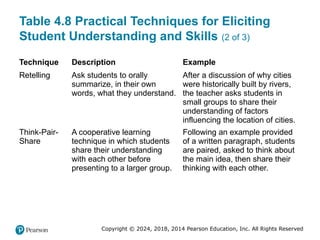
Technique Description Example
Retelling Ask students to orally
summarize, in their own
words, what they understand.
After a discussion of why cities
were historically built by rivers,
the teacher asks students in
small groups to share their
understanding of factors
influencing the location of cities.
Think-Pair-
Share
A cooperative learning
technique in which students
share their understanding
with each other before
presenting to a larger group.
Following an example provided
of a written paragraph, students
are paired, asked to think about
the main idea, then share their
thinking with each other.
38. Copyright © 2024, 2018, 2014 Pearson Education, Inc. All Rights Reserved
Table 4.8 Practical Techniques for Eliciting
Student Understanding and Skills (3 of 3)
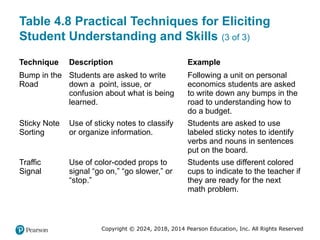
Technique Description Example
Bump in the
Road
Students are asked to write
down a point, issue, or
confusion about what is being
learned.
Following a unit on personal
economics students are asked
to write down any bumps in the
road to understanding how to
do a budget.
Sticky Note
Sorting
Use of sticky notes to classify
or organize information.
Students are asked to use
labeled sticky notes to identify
verbs and nouns in sentences
put on the board.
Traffic
Signal
Use of color-coded props to
signal “go on,” “go slower,” or
“stop.”
Students use different colored
cups to indicate to the teacher if
they are ready for the next
math problem.
39. Copyright © 2024, 2018, 2014 Pearson Education, Inc. All Rights Reserved
Providing Effective Feedback for
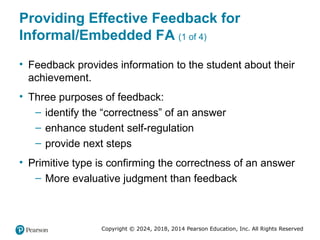
Informal/Embedded FA (1 of 4)
• Feedback provides information to the student about their
achievement.
• Three purposes of feedback:
– identify the “correctness” of an answer
– enhance student self-regulation
– provide next steps
• Primitive type is confirming the correctness of an answer
– More evaluative judgment than feedback
40. Copyright © 2024, 2018, 2014 Pearson Education, Inc. All Rights Reserved
Providing Effective Feedback for
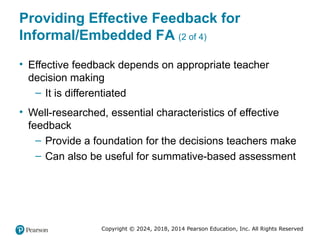
Informal/Embedded FA (2 of 4)
• Effective feedback depends on appropriate teacher
decision making
– It is differentiated
• Well-researched, essential characteristics of effective
feedback
– Provide a foundation for the decisions teachers make
– Can also be useful for summative-based assessment
41. Copyright © 2024, 2018, 2014 Pearson Education, Inc. All Rights Reserved
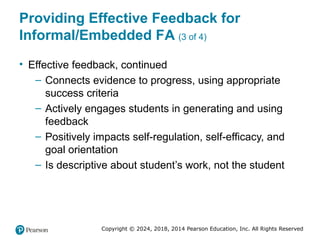
Providing Effective Feedback for
Informal/Embedded FA (3 of 4)
• Effective feedback, continued
– Connects evidence to progress, using appropriate
success criteria
– Actively engages students in generating and using
feedback
– Positively impacts self-regulation, self-efficacy, and
goal orientation
– Is descriptive about student’s work, not the student
42. Copyright © 2024, 2018, 2014 Pearson Education, Inc. All Rights Reserved
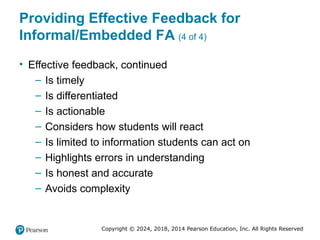
Providing Effective Feedback for
Informal/Embedded FA (4 of 4)
• Effective feedback, continued
– Is timely
– Is differentiated
– Is actionable
– Considers how students will react
– Is limited to information students can act on
– Highlights errors in understanding
– Is honest and accurate
– Avoids complexity
43. Copyright © 2024, 2018, 2014 Pearson Education, Inc. All Rights Reserved
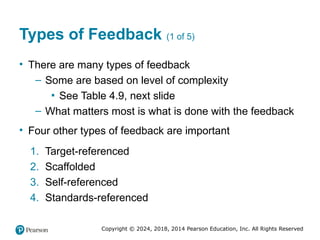
Types of Feedback (1 of 5)
• There are many types of feedback
– Some are based on level of complexity
▪ See Table 4.9, next slide
– What matters most is what is done with the feedback
• Four other types of feedback are important
1. Target-referenced
2. Scaffolded
3. Self-referenced
4. Standards-referenced
44. Copyright © 2024, 2018, 2014 Pearson Education, Inc. All Rights Reserved
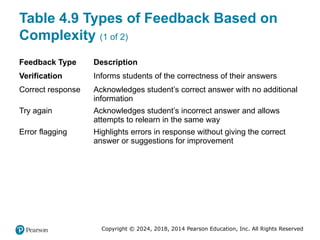
Table 4.9 Types of Feedback Based on
Complexity (1 of 2)
Feedback Type Description
Verification Informs students of the correctness of their answers
Correct response Acknowledges student’s correct answer with no additional
information
Try again Acknowledges student’s incorrect answer and allows
attempts to relearn in the same way
Error flagging Highlights errors in response without giving the correct
answer or suggestions for improvement
45. Copyright © 2024, 2018, 2014 Pearson Education, Inc. All Rights Reserved
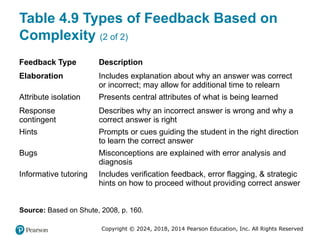
Table 4.9 Types of Feedback Based on
Complexity (2 of 2)
Feedback Type Description
Elaboration Includes explanation about why an answer was correct
or incorrect; may allow for additional time to relearn
Attribute isolation Presents central attributes of what is being learned
Response
contingent
Describes why an incorrect answer is wrong and why a
correct answer is right
Hints Prompts or cues guiding the student in the right direction
to learn the correct answer
Bugs Misconceptions are explained with error analysis and
diagnosis
Informative tutoring Includes verification feedback, error flagging, & strategic
hints on how to proceed without providing correct answer
Source: Based on Shute, 2008, p. 160.
46. Copyright © 2024, 2018, 2014 Pearson Education, Inc. All Rights Reserved
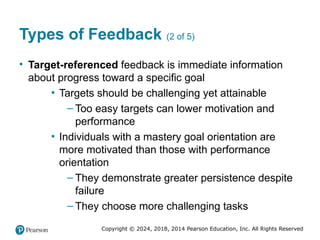
Types of Feedback (2 of 5)
• Target-referenced feedback is immediate information
about progress toward a specific goal
▪ Targets should be challenging yet attainable
– Too easy targets can lower motivation and
performance
▪ Individuals with a mastery goal orientation are
more motivated than those with performance
orientation
– They demonstrate greater persistence despite
failure
– They choose more challenging tasks
47. Copyright © 2024, 2018, 2014 Pearson Education, Inc. All Rights Reserved
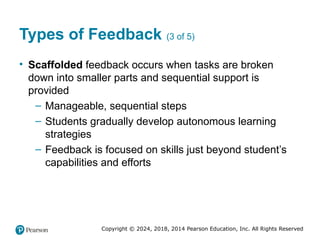
Types of Feedback (3 of 5)
• Scaffolded feedback occurs when tasks are broken
down into smaller parts and sequential support is
provided
– Manageable, sequential steps
– Students gradually develop autonomous learning
strategies
– Feedback is focused on skills just beyond student’s
capabilities and efforts
48. Copyright © 2024, 2018, 2014 Pearson Education, Inc. All Rights Reserved
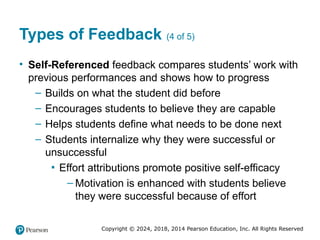
Types of Feedback (4 of 5)
• Self-Referenced feedback compares students’ work with
previous performances and shows how to progress
– Builds on what the student did before
– Encourages students to believe they are capable
– Helps students define what needs to be done next
– Students internalize why they were successful or
unsuccessful
▪ Effort attributions promote positive self-efficacy
– Motivation is enhanced with students believe
they were successful because of effort
49. Copyright © 2024, 2018, 2014 Pearson Education, Inc. All Rights Reserved
Types of Feedback (5 of 5)
• Standards-Referenced feedback compares student
performance to identified standards of performance and
exemplars
– Generally most effective at leading to higher learning
– Emphasizes connection to performance criteria
– The criteria needs to be established prior to
performance
– Feedback is worded to refer to the criteria
50. Copyright © 2024, 2018, 2014 Pearson Education, Inc. All Rights Reserved
Determining the Nature of Feedback (1 of 6)
• Feedback can differ on a number of dimensions
• Amount
– A few specific and descriptive comments are more
effective than many general comments
▪ It’s not practical to provide specific feedback to
every student during instruction
– Teachers must make choices
51. Copyright © 2024, 2018, 2014 Pearson Education, Inc. All Rights Reserved
Determining the Nature of Feedback (2 of 6)
• Timing
– Feedback is most effective when given during or
immediately following student performance
– Teachers provide more frequent, immediate feedback
when they
▪ Select activities with built-in opportunities for
feedback
▪ Monitor individual work, making comments to
students
▪ Use examples of ongoing student work
▪ Use techniques to monitor progress of all students
52. Copyright © 2024, 2018, 2014 Pearson Education, Inc. All Rights Reserved
Determining the Nature of Feedback (3 of 6)
• Mode
– There are three modes of delivering feedback
1. Oral
2. Written
3. Demonstration
• Oral feedback is for on-the-fly formative feedback
53. Copyright © 2024, 2018, 2014 Pearson Education, Inc. All Rights Reserved
Determining the Nature of Feedback (4 of 6)
• Audience
– Feedback can be given to individuals and small or
large groups
▪ Often embedded FaA feedback is given individually
▪ Group feedback is more efficient when many can
benefit from the same message
54. Copyright © 2024, 2018, 2014 Pearson Education, Inc. All Rights Reserved
Determining the Nature of Feedback (5 of 6)
• Type of Task
– Feedback typically focuses on what was learned or
how it was learned
– Feedback on what was learned focuses on
▪ Knowledge and understanding
▪ Content that needs to be mastered
▪ What was successfully understood
▪ What still needs work
▪ Actions to improve knowledge and understanding
55. Copyright © 2024, 2018, 2014 Pearson Education, Inc. All Rights Reserved
Determining the Nature of Feedback (6 of 6)
• Feedback on how something was learned focuses on
– Skills, strategies, and procedures students use
– How well students are applying important strategies
56. Copyright © 2024, 2018, 2014 Pearson Education, Inc. All Rights Reserved
Differentiated Informal/Embedded
Formative Feedback (1 of 7)
• Effective feedback is differentiated
– It depends on matching the type and nature of the
feedback within context
▪ Learner level of ability
▪ Grade level
▪ Subject
57. Copyright © 2024, 2018, 2014 Pearson Education, Inc. All Rights Reserved
Differentiated Informal/Embedded
Formative Feedback (2 of 7)
• Learner Level of Ability—Low-ability students may
benefit from
– Immediate, specific feedback
– Verification and elaboration feedback
– Knowing they are on track
– Scaffolded feedback
– Avoidance of norm-referenced comparisons
58. Copyright © 2024, 2018, 2014 Pearson Education, Inc. All Rights Reserved
Differentiated Informal/Embedded
Formative Feedback (3 of 7)
• Learner Level of Ability—Struggling students may
benefit from
– Checking that feedback is understood
– Self-referenced feedback with stress on effort
– Honest feedback without unjustified praise
– Setting goals that provide initial success
59. Copyright © 2024, 2018, 2014 Pearson Education, Inc. All Rights Reserved
Differentiated Informal/Embedded
Formative Feedback (4 of 7)
• Learner Level of Ability—High-ability students may
benefit from
– Feedback that helps them examine errors in thinking
– Messages that improve understanding and extend it
– Elaboration feedback that challenges them
– Emphasis on processes such as cognitive skills and
strategies
60. Copyright © 2024, 2018, 2014 Pearson Education, Inc. All Rights Reserved
Differentiated Informal/Embedded
Formative Feedback (5 of 7)
• Grade Level—At the elementary level, compared to the
secondary level, it can be easier to
– Give immediate feedback
– Scaffold
– Check student understanding of feedback
– Use elaborative feedback
– Work individually with students to guide them
• Elementary-level instruction tends to be more teacher-
directed than student-directed
61. Copyright © 2024, 2018, 2014 Pearson Education, Inc. All Rights Reserved
Differentiated Informal/Embedded
Formative Feedback (6 of 7)
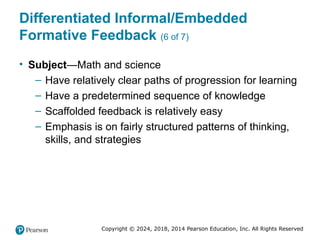
• Subject—Math and science
– Have relatively clear paths of progression for learning
– Have a predetermined sequence of knowledge
– Scaffolded feedback is relatively easy
– Emphasis is on fairly structured patterns of thinking,
skills, and strategies
62. Copyright © 2024, 2018, 2014 Pearson Education, Inc. All Rights Reserved
Differentiated Informal/Embedded
Formative Feedback (7 of 7)
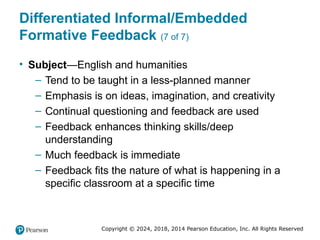
• Subject—English and humanities
– Tend to be taught in a less-planned manner
– Emphasis is on ideas, imagination, and creativity
– Continual questioning and feedback are used
– Feedback enhances thinking skills/deep
understanding
– Much feedback is immediate
– Feedback fits the nature of what is happening in a
specific classroom at a specific time
63. Copyright © 2024, 2018, 2014 Pearson Education, Inc. All Rights Reserved
Table 4.10 Key Do’s and Don’ts for
Effective Feedback (1 of 2)
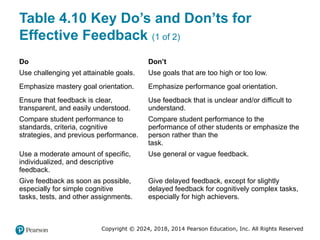
Do Don’t
Use challenging yet attainable goals. Use goals that are too high or too low.
Emphasize mastery goal orientation. Emphasize performance goal orientation.
Ensure that feedback is clear,
transparent, and easily understood.
Use feedback that is unclear and/or difficult to
understand.
Compare student performance to
standards, criteria, cognitive
strategies, and previous performance.
Compare student performance to the
performance of other students or emphasize the
person rather than the
task.
Use a moderate amount of specific,
individualized, and descriptive
feedback.
Use general or vague feedback.
Give feedback as soon as possible,
especially for simple cognitive
tasks, tests, and other assignments.
Give delayed feedback, except for slightly
delayed feedback for cognitively complex tasks,
especially for high achievers.
64. Copyright © 2024, 2018, 2014 Pearson Education, Inc. All Rights Reserved
Table 4.10 Key Do’s and Don’ts for
Effective Feedback (2 of 2)
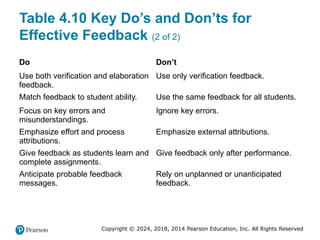
Do Don’t
Use both verification and elaboration
feedback.
Use only verification feedback.
Match feedback to student ability. Use the same feedback for all students.
Focus on key errors and
misunderstandings.
Ignore key errors.
Emphasize effort and process
attributions.
Emphasize external attributions.
Give feedback as students learn and
complete assignments.
Give feedback only after performance.
Anticipate probable feedback
messages.
Rely on unplanned or unanticipated
feedback.
65. Copyright © 2024, 2018, 2014 Pearson Education, Inc. All Rights Reserved
What About Giving Praise? (1 of 3)
• Praise can be thought of as feedback, but is also used for
classroom management
– In general, research shows that teachers
▪ Use too much praise
▪ Use it inappropriately as positive reinforcement
– Praise can be helpful if it connects student progress
with standards
66. Copyright © 2024, 2018, 2014 Pearson Education, Inc. All Rights Reserved
What About Giving Praise? (2 of 3)
• Praise is a good type of message to accompany other
types of feedback
• The most effective praise is
– Spontaneous
– Genuine
– Accurate
– Accompanied by description
▪ Simple, straightforward, declarative sentences are
best
67. Copyright © 2024, 2018, 2014 Pearson Education, Inc. All Rights Reserved
What About Giving Praise? (3 of 3)
• Avoid praising how smart kids are
• Try to use many different phrases
• Keep verbal praise consistent with your nonverbal
behavior
• Wiliam and Leahy (2015): “Feedback—no matter how
well designed—that the student does not act upon is a
waste of time” (p. 107).
68. Copyright © 2024, 2018, 2014 Pearson Education, Inc. All Rights Reserved
Summary (1 of 4)
• Informal/embedded formative assessment consists of a teacher
monitoring of students and their academic performances to inform
instructional and learning decision making and the nature of
feedback given to students.
• Informal/embedded formative assessment occurs on the fly, at the
moment, spontaneously.
• Observation for informal/embedded formative assessment includes
teacher “reading” nonverbal behavior, such as facial expressions,
eye contact, body language, and vocal cues. These behaviors
indicate student emotions, attitudes, and other dispositions that
communicate mental states.
• Emotion is communicated best through facial expression. Eye
contact is key to assessing attentiveness, confidence, and interest.
69. Copyright © 2024, 2018, 2014 Pearson Education, Inc. All Rights Reserved
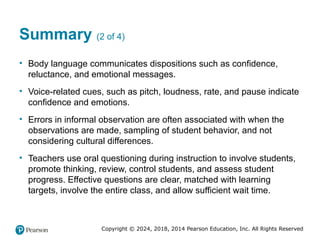
Summary (2 of 4)
• Body language communicates dispositions such as confidence,
reluctance, and emotional messages.
• Voice-related cues, such as pitch, loudness, rate, and pause indicate
confidence and emotions.
• Errors in informal observation are often associated with when the
observations are made, sampling of student behavior, and not
considering cultural differences.
• Teachers use oral questioning during instruction to involve students,
promote thinking, review, control students, and assess student
progress. Effective questions are clear, matched with learning
targets, involve the entire class, and allow sufficient wait time.
70. Copyright © 2024, 2018, 2014 Pearson Education, Inc. All Rights Reserved
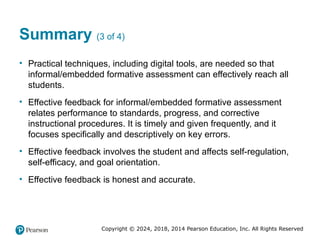
Summary (3 of 4)
• Practical techniques, including digital tools, are needed so that
informal/embedded formative assessment can effectively reach all
students.
• Effective feedback for informal/embedded formative assessment
relates performance to standards, progress, and corrective
instructional procedures. It is timely and given frequently, and it
focuses specifically and descriptively on key errors.
• Effective feedback involves the student and affects self-regulation,
self-efficacy, and goal orientation.
• Effective feedback is honest and accurate.
71. Copyright © 2024, 2018, 2014 Pearson Education, Inc. All Rights Reserved
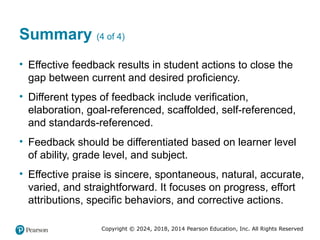
Summary (4 of 4)
• Effective feedback results in student actions to close the
gap between current and desired proficiency.
• Different types of feedback include verification,
elaboration, goal-referenced, scaffolded, self-referenced,
and standards-referenced.
• Feedback should be differentiated based on learner level
of ability, grade level, and subject.
• Effective praise is sincere, spontaneous, natural, accurate,
varied, and straightforward. It focuses on progress, effort
attributions, specific behaviors, and corrective actions.
72. Copyright © 2024, 2018, 2014 Pearson Education, Inc. All Rights Reserved
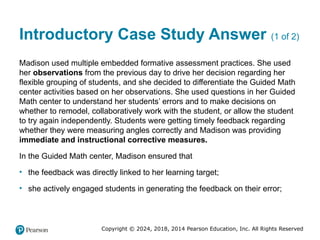
Introductory Case Study Answer (1 of 2)
Madison used multiple embedded formative assessment practices. She used
her observations from the previous day to drive her decision regarding her
flexible grouping of students, and she decided to differentiate the Guided Math
center activities based on her observations. She used questions in her Guided
Math center to understand her students’ errors and to make decisions on
whether to remodel, collaboratively work with the student, or allow the student
to try again independently. Students were getting timely feedback regarding
whether they were measuring angles correctly and Madison was providing
immediate and instructional corrective measures.
In the Guided Math center, Madison ensured that
• the feedback was directly linked to her learning target;
• she actively engaged students in generating the feedback on their error;
73. Copyright © 2024, 2018, 2014 Pearson Education, Inc. All Rights Reserved
Introductory Case Study Answer (2 of 2)
• the feedback positively impacted students’ self-regulation, self-
efficacy, and goal orientation;
• her feedback focused on the task;
• she provided immediate opportunities for students to use the
feedback;
• she and the student worked together to highlight errors in
understanding; and
• she made sure the feedback was accurate.
74. Copyright © 2024, 2018, 2014 Pearson Education, Inc. All Rights Reserved
Copyright
This work is protected by United States copyright laws and is
provided solely for the use of instructors in teaching their
courses and assessing student learning. Dissemination or sale of
any part of this work (including on the World Wide Web) will
destroy the integrity of the work and is not permitted. The work
and materials from it should never be made available to students
except by instructors using the accompanying text in their
classes. All recipients of this work are expected to abide by these
restrictions and to honor the intended pedagogical purposes and
the needs of other instructors who rely on these materials.
Editor's Notes #1 If this PowerPoint presentation contains mathematical equations, you may need to check that your computer has the following installed:
1) MathType Plugin
2) Math Player (free versions available)
3) NVDA Reader (free versions available) #4 As you read this chapter, think about Madison’s embedded formative assessment practices. What positives do you believe Tomika, the assistant principal, will give Madison regarding her observation on Madison’s use of informal/embedded formative assessment? What strengths will Tomika highlight about Madison’s feedback to students?
#5 Assessment for learning (AfL)–a test that gives diagnostic information can be FA
#12 Formative assessment divides into two sections informal or embedded and formal; informal or embedded divides into two sections observation and questioning; formal divides into three sections classroom, common, and large scale. #15 Formal is shown above the line; large scale, common, and classroom are shown below the line; informal or embedded on the right. An arrow on both sides shows weak on the left and strong on the right. #18 Confirming
Nonverbal consistent with verbal
Denying
Nonverbal not consistent with verbal
Strengthening
Adds emotional color, feelings, intensity
#20 The correct choices are distrust = 5, happiness = 6, sadness = 4,
surprise = 1, anger = 3, determination = 7, and fear = 2.
There are seven photos of the same girl making different expressions numbered from 1 to 7. Beneath the photos are the following words to be matched with the photos:
Distrust
Anger
Fear
Surprise
Sadness
Happiness
Determination
The photos are
1 Girl has eyes and mouth wide open, but not smiling.
2 Girl has eyes and mouth semi closed and not smiling.
3 Girl's head is tilted down, eyebrows are scrunched, lips are closed.
4 Girl's eyebrows are angled down, right eyebrow is up a little, lips are closed and in a slight frown.
5 Girl's head is turned to the side, eyebrows are relaxed, mouth is closed.
6 Girl is smiling, mouth is slightly open, and cheeks are pronounced.
7 Girl's eyes are staring, lips are closed and mouth is slightly smiling.