MANUAL HANDLING
Power Network Upgrade of all ADCO Fields
Objectives
Upon completion of the lesson, participants will be able
to:
1. Identify the proper and safe means for lifting and
moving heavy objects.
2. Identify the proper handling technique to prevent
back injuries.
3. Grasp some of the injuries associated with
improper handling.
WHAT’S THE PROBLEM
 More than a third of all over three-day injuries
reported each year to HSE and local authorities are
caused by manual handling – the transporting or
supporting of loads by hand
or by bodily force.
WHAT’S THE PROBLEM
 Many manual handling injuries are build up over a
period rather than being caused by a single handling
incident. These injuries occur wherever people are at
work – on farms and building sites, in factories,
offices, warehouses, hospitals, banks, laboratories
and while making
deliveries.
THE EMPLOYEE SHOULD
 AVOID the need for hazardous manual handling, as
reasonably practicable
 ASSESS the risk of injury from any hazardous
manual handling that can’t be avoided
 REDUCE the risk of injury from
hazardous manual handling,
as far as reasonably practicable
THE EMPLOYEES’ DUTIES
 Follow appropriate system of work laid down for
their safety
 Make proper use of equipment provided for their
safety
 Co-operate with their employer on health and safety
matters
 Inform the employer if they identify hazardous
handling activities
 Take care to ensure that their
activities do not put others to risk
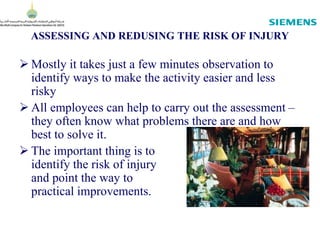
ASSESSING AND REDUSING THE RISK OF INJURY
 Mostly it takes just a few minutes observation to
identify ways to make the activity easier and less
risky
 All employees can help to carry out the assessment –
they often know what problems there are and how
best to solve it.
 The important thing is to
identify the risk of injury
and point the way to
practical improvements.
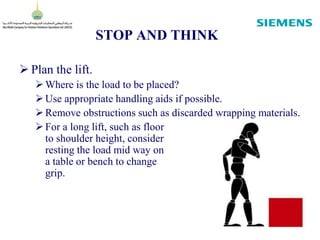
STOP AND THINK
 Plan the lift.
Where is the load to be placed?
Use appropriate handling aids if possible.
Remove obstructions such as discarded wrapping materials.
For a long lift, such as floor
to shoulder height, consider
resting the load mid way on
a table or bench to change
grip.
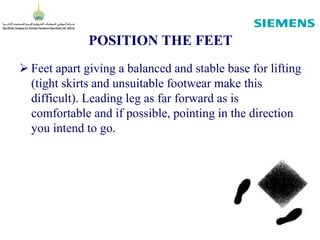
POSITION THE FEET
 Feet apart giving a balanced and stable base for lifting
(tight skirts and unsuitable footwear make this
difficult). Leading leg as far forward as is
comfortable and if possible, pointing in the direction
you intend to go.
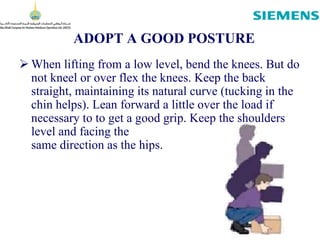
ADOPT A GOOD POSTURE
 When lifting from a low level, bend the knees. But do
not kneel or over flex the knees. Keep the back
straight, maintaining its natural curve (tucking in the
chin helps). Lean forward a little over the load if
necessary to to get a good grip. Keep the shoulders
level and facing the
same direction as the hips.
SCD- 2006 HSE-P-MHG-00
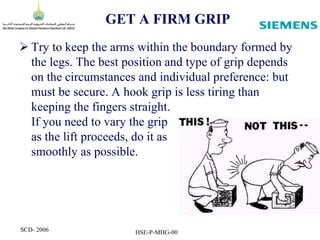
GET A FIRM GRIP
 Try to keep the arms within the boundary formed by
the legs. The best position and type of grip depends
on the circumstances and individual preference: but
must be secure. A hook grip is less tiring than
keeping the fingers straight.
If you need to vary the grip
as the lift proceeds, do it as
smoothly as possible.
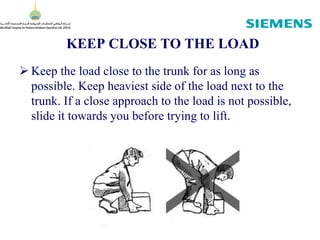
KEEP CLOSE TO THE LOAD
 Keep the load close to the trunk for as long as
possible. Keep heaviest side of the load next to the
trunk. If a close approach to the load is not possible,
slide it towards you before trying to lift.
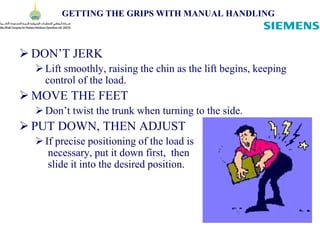
GETTING THE GRIPS WITH MANUAL HANDLING
 DON’T JERK
Lift smoothly, raising the chin as the lift begins, keeping
control of the load.
 MOVE THE FEET
Don’t twist the trunk when turning to the side.
 PUT DOWN, THEN ADJUST
If precise positioning of the load is
necessary, put it down first, then
slide it into the desired position.
SCD- 2006 HSE-P-MHG-00
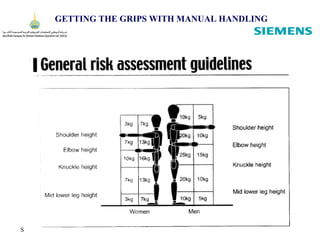
GETTING THE GRIPS WITH MANUAL HANDLING
GENERAL RISK ASSESSMENT GUIDELINES
 Each box in the diagram above shows guideline
weights for lifting and lowering.
 Observe the activity and compare to the diagram. If
the lifter’s hands enter more than one box during the
operation, use the smallest weight. Use an in between
weight if the hands are close to a boundary between
boxes. If the operation must take place with the hands
beyond the boxes, make a more detailed assessment.
GENERAL RISK ASSESSMENT GUIDELINES
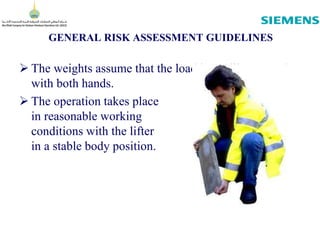
 The weights assume that the load is readily grasped
with both hands.
 The operation takes place
in reasonable working
conditions with the lifter
in a stable body position.
GENERAL RISK ASSESSMENT GUIDELINES
 Any operation involving more than twice the
guideline weights, should be rigorously assessed even
for very fit, well trained individuals working under
favorable conditions.
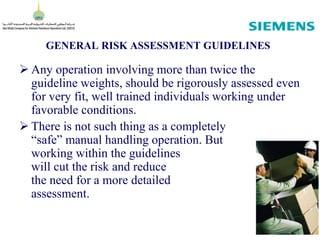
 There is not such thing as a completely
“safe” manual handling operation. But
working within the guidelines
will cut the risk and reduce
the need for a more detailed
assessment.
TWISTING
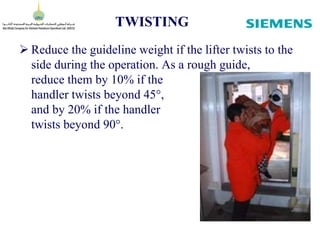
 Reduce the guideline weight if the lifter twists to the
side during the operation. As a rough guide,
reduce them by 10% if the
handler twists beyond 45,
and by 20% if the handler
twists beyond 90.
FREQUENT LIFTING AND LOWERING
The guideline weight are for infrequent operations – up
to about 30 operations per hour – where the pace of
work is not forced, adequate pauses to rest or use
different muscles are possible, and the load is not
supported for any length of time.
Reduce the weights if the operation is repeated more
than often. As a rough guide, reduce the weight by
30%, if the operation is repeated once or twice a
minute, by 50% where the operation is repeated five to
eight timed a minute: and by 80% where the operation
is repeated more than 12 times a minute.
DO WE SAYING WE MUSTN’T EXCEED THE GUIDELINE?
 No. The risk assessment guidelines are not safe limits
for lifting. But work outside the guidelines is likely to
increase the risk of injury , so we should examine it
closely for possible improvements.
We should remember that
you must make the work less
demanding if it is reasonable
practicable to do so.

Manual Handling (May-2017).ppt

  • 1.
    MANUAL HANDLING Power NetworkUpgrade of all ADCO Fields
  • 2.
    Objectives Upon completion ofthe lesson, participants will be able to: 1. Identify the proper and safe means for lifting and moving heavy objects. 2. Identify the proper handling technique to prevent back injuries. 3. Grasp some of the injuries associated with improper handling.
  • 3.
    WHAT’S THE PROBLEM More than a third of all over three-day injuries reported each year to HSE and local authorities are caused by manual handling – the transporting or supporting of loads by hand or by bodily force.
  • 4.
    WHAT’S THE PROBLEM Many manual handling injuries are build up over a period rather than being caused by a single handling incident. These injuries occur wherever people are at work – on farms and building sites, in factories, offices, warehouses, hospitals, banks, laboratories and while making deliveries.
  • 5.
    THE EMPLOYEE SHOULD AVOID the need for hazardous manual handling, as reasonably practicable  ASSESS the risk of injury from any hazardous manual handling that can’t be avoided  REDUCE the risk of injury from hazardous manual handling, as far as reasonably practicable
  • 6.
    THE EMPLOYEES’ DUTIES Follow appropriate system of work laid down for their safety  Make proper use of equipment provided for their safety  Co-operate with their employer on health and safety matters  Inform the employer if they identify hazardous handling activities  Take care to ensure that their activities do not put others to risk
  • 7.
    ASSESSING AND REDUSINGTHE RISK OF INJURY  Mostly it takes just a few minutes observation to identify ways to make the activity easier and less risky  All employees can help to carry out the assessment – they often know what problems there are and how best to solve it.  The important thing is to identify the risk of injury and point the way to practical improvements.
  • 8.
    STOP AND THINK Plan the lift. Where is the load to be placed? Use appropriate handling aids if possible. Remove obstructions such as discarded wrapping materials. For a long lift, such as floor to shoulder height, consider resting the load mid way on a table or bench to change grip.
  • 9.
    POSITION THE FEET Feet apart giving a balanced and stable base for lifting (tight skirts and unsuitable footwear make this difficult). Leading leg as far forward as is comfortable and if possible, pointing in the direction you intend to go.
  • 10.
    ADOPT A GOODPOSTURE  When lifting from a low level, bend the knees. But do not kneel or over flex the knees. Keep the back straight, maintaining its natural curve (tucking in the chin helps). Lean forward a little over the load if necessary to to get a good grip. Keep the shoulders level and facing the same direction as the hips.
  • 11.
    SCD- 2006 HSE-P-MHG-00 GETA FIRM GRIP  Try to keep the arms within the boundary formed by the legs. The best position and type of grip depends on the circumstances and individual preference: but must be secure. A hook grip is less tiring than keeping the fingers straight. If you need to vary the grip as the lift proceeds, do it as smoothly as possible.
  • 12.
    KEEP CLOSE TOTHE LOAD  Keep the load close to the trunk for as long as possible. Keep heaviest side of the load next to the trunk. If a close approach to the load is not possible, slide it towards you before trying to lift.
  • 13.
    GETTING THE GRIPSWITH MANUAL HANDLING  DON’T JERK Lift smoothly, raising the chin as the lift begins, keeping control of the load.  MOVE THE FEET Don’t twist the trunk when turning to the side.  PUT DOWN, THEN ADJUST If precise positioning of the load is necessary, put it down first, then slide it into the desired position.
  • 14.
    SCD- 2006 HSE-P-MHG-00 GETTINGTHE GRIPS WITH MANUAL HANDLING
  • 15.
    GENERAL RISK ASSESSMENTGUIDELINES  Each box in the diagram above shows guideline weights for lifting and lowering.  Observe the activity and compare to the diagram. If the lifter’s hands enter more than one box during the operation, use the smallest weight. Use an in between weight if the hands are close to a boundary between boxes. If the operation must take place with the hands beyond the boxes, make a more detailed assessment.
  • 16.
    GENERAL RISK ASSESSMENTGUIDELINES  The weights assume that the load is readily grasped with both hands.  The operation takes place in reasonable working conditions with the lifter in a stable body position.
  • 17.
    GENERAL RISK ASSESSMENTGUIDELINES  Any operation involving more than twice the guideline weights, should be rigorously assessed even for very fit, well trained individuals working under favorable conditions.  There is not such thing as a completely “safe” manual handling operation. But working within the guidelines will cut the risk and reduce the need for a more detailed assessment.
  • 18.
    TWISTING  Reduce theguideline weight if the lifter twists to the side during the operation. As a rough guide, reduce them by 10% if the handler twists beyond 45, and by 20% if the handler twists beyond 90.
  • 19.
    FREQUENT LIFTING ANDLOWERING The guideline weight are for infrequent operations – up to about 30 operations per hour – where the pace of work is not forced, adequate pauses to rest or use different muscles are possible, and the load is not supported for any length of time. Reduce the weights if the operation is repeated more than often. As a rough guide, reduce the weight by 30%, if the operation is repeated once or twice a minute, by 50% where the operation is repeated five to eight timed a minute: and by 80% where the operation is repeated more than 12 times a minute.
  • 20.
    DO WE SAYINGWE MUSTN’T EXCEED THE GUIDELINE?  No. The risk assessment guidelines are not safe limits for lifting. But work outside the guidelines is likely to increase the risk of injury , so we should examine it closely for possible improvements. We should remember that you must make the work less demanding if it is reasonable practicable to do so.