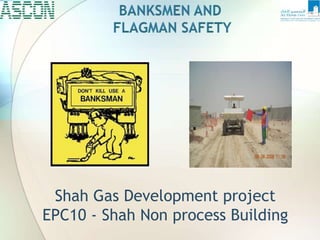
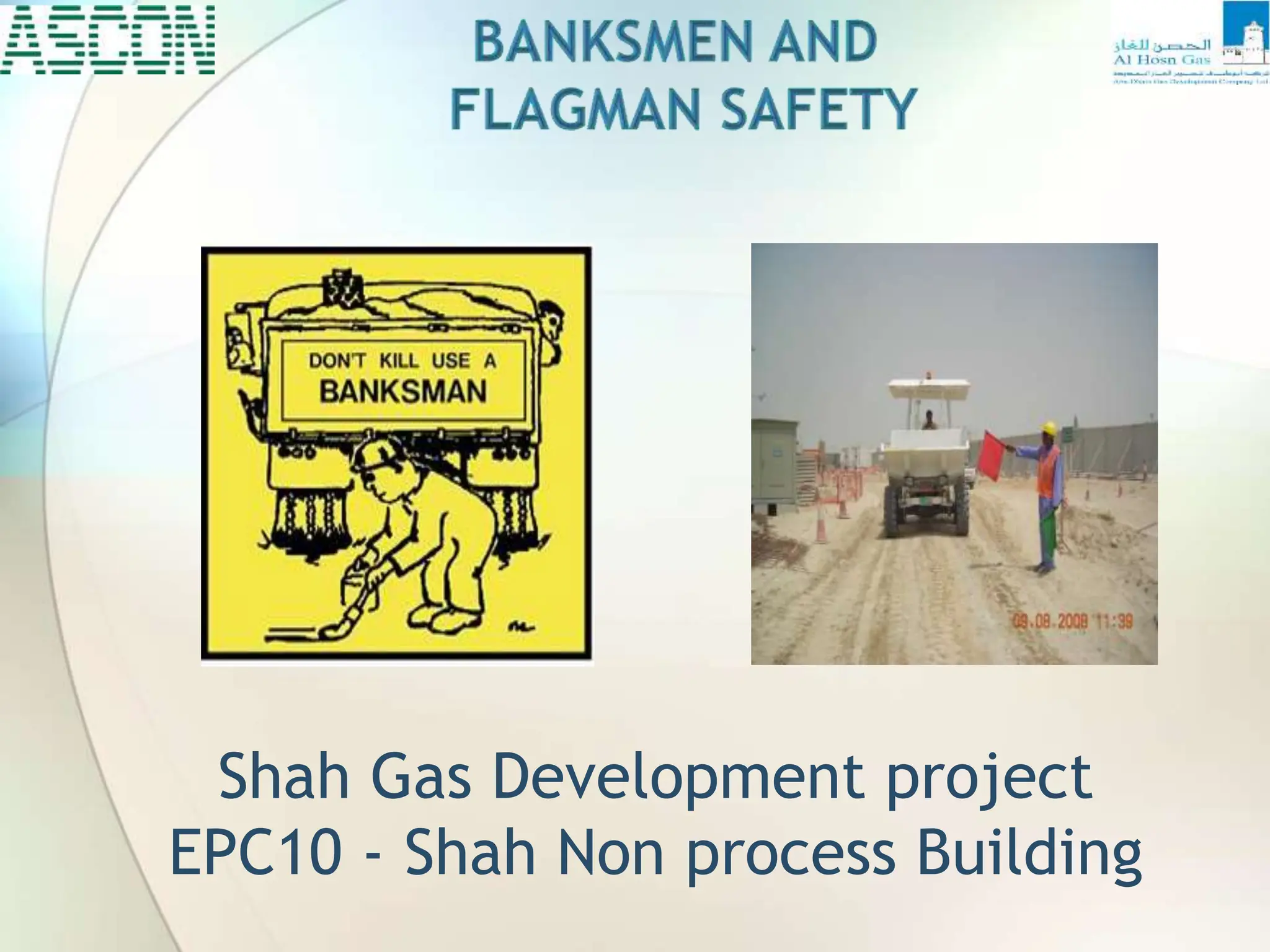
Shah Gas Development project
EPC10 - Shah Non process Building
• Importance of banksmen and flagmen
• Types of Signage for banksman
• Roles and responsibilities of banksmen and
flagmen
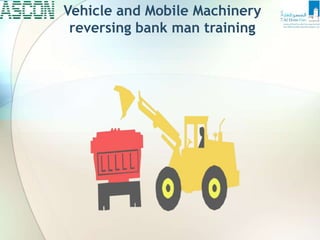
Vehicle and Mobile Machinery
reversing bank man training
Every Year a significant
number of people get injured
and killed by accidents
involving vehicles in the
workplace
Special Message
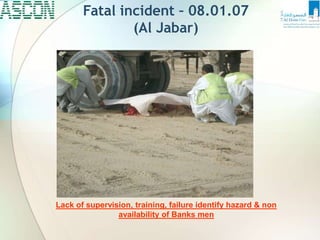
Fatal incident – 08.01.07
(Al Jabar)
Lack of supervision, training, failure identify hazard & non
availability of Banks men
• Traffic Plans
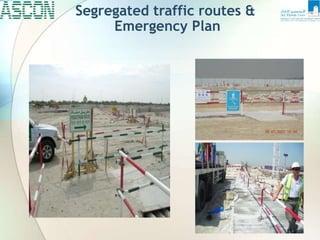
• Segregated traffic routes
• Reduced speed
• Site Maps and Signage
• Inductions
• Competent Drivers and site operatives
• Maintained plant and Equipment
• Banksmen
How vehicle / equipment operated
safely and with reduced risk
• One Way Systems where possible
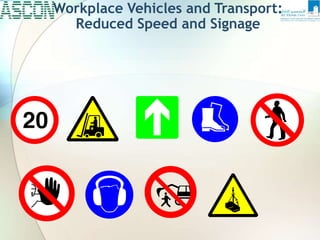
• Reduced speed requirements
• Measures to reduce the need for reversing &
Turning
• Segregated Pedestrians from Vehicles
• Loading and off-loading areas and lay down
areas indicated
• Applicable signage
Traffic Plans have
Workplace Vehicles and Transport:
Reduced Speed and Signage
Segregated traffic routes &
Emergency Plan
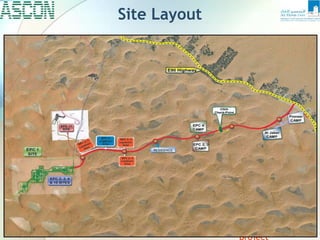
Site Layout
• Muster Point
• Pedestrian
Access
• Vehicles
Access
• First Aid
• Waste Bins
• Storage Area
• Welfare
Facilities
• Specific to be
discussed for
each specific
project
D2
Who is a banksman?
• Trained person who controls the movements of most
construction equipment by signaling the operator.
• Assists operator to safely drive the equipment in
crowded areas where people are working.
• Controls the movement of people while the
equipment is in operation.
• Erects necessary barricades to control access of
vehicles and persons clear from the equipment.
• Coordinates the work with other banksmen if more
than one equipment is in use in the same area.
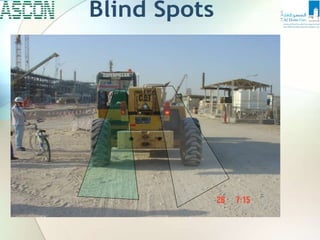
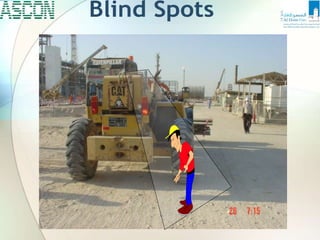
• Banksman is the eyes and ears of the operator of the
machine where he can not see (blind spots).
Banksman duties?
• Check vehicle maintenance and driver are trained
and competent.
• Monitor traffic & pedestrians routes as per traffic &
strategy.
• Monitor condition of traffic and pedestrian routes
• Control visiting delivery drivers & provide
information
• Manage loading and off-loading activities
• Ensure effective traffic movements & flow
• Ensure effective lighting at night
• MUST stay alert and prevent others becoming unsafe
• MUST never themselves in a blind spot
• MUST be seen by driver at all times
• MUST take a safe position at all times
Banksman duties?
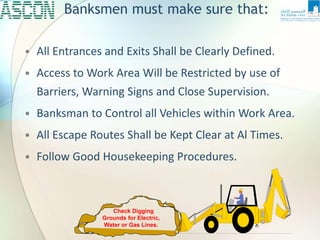
Banksmen must make sure that:
• All Entrances and Exits Shall be Clearly Defined.
• Access to Work Area Will be Restricted by use of
Barriers, Warning Signs and Close Supervision.
• Banksman to Control all Vehicles within Work Area.
• All Escape Routes Shall be Kept Clear at Al Times.
• Follow Good Housekeeping Procedures.
Check Digging
Grounds for Electric,
Water or Gas Lines.
What is required?
• Only one person shall be designated as a Banksman.
• Should be able to observe the load and other
workmen at all times.
• Must be always be in plain view of the crane
operator.
• Never assume anything.
• Make sure both workers and operators understand
exactly what is expected to safely move the load
All Banksmen are to Conduct
Daily Toolbox Talks
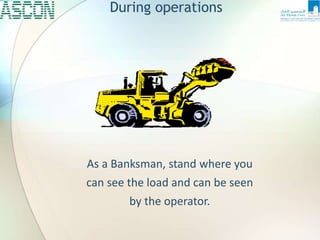
During operations
As a Banksman, stand where you
can see the load and can be seen
by the operator.
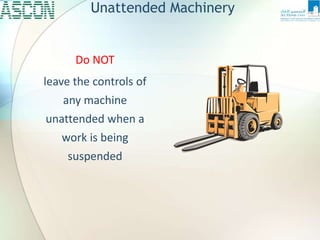
Do NOT
leave the controls of
any machine
unattended when a
work is being
suspended
Unattended Machinery
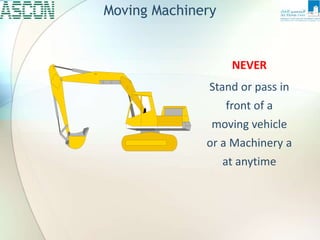
NEVER
Stand or pass in
front of a
moving vehicle
or a Machinery a
at anytime
Moving Machinery
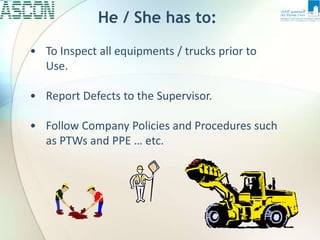
He / She has to:
• To Inspect all equipments / trucks prior to
Use.
• Report Defects to the Supervisor.
• Follow Company Policies and Procedures such
as PTWs and PPE … etc.
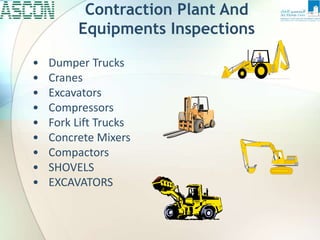
Contraction Plant And
Equipments Inspections
• Dumper Trucks
• Cranes
• Excavators
• Compressors
• Fork Lift Trucks
• Concrete Mixers
• Compactors
• SHOVELS
• EXCAVATORS
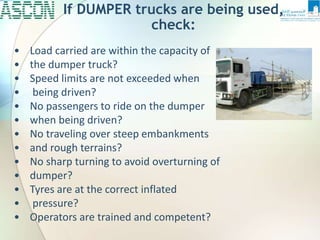
If DUMPER trucks are being used,
check:
• Load carried are within the capacity of
• the dumper truck?
• Speed limits are not exceeded when
• being driven?
• No passengers to ride on the dumper
• when being driven?
• No traveling over steep embankments
• and rough terrains?
• No sharp turning to avoid overturning of
• dumper?
• Tyres are at the correct inflated
• pressure?
• Operators are trained and competent?
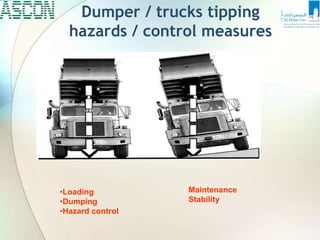
Dumper / trucks tipping
hazards / control measures
•Loading
•Dumping
•Hazard control
Maintenance
Stability
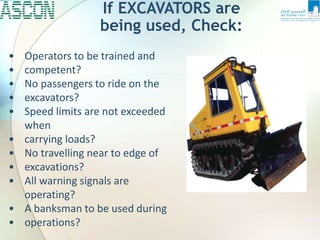
If EXCAVATORS are
being used, Check:
• Operators to be trained and
• competent?
• No passengers to ride on the
• excavators?
• Speed limits are not exceeded
when
• carrying loads?
• No travelling near to edge of
• excavations?
• All warning signals are
operating?
• A banksman to be used during
• operations?
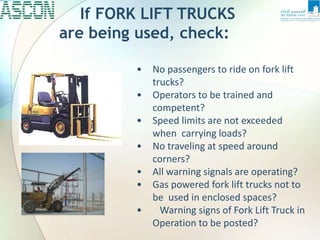
If FORK LIFT TRUCKS
are being used, check:
• No passengers to ride on fork lift
trucks?
• Operators to be trained and
competent?
• Speed limits are not exceeded
when carrying loads?
• No traveling at speed around
corners?
• All warning signals are operating?
• Gas powered fork lift trucks not to
be used in enclosed spaces?
• Warning signs of Fork Lift Truck in
Operation to be posted?
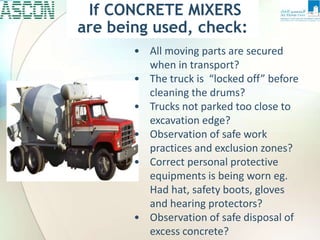
• All moving parts are secured
when in transport?
• The truck is “locked off” before
cleaning the drums?
• Trucks not parked too close to
excavation edge?
• Observation of safe work
practices and exclusion zones?
• Correct personal protective
equipments is being worn eg.
Had hat, safety boots, gloves
and hearing protectors?
• Observation of safe disposal of
excess concrete?
If CONCRETE MIXERS
are being used, check:
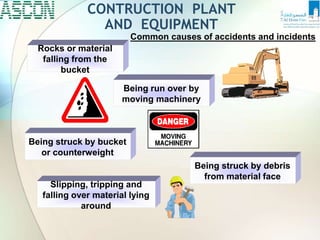
Common causes of accidents and incidents
Rocks or material
falling from the
bucket
Being run over by
moving machinery
Being struck by bucket
or counterweight
Being struck by debris
from material face
Slipping, tripping and
falling over material lying
around
CONTRUCTION PLANT
AND EQUIPMENT
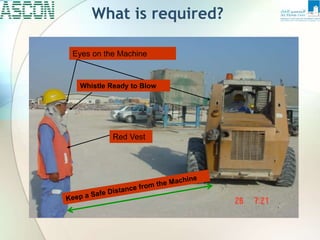
What is required?
Eyes on the Machine
Whistle Ready to Blow
Red Vest
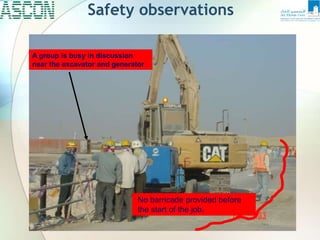
Safety observations
No barricade provided before
the start of the job.
A group is busy in discussion
near the excavator and generator
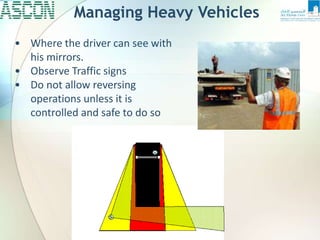
Managing Heavy Vehicles
• Where the driver can see with
his mirrors.
• Observe Traffic signs
• Do not allow reversing
operations unless it is
controlled and safe to do so
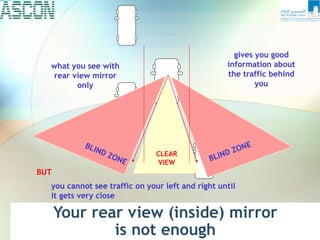
you cannot see traffic on your left and right until
it gets very close
what you see with
rear view mirror
only
gives you good
information about
the traffic behind
you
BUT
Your rear view (inside) mirror
is not enough
CLEAR
VIEW
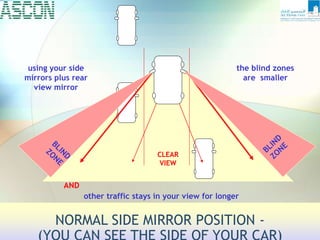
CLEAR
VIEW
other traffic stays in your view for longer
using your side
mirrors plus rear
view mirror
the blind zones
are smaller
AND
NORMAL SIDE MIRROR POSITION -
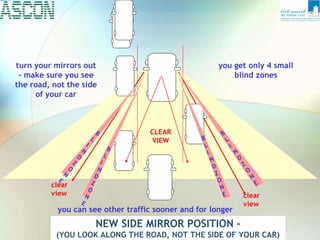
CLEAR
VIEW
clear
view clear
view
you can see other traffic sooner and for longer
NEW SIDE MIRROR POSITION -
(YOU LOOK ALONG THE ROAD, NOT THE SIDE OF YOUR CAR)
turn your mirrors out
- make sure you see
the road, not the side
of your car
you get only 4 small
blind zones
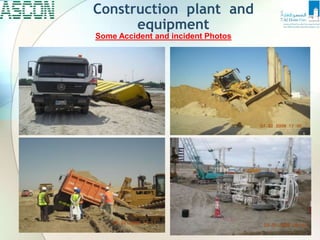
Construction plant and
equipment
Some Accident and incident Photos
If there is a danger ?
• Banksman must stop operator by using whistle and
hand signal if there is any danger to people or other
machine.
• Banksman must check clearance around
excavations, under pipe racks, structure
foundations or Scaffoldings before taking his
machine near or around such areas.
• Banksman should remain alert to see any danger
due to machine’s operation and should stop the
operation immediately if a danger is occurring.
• Always remain in operator’s view otherwise
machine can be dangerous to banksman as well as
workers.
• Lastly arrange to remove all signs, cones, barriers,
and lamps after finishing the work ?
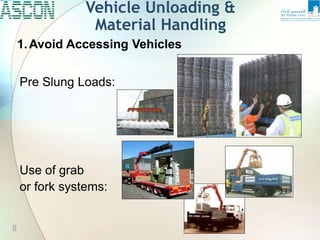
Vehicle Unloading &
Material Handling
1.Avoid Accessing Vehicles
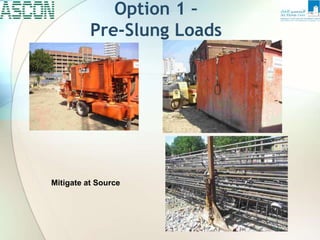
Pre Slung Loads:
Use of grab
or fork systems:
8
Option 1 –
Pre-Slung Loads
Mitigate at Source
Vehicle Unloading & Material
Handling
1.Avoid Accessing Vehicles – Before You Start
• Always bank reversing vehicles in trafficked areas
• Banksmen must be clearly identified
• Keep drivers in mirror – that means they see you!
• Keep out of the way of the vehicle
9
Vehicle Unloading & Material Handling
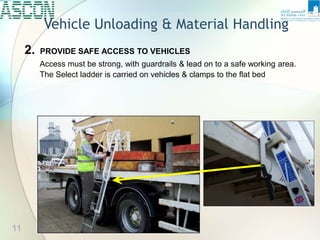
Access must be strong, with guardrails & lead on to a safe working area.
The Select ladder is carried on vehicles & clamps to the flat bed
2. PROVIDE SAFE ACCESS TO VEHICLES
11
Vehicle Unloading & Material Handling
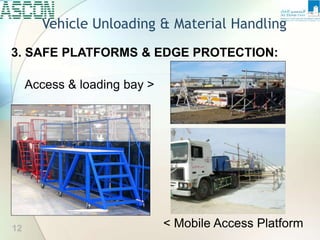
3. SAFE PLATFORMS & EDGE PROTECTION:
Access & loading bay >
< Mobile Access Platform
12
Vehicle Unloading & Material
Handling
What a supervisor can do to help:
• Know agreed methods for loading & unloading
• Check delivery schedules & consider how those
materials will be moved & stored
• Check handling equipment will be available
• Think about access to vehicles, if required
• Ensure people available & briefed
• Ensure correct footwear & can be kept clean
• Monitor deliveries & manage unloading
16
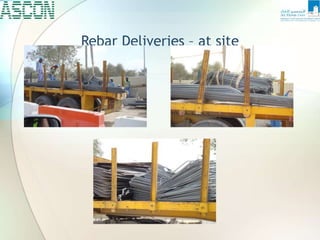
Rebar Deliveries – at site
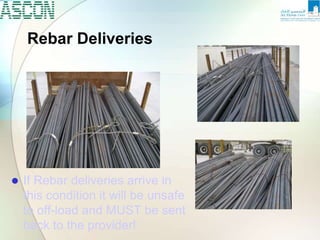
Rebar Deliveries
 If Rebar deliveries arrive in
this condition it will be unsafe
to off-load and MUST be sent
back to the provider!
Loose Re Bars / Tubes / etc
Method:
• Two leg chain slings or strops
• Double wrap to avoid slippage
• Chain slings must be choked
Precautions:
• Where choked, the SWL is reduced (20% or more –
Check with your Crane Supervisor).
• Position of chains to be determined to limit sag in
centre of bundle or at either end
SAFETY & HEALTH DEPARTMENT
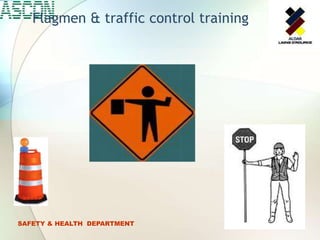
Flagmen & traffic control training
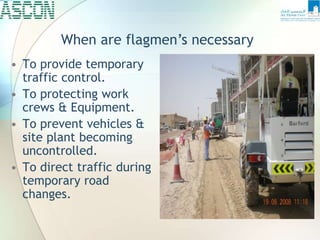
• To provide temporary
traffic control.
• To protecting work
crews & Equipment.
• To prevent vehicles &
site plant becoming
uncontrolled.
• To direct traffic during
temporary road
changes.
When are flagmen’s necessary
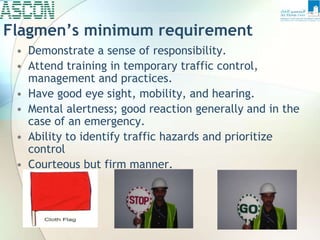
Flagmen’s minimum requirement
• Demonstrate a sense of responsibility.
• Attend training in temporary traffic control,
management and practices.
• Have good eye sight, mobility, and hearing.
• Mental alertness; good reaction generally and in the
case of an emergency.
• Ability to identify traffic hazards and prioritize
control
• Courteous but firm manner.
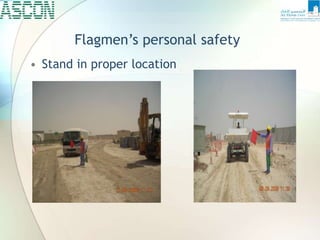
Flagmen’s personal safety
• Stand in proper location
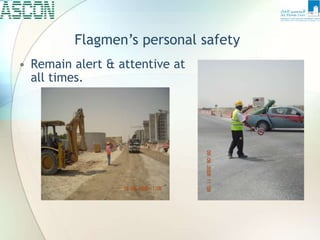
Flagmen’s personal safety
• Remain alert & attentive at
all times.
Flagmen’s personal safety
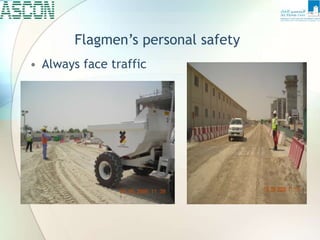
• Always face traffic
Flagmen’s personal safety
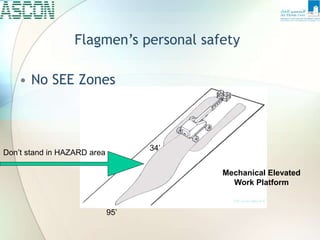
• No SEE Zones
34’
95’
Don’t stand in HAZARD area
Mechanical Elevated
Work Platform
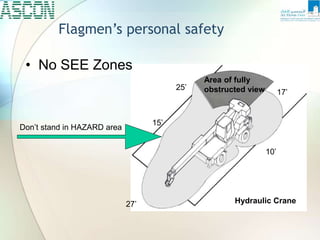
Flagmen’s personal safety
Don’t stand in HAZARD area
Area of fully
obstructed view
25’
10’
27’
15’
17’
Hydraulic Crane
• No SEE Zones
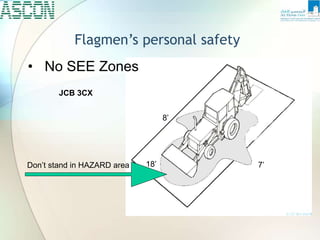
Flagmen’s personal safety
18’
8’
7’
Don’t stand in HAZARD area
JCB 3CX
• No SEE Zones
Flagmen’s personal safety
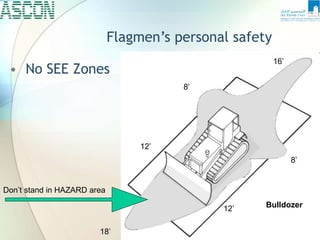
• No SEE Zones
Bulldozer
18’
16’
8’
8’
12’
12’
Don’t stand in HAZARD area
Flagmen’s personal safety
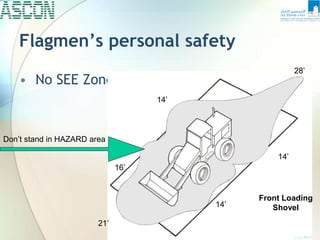
• No SEE Zones
21’
28’
14’
14’
16’
14’
Don’t stand in HAZARD area
Front Loading
Shovel
Flagmen’s personal safety
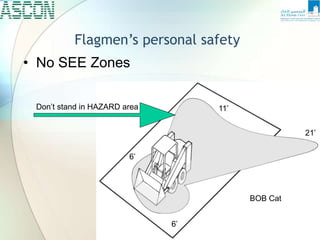
• No SEE Zones
BOB Cat
6’
6’
21’
11’
Don’t stand in HAZARD area
Flagmen’s personal safety
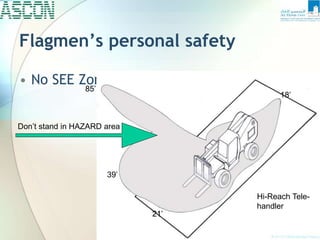
• No SEE Zones
Hi-Reach Tele-
handler
85’
39’
21’
18’
Don’t stand in HAZARD area
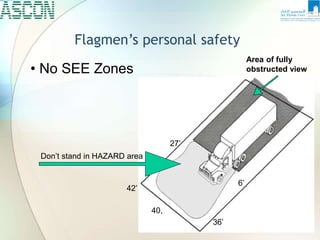
Flagmen’s personal safety
42’
40,
36’
27’
Area of fully
obstructed view
6’
Don’t stand in HAZARD area
• No SEE Zones
Flagmen’s personal safety
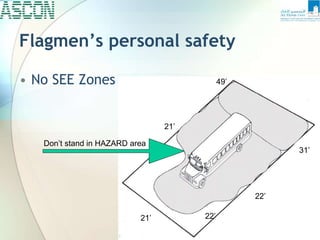
• No SEE Zones 49’
31’
22’
22’
21’
21’
Don’t stand in HAZARD area
Flagmen’s personal safety
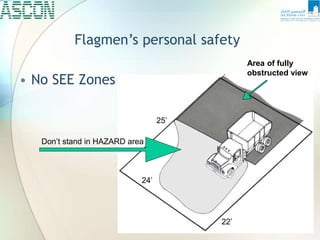
• No SEE Zones
Area of fully
obstructed view
25’
24’
22’
Don’t stand in HAZARD area
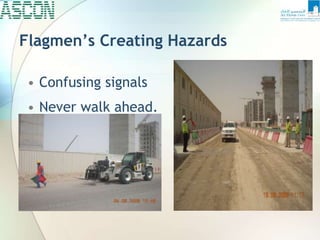
Flagmen’s Creating Hazards
• Confusing signals
• Never walk ahead.
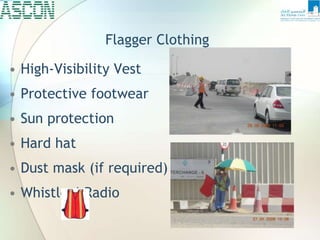
Flagger Clothing
• High-Visibility Vest
• Protective footwear
• Sun protection
• Hard hat
• Dust mask (if required)
• Whistle / Radio
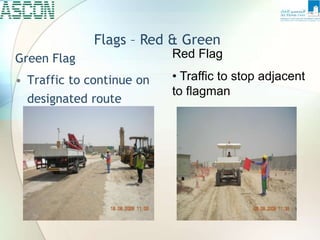
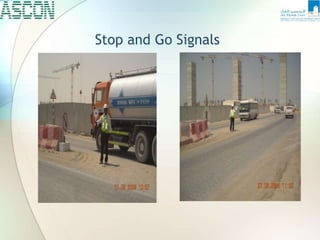
Flags – Red & Green
Green Flag
• Traffic to continue on
designated route
Red Flag
• Traffic to stop adjacent
to flagman
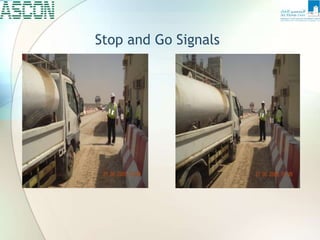
Stop and Go Signals
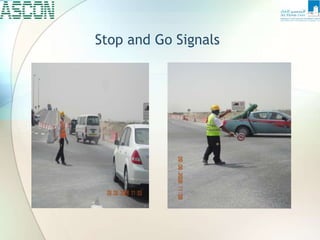
Stop and Go Signals
Stop and Go Signals
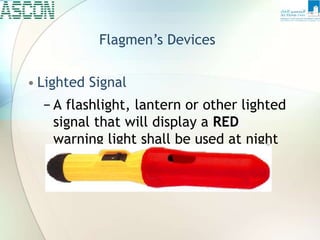
Flagmen’s Devices
• Lighted Signal
− A flashlight, lantern or other lighted
signal that will display a RED
warning light shall be used at night
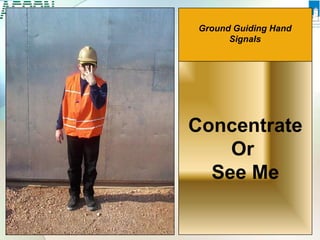
Concentrate
Or
See Me
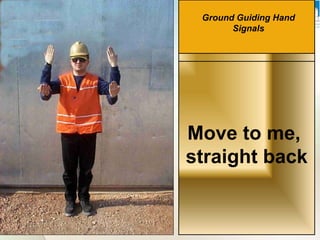
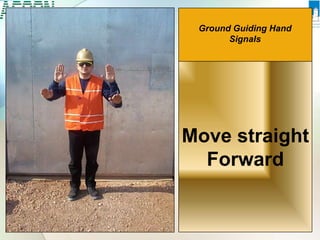
Ground Guiding Hand
Signals
Move to me,
straight back
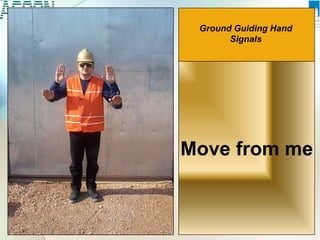
Ground Guiding Hand
Signals
Move from me
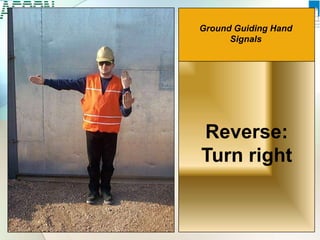
Ground Guiding Hand
Signals
Reverse:
Turn right
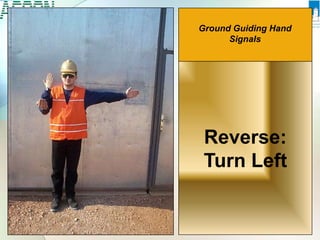
Ground Guiding Hand
Signals
Reverse:
Turn Left
Ground Guiding Hand
Signals
Move straight
Forward
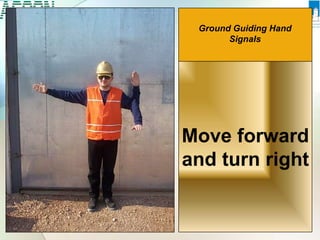
Ground Guiding Hand
Signals
Move forward
and turn right
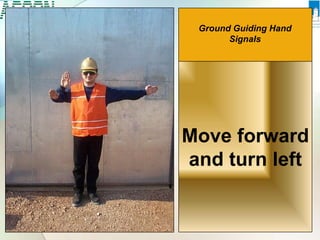
Ground Guiding Hand
Signals
Move forward
and turn left
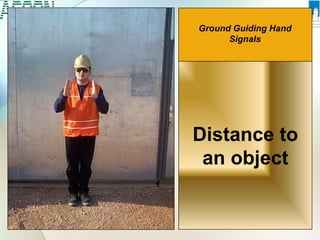
Ground Guiding Hand
Signals
Distance to
an object
Ground Guiding Hand
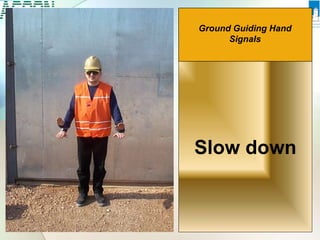
Signals
Slow down
Ground Guiding Hand
Signals
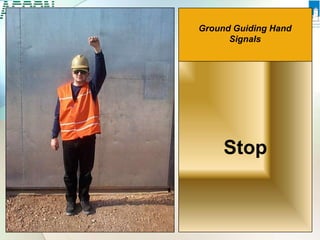
Ground Guiding Hand
Signals
Stop
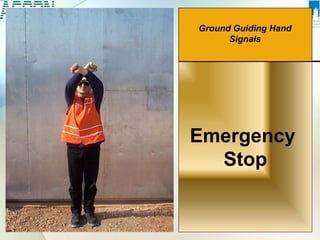
Emergency
Stop
Ground Guiding Hand
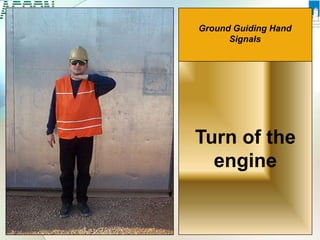
Signals
Turn of the
engine
Ground Guiding Hand
Signals
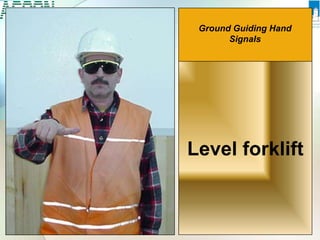
FORKLIFT SIGNALS
Ground Guiding Hand
Signals
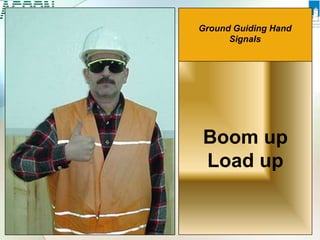
Boom up
Load up
Ground Guiding Hand
Signals
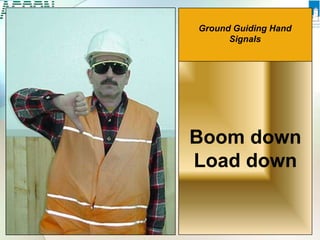
Boom down
Load down
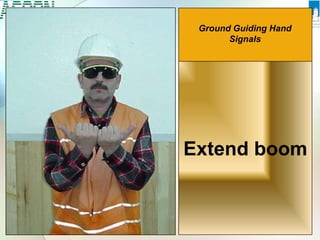
Extend boom
Ground Guiding Hand
Signals
Extend boom
Ground Guiding Hand
Signals
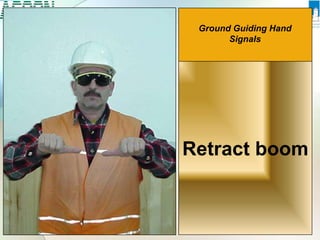
Retract boom
Ground Guiding Hand
Signals
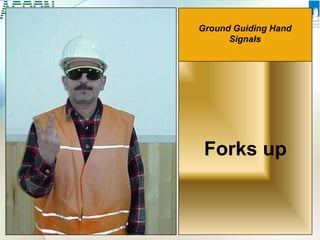
Forks up
Ground Guiding Hand
Signals
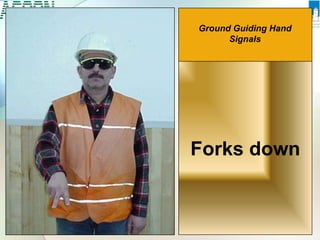
Forks down
Ground Guiding Hand
Signals
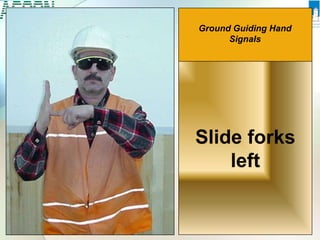
Slide forks
left
Ground Guiding Hand
Signals
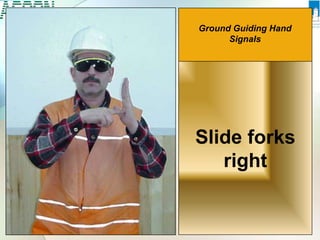
Slide forks
right
Ground Guiding Hand
Signals
Level forklift
1. Enlist role and responsibility of Banksman
and Flagman
2. Why Banksman and Flagman are required
at site.
THANK YOU
AND
HAVE A SAFE
WORKING DAY

1Ascon Banksman and flagman Presentation-RO.ppt

  • 1.
    Shah Gas Developmentproject EPC10 - Shah Non process Building
  • 2.
    • Importance ofbanksmen and flagmen • Types of Signage for banksman • Roles and responsibilities of banksmen and flagmen
  • 3.
    Vehicle and MobileMachinery reversing bank man training
  • 4.
    Every Year asignificant number of people get injured and killed by accidents involving vehicles in the workplace Special Message
  • 5.
    Fatal incident –08.01.07 (Al Jabar) Lack of supervision, training, failure identify hazard & non availability of Banks men
  • 6.
    • Traffic Plans •Segregated traffic routes • Reduced speed • Site Maps and Signage • Inductions • Competent Drivers and site operatives • Maintained plant and Equipment • Banksmen How vehicle / equipment operated safely and with reduced risk
  • 7.
    • One WaySystems where possible • Reduced speed requirements • Measures to reduce the need for reversing & Turning • Segregated Pedestrians from Vehicles • Loading and off-loading areas and lay down areas indicated • Applicable signage Traffic Plans have
  • 8.
    Workplace Vehicles andTransport: Reduced Speed and Signage
  • 9.
    Segregated traffic routes& Emergency Plan
  • 10.
    Site Layout • MusterPoint • Pedestrian Access • Vehicles Access • First Aid • Waste Bins • Storage Area • Welfare Facilities • Specific to be discussed for each specific project D2
  • 11.
    Who is abanksman? • Trained person who controls the movements of most construction equipment by signaling the operator. • Assists operator to safely drive the equipment in crowded areas where people are working. • Controls the movement of people while the equipment is in operation. • Erects necessary barricades to control access of vehicles and persons clear from the equipment. • Coordinates the work with other banksmen if more than one equipment is in use in the same area. • Banksman is the eyes and ears of the operator of the machine where he can not see (blind spots).
  • 12.
    Banksman duties? • Checkvehicle maintenance and driver are trained and competent. • Monitor traffic & pedestrians routes as per traffic & strategy. • Monitor condition of traffic and pedestrian routes • Control visiting delivery drivers & provide information • Manage loading and off-loading activities • Ensure effective traffic movements & flow
  • 13.
    • Ensure effectivelighting at night • MUST stay alert and prevent others becoming unsafe • MUST never themselves in a blind spot • MUST be seen by driver at all times • MUST take a safe position at all times Banksman duties?
  • 14.
    Banksmen must makesure that: • All Entrances and Exits Shall be Clearly Defined. • Access to Work Area Will be Restricted by use of Barriers, Warning Signs and Close Supervision. • Banksman to Control all Vehicles within Work Area. • All Escape Routes Shall be Kept Clear at Al Times. • Follow Good Housekeeping Procedures. Check Digging Grounds for Electric, Water or Gas Lines.
  • 15.
    What is required? •Only one person shall be designated as a Banksman. • Should be able to observe the load and other workmen at all times. • Must be always be in plain view of the crane operator. • Never assume anything. • Make sure both workers and operators understand exactly what is expected to safely move the load All Banksmen are to Conduct Daily Toolbox Talks
  • 16.
    During operations As aBanksman, stand where you can see the load and can be seen by the operator.
  • 17.
    Do NOT leave thecontrols of any machine unattended when a work is being suspended Unattended Machinery
  • 18.
    NEVER Stand or passin front of a moving vehicle or a Machinery a at anytime Moving Machinery
  • 19.
    He / Shehas to: • To Inspect all equipments / trucks prior to Use. • Report Defects to the Supervisor. • Follow Company Policies and Procedures such as PTWs and PPE … etc.
  • 20.
    Contraction Plant And EquipmentsInspections • Dumper Trucks • Cranes • Excavators • Compressors • Fork Lift Trucks • Concrete Mixers • Compactors • SHOVELS • EXCAVATORS
  • 21.
    If DUMPER trucksare being used, check: • Load carried are within the capacity of • the dumper truck? • Speed limits are not exceeded when • being driven? • No passengers to ride on the dumper • when being driven? • No traveling over steep embankments • and rough terrains? • No sharp turning to avoid overturning of • dumper? • Tyres are at the correct inflated • pressure? • Operators are trained and competent?
  • 22.
    Dumper / truckstipping hazards / control measures •Loading •Dumping •Hazard control Maintenance Stability
  • 23.
    If EXCAVATORS are beingused, Check: • Operators to be trained and • competent? • No passengers to ride on the • excavators? • Speed limits are not exceeded when • carrying loads? • No travelling near to edge of • excavations? • All warning signals are operating? • A banksman to be used during • operations?
  • 24.
    If FORK LIFTTRUCKS are being used, check: • No passengers to ride on fork lift trucks? • Operators to be trained and competent? • Speed limits are not exceeded when carrying loads? • No traveling at speed around corners? • All warning signals are operating? • Gas powered fork lift trucks not to be used in enclosed spaces? • Warning signs of Fork Lift Truck in Operation to be posted?
  • 25.
    • All movingparts are secured when in transport? • The truck is “locked off” before cleaning the drums? • Trucks not parked too close to excavation edge? • Observation of safe work practices and exclusion zones? • Correct personal protective equipments is being worn eg. Had hat, safety boots, gloves and hearing protectors? • Observation of safe disposal of excess concrete? If CONCRETE MIXERS are being used, check:
  • 26.
    Common causes ofaccidents and incidents Rocks or material falling from the bucket Being run over by moving machinery Being struck by bucket or counterweight Being struck by debris from material face Slipping, tripping and falling over material lying around CONTRUCTION PLANT AND EQUIPMENT
  • 27.
    What is required? Eyeson the Machine Whistle Ready to Blow Red Vest
  • 28.
    Safety observations No barricadeprovided before the start of the job. A group is busy in discussion near the excavator and generator
  • 31.
    Managing Heavy Vehicles •Where the driver can see with his mirrors. • Observe Traffic signs • Do not allow reversing operations unless it is controlled and safe to do so
  • 32.
    you cannot seetraffic on your left and right until it gets very close what you see with rear view mirror only gives you good information about the traffic behind you BUT Your rear view (inside) mirror is not enough CLEAR VIEW
  • 33.
    CLEAR VIEW other traffic staysin your view for longer using your side mirrors plus rear view mirror the blind zones are smaller AND NORMAL SIDE MIRROR POSITION -
  • 34.
    CLEAR VIEW clear view clear view you cansee other traffic sooner and for longer NEW SIDE MIRROR POSITION - (YOU LOOK ALONG THE ROAD, NOT THE SIDE OF YOUR CAR) turn your mirrors out - make sure you see the road, not the side of your car you get only 4 small blind zones
  • 35.
    Construction plant and equipment SomeAccident and incident Photos
  • 36.
    If there isa danger ? • Banksman must stop operator by using whistle and hand signal if there is any danger to people or other machine. • Banksman must check clearance around excavations, under pipe racks, structure foundations or Scaffoldings before taking his machine near or around such areas. • Banksman should remain alert to see any danger due to machine’s operation and should stop the operation immediately if a danger is occurring. • Always remain in operator’s view otherwise machine can be dangerous to banksman as well as workers. • Lastly arrange to remove all signs, cones, barriers, and lamps after finishing the work ?
  • 37.
    Vehicle Unloading & MaterialHandling 1.Avoid Accessing Vehicles Pre Slung Loads: Use of grab or fork systems: 8
  • 38.
    Option 1 – Pre-SlungLoads Mitigate at Source
  • 39.
    Vehicle Unloading &Material Handling 1.Avoid Accessing Vehicles – Before You Start • Always bank reversing vehicles in trafficked areas • Banksmen must be clearly identified • Keep drivers in mirror – that means they see you! • Keep out of the way of the vehicle 9
  • 40.
    Vehicle Unloading &Material Handling Access must be strong, with guardrails & lead on to a safe working area. The Select ladder is carried on vehicles & clamps to the flat bed 2. PROVIDE SAFE ACCESS TO VEHICLES 11
  • 41.
    Vehicle Unloading &Material Handling 3. SAFE PLATFORMS & EDGE PROTECTION: Access & loading bay > < Mobile Access Platform 12
  • 42.
    Vehicle Unloading &Material Handling What a supervisor can do to help: • Know agreed methods for loading & unloading • Check delivery schedules & consider how those materials will be moved & stored • Check handling equipment will be available • Think about access to vehicles, if required • Ensure people available & briefed • Ensure correct footwear & can be kept clean • Monitor deliveries & manage unloading 16
  • 43.
  • 44.
    Rebar Deliveries  IfRebar deliveries arrive in this condition it will be unsafe to off-load and MUST be sent back to the provider!
  • 45.
    Loose Re Bars/ Tubes / etc Method: • Two leg chain slings or strops • Double wrap to avoid slippage • Chain slings must be choked Precautions: • Where choked, the SWL is reduced (20% or more – Check with your Crane Supervisor). • Position of chains to be determined to limit sag in centre of bundle or at either end
  • 46.
    SAFETY & HEALTHDEPARTMENT Flagmen & traffic control training
  • 47.
    • To providetemporary traffic control. • To protecting work crews & Equipment. • To prevent vehicles & site plant becoming uncontrolled. • To direct traffic during temporary road changes. When are flagmen’s necessary
  • 48.
    Flagmen’s minimum requirement •Demonstrate a sense of responsibility. • Attend training in temporary traffic control, management and practices. • Have good eye sight, mobility, and hearing. • Mental alertness; good reaction generally and in the case of an emergency. • Ability to identify traffic hazards and prioritize control • Courteous but firm manner.
  • 49.
    Flagmen’s personal safety •Stand in proper location
  • 50.
    Flagmen’s personal safety •Remain alert & attentive at all times.
  • 51.
  • 52.
    Flagmen’s personal safety •No SEE Zones 34’ 95’ Don’t stand in HAZARD area Mechanical Elevated Work Platform
  • 53.
    Flagmen’s personal safety Don’tstand in HAZARD area Area of fully obstructed view 25’ 10’ 27’ 15’ 17’ Hydraulic Crane • No SEE Zones
  • 54.
    Flagmen’s personal safety 18’ 8’ 7’ Don’tstand in HAZARD area JCB 3CX • No SEE Zones
  • 55.
    Flagmen’s personal safety •No SEE Zones Bulldozer 18’ 16’ 8’ 8’ 12’ 12’ Don’t stand in HAZARD area
  • 56.
    Flagmen’s personal safety •No SEE Zones 21’ 28’ 14’ 14’ 16’ 14’ Don’t stand in HAZARD area Front Loading Shovel
  • 57.
    Flagmen’s personal safety •No SEE Zones BOB Cat 6’ 6’ 21’ 11’ Don’t stand in HAZARD area
  • 58.
    Flagmen’s personal safety •No SEE Zones Hi-Reach Tele- handler 85’ 39’ 21’ 18’ Don’t stand in HAZARD area
  • 59.
    Flagmen’s personal safety 42’ 40, 36’ 27’ Areaof fully obstructed view 6’ Don’t stand in HAZARD area • No SEE Zones
  • 60.
    Flagmen’s personal safety •No SEE Zones 49’ 31’ 22’ 22’ 21’ 21’ Don’t stand in HAZARD area
  • 61.
    Flagmen’s personal safety •No SEE Zones Area of fully obstructed view 25’ 24’ 22’ Don’t stand in HAZARD area
  • 62.
    Flagmen’s Creating Hazards •Confusing signals • Never walk ahead.
  • 63.
    Flagger Clothing • High-VisibilityVest • Protective footwear • Sun protection • Hard hat • Dust mask (if required) • Whistle / Radio
  • 64.
    Flags – Red& Green Green Flag • Traffic to continue on designated route Red Flag • Traffic to stop adjacent to flagman
  • 65.
    Stop and GoSignals
  • 66.
    Stop and GoSignals
  • 67.
    Stop and GoSignals
  • 68.
    Flagmen’s Devices • LightedSignal − A flashlight, lantern or other lighted signal that will display a RED warning light shall be used at night
  • 70.
  • 71.
    Move to me, straightback Ground Guiding Hand Signals
  • 72.
    Move from me GroundGuiding Hand Signals
  • 73.
  • 74.
  • 75.
  • 76.
    Move forward and turnright Ground Guiding Hand Signals
  • 77.
    Move forward and turnleft Ground Guiding Hand Signals
  • 78.
    Distance to an object GroundGuiding Hand Signals
  • 79.
  • 80.
  • 81.
  • 82.
    Turn of the engine GroundGuiding Hand Signals
  • 83.
  • 84.
  • 85.
  • 86.
    Extend boom Ground GuidingHand Signals Extend boom
  • 87.
  • 88.
  • 89.
  • 90.
  • 91.
  • 92.
  • 94.
    1. Enlist roleand responsibility of Banksman and Flagman 2. Why Banksman and Flagman are required at site.
  • 95.
    THANK YOU AND HAVE ASAFE WORKING DAY