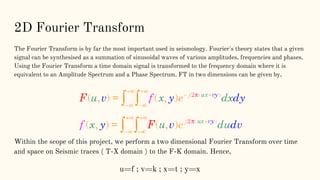
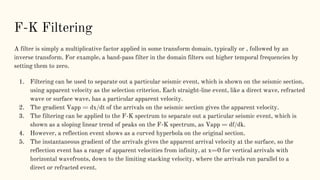
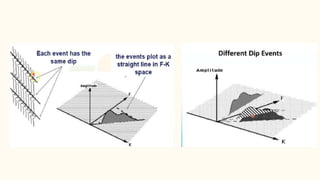
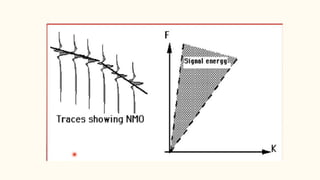
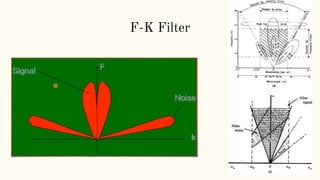
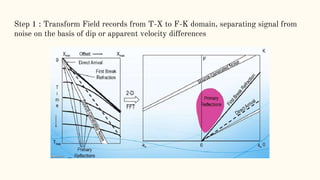
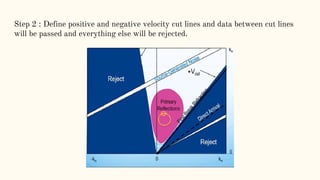
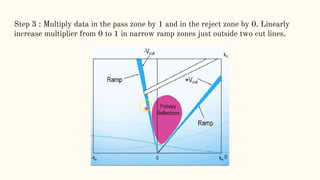
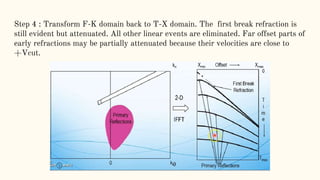
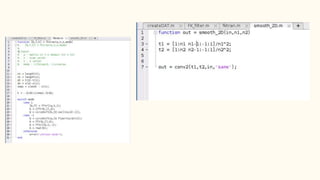
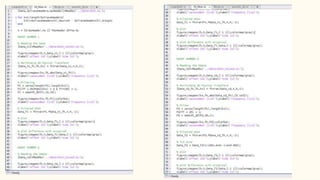
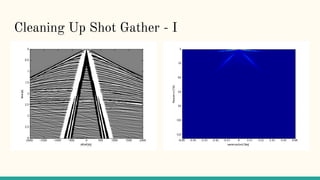
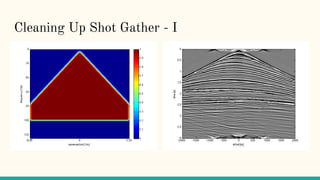
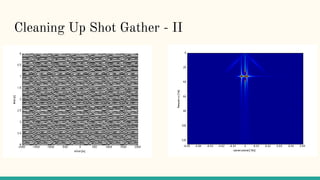
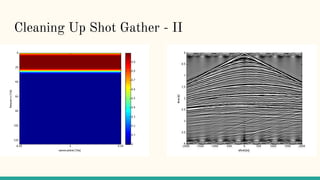
F-K filtering is a technique used in seismic data processing that transforms seismic traces from the time-space (T-X) domain to the frequency-wavenumber (F-K) domain. In the F-K domain, events with different apparent velocities appear as linear trends with distinct dips, allowing them to be separated using filters that reject data between defined positive and negative velocity cut lines. The filtered F-K domain data is then transformed back to the T-X domain, attenuating unwanted linear events while preserving the desired event, such as a first break refraction. The key steps are 1) transforming to F-K, 2) defining velocity filters, 3) multiplying data in pass/reject zones,