


FIWARE Lab Architecture
Fernando López,
Cloud Architect, TID
fernando.lopezaguilar@telefonica.com, @flopezaguilar
MD-VPN - Integration
• The setup must be discussed with local NRENs
• Federation IP addressing plan
– per node configuration available on public XiFi documents
Deliverable 5.2
– must be implemented on the network in which all the
federation related hosts are connected
• It is possible to provide backup solutions based on P2P
VPN.
– important delay of deployment of the NREN
– if the NREN do not provide MD-VPN service
– the Infrastructure can’t get NREN connectivity
2
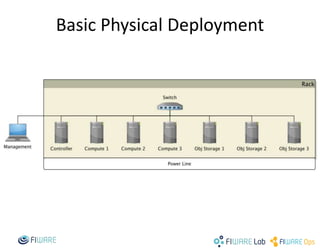
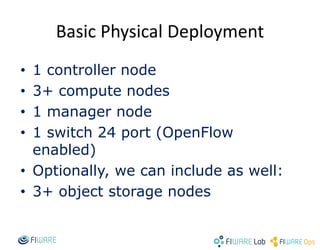
Basic Physical Deployment
• 1 controller node
• 3+ compute nodes
• 1 manager node
• 1 switch 24 port (OpenFlow
enabled)
• Optionally, we can include as well:
• 3+ object storage nodes
Basic Physical Deployment
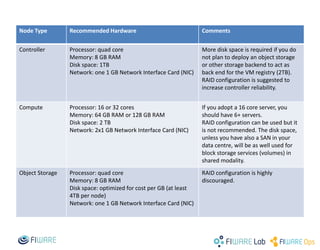
Node Type Recommended Hardware Comments
Controller Processor: quad core
Memory: 8 GB RAM
Disk space: 1TB
Network: one 1 GB Network Interface Card (NIC)
More disk space is required if you do
not plan to deploy an object storage
or other storage backend to act as
back end for the VM registry (2TB).
RAID configuration is suggested to
increase controller reliability.
Compute Processor: 16 or 32 cores
Memory: 64 GB RAM or 128 GB RAM
Disk space: 2 TB
Network: 2x1 GB Network Interface Card (NIC)
If you adopt a 16 core server, you
should have 6+ servers.
RAID configuration can be used but it
is not recommended. The disk space,
unless you have also a SAN in your
data centre, will be as well used for
block storage services (volumes) in
shared modality.
Object Storage Processor: quad core
Memory: 8 GB RAM
Disk space: optimized for cost per GB (at least
4TB per node)
Network: one 1 GB Network Interface Card (NIC)
RAID configuration is highly
discouraged.
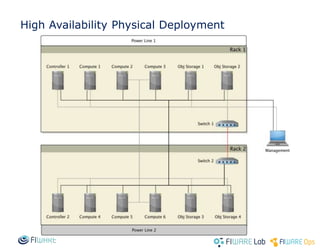
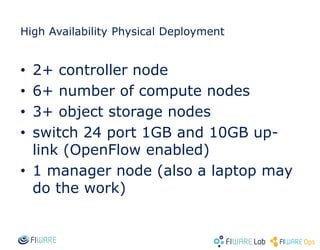
High Availability Physical Deployment
• 2+ controller node
• 6+ number of compute nodes
• 3+ object storage nodes
• switch 24 port 1GB and 10GB up-
link (OpenFlow enabled)
• 1 manager node (also a laptop may
do the work)
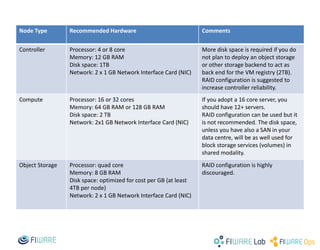
Node Type Recommended Hardware Comments
Controller Processor: 4 or 8 core
Memory: 12 GB RAM
Disk space: 1TB
Network: 2 x 1 GB Network Interface Card (NIC)
More disk space is required if you do
not plan to deploy an object storage
or other storage backend to act as
back end for the VM registry (2TB).
RAID configuration is suggested to
increase controller reliability.
Compute Processor: 16 or 32 cores
Memory: 64 GB RAM or 128 GB RAM
Disk space: 2 TB
Network: 2x1 GB Network Interface Card (NIC)
If you adopt a 16 core server, you
should have 12+ servers.
RAID configuration can be used but it
is not recommended. The disk space,
unless you have also a SAN in your
data centre, will be as well used for
block storage services (volumes) in
shared modality.
Object Storage Processor: quad core
Memory: 8 GB RAM
Disk space: optimized for cost per GB (at least
4TB per node)
Network: 2 x 1 GB Network Interface Card (NIC)
RAID configuration is highly
discouraged.
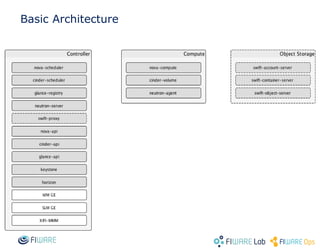
Basic Architecture
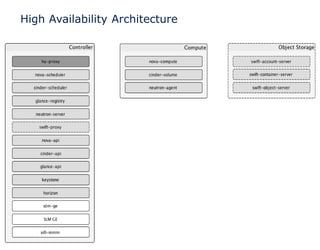
High Availability Architecture
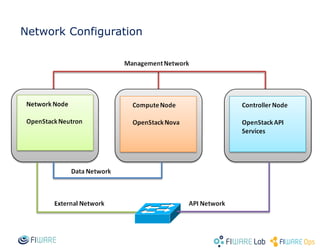
Network Configuration
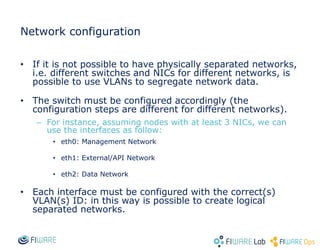
Network configuration
• If it is not possible to have physically separated networks,
i.e. different switches and NICs for different networks, is
possible to use VLANs to segregate network data.
• The switch must be configured accordingly (the
configuration steps are different for different networks).
– For instance, assuming nodes with at least 3 NICs, we can
use the interfaces as follow:
• eth0: Management Network
• eth1: External/API Network
• eth2: Data Network
• Each interface must be configured with the correct(s)
VLAN(s) ID: in this way is possible to create logical
separated networks.
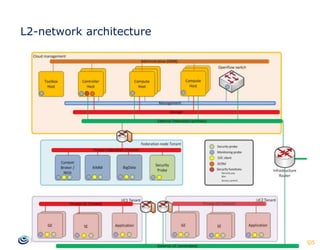
L2-network architecture
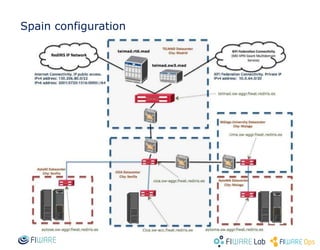
Spain configuration
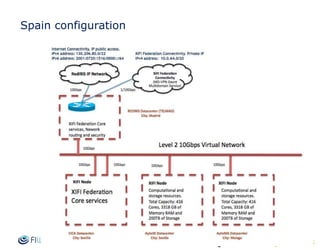
Spain configuration
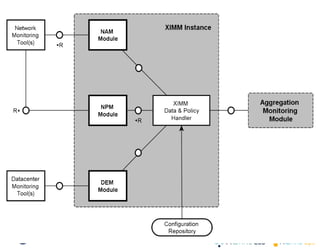
• Network Active Measurements: provide the capability to make a
custom-specified measurement between a pair of measurement tools.
The coordination between any two collectors to perform a measurement
is essential
– One Way Delay
– Delay Variation (Jitter)
– Packet Loss
– Achievable Bandwidth
– Layer 3 Path (e.g. Traceroute, Tracepath)
• Network Passive Measurements: allow specification of parameters
that would be used in capturing and deducing measurements from
network traffic or in retrieving network information status
– Layer 3 Statistics. Information retrieved from network-attached devices (e.g.
SNMP)
– Link Utilisation
• Datacenter Measurements
– CPU Usage
– Memory Usage
– Host Alive
– Disk Free
18
Thanks!Thanks!

FIWARE Lab architecture, an open point to start the installation of a new region

  • 1.
    FIWARE Lab Architecture FernandoLópez, Cloud Architect, TID fernando.lopezaguilar@telefonica.com, @flopezaguilar
  • 2.
    MD-VPN - Integration •The setup must be discussed with local NRENs • Federation IP addressing plan – per node configuration available on public XiFi documents Deliverable 5.2 – must be implemented on the network in which all the federation related hosts are connected • It is possible to provide backup solutions based on P2P VPN. – important delay of deployment of the NREN – if the NREN do not provide MD-VPN service – the Infrastructure can’t get NREN connectivity 2
  • 3.
  • 4.
    • 1 controllernode • 3+ compute nodes • 1 manager node • 1 switch 24 port (OpenFlow enabled) • Optionally, we can include as well: • 3+ object storage nodes Basic Physical Deployment
  • 5.
    Node Type RecommendedHardware Comments Controller Processor: quad core Memory: 8 GB RAM Disk space: 1TB Network: one 1 GB Network Interface Card (NIC) More disk space is required if you do not plan to deploy an object storage or other storage backend to act as back end for the VM registry (2TB). RAID configuration is suggested to increase controller reliability. Compute Processor: 16 or 32 cores Memory: 64 GB RAM or 128 GB RAM Disk space: 2 TB Network: 2x1 GB Network Interface Card (NIC) If you adopt a 16 core server, you should have 6+ servers. RAID configuration can be used but it is not recommended. The disk space, unless you have also a SAN in your data centre, will be as well used for block storage services (volumes) in shared modality. Object Storage Processor: quad core Memory: 8 GB RAM Disk space: optimized for cost per GB (at least 4TB per node) Network: one 1 GB Network Interface Card (NIC) RAID configuration is highly discouraged.
  • 6.
  • 7.
    High Availability PhysicalDeployment • 2+ controller node • 6+ number of compute nodes • 3+ object storage nodes • switch 24 port 1GB and 10GB up- link (OpenFlow enabled) • 1 manager node (also a laptop may do the work)
  • 8.
    Node Type RecommendedHardware Comments Controller Processor: 4 or 8 core Memory: 12 GB RAM Disk space: 1TB Network: 2 x 1 GB Network Interface Card (NIC) More disk space is required if you do not plan to deploy an object storage or other storage backend to act as back end for the VM registry (2TB). RAID configuration is suggested to increase controller reliability. Compute Processor: 16 or 32 cores Memory: 64 GB RAM or 128 GB RAM Disk space: 2 TB Network: 2x1 GB Network Interface Card (NIC) If you adopt a 16 core server, you should have 12+ servers. RAID configuration can be used but it is not recommended. The disk space, unless you have also a SAN in your data centre, will be as well used for block storage services (volumes) in shared modality. Object Storage Processor: quad core Memory: 8 GB RAM Disk space: optimized for cost per GB (at least 4TB per node) Network: 2 x 1 GB Network Interface Card (NIC) RAID configuration is highly discouraged.
  • 9.
  • 10.
  • 11.
  • 12.
    Network configuration • Ifit is not possible to have physically separated networks, i.e. different switches and NICs for different networks, is possible to use VLANs to segregate network data. • The switch must be configured accordingly (the configuration steps are different for different networks). – For instance, assuming nodes with at least 3 NICs, we can use the interfaces as follow: • eth0: Management Network • eth1: External/API Network • eth2: Data Network • Each interface must be configured with the correct(s) VLAN(s) ID: in this way is possible to create logical separated networks.
  • 13.
  • 14.
  • 15.
  • 17.
    • Network ActiveMeasurements: provide the capability to make a custom-specified measurement between a pair of measurement tools. The coordination between any two collectors to perform a measurement is essential – One Way Delay – Delay Variation (Jitter) – Packet Loss – Achievable Bandwidth – Layer 3 Path (e.g. Traceroute, Tracepath) • Network Passive Measurements: allow specification of parameters that would be used in capturing and deducing measurements from network traffic or in retrieving network information status – Layer 3 Statistics. Information retrieved from network-attached devices (e.g. SNMP) – Link Utilisation • Datacenter Measurements – CPU Usage – Memory Usage – Host Alive – Disk Free
  • 18.
  • 19.

Editor's Notes

  • #12 OpenStack distinguishes four logical networks: * Management network * Data network * External network * API network