

Different 5 Year Plan Of
Agriculture
Presented by :-
- Bhalodiya Khushbu (03)
- Ghelani Rima (09)
Submitted to :-
- Snehal ma’am
Subject :-
ENVIRONMENT MANAGEMENT
Five Year Plan Of Agriculture
 The pioneers (respective) of the Indian
government formulated 5 years plan to
develop the Indian economy.
 The duty of the chairman of the planning
commission in India is served by the Prime
Minister of the country.
 The economy of India is based in part on
planning through its five-year plans, which are
developed, executed and monitored by the
Planning Commission of India.
First Five Year Plan (1951-1955)
- OBJECTIVES
(Jawaharlal Nehru)
• The first Indian Prime Minister, Jawaharlal Nehru presented
the First Five-Year Plan to the Parliament of India and
needed urgent attention, 1951.
• Based on the Harrod–Domar model with few
modifications.
• The target growth rate was 2.1% annual gross domestic
product (GDP) growth; the achieved growth rate was 3.6%
the net domestic product went up by 15%.
• Increase capital income 8%
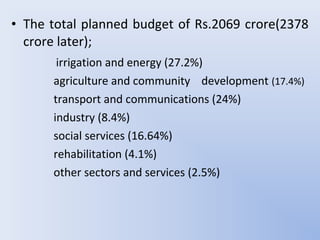
• The total planned budget of Rs.2069 crore(2378
crore later);
irrigation and energy (27.2%)
agriculture and community development (17.4%)
transport and communications (24%)
industry (8.4%)
social services (16.64%)
rehabilitation (4.1%)
other sectors and services (2.5%)
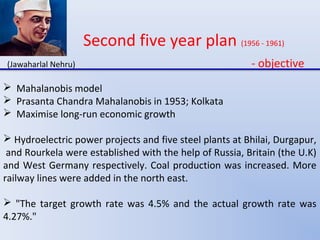
Second five year plan (1956 - 1961)
(Jawaharlal Nehru) - objective
 Mahalanobis model
 Prasanta Chandra Mahalanobis in 1953; Kolkata
 Maximise long-run economic growth
 Hydroelectric power projects and five steel plants at Bhilai, Durgapur,
and Rourkela were established with the help of Russia, Britain (the U.K)
and West Germany respectively. Coal production was increased. More
railway lines were added in the north east.
 "The target growth rate was 4.5% and the actual growth rate was
4.27%."
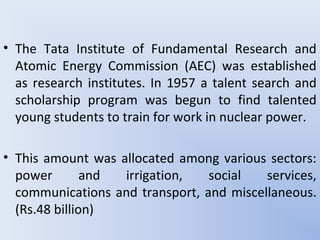
• The Tata Institute of Fundamental Research and
Atomic Energy Commission (AEC) was established
as research institutes. In 1957 a talent search and
scholarship program was begun to find talented
young students to train for work in nuclear power.
• This amount was allocated among various sectors:
power and irrigation, social services,
communications and transport, and miscellaneous.
(Rs.48 billion)
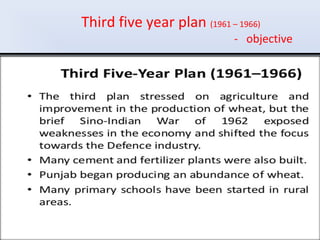
Third five year plan (1961 – 1966)
- objective
• The target growth rate was 5.6%, but the actual
growth rate was 2.4%.
• States were made responsible for secondary and
higher education.
• State road transportation corporations were
formed and local road building became a state
responsibility.
Holidays
• Due to miserable failure of the Third Plan the
government was forced to declare "plan holidays"
(from 1966–69).
• Three annual plans were drawn during this
intervening period.
• During 1966–67 there was again the problem of
drought.
• Equal priority was given to agriculture, its allied
activities, and industrial sector.
• The government of India declared
"Devaluation of Rupee" to increase the
exports of the country.
• The main reasons for plan holidays were the
war, lack of resources, and increase in
inflation after that plan holiday was created.
Fourth five year plan (1969-1974)
- Objectives
• At this time Indira Gandhi was the Prime Minister.
• The Indira Gandhi government nationalised 14 major
Indian banks and the Green Revolution in India advanced
agriculture.
• The situation in East Pakistan (now Bangladesh) was
becoming dire as the Indo-Pakistan War of 1971.
• Bangladesh Liberation War took funds earmarked for
industrial development.
• The target growth rate was 5.6%, but the actual growth
rate was 3.3%.
Fifth five year plan (1974-1979)
- Objectives
• The Fifth Five-Year Plan laid stress on employment,
poverty alleviation (Garibi Hatao), and justice. The
plan also focused on self-reliance in agricultural
production and defence.
• In 1978 the newly elected Morarji Desai
government rejected the plan.
• The Electricity Supply Act was amended in 1975,
which enabled the central government to enter into
power generation and transmission.
• The Indian national highway system was introduced and
many roads were widened to accommodate the increasing
traffic. Tourism also expanded. The twenty-point
programme was launched in 1975. It was followed from
1974 to 1979.
• The Minimum Needs Programme (MNP) was introduced in
the first year of the Fifth Five Year Plan (1974–78). The
objective of the programme is to provide certain basic
minimum needs and thereby improve the living standards
of the people.
• The target growth rate was 4.4% and the actual growth
rate was 4.8%.
Sixth five year plan (1980-1985)
- Objectives
• The Sixth Five-Year Plan marked the beginning of
economic liberalisation.
• Price controls were eliminated and ration shops were
closed.
• This led to an increase in food prices and an increase in the
cost of living.
• The National Bank for Agriculture and Rural Development
was established for development of rural areas on 12 July
1982 by recommendation of the Shivaraman Committee.
• Family planning was also expanded in order to
prevent overpopulation.
• In contrast to China's strict and binding one-child
policy, Indian policy did not rely on the threat of
force.
• More prosperous areas of India adopted family
planning more rapidly than less prosperous areas,
which continued to have a high birth rate.
• The Sixth Five-Year Plan was a great success to the
Indian economy. The target growth rate was 5.2%
and the actual growth rate was 5.7%.
Seventh five year plan (1985-1989)
- objective
• The Seventh Plan marked the comeback of the
Congress Party to power.
• Anti-poverty program (jgsy, noaps, nfbs)
• Improved facility for education to girls
• Agricultural development
• Increase production
- Achievement
• Using modern technology
• Agricultural development (Oilseeds, fruits,
vegetables, pulses, cereals, fish, egg, meat, milk
etc.)
• Anti-poverty programs
• Full supply of food, and clothing
• Increasing productivity of small and large scale
farmers.
Eighth five year plan (1992-1997)
- Objectives
• Modernization of industries was a major highlight
of the Eighth Plan.
• To generate full scale employment.
• To check the increasing population growth by
creating mass awareness programs.
• diversification of agriculture.
• To encourage growth (target growth :-5.6%, actual growth :- 6.8%)
- Achievement
• Rise in the employment level(with help of lpg policy)
• Poverty reduction
• The saving for investment was to come from domestic
sources and foreign sources.
• An average annual growth rate of 6.7% against the
target 5.6% was achieved.
Ninth five year plan (1997-2002)
- Objectives
• GDP target :- 6.5%
• To rural and urban development. :-
1) To generate adequate (requirement) employment
opportunities
2) To provide for the basic infrastructural facilitate like
education for all, safe drinking water, primary healthcare,
transport, energy.
3) To check the growing population increase
4) To create a liberal market for increase in private
investments
- Achievement
• GDP achieved 5.4%
• Increase education.
• Service sector showed fast growth rate.
• A combined effort of public, private, and all levels
of government is essential for ensuring the growth
of India's economy.
Tenth Five Year Plan (2002-2007)
- objective
• To transform the country into the fastest growing economy of the
world
• Targets an annual GDP growth 8.1%
• Human and Social development
• Industry and Services:
Industry, minerals, energy, information,
technology, tourism, real estate, construction, internal trade
• Forests and Environment
• Science and Technology
• Special area programs like SEZ, EOU
- Achievements
• Agricultural growth 10%
• 8% GDP Growth.
• Reduction of poverty rate by 5% at 2007.
• Providing gainful and high-quality employment at
least to the addition to the labor force.
Eleventh Five Year Plan (2007-12)
- Objective
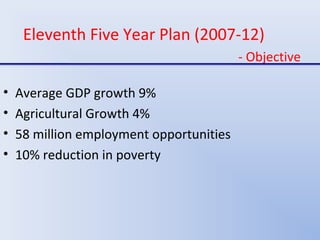
• Average GDP growth 9%
• Agricultural Growth 4%
• 58 million employment opportunities
• 10% reduction in poverty
- Achievements
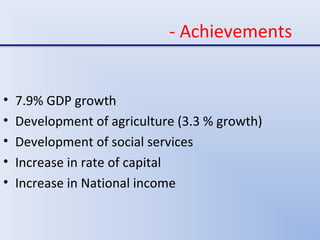
• 7.9% GDP growth
• Development of agriculture (3.3 % growth)
• Development of social services
• Increase in rate of capital
• Increase in National income
12th
Five Year Plan (2012-2017)
- objective
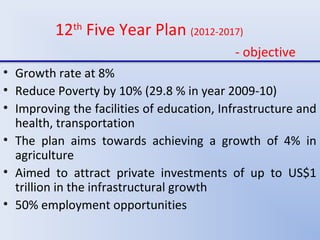
• Growth rate at 8%
• Reduce Poverty by 10% (29.8 % in year 2009-10)
• Improving the facilities of education, Infrastructure and
health, transportation
• The plan aims towards achieving a growth of 4% in
agriculture
• Aimed to attract private investments of up to US$1
trillion in the infrastructural growth
• 50% employment opportunities
Economic Growth
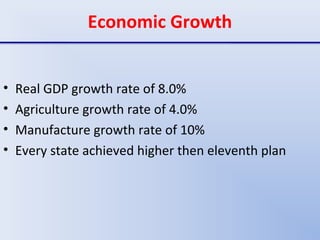
• Real GDP growth rate of 8.0%
• Agriculture growth rate of 4.0%
• Manufacture growth rate of 10%
• Every state achieved higher then eleventh plan
Poverty and Employment
• poverty to be reduced by 10% points over the
preceding estimates by the end of Twelfth FYP.
• Generate 50 million new work opportunities in the
non-farm sector and provide skill certification to
equivalent numbers during the Twelfth FYP.
Education
• Eliminate gender and social gap in school enrolment
(that is, between girls and boys, and between SCs,
STs, Muslims and the rest of the population) by the
end of Twelfth FYP.
Energy
• 8% GDP growth requires 6% growth in energy supply from all
sources.
• Our fossil fuel resources are limited, and our import dependence
is already high.
• We need to push for renewable Energy: Wind, Solar and
Storage Hydro ( resource of electricity)
Water
• Management of water resource is a major challenge. Estimates of
water availability have been optimistic.
• Twelfth Plan proposes modified AIBP(Accelerated Irrigation Benefit
Programme).
• Agriculture accounts for 80% of water use at present, must shift to
more water efficient agriculture practices.
• Manage urban and industrial water demand through water recycling
and rationalise user charges.
Environment
• Increase green revolution. (as measured by satellite
imagery) by 1 million hectare every year during the
Twelfth FYP.
• Add 30,000 MW of renewable energy capacity in
the Twelfth Plan
- Progress
• GDP 5% in 2012-2013
• Fiscal deficit is 4.89%
• 2.9% increase in Per capita income
- Positive Points
• Inclusive Growth
• Private investment
• Infrastructure development
five year agriculture plan

five year agriculture plan

  • 1.
    Different 5 YearPlan Of Agriculture Presented by :- - Bhalodiya Khushbu (03) - Ghelani Rima (09) Submitted to :- - Snehal ma’am Subject :- ENVIRONMENT MANAGEMENT
  • 2.
    Five Year PlanOf Agriculture  The pioneers (respective) of the Indian government formulated 5 years plan to develop the Indian economy.  The duty of the chairman of the planning commission in India is served by the Prime Minister of the country.  The economy of India is based in part on planning through its five-year plans, which are developed, executed and monitored by the Planning Commission of India.
  • 4.
    First Five YearPlan (1951-1955) - OBJECTIVES (Jawaharlal Nehru) • The first Indian Prime Minister, Jawaharlal Nehru presented the First Five-Year Plan to the Parliament of India and needed urgent attention, 1951. • Based on the Harrod–Domar model with few modifications. • The target growth rate was 2.1% annual gross domestic product (GDP) growth; the achieved growth rate was 3.6% the net domestic product went up by 15%. • Increase capital income 8%
  • 5.
    • The totalplanned budget of Rs.2069 crore(2378 crore later); irrigation and energy (27.2%) agriculture and community development (17.4%) transport and communications (24%) industry (8.4%) social services (16.64%) rehabilitation (4.1%) other sectors and services (2.5%)
  • 6.
    Second five yearplan (1956 - 1961) (Jawaharlal Nehru) - objective  Mahalanobis model  Prasanta Chandra Mahalanobis in 1953; Kolkata  Maximise long-run economic growth  Hydroelectric power projects and five steel plants at Bhilai, Durgapur, and Rourkela were established with the help of Russia, Britain (the U.K) and West Germany respectively. Coal production was increased. More railway lines were added in the north east.  "The target growth rate was 4.5% and the actual growth rate was 4.27%."
  • 7.
    • The TataInstitute of Fundamental Research and Atomic Energy Commission (AEC) was established as research institutes. In 1957 a talent search and scholarship program was begun to find talented young students to train for work in nuclear power. • This amount was allocated among various sectors: power and irrigation, social services, communications and transport, and miscellaneous. (Rs.48 billion)
  • 8.
    Third five yearplan (1961 – 1966) - objective
  • 9.
    • The targetgrowth rate was 5.6%, but the actual growth rate was 2.4%. • States were made responsible for secondary and higher education. • State road transportation corporations were formed and local road building became a state responsibility.
  • 10.
    Holidays • Due tomiserable failure of the Third Plan the government was forced to declare "plan holidays" (from 1966–69). • Three annual plans were drawn during this intervening period. • During 1966–67 there was again the problem of drought. • Equal priority was given to agriculture, its allied activities, and industrial sector.
  • 11.
    • The governmentof India declared "Devaluation of Rupee" to increase the exports of the country. • The main reasons for plan holidays were the war, lack of resources, and increase in inflation after that plan holiday was created.
  • 12.
    Fourth five yearplan (1969-1974) - Objectives • At this time Indira Gandhi was the Prime Minister. • The Indira Gandhi government nationalised 14 major Indian banks and the Green Revolution in India advanced agriculture. • The situation in East Pakistan (now Bangladesh) was becoming dire as the Indo-Pakistan War of 1971. • Bangladesh Liberation War took funds earmarked for industrial development. • The target growth rate was 5.6%, but the actual growth rate was 3.3%.
  • 13.
    Fifth five yearplan (1974-1979) - Objectives • The Fifth Five-Year Plan laid stress on employment, poverty alleviation (Garibi Hatao), and justice. The plan also focused on self-reliance in agricultural production and defence. • In 1978 the newly elected Morarji Desai government rejected the plan. • The Electricity Supply Act was amended in 1975, which enabled the central government to enter into power generation and transmission.
  • 14.
    • The Indiannational highway system was introduced and many roads were widened to accommodate the increasing traffic. Tourism also expanded. The twenty-point programme was launched in 1975. It was followed from 1974 to 1979. • The Minimum Needs Programme (MNP) was introduced in the first year of the Fifth Five Year Plan (1974–78). The objective of the programme is to provide certain basic minimum needs and thereby improve the living standards of the people. • The target growth rate was 4.4% and the actual growth rate was 4.8%.
  • 15.
    Sixth five yearplan (1980-1985) - Objectives • The Sixth Five-Year Plan marked the beginning of economic liberalisation. • Price controls were eliminated and ration shops were closed. • This led to an increase in food prices and an increase in the cost of living. • The National Bank for Agriculture and Rural Development was established for development of rural areas on 12 July 1982 by recommendation of the Shivaraman Committee.
  • 16.
    • Family planningwas also expanded in order to prevent overpopulation. • In contrast to China's strict and binding one-child policy, Indian policy did not rely on the threat of force. • More prosperous areas of India adopted family planning more rapidly than less prosperous areas, which continued to have a high birth rate. • The Sixth Five-Year Plan was a great success to the Indian economy. The target growth rate was 5.2% and the actual growth rate was 5.7%.
  • 17.
    Seventh five yearplan (1985-1989) - objective • The Seventh Plan marked the comeback of the Congress Party to power. • Anti-poverty program (jgsy, noaps, nfbs) • Improved facility for education to girls • Agricultural development • Increase production
  • 18.
    - Achievement • Usingmodern technology • Agricultural development (Oilseeds, fruits, vegetables, pulses, cereals, fish, egg, meat, milk etc.) • Anti-poverty programs • Full supply of food, and clothing • Increasing productivity of small and large scale farmers.
  • 19.
    Eighth five yearplan (1992-1997) - Objectives • Modernization of industries was a major highlight of the Eighth Plan. • To generate full scale employment. • To check the increasing population growth by creating mass awareness programs. • diversification of agriculture. • To encourage growth (target growth :-5.6%, actual growth :- 6.8%)
  • 20.
    - Achievement • Risein the employment level(with help of lpg policy) • Poverty reduction • The saving for investment was to come from domestic sources and foreign sources. • An average annual growth rate of 6.7% against the target 5.6% was achieved.
  • 21.
    Ninth five yearplan (1997-2002) - Objectives • GDP target :- 6.5% • To rural and urban development. :- 1) To generate adequate (requirement) employment opportunities 2) To provide for the basic infrastructural facilitate like education for all, safe drinking water, primary healthcare, transport, energy. 3) To check the growing population increase 4) To create a liberal market for increase in private investments
  • 22.
    - Achievement • GDPachieved 5.4% • Increase education. • Service sector showed fast growth rate. • A combined effort of public, private, and all levels of government is essential for ensuring the growth of India's economy.
  • 23.
    Tenth Five YearPlan (2002-2007) - objective • To transform the country into the fastest growing economy of the world • Targets an annual GDP growth 8.1% • Human and Social development • Industry and Services: Industry, minerals, energy, information, technology, tourism, real estate, construction, internal trade • Forests and Environment • Science and Technology • Special area programs like SEZ, EOU
  • 24.
    - Achievements • Agriculturalgrowth 10% • 8% GDP Growth. • Reduction of poverty rate by 5% at 2007. • Providing gainful and high-quality employment at least to the addition to the labor force.
  • 25.
    Eleventh Five YearPlan (2007-12) - Objective • Average GDP growth 9% • Agricultural Growth 4% • 58 million employment opportunities • 10% reduction in poverty
  • 26.
    - Achievements • 7.9%GDP growth • Development of agriculture (3.3 % growth) • Development of social services • Increase in rate of capital • Increase in National income
  • 27.
    12th Five Year Plan(2012-2017) - objective • Growth rate at 8% • Reduce Poverty by 10% (29.8 % in year 2009-10) • Improving the facilities of education, Infrastructure and health, transportation • The plan aims towards achieving a growth of 4% in agriculture • Aimed to attract private investments of up to US$1 trillion in the infrastructural growth • 50% employment opportunities
  • 28.
    Economic Growth • RealGDP growth rate of 8.0% • Agriculture growth rate of 4.0% • Manufacture growth rate of 10% • Every state achieved higher then eleventh plan
  • 29.
    Poverty and Employment •poverty to be reduced by 10% points over the preceding estimates by the end of Twelfth FYP. • Generate 50 million new work opportunities in the non-farm sector and provide skill certification to equivalent numbers during the Twelfth FYP.
  • 30.
    Education • Eliminate genderand social gap in school enrolment (that is, between girls and boys, and between SCs, STs, Muslims and the rest of the population) by the end of Twelfth FYP.
  • 31.
    Energy • 8% GDPgrowth requires 6% growth in energy supply from all sources. • Our fossil fuel resources are limited, and our import dependence is already high. • We need to push for renewable Energy: Wind, Solar and Storage Hydro ( resource of electricity)
  • 32.
    Water • Management ofwater resource is a major challenge. Estimates of water availability have been optimistic. • Twelfth Plan proposes modified AIBP(Accelerated Irrigation Benefit Programme). • Agriculture accounts for 80% of water use at present, must shift to more water efficient agriculture practices. • Manage urban and industrial water demand through water recycling and rationalise user charges.
  • 33.
    Environment • Increase greenrevolution. (as measured by satellite imagery) by 1 million hectare every year during the Twelfth FYP. • Add 30,000 MW of renewable energy capacity in the Twelfth Plan
  • 34.
    - Progress • GDP5% in 2012-2013 • Fiscal deficit is 4.89% • 2.9% increase in Per capita income - Positive Points • Inclusive Growth • Private investment • Infrastructure development

Editor's Notes

  • #18 2)Full form : - (jgsy) :- Jawaharlal gram samridhi yojana. (noaps) :- national old age pension scheme. (nfbs) :- national family benefit scheme. 3)New government at the center formed a full department of woman and child department , under the ministry of human resources. 5) With the use of increase new modern technology also increase the production.
  • #20 2&3) In 1st January 1995 India became a member of the world trade organization and it is a major objective of it.
  • #22 Starting government agency / The SAPs(special action plan) covered the areas of social infrastructure, agriculture, information technology and Water policy.
  • #26 Australia delegation explores agri-partnership with india under the Australia tread and investment commission. Globally export in agriculture production. On lines of the ‘make in india’ campaign aiming for substantial gains in agri-exports with a sign authority to monitor India's international agricultural trade-both export and import. 3) Employment generate in transport and telecommunication sector. 4) Generate employment and 7 crore new employment opportunity and ensuring electricity connection to all villages.