The Five Languages
of Apology
How to Experience Healing in All Your
Relationships
Why Apologize?
 A Cry for Reconciliation –
restoration of the relationship
 For lack of an apology…
 Can you forgive without an apology
 Can we learn to apologize?
What are some of the worst apologies you have given or received?
A Cry for Reconciliation
 While justice may bring some sense
of satisfaction to the offended
person, justice does not typically
restore relationships
 Humankind has an amazing
capacity to forgive
 The more intimate the relationship
the deeper the desire for
reconciliation
For lack of an apology…
 Individuals declare war, which can
last for years ending in divorce or
even death.
 Partners in a healthy relationship
are willing to apologize
Can you forgive without an apology?
 Christian worldview – to forgive
without an apology
 But what is the Christian instructed
to do? To forgive others as God
forgives us – by confessing to our
sins.
 No where in the New or Old
Testament does God forgive those
who do not confess to their sins.
Can you forgive without an apology?
 Genuine forgiveness removes the
barrier that was created by the
offense and opens the door to
restoring trust over time.
Can we learn to apologize?
 Yes, by learning the apology
language of the other person and be
willing to speak
The Five Languages of Apology
1. Expressing Regret – “I apologize”
2. Accepting Responsibility – “I was
wrong”
3. Making Restitution – “What can I do
to make it right”
4. Genuinely Repenting – “I’ll try not to
do that again”
5. Requesting Forgiveness – “Will you
please forgive me”
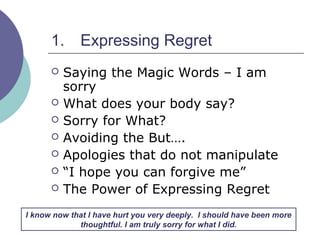
1. Expressing Regret
 Saying the Magic Words – I am
sorry
 What does your body say?
 Sorry for What?
 Avoiding the But….
 Apologies that do not manipulate
 “I hope you can forgive me”
 The Power of Expressing Regret
I know now that I have hurt you very deeply. I should have been more
thoughtful. I am truly sorry for what I did.
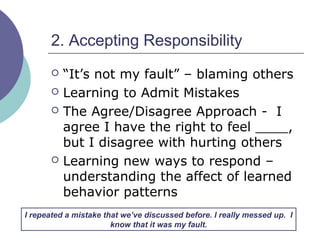
2. Accepting Responsibility
 “It’s not my fault” – blaming others
 Learning to Admit Mistakes
 The Agree/Disagree Approach - I
agree I have the right to feel ____,
but I disagree with hurting others
 Learning new ways to respond –
understanding the affect of learned
behavior patterns
I repeated a mistake that we’ve discussed before. I really messed up. I
know that it was my fault.
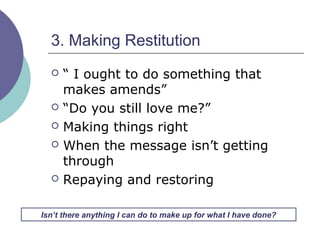
3. Making Restitution
 “ I ought to do something that
makes amends”
 “Do you still love me?”
 Making things right
 When the message isn’t getting
through
 Repaying and restoring
Isn’t there anything I can do to make up for what I have done?
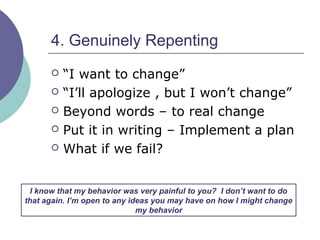
4. Genuinely Repenting
 “I want to change”
 “I’ll apologize , but I won’t change”
 Beyond words – to real change
 Put it in writing – Implement a plan
 What if we fail?
I know that my behavior was very painful to you? I don’t want to do
that again. I’m open to any ideas you may have on how I might change
my behavior
5. Requesting Forgiveness
 Why seek forgiveness? It means you want
to the relationship fully restored.
 What are we afraid of?
 Fear of losing control
 Fear of Rejection
 Fear of Failure
 Request – Don’t demand
 Why is it hard to forgive?
 It may require the forgiver to give up the quest for justice
 The forgiver may need to forgive consequences that are
long-lasting
 The forgiver may have difficulty if the offense is major
and/or has been repeated.
I know what I did hurt you deeply. You have every right not to speak to me
again, but I am truly sorry for what I did. And I hope that you can find it in your
heart to forgive me.
Discovering your Primary Apology Language
Questions for Identifying Your Own
language of Apology
1. What do I expect the person to do or say?
2. What hurts most deeply about this situation?
3. What language is most important when I
apologize?
4. Are you bilingual?
Three Questions to help discuss
someone’s apology language
 Describe an apology that someone once gave you
that you considered insufficient. What was
lacking?
 When you realize you have offended someone
then ask, “It hurts me that I have hurt you/ Why
don’t you tell me what hurts you most about what
I said or did?
 When you express an apology to someone for
something you have done that hurt him or her,
what do you think is the most important part of
an apology.
“I value our relationships. What do I need to do or say in order for you to
consider forgiving me?’
Apologizing is a Choice
 Why don’t people apologize?
 “It’s not worth the effort”
 “It was his fault”
 Low self-esteem and how to change it
 “What if I can’t learn a new language”
 “What if I am overly apologetic”
 “I shoot myself in the foot”
 “I want to get it over with”
 “I assume it’s my fault”
 A “peace” that leads to resentment
Learning to Forgive
 What is Forgiveness? – A pardon of the offense and a
welcoming back to the relationship of the offender
 The forgiveness cycle
 Take the initiative to apologize
 When no apology is offered
 Releasing the person to God
 Forgiving when the apologizer doesn’t speak your
language.
 The danger of forgiving too easily
 ‘I need some more time’
 Trust – The tender plant
 What Forgiveness can’t do
“What can I say? I’m touched by your apology. I value our relationship greatly.
Therefore, I am choosing to forgive you.
Learning to forgive – Completing the
cycle
 Forgiveness holds he power to give
renewed life to the relationship
 The choice not to forgive
pronounces the death penalty upon
the relationship
 Forgiveness is a gift that restores
the relationship
Expanding apologies to all aspects of
your life
 Learning to apologize in the family
 Teaching your child to apologize
 Apologizing in dating relationships
 Apologizing in the workplace
 Apologizing to yourself
 What if we all earned to apologize
effectively
Questions
Thank You!

Five Languages Of Apology

  • 1.
    The Five Languages ofApology How to Experience Healing in All Your Relationships
  • 2.
    Why Apologize?  ACry for Reconciliation – restoration of the relationship  For lack of an apology…  Can you forgive without an apology  Can we learn to apologize? What are some of the worst apologies you have given or received?
  • 3.
    A Cry forReconciliation  While justice may bring some sense of satisfaction to the offended person, justice does not typically restore relationships  Humankind has an amazing capacity to forgive  The more intimate the relationship the deeper the desire for reconciliation
  • 4.
    For lack ofan apology…  Individuals declare war, which can last for years ending in divorce or even death.  Partners in a healthy relationship are willing to apologize
  • 5.
    Can you forgivewithout an apology?  Christian worldview – to forgive without an apology  But what is the Christian instructed to do? To forgive others as God forgives us – by confessing to our sins.  No where in the New or Old Testament does God forgive those who do not confess to their sins.
  • 6.
    Can you forgivewithout an apology?  Genuine forgiveness removes the barrier that was created by the offense and opens the door to restoring trust over time.
  • 7.
    Can we learnto apologize?  Yes, by learning the apology language of the other person and be willing to speak
  • 8.
    The Five Languagesof Apology 1. Expressing Regret – “I apologize” 2. Accepting Responsibility – “I was wrong” 3. Making Restitution – “What can I do to make it right” 4. Genuinely Repenting – “I’ll try not to do that again” 5. Requesting Forgiveness – “Will you please forgive me”
  • 9.
    1. Expressing Regret Saying the Magic Words – I am sorry  What does your body say?  Sorry for What?  Avoiding the But….  Apologies that do not manipulate  “I hope you can forgive me”  The Power of Expressing Regret I know now that I have hurt you very deeply. I should have been more thoughtful. I am truly sorry for what I did.
  • 10.
    2. Accepting Responsibility “It’s not my fault” – blaming others  Learning to Admit Mistakes  The Agree/Disagree Approach - I agree I have the right to feel ____, but I disagree with hurting others  Learning new ways to respond – understanding the affect of learned behavior patterns I repeated a mistake that we’ve discussed before. I really messed up. I know that it was my fault.
  • 11.
    3. Making Restitution “ I ought to do something that makes amends”  “Do you still love me?”  Making things right  When the message isn’t getting through  Repaying and restoring Isn’t there anything I can do to make up for what I have done?
  • 12.
    4. Genuinely Repenting “I want to change”  “I’ll apologize , but I won’t change”  Beyond words – to real change  Put it in writing – Implement a plan  What if we fail? I know that my behavior was very painful to you? I don’t want to do that again. I’m open to any ideas you may have on how I might change my behavior
  • 13.
    5. Requesting Forgiveness Why seek forgiveness? It means you want to the relationship fully restored.  What are we afraid of?  Fear of losing control  Fear of Rejection  Fear of Failure  Request – Don’t demand  Why is it hard to forgive?  It may require the forgiver to give up the quest for justice  The forgiver may need to forgive consequences that are long-lasting  The forgiver may have difficulty if the offense is major and/or has been repeated. I know what I did hurt you deeply. You have every right not to speak to me again, but I am truly sorry for what I did. And I hope that you can find it in your heart to forgive me.
  • 14.
    Discovering your PrimaryApology Language Questions for Identifying Your Own language of Apology 1. What do I expect the person to do or say? 2. What hurts most deeply about this situation? 3. What language is most important when I apologize? 4. Are you bilingual?
  • 15.
    Three Questions tohelp discuss someone’s apology language  Describe an apology that someone once gave you that you considered insufficient. What was lacking?  When you realize you have offended someone then ask, “It hurts me that I have hurt you/ Why don’t you tell me what hurts you most about what I said or did?  When you express an apology to someone for something you have done that hurt him or her, what do you think is the most important part of an apology. “I value our relationships. What do I need to do or say in order for you to consider forgiving me?’
  • 16.
    Apologizing is aChoice  Why don’t people apologize?  “It’s not worth the effort”  “It was his fault”  Low self-esteem and how to change it  “What if I can’t learn a new language”  “What if I am overly apologetic”  “I shoot myself in the foot”  “I want to get it over with”  “I assume it’s my fault”  A “peace” that leads to resentment
  • 17.
    Learning to Forgive What is Forgiveness? – A pardon of the offense and a welcoming back to the relationship of the offender  The forgiveness cycle  Take the initiative to apologize  When no apology is offered  Releasing the person to God  Forgiving when the apologizer doesn’t speak your language.  The danger of forgiving too easily  ‘I need some more time’  Trust – The tender plant  What Forgiveness can’t do “What can I say? I’m touched by your apology. I value our relationship greatly. Therefore, I am choosing to forgive you.
  • 18.
    Learning to forgive– Completing the cycle  Forgiveness holds he power to give renewed life to the relationship  The choice not to forgive pronounces the death penalty upon the relationship  Forgiveness is a gift that restores the relationship
  • 19.
    Expanding apologies toall aspects of your life  Learning to apologize in the family  Teaching your child to apologize  Apologizing in dating relationships  Apologizing in the workplace  Apologizing to yourself  What if we all earned to apologize effectively
  • 20.
  • 21.