Do yourself a favor and
forgive…
Forgiveness; the release of anger and resentment
Why do we forgive?
We forgive not because it is an act of kindness to the offender, but
because it is an act of kindness to ourselves.
We forgive because carrying the burden of anger and resentment
does not work, and it’s heavy.
We forgive because holding onto resentment will have you living in
your past…why live somewhere you were hurt?
We forgive because we have been forgiven and will soon need to be
forgiven.
“Hating someone is like drinking poison and expecting them to die”
Why do we NOT forgive?
We do not forgive because we have not yet received an apology…
Will an apology wash the memory away? Will an apology give you permission to heal? No, You are giving
them the power to say when you get to heal. You’re also feeding your ego; there is a sense of entitlement
that comes with knowing you're owed something.
We do not forgive because we still feel the pain…
You may still feel the pain, and that’s ok. But, oftentimes were aware of what hurt us so holding onto that
pain is a way of preventing it from happening again (Look into vulnerability).
We do not forgive because we do not want to forget…
You're not going to forget, but there is a difference between remembering and being stuck in a past
memory.
We do not forgive because we hold onto bitterness…
Bitterness feels like justice because we think people deserve to be reminded of how they mistreated us.
Just like when you end a terrible relationship, it’s easy to hold onto bitterness by always throwing a cold
shoulder towards them to remind them of the pain they caused. Why not just throw an empty shoulder?
We do not forgive because we do not know how…
Where do we start?
How do I forgive? If you’re asking this, it’s the wrong question. There is
no right way to forgive, forgiveness flows different for each individual.
The better question is Why do I forgive? We are often quick to say we
forgive because we think it makes us a better person, but forgiveness
is about setting yourself free rather than proving your character. It is
important to set no deadline on self-growth, it’s everlasting. It is
impossible to wake up and fix all your problems in one day, it takes 1%
everyday to make a difference over a year, then imagine 10 years. You
can’t wake up and decide to build a house overnight, you lay each
brick one by one and eventually the masterpiece comes together.
Forgiveness takes patience and understanding within yourself.
Let go of Self-Righteousness; Life is a hard experience
We are right and they are wrong; we are good and they are bad. WRONG
You may have already hurt many people in your life, and you may hurt
more in the future. You may have already been granted forgiveness from
someone, and someday you will need forgiveness because life is hard and
we don’t always make the right decisions. Life can really beat you up
sometimes, and it will beat up those around you. When people inflict
serious pain on you it’s hard to step back and realize it has nothing to do
with your spirit but everything to do with them getting beat up by life.
When you take that leap of indifference and extend forgiveness to those
around you, you will be able to start forgiving yourself for the times you
were at fault and let life win.
Forgiveness is NOT justification
Many people believe forgiving someone means the situation is
justified and forgotten, many also believe that reconciliation is
necessary for forgiveness; good thing forgiveness flows different for
each individual. Forgiving someone doesn’t mean the pain you felt is
forgotten, it’s something like “I know that I felt a great deal of pain
from that situation, but I am setting you free of the burden we are
both attached to because I understand that we are all human beings
trying to figure out life in a broken world. I am choosing not to forget,
but to carry this lesson with me throughout my journey in order to
continue my growing process.” It is about recognizing that every
human, no matter how low they sink, humanity remains.
Resentment
The hardest part in preparing for forgiveness is letting go of
resentment. It is easy to feel anger after being hurt, the brain uses it
to respond to pain. There are 5 stages of grief in psychology and the
second one is anger; it's normal. But, resentment doesn’t work, anger
doesn't work. It controls us. Notice the last stage of grief is
acceptance. The science behind resentment has much to do with
injustice. You may feel like that person doesn’t know the depth to
which they hurt you so oftentimes we become bitter in order to inflict
justice upon this individual. Resentment is unmanifested revenge.
This doesn’t work because you are the only person who can fully feel
that pain, so how can you fully inflict justice for pain the individual
hasn’t experienced? Who’s job is it to inflict justice?
Are you ready to forgive?
My ideology is that you will know when you are ready to forgive
someone when you have no hate in your heart and mind for that
person. If you catch yourself thinking things like “I can’t believe they
did that to me”, or “one day they will see how much they hurt me and
hate them self”...chances are you're not ready to forgive. You may
need some more time to feel your emotions, and that’s ok.
Forgiveness has no time frame but it’s always important to remember
we're not promised a tomorrow. When you are ok with that person
moving onto a better life and genuinely hope for their future, you are
ready to forgive. When you are free of resentment, you are ready to
forgive. When their actions no longer have strings attached to your
growth, you’re ready to forgive.
1% everyday
Start small. Forgive that kid that made you insecure by saying your
forehead is big when you were 12 because his parents were abusing
him at home. Forgive road ragers because they are probably having
a bad day. Forgive the person who didn’t allow you to vent because
they weren’t in a position to listen. Extend grace every day and walk
with love in everything you do. Practice small things everyday and
maybe in a few weeks you’ll be able to forgive your ex. Maybe in a few
months you’ll be able to forgive your Mom and Dad. Maybe in a year
you’ll be able to forgive the person who raped you. Maybe in a few
years you’ll have forgiven so much, you’ll learn how to extend the
same grace and forgiveness to yourself.
Christianity
1 Corinthians 13:4-8 ; Love is patient, love is kind. It does not
envy, it does not boast, it is not proud. 5 It does not dishonor
others, it is not self-seeking, it is not easily angered, it keeps
no record of wrongs. 6 Love does not delight in evil but
rejoices with the truth. 7 It always protects, always trusts,
always hopes, always perseveres.
Prayer: “ I forgive you because God has forgiven me, because resentment
doesn't work, and because I will need forgiveness in the future. I am
releasing you from all things negative in my mind.”
Buddhism
“If one abuses you, there is a temptation to answer back,
or to be revenged. One should be on guard against this
natural reaction. It is like spitting against the wind, it
harms no one but oneself. …Misfortune always dogs the
steps of one who gives way to the desire for revenge.”
-DHAMMAPADA
Islamic
“And the retribution for an evil act is an evil
one like it, but whoever pardons and makes
reconciliation – his reward is [due] from Allah.
Indeed, He does not like wrongdoers.”
(Quran 42:40)
Atheism
"When we say, I forgive you, we do not
say, I don't care what you have done.
We say, What you have done is wrong,
but that does not mean you are lost
forever."
-Ben Pobjie
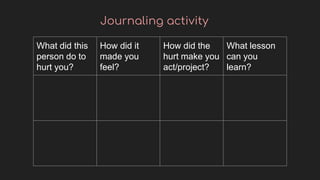
What did this
person do to
hurt you?
How did it
made you
feel?
How did the
hurt make you
act/project?
What lesson
can you
learn?
Journaling activity
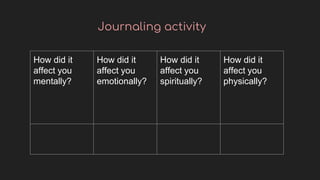
Journaling activity
How did it
affect you
mentally?
How did it
affect you
emotionally?
How did it
affect you
spiritually?
How did it
affect you
physically?

Forgiving Unfair.pptx

  • 1.
    Do yourself afavor and forgive… Forgiveness; the release of anger and resentment
  • 2.
    Why do weforgive? We forgive not because it is an act of kindness to the offender, but because it is an act of kindness to ourselves. We forgive because carrying the burden of anger and resentment does not work, and it’s heavy. We forgive because holding onto resentment will have you living in your past…why live somewhere you were hurt? We forgive because we have been forgiven and will soon need to be forgiven. “Hating someone is like drinking poison and expecting them to die”
  • 3.
    Why do weNOT forgive? We do not forgive because we have not yet received an apology… Will an apology wash the memory away? Will an apology give you permission to heal? No, You are giving them the power to say when you get to heal. You’re also feeding your ego; there is a sense of entitlement that comes with knowing you're owed something. We do not forgive because we still feel the pain… You may still feel the pain, and that’s ok. But, oftentimes were aware of what hurt us so holding onto that pain is a way of preventing it from happening again (Look into vulnerability). We do not forgive because we do not want to forget… You're not going to forget, but there is a difference between remembering and being stuck in a past memory. We do not forgive because we hold onto bitterness… Bitterness feels like justice because we think people deserve to be reminded of how they mistreated us. Just like when you end a terrible relationship, it’s easy to hold onto bitterness by always throwing a cold shoulder towards them to remind them of the pain they caused. Why not just throw an empty shoulder? We do not forgive because we do not know how…
  • 4.
    Where do westart? How do I forgive? If you’re asking this, it’s the wrong question. There is no right way to forgive, forgiveness flows different for each individual. The better question is Why do I forgive? We are often quick to say we forgive because we think it makes us a better person, but forgiveness is about setting yourself free rather than proving your character. It is important to set no deadline on self-growth, it’s everlasting. It is impossible to wake up and fix all your problems in one day, it takes 1% everyday to make a difference over a year, then imagine 10 years. You can’t wake up and decide to build a house overnight, you lay each brick one by one and eventually the masterpiece comes together. Forgiveness takes patience and understanding within yourself.
  • 5.
    Let go ofSelf-Righteousness; Life is a hard experience We are right and they are wrong; we are good and they are bad. WRONG You may have already hurt many people in your life, and you may hurt more in the future. You may have already been granted forgiveness from someone, and someday you will need forgiveness because life is hard and we don’t always make the right decisions. Life can really beat you up sometimes, and it will beat up those around you. When people inflict serious pain on you it’s hard to step back and realize it has nothing to do with your spirit but everything to do with them getting beat up by life. When you take that leap of indifference and extend forgiveness to those around you, you will be able to start forgiving yourself for the times you were at fault and let life win.
  • 6.
    Forgiveness is NOTjustification Many people believe forgiving someone means the situation is justified and forgotten, many also believe that reconciliation is necessary for forgiveness; good thing forgiveness flows different for each individual. Forgiving someone doesn’t mean the pain you felt is forgotten, it’s something like “I know that I felt a great deal of pain from that situation, but I am setting you free of the burden we are both attached to because I understand that we are all human beings trying to figure out life in a broken world. I am choosing not to forget, but to carry this lesson with me throughout my journey in order to continue my growing process.” It is about recognizing that every human, no matter how low they sink, humanity remains.
  • 7.
    Resentment The hardest partin preparing for forgiveness is letting go of resentment. It is easy to feel anger after being hurt, the brain uses it to respond to pain. There are 5 stages of grief in psychology and the second one is anger; it's normal. But, resentment doesn’t work, anger doesn't work. It controls us. Notice the last stage of grief is acceptance. The science behind resentment has much to do with injustice. You may feel like that person doesn’t know the depth to which they hurt you so oftentimes we become bitter in order to inflict justice upon this individual. Resentment is unmanifested revenge. This doesn’t work because you are the only person who can fully feel that pain, so how can you fully inflict justice for pain the individual hasn’t experienced? Who’s job is it to inflict justice?
  • 8.
    Are you readyto forgive? My ideology is that you will know when you are ready to forgive someone when you have no hate in your heart and mind for that person. If you catch yourself thinking things like “I can’t believe they did that to me”, or “one day they will see how much they hurt me and hate them self”...chances are you're not ready to forgive. You may need some more time to feel your emotions, and that’s ok. Forgiveness has no time frame but it’s always important to remember we're not promised a tomorrow. When you are ok with that person moving onto a better life and genuinely hope for their future, you are ready to forgive. When you are free of resentment, you are ready to forgive. When their actions no longer have strings attached to your growth, you’re ready to forgive.
  • 9.
    1% everyday Start small.Forgive that kid that made you insecure by saying your forehead is big when you were 12 because his parents were abusing him at home. Forgive road ragers because they are probably having a bad day. Forgive the person who didn’t allow you to vent because they weren’t in a position to listen. Extend grace every day and walk with love in everything you do. Practice small things everyday and maybe in a few weeks you’ll be able to forgive your ex. Maybe in a few months you’ll be able to forgive your Mom and Dad. Maybe in a year you’ll be able to forgive the person who raped you. Maybe in a few years you’ll have forgiven so much, you’ll learn how to extend the same grace and forgiveness to yourself.
  • 10.
    Christianity 1 Corinthians 13:4-8; Love is patient, love is kind. It does not envy, it does not boast, it is not proud. 5 It does not dishonor others, it is not self-seeking, it is not easily angered, it keeps no record of wrongs. 6 Love does not delight in evil but rejoices with the truth. 7 It always protects, always trusts, always hopes, always perseveres. Prayer: “ I forgive you because God has forgiven me, because resentment doesn't work, and because I will need forgiveness in the future. I am releasing you from all things negative in my mind.”
  • 11.
    Buddhism “If one abusesyou, there is a temptation to answer back, or to be revenged. One should be on guard against this natural reaction. It is like spitting against the wind, it harms no one but oneself. …Misfortune always dogs the steps of one who gives way to the desire for revenge.” -DHAMMAPADA
  • 12.
    Islamic “And the retributionfor an evil act is an evil one like it, but whoever pardons and makes reconciliation – his reward is [due] from Allah. Indeed, He does not like wrongdoers.” (Quran 42:40)
  • 13.
    Atheism "When we say,I forgive you, we do not say, I don't care what you have done. We say, What you have done is wrong, but that does not mean you are lost forever." -Ben Pobjie
  • 14.
    What did this persondo to hurt you? How did it made you feel? How did the hurt make you act/project? What lesson can you learn? Journaling activity
  • 15.
    Journaling activity How didit affect you mentally? How did it affect you emotionally? How did it affect you spiritually? How did it affect you physically?