Reconciliation- based Discipline “ To err is human; to ______, divine.”  - Alexander Pope forgive
Humans do not have natural enemies except perhaps, themselves. So, what is the best response when we make an enemy?
“ When a deep injury is done to us, we never recover until we forgive.” -Alan Paton, author of  Cry, The Beloved Country
“ Without forgiveness, there is no future.”  -Desmond Tutu Who really suffers when we refuse to forgive someone?
“… the weak can never forgive.  Forgiveness is an attribute of the strong.” -Mahatma Gandhi
“ The practice of forgiveness is never easy, because it is always a courageous, defiant act against our instincts of hatred and revenge and against the odds of getting hurt again. If to err is human, to forgive is super-human. It takes Herculean efforts and divine help to be able to embrace an enemy who may yet stick another knife into our hearts. But that is the risk we have to take if we want to experience the healing power of forgiveness and halt the danger of escalating revenge and terror.”   –  Dr. Paul T. P. Wong, President, Intl. Network on Personal Meaning
Introducing... Dr. Robert Enright, the “father” of forgiveness studies
Prior to 1970, there were only 110 studies done on forgiveness, dating back to 400 AD. Dr. Enright has guided over 100 forgiveness-based studies over the past 3 decades, despite the scientific community initially dismissing forgiveness studies as “soft science.” To date, almost 1,000 forgiveness-based studies have been published between 1970 and 2008, with hundreds more being developed/conducted.   Did You Know?
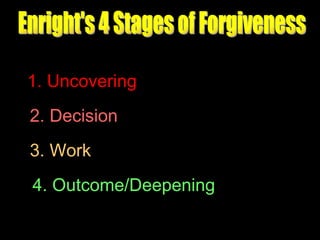
Enright's 4 Stages of Forgiveness 1. Uncovering 2. Decision 3. Work 4. Outcome/Deepening
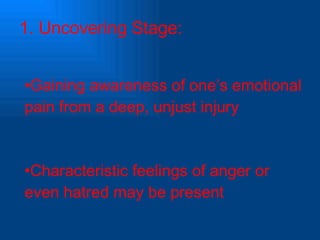
1. Uncovering Stage: Gaining awareness of one’s emotional pain from a deep, unjust injury Characteristic feelings of anger or even hatred may be present
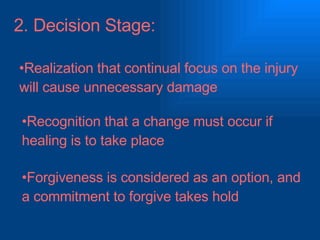
2. Decision Stage: Realization that continual focus on the injury will cause unnecessary damage Recognition that a change must occur if healing is to take place Forgiveness is considered as an option, and a commitment to forgive takes hold
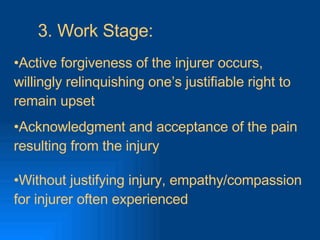
3. Work Stage: Active forgiveness of the injurer occurs, willingly relinquishing one’s justifiable right to remain upset Acknowledgment and acceptance of the pain resulting from the injury Without justifying injury, empathy/compassion for injurer often experienced
4. Outcome/Deepening Phase: Realization that emotional relief is gained by forgiving injurer Meaning/insight may be gained through ordeal The Forgiveness Paradox is revealed: “As we give the gift of forgiveness to another, we are also healed”
“ The rehab is painful; that, in essence, is what we’re doing when we’re forgiving.  We’re trying to rehab our heart.”  -Dr. Robert Enright Forgiveness is emotional rehab.
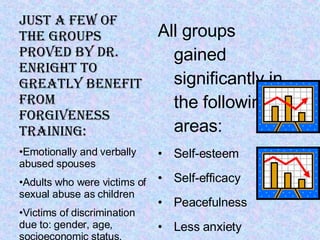
Just a few of the groups proved by Dr. Enright to greatly benefit from forgiveness training: Emotionally and verbally abused spouses Adults who were victims of sexual abuse as children Victims of discrimination due to: gender, age, socioeconomic status, religion, or race  All groups gained significantly in the following areas: Self-esteem Self-efficacy Peacefulness Less anxiety Less depression Less hypertension
“ After all, a person is a person, no matter how small.”  -Dr. Seuss
Is reconciliation instinctive? 41% of chimps pursue reconciliation within 10 minutes of a conflict with another chimp.
Can forgiveness improve career success? Salesmen trained in self-forgiveness and resisting anger due to rejection by potential customers have been found to be 25% more successful in attracting and retaining clients and 23% less stressed than colleagues without such training.
Can forgiveness strengthen marriages? The #1 reason for divorce,  cited by both genders, is   poor communication. When couples undergo forgiveness training, the effect size is…  +.68 for marital satisfaction +.26 for marital communication.
Can forgiveness curtail bullying? A Northern Ireland study found that 82% of kids believe it can.  A 12% decrease in bullying was seen over a 5-year period.
Can forgiveness improve physical health? YES! Improved cortisol levels! Less lower back pain! Less anxiety! Less sweaty? Hurray! Less heart disease!
Faster spinal cord healing! Less depression! Can forgiveness improve physical health? Lower blood pressure!
What other benefits of forgiveness have been researched? Hopefulness Self-confidence Quality of Life Interpersonal Relations
A Stanford University forgiveness study found that people who had suffered catastrophic family loss were able to cut two key indicators by more than half (on a scale of 1-10): Malice for injurer dropped from 8.9 to 3.2; Severity of Pain decreased from 8.6 to 3.4.
Key distinctions Active vs. Passive Involvement of Offended When simply told, “I’m sorry,” by the offender, the offended person’s only choice is whether or not to listen. When asked for forgiveness, the offended person is actively invited to choose whether or not to pursue reconciliation.
What is said The attitude of the heart
Key distinctions Accidental vs. Intentional Harm
Proper Responses: Accident = “I’m sorry.”
Proper Responses: Intentional harm = “Will you forgive me for…?”
 
Kids imitate adults, so let’s be good role models of forgiveness. Here's how...
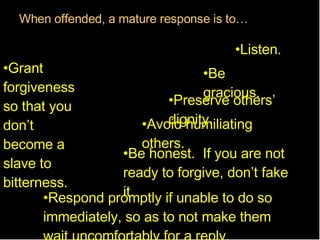
When   offended,   a   mature   response   is   to … Be gracious. Preserve others’ dignity. Avoid humiliating others. Listen. Be honest.  If you are not ready to forgive, don’t fake it. Respond promptly if unable to do so immediately, so as to not make them wait uncomfortably for a reply. Grant forgiveness so that you don’t become a slave to bitterness.
Ground Rules Nobody can be forced, only encouraged, to request forgiveness. Requesting forgiveness does not necessarily excuse the offender from a suitable consequence. The offender should say, “Will you forgive me for…?” and explicitly state the offense(s).  The offender may not offer any rationale for the offense(s) [ex: “I’m sorry that I punched you, but…”]. The offender may not devalue an offense while apologizing (ex: “I’m sorry that you thought I was mean to you”). The offended party must respond immediately by either: granting forgiveness, denying it, or indicating when the offender can anticipate a reply (ex: “I’m still upset, but I’ll reply by lunchtime”).
Why should I ask for forgiveness? It is uncomfortable to make yourself vulnerable to someone whom you recently offended, but if you do… You will experience relief, even if forgiveness is denied because you will have done what you can to make the situation right again. You will have acted courageously. You will have maturely taken responsibility for your error and shown respect to the person whom you offended.
Citations: Non-copyrighted images taken from www.images.google.com Quotations taken from www.quotationspage.com
 
 
The Action Research Plan notes will be provided to all.  If you would like a copy of this slide show, it will gladly be provided upon request, including a version that it recommended for showing to students, if desired.

Reconciliation-based Discipline

  • 1.
    Reconciliation- based Discipline“ To err is human; to ______, divine.” - Alexander Pope forgive
  • 2.
    Humans do nothave natural enemies except perhaps, themselves. So, what is the best response when we make an enemy?
  • 3.
    “ When adeep injury is done to us, we never recover until we forgive.” -Alan Paton, author of Cry, The Beloved Country
  • 4.
    “ Without forgiveness,there is no future.” -Desmond Tutu Who really suffers when we refuse to forgive someone?
  • 5.
    “… the weakcan never forgive. Forgiveness is an attribute of the strong.” -Mahatma Gandhi
  • 6.
    “ The practiceof forgiveness is never easy, because it is always a courageous, defiant act against our instincts of hatred and revenge and against the odds of getting hurt again. If to err is human, to forgive is super-human. It takes Herculean efforts and divine help to be able to embrace an enemy who may yet stick another knife into our hearts. But that is the risk we have to take if we want to experience the healing power of forgiveness and halt the danger of escalating revenge and terror.” – Dr. Paul T. P. Wong, President, Intl. Network on Personal Meaning
  • 7.
    Introducing... Dr. RobertEnright, the “father” of forgiveness studies
  • 8.
    Prior to 1970,there were only 110 studies done on forgiveness, dating back to 400 AD. Dr. Enright has guided over 100 forgiveness-based studies over the past 3 decades, despite the scientific community initially dismissing forgiveness studies as “soft science.” To date, almost 1,000 forgiveness-based studies have been published between 1970 and 2008, with hundreds more being developed/conducted. Did You Know?
  • 9.
    Enright's 4 Stagesof Forgiveness 1. Uncovering 2. Decision 3. Work 4. Outcome/Deepening
  • 10.
    1. Uncovering Stage:Gaining awareness of one’s emotional pain from a deep, unjust injury Characteristic feelings of anger or even hatred may be present
  • 11.
    2. Decision Stage:Realization that continual focus on the injury will cause unnecessary damage Recognition that a change must occur if healing is to take place Forgiveness is considered as an option, and a commitment to forgive takes hold
  • 12.
    3. Work Stage:Active forgiveness of the injurer occurs, willingly relinquishing one’s justifiable right to remain upset Acknowledgment and acceptance of the pain resulting from the injury Without justifying injury, empathy/compassion for injurer often experienced
  • 13.
    4. Outcome/Deepening Phase:Realization that emotional relief is gained by forgiving injurer Meaning/insight may be gained through ordeal The Forgiveness Paradox is revealed: “As we give the gift of forgiveness to another, we are also healed”
  • 14.
    “ The rehabis painful; that, in essence, is what we’re doing when we’re forgiving. We’re trying to rehab our heart.” -Dr. Robert Enright Forgiveness is emotional rehab.
  • 15.
    Just a fewof the groups proved by Dr. Enright to greatly benefit from forgiveness training: Emotionally and verbally abused spouses Adults who were victims of sexual abuse as children Victims of discrimination due to: gender, age, socioeconomic status, religion, or race All groups gained significantly in the following areas: Self-esteem Self-efficacy Peacefulness Less anxiety Less depression Less hypertension
  • 16.
    “ After all,a person is a person, no matter how small.” -Dr. Seuss
  • 17.
    Is reconciliation instinctive?41% of chimps pursue reconciliation within 10 minutes of a conflict with another chimp.
  • 18.
    Can forgiveness improvecareer success? Salesmen trained in self-forgiveness and resisting anger due to rejection by potential customers have been found to be 25% more successful in attracting and retaining clients and 23% less stressed than colleagues without such training.
  • 19.
    Can forgiveness strengthenmarriages? The #1 reason for divorce, cited by both genders, is poor communication. When couples undergo forgiveness training, the effect size is… +.68 for marital satisfaction +.26 for marital communication.
  • 20.
    Can forgiveness curtailbullying? A Northern Ireland study found that 82% of kids believe it can. A 12% decrease in bullying was seen over a 5-year period.
  • 21.
    Can forgiveness improvephysical health? YES! Improved cortisol levels! Less lower back pain! Less anxiety! Less sweaty? Hurray! Less heart disease!
  • 22.
    Faster spinal cordhealing! Less depression! Can forgiveness improve physical health? Lower blood pressure!
  • 23.
    What other benefitsof forgiveness have been researched? Hopefulness Self-confidence Quality of Life Interpersonal Relations
  • 24.
    A Stanford Universityforgiveness study found that people who had suffered catastrophic family loss were able to cut two key indicators by more than half (on a scale of 1-10): Malice for injurer dropped from 8.9 to 3.2; Severity of Pain decreased from 8.6 to 3.4.
  • 25.
    Key distinctions Activevs. Passive Involvement of Offended When simply told, “I’m sorry,” by the offender, the offended person’s only choice is whether or not to listen. When asked for forgiveness, the offended person is actively invited to choose whether or not to pursue reconciliation.
  • 26.
    What is saidThe attitude of the heart
  • 27.
    Key distinctions Accidentalvs. Intentional Harm
  • 28.
    Proper Responses: Accident= “I’m sorry.”
  • 29.
    Proper Responses: Intentionalharm = “Will you forgive me for…?”
  • 30.
  • 31.
    Kids imitate adults,so let’s be good role models of forgiveness. Here's how...
  • 32.
    When offended, a mature response is to … Be gracious. Preserve others’ dignity. Avoid humiliating others. Listen. Be honest. If you are not ready to forgive, don’t fake it. Respond promptly if unable to do so immediately, so as to not make them wait uncomfortably for a reply. Grant forgiveness so that you don’t become a slave to bitterness.
  • 33.
    Ground Rules Nobodycan be forced, only encouraged, to request forgiveness. Requesting forgiveness does not necessarily excuse the offender from a suitable consequence. The offender should say, “Will you forgive me for…?” and explicitly state the offense(s). The offender may not offer any rationale for the offense(s) [ex: “I’m sorry that I punched you, but…”]. The offender may not devalue an offense while apologizing (ex: “I’m sorry that you thought I was mean to you”). The offended party must respond immediately by either: granting forgiveness, denying it, or indicating when the offender can anticipate a reply (ex: “I’m still upset, but I’ll reply by lunchtime”).
  • 34.
    Why should Iask for forgiveness? It is uncomfortable to make yourself vulnerable to someone whom you recently offended, but if you do… You will experience relief, even if forgiveness is denied because you will have done what you can to make the situation right again. You will have acted courageously. You will have maturely taken responsibility for your error and shown respect to the person whom you offended.
  • 35.
    Citations: Non-copyrighted imagestaken from www.images.google.com Quotations taken from www.quotationspage.com
  • 36.
  • 37.
  • 38.
    The Action ResearchPlan notes will be provided to all. If you would like a copy of this slide show, it will gladly be provided upon request, including a version that it recommended for showing to students, if desired.

Editor's Notes

  • #2 -Ask for help with filling in the blank. Pope also said “Fools rush in where angels fear to tread.” -Briefly explain that this is my Action Research Plan and that I recognize that some of the content in the slide show is weighty and probably hits close to home for a people in the room. I have tried to be respectful to that possibility and injected lightheartedness where I felt it was appropriate.