Leadership On The Line Staying Alive Through the Dangers of Leading.
Introduction Post 9/11 Leadership The Adaptive Challenges Dangers of Collusion The Open Heart and Innocence Curiosity and Compassion
Introduction Five Challenges to Leading Adaptive Change Get off the dance floor and onto the balcony Think politically Orchestrate conflict Give the work back Hold steady
Part One The Challenge
The Heart of Danger Leadership is Dangerous People do not resist change, per se. People resist loss. Think about a time you had something important to say, do, tried, failed, succeeded, but was bruised along the way.
The Perils of Adaptive Change Leadership would be a safe undertaking if your organization and communities only face problems for which they already knew the solutions. People cannot see the beginning of the adaptive process that the new situation will be any better than the current condition
The Perils of Adaptive Change What people do see clearly is the potential for loss. When fears and passions run high, people can become desperate as they look to authorities for the answers. This dynamic renders adaptive contexts inherently dangerous.
The Perils of Adaptive Change When people look to authorities for easy answers to adaptive challenges, they end up with dysfunction. The single most common source of leadership failure is that people, especially those in positions of authority, treat adaptive challenges like technical solutions.
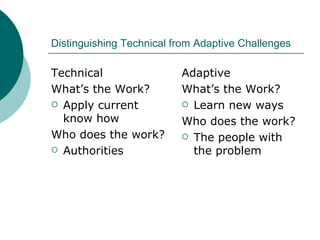
Distinguishing Technical from Adaptive Challenges Technical What’s the Work? Apply current know how Who does the work? Authorities Adaptive What’s the Work? Learn new ways Who does the work? The people with the problem
The Perils of Adaptive Change In mobilizing adaptive work, you have to engage people in adjusting their unrealistic expectations, rather than try to satisfy them as if the situation were amenable primarily to a technical solution.
The Perils of Adaptive Change The terrorism of September 11, 2001, brought home to the United States an adaptive challenge that has been festering for a long time. What is festering in DPD?
Going Beyond Your Authority People rarely elect or hire anyone to disturb their jobs or their lives. Generally, people will not authorize someone to make them face what they do not want to face. Organizations face adaptive pressures when conditions threaten the organization.
Going Beyond Your Authority To act outside the narrow confines of your job description when progress requires it lies close to the heart of leadership, and to its danger.
Going Beyond Your Authority The toughest problems that organizations and communities face are hard because the organizations or communities will not authorize anyone to push them to address the problems.  To the contrary, the rules, organizational culture and norms, SOP’s, and economic incentives regularly discourage people from facing the hardest questions and making the most difficult choices.
Going Beyond Your Authority Leadership is not the same as authority. Exceeding your authority is not, in and of itself, leadership. Oliver North Rosa Parks
At the Heart of Danger is Loss Frequently, people who seek to exercise leadership are amazed that their organizations and communities resist. To persuade people to give up the love they know for a love they’ve never experienced means convincing them to take a leap of faith in themselves and in life.
At the Heart of Danger is Loss Habits, values, and attitudes, even dysfunctional ones, are a apart of one’s identity. To change the way people see and do things is to challenge how they define themselves. People’s definition of themselves often involves roles and priorities that others may perceive as self-destructive or as barriers to progress.
At the Heart of Danger is Loss Habits are hard to give up because they give stability. The deepest influence is that habits, values, and attitudes come from somewhere, and to abandon them means to be disloyal to their origin. Refashioning loyalties is some of the toughest work in life.
At the Heart of Danger is Loss People hold on to ideas as a way of holding on to the person who taught them the ideas. Some of our most deeply held feelings come from people we love – a relative, a favored teacher, or a mentor.  To discard some part of their teaching may feel like we are diminishing the relationship.
Summary – The Heart of Danger The dangers of exercising leadership derive from the nature of the problems for which leadership is necessary. Adaptive change stimulates resistance because it challenges people’s habits, beliefs, and values.
Summary – The Heart of Danger Leadership asks people to take a loss, experience uncertainty, and even express disloyalty to people, organizations, and cultures. Adaptive change forces people to question and redefine aspects of their identity. Adaptive change challenges peoples’ sense of competence. This is a lot to ask, no wonder people resist.
Summary – The Heart of Danger Resistance is designed to get leaders to back off. The various forms of resistance may be hard to recognize. You may not see the trap until it is too late. Recognizing these dangers then becomes of paramount importance.
The Faces of Danger The dangers of leadership take many forms. Each organization has it’s preferred way of restoring equilibrium. When people resist adaptive work, their goal is to shut down those who exercise leadership in order to preserve what they have.
The Faces of Danger When exercising leadership , you risk: Getting Marginalized Getting Diverted Getting Attacked Getting Seduced
The Faces of Danger Organizations are clever about this. Each of these forms has its subtleties. People trying to exercise leadership are often pushed aside by surprise. The act of leading could very well blind you to the emerging patterns. Leaders often never see the danger coming until it is too late.
The Faces of Danger - Marginalization We often collude with those who marginalize us. Marginalization often comes in more seductive forms. Personalization tends toward marginalization.
The Faces of Danger - Diversion Broadening your agenda and often overwhelming it. Some people are promoted or given new glamorous responsibilities as a way of sidetracking their agenda. Leaders can easily be diverted by getting lost in other people’s demands and programmatic details.
The Faces of Danger - Attack Whatever the form of the attack, if the attackers can turn the subject of the conversation from the issue you are advancing to your character or style, or even the attack itself, it will have succeeded in submerging the issue.
The Faces of Danger - Attack Attention, the currency of leadership, gets wasted. If you cannot draw people’s attention to the issues that matter, then how can you lead them in the right direction or mobilize any progress?
The Faces of Danger - Attack Criticism Physical Personal
The Faces of Danger - Attack The attacks may go after your character, your competence, or your family, or may distort and misrepresent your views. Through trial and error, they will find your Achilles’ heel.
The Faces of Danger - Attack Simply, a way to divert your attention from an issue that is more troubling to people.
The Faces of Danger - Seduction You lose your sense of purpose altogether. The success lies in the special appeal the tactic has. People are seduced when their guard is down.
Summary – The Faces of Danger Seduction, marginalization, diversion, and attack all serve a purpose. They reduce the disequilibrium that would be generated were people to address the issues that were taking off the table. Leadership requires not only reverence for the pains of change and recognition of the manifestations of danger, but also the skill to respond
Part Two The Response
Get on the Balcony Play the game and observe it as a whole. Being both in and out of the game. Contemplation in action. Karma yoga.
Get on the Balcony Getting off the dance floor (where the action is) and getting on the balcony (where the perspective is). An image that captures the mental activity of stepping back in the midst of action. What’s really going on here?
Get on the Balcony Achieving a balcony perspective means taking yourself out of the dance, in your mind, even if only for a moment. The challenge is to move back and forth between the dance floor and the balcony, making interventions, observing their impact in real time, and then returning to the action.
Get on the Balcony When you observe from the balcony you must see yourself as well as the other participants. Perhaps this is the hardest task of all – to see yourself objectively.
Get on the Balcony What’s going on here? Distinguish technical from adaptive challenges. Find out where people are at. Listen to the song beneath the words. Read the behavior of authority figures for clues.
Distinguish Technical from Adaptive Challenges Most problems come in bundles with both technical and adaptive aspects. Before making an intervention, you need to distinguish between them in order to decide which to tackle first and with what strategy.
Distinguish Technical from Adaptive Challenges First, you know you are dealing with something more than a technical issue when people’s hearts and mind need to change, and not just their preferences or routine behaviors. In an adaptive challenge, people have to learn new ways and choose between what appear to be contradictory values.
Distinguish Technical from Adaptive Challenges Second, you can distinguish technical problems from adaptive challenges by a process of exclusion. If you throw all the technical fixes you can imagine at the problem and the problem persists, it’s a pretty clear signal that the underlying adaptive challenge still needs to be addressed
Distinguish Technical from Adaptive Challenges Third, the persistence of conflict usually indicates that people have not yet made the adjustments and accepted the losses that accompany adaptive change.
Distinguish Technical from Adaptive Challenges Fourth, crisis is a good indicator of adaptive issues that have festered.  Crisis represent danger because the stakes are high, time appears short, and the uncertainties are great.
Find Out Where People Are At Getting people in a community or organization to address a deeply felt issue is difficult and risky. If people have avoided a problem for a long time, it should not be a surprise that they try to silence you when you push them to face it.
Find Out Where People Are At Both your survival and success depend on your skill at reaching a true understanding of the varying perspectives among the factions. Learn from their stakes and fears.
Listen to the Song Beneath the Words People naturally, even unconsciously, defend their habits and ways of thinking and attempt to avoid difficult value choices. Thus, after hearing their stories, you need to take the provocative step of making an interpretation that gets below the surface.
Listen to the Song Beneath the Words Interpreting other people’s intentions is best done first inside one’s own head, or with a trusted confidant. Understandably, then, if you propose alternative explanations for people’s behavior – alternatives to the message they want you to adopt – they may get upset.
Listen to the Song Beneath the Words Making an interpretation is an important step. Whether and how you voice it, however, must depend on the culture and adaptability of your audience.
Read the Authority Figure for Clues When you seek to instigate significant change within an organization or community, focus on the words and behavior of the authority figure; they provide a critical signal about the impact of your action on the organization as a whole.
Read the Authority Figure for Clues The trap is thinking that the authority figure is operating independently and expressing a personal view. In reading the authority figure, you must not only look for shifts of view on relevant issues, but also assess where the authority stands on the ruckus you have created.
Read the Authority Figure for Clues In times of adaptive stress, groups exert pressure on people in authority to solve the problems that seem to be causing the stress. Consequently, the behaviors of authority figures provide critical clues to the organization’s  level of distress and its customary methods for restoring equilibrium.
Read the Authority Figure for Clues The conduct you observe is a response to pressures the authority figure is feeling from key constituents. A cooling attitude from your authority figure indicates the resistance of the larger organization to your initiative, and therefore provides an essential clue for leading and staying alive.
Read the Authority Figure for Clues Leadership is an improvisational art. Sustaining your leadership, then, requires first and foremost the capacity to see what is happening to you and your initiative, as it is happening.
Think Politically There are six essential aspects of thinking politically in the exercise of leadership: One for dealing with people who are with you on the issue One for managing those who are in opposition Four for working with those who are uncommitted but wary – the people you are trying to move
Find Partners Partners provide protection, and they create alliances for you with factions other than your own.  They strengthen both you and your initiatives. Partners who are members of the faction for whom the change is most difficult can make a huge difference.
Find Partners This happens all the time. Have you ever gone to a meeting and realized that there was a “pre-meeting” that did not include you? The pre-meeting allowed those attending to minimize their internal conflict at the real meeting, present a unified front, and isolate you.
Find Partners Make the next meeting one for which it is you who have made the advance phone calls, tested the waters, refined your approach, and line up support.
Keep the Opposition Close To survive and succeed in exercising leadership, you must work as closely with your opponents as you do with your supporters. Most of us cringe at spending time with and especially taking abuse from people who do not share our vision or passion.
Keep the Opposition Close People who oppose what you are trying to accomplish are usually those with the most to lose by your success. Your allies have the least to lose. For opponents to turn around will cost them dearly in terms of disloyalty to their own roots and constituency.
Keep the Opposition Close For your allies to come along may cost nothing. For that reason, your opponents deserve more of your attention, as a matter of compassion, as well as a tactic of strategy and survival. As you attend to your allies and opposition in advancing your issue, do not forget the uncommitted and wary people in the middle.
Accept Responsibility for Your Piece of the Mess  When you belong to the community or organization that you are trying to lead, you are part of the problem. In short, you need to identify and accept responsibility for your contributions to the current situation, even if you try to move your people to a different, better place.
Accept Responsibility for Your Piece of the Mess When you are too quick to lay blame on others, whether inside or outside the organization, you create risk for yourself.
Acknowledge Their Loss Adaptive work often demands some disloyalty to our roots. Asking people to leave behind something they have lived with for years of for generations practically invites them to get rid of you.
Acknowledge Their Loss It becomes critically important to communicate, in every possible way, the reason to sacrifice – why people need to sustain losses and reconstruct their loyalties. Make explicit your realization that the change you are asking them to make is difficult, and that what you are asking them to give up has real value.
Model the Behavior Demonstrate the behavior you expect of others, even if it hurts. The modeling in this case is more than symbolic.
Accept Casualties  An adaptive change that is beneficial to the organization as a whole may clearly and tangibly hurt some of those who had benefited from the world being left behind.
Accept Casualties If people simply cannot adapt, the reality is that they will be left behind. If you signal that you are unwilling to take casualties, you present an invitation to the people who are uncommitted to push your perspective aside.
Accept Casualties People seeking to exercise leadership can be thwarted because, in their unwillingness to take casualties, they give people mixed signals. We would prefer to bring everyone along, and we admirably hold up this ideal. Unfortunately, casualties are often a necessary by-product of adaptive work.
Summary – Think Politically The lone warrior myth of leadership is a sure route to heroic suicide. Nobody is smart enough or fast enough to engage alone the political complexity of an organization or community when it is facing and reacting to adaptive pressures.
Orchestrate the Conflict When you tackle a tough issue in any group, rest assured there will be conflict. Most people have a natural aversion to conflict. Most organizations are downright allergic to conflict.
Orchestrate the Conflict Adaptive work, from biology to human culture, requires engagement with something in the environment lying outside our perceived boundaries. People are passionate about their own values and perspectives, which means they often view outsiders as a threat to those values.
Orchestrate the Conflict The texture of the engagement can move quickly from polite exchange to intense argument and disruptive conflict.
Orchestrate the Conflict The challenge of leadership when trying to generate adaptive change is to work with differences, passions, and conflicts in a way that diminishes their destructive potential and constructively harnesses their energy.
Orchestrate the Conflict Create a holding environment Control the temperature Set the pace Show them the future
Create a Holding Environment  A holding environment is a space formed by a network of relationships within which people can tackle tough, sometimes divisive questions without flying apart.
Create a Holding Environment A holding environment is a place where there is enough cohesion to offset the centrifugal forces that arise when people do adaptive work.
Create a Holding Environment All social relationships have limits; therefore, one of the great challenges of leadership in any organization or community is keeping stress at a productive level.
Control the Temperature Changing the status quo generates tension and produces heat by surfacing hidden conflicts and challenging organizational culture. If you try to stimulate deep change within an organization, you have to control the temperature.
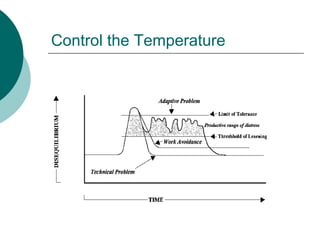
Control the Temperature There are two tasks here. The first is to raise the heat enough that people sit up, pay attention, and deal with the real threats and challenges facing them. The second is to lower the temperature when necessary to reduce a counterproductive level of tension.
Control the Temperature The heat must stay within a tolerable range – not so high that people demand it be turned off completely, and not so low that they are lulled into inaction. We call this span the productive range of distress.
Control the Temperature
Control the Temperature There is tremendous pressure on you to control your own natural emotional responses, which may be entirely appropriate and normal to express, except within the role you are trying to play.
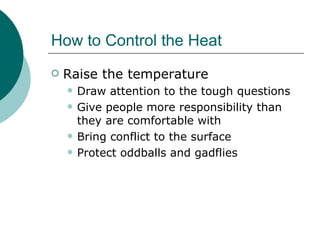
Control the Temperature You can constructively raise the temperature and the tension in two ways. Bring attention to the hard issues, and keep it focused here Let people feel the weight of responsibility for tackling those issues.
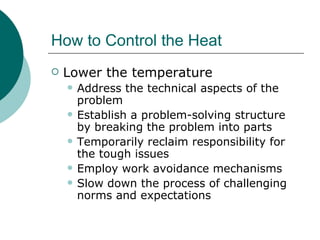
Control the Temperature There are many ways to reduce the temperature since organizations are more practiced at cooling things down than intentionally heating them up. Start with technical problems deferring adaptive challenges until people are “warmed up” Create shared successes  Bear more of the responsibility yourself Use transcendent values
Control the Temperature Be mindful that the organization will almost always, reflexively, want you to turn down the heat. Therefore, you need to take the temperature of the group constantly trying to keep it high enough to motivate people, but not so high that it paralyzes them.
Control the Temperature When people come to you to describe the distress you are causing, it might be a sign that you have touched a nerve and are doing good work.
How to Control the Heat Raise the temperature Draw attention to the tough questions Give people more responsibility than they are comfortable with Bring conflict to the surface Protect oddballs and gadflies
How to Control the Heat Lower the temperature Address the technical aspects of the problem Establish a problem-solving structure by breaking the problem into parts Temporarily reclaim responsibility for the tough issues Employ work avoidance mechanisms Slow down the process of challenging norms and expectations
Pace the Work Leadership addresses emotional as well as conceptual work. When you lead people though difficult change, you take them on an emotional roller coaster because you ask them to relinquish something – a belief, a value, a behavior – that they hold dear.
Pace the Work People can only stand so much change at one time.  You risk revolt, and your own survival, by trying to do too much, too soon.
Pace the Work Pacing typically requires people in authority to let their ideas and programs seep out a little at a time, so they can be absorbed slowly enough to be tested and accepted.
Pace the Work Postpone the most threatening or provocative issues. Draw out the process so the group is not faced with too much too soon. This is not avoidance, but means to get the group ready to do adaptive work.
Show Them the Future  You have to find ways to remind people of the orienting value – the positive vision – that makes the current angst worthwhile. Revealing the future is an extremely useful way to mobilize adaptive work and yet avoid becoming the target of resistance.
Summary – Orchestrate the Conflict Build structures of relationships to work the tough issues, establishing norms that make passionate disagreement permissible. Keep your hands on the temperature controls. Don’t provoke people too much at any one time.
Summary – Orchestrate the Conflict Your job is to orchestrate the conflict, not become the conflict. You need to let people do the work that only they can do.
Give the Work Back Shouldering the adaptive work of others is risky. Remember, when you take on a issue, you become the issue. Whatever the outcome you will be held responsible for the disequilibrium the process has generated, the losses people have had to absorb, and the backlash from those left behind.
Give the Work Back Take the work off your shoulders. Place the work where it belongs in the right place where it can be resolved by the parties involved. Do not waste time trying to explain yourself.  This tends to personalize the issue.
Give the Work Back Make your interventions short and simple. Making observations Asking questions Offering interpretations Taking action