FOOD (FISH)
PROCESSING
Module 5
Interpret a Layout Plan
Department of Education ● Republic of the Philippines
7
Food (Fish) Processing – Grade 7
Alternative Delivery Mode
Module
First Edition, 2020
Republic Act 8293, section 176 states that: “No copyright shall subsist in any work of the
Government of the Philippines. However, prior approval of the government agency or office
wherein the work is created shall be necessary for exploitation of such work for profit. Such
agency or office may, among other things, impose as a condition, payment of royalty.”
Borrowed materials included in this module are owned by the respective copyright holders. Effort
has been exerted to locate and seek permission to use these materials from the respective copyright
owners. The publisher and author do not represent nor claim ownership over them.
Published by the Department of Education – Region 10
Regional Director: Arturo B. Bayocot, CESO III
Assistant Regional Director: Dr. Victor G. De Gracia Jr., CESO V
Printed in the Philippines by
Department of Education – Region 10
Office Address: Zone 1, DepEd Building, Masterson Avenue, Upper Balulang,
Cagayan de Oro City
Contact Number: (088) 880 7072
E-mail Address: region10@deped.gov.ph
Development Team of the Module
Writer/s: Angel Norm L. Ramirez
Evaluators: Esterlita J. Sanchez
Josie O. Mejos
Evelyn A. Taruc
Niel John M. Roxas
Illustrator and Layout Artist:
Management Team:
Chairperson: Dr. Arturo B. Bayucot, CESO III
Regional Director
Co-Chairpersons: Dr. Victor G. De Gracia Jr., CESO V
Asst. Regional Director
Edwin R. Maribojoc EdD, CESO VI
Schools Division Superintendent
Mala Epra B. Magnaong, Chief ES, CLMD
Members: Neil A. Improgo, EPS-LRMS
Bienvenido U. Tagolimot, Jr.,EPS-ADM
Samuel C. Silacan, EdD, CID Chief
Joseph T. Boniao, EPS-EPP/TLE
Rone Ray M. Portacion,EdD EPS-LRMS
Edwin V. Palma, PSDS
Ray G. Salcedo, Principal II/District In-charge
Avilla G. Taclob, Principal I/District In-charge
Agnes P. Gonzales,PDO II
Vilma M. Inso, Librarian II
Food
(Fish)Processing
Module 5
Interpret a Layout Plan
Department of Education ● Republic of the Philippines
7
This instructional material is collaboratively developed and reviewed
by educators from public schools. We encourage teachers and other
education stakeholders to email their feedback, comments, and
recommendations to the Department of Education – Region 10 at
region10@deped.gov.ph
Your feedback and recommendations are highly valued.
What I Need to Know ……….......................................... 1
What I Know ……….......................................... 2
Technical Terms ……….......................................... 4
Lesson 1: Interpret Lay-out Plan ………………..................... 5
What’s In ……….......................................... 5
What’s New ……….......................................... 5
What Is It? ……….......................................... 6
Fish Processing Activities ……………………………………. 6
Characteristics of a Fresh and Spoiled Fish…...................... 8
Grading ……………………………………. 9
Grading of Fishery Products ……………………………………. 9
Steps in Cleaning Fresh Fish …………………………………. 10
Layout of an Ideal Processing Room ………………………… 14
What’s More? ………........................................... 15
What I have Learned …................................................. 15
What I Can Do ………........................................... 16
Assessment …................................................. 17
Additional Activities …................................................. 19
Answer Key ………........................................... 20
References ………........................................... 21
TABLE OF CONTENTS
Introductory Message
For the Learner
Hello, learners! Congratulations and welcome to the next module. Again, the
basis for living in this wonderful world is the ability to recruit for survival. Unless you
have fully and clearly understood what awaits on you. You are generally in the position
to exceed difficult situation on the quality of life, achievement, acquisition that you’ve
been dreaming about for a long period of time. Thus, one needs help to realize it.
Philosophers really believed that life is clearly infinite lesson, that the
incorporation of invaluable, applicable, ideas in the daily work has no ending and it
needs courage and determination to be on the right track.
This module provides imperative information towards reaching your goals in
your life.
1. It helps acquire competencies in interpreting layout plan in
food/fish processing.
2. It provides information on the different meanings of signs and
symbols used in lay outing plan for fish processing activity.
3. It allows you to understand the importance of interpreting a layout
plan.
Substantial knowledge of food (fish) processing is important as this increases
the chances of knowing indispensable things relative to it.
In this module, you are guided with a set of learning icons that will help you
understand the underlying principles of Food (fish) processing.
1. What I Need to Know – the icon used to introduce the learning
objectives in this module.
2. What I Know – the icon used to test what you have learned in this
module.
3. What’s In – the icon used to connect your previous learning with the
new lesson.
4. What’s New – the icon used to introduce new lesson through an
activity, situation or activity.
5. What is It – the icon that will help you discover and understand food (fish)
processing concepts.
6. What’s More – the icon that will help enrich your learnings of food(fish)
concepts.
7. What I Have Learned – the icon that will help you process what you
have learned in the lesson.
8. What I Can Do – the icon that allows you to apply what you have
learned into real-life situations.
9. Assessment – the icon that evaluates your level of mastery in
achieving the learning objectives.
10. Additional Activities – the icon that enhance your learning and
improves your mastery of the lesson.
1
This module will help give you all the essentials needed in your food (fish)
processing journey.
What I Need To Know
In our place, we are surrounded with great percentage of water. One of the
sources of living is through water that’s why most of the occupation are fishermen.
Fishermen cannot return to the seashore with fresh fish they have caught and it will
be of great helps to know how to process their catch in order to transport their products
with a good quality.
Through this module, you will know the different fish processing activities
inside a food processing laboratory. These activities will serve as your guide in
knowing the different signs and symbols in interpreting a layout plan.
After reading this module, the learners should be able to:
LO 1: Interpret a layout plan (TLE_AFFP9-121D-0f-1)
1. Explain the meanings of signs and symbol used in lay outing plan for fish
processing activity;
2. Interpret layout plan for fish processing area according to standard set;
2
What I Know
Activity 1: Evaluate yourself
Directions: Read and understand the questions below. Select the best answer for
each item then write your choice in your activity notebook.
1. This processing activity involves pre-cooking.
A. storing C. preparation
B. receiving D. processing
2. This activity involves the final heat treatment during processing.
A. sterilizing C. preparation
B. storing D. labeling
3. This activity involves segregating suitable from unsuitable raw materials.
A. grading and sorting C. receiving
B. labeling D. preparation
4. The purpose of this activity is to give the correct information about the product
A. storing C. processing
B. labeling D. receiving
5. One purpose of this processing activity is to prolong the keeping quality of the
finished product.
A. Labeling C. processing
B. Storing D. preparation
6. Fish has bulging eyes, red gills and a firm body. What can you say about the
fish?
A. The fish is fresh C. The fish is partially fresh
B. The fish is stale D. The fish is undergoing rigor mortis
7. The fishes you graded have slightly sunken eyes with grayish pupil; the flesh
and backbone are slightly soft and with a slightly sour odor. To what grade
will you assign them ?
A. Grade I C. Grade III
B. Grade II D. Off-grade
3
8. Why must raw materials like fishes be gutted before salting, curing or smoking
them?
A. To thoroughly clean the fish
B. To prevent spoilage of the fish
C. To improve the odor of the fish
D. To remove the internal organs which contain spoilage organisms
9. When descaling a fish like tilapia or bangus, why should you use a blunt
knife?
A. To prevent injuring the fish flesh
B. To hasten the removal of scales
C. To prevent damaging the scales
D. To maintain firmness of the fish flesh
10.This consists of fish which failed to meet the requirements of Grade III and
therefore must be rejected.
A. Grade I C. Grade III
B. Grade II D. Off-grade
11.It is described as any tag, brand, mark, pictorial, or other descriptive matter.
A. Label C. Manual
B. Layout D. Specifications
12. It refers to a detailed itemized description of dimension plans, materials, and
other equipment.
A. Label C. Manual
B. Layout D. Specifications
13.It is the way facilities are placed according to plan.
A. Label C. Manual
B. Layout D. Specifications
14.It refers to the removal of the scales from a fish using a blunt knife.
A. Brining C. Grading
B. Eviscerating D. Scaling
15.It refers to the removal of the internal organs; gut scaled or unscaled fish.
A. Brining C. Grading
B. Eviscerating D. Scaling
4
TECHNICAL TERMS
Layout – the way facilities are placed according to plan.
Labeling – attaching of any printed materials to food products for
identification.
Label – any tag, brand, mark, pictorial, or other descriptive matter.
Specification – a detailed itemized description of dimension plans,
materials, and other equipment.
Splitting -split fish on the dorsal side starting from the tail to the head
by running the edge of the knife along the backbone.
Brining– is treating food with brine or coarse salt which preserves and
seasons the food while enhancing tenderness and flavor.
Eviscerating/gutting– removal of the internal organs; gut scaled or
unscaled fish.
Organdeptic characteristics –the characteristics of a fish evaluated
using the sense of sight, smell, touch such as appearance, color and
texture.
5
What’s In
Activity 1: Fill Me In
Directions: The following words below are used in the topic “Cost Production”. Write
the appropriate letter to complete the word/s and write it in your activity notebook.
i. P R _ F I _ 6. S _ L _ S
ii. E_PEN_ITUR_S 7. I N _ U T
iii. M _T E R _ A L S 8. _ U T P _ T
iv. _ N I T C _ S T 9. P_ O D _ C T I O N C _ S T
v. Y I _ L D 10. S _L L I N _ P _ I C E
What’s New?
Activity 1: Name Game – Fresh Fish
Directions: Give at least three characteristics in choosing a fresh fish. Write it in your
activity notebook.
1. __________________________
2. __________________________
3. __________________________
Lesson
1
Interpret a Layout Plan
6
What is it?
Fish Processing Activities
The term fish processing refers to the processes associated with fish and fish
products between the time fish are caught or harvested, and the time the final product
is delivered to the customer.
Fish is a highly perishable food which needs proper handling and preservation if
it is to have a long shelf life and retain a desirable quality and nutritional value. The
central concern of fish processing is to prevent fish from deteriorating. The most
obvious method for preserving the quality of fish is to keep them alive until they are
ready for cooking and eating.
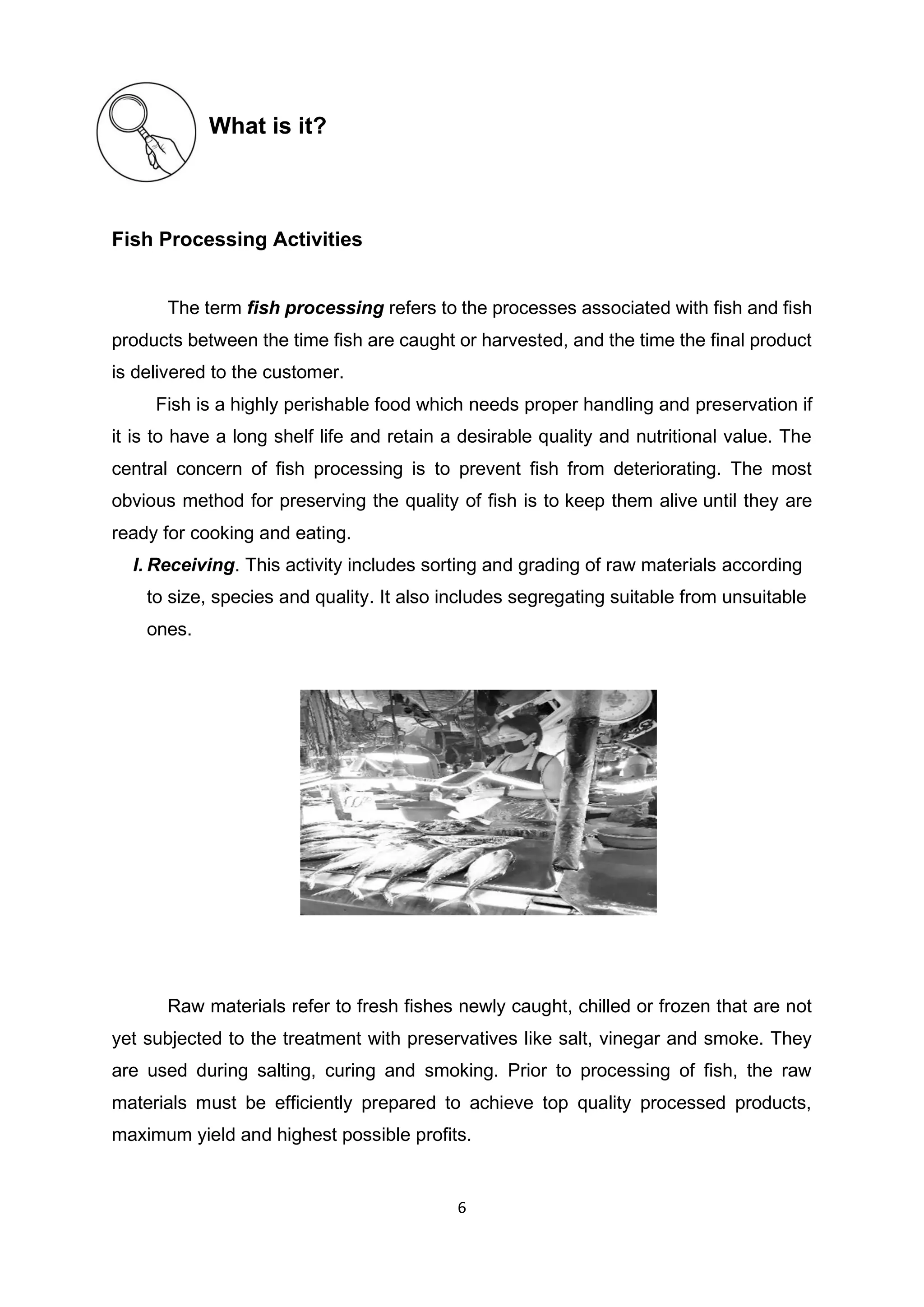
I. Receiving. This activity includes sorting and grading of raw materials according
to size, species and quality. It also includes segregating suitable from unsuitable
ones.
Raw materials refer to fresh fishes newly caught, chilled or frozen that are not
yet subjected to the treatment with preservatives like salt, vinegar and smoke. They
are used during salting, curing and smoking. Prior to processing of fish, the raw
materials must be efficiently prepared to achieve top quality processed products,
maximum yield and highest possible profits.
7
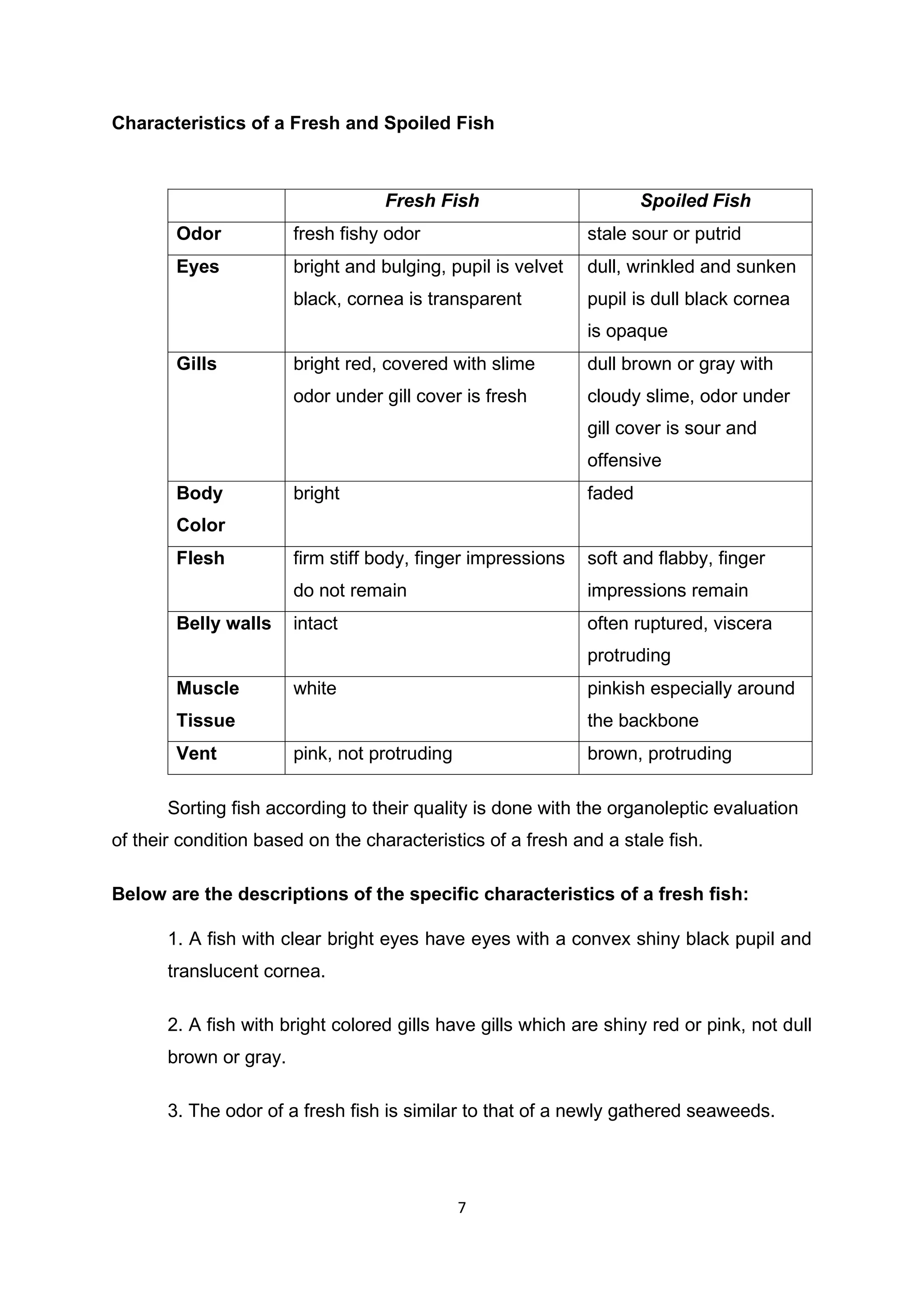
Characteristics of a Fresh and Spoiled Fish
Fresh Fish Spoiled Fish
Odor fresh fishy odor stale sour or putrid
Eyes bright and bulging, pupil is velvet
black, cornea is transparent
dull, wrinkled and sunken
pupil is dull black cornea
is opaque
Gills bright red, covered with slime
odor under gill cover is fresh
dull brown or gray with
cloudy slime, odor under
gill cover is sour and
offensive
Body
Color
bright faded
Flesh firm stiff body, finger impressions
do not remain
soft and flabby, finger
impressions remain
Belly walls intact often ruptured, viscera
protruding
Muscle
Tissue
white pinkish especially around
the backbone
Vent pink, not protruding brown, protruding
Sorting fish according to their quality is done with the organoleptic evaluation
of their condition based on the characteristics of a fresh and a stale fish.
Below are the descriptions of the specific characteristics of a fresh fish:
1. A fish with clear bright eyes have eyes with a convex shiny black pupil and
translucent cornea.
2. A fish with bright colored gills have gills which are shiny red or pink, not dull
brown or gray.
3. The odor of a fresh fish is similar to that of a newly gathered seaweeds.
8
4. A fresh fish has a firm flesh characterized by a stiff body and texture elastic
to slight pressure.
5. A fresh fish with intact belly walls have no protruding viscera and the walls
are not soft or ruptured but firm and springy.
6. The fish with a bright body color has a glossy appearance, with body color
typical of the species.
7. The slime present in a fresh fish must be clear, colorless and transparent in
normal quantities at the gills and body.
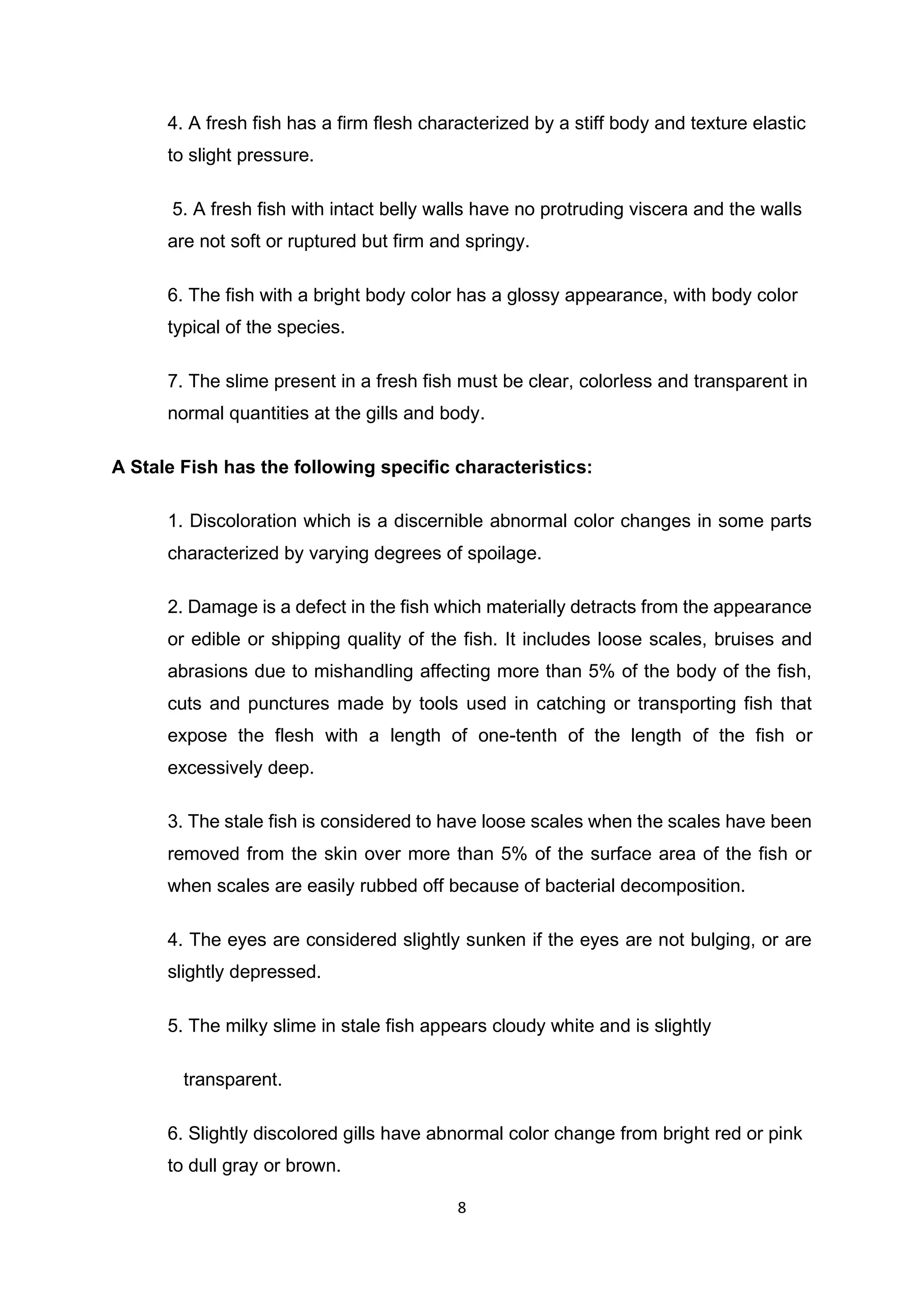
A Stale Fish has the following specific characteristics:
1. Discoloration which is a discernible abnormal color changes in some parts
characterized by varying degrees of spoilage.
2. Damage is a defect in the fish which materially detracts from the appearance
or edible or shipping quality of the fish. It includes loose scales, bruises and
abrasions due to mishandling affecting more than 5% of the body of the fish,
cuts and punctures made by tools used in catching or transporting fish that
expose the flesh with a length of one-tenth of the length of the fish or
excessively deep.
3. The stale fish is considered to have loose scales when the scales have been
removed from the skin over more than 5% of the surface area of the fish or
when scales are easily rubbed off because of bacterial decomposition.
4. The eyes are considered slightly sunken if the eyes are not bulging, or are
slightly depressed.
5. The milky slime in stale fish appears cloudy white and is slightly
transparent.
6. Slightly discolored gills have abnormal color change from bright red or pink
to dull gray or brown.
9
7. A fish with a slightly soft flesh has a texture which is not elastic and leaves
a dent or mark to slight pressure.
Grading
Evaluating the raw materials based on their organoleptic characteristics such
as appearance, color, odor and texture.
Grading of Fishery Products
The grading of fishery products is based on the organoleptic characteristics as
shown in the grading of tuna. Organoleptic characteristics refer to the characteristics
of a fish obtained through the use of the sense organs like the color, odor, texture,
etc.
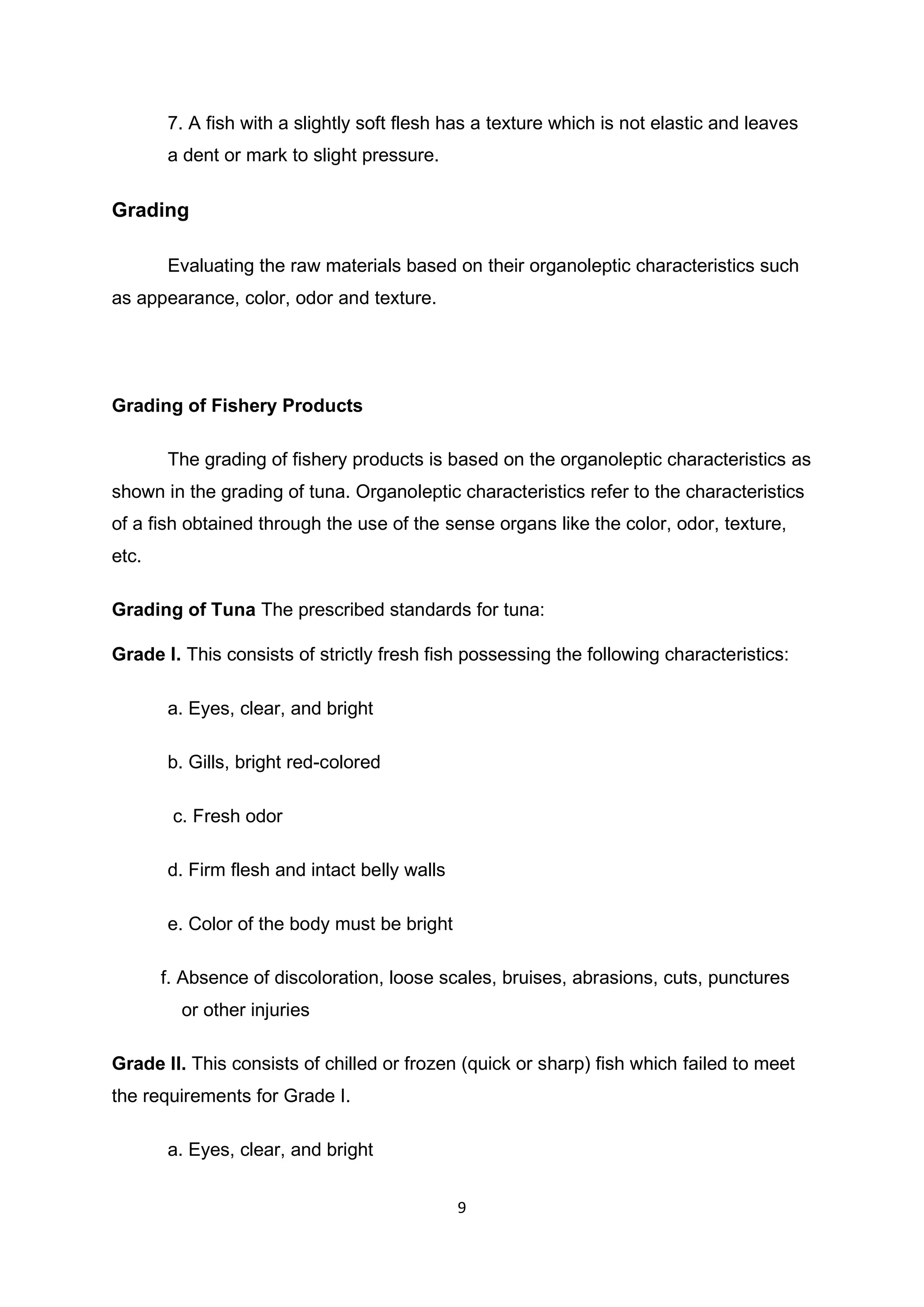
Grading of Tuna The prescribed standards for tuna:
Grade I. This consists of strictly fresh fish possessing the following characteristics:
a. Eyes, clear, and bright
b. Gills, bright red-colored
c. Fresh odor
d. Firm flesh and intact belly walls
e. Color of the body must be bright
f. Absence of discoloration, loose scales, bruises, abrasions, cuts, punctures
or other injuries
Grade II. This consists of chilled or frozen (quick or sharp) fish which failed to meet
the requirements for Grade I.
a. Eyes, clear, and bright
10
b. Gills, bright red-colored
c. Fresh odor
d. Firm flesh and intact belly walls
e. Normal body color characteristics of the species
f. Absence of discoloration, loose scales, bruises, abrasions, cuts, punctures
or other injuries.
Grade III. This consists of fish which failed to meet the requirements of Grades I and
II, but which has the following characteristics:
a. Eyes, slightly sunken; pupil, grayish
b. Gills, slightly discolored and shiny
c. Body, covered with somewhat milky slime
d. Abdomen and belly walls, slightly soft
e. Flesh and backbone, slightly soft
f. Odor, slightly sour and somewhat like bread or weak acetic acid.
Off – Grade. This consists of fish which failed to meet the requirements of Grade III
and therefore must be rejected.
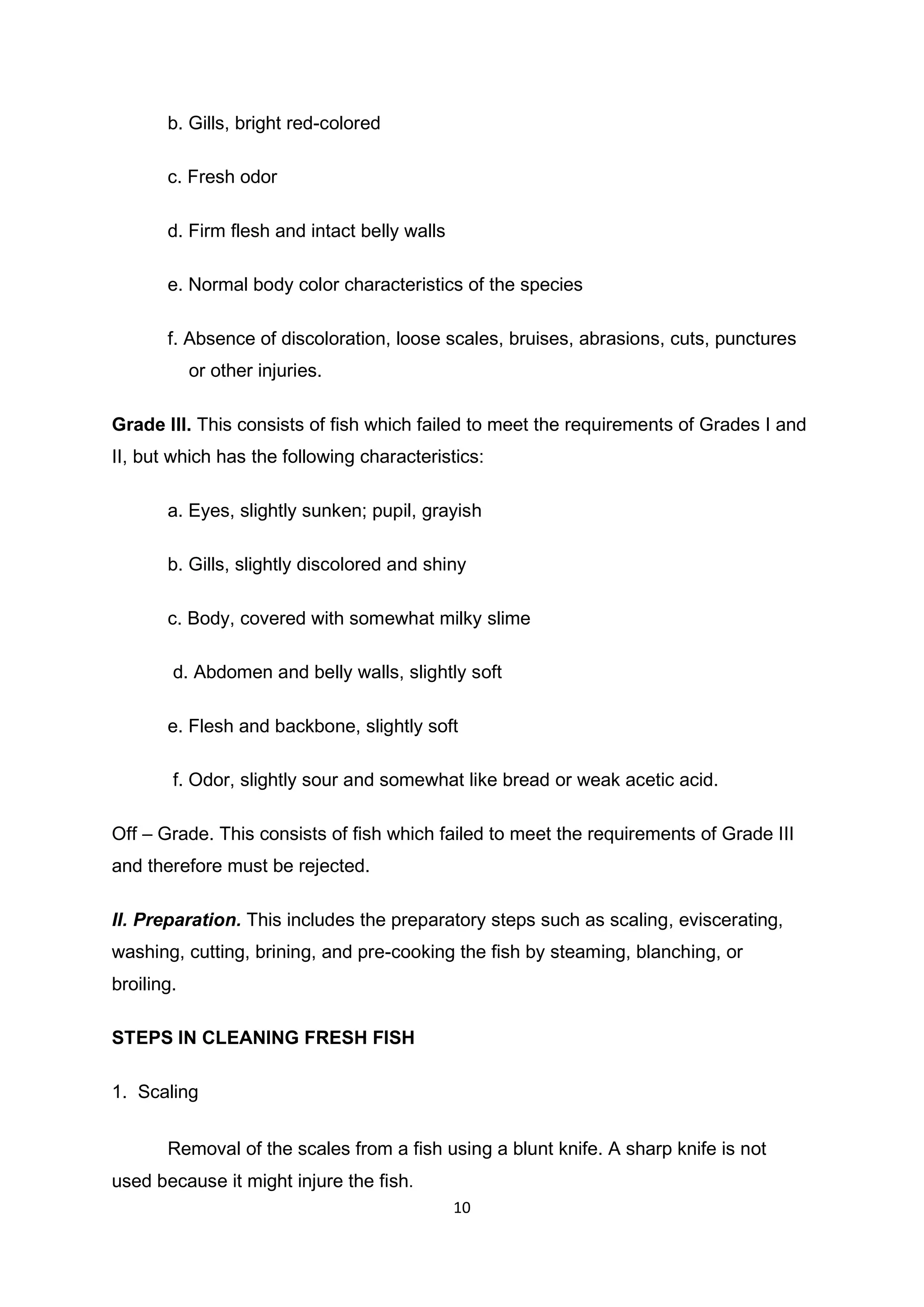
II. Preparation. This includes the preparatory steps such as scaling, eviscerating,
washing, cutting, brining, and pre-cooking the fish by steaming, blanching, or
broiling.
STEPS IN CLEANING FRESH FISH
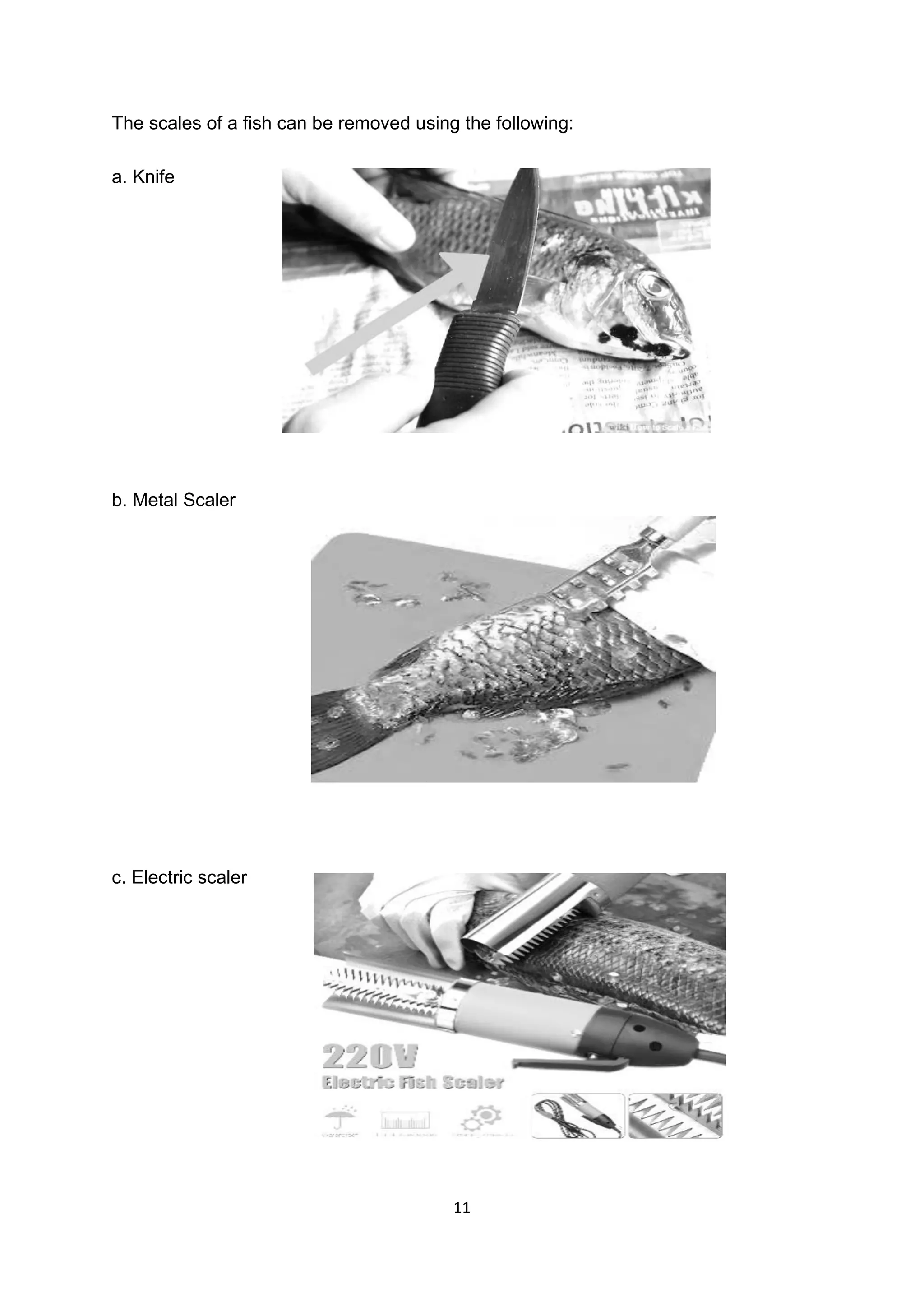
1. Scaling
Removal of the scales from a fish using a blunt knife. A sharp knife is not
used because it might injure the fish.
11
The scales of a fish can be removed using the following:
a. Knife
b. Metal Scaler
c. Electric scaler
12
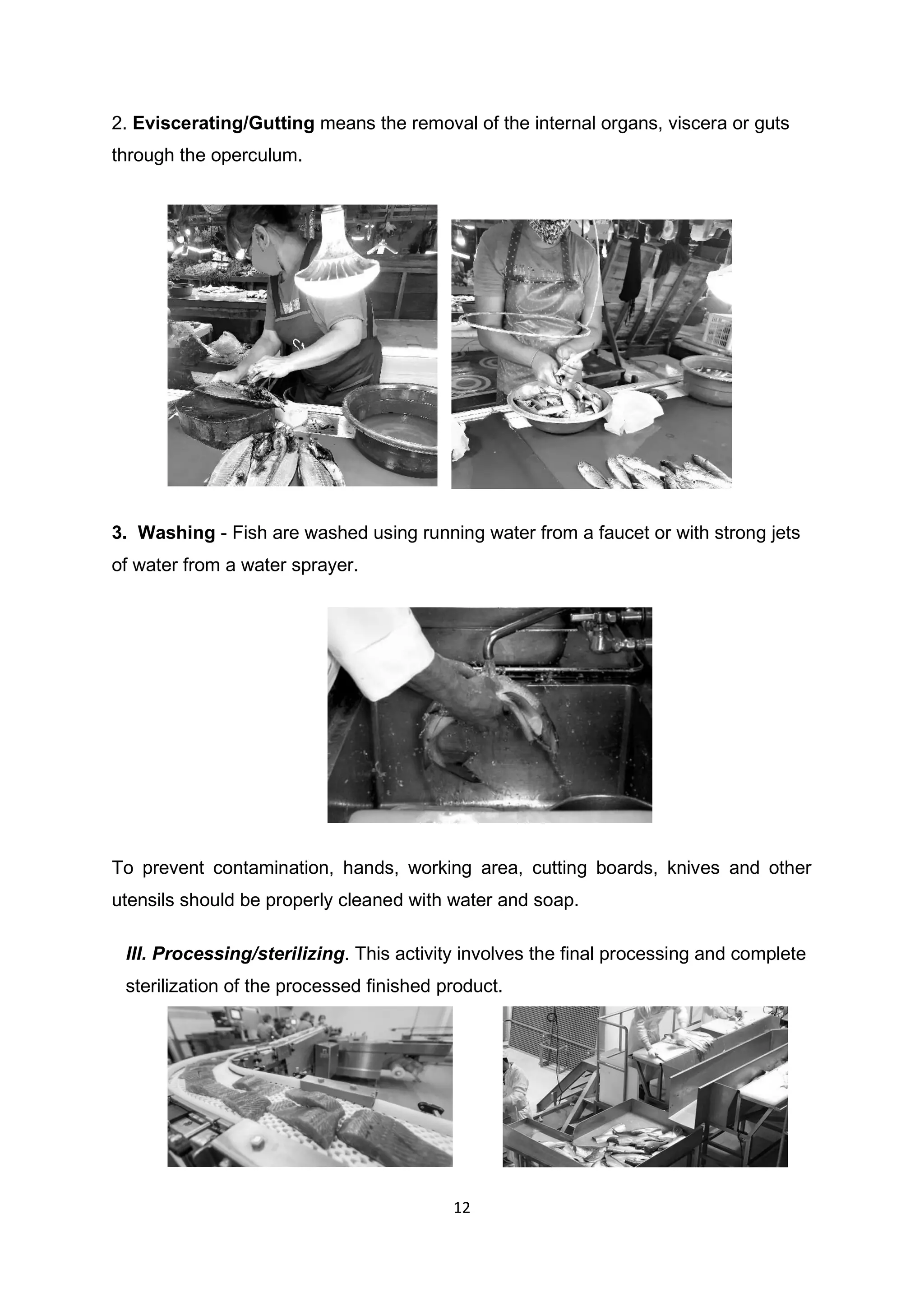
2. Eviscerating/Gutting means the removal of the internal organs, viscera or guts
through the operculum.
3. Washing - Fish are washed using running water from a faucet or with strong jets
of water from a water sprayer.
To prevent contamination, hands, working area, cutting boards, knives and other
utensils should be properly cleaned with water and soap.
III. Processing/sterilizing. This activity involves the final processing and complete
sterilization of the processed finished product.
13
IV. Storing. Storage room is provided for storing finished product such as
canned/bottled fish, smoked fish, salted fish, pickled fish and other processed
fishery products. Proper storage will also extend the shelf life of the product.
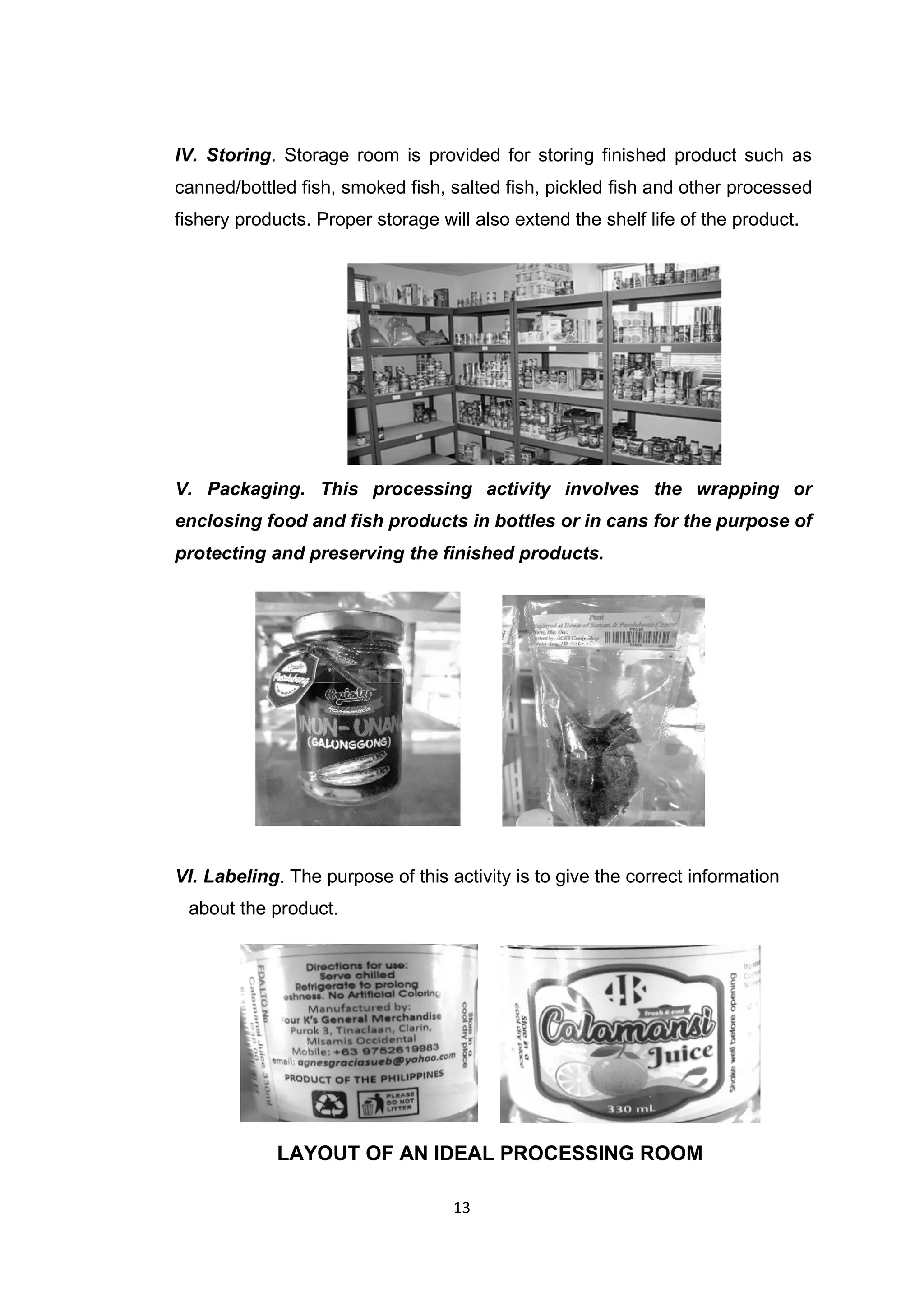
V. Packaging. This processing activity involves the wrapping or
enclosing food and fish products in bottles or in cans for the purpose of
protecting and preserving the finished products.
VI. Labeling. The purpose of this activity is to give the correct information
about the product.
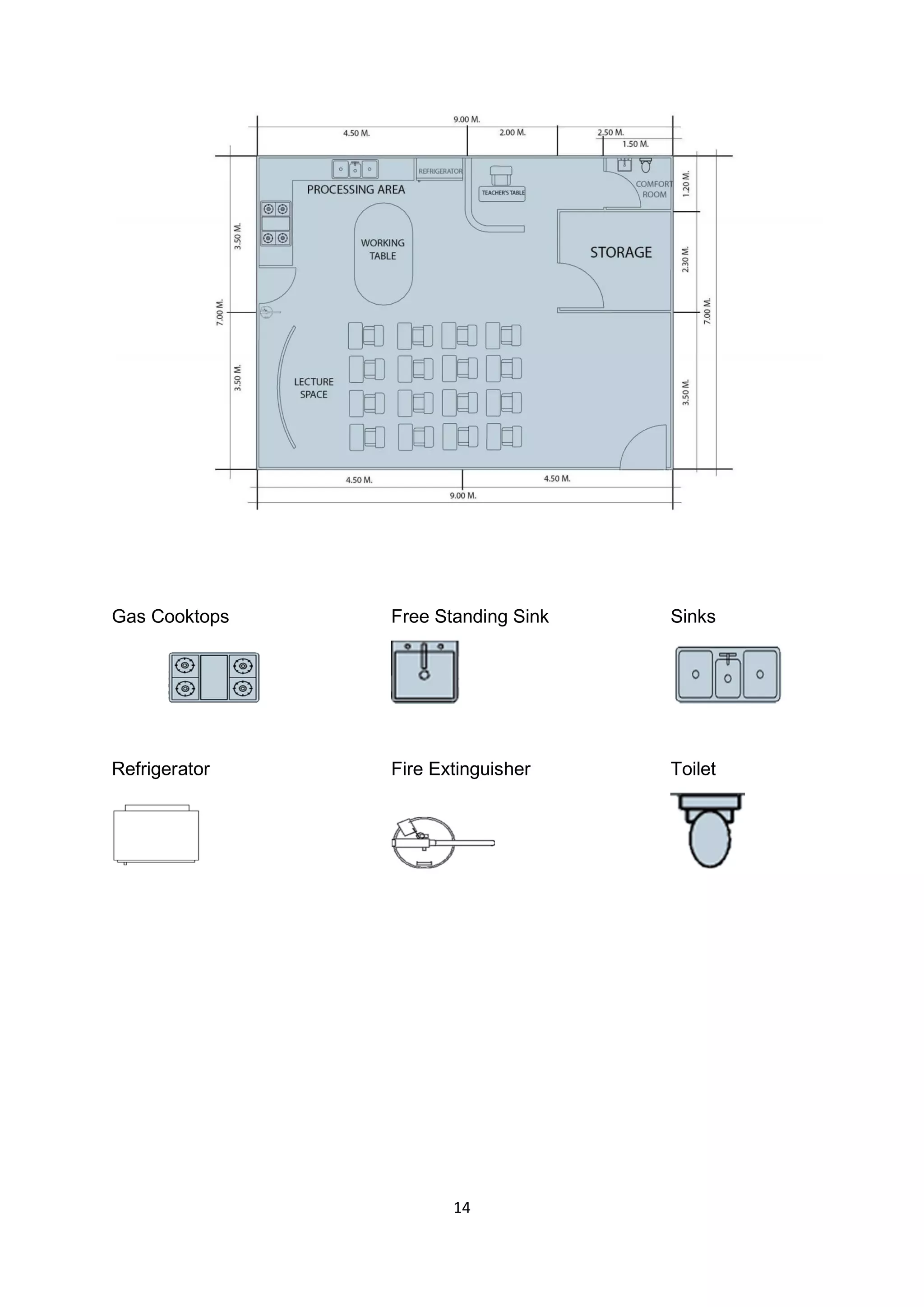
LAYOUT OF AN IDEAL PROCESSING ROOM
14
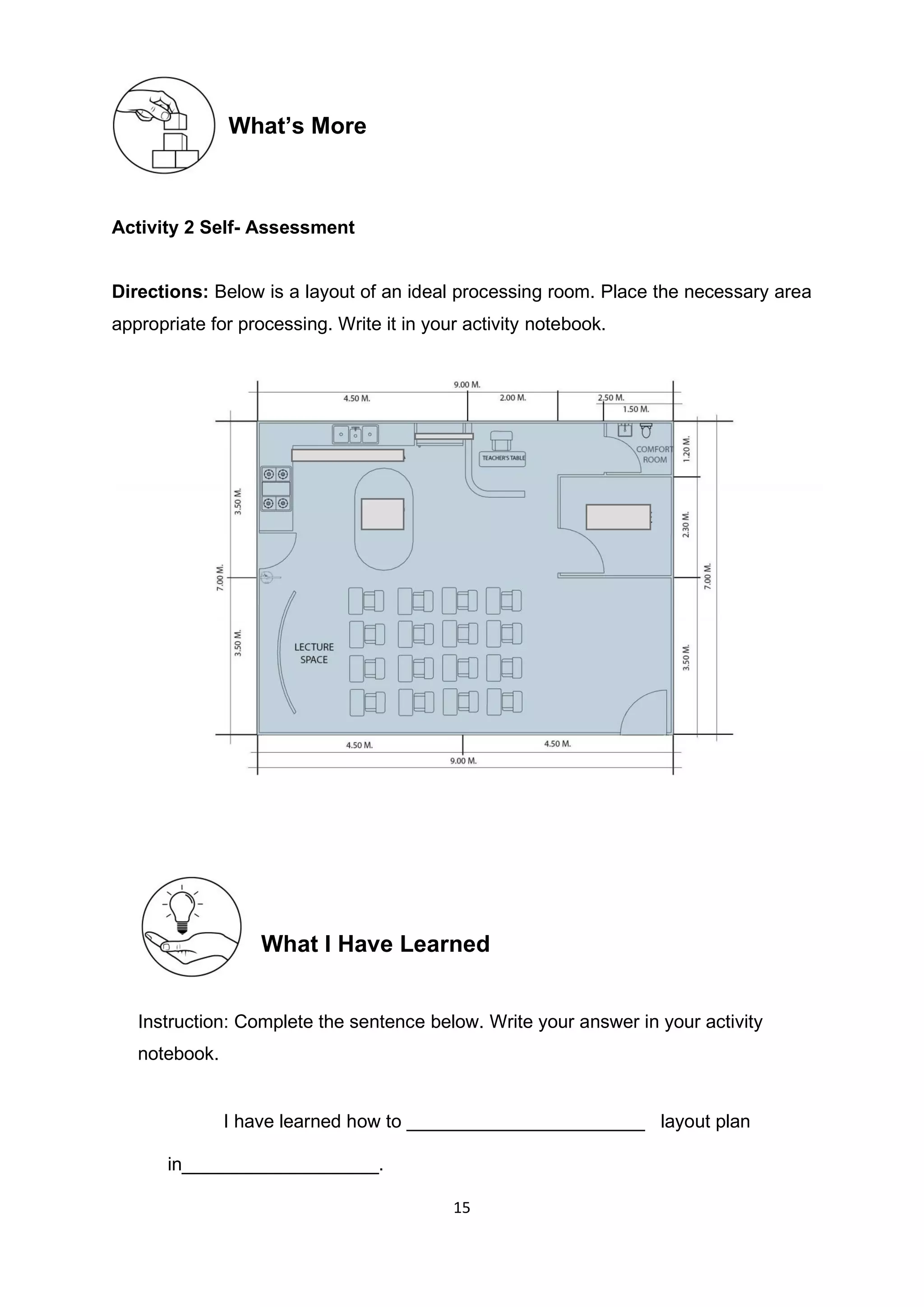
Gas Cooktops Free Standing Sink Sinks
Refrigerator Fire Extinguisher Toilet
15
What’s More
Activity 2 Self- Assessment
Directions: Below is a layout of an ideal processing room. Place the necessary area
appropriate for processing. Write it in your activity notebook.
What I Have Learned
Instruction: Complete the sentence below. Write your answer in your activity
notebook.
I have learned how to _______________________ layout plan
in___________________.
16
What I Can Do
Activity 3: Go with the Flow
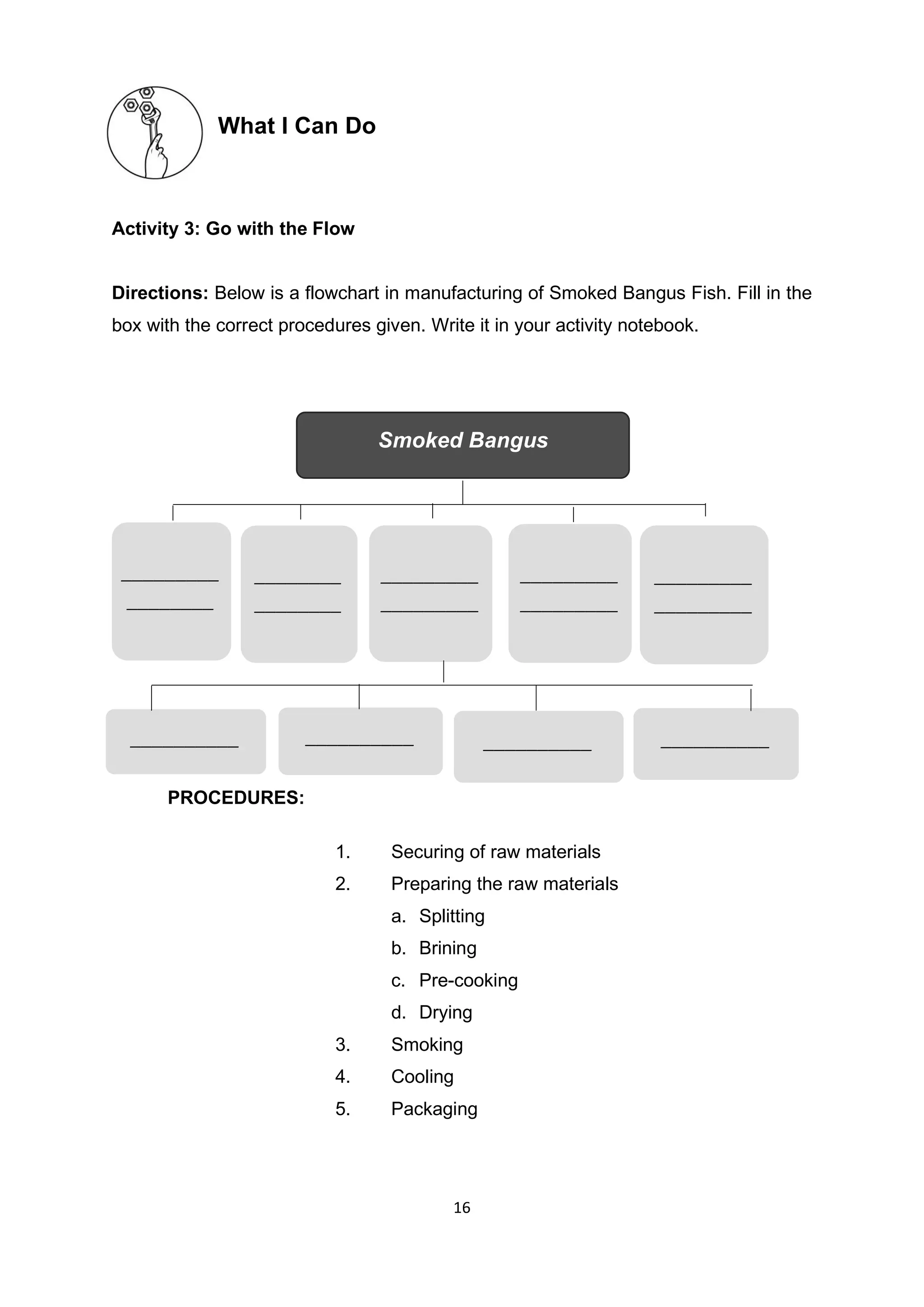
Directions: Below is a flowchart in manufacturing of Smoked Bangus Fish. Fill in the
box with the correct procedures given. Write it in your activity notebook.
PROCEDURES:
1. Securing of raw materials
2. Preparing the raw materials
a. Splitting
b. Brining
c. Pre-cooking
d. Drying
3. Smoking
4. Cooling
5. Packaging
_________
________
________
________
_________
_________
_________
_________
_________
_________
__________ __________ __________ __________
Smoked Bangus
17
Assessment
Now, that you are finished accomplishing the module, let us check what
you have learned.
Directions: Identify the correct answer. Write the letter only in your activity notebook.
1. Fish has bulging eyes, red gills and a firm body. What can you say about the
fish?
A. The fish is fresh C. The fish is partially fresh
B. The fish is stale D. The fish is undergoing rigor mortis
2. The fishes you graded have slightly sunken eyes with grayish pupil; the flesh
and backbone are slightly soft and with a slightly sour odor. To what grade will
you assign them?
A. Grade I C. Grade III
B. Grade II D. Off-grade
3. Why must raw materials like fishes be eviscerated before salting, curing or
smoking them?
A. To thoroughly clean the fish
B. To prevent spoilage of the fish
C. To improve the odor of the fish
D. To remove the internal organs which contain spoilage organisms
4. The purpose of this activity is to give the correct information about the product
A. Storing C. Processing
B. Labeling D. Receiving
5. One purpose of this processing activity is to prolong the keeping quality of the
finished product.
A. Labeling C. processing
B. Storing D. preparation
6. It is the way facilities are placed according to plan.
A. Label C. Manual
B. Layout D. Specifications
18
7. It refers to the removal of the scales from a fish using a blunt knife.
A. Brining C. Grading
B. Eviscerating D. Scaling
8. When descaling a fish like tilapia or bangus, why should you use a blunt knife?
A. To prevent injuring the fish flesh
B. To hasten the removal of scales
C. To maintain firmness of the fish flesh
D. To prevent damaging the scales
9. This consists of fish which failed to meet the requirements of Grade III and
therefore must be rejected.
A. Grade I C. Grade III
B. Grade II D. Off-grade
10. This processing activity involves pre-cooking.
A. Storing C. Preparation
B. Receiving D. Processing
11. This activity involves segregating suitable from unsuitable raw materials.
A. Grading and sorting C. Receiving
B. Labeling D. Preparation
12. It refers to the removal of the internal organs; gut scaled or unscaled fish.
A. Brining C. Grading
B. Eviscerating D. Scaling
13.This activity involves the final heat treatment during processing.
A. Sterilizing C. Preparation
B. Storing D. Labeling
14. It is described as any tag, brand, mark, pictorial, or other descriptive matter.
A. Label C. Manual
B. Layout D. Specifications
15. It refers to a detailed itemized description of dimension plans, materials, and
other equipment.
A. Label C. Manual
B. Layout D. Specifications
19
Additional Activities
Activity 4: Express your Ideas
Questions: If you were to choose, which would you prefer to buy expensive fresh fish
or cheap stale fish? Why? Give at least two (2) reasons.
Rubrics for Evaluation
Points Description
4 ❖ Student’s understanding of concept is clearly evident
❖ Student uses logical thinking to arrive at conclusion
3 ❖ Student’s understanding of concept is evident
❖ Student shows thinking skills to arrive at conclusion
2 ❖ Student has limited understanding of the concept
❖ Student attempts to show thinking skills
1 ❖ Student has a complete lack of understanding of the
concept
❖ Student shows no understanding
20
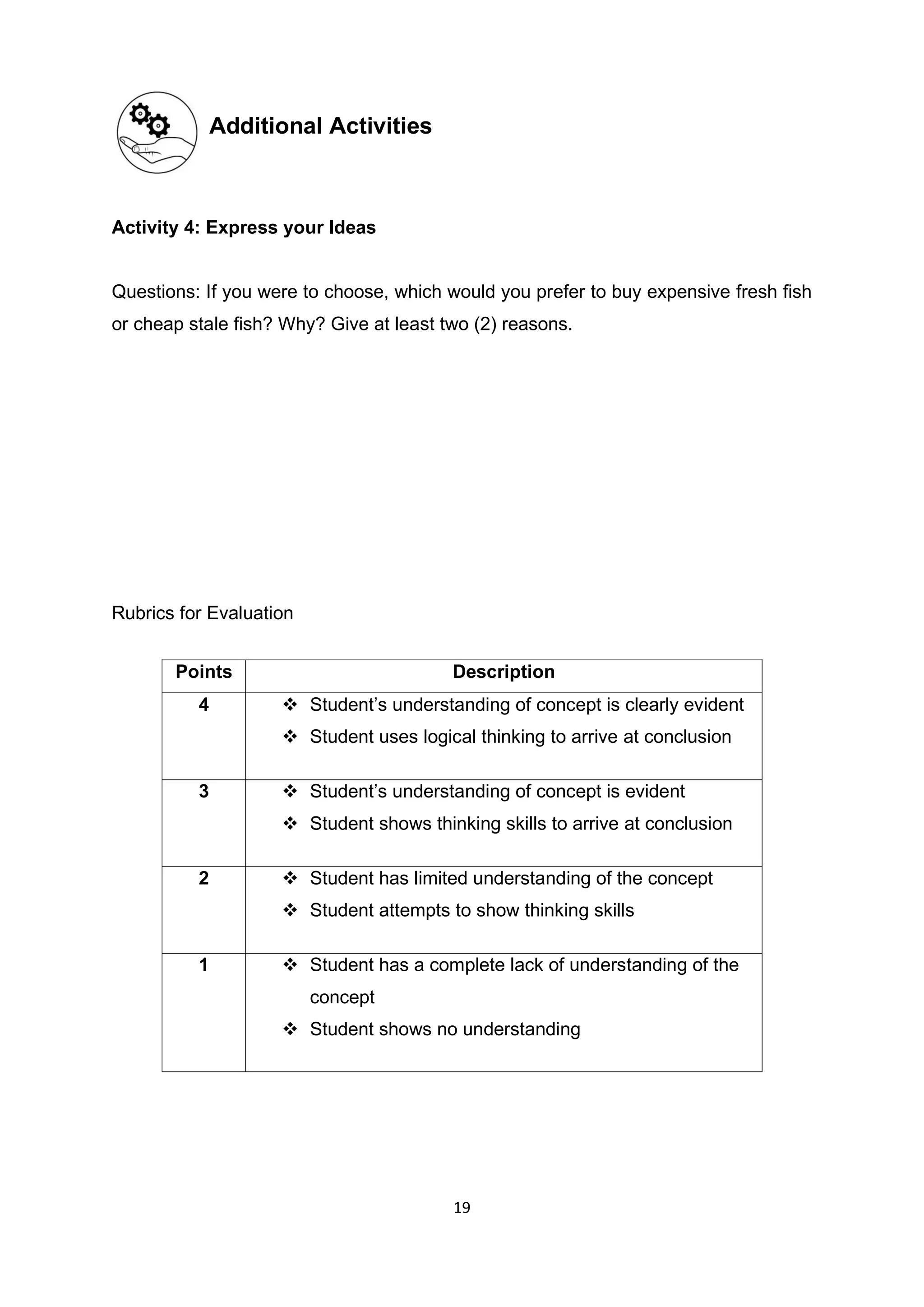
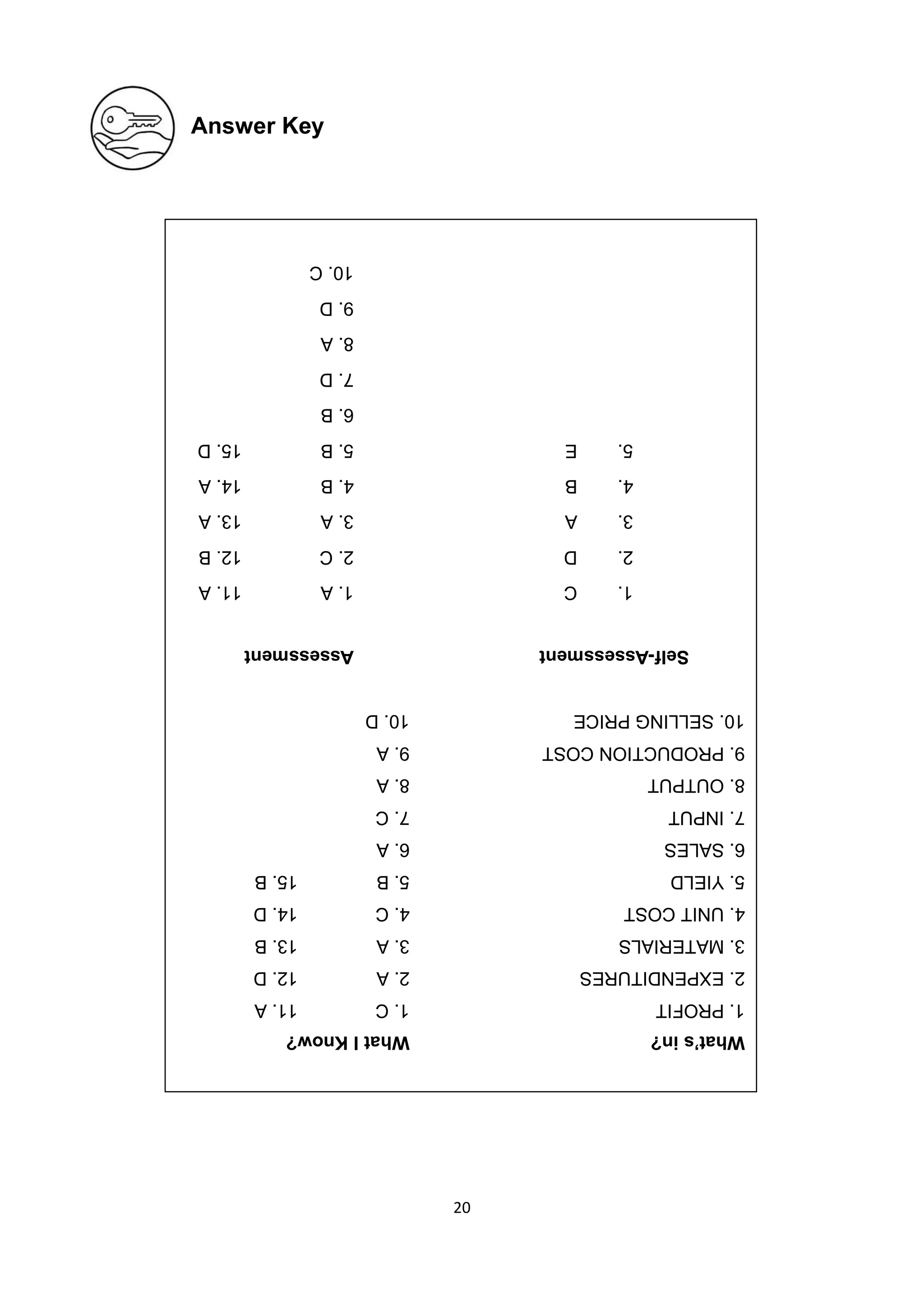
Answer Key
What’s
in?
What
I
Know?
1.
PROFIT
1.
C
11.
A
2.
EXPENDITURES
2.
A
12.
D
3.
MATERIALS
3.
A
13.
B
4.
UNIT
COST
4.
C
14.
D
5.
YIELD
5.
B
15.
B
6.
SALES
6.
A
7.
INPUT
7.
C
8.
OUTPUT
8.
A
9.
PRODUCTION
COST
9.
A
10.
SELLING
PRICE
10.
D
Self-Assessment
Assessment
1.
C
1.
A
11.
A
2.
D
2.
C
12.
B
3.
A
3.
A
13.
A
4.
B
4.
B
14.
A
5.
E
5.
B
15.
D
6.
B
7.
D
8.
A
9.
D
10.
C
21
References
BOOKS
Bravo, Ferdinand S. K to 12 Basic Education Curriculum Technology and
Livelihood Education Learning Module (Food/Fish Processing.) 114p.
ELECTRONIC RESOURCES
Competency-Based Learning Material(Fish Processing). 19p.
https://pdfslide.net/documents/cblm-for-fish-processing-y2pdf.html
For inquiries or feedback, please write or call:
Department of Education – Region 10
Zone 1, DepEd Building Masterson Avenue, Upper Balulang
Cagayan de Oro City, 9000
Telefax: (088) 880 7072
E-mail Address: region10@deped.govph

Tle 7 afa food (fish) processing module 5

  • 1.
    FOOD (FISH) PROCESSING Module 5 Interpreta Layout Plan Department of Education ● Republic of the Philippines 7
  • 2.
    Food (Fish) Processing– Grade 7 Alternative Delivery Mode Module First Edition, 2020 Republic Act 8293, section 176 states that: “No copyright shall subsist in any work of the Government of the Philippines. However, prior approval of the government agency or office wherein the work is created shall be necessary for exploitation of such work for profit. Such agency or office may, among other things, impose as a condition, payment of royalty.” Borrowed materials included in this module are owned by the respective copyright holders. Effort has been exerted to locate and seek permission to use these materials from the respective copyright owners. The publisher and author do not represent nor claim ownership over them. Published by the Department of Education – Region 10 Regional Director: Arturo B. Bayocot, CESO III Assistant Regional Director: Dr. Victor G. De Gracia Jr., CESO V Printed in the Philippines by Department of Education – Region 10 Office Address: Zone 1, DepEd Building, Masterson Avenue, Upper Balulang, Cagayan de Oro City Contact Number: (088) 880 7072 E-mail Address: region10@deped.gov.ph Development Team of the Module Writer/s: Angel Norm L. Ramirez Evaluators: Esterlita J. Sanchez Josie O. Mejos Evelyn A. Taruc Niel John M. Roxas Illustrator and Layout Artist: Management Team: Chairperson: Dr. Arturo B. Bayucot, CESO III Regional Director Co-Chairpersons: Dr. Victor G. De Gracia Jr., CESO V Asst. Regional Director Edwin R. Maribojoc EdD, CESO VI Schools Division Superintendent Mala Epra B. Magnaong, Chief ES, CLMD Members: Neil A. Improgo, EPS-LRMS Bienvenido U. Tagolimot, Jr.,EPS-ADM Samuel C. Silacan, EdD, CID Chief Joseph T. Boniao, EPS-EPP/TLE Rone Ray M. Portacion,EdD EPS-LRMS Edwin V. Palma, PSDS Ray G. Salcedo, Principal II/District In-charge Avilla G. Taclob, Principal I/District In-charge Agnes P. Gonzales,PDO II Vilma M. Inso, Librarian II
  • 3.
    Food (Fish)Processing Module 5 Interpret aLayout Plan Department of Education ● Republic of the Philippines 7 This instructional material is collaboratively developed and reviewed by educators from public schools. We encourage teachers and other education stakeholders to email their feedback, comments, and recommendations to the Department of Education – Region 10 at region10@deped.gov.ph Your feedback and recommendations are highly valued.
  • 4.
    What I Needto Know ……….......................................... 1 What I Know ……….......................................... 2 Technical Terms ……….......................................... 4 Lesson 1: Interpret Lay-out Plan ………………..................... 5 What’s In ……….......................................... 5 What’s New ……….......................................... 5 What Is It? ……….......................................... 6 Fish Processing Activities ……………………………………. 6 Characteristics of a Fresh and Spoiled Fish…...................... 8 Grading ……………………………………. 9 Grading of Fishery Products ……………………………………. 9 Steps in Cleaning Fresh Fish …………………………………. 10 Layout of an Ideal Processing Room ………………………… 14 What’s More? ………........................................... 15 What I have Learned …................................................. 15 What I Can Do ………........................................... 16 Assessment …................................................. 17 Additional Activities …................................................. 19 Answer Key ………........................................... 20 References ………........................................... 21 TABLE OF CONTENTS
  • 5.
    Introductory Message For theLearner Hello, learners! Congratulations and welcome to the next module. Again, the basis for living in this wonderful world is the ability to recruit for survival. Unless you have fully and clearly understood what awaits on you. You are generally in the position to exceed difficult situation on the quality of life, achievement, acquisition that you’ve been dreaming about for a long period of time. Thus, one needs help to realize it. Philosophers really believed that life is clearly infinite lesson, that the incorporation of invaluable, applicable, ideas in the daily work has no ending and it needs courage and determination to be on the right track. This module provides imperative information towards reaching your goals in your life. 1. It helps acquire competencies in interpreting layout plan in food/fish processing. 2. It provides information on the different meanings of signs and symbols used in lay outing plan for fish processing activity. 3. It allows you to understand the importance of interpreting a layout plan. Substantial knowledge of food (fish) processing is important as this increases the chances of knowing indispensable things relative to it.
  • 6.
    In this module,you are guided with a set of learning icons that will help you understand the underlying principles of Food (fish) processing. 1. What I Need to Know – the icon used to introduce the learning objectives in this module. 2. What I Know – the icon used to test what you have learned in this module. 3. What’s In – the icon used to connect your previous learning with the new lesson. 4. What’s New – the icon used to introduce new lesson through an activity, situation or activity. 5. What is It – the icon that will help you discover and understand food (fish) processing concepts. 6. What’s More – the icon that will help enrich your learnings of food(fish) concepts. 7. What I Have Learned – the icon that will help you process what you have learned in the lesson. 8. What I Can Do – the icon that allows you to apply what you have learned into real-life situations. 9. Assessment – the icon that evaluates your level of mastery in achieving the learning objectives. 10. Additional Activities – the icon that enhance your learning and improves your mastery of the lesson.
  • 7.
    1 This module willhelp give you all the essentials needed in your food (fish) processing journey. What I Need To Know In our place, we are surrounded with great percentage of water. One of the sources of living is through water that’s why most of the occupation are fishermen. Fishermen cannot return to the seashore with fresh fish they have caught and it will be of great helps to know how to process their catch in order to transport their products with a good quality. Through this module, you will know the different fish processing activities inside a food processing laboratory. These activities will serve as your guide in knowing the different signs and symbols in interpreting a layout plan. After reading this module, the learners should be able to: LO 1: Interpret a layout plan (TLE_AFFP9-121D-0f-1) 1. Explain the meanings of signs and symbol used in lay outing plan for fish processing activity; 2. Interpret layout plan for fish processing area according to standard set;
  • 8.
    2 What I Know Activity1: Evaluate yourself Directions: Read and understand the questions below. Select the best answer for each item then write your choice in your activity notebook. 1. This processing activity involves pre-cooking. A. storing C. preparation B. receiving D. processing 2. This activity involves the final heat treatment during processing. A. sterilizing C. preparation B. storing D. labeling 3. This activity involves segregating suitable from unsuitable raw materials. A. grading and sorting C. receiving B. labeling D. preparation 4. The purpose of this activity is to give the correct information about the product A. storing C. processing B. labeling D. receiving 5. One purpose of this processing activity is to prolong the keeping quality of the finished product. A. Labeling C. processing B. Storing D. preparation 6. Fish has bulging eyes, red gills and a firm body. What can you say about the fish? A. The fish is fresh C. The fish is partially fresh B. The fish is stale D. The fish is undergoing rigor mortis 7. The fishes you graded have slightly sunken eyes with grayish pupil; the flesh and backbone are slightly soft and with a slightly sour odor. To what grade will you assign them ? A. Grade I C. Grade III B. Grade II D. Off-grade
  • 9.
    3 8. Why mustraw materials like fishes be gutted before salting, curing or smoking them? A. To thoroughly clean the fish B. To prevent spoilage of the fish C. To improve the odor of the fish D. To remove the internal organs which contain spoilage organisms 9. When descaling a fish like tilapia or bangus, why should you use a blunt knife? A. To prevent injuring the fish flesh B. To hasten the removal of scales C. To prevent damaging the scales D. To maintain firmness of the fish flesh 10.This consists of fish which failed to meet the requirements of Grade III and therefore must be rejected. A. Grade I C. Grade III B. Grade II D. Off-grade 11.It is described as any tag, brand, mark, pictorial, or other descriptive matter. A. Label C. Manual B. Layout D. Specifications 12. It refers to a detailed itemized description of dimension plans, materials, and other equipment. A. Label C. Manual B. Layout D. Specifications 13.It is the way facilities are placed according to plan. A. Label C. Manual B. Layout D. Specifications 14.It refers to the removal of the scales from a fish using a blunt knife. A. Brining C. Grading B. Eviscerating D. Scaling 15.It refers to the removal of the internal organs; gut scaled or unscaled fish. A. Brining C. Grading B. Eviscerating D. Scaling
  • 10.
    4 TECHNICAL TERMS Layout –the way facilities are placed according to plan. Labeling – attaching of any printed materials to food products for identification. Label – any tag, brand, mark, pictorial, or other descriptive matter. Specification – a detailed itemized description of dimension plans, materials, and other equipment. Splitting -split fish on the dorsal side starting from the tail to the head by running the edge of the knife along the backbone. Brining– is treating food with brine or coarse salt which preserves and seasons the food while enhancing tenderness and flavor. Eviscerating/gutting– removal of the internal organs; gut scaled or unscaled fish. Organdeptic characteristics –the characteristics of a fish evaluated using the sense of sight, smell, touch such as appearance, color and texture.
  • 11.
    5 What’s In Activity 1:Fill Me In Directions: The following words below are used in the topic “Cost Production”. Write the appropriate letter to complete the word/s and write it in your activity notebook. i. P R _ F I _ 6. S _ L _ S ii. E_PEN_ITUR_S 7. I N _ U T iii. M _T E R _ A L S 8. _ U T P _ T iv. _ N I T C _ S T 9. P_ O D _ C T I O N C _ S T v. Y I _ L D 10. S _L L I N _ P _ I C E What’s New? Activity 1: Name Game – Fresh Fish Directions: Give at least three characteristics in choosing a fresh fish. Write it in your activity notebook. 1. __________________________ 2. __________________________ 3. __________________________ Lesson 1 Interpret a Layout Plan
  • 12.
    6 What is it? FishProcessing Activities The term fish processing refers to the processes associated with fish and fish products between the time fish are caught or harvested, and the time the final product is delivered to the customer. Fish is a highly perishable food which needs proper handling and preservation if it is to have a long shelf life and retain a desirable quality and nutritional value. The central concern of fish processing is to prevent fish from deteriorating. The most obvious method for preserving the quality of fish is to keep them alive until they are ready for cooking and eating. I. Receiving. This activity includes sorting and grading of raw materials according to size, species and quality. It also includes segregating suitable from unsuitable ones. Raw materials refer to fresh fishes newly caught, chilled or frozen that are not yet subjected to the treatment with preservatives like salt, vinegar and smoke. They are used during salting, curing and smoking. Prior to processing of fish, the raw materials must be efficiently prepared to achieve top quality processed products, maximum yield and highest possible profits.
  • 13.
    7 Characteristics of aFresh and Spoiled Fish Fresh Fish Spoiled Fish Odor fresh fishy odor stale sour or putrid Eyes bright and bulging, pupil is velvet black, cornea is transparent dull, wrinkled and sunken pupil is dull black cornea is opaque Gills bright red, covered with slime odor under gill cover is fresh dull brown or gray with cloudy slime, odor under gill cover is sour and offensive Body Color bright faded Flesh firm stiff body, finger impressions do not remain soft and flabby, finger impressions remain Belly walls intact often ruptured, viscera protruding Muscle Tissue white pinkish especially around the backbone Vent pink, not protruding brown, protruding Sorting fish according to their quality is done with the organoleptic evaluation of their condition based on the characteristics of a fresh and a stale fish. Below are the descriptions of the specific characteristics of a fresh fish: 1. A fish with clear bright eyes have eyes with a convex shiny black pupil and translucent cornea. 2. A fish with bright colored gills have gills which are shiny red or pink, not dull brown or gray. 3. The odor of a fresh fish is similar to that of a newly gathered seaweeds.
  • 14.
    8 4. A freshfish has a firm flesh characterized by a stiff body and texture elastic to slight pressure. 5. A fresh fish with intact belly walls have no protruding viscera and the walls are not soft or ruptured but firm and springy. 6. The fish with a bright body color has a glossy appearance, with body color typical of the species. 7. The slime present in a fresh fish must be clear, colorless and transparent in normal quantities at the gills and body. A Stale Fish has the following specific characteristics: 1. Discoloration which is a discernible abnormal color changes in some parts characterized by varying degrees of spoilage. 2. Damage is a defect in the fish which materially detracts from the appearance or edible or shipping quality of the fish. It includes loose scales, bruises and abrasions due to mishandling affecting more than 5% of the body of the fish, cuts and punctures made by tools used in catching or transporting fish that expose the flesh with a length of one-tenth of the length of the fish or excessively deep. 3. The stale fish is considered to have loose scales when the scales have been removed from the skin over more than 5% of the surface area of the fish or when scales are easily rubbed off because of bacterial decomposition. 4. The eyes are considered slightly sunken if the eyes are not bulging, or are slightly depressed. 5. The milky slime in stale fish appears cloudy white and is slightly transparent. 6. Slightly discolored gills have abnormal color change from bright red or pink to dull gray or brown.
  • 15.
    9 7. A fishwith a slightly soft flesh has a texture which is not elastic and leaves a dent or mark to slight pressure. Grading Evaluating the raw materials based on their organoleptic characteristics such as appearance, color, odor and texture. Grading of Fishery Products The grading of fishery products is based on the organoleptic characteristics as shown in the grading of tuna. Organoleptic characteristics refer to the characteristics of a fish obtained through the use of the sense organs like the color, odor, texture, etc. Grading of Tuna The prescribed standards for tuna: Grade I. This consists of strictly fresh fish possessing the following characteristics: a. Eyes, clear, and bright b. Gills, bright red-colored c. Fresh odor d. Firm flesh and intact belly walls e. Color of the body must be bright f. Absence of discoloration, loose scales, bruises, abrasions, cuts, punctures or other injuries Grade II. This consists of chilled or frozen (quick or sharp) fish which failed to meet the requirements for Grade I. a. Eyes, clear, and bright
  • 16.
    10 b. Gills, brightred-colored c. Fresh odor d. Firm flesh and intact belly walls e. Normal body color characteristics of the species f. Absence of discoloration, loose scales, bruises, abrasions, cuts, punctures or other injuries. Grade III. This consists of fish which failed to meet the requirements of Grades I and II, but which has the following characteristics: a. Eyes, slightly sunken; pupil, grayish b. Gills, slightly discolored and shiny c. Body, covered with somewhat milky slime d. Abdomen and belly walls, slightly soft e. Flesh and backbone, slightly soft f. Odor, slightly sour and somewhat like bread or weak acetic acid. Off – Grade. This consists of fish which failed to meet the requirements of Grade III and therefore must be rejected. II. Preparation. This includes the preparatory steps such as scaling, eviscerating, washing, cutting, brining, and pre-cooking the fish by steaming, blanching, or broiling. STEPS IN CLEANING FRESH FISH 1. Scaling Removal of the scales from a fish using a blunt knife. A sharp knife is not used because it might injure the fish.
  • 17.
    11 The scales ofa fish can be removed using the following: a. Knife b. Metal Scaler c. Electric scaler
  • 18.
    12 2. Eviscerating/Gutting meansthe removal of the internal organs, viscera or guts through the operculum. 3. Washing - Fish are washed using running water from a faucet or with strong jets of water from a water sprayer. To prevent contamination, hands, working area, cutting boards, knives and other utensils should be properly cleaned with water and soap. III. Processing/sterilizing. This activity involves the final processing and complete sterilization of the processed finished product.
  • 19.
    13 IV. Storing. Storageroom is provided for storing finished product such as canned/bottled fish, smoked fish, salted fish, pickled fish and other processed fishery products. Proper storage will also extend the shelf life of the product. V. Packaging. This processing activity involves the wrapping or enclosing food and fish products in bottles or in cans for the purpose of protecting and preserving the finished products. VI. Labeling. The purpose of this activity is to give the correct information about the product. LAYOUT OF AN IDEAL PROCESSING ROOM
  • 20.
    14 Gas Cooktops FreeStanding Sink Sinks Refrigerator Fire Extinguisher Toilet
  • 21.
    15 What’s More Activity 2Self- Assessment Directions: Below is a layout of an ideal processing room. Place the necessary area appropriate for processing. Write it in your activity notebook. What I Have Learned Instruction: Complete the sentence below. Write your answer in your activity notebook. I have learned how to _______________________ layout plan in___________________.
  • 22.
    16 What I CanDo Activity 3: Go with the Flow Directions: Below is a flowchart in manufacturing of Smoked Bangus Fish. Fill in the box with the correct procedures given. Write it in your activity notebook. PROCEDURES: 1. Securing of raw materials 2. Preparing the raw materials a. Splitting b. Brining c. Pre-cooking d. Drying 3. Smoking 4. Cooling 5. Packaging _________ ________ ________ ________ _________ _________ _________ _________ _________ _________ __________ __________ __________ __________ Smoked Bangus
  • 23.
    17 Assessment Now, that youare finished accomplishing the module, let us check what you have learned. Directions: Identify the correct answer. Write the letter only in your activity notebook. 1. Fish has bulging eyes, red gills and a firm body. What can you say about the fish? A. The fish is fresh C. The fish is partially fresh B. The fish is stale D. The fish is undergoing rigor mortis 2. The fishes you graded have slightly sunken eyes with grayish pupil; the flesh and backbone are slightly soft and with a slightly sour odor. To what grade will you assign them? A. Grade I C. Grade III B. Grade II D. Off-grade 3. Why must raw materials like fishes be eviscerated before salting, curing or smoking them? A. To thoroughly clean the fish B. To prevent spoilage of the fish C. To improve the odor of the fish D. To remove the internal organs which contain spoilage organisms 4. The purpose of this activity is to give the correct information about the product A. Storing C. Processing B. Labeling D. Receiving 5. One purpose of this processing activity is to prolong the keeping quality of the finished product. A. Labeling C. processing B. Storing D. preparation 6. It is the way facilities are placed according to plan. A. Label C. Manual B. Layout D. Specifications
  • 24.
    18 7. It refersto the removal of the scales from a fish using a blunt knife. A. Brining C. Grading B. Eviscerating D. Scaling 8. When descaling a fish like tilapia or bangus, why should you use a blunt knife? A. To prevent injuring the fish flesh B. To hasten the removal of scales C. To maintain firmness of the fish flesh D. To prevent damaging the scales 9. This consists of fish which failed to meet the requirements of Grade III and therefore must be rejected. A. Grade I C. Grade III B. Grade II D. Off-grade 10. This processing activity involves pre-cooking. A. Storing C. Preparation B. Receiving D. Processing 11. This activity involves segregating suitable from unsuitable raw materials. A. Grading and sorting C. Receiving B. Labeling D. Preparation 12. It refers to the removal of the internal organs; gut scaled or unscaled fish. A. Brining C. Grading B. Eviscerating D. Scaling 13.This activity involves the final heat treatment during processing. A. Sterilizing C. Preparation B. Storing D. Labeling 14. It is described as any tag, brand, mark, pictorial, or other descriptive matter. A. Label C. Manual B. Layout D. Specifications 15. It refers to a detailed itemized description of dimension plans, materials, and other equipment. A. Label C. Manual B. Layout D. Specifications
  • 25.
    19 Additional Activities Activity 4:Express your Ideas Questions: If you were to choose, which would you prefer to buy expensive fresh fish or cheap stale fish? Why? Give at least two (2) reasons. Rubrics for Evaluation Points Description 4 ❖ Student’s understanding of concept is clearly evident ❖ Student uses logical thinking to arrive at conclusion 3 ❖ Student’s understanding of concept is evident ❖ Student shows thinking skills to arrive at conclusion 2 ❖ Student has limited understanding of the concept ❖ Student attempts to show thinking skills 1 ❖ Student has a complete lack of understanding of the concept ❖ Student shows no understanding
  • 26.
  • 27.
    21 References BOOKS Bravo, Ferdinand S.K to 12 Basic Education Curriculum Technology and Livelihood Education Learning Module (Food/Fish Processing.) 114p. ELECTRONIC RESOURCES Competency-Based Learning Material(Fish Processing). 19p. https://pdfslide.net/documents/cblm-for-fish-processing-y2pdf.html For inquiries or feedback, please write or call: Department of Education – Region 10 Zone 1, DepEd Building Masterson Avenue, Upper Balulang Cagayan de Oro City, 9000 Telefax: (088) 880 7072 E-mail Address: region10@deped.govph