Saiprasad Bhusare
III Year, B.F.Sc.
College of Fishery Science, Udgir,
Dist : Latur, Maharashtra, 413517
Economics of Cage Culture
Introduction
 Cage culture is one of the intensive methods of
aquafarming, however, it involves less costs than
raceway or enclosure methods.
 The capital involvement consists of collars, floats,
mooring facilities, nets etc.
 It is usually less than 10 % of the total operational costs.
 The nets and the physical facilities are usually given a
life span of four years in view of the marine conditions
especially in tropical environment.
 With proper maintenance the frame also can be retained
for more than five years.
Economics of Cage Culture
Introduction
 The main expenses in marine cage farming are cost
of feeds (30–50%) and seeds (30–35%), which usually
make up 60–85% of the total operational cost.
 Rearing fingerlings from fry using cage culture in the
reservoirs to be stocked is more cost-effective than
using either pens or nurseries.
 One battery of eight cages is sufficient to produce
stocking materials for a water body of 200 ha.
 Three crops of fingerlings can easily be harvested per
year.
Economics of Cage Culture
Net
 Useful life of HDPE plastic nets is at least 1 year
and, with minor repair, may extend to 2 years,
depending on their management after each
harvest.
Economics of Cage Culture
Net
 Nets should be cleaned immediately after the
harvest, dried in the sun, and either stored properly
or immediately reused.
 After a year of use, Nylon may be sold as scrap for 7-
8% of the initial procurement price.
Economics of Cage Culture
 As steel drums used as floats have only 27% of
their surface area under water, they can easily be
rotated immediately after the harvest to allow
repaintingthe previously submerged portion.
Float
Economics of Cage Culture
 To maximize the useful life of the drums, the
whole drum should be repainted annually.
 Steel drums used as floats can be used for at
least 5 years, during which time 15 fingerling
crops can be
 harvested.
 After 5 years of use, they can be sold for 40% of
their procurement price.
Float
Economics of Cage Culture
 Bamboo poles used for frames normally last for 2
years, with 10% of poles needing to be changed every
year.
 The poles used in the submerged frame will last for
more than 3 years with proper care and management.
 Used bamboo poles may be sold for 5% of their initial
price.
Bamboo Pole
Economics of Cage Culture
Nylon Rope
 The thicker nylon ropes used for anchors serve for
more than 5 years, especially the portions that
remain under water.
 The silk ropes for tying Netlon cages with bamboo
frame last for at least 2 years.
Economics of Cage Culture
Unit cost economics for cage farming of cobia
(in a 6 m diameter GI cage)
A. Capital Expenditure
Sl. No Head of expense Cost in Rs.
1
Cage ( 6 meter dia) made of ‘C‘ class GI Pipe of
1.5 inch dia)
50000
2 Mooring 15000
3
Nets ( 2 Inner net and one outer net with
ballast pipe)
60000
Sub Total 1,25,000.00
Economics of Cage Culture
Unit cost economics for cage farming of cobia
(in a 6 m diameter GI cage)
B. Operational Expenditure
Sl. No Head of expense Cost in Rs.
1 Cost of 750 Numbers of cobia seeds @ Rs 10/seed 7,500
2 Transportation 5,000
3 Cost of 12.82 tonnes of low value fishes @ Rs.25,000/tonne 3,20,500
4 Labour Charges @ Rs.1000/ Person for 7 months for 2 persons 14,000
5 Boat Hire & Fuel Charges 10,000
6 Harvesting Charges 5,000
7 Miscellaneous Expenses 10,000
Sub Total 3,72,000
Economics of Cage Culture
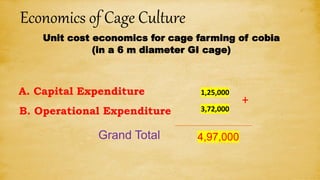
Unit cost economics for cage farming of cobia
(in a 6 m diameter GI cage)
B. Operational Expenditure
A. Capital Expenditure 1,25,000
3,72,000
+
Grand Total 4,97,000
Sl. No Production Estimates
1 Survival 95% = 712 fishes
2 Feed Conversion Ratio = 1 : 6
3 Average size of each fish at
the time of harvest = 3kg
4 Total harvest = 2.136 tonnes/cage
5 Sale price of the produce @ Rs.280/ = Rs. 5,98,080/-
Gross Income from the harvest = Rs. 5,98,080/-
Economics of Cage Culture
Unit cost economics for cage farming of cobia
(in a 6 m diameter GI cage)
Sl. No Economics
1 Gross income from Harvest = Rs. 5,98,080/-
2 Operational expenditure = Rs. 3,72,000/-
3 Gross income – Operational expenses = Rs. 2,26,080/-
Net Profit = Rs. 2,26,080/-
4 Partial repayment of the capital expenditure = Rs. 25,000/year
(Capital cost Rs. 1,25,000 – Subsidy Rs. 50,000 - Rs. 75,000)
Repayment of capital @ Rs. 25,000/year x 3 years
5 Interest in the total project cost @ 11% = Rs. 52,800/-
6 Part of Capital + interest = 25,000 + 52,800 = Rs. 77,800/-
7 Rs. 2,26,080 – 77,800 = 1,48,280/-
Net profit (after repayment of interest & part of capital expenditure) Rs. 1,48,280/-
Economics of Cage Culture
Unit cost economics for cage farming of cobia
(in a 6 m diameter GI cage)
REFERENCED
Cage Culture in Reservoirs in India,
(www.worldfishcenter.rog)
Sea cage farming of cobia
- A.K. Abdul Nazar, R. Jayakumar
(CMFRI)

Cage Economics

  • 1.
    Saiprasad Bhusare III Year,B.F.Sc. College of Fishery Science, Udgir, Dist : Latur, Maharashtra, 413517 Economics of Cage Culture
  • 2.
    Economics of CageCulture Introduction  Cage culture is one of the intensive methods of aquafarming, however, it involves less costs than raceway or enclosure methods.  The capital involvement consists of collars, floats, mooring facilities, nets etc.  It is usually less than 10 % of the total operational costs.  The nets and the physical facilities are usually given a life span of four years in view of the marine conditions especially in tropical environment.  With proper maintenance the frame also can be retained for more than five years.
  • 3.
    Economics of CageCulture Introduction  The main expenses in marine cage farming are cost of feeds (30–50%) and seeds (30–35%), which usually make up 60–85% of the total operational cost.  Rearing fingerlings from fry using cage culture in the reservoirs to be stocked is more cost-effective than using either pens or nurseries.  One battery of eight cages is sufficient to produce stocking materials for a water body of 200 ha.  Three crops of fingerlings can easily be harvested per year.
  • 4.
    Economics of CageCulture Net  Useful life of HDPE plastic nets is at least 1 year and, with minor repair, may extend to 2 years, depending on their management after each harvest.
  • 5.
    Economics of CageCulture Net  Nets should be cleaned immediately after the harvest, dried in the sun, and either stored properly or immediately reused.  After a year of use, Nylon may be sold as scrap for 7- 8% of the initial procurement price.
  • 6.
    Economics of CageCulture  As steel drums used as floats have only 27% of their surface area under water, they can easily be rotated immediately after the harvest to allow repaintingthe previously submerged portion. Float
  • 7.
    Economics of CageCulture  To maximize the useful life of the drums, the whole drum should be repainted annually.  Steel drums used as floats can be used for at least 5 years, during which time 15 fingerling crops can be  harvested.  After 5 years of use, they can be sold for 40% of their procurement price. Float
  • 8.
    Economics of CageCulture  Bamboo poles used for frames normally last for 2 years, with 10% of poles needing to be changed every year.  The poles used in the submerged frame will last for more than 3 years with proper care and management.  Used bamboo poles may be sold for 5% of their initial price. Bamboo Pole
  • 9.
    Economics of CageCulture Nylon Rope  The thicker nylon ropes used for anchors serve for more than 5 years, especially the portions that remain under water.  The silk ropes for tying Netlon cages with bamboo frame last for at least 2 years.
  • 10.
    Economics of CageCulture Unit cost economics for cage farming of cobia (in a 6 m diameter GI cage) A. Capital Expenditure Sl. No Head of expense Cost in Rs. 1 Cage ( 6 meter dia) made of ‘C‘ class GI Pipe of 1.5 inch dia) 50000 2 Mooring 15000 3 Nets ( 2 Inner net and one outer net with ballast pipe) 60000 Sub Total 1,25,000.00
  • 11.
    Economics of CageCulture Unit cost economics for cage farming of cobia (in a 6 m diameter GI cage) B. Operational Expenditure Sl. No Head of expense Cost in Rs. 1 Cost of 750 Numbers of cobia seeds @ Rs 10/seed 7,500 2 Transportation 5,000 3 Cost of 12.82 tonnes of low value fishes @ Rs.25,000/tonne 3,20,500 4 Labour Charges @ Rs.1000/ Person for 7 months for 2 persons 14,000 5 Boat Hire & Fuel Charges 10,000 6 Harvesting Charges 5,000 7 Miscellaneous Expenses 10,000 Sub Total 3,72,000
  • 12.
    Economics of CageCulture Unit cost economics for cage farming of cobia (in a 6 m diameter GI cage) B. Operational Expenditure A. Capital Expenditure 1,25,000 3,72,000 + Grand Total 4,97,000
  • 13.
    Sl. No ProductionEstimates 1 Survival 95% = 712 fishes 2 Feed Conversion Ratio = 1 : 6 3 Average size of each fish at the time of harvest = 3kg 4 Total harvest = 2.136 tonnes/cage 5 Sale price of the produce @ Rs.280/ = Rs. 5,98,080/- Gross Income from the harvest = Rs. 5,98,080/- Economics of Cage Culture Unit cost economics for cage farming of cobia (in a 6 m diameter GI cage)
  • 14.
    Sl. No Economics 1Gross income from Harvest = Rs. 5,98,080/- 2 Operational expenditure = Rs. 3,72,000/- 3 Gross income – Operational expenses = Rs. 2,26,080/- Net Profit = Rs. 2,26,080/- 4 Partial repayment of the capital expenditure = Rs. 25,000/year (Capital cost Rs. 1,25,000 – Subsidy Rs. 50,000 - Rs. 75,000) Repayment of capital @ Rs. 25,000/year x 3 years 5 Interest in the total project cost @ 11% = Rs. 52,800/- 6 Part of Capital + interest = 25,000 + 52,800 = Rs. 77,800/- 7 Rs. 2,26,080 – 77,800 = 1,48,280/- Net profit (after repayment of interest & part of capital expenditure) Rs. 1,48,280/- Economics of Cage Culture Unit cost economics for cage farming of cobia (in a 6 m diameter GI cage)
  • 15.
    REFERENCED Cage Culture inReservoirs in India, (www.worldfishcenter.rog) Sea cage farming of cobia - A.K. Abdul Nazar, R. Jayakumar (CMFRI)