LOCAL FISCAL
MANAGEMENT
Report by: MELISSA BAYLON-
PERLAS
Subject: Theory and Practice in
Public Administration
WHAT IS FISCAL
MANAGEMENT?
-Is the process of planning, directing and
controlling financial resources of an
organization.
-Refers to money within a government
entity
-It is the process of keeping an
organization running efficiently within its
allotted budget.
This Photo by Unknown Author is licensed under CC BY
FISCAL MANAGEMENT GOALS
To maintain fiscal records and
procedures that provides protection for
the resources as well as records which
generate economy, effectiveness and
efficiency of the operation that relate to
the budget of the agency.
To improve the way agency operates
by properly planning, recording and
performing procedures that relate to the
budget.
This involves a variety of tools,
including budget spreadsheets,
accounting, and guides outlining
procedures for an agency.
This Photo by Unknown Author is licensed under CC BY-SA
AREAS OF FISCAL
MANAGEMENT
Procurement of Funds
– it is the process of finding and
acquiring goods, services or works from an
external source
Allocation of funds
– the process of fair distribution of
funds assigned to a particular item
Monitoring their use in the interest of
accountability
- to be responsible for their actions and
decisions, and having the obligation to report
about it anytime
Producing financial reports for the relevant
stakeholders
- refers to an openness with regards to This Photo by Unknown Author is licensed under CC BY
FISCAL MANAGEMENT PROCESS
Planning the budget
Formal review and approval of the
budget
Implementing the budget
Monitoring and evaluating the
expenditure of funds
Communication with the public
about how funds are used
This Photo by Unknown Author is licensed under CC BY-SA
WHAT IS THE
IMPORTANCE
OF FISCAL
MANAGEMEN
T?
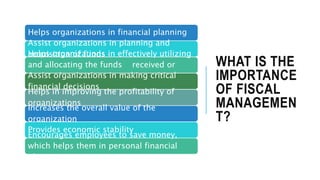
Helps organizations in financial planning
Assist organizations in planning and
acquisition of fundsHelps organizations in effectively utilizing
and allocating the funds received or
acquiredAssist organizations in making critical
financial decisions
Helps in improving the profitability of
organizations
Increases the overall value of the
organization
Provides economic stability
Encourages employees to save money,
which helps them in personal financial
planning
CHARACTERISTI
CS OF FISCAL
MANAGEMENT
POOR FISCAL MANAGEMENT –
indicated by a lack of record-
keeping and unnecessary or
unplanned expenditures that
can cause a department to go
over budget or fail to meet its
objectives
GOOD FISCAL MANAGEMENT
– involves recording all fiscal
transactions in checks- and-
balances system that reduces
mistakes or omissions that
might lead to surprise budget
overages
This Photo by Unknown Author is licensed under CC BY-SA
FISCAL MANAGERS
SHOULD ENSURE THAT:
All financial regulations and
procedures are complied with.
All financial transactions are recorded
accurately.
Adequate controls are in place to
ensure that expenditures do not
exceed income
Only authorized expenditures are
incurred
GOVERNME
NT
PROCUREM
ENT
REFORM
ACT –
RA9184
(R.A.) 9184, otherwise known as the
“Government Procurement Reform Act,”
for the purpose of prescribing the
necessary rules and regulations for the
modernization, standardization, and
regulation of the procurement activities
of the Government of the Philippines
(GoP).
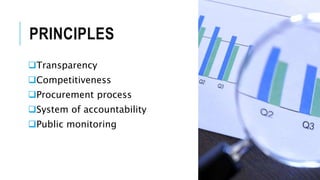
PRINCIPLES
Transparency
Competitiveness
Procurement process
System of accountability
Public monitoring
5 FISCAL
MANAGEMENT
TECHNIQUES Regular cash flow management Most
businesses are not able to forecast their cash
flow, which reduces their ability to anticipate
shortfalls in the future and correct them. To
improve your financial position, it is
significant to spend time on regular
management and analysis of cash flow.
 Timely & accurate financial statements It is
seen that the preparation of financial
statements is often outsourced and used
mainly for the purpose of tax computation.
Creating timely, accurate and relevant
financial statements can help in decision
making and validating those decisions.
 Key Financial Indicators In today's economy,
you need to be proactive in ascertaining your
business' financial position and knowing
whether things are going according to plan.
KPIs make life a lot easier by signalling the This Photo by Unknown Author is licensed under CC BY-SA-NC
5 FISCAL MANGEMENT
TECHNIQUES
 Realistic Operating Budget In today's
dynamic environment, your operating budget
is your measurement tool for success. It
drives pricing and profitability, and therefore
has to be realistic and meaningful.
Updated Systems & Processes Having proper
systems and processes in place helps run
things in the fastest, most effective and
efficient way possible. Vital financial
procedures can be reviewed for credit, billing
and collection. Updated systems can help
avoid repetitive and time consuming activities
and speed things up which invariably
contributes to improved financial position of a
This Photo by Unknown Author is licensed under CC BY-SA-NC
WHO CAN DO
THIS???
A good Finance Team has to work to
implement standardization to reduce
costs and result in profit
maximization.
So, Taking care of these factors gives
improved financial position by
ensuring futuristic planning and
security through longer time frames.
FISCAL MANAGEMENT

FISCAL MANAGEMENT

  • 1.
    LOCAL FISCAL MANAGEMENT Report by:MELISSA BAYLON- PERLAS Subject: Theory and Practice in Public Administration
  • 2.
    WHAT IS FISCAL MANAGEMENT? -Isthe process of planning, directing and controlling financial resources of an organization. -Refers to money within a government entity -It is the process of keeping an organization running efficiently within its allotted budget. This Photo by Unknown Author is licensed under CC BY
  • 3.
    FISCAL MANAGEMENT GOALS Tomaintain fiscal records and procedures that provides protection for the resources as well as records which generate economy, effectiveness and efficiency of the operation that relate to the budget of the agency. To improve the way agency operates by properly planning, recording and performing procedures that relate to the budget. This involves a variety of tools, including budget spreadsheets, accounting, and guides outlining procedures for an agency. This Photo by Unknown Author is licensed under CC BY-SA
  • 4.
    AREAS OF FISCAL MANAGEMENT Procurementof Funds – it is the process of finding and acquiring goods, services or works from an external source Allocation of funds – the process of fair distribution of funds assigned to a particular item Monitoring their use in the interest of accountability - to be responsible for their actions and decisions, and having the obligation to report about it anytime Producing financial reports for the relevant stakeholders - refers to an openness with regards to This Photo by Unknown Author is licensed under CC BY
  • 5.
    FISCAL MANAGEMENT PROCESS Planningthe budget Formal review and approval of the budget Implementing the budget Monitoring and evaluating the expenditure of funds Communication with the public about how funds are used This Photo by Unknown Author is licensed under CC BY-SA
  • 6.
    WHAT IS THE IMPORTANCE OFFISCAL MANAGEMEN T? Helps organizations in financial planning Assist organizations in planning and acquisition of fundsHelps organizations in effectively utilizing and allocating the funds received or acquiredAssist organizations in making critical financial decisions Helps in improving the profitability of organizations Increases the overall value of the organization Provides economic stability Encourages employees to save money, which helps them in personal financial planning
  • 7.
    CHARACTERISTI CS OF FISCAL MANAGEMENT POORFISCAL MANAGEMENT – indicated by a lack of record- keeping and unnecessary or unplanned expenditures that can cause a department to go over budget or fail to meet its objectives GOOD FISCAL MANAGEMENT – involves recording all fiscal transactions in checks- and- balances system that reduces mistakes or omissions that might lead to surprise budget overages This Photo by Unknown Author is licensed under CC BY-SA
  • 8.
    FISCAL MANAGERS SHOULD ENSURETHAT: All financial regulations and procedures are complied with. All financial transactions are recorded accurately. Adequate controls are in place to ensure that expenditures do not exceed income Only authorized expenditures are incurred
  • 9.
    GOVERNME NT PROCUREM ENT REFORM ACT – RA9184 (R.A.) 9184,otherwise known as the “Government Procurement Reform Act,” for the purpose of prescribing the necessary rules and regulations for the modernization, standardization, and regulation of the procurement activities of the Government of the Philippines (GoP).
  • 10.
  • 11.
    5 FISCAL MANAGEMENT TECHNIQUES Regularcash flow management Most businesses are not able to forecast their cash flow, which reduces their ability to anticipate shortfalls in the future and correct them. To improve your financial position, it is significant to spend time on regular management and analysis of cash flow.  Timely & accurate financial statements It is seen that the preparation of financial statements is often outsourced and used mainly for the purpose of tax computation. Creating timely, accurate and relevant financial statements can help in decision making and validating those decisions.  Key Financial Indicators In today's economy, you need to be proactive in ascertaining your business' financial position and knowing whether things are going according to plan. KPIs make life a lot easier by signalling the This Photo by Unknown Author is licensed under CC BY-SA-NC
  • 12.
    5 FISCAL MANGEMENT TECHNIQUES Realistic Operating Budget In today's dynamic environment, your operating budget is your measurement tool for success. It drives pricing and profitability, and therefore has to be realistic and meaningful. Updated Systems & Processes Having proper systems and processes in place helps run things in the fastest, most effective and efficient way possible. Vital financial procedures can be reviewed for credit, billing and collection. Updated systems can help avoid repetitive and time consuming activities and speed things up which invariably contributes to improved financial position of a This Photo by Unknown Author is licensed under CC BY-SA-NC
  • 13.
    WHO CAN DO THIS??? Agood Finance Team has to work to implement standardization to reduce costs and result in profit maximization. So, Taking care of these factors gives improved financial position by ensuring futuristic planning and security through longer time frames.

Editor's Notes

  • #7 Proper use and allocation of funds leads to improve the operational efficiency of the agency concern. When the finance manager uses the funds properly, they can reduce the cost of capital and increase the value of the agency.
  • #8 Sometimes its not about the money but rather the process of managing the money
  • #12 5 Techniques that tremendously improve a business' financial position