MANDATORY EXPENSES: 
Presented by: 
CHERYL M. ASIA
Operating Expenses are expenses that 
are incurred while running a business. 
Maintenance Expense could be 
considered anything from the cost of 
maintaining a company vehicle to repairs 
made on a building or some other type of 
"maintenance" that is require by the 
business in order to function at 100%. 
Many expenses have their own account 
such as, Utilities Expense, Rent Expense, 
Insurance Expense, Interest Expense, 
Supply Expense, just to name a few. Other 
expense may not have a specific account 
in which to be recorded, such as Travel 
Expense, Food Expense (perhaps to 
entertain a possible client), these expense 
are often listed under "Other Expenses".
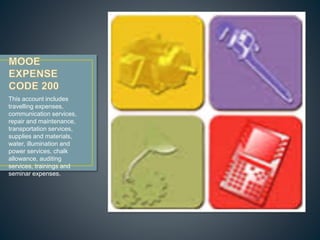
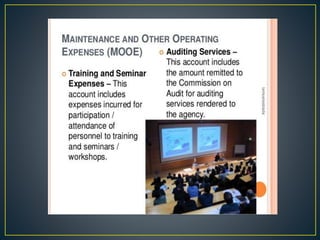
This account includes 
travelling expenses, 
communication services, 
repair and maintenance, 
transportation services, 
supplies and materials, 
water, illumination and 
power services, chalk 
allowance, auditing 
services, trainings and 
seminar expenses.
Legal Bases 
The following are the legal bases of these guidelines: 
a. Department of Budget and Management (DBM) and 
DepEd Joint Circular No. 2004-1 dated January 01, 2004 
entitled Guidelines on the Direct Release of Funds to 
DepED-Regional Offices and Implementing Units; 
b. Section 10, Republic Act No. 9155 (Governance of 
Basic Education Act of 2001) which provides that the 
appropriations intended for the regional and field offices 
(elementary/secondary schools and schools division 
offices) are to be allocated directly and released 
immediately by the DBM to the said offices; and 
c. Section 10 of the DepEd Special Provisions, Republic 
Act No. 10147, the General Appropriations Act (GAA) of 
Fiscal Year 2011.
Implementation Requirements 
a. The implementing units (IUs) are capable of 
administering their own funds since they have position items 
assigned to handle cashiering and bookkeeping functions, 
whether on a permanent or temporary basis. 
b. The DBM has already assigned agency codes to the 
said IUs, hence, they are authorized to open Modified 
Disbursement Scheme (MDS) Sub-Accounts in government 
depository banks and that the cash allocations intended for 
the aforementioned IUs are directly issued by the DBM to 
their respective MDS Sub-Accounts. 
c. The IUs are required to maintain sets of books of 
accounts. 
d. The MDS Sub-Accounts of Schools Division Offices 
(SDOs) shall cover transactions of the SDO (Proper), 
elementary schools (ESs) and secondary schools (SSs) 
without financial staff, and may also include SSs with
a. The DepED-Central Office (CO) shall... 
a. 1. provide the Regional and Schools Division Offices with a matrix showing the MOOE allocation 
of every public elementary school out of the appropriation authorized for MOOE for each Schools 
Division Office under the Elementary Education as reflected in the GAA; and 
a.2. post on its website the allocations for elementary schools as mentioned in Item 3.1.1 hereof. 
b. The Schools Division Offices (SDOs) shall... 
b.1. inform the heads of ESs and SSs without financial staff of their allotment and/or cash allocation for 
MOOE; 
b.2. download in full to the heads of elementary schools and non-implementing secondary schools 
their MOOE allocations through cash advance using the replenishment method. The SDOs are 
prohibited from undertaking centralized procurement of any good or service out of school MOOE 
intended for distribution to schools in kind. In extreme cases, however, the SDOs may procure items 
using school MOOE provided that they submit a report to the Office of the Secretary through the Office 
of the Undersecretary for Finance and Administration explaining the need for such items; describing 
the nature, type, quantity and price of those items listed by the receiving school; and presenting the 
estimated price difference between the division and school procurement, and the name of the supplier 
including the mode of procurement used. While the report does not require pre-approval, SDOs must 
submit such report within thirty (30) days after the conduct of the procurement, for audit and monitoring 
purposes. 
b.3 submit to the Office of the Secretary through the Office of the Undersecretary for Finance and 
Administration monthly reports on the status of the downloading of school MOOE and its utilization.
C. The Elementary School (ES) and Secondary School (SS) Without 
Financial Staff shall... 
c. 1. apply for bonding with the Bureau of Treasury, Fidelity Bond 
Division; 
c.2. draw cash advance from their supervising/directing SDO for their 
MOOE requirements; 
c.3 pursuant to Item H.1.1 of the Manual on Simplified Accounting 
Guidelines and Procedures for the Use of Non-Implementing 
Units/Schools, Version 2008, submit to the SDO on or before the 5th 
day of the following month the original copy of the Cash Disbursement 
Register (CDR), the paid Disbursement Vouchers (DVs) and all 
supporting documents which shall serve as liquidation or replenishment 
of the cash advance granted. Subsequent cash advance shall be 
granted only upon receipt of the CDR equivalent to at least 75% of the 
previous cash advance. It is reiterated, however, that any remaining 
cash advance at the end of the year must be liquidated in full and 
unexpended balances be refunded; and 
c.4. disburse funds in accordance with the existing budgeting, 
accounting, procurement, and auditing rules and regulations.
a. To fund activities as identified in the approved School 
Improvement Plan (SIP) which are for implementation in the 
current year particularly in improving learning outcomes and as 
specifically determined in the Annual Implementation Plan (AIP) 
of the school; 
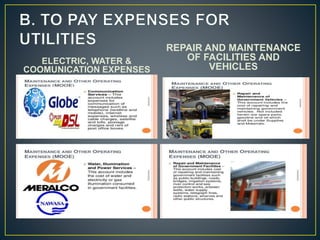
b. To pay expenses for utilities (e.g. electric and water 
expenses); 
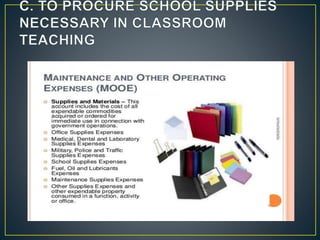
c. To procure school supplies necessary in classroom 
teaching; 
d. To pay salaries for janitorial and security services; and 
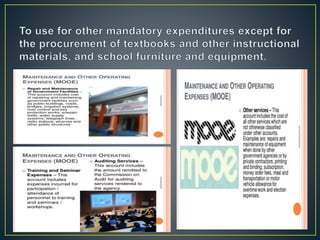
e. To use for other mandatory expenditures except for the 
procurement of textbooks and other instructional materials, and 
school furniture and equipment.
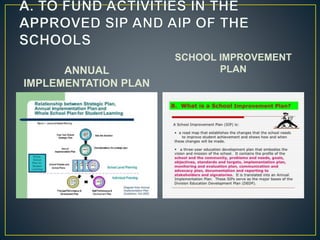
ANNUAL 
IMPLEMENTATION PLAN 
SCHOOL IMPROVEMENT 
PLAN
ELECTRIC, WATER & 
COOMUNICATION EXPENSES 
REPAIR AND MAINTENANCE 
OF FACILITIES AND 
VEHICLES
The SDO and school officials/personnel who violate any 
provision of this Order shall be dealt with administratively, 
pursuant to DepEd Order No. 49, s. 2006, otherwise known 
as the "Revised Rules of Procedure of the Department of 
Education in Administrative Cases."
thank you…..

Maintenance and other operating expenses

  • 1.
  • 2.
    Operating Expenses areexpenses that are incurred while running a business. Maintenance Expense could be considered anything from the cost of maintaining a company vehicle to repairs made on a building or some other type of "maintenance" that is require by the business in order to function at 100%. Many expenses have their own account such as, Utilities Expense, Rent Expense, Insurance Expense, Interest Expense, Supply Expense, just to name a few. Other expense may not have a specific account in which to be recorded, such as Travel Expense, Food Expense (perhaps to entertain a possible client), these expense are often listed under "Other Expenses".
  • 3.
    This account includes travelling expenses, communication services, repair and maintenance, transportation services, supplies and materials, water, illumination and power services, chalk allowance, auditing services, trainings and seminar expenses.
  • 5.
    Legal Bases Thefollowing are the legal bases of these guidelines: a. Department of Budget and Management (DBM) and DepEd Joint Circular No. 2004-1 dated January 01, 2004 entitled Guidelines on the Direct Release of Funds to DepED-Regional Offices and Implementing Units; b. Section 10, Republic Act No. 9155 (Governance of Basic Education Act of 2001) which provides that the appropriations intended for the regional and field offices (elementary/secondary schools and schools division offices) are to be allocated directly and released immediately by the DBM to the said offices; and c. Section 10 of the DepEd Special Provisions, Republic Act No. 10147, the General Appropriations Act (GAA) of Fiscal Year 2011.
  • 7.
    Implementation Requirements a.The implementing units (IUs) are capable of administering their own funds since they have position items assigned to handle cashiering and bookkeeping functions, whether on a permanent or temporary basis. b. The DBM has already assigned agency codes to the said IUs, hence, they are authorized to open Modified Disbursement Scheme (MDS) Sub-Accounts in government depository banks and that the cash allocations intended for the aforementioned IUs are directly issued by the DBM to their respective MDS Sub-Accounts. c. The IUs are required to maintain sets of books of accounts. d. The MDS Sub-Accounts of Schools Division Offices (SDOs) shall cover transactions of the SDO (Proper), elementary schools (ESs) and secondary schools (SSs) without financial staff, and may also include SSs with
  • 9.
    a. The DepED-CentralOffice (CO) shall... a. 1. provide the Regional and Schools Division Offices with a matrix showing the MOOE allocation of every public elementary school out of the appropriation authorized for MOOE for each Schools Division Office under the Elementary Education as reflected in the GAA; and a.2. post on its website the allocations for elementary schools as mentioned in Item 3.1.1 hereof. b. The Schools Division Offices (SDOs) shall... b.1. inform the heads of ESs and SSs without financial staff of their allotment and/or cash allocation for MOOE; b.2. download in full to the heads of elementary schools and non-implementing secondary schools their MOOE allocations through cash advance using the replenishment method. The SDOs are prohibited from undertaking centralized procurement of any good or service out of school MOOE intended for distribution to schools in kind. In extreme cases, however, the SDOs may procure items using school MOOE provided that they submit a report to the Office of the Secretary through the Office of the Undersecretary for Finance and Administration explaining the need for such items; describing the nature, type, quantity and price of those items listed by the receiving school; and presenting the estimated price difference between the division and school procurement, and the name of the supplier including the mode of procurement used. While the report does not require pre-approval, SDOs must submit such report within thirty (30) days after the conduct of the procurement, for audit and monitoring purposes. b.3 submit to the Office of the Secretary through the Office of the Undersecretary for Finance and Administration monthly reports on the status of the downloading of school MOOE and its utilization.
  • 10.
    C. The ElementarySchool (ES) and Secondary School (SS) Without Financial Staff shall... c. 1. apply for bonding with the Bureau of Treasury, Fidelity Bond Division; c.2. draw cash advance from their supervising/directing SDO for their MOOE requirements; c.3 pursuant to Item H.1.1 of the Manual on Simplified Accounting Guidelines and Procedures for the Use of Non-Implementing Units/Schools, Version 2008, submit to the SDO on or before the 5th day of the following month the original copy of the Cash Disbursement Register (CDR), the paid Disbursement Vouchers (DVs) and all supporting documents which shall serve as liquidation or replenishment of the cash advance granted. Subsequent cash advance shall be granted only upon receipt of the CDR equivalent to at least 75% of the previous cash advance. It is reiterated, however, that any remaining cash advance at the end of the year must be liquidated in full and unexpended balances be refunded; and c.4. disburse funds in accordance with the existing budgeting, accounting, procurement, and auditing rules and regulations.
  • 11.
    a. To fundactivities as identified in the approved School Improvement Plan (SIP) which are for implementation in the current year particularly in improving learning outcomes and as specifically determined in the Annual Implementation Plan (AIP) of the school; b. To pay expenses for utilities (e.g. electric and water expenses); c. To procure school supplies necessary in classroom teaching; d. To pay salaries for janitorial and security services; and e. To use for other mandatory expenditures except for the procurement of textbooks and other instructional materials, and school furniture and equipment.
  • 12.
    ANNUAL IMPLEMENTATION PLAN SCHOOL IMPROVEMENT PLAN
  • 14.
    ELECTRIC, WATER & COOMUNICATION EXPENSES REPAIR AND MAINTENANCE OF FACILITIES AND VEHICLES
  • 18.
    The SDO andschool officials/personnel who violate any provision of this Order shall be dealt with administratively, pursuant to DepEd Order No. 49, s. 2006, otherwise known as the "Revised Rules of Procedure of the Department of Education in Administrative Cases."
  • 19.