Topic – financial management
Submitted to- Dr. Komal
Submitted By – Sandeep
REG No.- 11700156
Class- Bsc. In health And Physical Education
(6th sem.)
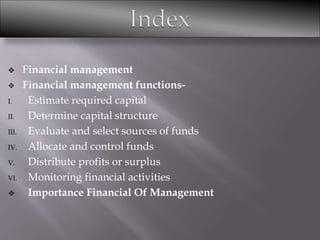
 Financial management
 Financial management functions-
I. Estimate required capital
II. Determine capital structure
III. Evaluate and select sources of funds
IV. Allocate and control funds
V. Distribute profits or surplus
VI. Monitoring financial activities
 Importance Financial Of Management
Financial management is the process of planning
funds, organizing available funds and controlling
financial activities to achieve the goal of an
organization It includes three important decisions
which are investment decisions, financing decision
and dividend decision for a specified period of time.
Investment decision includes working capital
decision and capital budgeting decision. Financing
decision involves identifying sources of financing,
determining the duration and cost of financing and
managing investment return.
 Example:
Company X is willing to introduce a new product.
For this, the CEO employs a financial manager to
perform all financial activities. Now the manager has
to identify the sources of funds needed for producing
the new product. Then he should determine and
evaluate the cost of financing. He will allocate the
fund using financial planning. And after gaining
profit he will distribute the profit to the designated
stakeholders.
 There are some core functions in the process of
financial management which are shown in a diagram
below:
Now we can see the functions in details which will
make us able to understand the purpose of these in
the process of financial management. Discussion
about these functions are given below:
 Estimate required capital: Financial managers’ first
duty is to forecast the amount of required capital.
There are several areas for using financial planning
and implementation such as establishment,
expansion, and modernization of business,
investment in fixed assets and meet daily working
capital requirements.
 Determine capital structure: After determining the
requirement of capital funds, a decision has to be
made regarding the type and proportion of different
sources of funds. At this stage, the financial manager
has to evaluate the appropriate mix of debt and
equity capital and various short and long-term debt
ratios. The main objective is to maximize
shareholders wealth with a minimum cost of capital.
 Evaluate and select sources of funds: the Financial
manager will have several options from which he can
raise capital for the company. He will choose that
option which will provide greater earning possibility
in less cost. He will compose leverage to maximizing
the shareholder’s value.
 Allocate and control funds: Financial manager
determine the necessary amount of funds in each of
financial area and allocate the funds accordingly.
Any change in the financial decision that increases or
decrease in allocated amount can be implemented at
times. The manager always tries to keep the standard
of the business firm.
 Distribute profits or surplus: After a certain time,
the business experience profits. Here management
decides whether to distribute the profits or retain it
for future use. Business can combine dividend and
retain earning to distribute the profits.
 Monitoring financial activities: the Financial
manager has to be remaining alert all the time about
financial activities and business position. Any flaws
in the financial aspect can affect the overall business
decision. So the manager should continuously
monitor the financial activities of the firm.
 The importance of financial management is vital to
an organization. It is a pathway to attain goals and
objectives. The financial manager measures
organizational efficiency through proper allocation,
acquisition, and management. It improves
operational efficiency by providing a timely supply
of fund. The following noticeable importance is
found from financial management:
I. Provides guidance in financial planning
II. Assist in acquiring funds from different sources
III. Helps in investing the appropriate amount of funds
IV. Increase organizational efficiency
V. Reduces delay production
VI. Cut down financial costs
VII. Reduces cost of fund
VIII. Ensures proper use of fund
IX. Helps business firm to take financial decisions
X. Control the financial aspects of the business
XI. Provide information through financial reporting
XII. Makes the employees aware of saving funds.

Financial management

  • 1.
    Topic – financialmanagement Submitted to- Dr. Komal Submitted By – Sandeep REG No.- 11700156 Class- Bsc. In health And Physical Education (6th sem.)
  • 2.
     Financial management Financial management functions- I. Estimate required capital II. Determine capital structure III. Evaluate and select sources of funds IV. Allocate and control funds V. Distribute profits or surplus VI. Monitoring financial activities  Importance Financial Of Management
  • 3.
    Financial management isthe process of planning funds, organizing available funds and controlling financial activities to achieve the goal of an organization It includes three important decisions which are investment decisions, financing decision and dividend decision for a specified period of time. Investment decision includes working capital decision and capital budgeting decision. Financing decision involves identifying sources of financing, determining the duration and cost of financing and managing investment return.
  • 4.
     Example: Company Xis willing to introduce a new product. For this, the CEO employs a financial manager to perform all financial activities. Now the manager has to identify the sources of funds needed for producing the new product. Then he should determine and evaluate the cost of financing. He will allocate the fund using financial planning. And after gaining profit he will distribute the profit to the designated stakeholders.
  • 5.
     There aresome core functions in the process of financial management which are shown in a diagram below:
  • 6.
    Now we cansee the functions in details which will make us able to understand the purpose of these in the process of financial management. Discussion about these functions are given below:  Estimate required capital: Financial managers’ first duty is to forecast the amount of required capital. There are several areas for using financial planning and implementation such as establishment, expansion, and modernization of business, investment in fixed assets and meet daily working capital requirements.
  • 7.
     Determine capitalstructure: After determining the requirement of capital funds, a decision has to be made regarding the type and proportion of different sources of funds. At this stage, the financial manager has to evaluate the appropriate mix of debt and equity capital and various short and long-term debt ratios. The main objective is to maximize shareholders wealth with a minimum cost of capital.
  • 8.
     Evaluate andselect sources of funds: the Financial manager will have several options from which he can raise capital for the company. He will choose that option which will provide greater earning possibility in less cost. He will compose leverage to maximizing the shareholder’s value.  Allocate and control funds: Financial manager determine the necessary amount of funds in each of financial area and allocate the funds accordingly. Any change in the financial decision that increases or decrease in allocated amount can be implemented at times. The manager always tries to keep the standard of the business firm.
  • 9.
     Distribute profitsor surplus: After a certain time, the business experience profits. Here management decides whether to distribute the profits or retain it for future use. Business can combine dividend and retain earning to distribute the profits.  Monitoring financial activities: the Financial manager has to be remaining alert all the time about financial activities and business position. Any flaws in the financial aspect can affect the overall business decision. So the manager should continuously monitor the financial activities of the firm.
  • 10.
     The importanceof financial management is vital to an organization. It is a pathway to attain goals and objectives. The financial manager measures organizational efficiency through proper allocation, acquisition, and management. It improves operational efficiency by providing a timely supply of fund. The following noticeable importance is found from financial management:
  • 11.
    I. Provides guidancein financial planning II. Assist in acquiring funds from different sources III. Helps in investing the appropriate amount of funds IV. Increase organizational efficiency V. Reduces delay production VI. Cut down financial costs VII. Reduces cost of fund VIII. Ensures proper use of fund IX. Helps business firm to take financial decisions X. Control the financial aspects of the business XI. Provide information through financial reporting XII. Makes the employees aware of saving funds.