CAMPUS CLOUD SHOW
IUT 2015
Md. Delwar Hossain
Adviser & Project Manager,
NerdDevs.
Skype: delwar_databiz
E-mail: twinkle_023020@yahoo.com
Linkedin: delwar-hossain
 Amount of data stored is on up & up.
 The data we store is more complex than 15 years ago.
 Agile development approaches
 Easy Distribution
 Not using the relational model
 Running well on clusters
 Mostly open-source
 Schema-less
 Key-Value
 Graph
 BigTable
 Document
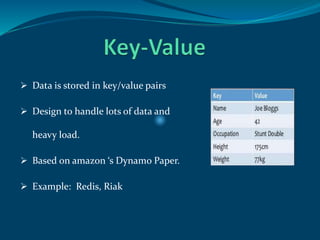
 Data is stored in key/value pairs
 Design to handle lots of data and
heavy load.
 Based on amazon ‘s Dynamo Paper.
 Example: Redis, Riak
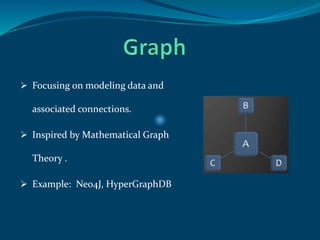
 Focusing on modeling data and
associated connections.
 Inspired by Mathematical Graph
Theory .
 Example: Neo4J, HyperGraphDB
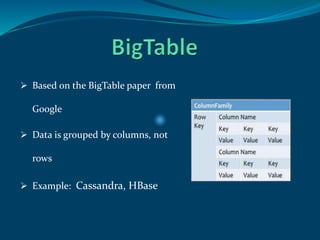
 Based on the BigTable paper from
Google
 Data is grouped by columns, not
rows
 Example: Cassandra, HBase
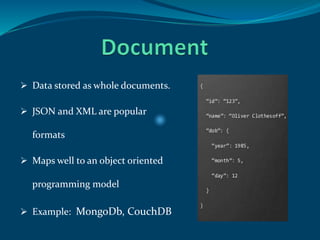
 Data stored as whole documents.
 JSON and XML are popular
formats
 Maps well to an object oriented
programming model
 Example: MongoDb, CouchDB
Lets try on ... … …
 Go to
http://docs.mongodb.org/manual/
 Create folder: datadb
 Set path:
C:mongodbbin
mongod.exe --dbpath yourdirectorydata
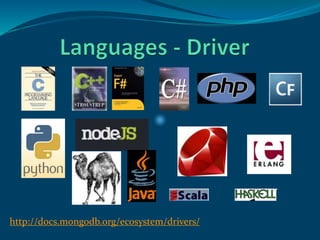
http://docs.mongodb.org/ecosystem/drivers/
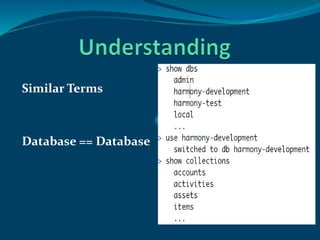
Similar Terms
Database == Database
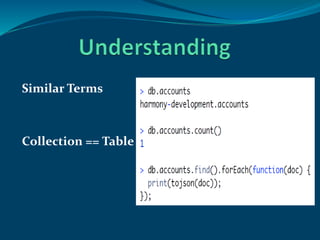
Similar Terms
Collection == Table
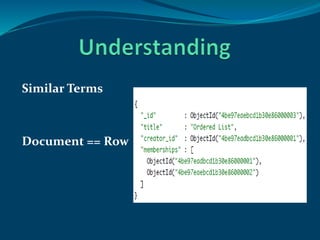
Similar Terms
Document == Row
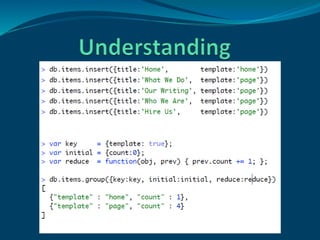
Dynamic Queries
http://docs.mongodb.org/manual/tutorial/query-documents/
http://www.mongodb.org/display/DOCS/Advanced+Queries
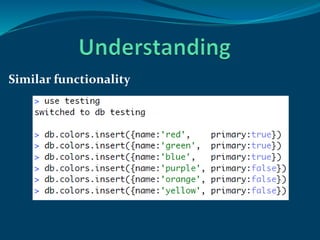
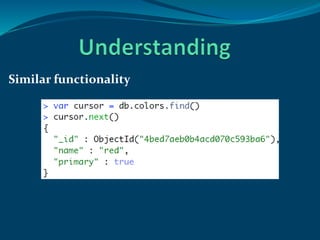
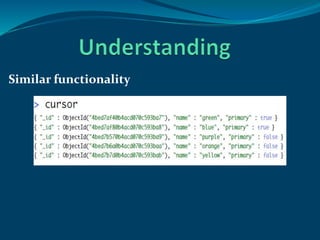
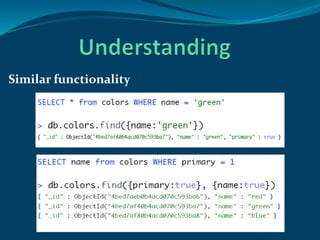
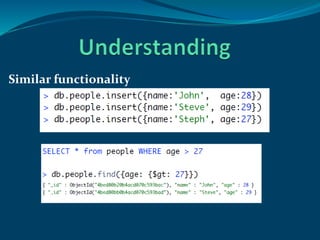
Similar functionality
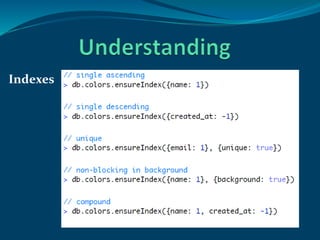
Indexes
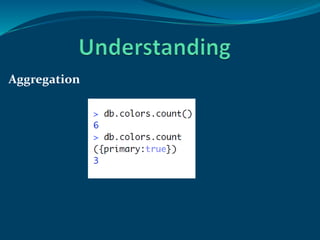
Aggregation
First Step in NoSql
First Step in NoSql

First Step in NoSql

Editor's Notes

  • #3 Introduction my self and ask question to audience How many are working in SQL? How many are already in NoSQL?
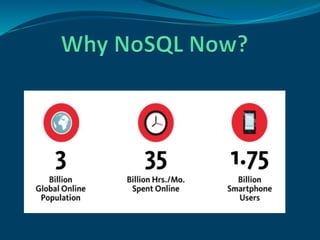
  • #4 Not long ago, 1,000 daily users of an application was a lot of users, and 10,000 was an extreme case.   Today, nearly 3 billion people are connected to the internet and the amount of time they spend online — about 35 billion hours a month in 2014 — is steadily growing, creating an explosion in the number of concurrent users.   It’s not uncommon for apps to have millions of different users a day, and must support global users 24 hours a day, 365 days a year. Large numbers of users combined with the dynamic nature of usage patterns is driving the need for more easily scalable database technology. With relational technologies, many application developers find it difficult, or even impossible, to get the dynamic scalability and level of scale they need while also maintaining the performance users demand. Ref: http://www.couchbase.com/nosql-resources/what-is-no-sql
  • #5  Large volumes of structured, semi-structured, and unstructured data Agile sprints, quick iteration, and frequent code pushes Object-oriented programming that is easy to use and flexible Efficient, scale-out architecture instead of expensive, monolithic architecture Ref: https://www.mongodb.com/nosql-explained
  • #6  NoSQL does not have a prescriptive definition but we can make a set of common observations, such as:
  • #7 NoSQL Database Types Document databases pair each key with a complex data structure known as a document. Documents can contain many different key-value pairs, or key-array pairs, or even nested documents. Graph stores are used to store information about networks, such as social connections. Graph stores include Neo4J and HyperGraphDB. Key-value stores are the simplest NoSQL databases. Every single item in the database is stored as an attribute name (or "key"), together with its value. Examples of key-value stores are Riak and Voldemort. Some key-value stores, such as Redis, allow each value to have a type, such as "integer", which adds functionality. Wide-column stores such as Cassandra and HBase are optimized for queries over large datasets, and store columns of data together, instead of rows.
  • #8 NoSQL Database Types Document databases pair each key with a complex data structure known as a document. Documents can contain many different key-value pairs, or key-array pairs, or even nested documents. Graph stores are used to store information about networks, such as social connections. Graph stores include Neo4J and HyperGraphDB. Key-value stores are the simplest NoSQL databases. Every single item in the database is stored as an attribute name (or "key"), together with its value. Examples of key-value stores are Riak and Voldemort. Some key-value stores, such as Redis, allow each value to have a type, such as "integer", which adds functionality. Wide-column stores such as Cassandra and HBase are optimized for queries over large datasets, and store columns of data together, instead of rows.
  • #9 NoSQL Database Types Document databases pair each key with a complex data structure known as a document. Documents can contain many different key-value pairs, or key-array pairs, or even nested documents. Graph stores are used to store information about networks, such as social connections. Graph stores include Neo4J and HyperGraphDB. Key-value stores are the simplest NoSQL databases. Every single item in the database is stored as an attribute name (or "key"), together with its value. Examples of key-value stores are Riak and Voldemort. Some key-value stores, such as Redis, allow each value to have a type, such as "integer", which adds functionality. Wide-column stores such as Cassandra and HBase are optimized for queries over large datasets, and store columns of data together, instead of rows.
  • #10 NoSQL Database Types Document databases pair each key with a complex data structure known as a document. Documents can contain many different key-value pairs, or key-array pairs, or even nested documents. Graph stores are used to store information about networks, such as social connections. Graph stores include Neo4J and HyperGraphDB. Key-value stores are the simplest NoSQL databases. Every single item in the database is stored as an attribute name (or "key"), together with its value. Examples of key-value stores are Riak and Voldemort. Some key-value stores, such as Redis, allow each value to have a type, such as "integer", which adds functionality. Wide-column stores such as Cassandra and HBase are optimized for queries over large datasets, and store columns of data together, instead of rows.
  • #11 NoSQL Database Types Document databases pair each key with a complex data structure known as a document. Documents can contain many different key-value pairs, or key-array pairs, or even nested documents. Graph stores are used to store information about networks, such as social connections. Graph stores include Neo4J and HyperGraphDB. Key-value stores are the simplest NoSQL databases. Every single item in the database is stored as an attribute name (or "key"), together with its value. Examples of key-value stores are Riak and Voldemort. Some key-value stores, such as Redis, allow each value to have a type, such as "integer", which adds functionality. Wide-column stores such as Cassandra and HBase are optimized for queries over large datasets, and store columns of data together, instead of rows.
  • #15 Documents are the main concept in document databases. The database stores and retrieves documents, which can be XML, JSON, BSON, and so on. These documents are self-describing, hierarchical tree data structures which can consist of maps, collections, and scalar values. The documents stored are similar to each other but do not have to be exactly the same. Document databases store documents in the value part of the key-value store; think about document databases as key-value stores where the value is examinable. Document databases such as MongoDB provide a rich query language and constructs such as database, indexes etc allowing for easier transition from relational databases. MongoDB stores data in the form of documents, which are JSON-like field and value pairs. Documents are analogous to structures in programming languages that associate keys with values (e.g. dictionaries, hashes, maps, and associative arrays). Formally, MongoDB documents are BSON documents. BSON is a binary representation of JSON with additional type information. In the documents, the value of a field can be any of the BSON data types, including other documents, arrays, and arrays of documents
  • #16 Documents are the main concept in document databases. The database stores and retrieves documents, which can be XML, JSON, BSON, and so on. These documents are self-describing, hierarchical tree data structures which can consist of maps, collections, and scalar values. The documents stored are similar to each other but do not have to be exactly the same. Document databases store documents in the value part of the key-value store; think about document databases as key-value stores where the value is examinable. Document databases such as MongoDB provide a rich query language and constructs such as database, indexes etc allowing for easier transition from relational databases. MongoDB stores data in the form of documents, which are JSON-like field and value pairs. Documents are analogous to structures in programming languages that associate keys with values (e.g. dictionaries, hashes, maps, and associative arrays). Formally, MongoDB documents are BSON documents. BSON is a binary representation of JSON with additional type information. In the documents, the value of a field can be any of the BSON data types, including other documents, arrays, and arrays of documents
  • #17 Documents are the main concept in document databases. The database stores and retrieves documents, which can be XML, JSON, BSON, and so on. These documents are self-describing, hierarchical tree data structures which can consist of maps, collections, and scalar values. The documents stored are similar to each other but do not have to be exactly the same. Document databases store documents in the value part of the key-value store; think about document databases as key-value stores where the value is examinable. Document databases such as MongoDB provide a rich query language and constructs such as database, indexes etc allowing for easier transition from relational databases. MongoDB stores data in the form of documents, which are JSON-like field and value pairs. Documents are analogous to structures in programming languages that associate keys with values (e.g. dictionaries, hashes, maps, and associative arrays). Formally, MongoDB documents are BSON documents. BSON is a binary representation of JSON with additional type information. In the documents, the value of a field can be any of the BSON data types, including other documents, arrays, and arrays of documents
  • #18 Documents are the main concept in document databases. The database stores and retrieves documents, which can be XML, JSON, BSON, and so on. These documents are self-describing, hierarchical tree data structures which can consist of maps, collections, and scalar values. The documents stored are similar to each other but do not have to be exactly the same. Document databases store documents in the value part of the key-value store; think about document databases as key-value stores where the value is examinable. Document databases such as MongoDB provide a rich query language and constructs such as database, indexes etc allowing for easier transition from relational databases. MongoDB stores data in the form of documents, which are JSON-like field and value pairs. Documents are analogous to structures in programming languages that associate keys with values (e.g. dictionaries, hashes, maps, and associative arrays). Formally, MongoDB documents are BSON documents. BSON is a binary representation of JSON with additional type information. In the documents, the value of a field can be any of the BSON data types, including other documents, arrays, and arrays of documents
  • #19 Documents are the main concept in document databases. The database stores and retrieves documents, which can be XML, JSON, BSON, and so on. These documents are self-describing, hierarchical tree data structures which can consist of maps, collections, and scalar values. The documents stored are similar to each other but do not have to be exactly the same. Document databases store documents in the value part of the key-value store; think about document databases as key-value stores where the value is examinable. Document databases such as MongoDB provide a rich query language and constructs such as database, indexes etc allowing for easier transition from relational databases. MongoDB stores data in the form of documents, which are JSON-like field and value pairs. Documents are analogous to structures in programming languages that associate keys with values (e.g. dictionaries, hashes, maps, and associative arrays). Formally, MongoDB documents are BSON documents. BSON is a binary representation of JSON with additional type information. In the documents, the value of a field can be any of the BSON data types, including other documents, arrays, and arrays of documents
  • #20 Documents are the main concept in document databases. The database stores and retrieves documents, which can be XML, JSON, BSON, and so on. These documents are self-describing, hierarchical tree data structures which can consist of maps, collections, and scalar values. The documents stored are similar to each other but do not have to be exactly the same. Document databases store documents in the value part of the key-value store; think about document databases as key-value stores where the value is examinable. Document databases such as MongoDB provide a rich query language and constructs such as database, indexes etc allowing for easier transition from relational databases. MongoDB stores data in the form of documents, which are JSON-like field and value pairs. Documents are analogous to structures in programming languages that associate keys with values (e.g. dictionaries, hashes, maps, and associative arrays). Formally, MongoDB documents are BSON documents. BSON is a binary representation of JSON with additional type information. In the documents, the value of a field can be any of the BSON data types, including other documents, arrays, and arrays of documents
  • #21 Documents are the main concept in document databases. The database stores and retrieves documents, which can be XML, JSON, BSON, and so on. These documents are self-describing, hierarchical tree data structures which can consist of maps, collections, and scalar values. The documents stored are similar to each other but do not have to be exactly the same. Document databases store documents in the value part of the key-value store; think about document databases as key-value stores where the value is examinable. Document databases such as MongoDB provide a rich query language and constructs such as database, indexes etc allowing for easier transition from relational databases. MongoDB stores data in the form of documents, which are JSON-like field and value pairs. Documents are analogous to structures in programming languages that associate keys with values (e.g. dictionaries, hashes, maps, and associative arrays). Formally, MongoDB documents are BSON documents. BSON is a binary representation of JSON with additional type information. In the documents, the value of a field can be any of the BSON data types, including other documents, arrays, and arrays of documents
  • #22 Documents are the main concept in document databases. The database stores and retrieves documents, which can be XML, JSON, BSON, and so on. These documents are self-describing, hierarchical tree data structures which can consist of maps, collections, and scalar values. The documents stored are similar to each other but do not have to be exactly the same. Document databases store documents in the value part of the key-value store; think about document databases as key-value stores where the value is examinable. Document databases such as MongoDB provide a rich query language and constructs such as database, indexes etc allowing for easier transition from relational databases. MongoDB stores data in the form of documents, which are JSON-like field and value pairs. Documents are analogous to structures in programming languages that associate keys with values (e.g. dictionaries, hashes, maps, and associative arrays). Formally, MongoDB documents are BSON documents. BSON is a binary representation of JSON with additional type information. In the documents, the value of a field can be any of the BSON data types, including other documents, arrays, and arrays of documents
  • #23 Documents are the main concept in document databases. The database stores and retrieves documents, which can be XML, JSON, BSON, and so on. These documents are self-describing, hierarchical tree data structures which can consist of maps, collections, and scalar values. The documents stored are similar to each other but do not have to be exactly the same. Document databases store documents in the value part of the key-value store; think about document databases as key-value stores where the value is examinable. Document databases such as MongoDB provide a rich query language and constructs such as database, indexes etc allowing for easier transition from relational databases. MongoDB stores data in the form of documents, which are JSON-like field and value pairs. Documents are analogous to structures in programming languages that associate keys with values (e.g. dictionaries, hashes, maps, and associative arrays). Formally, MongoDB documents are BSON documents. BSON is a binary representation of JSON with additional type information. In the documents, the value of a field can be any of the BSON data types, including other documents, arrays, and arrays of documents
  • #24 Documents are the main concept in document databases. The database stores and retrieves documents, which can be XML, JSON, BSON, and so on. These documents are self-describing, hierarchical tree data structures which can consist of maps, collections, and scalar values. The documents stored are similar to each other but do not have to be exactly the same. Document databases store documents in the value part of the key-value store; think about document databases as key-value stores where the value is examinable. Document databases such as MongoDB provide a rich query language and constructs such as database, indexes etc allowing for easier transition from relational databases. MongoDB stores data in the form of documents, which are JSON-like field and value pairs. Documents are analogous to structures in programming languages that associate keys with values (e.g. dictionaries, hashes, maps, and associative arrays). Formally, MongoDB documents are BSON documents. BSON is a binary representation of JSON with additional type information. In the documents, the value of a field can be any of the BSON data types, including other documents, arrays, and arrays of documents
  • #25 Documents are the main concept in document databases. The database stores and retrieves documents, which can be XML, JSON, BSON, and so on. These documents are self-describing, hierarchical tree data structures which can consist of maps, collections, and scalar values. The documents stored are similar to each other but do not have to be exactly the same. Document databases store documents in the value part of the key-value store; think about document databases as key-value stores where the value is examinable. Document databases such as MongoDB provide a rich query language and constructs such as database, indexes etc allowing for easier transition from relational databases. MongoDB stores data in the form of documents, which are JSON-like field and value pairs. Documents are analogous to structures in programming languages that associate keys with values (e.g. dictionaries, hashes, maps, and associative arrays). Formally, MongoDB documents are BSON documents. BSON is a binary representation of JSON with additional type information. In the documents, the value of a field can be any of the BSON data types, including other documents, arrays, and arrays of documents
  • #26 Documents are the main concept in document databases. The database stores and retrieves documents, which can be XML, JSON, BSON, and so on. These documents are self-describing, hierarchical tree data structures which can consist of maps, collections, and scalar values. The documents stored are similar to each other but do not have to be exactly the same. Document databases store documents in the value part of the key-value store; think about document databases as key-value stores where the value is examinable. Document databases such as MongoDB provide a rich query language and constructs such as database, indexes etc allowing for easier transition from relational databases. MongoDB stores data in the form of documents, which are JSON-like field and value pairs. Documents are analogous to structures in programming languages that associate keys with values (e.g. dictionaries, hashes, maps, and associative arrays). Formally, MongoDB documents are BSON documents. BSON is a binary representation of JSON with additional type information. In the documents, the value of a field can be any of the BSON data types, including other documents, arrays, and arrays of documents