AHMED HELMY (@HELMY204)
SOFTWARE ENGINEER | CSD | CSM
AHMEDHELMY204@HOTMAIL.COM
mongoDB
Getting Started
Agenda
• Intro
• Power of RDBMS
• Problems with RDBMS
• Solutions from NoSQL
• MongoDB Document Model
• Demo | MongoDB basic CRUD Operations
Power of RDBMS
• Default choice for serious data storage
• Specific Vendor
• Concurrency (ACID)
• Almost Standard
• Model
• Query Language
Share your
thoughts
Are there problems with RDBMS!
Big Data
• Websites tracking activities in a very detailed way
• Links, social networks, activity logs, etc…
• Require more computing resources
• Scaling up
• Scaling out (Clusters)
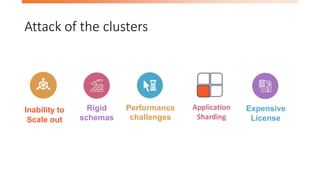
Attack of the clusters
Rigid
schemas
Inability to
Scale out
Performance
challenges
•Expensive
License
Application
Sharding
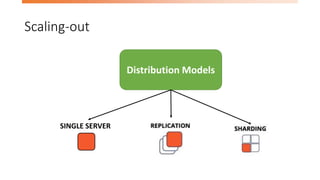
Scaling-out
Distribution Models
SINGLE SERVER
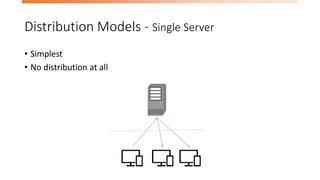
Distribution Models - Single Server
• Simplest
• No distribution at all
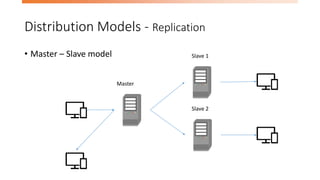
Distribution Models - Replication
• Master – Slave model
Master
Slave 1
Slave 2
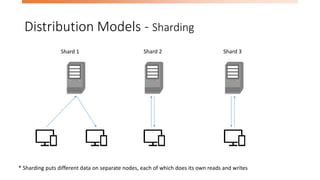
Distribution Models - Sharding
Shard 1 Shard 2 Shard 3
* Sharding puts different data on separate nodes, each of which does its own reads and writes
Impedance Mismatch
• Relational Model
• Tables, Columns, Rows, Relations
• We are developers
• OOP, Polymorphism, Inheritance
• Objects are not uniform
• Work around
• Mapping layer, ORMs
Id Name
1 Comp A
2 Comp B
Id Name
02 Cairo
03 Alexandria
CompanyId CityId
1 02
2 03
1 03
// application code
class Company { int Id; string Name; City[] Cities; }
Solution is
NoSQL
Google and Amazon
• Scale out (distributed ,clusters)
• BigTable, DynamoDB
What is NoSQL
• No Relational Model
• No SQL (some use others i.e. CQL)
• Schemaless
• BASE (Basically Available, Soft state, Eventual consistency) instead of ACID
• Distributed (Run on Clusters)
• Open-source
• Classified into four types
• Key-Value pair (Redis)
• Document (MongoDB)
• Column Family (Cassandra)
• Graph (neo4j)
Impedance Mismatch - Solution
• No Relational Model
• Tables, Columns, Rows, Relations
// application code
class Company { int Id; string Name; City[] Cities; }
// mongo document for Company
{
id: 1,
name: “Comp A”,
cities: [ “Cairo”, ”Alexandria” ]
}
MongoDB Document Model
• Consistency
• MongoDB database is configured by using replica sets
• Every write can specify the number of servers the write has to be propagated to
before it returns as successful
• Transactions
• Transactions involving more than one operation are possible (4.0+)
• Availability
• MongoDB implements replication, providing high availability using replica sets
• Scaling
• Sharding
• Replication
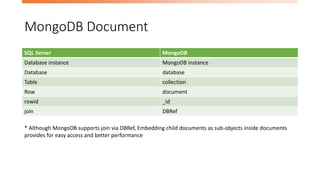
MongoDB Document
SQL Server MongoDB
Database instance MongoDB instance
Database database
Table collection
Row document
rowid _id
join DBRef
* Although MongoDB supports join via DBRef, Embedding child documents as sub-objects inside documents
provides for easy access and better performance
Use cases
• Event Logging
• CMS, Blogs
• Web analytics
• E-commerce
Using compass for CRUD operations
Demo
Questions
Summary
• RDBMS pros and cons
• Solutions from NoSQL
• MongoDB Document Model
• Demo
References
• NoSQL Distilled
• https://martinfowler.com/books/nosql.html
• Understanding NoSQL
• https://www.pluralsight.com/courses/understanding-nosql
Thank you

MongoDB - Getting Started

  • 1.
    AHMED HELMY (@HELMY204) SOFTWAREENGINEER | CSD | CSM AHMEDHELMY204@HOTMAIL.COM mongoDB Getting Started
  • 2.
    Agenda • Intro • Powerof RDBMS • Problems with RDBMS • Solutions from NoSQL • MongoDB Document Model • Demo | MongoDB basic CRUD Operations
  • 3.
    Power of RDBMS •Default choice for serious data storage • Specific Vendor • Concurrency (ACID) • Almost Standard • Model • Query Language
  • 4.
    Share your thoughts Are thereproblems with RDBMS!
  • 5.
    Big Data • Websitestracking activities in a very detailed way • Links, social networks, activity logs, etc… • Require more computing resources • Scaling up • Scaling out (Clusters)
  • 6.
    Attack of theclusters Rigid schemas Inability to Scale out Performance challenges •Expensive License Application Sharding
  • 7.
  • 8.
    Distribution Models -Single Server • Simplest • No distribution at all
  • 9.
    Distribution Models -Replication • Master – Slave model Master Slave 1 Slave 2
  • 10.
    Distribution Models -Sharding Shard 1 Shard 2 Shard 3 * Sharding puts different data on separate nodes, each of which does its own reads and writes
  • 11.
    Impedance Mismatch • RelationalModel • Tables, Columns, Rows, Relations • We are developers • OOP, Polymorphism, Inheritance • Objects are not uniform • Work around • Mapping layer, ORMs Id Name 1 Comp A 2 Comp B Id Name 02 Cairo 03 Alexandria CompanyId CityId 1 02 2 03 1 03 // application code class Company { int Id; string Name; City[] Cities; }
  • 12.
    Solution is NoSQL Google andAmazon • Scale out (distributed ,clusters) • BigTable, DynamoDB
  • 13.
    What is NoSQL •No Relational Model • No SQL (some use others i.e. CQL) • Schemaless • BASE (Basically Available, Soft state, Eventual consistency) instead of ACID • Distributed (Run on Clusters) • Open-source • Classified into four types • Key-Value pair (Redis) • Document (MongoDB) • Column Family (Cassandra) • Graph (neo4j)
  • 14.
    Impedance Mismatch -Solution • No Relational Model • Tables, Columns, Rows, Relations // application code class Company { int Id; string Name; City[] Cities; } // mongo document for Company { id: 1, name: “Comp A”, cities: [ “Cairo”, ”Alexandria” ] }
  • 15.
    MongoDB Document Model •Consistency • MongoDB database is configured by using replica sets • Every write can specify the number of servers the write has to be propagated to before it returns as successful • Transactions • Transactions involving more than one operation are possible (4.0+) • Availability • MongoDB implements replication, providing high availability using replica sets • Scaling • Sharding • Replication
  • 16.
    MongoDB Document SQL ServerMongoDB Database instance MongoDB instance Database database Table collection Row document rowid _id join DBRef * Although MongoDB supports join via DBRef, Embedding child documents as sub-objects inside documents provides for easy access and better performance
  • 17.
    Use cases • EventLogging • CMS, Blogs • Web analytics • E-commerce
  • 18.
    Using compass forCRUD operations Demo
  • 19.
  • 20.
    Summary • RDBMS prosand cons • Solutions from NoSQL • MongoDB Document Model • Demo
  • 21.
    References • NoSQL Distilled •https://martinfowler.com/books/nosql.html • Understanding NoSQL • https://www.pluralsight.com/courses/understanding-nosql
  • 22.

Editor's Notes

  • #6 Attack of the clusters Big data Websites tracking activities in a very detailed way Links, social networks, activity logs, etc… Require more computing resources Scaling up Scaling out (Clusters) Relational databases are not designed to be run on clusters Relational sharding has to be controlled by the application Relational on clusters has high license prices
  • #7 Attack of the clusters Big data Websites tracking activities in a very detailed way Links, social networks, activity logs, etc… Require more computing resources Scaling up Scaling out (Clusters) Relational databases are not designed to be run on clusters Relational sharding has to be controlled by the application Relational on clusters has high license prices
  • #10 One node is the master or primary Master used to update data Slave nodes used for scaling read requests horizontally If Master fails, the slaves can still handle read request Slave can act as a hot backup
  • #11 Horizontal Scalability Putting different parts of the data onto different servers Each node does its own reads and writes Improve performance Can place the data close to where it’s being accessed Many NoSQL databases offers auto-sharding
  • #14 NoSQL databases known by it’s characteristics Not using Relational Model Not using SQL (some use others i.e. CQL) Schemaless BASE (Basically Available, Soft state, Eventual consistency) instead of ACID Distributed (Run on Clusters) Open-source Classified into four types Key-Value pair Document Column Family Graph
  • #15 NoSQL databases known by it’s characteristics Not using Relational Model Not using SQL (some use others i.e. CQL) Schemaless BASE (Basically Available, Soft state, Eventual consistency) instead of ACID Distributed (Run on Clusters) Open-source Classified into four types Key-Value pair Document Column Family Graph
  • #16 Consistency MongoDB database is configured by using replica sets Every write can specify the number of servers the write has to be propagated to before it returns as successful You can increase the w value for stronger consistency but will suffer on write performance Transactions Transactions involving more than one operation are possible (4.0+) Availability MongoDB implements replication, providing high availability using replica sets Scaling Sharding Replication