Improvement of NoSQL Technology for Relational DatabasesTsendsurenMunkhdalaitwitter: @tsendeemts
ContentsLimitation of relational databaseNoSQL technologyTypes of NoSQL databaseConclusion
Nowadays, statement of dataLarge dataSome data generatorsFacebook photos +25TB/weekTwitter +7TB/dayFlickr +21GB/hourData size is repeatedly increased every yearNot structured dataNew kinds of applications are growing upSuch as Web 2.0, Enterprise applications and Cloud computingThey needed not structured dataThere are many no structured data generators
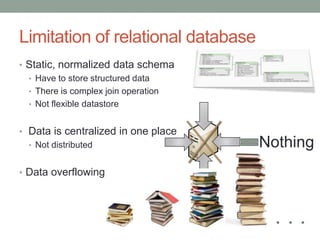
Limitation of relational databaseStatic, normalized data schemaHave to store structured dataThere is complex join operationNot flexible datastore Data is centralized in one placeNot distributedData overflowingNothing
NoSQL technologyNoSQL: Not Only SQLHandle huge amount of data at full speedDistributedNatively support clusteringHave Map/Reduce mechanismSupport replication and shardingSchema freeMore flexibleHave hashing and B-tree indexingThere are four types of NoSQL databases
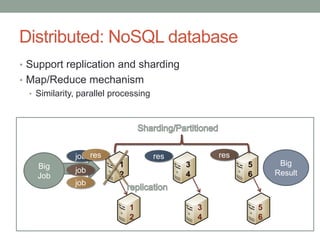
Distributed: NoSQL databaseSupport replication and shardingMap/Reduce mechanismSimilarity, parallel processingSharding/PartitionedresresBig ResultresjobBig JobData123456jobjobreplication345612
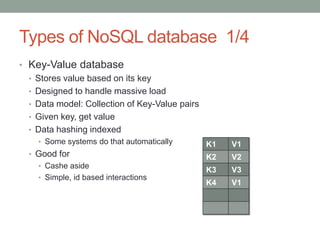
Types of NoSQL database  1/4 Key-Value databaseStores value based on its keyDesigned to handle massive loadData model: Collection of Key-Value pairsGiven key, get valueData hashing indexedSome systems do that automaticallyGood for Cashe asideSimple, id based interactions
Types of NoSQL database  2/4Column oriented databaseColumn oriented Relational databaseTables similarly to RDBMS, but handles semi-structuredEach row can have a different number of columnsTable is sparse Columns are dynamic
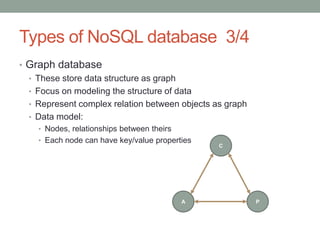
Types of NoSQL database  3/4 Graph databaseThese store data structure as graphFocus on modeling the structure of data Represent complex relation between objects as graphData model:Nodes, relationships between theirsEach node can have key/value propertiesCPA
Types of NoSQL database  4/4Document databaseStores data as documentMore complex Key-Value databaseData model: Collection of Key-Value, collections as JSON or XML types document{   “name” : “Lady Gaga”,   “ssn” : “213445”,   “hobbies” : [“Dressing up”, “Singing”],   “albums” : [{“name” : “The fame”   “release_year” : “2008”},   {“name” : “Born this away”   “release_year” : “2011”}]}{     {….}}{     {….}}
Some statisticFacebook searchMySQL > 50 GB DataWrites Average : ~300 msReads Average : ~350 msRewritten with Cassandra (NoSQL) > 50 GB DataWrites Average : 0.12 msReads Average : 15 ms
Who uses NoSQL ?Big Data         Big data Analysis
ConclusionNoSQL databasesData process quite faster than relational databaseDistributedDynamically determine new attributesCheapMostly, open sourceHave natively clustering, don’t need supercomputer (Expensive)Map/Reduce mechanism is providedHave B-tree and hashing indexing
Thank You

Improvement of no sql technology for relational databases v2

  • 1.
    Improvement of NoSQLTechnology for Relational DatabasesTsendsurenMunkhdalaitwitter: @tsendeemts
  • 2.
    ContentsLimitation of relationaldatabaseNoSQL technologyTypes of NoSQL databaseConclusion
  • 3.
    Nowadays, statement ofdataLarge dataSome data generatorsFacebook photos +25TB/weekTwitter +7TB/dayFlickr +21GB/hourData size is repeatedly increased every yearNot structured dataNew kinds of applications are growing upSuch as Web 2.0, Enterprise applications and Cloud computingThey needed not structured dataThere are many no structured data generators
  • 4.
    Limitation of relationaldatabaseStatic, normalized data schemaHave to store structured dataThere is complex join operationNot flexible datastore Data is centralized in one placeNot distributedData overflowingNothing
  • 5.
    NoSQL technologyNoSQL: NotOnly SQLHandle huge amount of data at full speedDistributedNatively support clusteringHave Map/Reduce mechanismSupport replication and shardingSchema freeMore flexibleHave hashing and B-tree indexingThere are four types of NoSQL databases
  • 6.
    Distributed: NoSQL databaseSupportreplication and shardingMap/Reduce mechanismSimilarity, parallel processingSharding/PartitionedresresBig ResultresjobBig JobData123456jobjobreplication345612
  • 7.
    Types of NoSQLdatabase 1/4 Key-Value databaseStores value based on its keyDesigned to handle massive loadData model: Collection of Key-Value pairsGiven key, get valueData hashing indexedSome systems do that automaticallyGood for Cashe asideSimple, id based interactions
  • 8.
    Types of NoSQLdatabase 2/4Column oriented databaseColumn oriented Relational databaseTables similarly to RDBMS, but handles semi-structuredEach row can have a different number of columnsTable is sparse Columns are dynamic
  • 9.
    Types of NoSQLdatabase 3/4 Graph databaseThese store data structure as graphFocus on modeling the structure of data Represent complex relation between objects as graphData model:Nodes, relationships between theirsEach node can have key/value propertiesCPA
  • 10.
    Types of NoSQLdatabase 4/4Document databaseStores data as documentMore complex Key-Value databaseData model: Collection of Key-Value, collections as JSON or XML types document{ “name” : “Lady Gaga”, “ssn” : “213445”, “hobbies” : [“Dressing up”, “Singing”], “albums” : [{“name” : “The fame” “release_year” : “2008”}, {“name” : “Born this away” “release_year” : “2011”}]}{ {….}}{ {….}}
  • 11.
    Some statisticFacebook searchMySQL> 50 GB DataWrites Average : ~300 msReads Average : ~350 msRewritten with Cassandra (NoSQL) > 50 GB DataWrites Average : 0.12 msReads Average : 15 ms
  • 12.
    Who uses NoSQL?Big Data Big data Analysis
  • 13.
    ConclusionNoSQL databasesData processquite faster than relational databaseDistributedDynamically determine new attributesCheapMostly, open sourceHave natively clustering, don’t need supercomputer (Expensive)Map/Reduce mechanism is providedHave B-tree and hashing indexing
  • 14.

Editor's Notes

  • #2 Hello everyone, I’m tsendee from Database/Bioinformatics lab, Chungbuk national university. Welcome to today’s my presentation. I will try to talk improvement of NoSQL technology for relational databases. It is topic of my paper. Ok let’s begin.
  • #3 -> I am going to introduce contents of my presentation-> First I will describe limitation of relational database, in this section we present what are there limitations of relational database for today’s data.-> NoSQL technology, this is our primary section. I will give you what is actually NoSQL what does NoSQL do that is better than relational databases.-> and there are a several types of nosql, that is presented in types of nosql section.-> Finally I will conclude to my presentation
  • #4 -> We consider two things those would recently be features for data science-> Large volume of data was generated, there are a number of huge data generators Here showed some data generators, for example facebook photos are increased by twenty five terrabyteseveryweek , size of twitter database is increased by seven terrabytes per one day, so big data that is one special point for data science and data management system.-> Next thing is not structureddata there is not structured data everywhere
  • #5 -> Now, I’m going to talk about limitation aspects of relational database.-> schema consists of tables and theirs relations, already we designed a schema , next time we difficulty modify the schema. So schema is hard. You have to store structured data, Your data must fit a table. After did that datastore can be more complex or not flexible-> data centralized in one place, not distributed depend on ACID property, join operation. There is one node failure. If the node fail, entire system That is big problem for developer.
  • #6 -> So some problems fail in RDBMS,NoSQL technology aimed to improve relational database. That is one kind of database.-> NoSQL is standing Not Only SQL, -> Itcan handle huge amount of data at full speed. -> because such databases work well distributed over multiple nodes in a cluster.-> these are explained in next slide-> Schema free, At any time we can define new attribute for object in NoSQL database so it is more flexible-> There are four types of NoSQL databases according their data model. after some slide I will give you in more detailed
  • #7 -> Sharding: big data is partitioned over individual nodes in cluster, those are connected in network-> replication: it means multiple write, same data, that is written on more than one nodes. There is not one node failure if a master computer failed then system automatically chooses another the data replicated computer.-> map/reduce mechanism consist of two phase first one is map next phase is reduce. In some case We need to process big job. We can easily do the big job by using map/reduce mechanism. This our big job Firstly, the big job is separated into a several small sections and distributed over nodes then these are processed on each nodes now we have small results finally bring to big result by combining to them, final process is called reduce the other one is map phase.