3rd FIVE YEAR PLAN
(1961-1966)
BY: SHUBHANSHU SINGHAI
AMITY UNIVERSITY, RAJASTHAN
A BRIEF TO ECONOMIC PLANNING
What is Economic Planning?
 It is the most systematic technique for redressing all economic
ills.
 Economic Planning is to make decision with respect to the use of
resources.
 Economic Planning is a term used to describe the long term plans
of government to co-ordinate and develop the economy.
 Economic planning in India was stared in 1950 is necessary for
economic development and economic growth.
NEED OF ECONOMIC PLANNING
 Mess Poverty And Low Per Capita Income
 High Rate of Growth of Population
 Low Level of Literacy
 Backward Technology
 Social And Economic Problem Created By Partition Of
Country
INTRODUCTION TO 3rd YEAR PLAN
 The Third Five Year Plan seeks to give a more precise
content to the social objectives of the Constitution and
represents a large advance towards their realisation.
 It takes account of the successes and the failures in the
first two Plans and sets the tasks to be fulfilled in the
perspective of development over the next fifteen years and
more.
• By the beginning of the third plan, the Indian planners
felt that the Indian economy had entered the “Take Off
Stage”
• The first two plans had generated an institutional
structure needed for rapid economic development.
• Its goal is to establish a self reliant and self generating
economy.
• The Third Plan had given top priority to Agriculture.
• It also laid adequate emphasis on the development of
basic industries vitally necessary for rapid economic
development.
• Later the approach of the third plan was shifted from
development to Defence & Development (because of
Indo-China War in 1962 and Indo-Pak War in 1965)
SIZE & SECTORAL DISTRIBUTION OF
FINANCIAL OUTLAY
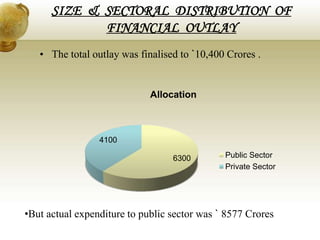
• The total outlay was finalised to `10,400 Crores .
6300
4100
Allocation
Public Sector
Private Sector
•But actual expenditure to public sector was ` 8577 Crores
DISTRIBUTION OF PUBLIC SECTOR OUTLAY
(IN CRORES)
S.N
O
HEADS ACTUAL
EXPENDITU
RE
PERCENTA
GES
1 Agriculture and community development 1,089 12.7
2 Major and minor irrigation 664 7.7
3 Power 1,252 14.6
4 Village and small industries 241 2.8
5 Organised industry and mining 1,726 20.1
6 Transport and communication 2,112 24.7
7 Social services and miscellanious 1,493 14.4
Total 8,577 100.0
OBJECTIVES OF THE PLAN
Gives more
Stress to
Agriculture
Subsidies
Sufficient Help
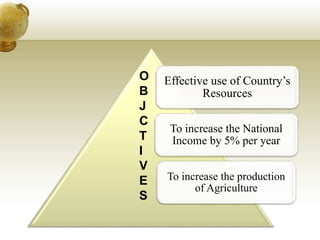
Effective use of Country’s
Resources
To increase the National
Income by 5% per year
To increase the production
of Agriculture
O
B
J
C
T
I
V
E
S
To expand basic
industries like Steel,
Chemical etc.
Employment
Generation
To establish equality
among all the people
of the country
Agricultural Development & Third Year Plan
 A sum of `2110 Crore allotted to Agriculture and Irrigation.
 The foodgrains target was 100 million tonnes.
 The third plan stressed on agriculture and improving
production of wheat.
 Punjab began producing an abundance of wheat.
POPULATION POLICY & THIRD PLAN
 The plan stated clearly the objective of stablishing the
growth of population should be the central future of
planning.
 The Family Planning programme has to be adopted as the
principle measure.
 `25 Crores allotted for the expenditure on family planning
.
 The programme was to be extended through “Clinical-
cum-Extension” approach.
There was a arrangement of health visitors
to move from house to house to impress
upon the minds of married couples
It emphasize the need:
for educating the people through various media
To convince them to accept the norms of the small
family size.
SMALL SCALE INDUSTRIES IN THIRD PLAN
The main objectives of the small industries
programme in this plan were:
To improve the productivity of the workers
To enlarge the availability of institutional finance
To pay special attention to the growth of small
industries in rural areas and small towns
By offering subsidies, sales rebate and sheltered
markets, they were made ancillary to large scale
industries
EMPLOYMENT GENERATION SCHEMES
IN THIRD PLAN
 The Rural Work Programme was made to generate the
employment.
 This programme was intended to utilise to the fullest
extent the Man-power resources of the country.
 It also ensures the substantial expansion in employment
opportunities.
ACHIEVEMENTS
 Role of the states increased and they were given more
prominence.
 Many primary schools had started functioning in the village
areas.
 The state governments were entrusted with the responsibility
of constructing roads.
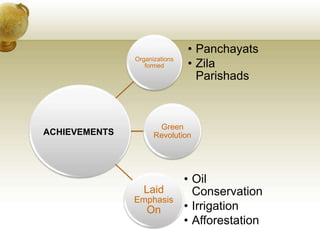
Organizations
formed
• Panchayats
• Zila
Parishads
Green
Revolution
Laid
Emphasis
On
• Oil
Conservation
• Irrigation
• Afforestation
ACHIEVEMENTS
ACHIEVEMENTS
• There was formation of state electricity boards.
• Various bodies looking into matters related to
secondary education were also formed.
• Some of the important industries for say Machine
tools, Machine building, Cement, Paper & Pulp,
Sugar, Cotton Textile, Coal Mining etc were
expanded substantially.
Achievements
Many fertilizer
& Cement
plants were built
Decentralization
Petro-Chemical
Industries were
set up
Good progress
in Import
Substitution
Programme
FAILURES OF THIRD YEAR PLAN
 There were number of finanical difficulties
 Foreign exchange crisis
 Adverse weather
 Chinese aggression and indo pakistan war
 Annual average growth rate was just 4%[Target of 5%]
 National income increased only by 12%
FAILURES OF THIRD PLAN
 Agricultural production increased by only 2.8[target 5.4%]
 Industrial production increased by 7.8%[Target of 11% per
annum]
 Fall in agricultural production from 82 million tones to 72
million tones
 The brief Sino-Indian War of 1962 exposed weaknesses in
the economy and shifted the focus towards the Defence
industry from Agriculture
PROBLEMS FACED BY THIRD PLAN
 Due to the Sino Indian War, India witnessed increase in
price of products. The resulting inflation was cost push in
nature.
 The third plan stressed on agriculture and improving
production of wheat, but the brief Sino-Indian War of
1962 exposed weaknesses in the economy and shifted the
focus towards the Defence industry.
CONCLUSION
 The Third Plan of India accorded greatest importance to
the achievement of a balanced reasonal development.
 This Plan realised the need for a balanced approach and
thus gave importance on of the development of
Agriculture and rapid industrialisation through the
promotion and development of heavy industries.
CONCLUSION
 The country had to face a lot of hurdles during the plan,
thus the launching of Fourth Plan was delayed by 3 Years
(1966-99) three ad-hog annual plans were continued.
 When the 1st five year plan was introduced people were
slightly apprehensive about the success of the plan. So,
when it was discovered that the 1st and the 2nd five year
plans were successful, people pinned their hopes on the
next five year plan but the result was disappointing.

3rd Five Year Plan (1961-1966)

  • 1.
    3rd FIVE YEARPLAN (1961-1966) BY: SHUBHANSHU SINGHAI AMITY UNIVERSITY, RAJASTHAN
  • 2.
    A BRIEF TOECONOMIC PLANNING What is Economic Planning?  It is the most systematic technique for redressing all economic ills.  Economic Planning is to make decision with respect to the use of resources.  Economic Planning is a term used to describe the long term plans of government to co-ordinate and develop the economy.  Economic planning in India was stared in 1950 is necessary for economic development and economic growth.
  • 3.
    NEED OF ECONOMICPLANNING  Mess Poverty And Low Per Capita Income  High Rate of Growth of Population  Low Level of Literacy  Backward Technology  Social And Economic Problem Created By Partition Of Country
  • 4.
    INTRODUCTION TO 3rdYEAR PLAN  The Third Five Year Plan seeks to give a more precise content to the social objectives of the Constitution and represents a large advance towards their realisation.  It takes account of the successes and the failures in the first two Plans and sets the tasks to be fulfilled in the perspective of development over the next fifteen years and more.
  • 5.
    • By thebeginning of the third plan, the Indian planners felt that the Indian economy had entered the “Take Off Stage” • The first two plans had generated an institutional structure needed for rapid economic development. • Its goal is to establish a self reliant and self generating economy.
  • 6.
    • The ThirdPlan had given top priority to Agriculture. • It also laid adequate emphasis on the development of basic industries vitally necessary for rapid economic development. • Later the approach of the third plan was shifted from development to Defence & Development (because of Indo-China War in 1962 and Indo-Pak War in 1965)
  • 7.
    SIZE & SECTORALDISTRIBUTION OF FINANCIAL OUTLAY • The total outlay was finalised to `10,400 Crores . 6300 4100 Allocation Public Sector Private Sector •But actual expenditure to public sector was ` 8577 Crores
  • 8.
    DISTRIBUTION OF PUBLICSECTOR OUTLAY (IN CRORES) S.N O HEADS ACTUAL EXPENDITU RE PERCENTA GES 1 Agriculture and community development 1,089 12.7 2 Major and minor irrigation 664 7.7 3 Power 1,252 14.6 4 Village and small industries 241 2.8 5 Organised industry and mining 1,726 20.1 6 Transport and communication 2,112 24.7 7 Social services and miscellanious 1,493 14.4 Total 8,577 100.0
  • 9.
    OBJECTIVES OF THEPLAN Gives more Stress to Agriculture Subsidies Sufficient Help
  • 10.
    Effective use ofCountry’s Resources To increase the National Income by 5% per year To increase the production of Agriculture O B J C T I V E S
  • 11.
    To expand basic industrieslike Steel, Chemical etc. Employment Generation To establish equality among all the people of the country
  • 12.
    Agricultural Development &Third Year Plan  A sum of `2110 Crore allotted to Agriculture and Irrigation.  The foodgrains target was 100 million tonnes.  The third plan stressed on agriculture and improving production of wheat.  Punjab began producing an abundance of wheat.
  • 13.
    POPULATION POLICY &THIRD PLAN  The plan stated clearly the objective of stablishing the growth of population should be the central future of planning.  The Family Planning programme has to be adopted as the principle measure.  `25 Crores allotted for the expenditure on family planning .  The programme was to be extended through “Clinical- cum-Extension” approach.
  • 14.
    There was aarrangement of health visitors to move from house to house to impress upon the minds of married couples It emphasize the need: for educating the people through various media To convince them to accept the norms of the small family size.
  • 15.
    SMALL SCALE INDUSTRIESIN THIRD PLAN The main objectives of the small industries programme in this plan were: To improve the productivity of the workers To enlarge the availability of institutional finance To pay special attention to the growth of small industries in rural areas and small towns By offering subsidies, sales rebate and sheltered markets, they were made ancillary to large scale industries
  • 16.
    EMPLOYMENT GENERATION SCHEMES INTHIRD PLAN  The Rural Work Programme was made to generate the employment.  This programme was intended to utilise to the fullest extent the Man-power resources of the country.  It also ensures the substantial expansion in employment opportunities.
  • 17.
    ACHIEVEMENTS  Role ofthe states increased and they were given more prominence.  Many primary schools had started functioning in the village areas.  The state governments were entrusted with the responsibility of constructing roads.
  • 18.
    Organizations formed • Panchayats • Zila Parishads Green Revolution Laid Emphasis On •Oil Conservation • Irrigation • Afforestation ACHIEVEMENTS
  • 19.
    ACHIEVEMENTS • There wasformation of state electricity boards. • Various bodies looking into matters related to secondary education were also formed. • Some of the important industries for say Machine tools, Machine building, Cement, Paper & Pulp, Sugar, Cotton Textile, Coal Mining etc were expanded substantially.
  • 20.
    Achievements Many fertilizer & Cement plantswere built Decentralization Petro-Chemical Industries were set up Good progress in Import Substitution Programme
  • 21.
    FAILURES OF THIRDYEAR PLAN  There were number of finanical difficulties  Foreign exchange crisis  Adverse weather  Chinese aggression and indo pakistan war  Annual average growth rate was just 4%[Target of 5%]  National income increased only by 12%
  • 22.
    FAILURES OF THIRDPLAN  Agricultural production increased by only 2.8[target 5.4%]  Industrial production increased by 7.8%[Target of 11% per annum]  Fall in agricultural production from 82 million tones to 72 million tones  The brief Sino-Indian War of 1962 exposed weaknesses in the economy and shifted the focus towards the Defence industry from Agriculture
  • 23.
    PROBLEMS FACED BYTHIRD PLAN  Due to the Sino Indian War, India witnessed increase in price of products. The resulting inflation was cost push in nature.  The third plan stressed on agriculture and improving production of wheat, but the brief Sino-Indian War of 1962 exposed weaknesses in the economy and shifted the focus towards the Defence industry.
  • 24.
    CONCLUSION  The ThirdPlan of India accorded greatest importance to the achievement of a balanced reasonal development.  This Plan realised the need for a balanced approach and thus gave importance on of the development of Agriculture and rapid industrialisation through the promotion and development of heavy industries.
  • 25.
    CONCLUSION  The countryhad to face a lot of hurdles during the plan, thus the launching of Fourth Plan was delayed by 3 Years (1966-99) three ad-hog annual plans were continued.  When the 1st five year plan was introduced people were slightly apprehensive about the success of the plan. So, when it was discovered that the 1st and the 2nd five year plans were successful, people pinned their hopes on the next five year plan but the result was disappointing.