International Journal of Trend in Scientific Research and Development (IJTSRD)
Volume 3 Issue 5, August 2019 Available Online: www.ijtsrd.com e-ISSN: 2456 – 6470
@ IJTSRD | Unique Paper ID – IJTSRD27854 | Volume – 3 | Issue – 5 | July - August 2019 Page 2101
Fire Fighting Robot System
Khin Thandar Tun1, Hay Man Oo1, Su Mon Aung2
1Lecturer, 2Assistant Lecturer
1,2Department of Electronic Engineering, Technological University, Meiktila, Myanmar
How to cite this paper: KhinThandarTun
| Hay Man Oo | Su Mon Aung "Fire
Fighting Robot System" Published in
International Journal
of Trend in Scientific
Research and
Development
(ijtsrd), ISSN: 2456-
6470, Volume-3 |
Issue-5, August
2019,pp.2101-2105,
https://doi.org/10.31142/ijtsrd27854
Copyright © 2019 by author(s) and
International Journal ofTrend inScientific
Research and Development Journal. This
is an Open Access article distributed
under the terms of
the Creative
Commons Attribution
License (CC BY 4.0)
(http://creativecommons.org/licenses/by
/4.0)
ABSTRACT
Increasing human population and technological development has led to
increase in fire accidents and hazards. Adverse conditions and physical
limitations of human being make fire extinguishing challenging and
demanding task. Fire extinguishing is very risky task and itinvolves loss oflife.
Robotics is the emerging solution to protect the surrounding andhumanlives.
Fire extinguishing robot is a hardware model which is used for extinguishing
the fire during fire accidents. It reduces the errors and limitations faced by the
humans during fire extinguishing task. In this paper includes Arduino UNO,
fire sensor, servo motor, motor driver, water level sensor and water pump.
The vehicle consists of a water tank along with a pump which throws water
when needed. The system uses an Arduino UNO microcontrollerboardforthis
purpose. The fire sensor on the vehicle is used to receive the amount of fire.
These values are used to find the location of the fire. These are then fed to the
motors responsible for controlling the vehicle movements in front, back, left
and right directions. The fire sensor is interfaced with an Arduino UNO
microcontroller for this purpose. The microcontroller after receiving input
commands operates the motors through a motor driver for vehicle
movements. It also uses a water pump which is used to spray water with a
desired pressure.
KEYWORDS: Arduino UNO, C Programming, Sensors,Waterpump, Motors,L293D
motor driver
I. INTRODUCTION
With the ever increasing technology, the developments are
increasing in the face of the situations that cause human life.
Every day, the robot industry emerges as a model that is
produced as an alternative to human element in a new
branch. Flying, robots, wheeled robots, legged robots;
underwater robots are just some of them. The growing
world population is bringing involuntary problems together.
Fires are among the most important of these problems.
Robot industry has a lot of work in this area.Robotis defined
as a mechanical design that is capable of performing human
tasks or behaving in a human like manner. As the robotic
field is developed a lot, human interaction is made less and
the robots are widely used for the purpose of safely. Fire
accidents have become common in day to day life and
sometimes it leads to dangerous problemwhich isharder for
the fireman for protecting the human life. In order to avoid
these cases, this robot is used to guard human lives,
surrounding, and wealth from the fire accidents. For
engineering students, who are interesting in robotics, this
fire fighting? Robot system is anadvanced system.Buildinga
robot requires expertise and complex programming. This
robot implements the concepts of environmental fire
sensing, proportional motor control. The motor driver is
used for the bidirectional control of the motors equipped in
the robot. Every instruction formotioncontrolisgiventothe
robot with the help of Arduino technology. The
programming of the robot is doneusingtheArduinowhichis
derived from C and C++ languages and the operating voltage
of the controller is 5V and the clock speed is 16MHz. And the
water level sensor is used for measuring the water level in
the container. Arduino is assigned the required level of
water level sensor for controlling the backward direction of
robot. Moreover, servo motor is controlled the rotation of
container depending on the sensing direction of fire sensor.
The fire fighting robot is one that has DC water pump added
to it. By attaching DC water pump to the robot, the
automation pumped out the fire.
II. System Block Diagram
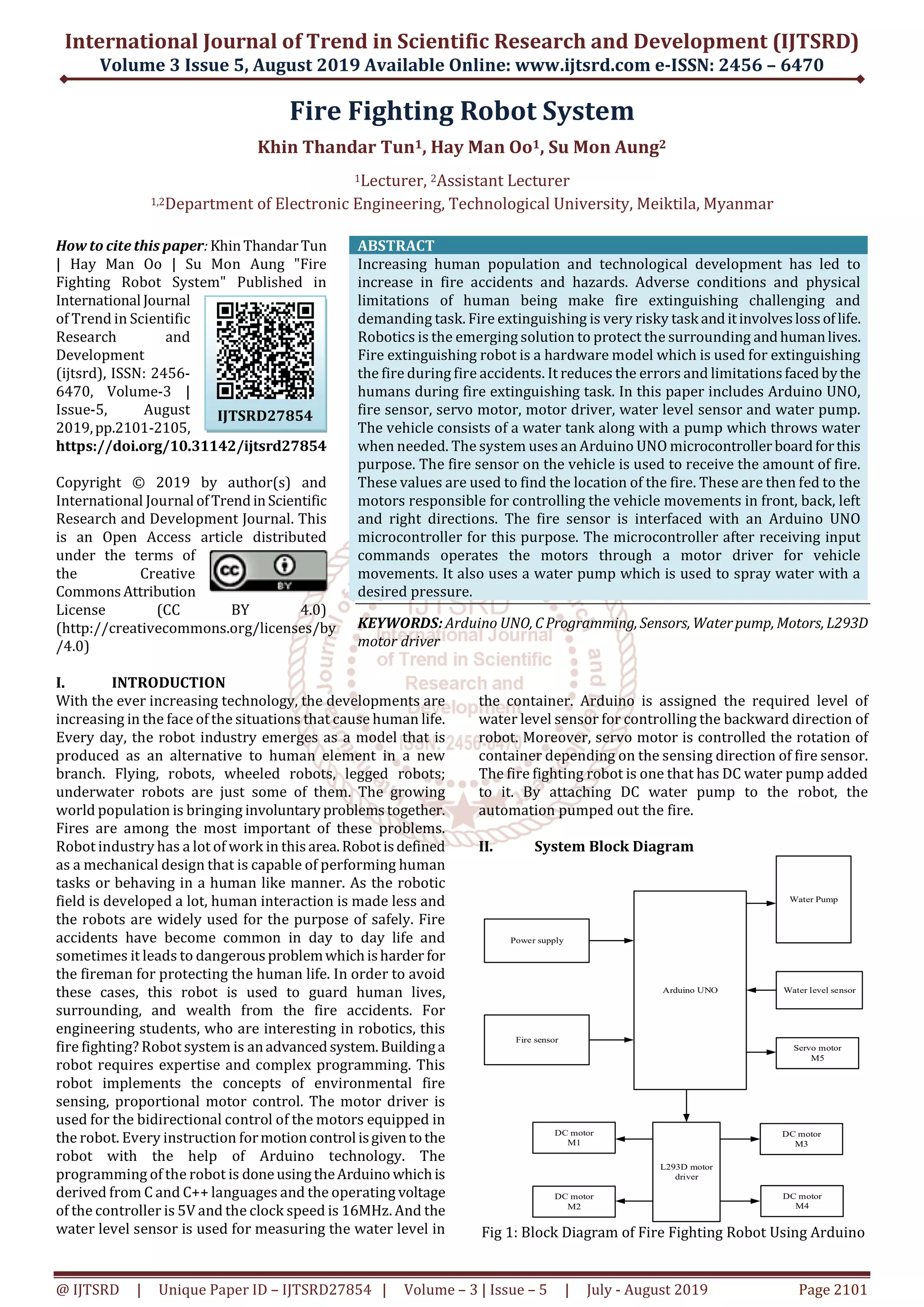
Arduino UNO
Fire sensor
Water Pump
L293D motor
driver
Water level sensor
Power supply
Servo motor
M5
DC motor
M4
DC motor
M3
DC motor
M2
DC motor
M1
Fig 1: Block Diagram of Fire Fighting Robot Using Arduino
IJTSRD27854
International Journal of Trend in Scientific Research and Development (IJTSRD) @ www.ijtsrd.com eISSN: 2456-6470
@ IJTSRD | Unique Paper ID – IJTSRD27854 | Volume – 3 | Issue – 5 | July - August 2019 Page 2102
In this Fig.1, the two input sessions are included power
supply and fire sensor. Power supply is used to supply the
need voltage for Arduino and fire sensor is detected the
flame. Motor driver is controlled the robot classic wheeland
moving direction of motordriverdependingonthedetection
of fire sensor and water level sensor is used to measure the
waterlevel in the container. The water pump is placed in the
container to pump out the detected fire.
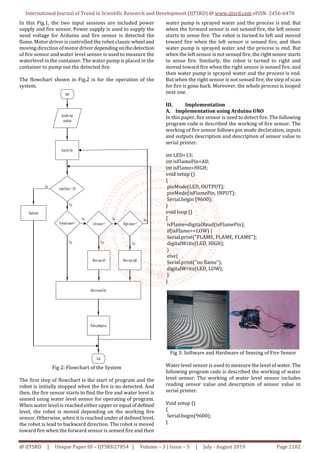
The flowchart shown in Fig.2 is for the operation of the
system.
Start
waterValue>=150
Rightsensor=?
Backward
End
No
Yes
Waterpumpedon
Leftsensor=?Forwardsensor=?
MoveturnrightMoveturnleft
NoNo No
YesYesYes
Movetowardfire
Scanfor fire
Initiallystop
condition
Fig 2: Flowchart of the System
The first step of flowchart is the start of program and the
robot is initially stopped when the fire is no detected. And
then, the fire sensor starts to find the fire and water level is
sensed using water level sensor for operating of program.
When water level is reached either upper or equal ofdefined
level, the robot is moved depending on the working fire
sensor. Otherwise, when it is reached under of defined level,
the robot is lead to backward direction. The robot is moved
toward fire when the forward sensor is sensed fire and then
water pump is sprayed water and the process is end. But
when the forward sensor is not sensed fire, the left sensor
starts to sense fire. The robot is turned to left and moved
toward fire when the left sensor is sensed fire, and then
water pump is sprayed water and the process is end. But
when the left sensor is not sensed fire, theright sensorstarts
to sense fire. Similarly, the robot is turned to right and
moved toward fire when the right sensor is sensed fire, and
then water pump is sprayed water and the process is end.
But when the right sensor is not sensed fire, the step of scan
for fire is gone back. Moreover, the whole process is looped
next one.
III. Implementation
A. Implementation using Arduino UNO
In this paper, fire sensor is used to detect fire. The following
program code is described the working of fire sensor. The
working of fire sensor follows pin mode declaration, inputs
and outputs description and description of sensor value in
serial printer.
int LED=13;
int isFlamePin=A0;
int isFlame=HIGH;
void setup ()
{
pinMode(LED, OUTPUT);
pinMode(isFlamePin, INPUT);
Serial.begin (9600);
}
void loop ()
{
isFlame=digitalRead(isFlamePin);
if(isFlame==LOW) {
Serial.print("FLAME, FLAME, FLAME");
digitalWrite(LED, HIGH);
}
else{
Serial.print("no flame");
digitalWrite(LED, LOW);
}
}
Fig 3: Software and Hardware of Sensing of Fire Sensor
Water level sensor is used to measure the level of water.The
following program code is described the working of water
level sensor. The working of water level sensor includes
reading sensor value and description of sensor value in
serial printer.
Void setup ()
{
Serial.begin(9600);
}
International Journal of Trend in Scientific Research and Development (IJTSRD) @ www.ijtsrd.com eISSN: 2456-6470
@ IJTSRD | Unique Paper ID – IJTSRD27854 | Volume – 3 | Issue – 5 | July - August 2019 Page 2103
Void loop ()
{
int val = analogRead(A0);
Serial.print("Pin Value ");
Serial.println(val);
delay (1000);
}
Fig 4: Software and Hardware of Water Level Sensor
The water pump is used to spray water. The following
program code is described the working of water pump. The
working of water pump describes output pin declaration,
delay time and description of HIGH or LOW operation.
int pin_out = 9;
void setup ()
{
pinMode (pin_out, OUTPUT);
}
void loop ()
{
digitalWrite (pin_out, HIGH);
delay (1000);
digitalWrite (pin_out, LOW);
delay (1000);
}
Fig 5: Software and Hardware of Water Pump
The servo motor is used to rotate the container. The
following program code is described the working of servo
motor. The working of servo motorincludes thelibraryfileis
called in first step, create servo object to control a servo,
variable to store the servo position,attaches theservoon pin
10 to the servo object, goes from 0 degrees to 180 degrees,
tell servo to go to position in variable 'position', waits 20ms
between servo commands and goes from 180 degrees to 0
degrees.
#include <Servo.h>
Servo myservo; // create servo object to control a
Servo
int angle = 0; // variable to store the servo position
void setup ()
{
myservo.attach(9); // attaches the servo on pin 10 to the
servo object
}
Void loop ()
{
For (angle = 0; angle < 180; angle += 1) // goes from 0
degrees to 180 degrees
{
myservo.write(angle);
Delay (20);
}
for (angle = 180; angle >= 1; angle -= 1) // goes from 180
degrees to 0 degrees
{
myservo.write(angle); delay(20);
}
}
Fig 6: Software and Hardware of Servo Motor
L293D motor driver is used to control the direction of robot.
The following program code is described the working of
motor driver. The working of motor driver followspinmode
declaration, inputs and outputs description and stop,
forward, left, right and back direction of the robot.
#define LM1 8 // left motor
#define LM2 9 // left motor
#define RM1 10 // right motor
#define RM2 11 // right motor
void setup ()
{
pinMode(LM1, OUTPUT);
pinMode(LM2, OUTPUT);
pinMode(RM1, OUTPUT);
pinMode(RM2, OUTPUT);
}
Void loop ()
{
//Do not move the robot
digitalWrite(LM1, LOW);
digitalWrite(LM2, LOW);
digitalWrite(RM1, LOW);
digitalWrite(RM2, LOW);
delay (1000);
//Move the robot forward
digitalWrite(LM1, HIGH);
digitalWrite(LM2, LOW);
digitalWrite(RM1, HIGH);
digitalWrite(RM2, LOW);
Delay (1000);
//Move the robot left
digitalWrite(LM1, LOW);
International Journal of Trend in Scientific Research and Development (IJTSRD) @ www.ijtsrd.com eISSN: 2456-6470
@ IJTSRD | Unique Paper ID – IJTSRD27854 | Volume – 3 | Issue – 5 | July - August 2019 Page 2104
digitalWrite(LM2, LOW);
digitalWrite(RM1, LOW);
digitalWrite(RM2, HIGH);
Delay (1000);
//Move the robot right
digitalWrite(LM1, LOW);
digitalWrite(LM2, HIGH);
digitalWrite(RM1, LOW);
digitalWrite(RM2, LOW);
Delay (1000);
//Move the backward
digitalWrite(LM1, LOW);
digitalWrite(LM2, HIGH);
digitalWrite(RM1, LOW);
digitalWrite(RM2, HIGH);
Delay (1000);
}
Fig 7: Software and Hardware of L293D Motor Driver
B. Implementation by Hardware
The main brain of this paper is the Arduino, which is derived
from C and C++ languages and the operating voltage of the
controller is 5V and the clock speed is 16MHz. Butinorder to
sense fire using the fire sensor module(flamesensor).These
sensors have an IR receiver (photodiode) which is used to
detect the fire. When fire burns it emits a small amount of
infrared light, this light is received by the IR receiver on the
sensor module. The maximum distance to which the fire can
be detected depends on the size of the fire, for a small
matchstick the distance is relatively less andcanalsousethe
potentiometers on top of the modules to control the
sensitivity of the robot. So that if a fire is detected the output
pin (DO) gives 0V (LOW) and if the is no fire the outputpin is
5V (HIGH) and place three such sensors in three directions
of the robot to sense on which direction the fire is burning.
Detect the direction of the fire and use the motors to move
near the fire by driving motors through the L293D motor
driver module which is used to control the robot classic
wheels and moving direction of motor driver depending on
the detection of fire sensor. When near a fire, the robot has
to put it out using water. Using a small container, the robot
can carry water, water level sensoranda pumpis alsoplaced
in the container and the whole container is placedontopofa
servo motor so that it can control the direction in which the
water has to be sprayed. From 0 degrees to 180 degrees of
servo range is changed to require the creatingofservorange
from 40 degrees to 140 degrees. 2.5V to 6V water pump is
used to spray water and to balance the operating voltage of
Arduino. The water level sensor is used for measuring the
water level in the container. Arduino is assigned the
required level of water level sensor for controlling the
backward direction of robot. In this paper, the robot used a
power bank to provide power and can use a battery or even
power it with a 12V battery.
ArduinoUNO
Fire
sensor
Fire
sensor
Fire
sensor
L293D
Motor
Driver
Module
Water
level
sensor
Water
pump
Servo
motor
M1
A3
A2
A1
A0
D0
D1
D2
D3
D4
D5
D6
D7
D8
D9
D10
D11
D13
D12
Vcc
Gnd
VccGnd
+5V
Gnd
Vcc
Gnd
Signal
Vcc
Gnd
Vcc
Vcc
Vcc
Gnd
Gnd
Gnd
PWM
D0
D1
D2
IN1
IN2
IN3
IN4
A-
A+
B-
B+
M2
M3 M4
+
++
+
__
_ _
Fig 8: Circuit Diagram of Fire Fighting Robot
IV. Results
In this paper, when the water level sensor is reached either
equal or upper of defined level in container and the forward
sensor is sensed fire and operated. The robot is moved
toward fire.
Fig 9: Testing of Forward Sensor
When the water level sensor isreached eitherequal orupper
of defined level in container and the left sensor is sensed fire
and operated. The robot is moved to turn left and toward
fire.
Fig 10: Testing of Left Sensor
International Journal of Trend in Scientific Research and Development (IJTSRD) @ www.ijtsrd.com eISSN: 2456-6470
@ IJTSRD | Unique Paper ID – IJTSRD27854 | Volume – 3 | Issue – 5 | July - August 2019 Page 2105
When the water level sensor isreached eitherequal orupper
of defined level in container and the right sensor is sensed
fire and operated. The robot is moved to turn right and
toward fire.
Fig 11: Testing of Right Sensor
When the water level sensor is reached under the defined
level of sensor in container, the robot is moved to backward.
Fig 12: Testing of Backward Direction
V. Discussion
This paper is discussed about fire fighting robot system.The
extensive use of microcontrollers ensured the integration
step to be simpler. There were still some problems at
integration step but they were solved easily because
debugging is done on each module. Therefore, final modelof
the robot successfully finds “fire” and reach it without
running into obstacles. Throughout the paper, technical
knowledge was put to practical use and hence learnt many
technical skills, and aims to avoid fire accidents and also
prevent manual intervention of fire extinguishing.Therobot
performs its operation under adverse circumstances
effectively.
VI. Conclusion
In conclusion, approach of modular design strategy was a
good solution in implementing the fire fighting robot as it
made it easier for individuals to work on their tasks
independently. The fire fighting robot employs Arduino
technology to control the directions of the robot.This design
is the fire detection system using fire sensor that is capable
of sensing the flame of wavelength range 760nm to 1100nm
and the sensing range depends on the sensitivity and varies
from 10cm to 50cm. The robot can operate in the
environment which is out of human reach in veryshorttime,
the delay employed minimum time after the fire is detected
to extinguish.
VII. REFERENCES
[1] Anonymous: “Fire Fighting System”, (2018).
https://www.slideshare.net/NaqashKazmi/final-year-
project-on-fire-fighting-systems-64012615
[2] Anonymous: “Arduino UNO”, (2018).
https://www.trossenrobotics.com/p/arduino-
uno.aspx
[3] Anonymous: “Fire Sensor”, (2018).
https://www.instructables.com/id/Arduino-Modules-
Flame-Sensor
[4] Anonymous: “Servo Motor”, (2018).
https://components101.com/servo-motor-basics-
pinout-datasheet
[5] Anonymous: “L293D Motor Driver”, (2018).
https://www.campuscomponent.com
[6] Anonymous: “Water Pump”, (2018).
https://www.seeedstudio.com/6V-Mini-Water-Pump-
p-1945.htm
[7] Anonymous: “Water Level Sensor”, (2018).
http://osoyoo.com/2017/09/27/arduino-lesson-
water-sensor/#2.2
[8] Aswinth, R.: “Fire Fighting Robot Code”, December,
(2017).
https://www.circuitdigest.com/microcontrollerproject
s/arduino-fire-fighting- robot-code.com
[9] Stafford, M.: “Fire Fighting Robot.pdf”,October,(2017).
https://www.researchgate.net/publication/31761094

Fire Fighting Robot System

  • 1.
    International Journal ofTrend in Scientific Research and Development (IJTSRD) Volume 3 Issue 5, August 2019 Available Online: www.ijtsrd.com e-ISSN: 2456 – 6470 @ IJTSRD | Unique Paper ID – IJTSRD27854 | Volume – 3 | Issue – 5 | July - August 2019 Page 2101 Fire Fighting Robot System Khin Thandar Tun1, Hay Man Oo1, Su Mon Aung2 1Lecturer, 2Assistant Lecturer 1,2Department of Electronic Engineering, Technological University, Meiktila, Myanmar How to cite this paper: KhinThandarTun | Hay Man Oo | Su Mon Aung "Fire Fighting Robot System" Published in International Journal of Trend in Scientific Research and Development (ijtsrd), ISSN: 2456- 6470, Volume-3 | Issue-5, August 2019,pp.2101-2105, https://doi.org/10.31142/ijtsrd27854 Copyright © 2019 by author(s) and International Journal ofTrend inScientific Research and Development Journal. This is an Open Access article distributed under the terms of the Creative Commons Attribution License (CC BY 4.0) (http://creativecommons.org/licenses/by /4.0) ABSTRACT Increasing human population and technological development has led to increase in fire accidents and hazards. Adverse conditions and physical limitations of human being make fire extinguishing challenging and demanding task. Fire extinguishing is very risky task and itinvolves loss oflife. Robotics is the emerging solution to protect the surrounding andhumanlives. Fire extinguishing robot is a hardware model which is used for extinguishing the fire during fire accidents. It reduces the errors and limitations faced by the humans during fire extinguishing task. In this paper includes Arduino UNO, fire sensor, servo motor, motor driver, water level sensor and water pump. The vehicle consists of a water tank along with a pump which throws water when needed. The system uses an Arduino UNO microcontrollerboardforthis purpose. The fire sensor on the vehicle is used to receive the amount of fire. These values are used to find the location of the fire. These are then fed to the motors responsible for controlling the vehicle movements in front, back, left and right directions. The fire sensor is interfaced with an Arduino UNO microcontroller for this purpose. The microcontroller after receiving input commands operates the motors through a motor driver for vehicle movements. It also uses a water pump which is used to spray water with a desired pressure. KEYWORDS: Arduino UNO, C Programming, Sensors,Waterpump, Motors,L293D motor driver I. INTRODUCTION With the ever increasing technology, the developments are increasing in the face of the situations that cause human life. Every day, the robot industry emerges as a model that is produced as an alternative to human element in a new branch. Flying, robots, wheeled robots, legged robots; underwater robots are just some of them. The growing world population is bringing involuntary problems together. Fires are among the most important of these problems. Robot industry has a lot of work in this area.Robotis defined as a mechanical design that is capable of performing human tasks or behaving in a human like manner. As the robotic field is developed a lot, human interaction is made less and the robots are widely used for the purpose of safely. Fire accidents have become common in day to day life and sometimes it leads to dangerous problemwhich isharder for the fireman for protecting the human life. In order to avoid these cases, this robot is used to guard human lives, surrounding, and wealth from the fire accidents. For engineering students, who are interesting in robotics, this fire fighting? Robot system is anadvanced system.Buildinga robot requires expertise and complex programming. This robot implements the concepts of environmental fire sensing, proportional motor control. The motor driver is used for the bidirectional control of the motors equipped in the robot. Every instruction formotioncontrolisgiventothe robot with the help of Arduino technology. The programming of the robot is doneusingtheArduinowhichis derived from C and C++ languages and the operating voltage of the controller is 5V and the clock speed is 16MHz. And the water level sensor is used for measuring the water level in the container. Arduino is assigned the required level of water level sensor for controlling the backward direction of robot. Moreover, servo motor is controlled the rotation of container depending on the sensing direction of fire sensor. The fire fighting robot is one that has DC water pump added to it. By attaching DC water pump to the robot, the automation pumped out the fire. II. System Block Diagram Arduino UNO Fire sensor Water Pump L293D motor driver Water level sensor Power supply Servo motor M5 DC motor M4 DC motor M3 DC motor M2 DC motor M1 Fig 1: Block Diagram of Fire Fighting Robot Using Arduino IJTSRD27854
  • 2.
    International Journal ofTrend in Scientific Research and Development (IJTSRD) @ www.ijtsrd.com eISSN: 2456-6470 @ IJTSRD | Unique Paper ID – IJTSRD27854 | Volume – 3 | Issue – 5 | July - August 2019 Page 2102 In this Fig.1, the two input sessions are included power supply and fire sensor. Power supply is used to supply the need voltage for Arduino and fire sensor is detected the flame. Motor driver is controlled the robot classic wheeland moving direction of motordriverdependingonthedetection of fire sensor and water level sensor is used to measure the waterlevel in the container. The water pump is placed in the container to pump out the detected fire. The flowchart shown in Fig.2 is for the operation of the system. Start waterValue>=150 Rightsensor=? Backward End No Yes Waterpumpedon Leftsensor=?Forwardsensor=? MoveturnrightMoveturnleft NoNo No YesYesYes Movetowardfire Scanfor fire Initiallystop condition Fig 2: Flowchart of the System The first step of flowchart is the start of program and the robot is initially stopped when the fire is no detected. And then, the fire sensor starts to find the fire and water level is sensed using water level sensor for operating of program. When water level is reached either upper or equal ofdefined level, the robot is moved depending on the working fire sensor. Otherwise, when it is reached under of defined level, the robot is lead to backward direction. The robot is moved toward fire when the forward sensor is sensed fire and then water pump is sprayed water and the process is end. But when the forward sensor is not sensed fire, the left sensor starts to sense fire. The robot is turned to left and moved toward fire when the left sensor is sensed fire, and then water pump is sprayed water and the process is end. But when the left sensor is not sensed fire, theright sensorstarts to sense fire. Similarly, the robot is turned to right and moved toward fire when the right sensor is sensed fire, and then water pump is sprayed water and the process is end. But when the right sensor is not sensed fire, the step of scan for fire is gone back. Moreover, the whole process is looped next one. III. Implementation A. Implementation using Arduino UNO In this paper, fire sensor is used to detect fire. The following program code is described the working of fire sensor. The working of fire sensor follows pin mode declaration, inputs and outputs description and description of sensor value in serial printer. int LED=13; int isFlamePin=A0; int isFlame=HIGH; void setup () { pinMode(LED, OUTPUT); pinMode(isFlamePin, INPUT); Serial.begin (9600); } void loop () { isFlame=digitalRead(isFlamePin); if(isFlame==LOW) { Serial.print("FLAME, FLAME, FLAME"); digitalWrite(LED, HIGH); } else{ Serial.print("no flame"); digitalWrite(LED, LOW); } } Fig 3: Software and Hardware of Sensing of Fire Sensor Water level sensor is used to measure the level of water.The following program code is described the working of water level sensor. The working of water level sensor includes reading sensor value and description of sensor value in serial printer. Void setup () { Serial.begin(9600); }
  • 3.
    International Journal ofTrend in Scientific Research and Development (IJTSRD) @ www.ijtsrd.com eISSN: 2456-6470 @ IJTSRD | Unique Paper ID – IJTSRD27854 | Volume – 3 | Issue – 5 | July - August 2019 Page 2103 Void loop () { int val = analogRead(A0); Serial.print("Pin Value "); Serial.println(val); delay (1000); } Fig 4: Software and Hardware of Water Level Sensor The water pump is used to spray water. The following program code is described the working of water pump. The working of water pump describes output pin declaration, delay time and description of HIGH or LOW operation. int pin_out = 9; void setup () { pinMode (pin_out, OUTPUT); } void loop () { digitalWrite (pin_out, HIGH); delay (1000); digitalWrite (pin_out, LOW); delay (1000); } Fig 5: Software and Hardware of Water Pump The servo motor is used to rotate the container. The following program code is described the working of servo motor. The working of servo motorincludes thelibraryfileis called in first step, create servo object to control a servo, variable to store the servo position,attaches theservoon pin 10 to the servo object, goes from 0 degrees to 180 degrees, tell servo to go to position in variable 'position', waits 20ms between servo commands and goes from 180 degrees to 0 degrees. #include <Servo.h> Servo myservo; // create servo object to control a Servo int angle = 0; // variable to store the servo position void setup () { myservo.attach(9); // attaches the servo on pin 10 to the servo object } Void loop () { For (angle = 0; angle < 180; angle += 1) // goes from 0 degrees to 180 degrees { myservo.write(angle); Delay (20); } for (angle = 180; angle >= 1; angle -= 1) // goes from 180 degrees to 0 degrees { myservo.write(angle); delay(20); } } Fig 6: Software and Hardware of Servo Motor L293D motor driver is used to control the direction of robot. The following program code is described the working of motor driver. The working of motor driver followspinmode declaration, inputs and outputs description and stop, forward, left, right and back direction of the robot. #define LM1 8 // left motor #define LM2 9 // left motor #define RM1 10 // right motor #define RM2 11 // right motor void setup () { pinMode(LM1, OUTPUT); pinMode(LM2, OUTPUT); pinMode(RM1, OUTPUT); pinMode(RM2, OUTPUT); } Void loop () { //Do not move the robot digitalWrite(LM1, LOW); digitalWrite(LM2, LOW); digitalWrite(RM1, LOW); digitalWrite(RM2, LOW); delay (1000); //Move the robot forward digitalWrite(LM1, HIGH); digitalWrite(LM2, LOW); digitalWrite(RM1, HIGH); digitalWrite(RM2, LOW); Delay (1000); //Move the robot left digitalWrite(LM1, LOW);
  • 4.
    International Journal ofTrend in Scientific Research and Development (IJTSRD) @ www.ijtsrd.com eISSN: 2456-6470 @ IJTSRD | Unique Paper ID – IJTSRD27854 | Volume – 3 | Issue – 5 | July - August 2019 Page 2104 digitalWrite(LM2, LOW); digitalWrite(RM1, LOW); digitalWrite(RM2, HIGH); Delay (1000); //Move the robot right digitalWrite(LM1, LOW); digitalWrite(LM2, HIGH); digitalWrite(RM1, LOW); digitalWrite(RM2, LOW); Delay (1000); //Move the backward digitalWrite(LM1, LOW); digitalWrite(LM2, HIGH); digitalWrite(RM1, LOW); digitalWrite(RM2, HIGH); Delay (1000); } Fig 7: Software and Hardware of L293D Motor Driver B. Implementation by Hardware The main brain of this paper is the Arduino, which is derived from C and C++ languages and the operating voltage of the controller is 5V and the clock speed is 16MHz. Butinorder to sense fire using the fire sensor module(flamesensor).These sensors have an IR receiver (photodiode) which is used to detect the fire. When fire burns it emits a small amount of infrared light, this light is received by the IR receiver on the sensor module. The maximum distance to which the fire can be detected depends on the size of the fire, for a small matchstick the distance is relatively less andcanalsousethe potentiometers on top of the modules to control the sensitivity of the robot. So that if a fire is detected the output pin (DO) gives 0V (LOW) and if the is no fire the outputpin is 5V (HIGH) and place three such sensors in three directions of the robot to sense on which direction the fire is burning. Detect the direction of the fire and use the motors to move near the fire by driving motors through the L293D motor driver module which is used to control the robot classic wheels and moving direction of motor driver depending on the detection of fire sensor. When near a fire, the robot has to put it out using water. Using a small container, the robot can carry water, water level sensoranda pumpis alsoplaced in the container and the whole container is placedontopofa servo motor so that it can control the direction in which the water has to be sprayed. From 0 degrees to 180 degrees of servo range is changed to require the creatingofservorange from 40 degrees to 140 degrees. 2.5V to 6V water pump is used to spray water and to balance the operating voltage of Arduino. The water level sensor is used for measuring the water level in the container. Arduino is assigned the required level of water level sensor for controlling the backward direction of robot. In this paper, the robot used a power bank to provide power and can use a battery or even power it with a 12V battery. ArduinoUNO Fire sensor Fire sensor Fire sensor L293D Motor Driver Module Water level sensor Water pump Servo motor M1 A3 A2 A1 A0 D0 D1 D2 D3 D4 D5 D6 D7 D8 D9 D10 D11 D13 D12 Vcc Gnd VccGnd +5V Gnd Vcc Gnd Signal Vcc Gnd Vcc Vcc Vcc Gnd Gnd Gnd PWM D0 D1 D2 IN1 IN2 IN3 IN4 A- A+ B- B+ M2 M3 M4 + ++ + __ _ _ Fig 8: Circuit Diagram of Fire Fighting Robot IV. Results In this paper, when the water level sensor is reached either equal or upper of defined level in container and the forward sensor is sensed fire and operated. The robot is moved toward fire. Fig 9: Testing of Forward Sensor When the water level sensor isreached eitherequal orupper of defined level in container and the left sensor is sensed fire and operated. The robot is moved to turn left and toward fire. Fig 10: Testing of Left Sensor
  • 5.
    International Journal ofTrend in Scientific Research and Development (IJTSRD) @ www.ijtsrd.com eISSN: 2456-6470 @ IJTSRD | Unique Paper ID – IJTSRD27854 | Volume – 3 | Issue – 5 | July - August 2019 Page 2105 When the water level sensor isreached eitherequal orupper of defined level in container and the right sensor is sensed fire and operated. The robot is moved to turn right and toward fire. Fig 11: Testing of Right Sensor When the water level sensor is reached under the defined level of sensor in container, the robot is moved to backward. Fig 12: Testing of Backward Direction V. Discussion This paper is discussed about fire fighting robot system.The extensive use of microcontrollers ensured the integration step to be simpler. There were still some problems at integration step but they were solved easily because debugging is done on each module. Therefore, final modelof the robot successfully finds “fire” and reach it without running into obstacles. Throughout the paper, technical knowledge was put to practical use and hence learnt many technical skills, and aims to avoid fire accidents and also prevent manual intervention of fire extinguishing.Therobot performs its operation under adverse circumstances effectively. VI. Conclusion In conclusion, approach of modular design strategy was a good solution in implementing the fire fighting robot as it made it easier for individuals to work on their tasks independently. The fire fighting robot employs Arduino technology to control the directions of the robot.This design is the fire detection system using fire sensor that is capable of sensing the flame of wavelength range 760nm to 1100nm and the sensing range depends on the sensitivity and varies from 10cm to 50cm. The robot can operate in the environment which is out of human reach in veryshorttime, the delay employed minimum time after the fire is detected to extinguish. VII. REFERENCES [1] Anonymous: “Fire Fighting System”, (2018). https://www.slideshare.net/NaqashKazmi/final-year- project-on-fire-fighting-systems-64012615 [2] Anonymous: “Arduino UNO”, (2018). https://www.trossenrobotics.com/p/arduino- uno.aspx [3] Anonymous: “Fire Sensor”, (2018). https://www.instructables.com/id/Arduino-Modules- Flame-Sensor [4] Anonymous: “Servo Motor”, (2018). https://components101.com/servo-motor-basics- pinout-datasheet [5] Anonymous: “L293D Motor Driver”, (2018). https://www.campuscomponent.com [6] Anonymous: “Water Pump”, (2018). https://www.seeedstudio.com/6V-Mini-Water-Pump- p-1945.htm [7] Anonymous: “Water Level Sensor”, (2018). http://osoyoo.com/2017/09/27/arduino-lesson- water-sensor/#2.2 [8] Aswinth, R.: “Fire Fighting Robot Code”, December, (2017). https://www.circuitdigest.com/microcontrollerproject s/arduino-fire-fighting- robot-code.com [9] Stafford, M.: “Fire Fighting Robot.pdf”,October,(2017). https://www.researchgate.net/publication/31761094