International Journal of Trend in Scientific Research and Development (IJTSRD)
Volume 6 Issue 4, May-June 2022 Available Online: www.ijtsrd.com e-ISSN: 2456 – 6470
@ IJTSRD | Unique Paper ID – IJTSRD50189 | Volume – 6 | Issue – 4 | May-June 2022 Page 760
Fire Detection System using GSM Module
Mr. J. D Sonone, Miss Komal Gavhale, Miss Komal Patil, Miss Ashwini Kakade, Miss Shital Gavhale,
Miss Rutuja Chavhan, Mr. Vikas Sapkal, Mr. Shrikrushn Patil, Mr. Vijay Chavandke
Electrical Engineering, Padmashri Dr. V.B. Kolte College of Engineering, Malkapur, Buldhana, Maharashtra, India
ABSTRACT
Fire accidents are an unplanned and undesirable event that brings
damages to social wealth and human life needs to be prevented at all
cost. In order to prevent the losses accrued from fire accidents,
various alarm systems have been developed such as smoke detectors
and temperature sensor based systems etc. The availability of a GSM
technology is now started into the fire alarm system in order to
prevent the menace that could be caused by fire accidents. This
project is design and implementation of a cost effective and reliable
automated GSM based fire alarm system. The device is able to detect
fire in the environment, the system sends SMS and call alert to an
inbuilt GSM number when necessary, and make loud sound to alert
occupants on pending danger. This was achieved by the use of 12
Volt power supply system that powers the device using step down
transformer, programming Arduino Uno Microcontroller using
embedded C programming Language in the Arduino IDE, and
integrating the program with Arduino Uno Microcontroller with
GSM SIM900 module.
KEYWORDS: GSM modules, Flame Sensor, Buzzer, 16x2 LCD,
Atmega328 Microcontroller
How to cite this paper: Mr. J. D Sonone
| Miss Komal Gavhale | Miss Komal
Patil | Miss Ashwini Kakade | Miss
Shital Gavhale | Miss Rutuja Chavhan |
Mr. Vikas Sapkal | Mr. Shrikrushn Patil |
Mr. Vijay Chavandke "Fire Detection
System using GSM
Module" Published
in International
Journal of Trend in
Scientific Research
and Development
(ijtsrd), ISSN: 2456-
6470, Volume-6 |
Issue-4, June 2022, pp.760-763, URL:
www.ijtsrd.com/papers/ijtsrd50189.pdf
Copyright © 2022 by author(s) and
International Journal of Trend in
Scientific Research and Development
Journal. This is an
Open Access article
distributed under the
terms of the Creative Commons
Attribution License (CC BY 4.0)
(http://creativecommons.org/licenses/by/4.0)
1. INTRODUCTION
A fire alarm system is number of devices working
together to detect and warn people through visual and
audio appliances whenever fire caches. These alarms
may be activated automatically from flame detectors
or heat detectors or may also be activated via manual
fire alarm activation devices such as manual call
points or pull stations. Alarms may be either motor
bell or wall mountable sounders, horns. They can also
be speaker strobes which sound alarm, followed by a
voice evacuation message which warns people inside
the building not to use the elevators. Fire and smoke
that spread within a building can be affected by
various factors such as the geometry, dimension,
layout and usage of the building. In order to prevent
fire accident in building, it is critical to detect fire at
its early stage and nip it to the bud. In most instances,
fire outbreaks are reported to the fire brigades or
authorities very late, often when the entire building
has been burnt down. This makes the case for design
of automatic fire alarm system a necessity. A fire
alarm system is designed to detect the unwanted
presence of fire by monitoring environmental changes
associated with the combustion. Automatic fire alert
system is required not onlyin industrial complexes but
also residential buildings. In general, fire alarm
systems are designed as either automatically actuated
or manually actuated. However, some fire alarm
systems have been reported to have incorporated both
designs in integrated manner. Automatic fire alarm
systems are designed to automaticallypick fire signals
and notify the building occupants of pending dangers.
Here in this project model we are going to implement
a system using flame detector sensor which detects the
any flame in front of sensor, we are using GSM
module to send and call alert, both GSM and flame
sensor is interfaced to atmega 328 arduino
microcontroller with 16x2 LCD to display alert.
2. HARDWARE DESCRIPTION:
The hardware part used in this solar power bank are
mentioned below,
IJTSRD50189
International Journal of Trend in Scientific Research and Development @ www.ijtsrd.com eISSN: 2456-6470
@ IJTSRD | Unique Paper ID – IJTSRD50189 | Volume – 6 | Issue – 4 | May-June 2022 Page 761
A. Flame Detector Sensor:
Fig.1
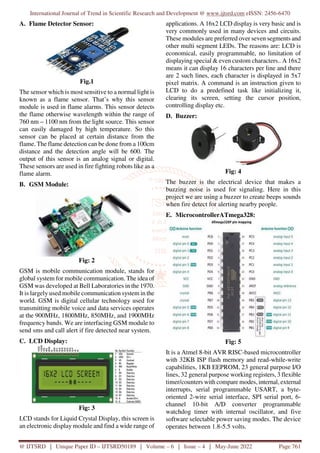
The sensor which is most sensitive to a normal light is
known as a flame sensor. That’s why this sensor
module is used in flame alarms. This sensor detects
the flame otherwise wavelength within the range of
760 nm – 1100 nm from the light source. This sensor
can easily damaged by high temperature. So this
sensor can be placed at certain distance from the
flame. The flame detection can be done from a 100cm
distance and the detection angle will be 600. The
output of this sensor is an analog signal or digital.
These sensors are used in fire fighting robots like as a
flame alarm.
B. GSM Module:
Fig: 2
GSM is mobile communication module, stands for
global system for mobile communication. The idea of
GSM was developed at Bell Laboratories in the 1970.
It is largely used mobile communication system in the
world. GSM is digital cellular technology used for
transmitting mobile voice and data services operates
at the 900MHz, 1800MHz, 850MHz, and 1900MHz
frequency bands. We are interfacing GSM module to
send sms and call alert if fire detected near system.
C. LCD Display:
Fig: 3
LCD stands for Liquid Crystal Display, this screen is
an electronic display module and find a wide range of
applications. A 16x2 LCD display is very basic and is
very commonly used in many devices and circuits.
These modules are preferred over seven segments and
other multi segment LEDs. The reasons are: LCD is
economical, easily programmable, no limitation of
displaying special & even custom characters.. A 16x2
means it can display 16 characters per line and there
are 2 such lines, each character is displayed in 5x7
pixel matrix. A command is an instruction given to
LCD to do a predefined task like initializing it,
clearing its screen, setting the cursor position,
controlling display etc.
D. Buzzer:
Fig: 4
The buzzer is the electrical device that makes a
buzzing noise is used for signaling. Here in this
project we are using a buzzer to create beeps sounds
when fire detect for alerting nearby people.
E. MicrocontrollerATmega328:
Fig: 5
It is a Atmel 8-bit AVR RISC-based microcontroller
with 32KB ISP flash memory and read-while-write
capabilities, 1KB EEPROM, 23 general purpose I/O
lines, 32 general purpose working registers, 3 flexible
timer/counters with compare modes, internal, external
interrupts, serial programmable USART, a byte-
oriented 2-wire serial interface, SPI serial port, 6-
channel 10-bit A/D converter programmable
watchdog timer with internal oscillator, and five
software selectable power saving modes. The device
operates between 1.8-5.5 volts.
International Journal of Trend in Scientific Research and Development @ www.ijtsrd.com eISSN: 2456-6470
@ IJTSRD | Unique Paper ID – IJTSRD50189 | Volume – 6 | Issue – 4 | May-June 2022 Page 762
Key parameters for ATmega328:
Flash (KBytes):32kBytes, Pin count: 28, Max.
Operating Frequency (MHz): 20MHz, CPU: 8-bit
AVR, Touch channels: 16, Hardware touch
Acquisition: No, Max I/o pins: 22, Ext Interrupts: 24,
SPI: 221, TWI (12c):1, UART: 1, ADC Channels: 8
ADC Resolution (bits): 10, ADC speed (kbps): 15,
Analog comparator: 1, DAC Resolution:0,
Temperature sensor: yes, Operating voltage: 1.8 to
5.5
3. SOFTWARE DISCRIPTION (ARDUINO
IDE):
Arduino IDE is open source software that is mainly
used for writing and compiling the code into the
Arduino Module. It is an official Arduino software,
making code compilation too easy that even a
common person with no prior technical knowledge
can get their feet wet with the learning process. It is
easily available for operating systems like MAC,
Windows, Linux and runs on the Java Platform that
comes with inbuilt functions and commands that play
a vital role for debugging, editing and compiling the
code in the environment. A range of Arduino modules
available in market, each of them contains a
microcontroller on the board that is actually
programmed and accepts the information in the form
of code. The main code, also known as a sketch,
created on the IDE platform will ultimately generate a
Hex File which is then transferred and uploaded in
the controller on the board. The IDE environment
mainly contains two basic parts: Editor and Compiler
where former is used for writing the required code
and later is used for compiling and uploading the
code into the given Arduino Module. This
environment supports both C and C++ languages.
4. BLOCK DIAGRAM:
Fig: 6
WORKING OF THE SYSTEM:
As shown in block diagram we have made the circuit
connections. First the AC power applied to primary
coil of step down transformer, at secondary coil we
get the unregulated AC 12v. Then this 12V AC
applied to bridge rectifier and filter capacitors, so we
will get a pure DC output. This pure DC output given
to the 7805 an 7812 voltage regulators, so we will get
a regulated DC 5 and DC 12 Voltages. The 5 v is
given to the microcontroller, flame sensor and LCD.
The 12 Volt DC is for GSM module and Buzzer. In
this system 16x2 LCD is used to show the current
status of fire detection. 16x2 LCD’s data pin DB4,
DB5, DB6, DB7 are connected with pin D5, D4, D3,
D2 of microcontroller. And command pin RS and EN
is directly connected with pin D12, D11 of
microcontroller. RW pin of LCD is directly connected
with ground. The output of flame sensor is connected
toD7 pin of microcontroller, buzzer is connected to
D8 pin and GSM Module’s Rx And Tx pin is
connected to D1 And D0 pin of microcontroller
respectively. We have written a C code in Arduino
IDE as like, When the sensor detects the fire the
microcontroller send signal to the buzzer for beeping
and also indicates about fire detected on LCD
displays. The microcontroller sends AT commands to
GSM module to send text message and to make call
to occupants.
5. RESULT:
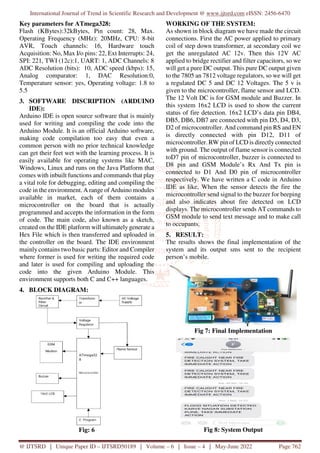
The results shows the final implementation of the
system and its output sms sent to the recipient
person’s mobile.
Fig 7: Final Implementation
Fig 8: System Output
International Journal of Trend in Scientific Research and Development @ www.ijtsrd.com eISSN: 2456-6470
@ IJTSRD | Unique Paper ID – IJTSRD50189 | Volume – 6 | Issue – 4 | May-June 2022 Page 763
6. CONCLUSION
Fire accident claims the lives of innocent people
around the world every single day. A small amount of
fire is able to damage a huge part of a society.
Although heat detectors and fire alarms alert people
of danger, they often have few choices other than
escaping from a building and calling the fire
department. In this paper, it can be concluded that the
proposed system can provide a secure, safe, and
efficient way for preventing or combating fire
accident. This was achieved by the implemention of
12 V power supply system that powers the device,
programming Arduino Uno Microcontroller using
C++ programming Language in the Arduino software
platform, and integrating the program med Arduino
Uno Microcontroller with GSM SIM800 module. The
GSM SIM800 module was incorporated in the system
in order to send sms and call to the occupant of the
building on any impeding danger so as to combat the
situation on time and to prevent losses.
7. REFERENCES
[1] L. Zhang and G. Wang, ‘Design and
Implementation of Automatic Fire Alarm
System based on Wireless Sensor Works’,
Proceedings of the International Symposium on
Information Processing (ISIP’09), Huangshan,
2009, pp 410-413.
[2] O.H. Kwon, S.M. Cho, and S.M. Hwang,
‘Design and Implementation of Fire Detection
System. Advanced Software Engineering and
its Applications’, Hainan Island, 2008, pp.
233236.
[3] J. H. Li, X. H. Zou, and W. Lu, ‘The Design
and Implementation of Fire Smoke Detection
System Based on FPGA’, Proceedings of the
24th Control and Decision Conference,
Taiyuan, 2012, pp 3919-3922.
[4] A Cote and P. Bugbee, ‘Ionization Smoke
Detectors: Principles of Fire Protection’,
National Fire Protection Association, Quincy,
249, 1988.
[5] R.W. Bukowski, R.D. Peacock, J.D. Averill,
T.G. Cleary, N.P. Bryner, W.D. Walton, P.A.
Reneke, and E..D. Kuligowski, ‘Performance of
Home Smoke Alarms Analysis of the Response
of Several Available Technologies in
Residential Fire Settings’, NIST TN 1455-1;
NIST Technical Note 1455-1; 2007, pp. 396.
[6] J. Gerhart, ‘Home Automation and Wiring’
McGraw-Hill Professional, 1999, ISBN
0070246742.
[7] H. Richard, ‘Inside the Smart Home’, Springer,
2003, ISBN 1852336889.
[8] T. Nikola, ‘Method of and apparatus for
controlling mechanism of moving vessels and
vehicles’, United States Patent and Trademark
Office, U.S. Patent 613809, 1898.

Fire Detection System using GSM Module

  • 1.
    International Journal ofTrend in Scientific Research and Development (IJTSRD) Volume 6 Issue 4, May-June 2022 Available Online: www.ijtsrd.com e-ISSN: 2456 – 6470 @ IJTSRD | Unique Paper ID – IJTSRD50189 | Volume – 6 | Issue – 4 | May-June 2022 Page 760 Fire Detection System using GSM Module Mr. J. D Sonone, Miss Komal Gavhale, Miss Komal Patil, Miss Ashwini Kakade, Miss Shital Gavhale, Miss Rutuja Chavhan, Mr. Vikas Sapkal, Mr. Shrikrushn Patil, Mr. Vijay Chavandke Electrical Engineering, Padmashri Dr. V.B. Kolte College of Engineering, Malkapur, Buldhana, Maharashtra, India ABSTRACT Fire accidents are an unplanned and undesirable event that brings damages to social wealth and human life needs to be prevented at all cost. In order to prevent the losses accrued from fire accidents, various alarm systems have been developed such as smoke detectors and temperature sensor based systems etc. The availability of a GSM technology is now started into the fire alarm system in order to prevent the menace that could be caused by fire accidents. This project is design and implementation of a cost effective and reliable automated GSM based fire alarm system. The device is able to detect fire in the environment, the system sends SMS and call alert to an inbuilt GSM number when necessary, and make loud sound to alert occupants on pending danger. This was achieved by the use of 12 Volt power supply system that powers the device using step down transformer, programming Arduino Uno Microcontroller using embedded C programming Language in the Arduino IDE, and integrating the program with Arduino Uno Microcontroller with GSM SIM900 module. KEYWORDS: GSM modules, Flame Sensor, Buzzer, 16x2 LCD, Atmega328 Microcontroller How to cite this paper: Mr. J. D Sonone | Miss Komal Gavhale | Miss Komal Patil | Miss Ashwini Kakade | Miss Shital Gavhale | Miss Rutuja Chavhan | Mr. Vikas Sapkal | Mr. Shrikrushn Patil | Mr. Vijay Chavandke "Fire Detection System using GSM Module" Published in International Journal of Trend in Scientific Research and Development (ijtsrd), ISSN: 2456- 6470, Volume-6 | Issue-4, June 2022, pp.760-763, URL: www.ijtsrd.com/papers/ijtsrd50189.pdf Copyright © 2022 by author(s) and International Journal of Trend in Scientific Research and Development Journal. This is an Open Access article distributed under the terms of the Creative Commons Attribution License (CC BY 4.0) (http://creativecommons.org/licenses/by/4.0) 1. INTRODUCTION A fire alarm system is number of devices working together to detect and warn people through visual and audio appliances whenever fire caches. These alarms may be activated automatically from flame detectors or heat detectors or may also be activated via manual fire alarm activation devices such as manual call points or pull stations. Alarms may be either motor bell or wall mountable sounders, horns. They can also be speaker strobes which sound alarm, followed by a voice evacuation message which warns people inside the building not to use the elevators. Fire and smoke that spread within a building can be affected by various factors such as the geometry, dimension, layout and usage of the building. In order to prevent fire accident in building, it is critical to detect fire at its early stage and nip it to the bud. In most instances, fire outbreaks are reported to the fire brigades or authorities very late, often when the entire building has been burnt down. This makes the case for design of automatic fire alarm system a necessity. A fire alarm system is designed to detect the unwanted presence of fire by monitoring environmental changes associated with the combustion. Automatic fire alert system is required not onlyin industrial complexes but also residential buildings. In general, fire alarm systems are designed as either automatically actuated or manually actuated. However, some fire alarm systems have been reported to have incorporated both designs in integrated manner. Automatic fire alarm systems are designed to automaticallypick fire signals and notify the building occupants of pending dangers. Here in this project model we are going to implement a system using flame detector sensor which detects the any flame in front of sensor, we are using GSM module to send and call alert, both GSM and flame sensor is interfaced to atmega 328 arduino microcontroller with 16x2 LCD to display alert. 2. HARDWARE DESCRIPTION: The hardware part used in this solar power bank are mentioned below, IJTSRD50189
  • 2.
    International Journal ofTrend in Scientific Research and Development @ www.ijtsrd.com eISSN: 2456-6470 @ IJTSRD | Unique Paper ID – IJTSRD50189 | Volume – 6 | Issue – 4 | May-June 2022 Page 761 A. Flame Detector Sensor: Fig.1 The sensor which is most sensitive to a normal light is known as a flame sensor. That’s why this sensor module is used in flame alarms. This sensor detects the flame otherwise wavelength within the range of 760 nm – 1100 nm from the light source. This sensor can easily damaged by high temperature. So this sensor can be placed at certain distance from the flame. The flame detection can be done from a 100cm distance and the detection angle will be 600. The output of this sensor is an analog signal or digital. These sensors are used in fire fighting robots like as a flame alarm. B. GSM Module: Fig: 2 GSM is mobile communication module, stands for global system for mobile communication. The idea of GSM was developed at Bell Laboratories in the 1970. It is largely used mobile communication system in the world. GSM is digital cellular technology used for transmitting mobile voice and data services operates at the 900MHz, 1800MHz, 850MHz, and 1900MHz frequency bands. We are interfacing GSM module to send sms and call alert if fire detected near system. C. LCD Display: Fig: 3 LCD stands for Liquid Crystal Display, this screen is an electronic display module and find a wide range of applications. A 16x2 LCD display is very basic and is very commonly used in many devices and circuits. These modules are preferred over seven segments and other multi segment LEDs. The reasons are: LCD is economical, easily programmable, no limitation of displaying special & even custom characters.. A 16x2 means it can display 16 characters per line and there are 2 such lines, each character is displayed in 5x7 pixel matrix. A command is an instruction given to LCD to do a predefined task like initializing it, clearing its screen, setting the cursor position, controlling display etc. D. Buzzer: Fig: 4 The buzzer is the electrical device that makes a buzzing noise is used for signaling. Here in this project we are using a buzzer to create beeps sounds when fire detect for alerting nearby people. E. MicrocontrollerATmega328: Fig: 5 It is a Atmel 8-bit AVR RISC-based microcontroller with 32KB ISP flash memory and read-while-write capabilities, 1KB EEPROM, 23 general purpose I/O lines, 32 general purpose working registers, 3 flexible timer/counters with compare modes, internal, external interrupts, serial programmable USART, a byte- oriented 2-wire serial interface, SPI serial port, 6- channel 10-bit A/D converter programmable watchdog timer with internal oscillator, and five software selectable power saving modes. The device operates between 1.8-5.5 volts.
  • 3.
    International Journal ofTrend in Scientific Research and Development @ www.ijtsrd.com eISSN: 2456-6470 @ IJTSRD | Unique Paper ID – IJTSRD50189 | Volume – 6 | Issue – 4 | May-June 2022 Page 762 Key parameters for ATmega328: Flash (KBytes):32kBytes, Pin count: 28, Max. Operating Frequency (MHz): 20MHz, CPU: 8-bit AVR, Touch channels: 16, Hardware touch Acquisition: No, Max I/o pins: 22, Ext Interrupts: 24, SPI: 221, TWI (12c):1, UART: 1, ADC Channels: 8 ADC Resolution (bits): 10, ADC speed (kbps): 15, Analog comparator: 1, DAC Resolution:0, Temperature sensor: yes, Operating voltage: 1.8 to 5.5 3. SOFTWARE DISCRIPTION (ARDUINO IDE): Arduino IDE is open source software that is mainly used for writing and compiling the code into the Arduino Module. It is an official Arduino software, making code compilation too easy that even a common person with no prior technical knowledge can get their feet wet with the learning process. It is easily available for operating systems like MAC, Windows, Linux and runs on the Java Platform that comes with inbuilt functions and commands that play a vital role for debugging, editing and compiling the code in the environment. A range of Arduino modules available in market, each of them contains a microcontroller on the board that is actually programmed and accepts the information in the form of code. The main code, also known as a sketch, created on the IDE platform will ultimately generate a Hex File which is then transferred and uploaded in the controller on the board. The IDE environment mainly contains two basic parts: Editor and Compiler where former is used for writing the required code and later is used for compiling and uploading the code into the given Arduino Module. This environment supports both C and C++ languages. 4. BLOCK DIAGRAM: Fig: 6 WORKING OF THE SYSTEM: As shown in block diagram we have made the circuit connections. First the AC power applied to primary coil of step down transformer, at secondary coil we get the unregulated AC 12v. Then this 12V AC applied to bridge rectifier and filter capacitors, so we will get a pure DC output. This pure DC output given to the 7805 an 7812 voltage regulators, so we will get a regulated DC 5 and DC 12 Voltages. The 5 v is given to the microcontroller, flame sensor and LCD. The 12 Volt DC is for GSM module and Buzzer. In this system 16x2 LCD is used to show the current status of fire detection. 16x2 LCD’s data pin DB4, DB5, DB6, DB7 are connected with pin D5, D4, D3, D2 of microcontroller. And command pin RS and EN is directly connected with pin D12, D11 of microcontroller. RW pin of LCD is directly connected with ground. The output of flame sensor is connected toD7 pin of microcontroller, buzzer is connected to D8 pin and GSM Module’s Rx And Tx pin is connected to D1 And D0 pin of microcontroller respectively. We have written a C code in Arduino IDE as like, When the sensor detects the fire the microcontroller send signal to the buzzer for beeping and also indicates about fire detected on LCD displays. The microcontroller sends AT commands to GSM module to send text message and to make call to occupants. 5. RESULT: The results shows the final implementation of the system and its output sms sent to the recipient person’s mobile. Fig 7: Final Implementation Fig 8: System Output
  • 4.
    International Journal ofTrend in Scientific Research and Development @ www.ijtsrd.com eISSN: 2456-6470 @ IJTSRD | Unique Paper ID – IJTSRD50189 | Volume – 6 | Issue – 4 | May-June 2022 Page 763 6. CONCLUSION Fire accident claims the lives of innocent people around the world every single day. A small amount of fire is able to damage a huge part of a society. Although heat detectors and fire alarms alert people of danger, they often have few choices other than escaping from a building and calling the fire department. In this paper, it can be concluded that the proposed system can provide a secure, safe, and efficient way for preventing or combating fire accident. This was achieved by the implemention of 12 V power supply system that powers the device, programming Arduino Uno Microcontroller using C++ programming Language in the Arduino software platform, and integrating the program med Arduino Uno Microcontroller with GSM SIM800 module. The GSM SIM800 module was incorporated in the system in order to send sms and call to the occupant of the building on any impeding danger so as to combat the situation on time and to prevent losses. 7. REFERENCES [1] L. Zhang and G. Wang, ‘Design and Implementation of Automatic Fire Alarm System based on Wireless Sensor Works’, Proceedings of the International Symposium on Information Processing (ISIP’09), Huangshan, 2009, pp 410-413. [2] O.H. Kwon, S.M. Cho, and S.M. Hwang, ‘Design and Implementation of Fire Detection System. Advanced Software Engineering and its Applications’, Hainan Island, 2008, pp. 233236. [3] J. H. Li, X. H. Zou, and W. Lu, ‘The Design and Implementation of Fire Smoke Detection System Based on FPGA’, Proceedings of the 24th Control and Decision Conference, Taiyuan, 2012, pp 3919-3922. [4] A Cote and P. Bugbee, ‘Ionization Smoke Detectors: Principles of Fire Protection’, National Fire Protection Association, Quincy, 249, 1988. [5] R.W. Bukowski, R.D. Peacock, J.D. Averill, T.G. Cleary, N.P. Bryner, W.D. Walton, P.A. Reneke, and E..D. Kuligowski, ‘Performance of Home Smoke Alarms Analysis of the Response of Several Available Technologies in Residential Fire Settings’, NIST TN 1455-1; NIST Technical Note 1455-1; 2007, pp. 396. [6] J. Gerhart, ‘Home Automation and Wiring’ McGraw-Hill Professional, 1999, ISBN 0070246742. [7] H. Richard, ‘Inside the Smart Home’, Springer, 2003, ISBN 1852336889. [8] T. Nikola, ‘Method of and apparatus for controlling mechanism of moving vessels and vehicles’, United States Patent and Trademark Office, U.S. Patent 613809, 1898.