International Journal of Trend in Scientific Research and Development (IJTSRD)
Volume 3 Issue 5, August 2019 Available Online: www.ijtsrd.com e-ISSN: 2456 – 6470
@ IJTSRD | Unique Paper ID – IJTSRD26697 | Volume – 3 | Issue – 5 | July - August 2019 Page 1686
GSM Based Fire Security System
Khin Thandar Tun1, Aye Sandar Aung2, May Lwin Thant3
1Lecturer, 2,3Assistant Lecturer
1, 2, 3Department of Electronic Engineering, Technological University, Meiktila, Myanmar
How to cite this paper: Khin ThandarTun
| Aye Sandar Aung | May LwinThant"GSM
Based Fire Security System" Published in
International
Journal of Trend in
Scientific Research
and Development
(ijtsrd), ISSN: 2456-
6470, Volume-3 |
Issue-5, August
2019,pp.1686-1690,
https://doi.org/10.31142/ijtsrd26697
Copyright © 2019 by author(s) and
International Journalof Trendin Scientific
Research and Development Journal. This
is an Open Access article distributed
under the terms of
the Creative
CommonsAttribution
License (CC BY 4.0)
(http://creativecommons.org/licenses/by
/4.0)
ABSTRACT
Telecommunication is a very important part of its life. This technologyisused
in a very sophisticated area like safety and security purpose. Using the GSM
technology, telecommunication is conducive to save its life as well as
households from fire accidents which have shown in this paper. In this paper,
the overall circuit is constructed with six sections. The first section is power
supply. The second section is temperaturesensorandsmokesensor.Thethird
section is Arduino. The fourth section is LCD display. The fifth section is fan,
buzzer and water pump. The sixthsectionisGSMmodule. Temperaturesensor
is connected to the digital input pin of the Arduino and smoke sensor is
connected to the analog input pin of the Arduino. When the temperature
sensor detects heat and the smoke detector detects smoke (the detectable
measurement of smoke can beconfiguredregardingthesizeandsurroundings
of the room), there is a LCD display which shows temperatureand smokedata.
When the temperature reach above 40°C and the smoke sensor had reached
over 200ppm, the buzzer is ON, spray automatically water and send SMS.
KEYWORDS: Arduino Mega2560, C Programming, Sensors, GSM module, LCD
display
I. INTRODUCTION
In today’s world of technological advancement and automation, home
automating system has made its mark and is also becoming one of the rapidly
developing sectors of application based technology.
The past idea of a comfortable living had changed
widespread since the advent of the digital and wireless
technologies. Smart homes, or in simple terms, homes that
are fully automated, pre-programmed to carry out some
predefined tasks, respond to certain situations and also
change according to the needs of the user takes up the new
definition of comfortable homes. The smart homes are
expected to perform tasks such as temperature control,
lightning and entertainmentcontrol,securityand emergency
response and many such others.
Fire alarm systems are very essential for security purpose.
Fire alarm and protection system is a combination of
electrical and electronics instruments. By using power
electronics, switches increase the efficiency of this system a
lot. Thermistors are the most use sensing device which is
used in fire detection and prevention systems. For this,
thermochemistry is used for resistances. Along with this
thesis is able to know about fire, fire system protection and
precaution is known.
Fire alarm systems (also commonly called smoke alarm and
a smoke detector) provide a means to detect and identify a
fire or a potential fire outbreak in a building, warn the
occupants of the building about the fire via audible alarm
and potentially notify emergency response professionals.
Some advantages of fire alarms include an early warning
benefit and the potential to save life and property, low cost
and the opportunity to place the device in chosen locations.
The fire alarm systems used today involve sensors,
intelligent control panels and integrationwith other building
services, but the core essence of fire alarm systems hasn’t
changed give the occupants of buildings an early and clear
warning of a fire.
II. System Block Diagram
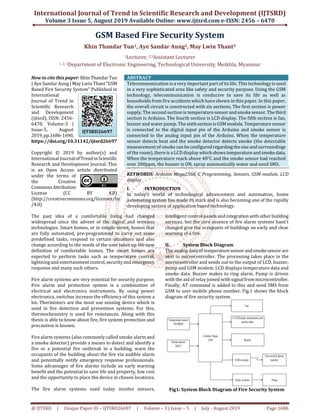
The analog data of temperaturesensor andsmokesensor are
sent to microcontroller. The processing takes place in the
microcontroller and sends out to the output of LCD, buzzer,
pump and GSM modem. LCD displays temperature data and
smoke data. Buzzer makes to ring alarm. Pump is driven
with the aid of relay joined with signal frommicrocontroller.
Finally, AT command is added to this and send SMS from
GSM to user mobile phone number. Fig.1 shows the block
diagram of fire security system.
Fig1: System Block Diagram of Fire Security System
IJTSRD26697
International Journal of Trend in Scientific Research and Development (IJTSRD) @ www.ijtsrd.com eISSN: 2456-6470
@ IJTSRD | Unique Paper ID – IJTSRD26697 | Volume – 3 | Issue – 5 | July - August 2019 Page 1687
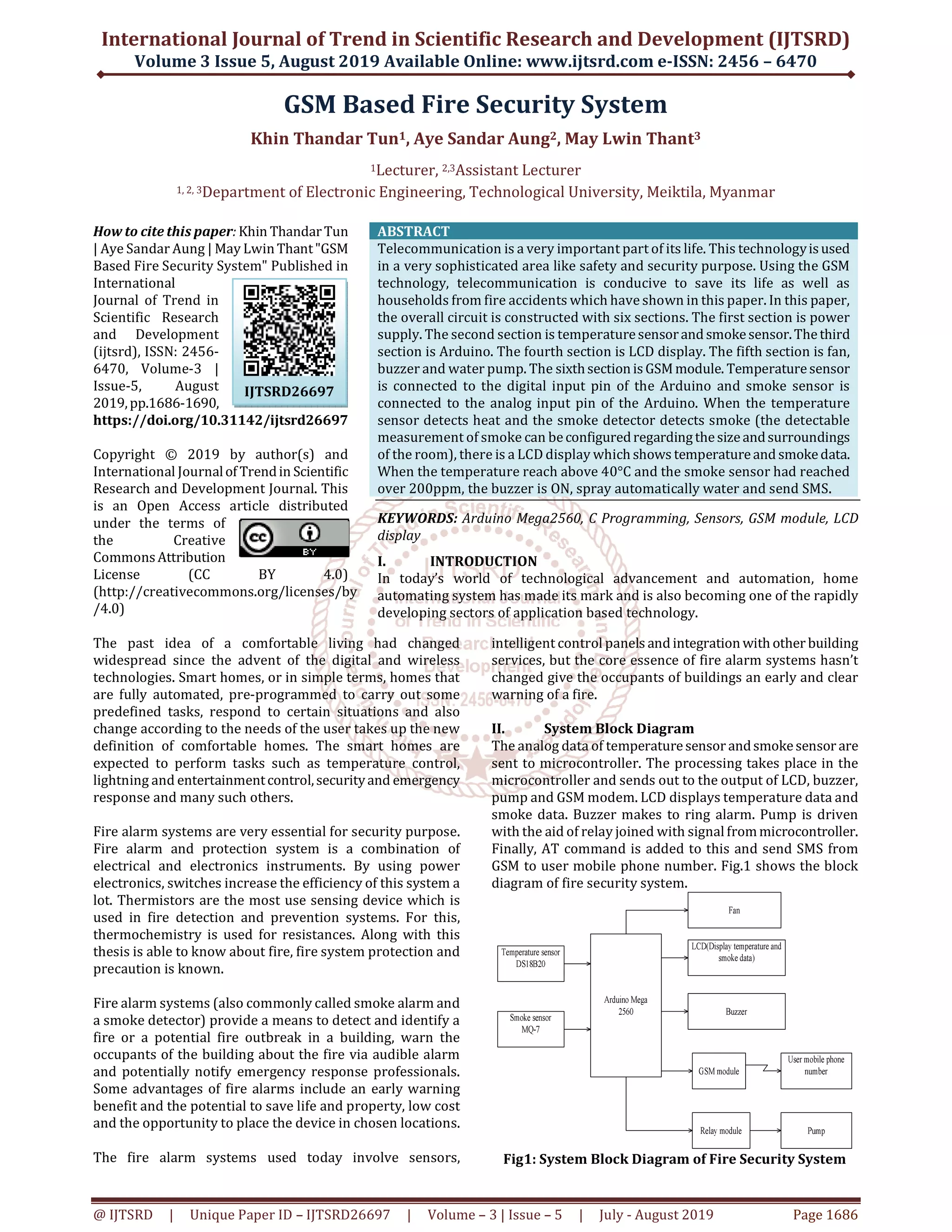
The flowchart shown in Fig.2 is for the operation of the
system. The algorithm used in the flow chart.
Step 1: Start.
Step 2: Read temperature sensor and smoke sensor.
Step 3: Check the temperature value between 30ºC and
35ºC
Step 4: Check the temperature value between 36ºC and
40ºC
Step 5: Check the temperature and smoke sensor reach
above 40ºC and 200rpm
Step 6: After the fan rotate with 200 between the
temperature 30ºC and 35ºC. At the temperature, the
buzzer does not ring the alarm and water does not
spray.
Step 7: The fan rotates with 250 between the
temperature 36ºC and 40ºC. At the temperature, the
buzzer does not ring the alarm and water does not
spray.
Step 8: When the temperature and smoke sensor reach
above 40ºC and 200, the fan does not rotate, the buzzer
ring the alarm, spray water automatically and send SMS
from GSM to phone number of user mobile.
Step 9: The fan rotates with 100rpm below 30ºC. At the
temperature, the buzzer will not ring the alarm and
water does not spray.
Step10: End.
Fig2: Flowchart of the system.
III. Implementation
A. Implementation using Arduino Mega2560
The software for programming an Arduino iseasytouseand
also freely available for Windows, Mac, and Linux computer
at no cost. The Arduino software which is shown in Fig.3 is
referred to as an Integrated Development Environment
(IDE). This is the programming software that is used to
upload code to the Arduino microcontroller. The IDE is
divided into three main areas: the command area, the text
area, and the message window area. The IDE also transfers
those instructions to the Arduino board (a process called
uploading). The Arduino language is a variant of the C++
programming language, but uses built-inlibrariestosimplify
complicated coding tasks to make it easier for beginners to
pick up. The Arduino language is an open source. One aim of
the IDE is to reduce the configuration necessary to piece
together multiple development utilities, instead providing
the same set of capabilities as a cohesive unit. The functions
of each button on IDE toolbar are shown in Table 1.
Fig3: Arduino IDE
Table1. Functions of Toolbar Buttons
Button Functions
Verify or
Compile
Checks the code for errors and
convert machine code
Stop Stop the serial monitor
New Creates a new blank sketch
Open
Shows a list of sketches in
sketchbook
Save Save the current sketch
Upload Upload the current sketch to Arduino
Serial
Monitor
Displays serial data sending from
Arduino
After the temperature sensor is interfaced with Arduino,the
required program shown in Fig.4 for temperature is written
on the Arduino IDE. Firstly, library file and address for
DS18B20 is defined and register in this DS18B20 is set to
read one wire bus value. And then, pinof Arduinois assigned
for DS18B20 and are defined what pin is digitalpin. And
then, the code is written for temperature. To do an
explanation of the code, as usual, it go to the OneWire.h
library.
#include<OneWire.h >
Finally, the required temperature is converted from float
temperature by using “float temp=
sensors.getTempCByIndex(0);” equation and the unitof this
distance is described in degree.
float temp= sensors.getTempCByIndex(0);
Fig4: Testing Program for Temperature Sensors
International Journal of Trend in Scientific Research and Development (IJTSRD) @ www.ijtsrd.com eISSN: 2456-6470
@ IJTSRD | Unique Paper ID – IJTSRD26697 | Volume – 3 | Issue – 5 | July - August 2019 Page 1688
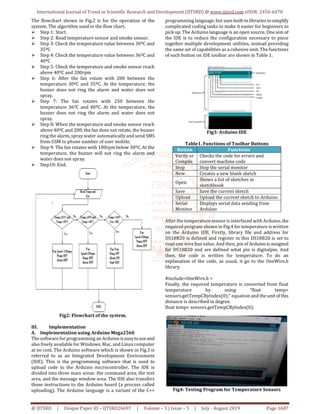
Then, C program language forMQ-7 isdefinedand register in
the MQ-7 is set to read integer value. The program required
which is shown in Fig.5. The MQ-7 is coded to know smoke
detection. Finally, pin of Arduino is assigned for MQ-7 and
are defined what pin is analog (A1) pin.
Fig5: Testing Program for Smoke Sensor
And then, LiquidCrystal_I2C function sets the dimensions of
the LCD. It needs to be placed before any other LiquidCrystal
function in the void setup() section of the program. The
number of rows and columns are specified as lcd.begin
(columns, rows). For 16x2 LCD, lcd.begin (16,2) can beseen,
and for a 20x4 LCD, lcd.begin (20,4) can be used. The
backlight is also be turned on and off with lcd.setBacklight
(HIGH) or lcd.setBacklight (LOW).
Fig6: Testing Program for LCD
To get target message, SIM900A GSM module is selected.
Therefore, program which is shown in Fig.7 is written for
GSM module to read message. Firstly, library file for GSM
module is defined and pins of Arduino are assigned for GSM
module and then define what pins are transmitted pin and
received pin. To do an explanation of the code, as usual, the
first thing do is include the libraries the SoftareSerial.h
library.
#include <SoftwareSerial.h>
Fig7: Testing Program for GSM Module
B. Implementation by Hardware
1. GSM based Fire Security System
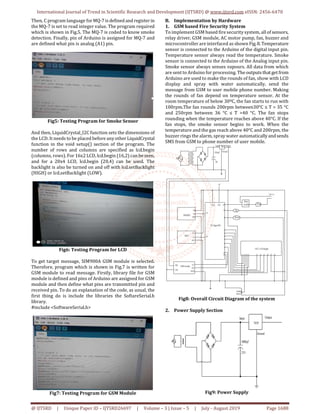
To implement GSM based fire security system, all of sensors,
relay driver, GSM module, AC motor pump, fan, buzzer and
microcontroller are interfaced as shown Fig.8.Temperature
sensor is connected to the Arduino of the digital input pin.
Temperature sensor always read the temperature. Smoke
sensor is connected to the Arduino of the Analog input pin.
Smoke sensor always senses vapours. All data from which
are sent to Arduino for processing. The outputsthatgetfrom
Arduino are used to make the rounds of fan, show with LCD
display and spray with water automatically, send the
message from GSM to user mobile phone number. Making
the rounds of fan depend on temperature sensor. At the
room temperature of below 30ºC, the fan starts to run with
100rpm.The fan rounds 200rpm between30°C ≤ T > 35 °C
and 250rpm between 36 °C ≤ T >40 °C. The fan stops
rounding when the temperature reaches above 40°C. If the
fan stops, the smoke sensor begins to work. When the
temperature and the gas reach above 40°C and 200rpm, the
buzzer rings the alarm, spray water automatically andsends
SMS from GSM to phone number of user mobile.
Fig8: Overall Circuit Diagram of the system
2. Power Supply Section
Fig9: Power Supply
International Journal of Trend in Scientific Research and Development (IJTSRD) @ www.ijtsrd.com eISSN: 2456-6470
@ IJTSRD | Unique Paper ID – IJTSRD26697 | Volume – 3 | Issue – 5 | July - August 2019 Page 1689
Power supply is one of the main parts of thissystem.220Vto
12V step down transformer is used to reduce 12V AC in
transformer’s secondary. The four rectifierdiodes(1N4007)
make to convert DC (Direct Current). DC from a full wave
rectifier diode isn’t smooth to use. So, 1000µF capacitor is
used to filter ripple. And then, 7805 (5V regulator IC) isused
to produce 5V stable voltage. 7805 pin out connects to GSM
module VCC and GND pin for GSM module GND. This circuit
uses 5V adapter for Arduino board. 5V from Arduino board
is used for temperature sensor, smoke sensor and 16x2 LCD
supply.
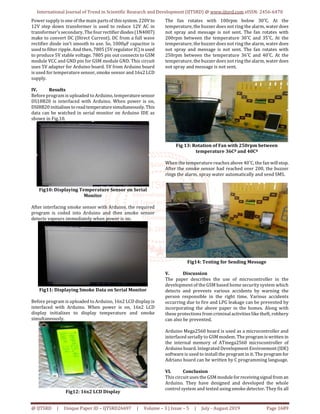
IV. Results
Before program is uploaded to Arduino, temperaturesensor
DS18B20 is interfaced with Arduino. When power is on,
DSI8B20 initializes toreadtemperaturesimultaneously. This
data can be watched in serial monitor on Arduino IDE as
shown in Fig.10.
Fig10: Displaying Temperature Sensor on Serial
Monitor
After interfacing smoke sensor with Arduino, the required
program is coded into Arduino and then smoke sensor
detects vapours immediately when power is on.
Fig11: Displaying Smoke Data on Serial Monitor
Before program is uploaded to Arduino, 16x2 LCD display is
interfaced with Arduino. When power is on, 16x2 LCD
display initializes to display temperature and smoke
simultaneously.
Fig12: 16x2 LCD Display
The fan rotates with 100rpm below 30˚C. At the
temperature, the buzzer does not ring the alarm, water does
not spray and message is not sent. The fan rotates with
200rpm between the temperature 30˚C and 35˚C. At the
temperature, the buzzer does not ring the alarm, water does
not spray and message is not sent. The fan rotates with
250rpm between the temperature 36˚C and 40˚C. At the
temperature, the buzzer does not ring the alarm, water does
not spray and message is not sent.
Fig 13: Rotation of Fan with 250rpm between
temperature 36Cº and 40Cº
When the temperature reaches above 40˚C, the fan willstop.
After the smoke sensor had reached over 200, the buzzer
rings the alarm, spray water automatically and send SMS.
Fig14: Testing for Sending Message
V. Discussion
The paper describes the use of microcontroller in the
development of the GSM based home security system which
detects and prevents various accidents by warning the
person responsible in the right time. Various accidents
occurring due to fire and LPG leakage can be prevented by
incorporating the above paper in the homes. Along with
these protections from criminal activities like theft, robbery
can also be prevented.
Arduino Mega2560 board is used as a microcontroller and
interfaced serially to GSM modem. The programiswritten in
the internal memory of ATmega2560 microcontroller of
Arduino board. Integrated Development Environment(IDE)
software is used to install the program in it. The program for
Adriano board can be written by C programming language.
VI. Conclusion
This circuit uses the GSM moduleforreceivingsignalfrom an
Arduino. They have designed and developed the whole
control system and tested using smoke detector. They fix all
International Journal of Trend in Scientific Research and Development (IJTSRD) @ www.ijtsrd.com eISSN: 2456-6470
@ IJTSRD | Unique Paper ID – IJTSRD26697 | Volume – 3 | Issue – 5 | July - August 2019 Page 1690
the problems encountered during the design and testing of
the system. Finally, it successfully achieved their goals. In
this study, the application of microcontroller with improved
algorithm of extended specification has increased the use of
GSM shield and improves the controlling the smoke. GSM
communicationhas been designed anddevelopedformaking
their life easier and secured. So, fire alarm systemusingGSM
communication is suitable.
VII. REFERENCES
[1] Anonymous.: “Fan Speed”, (2018),
https://www.techadvisor.com
[2] Anonymous.: “LCD Display”, (2018),
https://www.instructables.com
[3] Anonymous.: “Smoke Senor”, (2018),
http://www.instructables.com
[4] Anonymous.: “Temperature Sensor”, (2018),
http://www.maximintegrated.com
[5] Amelia, R.: “Sims 900A GSM module, February (2015),
http://www.sim.com
[6] Brian, E.: “Arduino introduction”, May (2013),
http://www.arduino.com
[7] Alexey, P.: “Connecting GSM Sims900A module with
Arduino”. March, (2011)
http://www.electronics.stackexchange.com
[8] Chinonzo, E.: “Introduction to GSM”. April, (2011)
http://www.karimsalih.6te.net
[9] Bharath, Vijay K., Anil R., Abhishek: “Vehicle Tracking
System using GSM”, (1998).
[10] Kernigham, B.W., Ritchie, D.; M.: The C Programming
language, Prentice Hall, (1988).

GSM Based Fire Security System

  • 1.
    International Journal ofTrend in Scientific Research and Development (IJTSRD) Volume 3 Issue 5, August 2019 Available Online: www.ijtsrd.com e-ISSN: 2456 – 6470 @ IJTSRD | Unique Paper ID – IJTSRD26697 | Volume – 3 | Issue – 5 | July - August 2019 Page 1686 GSM Based Fire Security System Khin Thandar Tun1, Aye Sandar Aung2, May Lwin Thant3 1Lecturer, 2,3Assistant Lecturer 1, 2, 3Department of Electronic Engineering, Technological University, Meiktila, Myanmar How to cite this paper: Khin ThandarTun | Aye Sandar Aung | May LwinThant"GSM Based Fire Security System" Published in International Journal of Trend in Scientific Research and Development (ijtsrd), ISSN: 2456- 6470, Volume-3 | Issue-5, August 2019,pp.1686-1690, https://doi.org/10.31142/ijtsrd26697 Copyright © 2019 by author(s) and International Journalof Trendin Scientific Research and Development Journal. This is an Open Access article distributed under the terms of the Creative CommonsAttribution License (CC BY 4.0) (http://creativecommons.org/licenses/by /4.0) ABSTRACT Telecommunication is a very important part of its life. This technologyisused in a very sophisticated area like safety and security purpose. Using the GSM technology, telecommunication is conducive to save its life as well as households from fire accidents which have shown in this paper. In this paper, the overall circuit is constructed with six sections. The first section is power supply. The second section is temperaturesensorandsmokesensor.Thethird section is Arduino. The fourth section is LCD display. The fifth section is fan, buzzer and water pump. The sixthsectionisGSMmodule. Temperaturesensor is connected to the digital input pin of the Arduino and smoke sensor is connected to the analog input pin of the Arduino. When the temperature sensor detects heat and the smoke detector detects smoke (the detectable measurement of smoke can beconfiguredregardingthesizeandsurroundings of the room), there is a LCD display which shows temperatureand smokedata. When the temperature reach above 40°C and the smoke sensor had reached over 200ppm, the buzzer is ON, spray automatically water and send SMS. KEYWORDS: Arduino Mega2560, C Programming, Sensors, GSM module, LCD display I. INTRODUCTION In today’s world of technological advancement and automation, home automating system has made its mark and is also becoming one of the rapidly developing sectors of application based technology. The past idea of a comfortable living had changed widespread since the advent of the digital and wireless technologies. Smart homes, or in simple terms, homes that are fully automated, pre-programmed to carry out some predefined tasks, respond to certain situations and also change according to the needs of the user takes up the new definition of comfortable homes. The smart homes are expected to perform tasks such as temperature control, lightning and entertainmentcontrol,securityand emergency response and many such others. Fire alarm systems are very essential for security purpose. Fire alarm and protection system is a combination of electrical and electronics instruments. By using power electronics, switches increase the efficiency of this system a lot. Thermistors are the most use sensing device which is used in fire detection and prevention systems. For this, thermochemistry is used for resistances. Along with this thesis is able to know about fire, fire system protection and precaution is known. Fire alarm systems (also commonly called smoke alarm and a smoke detector) provide a means to detect and identify a fire or a potential fire outbreak in a building, warn the occupants of the building about the fire via audible alarm and potentially notify emergency response professionals. Some advantages of fire alarms include an early warning benefit and the potential to save life and property, low cost and the opportunity to place the device in chosen locations. The fire alarm systems used today involve sensors, intelligent control panels and integrationwith other building services, but the core essence of fire alarm systems hasn’t changed give the occupants of buildings an early and clear warning of a fire. II. System Block Diagram The analog data of temperaturesensor andsmokesensor are sent to microcontroller. The processing takes place in the microcontroller and sends out to the output of LCD, buzzer, pump and GSM modem. LCD displays temperature data and smoke data. Buzzer makes to ring alarm. Pump is driven with the aid of relay joined with signal frommicrocontroller. Finally, AT command is added to this and send SMS from GSM to user mobile phone number. Fig.1 shows the block diagram of fire security system. Fig1: System Block Diagram of Fire Security System IJTSRD26697
  • 2.
    International Journal ofTrend in Scientific Research and Development (IJTSRD) @ www.ijtsrd.com eISSN: 2456-6470 @ IJTSRD | Unique Paper ID – IJTSRD26697 | Volume – 3 | Issue – 5 | July - August 2019 Page 1687 The flowchart shown in Fig.2 is for the operation of the system. The algorithm used in the flow chart. Step 1: Start. Step 2: Read temperature sensor and smoke sensor. Step 3: Check the temperature value between 30ºC and 35ºC Step 4: Check the temperature value between 36ºC and 40ºC Step 5: Check the temperature and smoke sensor reach above 40ºC and 200rpm Step 6: After the fan rotate with 200 between the temperature 30ºC and 35ºC. At the temperature, the buzzer does not ring the alarm and water does not spray. Step 7: The fan rotates with 250 between the temperature 36ºC and 40ºC. At the temperature, the buzzer does not ring the alarm and water does not spray. Step 8: When the temperature and smoke sensor reach above 40ºC and 200, the fan does not rotate, the buzzer ring the alarm, spray water automatically and send SMS from GSM to phone number of user mobile. Step 9: The fan rotates with 100rpm below 30ºC. At the temperature, the buzzer will not ring the alarm and water does not spray. Step10: End. Fig2: Flowchart of the system. III. Implementation A. Implementation using Arduino Mega2560 The software for programming an Arduino iseasytouseand also freely available for Windows, Mac, and Linux computer at no cost. The Arduino software which is shown in Fig.3 is referred to as an Integrated Development Environment (IDE). This is the programming software that is used to upload code to the Arduino microcontroller. The IDE is divided into three main areas: the command area, the text area, and the message window area. The IDE also transfers those instructions to the Arduino board (a process called uploading). The Arduino language is a variant of the C++ programming language, but uses built-inlibrariestosimplify complicated coding tasks to make it easier for beginners to pick up. The Arduino language is an open source. One aim of the IDE is to reduce the configuration necessary to piece together multiple development utilities, instead providing the same set of capabilities as a cohesive unit. The functions of each button on IDE toolbar are shown in Table 1. Fig3: Arduino IDE Table1. Functions of Toolbar Buttons Button Functions Verify or Compile Checks the code for errors and convert machine code Stop Stop the serial monitor New Creates a new blank sketch Open Shows a list of sketches in sketchbook Save Save the current sketch Upload Upload the current sketch to Arduino Serial Monitor Displays serial data sending from Arduino After the temperature sensor is interfaced with Arduino,the required program shown in Fig.4 for temperature is written on the Arduino IDE. Firstly, library file and address for DS18B20 is defined and register in this DS18B20 is set to read one wire bus value. And then, pinof Arduinois assigned for DS18B20 and are defined what pin is digitalpin. And then, the code is written for temperature. To do an explanation of the code, as usual, it go to the OneWire.h library. #include<OneWire.h > Finally, the required temperature is converted from float temperature by using “float temp= sensors.getTempCByIndex(0);” equation and the unitof this distance is described in degree. float temp= sensors.getTempCByIndex(0); Fig4: Testing Program for Temperature Sensors
  • 3.
    International Journal ofTrend in Scientific Research and Development (IJTSRD) @ www.ijtsrd.com eISSN: 2456-6470 @ IJTSRD | Unique Paper ID – IJTSRD26697 | Volume – 3 | Issue – 5 | July - August 2019 Page 1688 Then, C program language forMQ-7 isdefinedand register in the MQ-7 is set to read integer value. The program required which is shown in Fig.5. The MQ-7 is coded to know smoke detection. Finally, pin of Arduino is assigned for MQ-7 and are defined what pin is analog (A1) pin. Fig5: Testing Program for Smoke Sensor And then, LiquidCrystal_I2C function sets the dimensions of the LCD. It needs to be placed before any other LiquidCrystal function in the void setup() section of the program. The number of rows and columns are specified as lcd.begin (columns, rows). For 16x2 LCD, lcd.begin (16,2) can beseen, and for a 20x4 LCD, lcd.begin (20,4) can be used. The backlight is also be turned on and off with lcd.setBacklight (HIGH) or lcd.setBacklight (LOW). Fig6: Testing Program for LCD To get target message, SIM900A GSM module is selected. Therefore, program which is shown in Fig.7 is written for GSM module to read message. Firstly, library file for GSM module is defined and pins of Arduino are assigned for GSM module and then define what pins are transmitted pin and received pin. To do an explanation of the code, as usual, the first thing do is include the libraries the SoftareSerial.h library. #include <SoftwareSerial.h> Fig7: Testing Program for GSM Module B. Implementation by Hardware 1. GSM based Fire Security System To implement GSM based fire security system, all of sensors, relay driver, GSM module, AC motor pump, fan, buzzer and microcontroller are interfaced as shown Fig.8.Temperature sensor is connected to the Arduino of the digital input pin. Temperature sensor always read the temperature. Smoke sensor is connected to the Arduino of the Analog input pin. Smoke sensor always senses vapours. All data from which are sent to Arduino for processing. The outputsthatgetfrom Arduino are used to make the rounds of fan, show with LCD display and spray with water automatically, send the message from GSM to user mobile phone number. Making the rounds of fan depend on temperature sensor. At the room temperature of below 30ºC, the fan starts to run with 100rpm.The fan rounds 200rpm between30°C ≤ T > 35 °C and 250rpm between 36 °C ≤ T >40 °C. The fan stops rounding when the temperature reaches above 40°C. If the fan stops, the smoke sensor begins to work. When the temperature and the gas reach above 40°C and 200rpm, the buzzer rings the alarm, spray water automatically andsends SMS from GSM to phone number of user mobile. Fig8: Overall Circuit Diagram of the system 2. Power Supply Section Fig9: Power Supply
  • 4.
    International Journal ofTrend in Scientific Research and Development (IJTSRD) @ www.ijtsrd.com eISSN: 2456-6470 @ IJTSRD | Unique Paper ID – IJTSRD26697 | Volume – 3 | Issue – 5 | July - August 2019 Page 1689 Power supply is one of the main parts of thissystem.220Vto 12V step down transformer is used to reduce 12V AC in transformer’s secondary. The four rectifierdiodes(1N4007) make to convert DC (Direct Current). DC from a full wave rectifier diode isn’t smooth to use. So, 1000µF capacitor is used to filter ripple. And then, 7805 (5V regulator IC) isused to produce 5V stable voltage. 7805 pin out connects to GSM module VCC and GND pin for GSM module GND. This circuit uses 5V adapter for Arduino board. 5V from Arduino board is used for temperature sensor, smoke sensor and 16x2 LCD supply. IV. Results Before program is uploaded to Arduino, temperaturesensor DS18B20 is interfaced with Arduino. When power is on, DSI8B20 initializes toreadtemperaturesimultaneously. This data can be watched in serial monitor on Arduino IDE as shown in Fig.10. Fig10: Displaying Temperature Sensor on Serial Monitor After interfacing smoke sensor with Arduino, the required program is coded into Arduino and then smoke sensor detects vapours immediately when power is on. Fig11: Displaying Smoke Data on Serial Monitor Before program is uploaded to Arduino, 16x2 LCD display is interfaced with Arduino. When power is on, 16x2 LCD display initializes to display temperature and smoke simultaneously. Fig12: 16x2 LCD Display The fan rotates with 100rpm below 30˚C. At the temperature, the buzzer does not ring the alarm, water does not spray and message is not sent. The fan rotates with 200rpm between the temperature 30˚C and 35˚C. At the temperature, the buzzer does not ring the alarm, water does not spray and message is not sent. The fan rotates with 250rpm between the temperature 36˚C and 40˚C. At the temperature, the buzzer does not ring the alarm, water does not spray and message is not sent. Fig 13: Rotation of Fan with 250rpm between temperature 36Cº and 40Cº When the temperature reaches above 40˚C, the fan willstop. After the smoke sensor had reached over 200, the buzzer rings the alarm, spray water automatically and send SMS. Fig14: Testing for Sending Message V. Discussion The paper describes the use of microcontroller in the development of the GSM based home security system which detects and prevents various accidents by warning the person responsible in the right time. Various accidents occurring due to fire and LPG leakage can be prevented by incorporating the above paper in the homes. Along with these protections from criminal activities like theft, robbery can also be prevented. Arduino Mega2560 board is used as a microcontroller and interfaced serially to GSM modem. The programiswritten in the internal memory of ATmega2560 microcontroller of Arduino board. Integrated Development Environment(IDE) software is used to install the program in it. The program for Adriano board can be written by C programming language. VI. Conclusion This circuit uses the GSM moduleforreceivingsignalfrom an Arduino. They have designed and developed the whole control system and tested using smoke detector. They fix all
  • 5.
    International Journal ofTrend in Scientific Research and Development (IJTSRD) @ www.ijtsrd.com eISSN: 2456-6470 @ IJTSRD | Unique Paper ID – IJTSRD26697 | Volume – 3 | Issue – 5 | July - August 2019 Page 1690 the problems encountered during the design and testing of the system. Finally, it successfully achieved their goals. In this study, the application of microcontroller with improved algorithm of extended specification has increased the use of GSM shield and improves the controlling the smoke. GSM communicationhas been designed anddevelopedformaking their life easier and secured. So, fire alarm systemusingGSM communication is suitable. VII. REFERENCES [1] Anonymous.: “Fan Speed”, (2018), https://www.techadvisor.com [2] Anonymous.: “LCD Display”, (2018), https://www.instructables.com [3] Anonymous.: “Smoke Senor”, (2018), http://www.instructables.com [4] Anonymous.: “Temperature Sensor”, (2018), http://www.maximintegrated.com [5] Amelia, R.: “Sims 900A GSM module, February (2015), http://www.sim.com [6] Brian, E.: “Arduino introduction”, May (2013), http://www.arduino.com [7] Alexey, P.: “Connecting GSM Sims900A module with Arduino”. March, (2011) http://www.electronics.stackexchange.com [8] Chinonzo, E.: “Introduction to GSM”. April, (2011) http://www.karimsalih.6te.net [9] Bharath, Vijay K., Anil R., Abhishek: “Vehicle Tracking System using GSM”, (1998). [10] Kernigham, B.W., Ritchie, D.; M.: The C Programming language, Prentice Hall, (1988).