PRODUCT QUALITY REVIEW
by
Muhammad Zubair
Assistant Manager Quality
Assurance
Indus Pharma (Pvt.) Ltd.
“You tell me,… and I forget.
You teach me,… and I remember.
You involve me,… and I learn.”
- BENJAMIN FRANKLIN
2
PRODUCT QUALITY REVIEW WHAT
Regular periodic or rolling quality reviews of all authorized medicinal products,
including export only products should be conducted.
Purpose of this review is to verify the consistency of the existing process, the
appropriateness of current specifications for both starting materials and finished
product, to highlight any trends and to identify product and process improvements.
Product Quality Reviews (PQRs) are important for communication between
manufacturing, quality and regulatory Affairs, to enable quality improvement
processes.
3
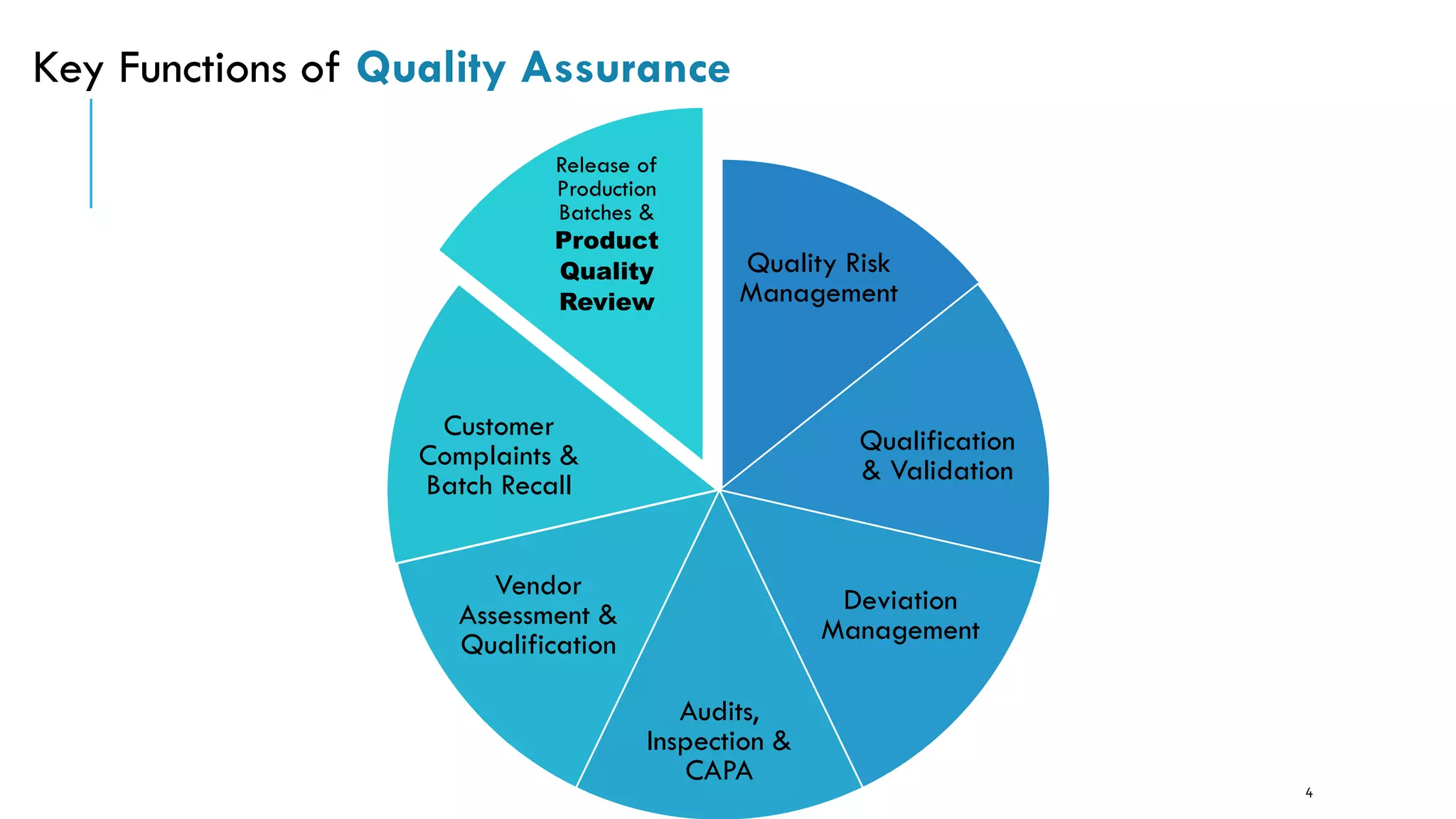
Quality Risk
Management
Qualification
& Validation
Deviation
Management
Audits,
Inspection &
CAPA
Vendor
Assessment &
Qualification
Customer
Complaints &
Batch Recall
Release of
Production
Batches &
Product
Quality
Review
Key Functions of Quality Assurance
4
PRODUCT QUALITY REVIEW WHY
"Reviews" are a critical element of any Quality Management System.
Regular reviews of process and quality system performance is necessary to ensure product
quality.
All regulatory authorities require "reviews“ which may be called
 "Annual Product Review“ (US GMP term), or
 "Product Quality Review“ (EU GMP term)
Expectations regarding contents and objectives are more or less the same.
5
BENEFITS OF PQR…
Decrease the risk of out-of-specification results
Minimize the risk of rework/reprocessing
Decrease downtime
Increase productivity
Decrease the risk of product recalls
Meet all regulatory commitments/requirements
Improve communication between production, engineering, quality and regulatory
functions
6
Product Quality Review
Engineering
Supply
Chain
Production
Pharmacovi
gilance
Quality &
Compliance
Regulatory
Affairs
RESPONSIBILITIES
Individual departments, such as,
Supply Chain, Engineering,
Production,, Quality and Compliance,
Pharmacovigilance and Regulatory
Affairs are responsible for providing
data required (if any) and
participating in the Product Quality
Review process
7
REQUIREMENTS
There should be a written procedures, which must be followed when
conducting Product Quality Reviews.
The Product Quality Review should cover a one year rolling period
The review should normally be completed within sixty (60) calendar
days of the period close and must in all cases be completed within ninety
(90) calendar days of the period close
If the production is less than 10 batches per year, an annual product
review must still be conducted and this review can include a review
performed on the 2 or 3 preceding production years
8
REQUIREMENTS (CONT.)
The number of batches to be considered is the number of batches
manufactured during the agreed annual period. The Product
Quality Review must include all batches of product whether they
were accepted or rejected or destroyed during manufacture
The Product Quality Review report must address the assessment of
data, documents and electronic records reviewed
Product Quality Reviews are to take into account previous reviews.
9
PQR MUST INCLUDE, AT A MINIMUM
Review of starting materials (API(s) & Excipients) and primary
packaging materials
Critical inprocess controls, finished product results and critical API
test results
Number of batches manufactured, including partially completed
batches and corresponding yields
Number and percentage of batches rejected and related
reasons
Number and percentage of batches reworked or reprocessed
and related reasons
10
PQR MUST INCLUDE, AT A MINIMUM (CONT.)
Review of "deviations from the validated state“
A review of all batches that failed to meet established specification(s)
and their investigation
Out of Specification Results and related failure investigations
Product quality complaints
Product Recalls
A review of the adequacy of all corrective & preventive actions
11
PQR MUST INCLUDE, AT A MINIMUM (CONT.)
Product quality Review must be prepared for each water
quality grade produced at each site
If one quality of water is only used for one product , the
data concerning this water can be included in the PQR of the
corresponding FPP
For critical utilities it is recommending either to perform a
separate PQR or to include a specific chapter in the
corresponding PQR
12
PQR MUST INCLUDE, AT A MINIMUM (CONT.)
Changes effected (change control) and variations during the period
(e.g. process, suppliers, equipment, facility)
Changes of product specifications or methods (e.g. analytical
changes as required by regulatory bodies, FPP appears in
compendium, etc.)
Any outstanding validation commitments or corrective and preventive
action plans from last PQR and its status ?
Is the qualification status (IQ/OQ/PQ) acceptable for production
and QC equipment ?
13
PQR MUST INCLUDE, AT A MINIMUM (CONT.)
Any significant findings concerning the stability monitoring
program ?
Are all required Technical Agreements in place and up-to-date ?
14
PQR DATA INTERPRETATION & TREND EVALUATION
Data will be tabulated and/or graphed in such a
fashion as to easily exhibit results, deviations and
trends to determine if:
The process is in control
The process is capable.
Use of Control Charts
Trend analysis on key in-process and release testing with Shewart
control charts
The use of such charts will help to determine the upper and lower
control limits
15
PQR DATA INTERPRETATION & TREND EVALUATION (CONT.….)
Use of Process Capability
Process Capability – A measure of how “capable” the process is
to meet customer requirements.
Interpreting the Process Capability Index
Cpk < 1 Not Capable
Cpk > 1 Capable at 3
Cpk > 1.33 Capable at 4
Cpk > 1.67 Capable at 5
Cpk > 2 Capable at 6
16
WHAT MAY BE INCLUDED IN THE PQR CONCLUSION
Follow-up actions may be included but are not limited to:
 Product process improvement
 Formulation improvement
 Analytical method improvements
 In-process or final product specification review
 Revalidation
 Product recall or withdrawal
 New packaging
17
PQR PRINCIPLES
Focus on evaluation and assessment of data and information
Create a meaningful list of facts and data
Reviews should focus on mid and long-term trends (e.g. intra and interbatch)
because these trends are not obvious from single batch data
Therefore, make a connection to the previous report
One element of a meaningful review is the verification of selected original
records (e.g. batch record, test records)
18
PQR SHOULD CONFIRM THE STATE OF CONTROL
'Validated status' based on assessment of process performance
(critical / relevant process information, trends)
Closure of any deviation from the validated state, especially changes,
batch failures / OOS / deviations, or complaints /recalls
Confirmation that the product is stable
Confirmation that specifications and acceptance criteria are still
suitable to assure product quality
19
APPROVAL AND ARCHIVING
Product Quality Reviews will be reviewed, assessed, and approved
by all concerns (Production, R&D, QC & Engineering)
The approved documents must be archived for a minimum of 05
years and made available (upon request) during internal or external
audits by Regulatory Authorities.
20
QUESTIONS
21
22

Product Quality Review.

  • 1.
    PRODUCT QUALITY REVIEW by MuhammadZubair Assistant Manager Quality Assurance Indus Pharma (Pvt.) Ltd.
  • 2.
    “You tell me,…and I forget. You teach me,… and I remember. You involve me,… and I learn.” - BENJAMIN FRANKLIN 2
  • 3.
    PRODUCT QUALITY REVIEWWHAT Regular periodic or rolling quality reviews of all authorized medicinal products, including export only products should be conducted. Purpose of this review is to verify the consistency of the existing process, the appropriateness of current specifications for both starting materials and finished product, to highlight any trends and to identify product and process improvements. Product Quality Reviews (PQRs) are important for communication between manufacturing, quality and regulatory Affairs, to enable quality improvement processes. 3
  • 4.
    Quality Risk Management Qualification & Validation Deviation Management Audits, Inspection& CAPA Vendor Assessment & Qualification Customer Complaints & Batch Recall Release of Production Batches & Product Quality Review Key Functions of Quality Assurance 4
  • 5.
    PRODUCT QUALITY REVIEWWHY "Reviews" are a critical element of any Quality Management System. Regular reviews of process and quality system performance is necessary to ensure product quality. All regulatory authorities require "reviews“ which may be called  "Annual Product Review“ (US GMP term), or  "Product Quality Review“ (EU GMP term) Expectations regarding contents and objectives are more or less the same. 5
  • 6.
    BENEFITS OF PQR… Decreasethe risk of out-of-specification results Minimize the risk of rework/reprocessing Decrease downtime Increase productivity Decrease the risk of product recalls Meet all regulatory commitments/requirements Improve communication between production, engineering, quality and regulatory functions 6
  • 7.
    Product Quality Review Engineering Supply Chain Production Pharmacovi gilance Quality& Compliance Regulatory Affairs RESPONSIBILITIES Individual departments, such as, Supply Chain, Engineering, Production,, Quality and Compliance, Pharmacovigilance and Regulatory Affairs are responsible for providing data required (if any) and participating in the Product Quality Review process 7
  • 8.
    REQUIREMENTS There should bea written procedures, which must be followed when conducting Product Quality Reviews. The Product Quality Review should cover a one year rolling period The review should normally be completed within sixty (60) calendar days of the period close and must in all cases be completed within ninety (90) calendar days of the period close If the production is less than 10 batches per year, an annual product review must still be conducted and this review can include a review performed on the 2 or 3 preceding production years 8
  • 9.
    REQUIREMENTS (CONT.) The numberof batches to be considered is the number of batches manufactured during the agreed annual period. The Product Quality Review must include all batches of product whether they were accepted or rejected or destroyed during manufacture The Product Quality Review report must address the assessment of data, documents and electronic records reviewed Product Quality Reviews are to take into account previous reviews. 9
  • 10.
    PQR MUST INCLUDE,AT A MINIMUM Review of starting materials (API(s) & Excipients) and primary packaging materials Critical inprocess controls, finished product results and critical API test results Number of batches manufactured, including partially completed batches and corresponding yields Number and percentage of batches rejected and related reasons Number and percentage of batches reworked or reprocessed and related reasons 10
  • 11.
    PQR MUST INCLUDE,AT A MINIMUM (CONT.) Review of "deviations from the validated state“ A review of all batches that failed to meet established specification(s) and their investigation Out of Specification Results and related failure investigations Product quality complaints Product Recalls A review of the adequacy of all corrective & preventive actions 11
  • 12.
    PQR MUST INCLUDE,AT A MINIMUM (CONT.) Product quality Review must be prepared for each water quality grade produced at each site If one quality of water is only used for one product , the data concerning this water can be included in the PQR of the corresponding FPP For critical utilities it is recommending either to perform a separate PQR or to include a specific chapter in the corresponding PQR 12
  • 13.
    PQR MUST INCLUDE,AT A MINIMUM (CONT.) Changes effected (change control) and variations during the period (e.g. process, suppliers, equipment, facility) Changes of product specifications or methods (e.g. analytical changes as required by regulatory bodies, FPP appears in compendium, etc.) Any outstanding validation commitments or corrective and preventive action plans from last PQR and its status ? Is the qualification status (IQ/OQ/PQ) acceptable for production and QC equipment ? 13
  • 14.
    PQR MUST INCLUDE,AT A MINIMUM (CONT.) Any significant findings concerning the stability monitoring program ? Are all required Technical Agreements in place and up-to-date ? 14
  • 15.
    PQR DATA INTERPRETATION& TREND EVALUATION Data will be tabulated and/or graphed in such a fashion as to easily exhibit results, deviations and trends to determine if: The process is in control The process is capable. Use of Control Charts Trend analysis on key in-process and release testing with Shewart control charts The use of such charts will help to determine the upper and lower control limits 15
  • 16.
    PQR DATA INTERPRETATION& TREND EVALUATION (CONT.….) Use of Process Capability Process Capability – A measure of how “capable” the process is to meet customer requirements. Interpreting the Process Capability Index Cpk < 1 Not Capable Cpk > 1 Capable at 3 Cpk > 1.33 Capable at 4 Cpk > 1.67 Capable at 5 Cpk > 2 Capable at 6 16
  • 17.
    WHAT MAY BEINCLUDED IN THE PQR CONCLUSION Follow-up actions may be included but are not limited to:  Product process improvement  Formulation improvement  Analytical method improvements  In-process or final product specification review  Revalidation  Product recall or withdrawal  New packaging 17
  • 18.
    PQR PRINCIPLES Focus onevaluation and assessment of data and information Create a meaningful list of facts and data Reviews should focus on mid and long-term trends (e.g. intra and interbatch) because these trends are not obvious from single batch data Therefore, make a connection to the previous report One element of a meaningful review is the verification of selected original records (e.g. batch record, test records) 18
  • 19.
    PQR SHOULD CONFIRMTHE STATE OF CONTROL 'Validated status' based on assessment of process performance (critical / relevant process information, trends) Closure of any deviation from the validated state, especially changes, batch failures / OOS / deviations, or complaints /recalls Confirmation that the product is stable Confirmation that specifications and acceptance criteria are still suitable to assure product quality 19
  • 20.
    APPROVAL AND ARCHIVING ProductQuality Reviews will be reviewed, assessed, and approved by all concerns (Production, R&D, QC & Engineering) The approved documents must be archived for a minimum of 05 years and made available (upon request) during internal or external audits by Regulatory Authorities. 20
  • 21.
  • 22.