The document discusses key fingerprint terminology used for identification, including:
- Pattern area is defined by type lines, which are the two innermost ridges surrounding an area. This area contains features like deltas and cores.
- Deltas are the first ridge or obstruction at the point where type lines diverge, usually a bifurcation or dot.
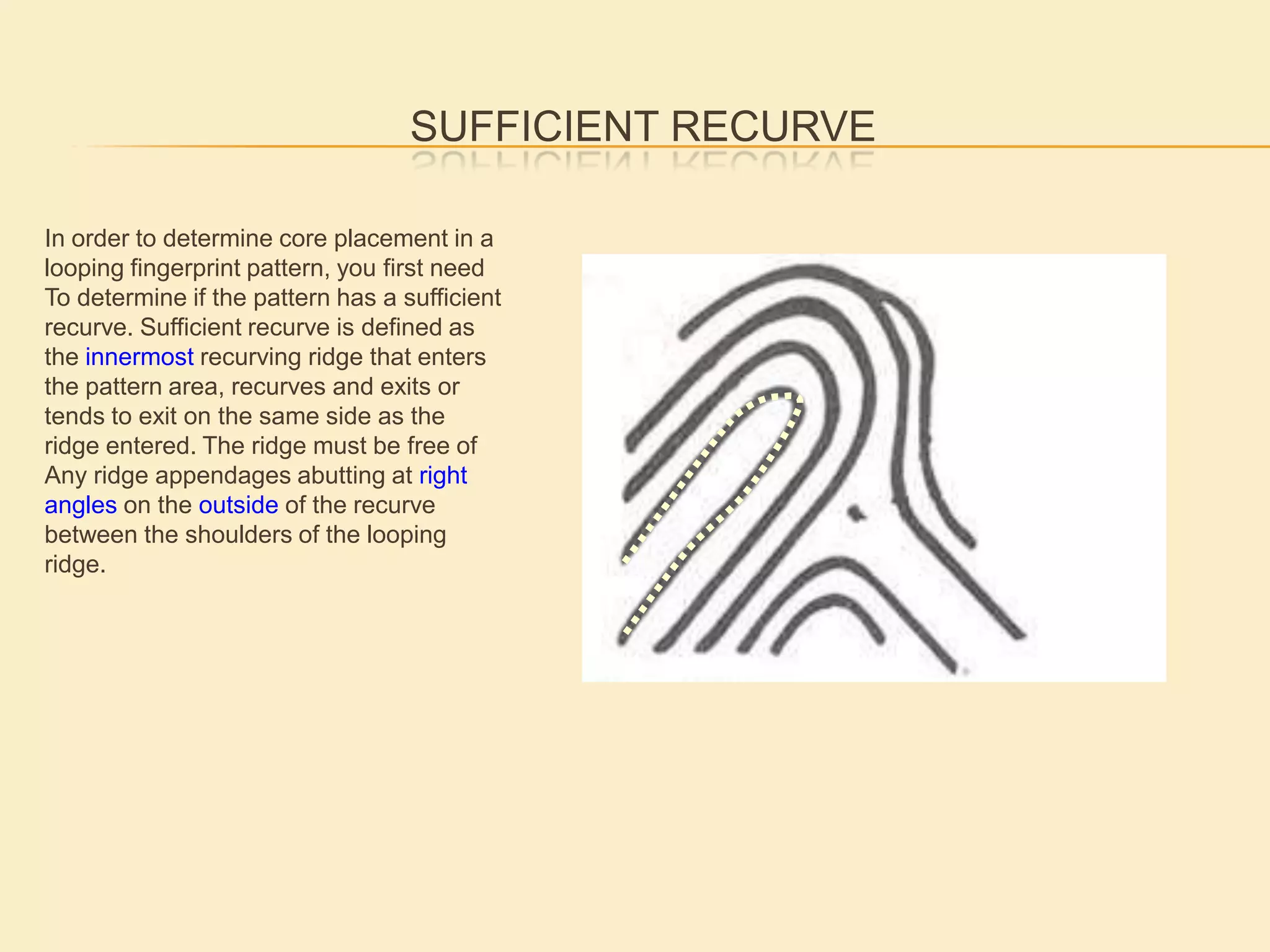
- Cores are the center of looping patterns, determined by finding the innermost sufficient recurving ridge without appendages between its shoulders.
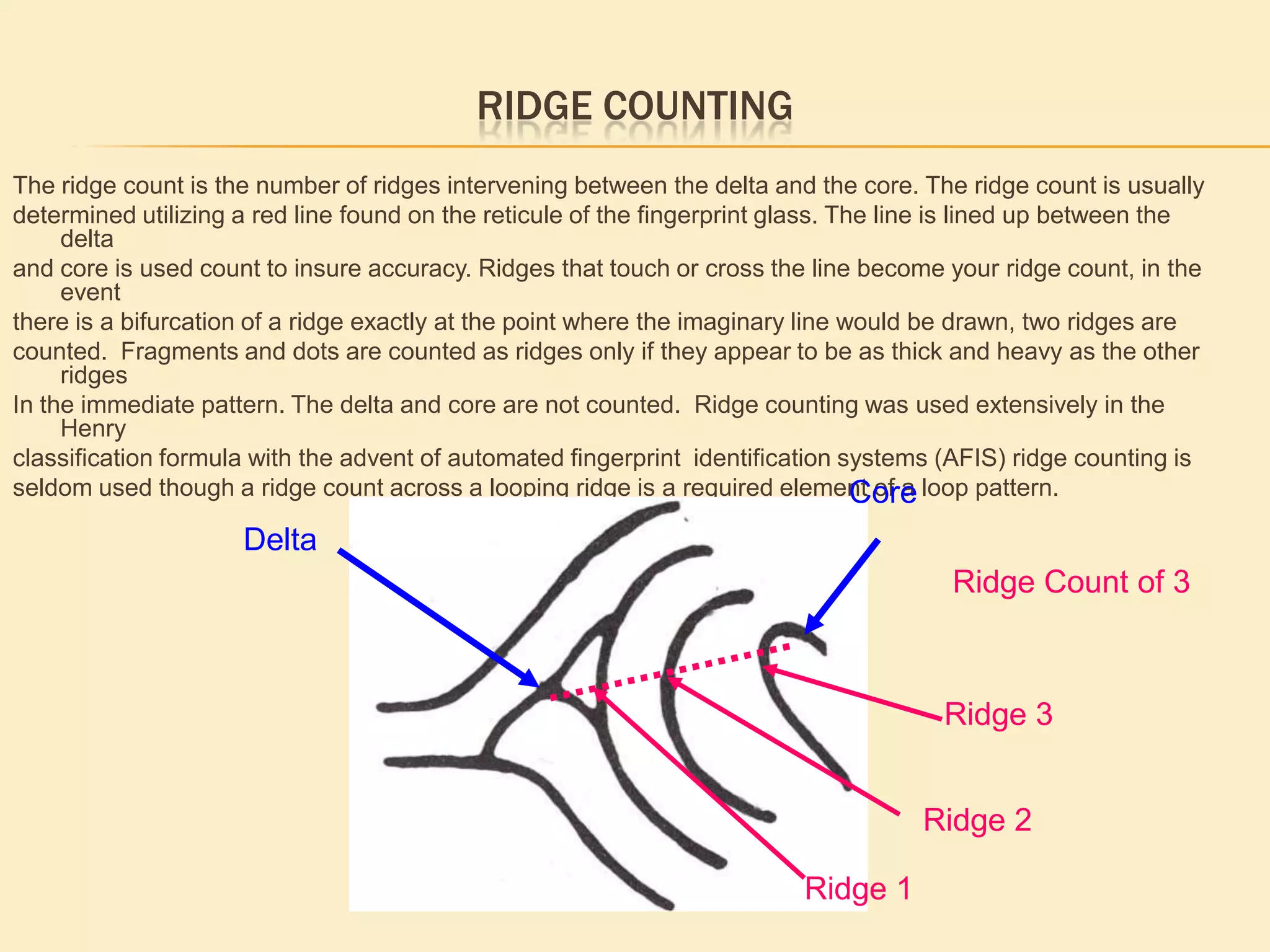
- Ridge counting is done between the delta and core to further identify patterns.
In this document
Powered by AI
Introduction to fingerprinting and its significance in forensic identification.
Common terms related to fingerprints including bifurcation, divergence, AFIS, and pattern areas.
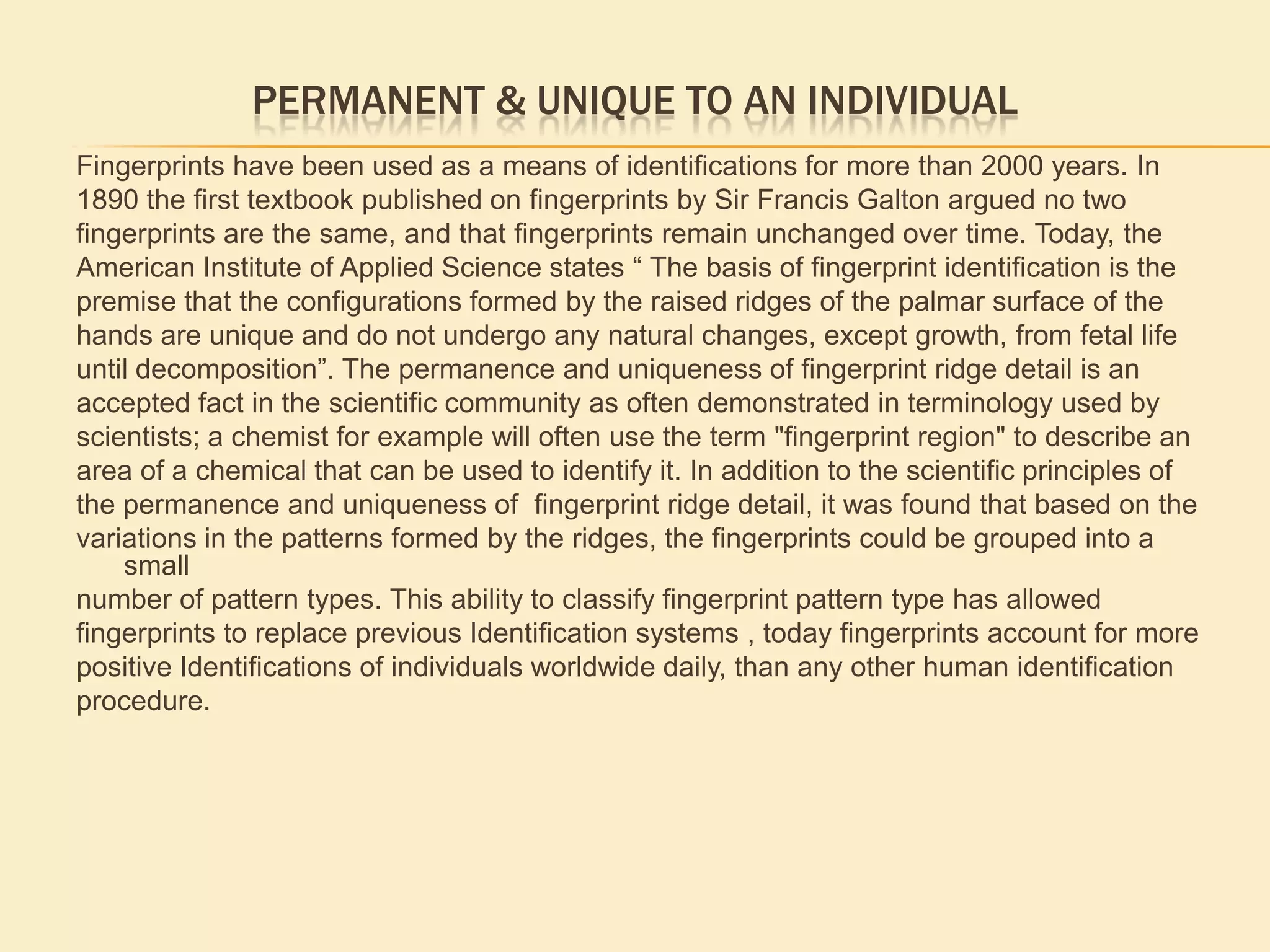
Fingerprints' uniqueness and permanence established over 2000 years, crucial for accurate identifications.
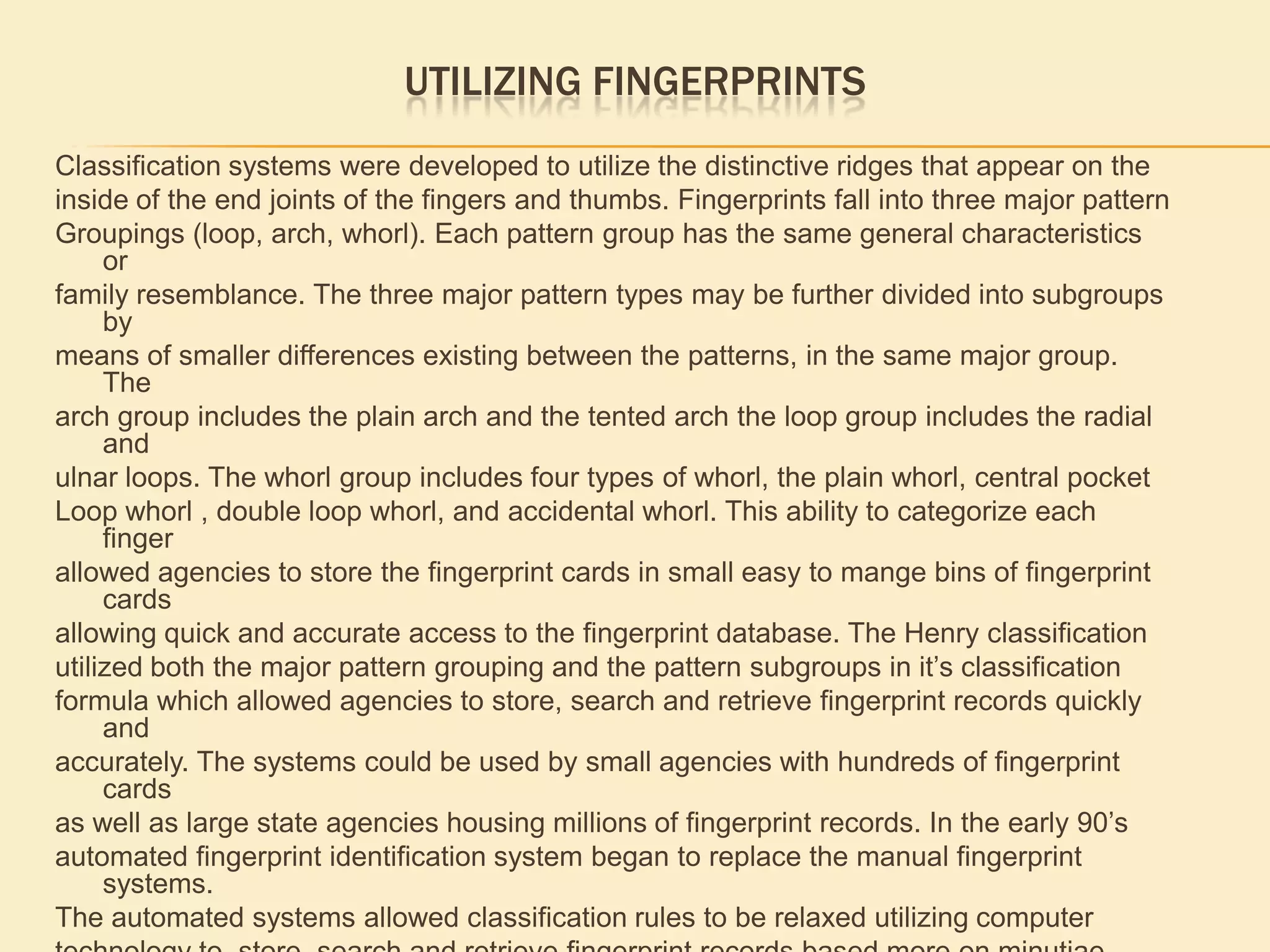
Development of classification systems to categorize fingerprints into loop, arch, and whorl patterns.
Introduction to the three main fingerprint pattern types: loops, arches, and whorls, and their characteristics.
Rules for determining fingerprint pattern groupings, focusing on the pattern area and its importance.
Definition of typelines and their role in defining the pattern area of fingerprints.
Challenges with typelines that aren't continuous, including methods to address breaks in ridges.
Guidelines for determining pattern area despite imperfections in fingerprint images.
Explanation of why angled ridges do not qualify as typelines in fingerprint analysis.
Description of bifurcating ridges and their identification in determining typelines.
Specific rules for identifying typelines, focusing on parallelism and divergence.
Process of identifying key points (delta, core, ridge detail) after determining the pattern area.
Criteria for identifying delta within a fingerprint pattern and its significance.
Different forms a delta may take in fingerprint patterns.
Core definition and its central role in various fingerprint patterns, especially loops.
Criteria for recognizing sufficient recurve necessary for core determination in loops.
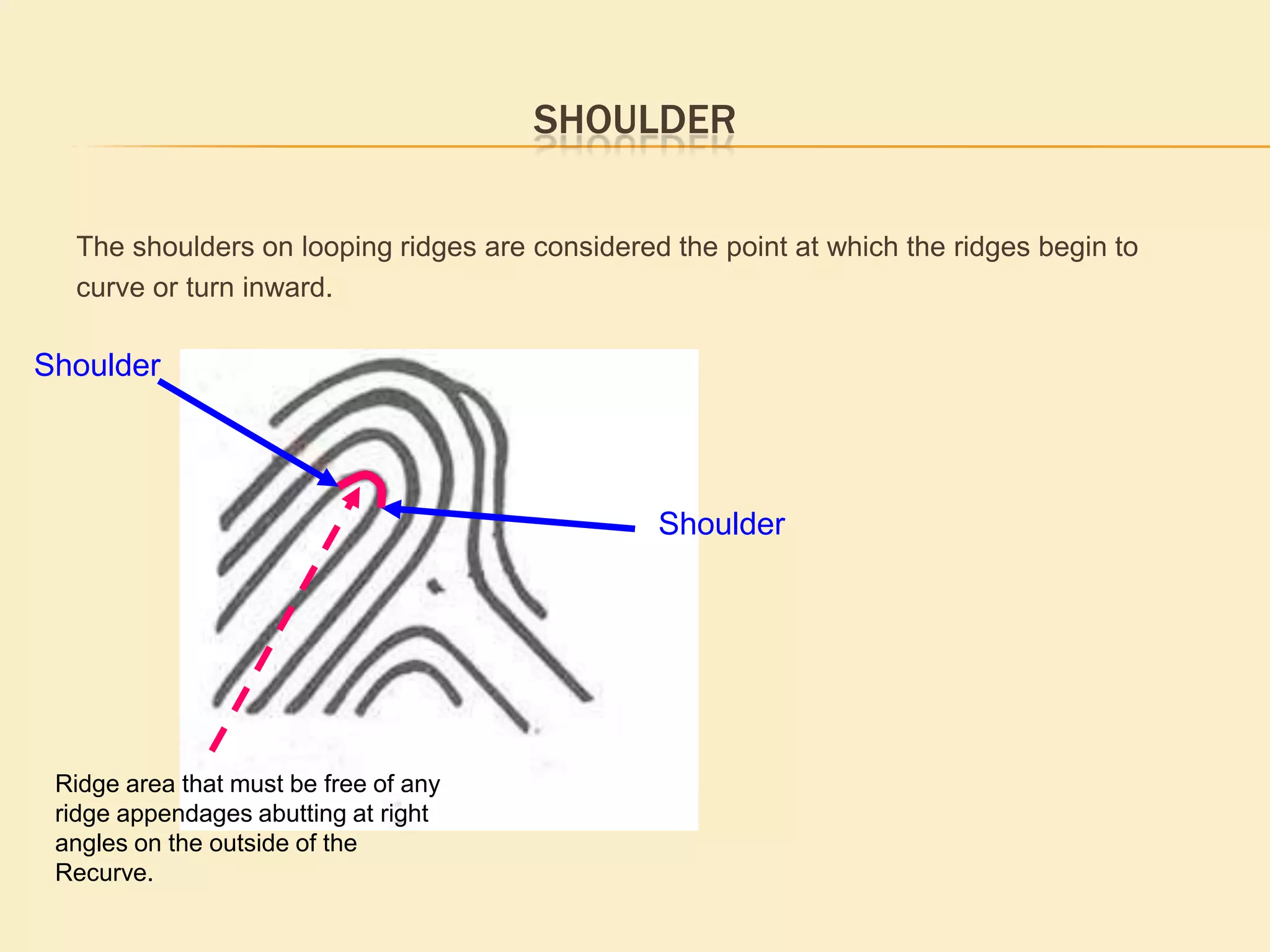
Defining the shoulder as the starting point of curvature in looping ridges.
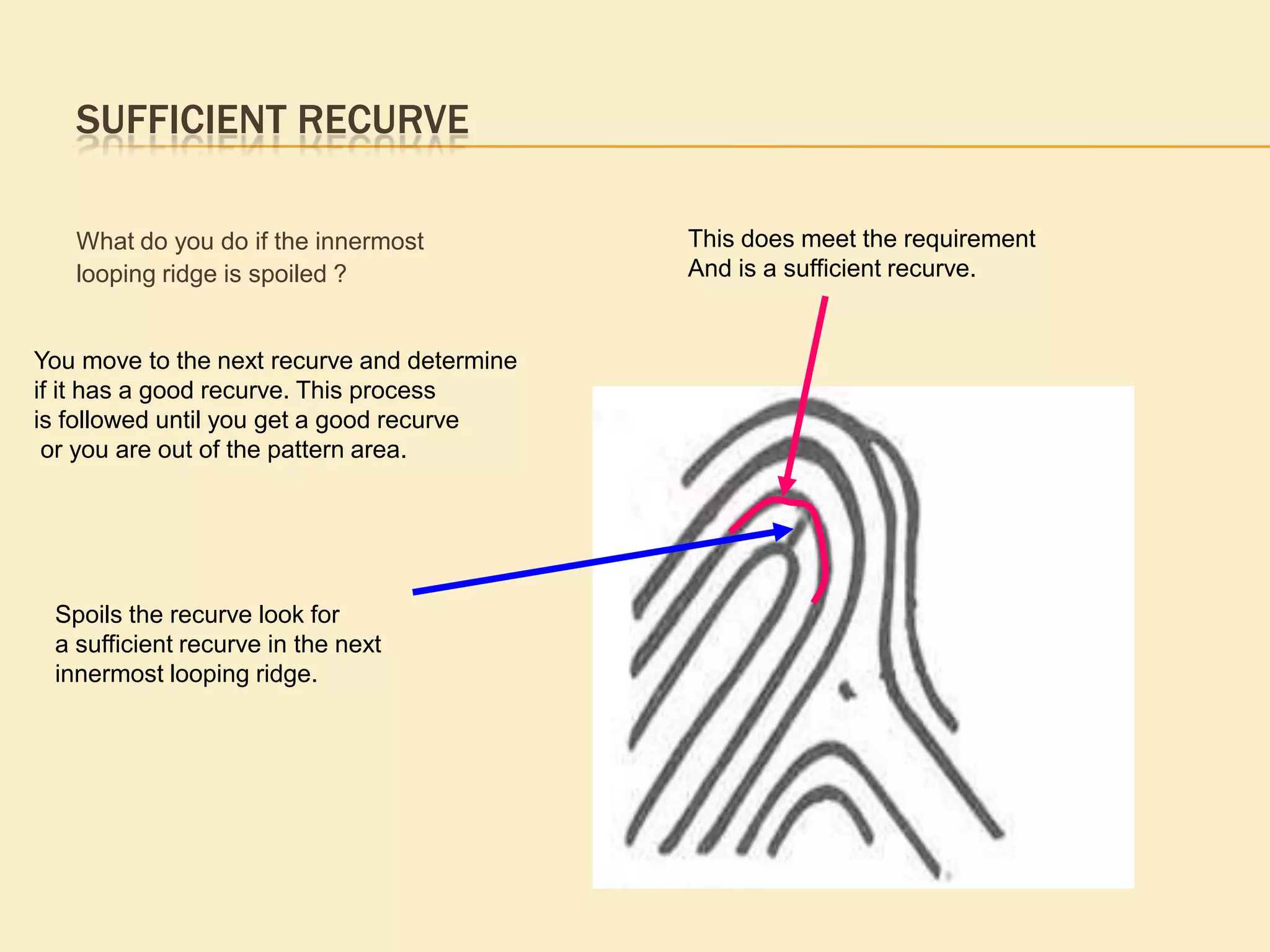
Approach to finding sufficient recurves in spoiled patterns.
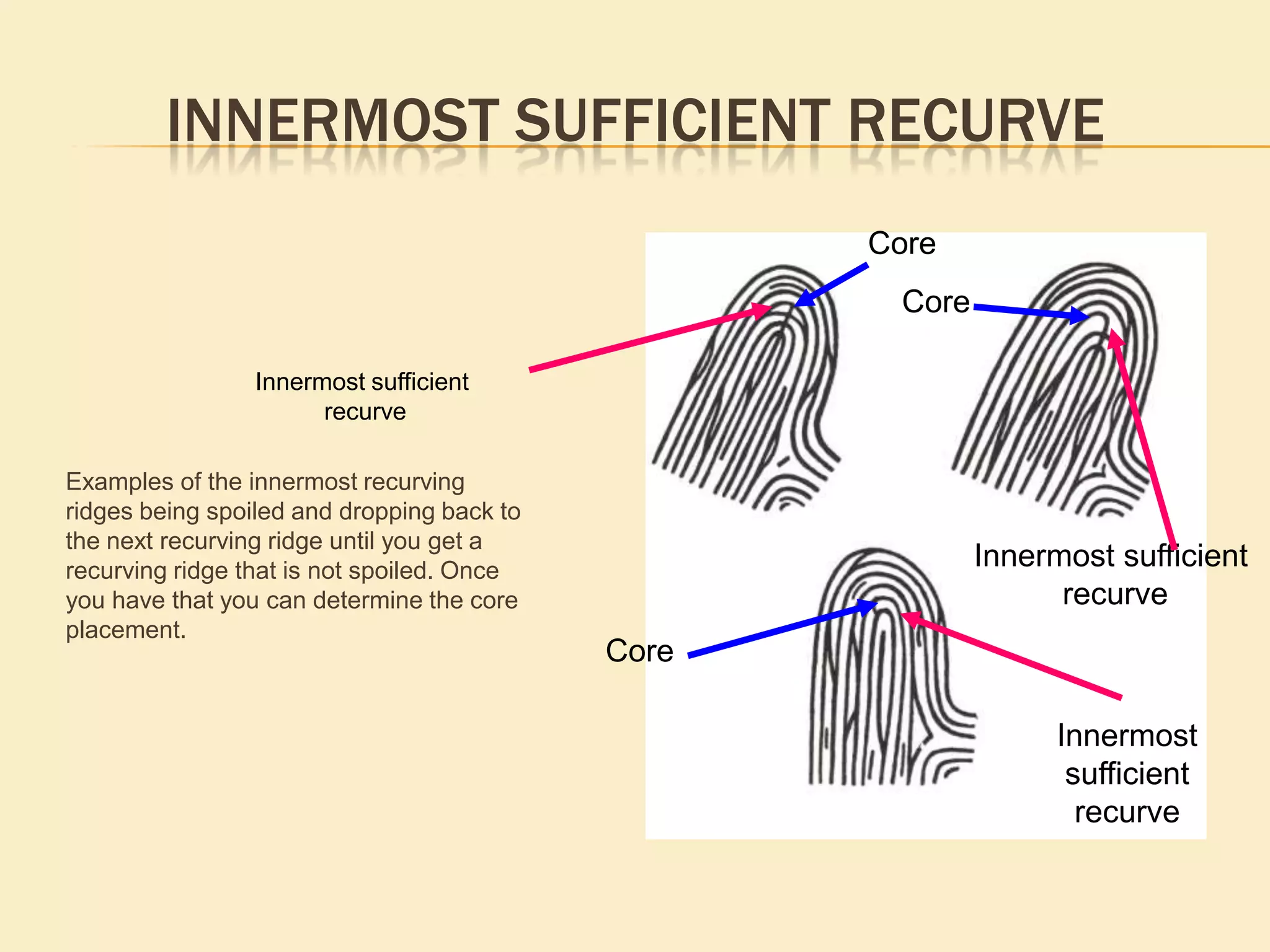
Steps to determine core placement using the innermost sufficient recurve.
Counting ridges between delta and core, relevant for fingerprint classification.
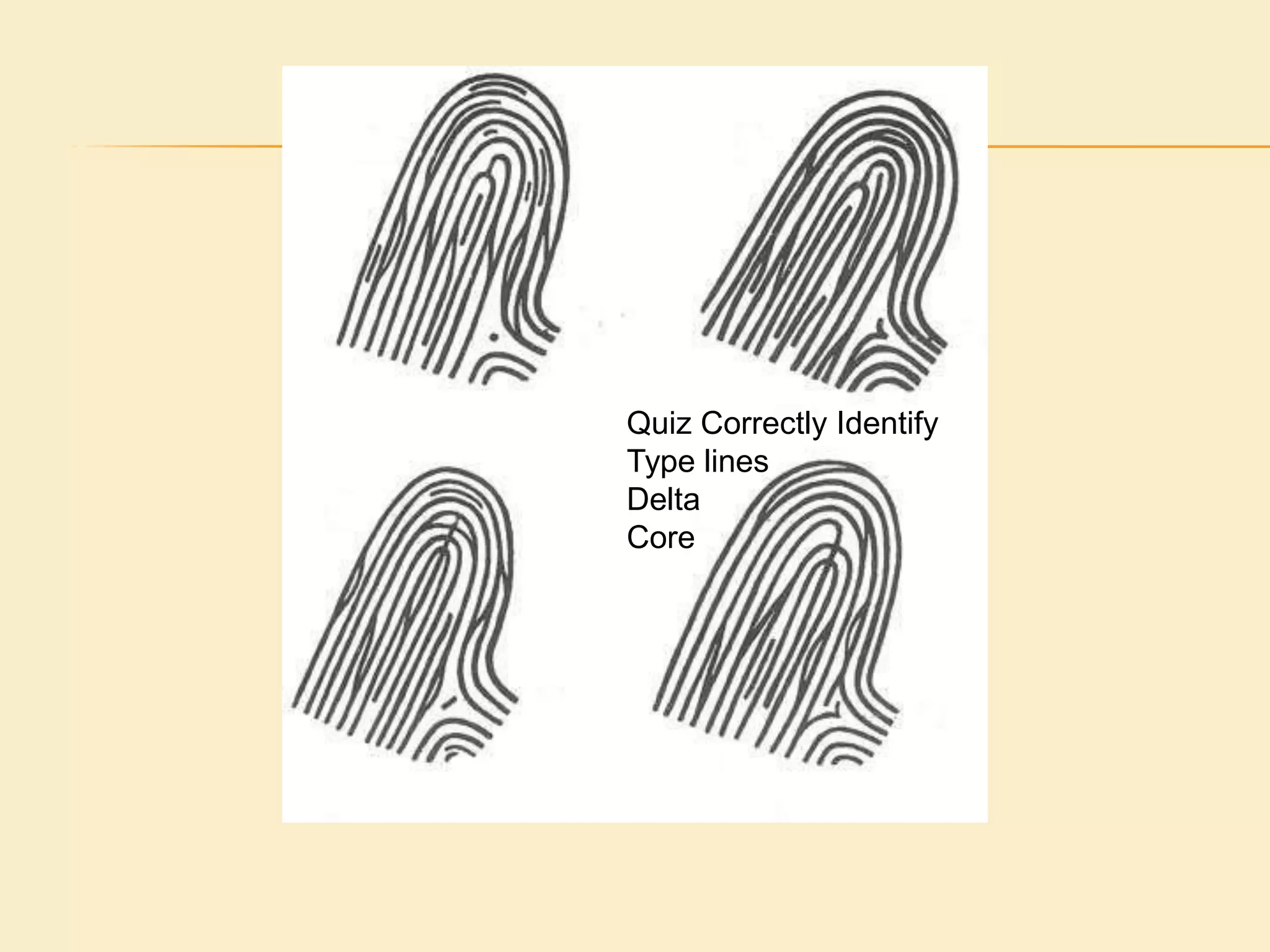
Quiz focused on identifying type lines, delta, and core in given fingerprints.
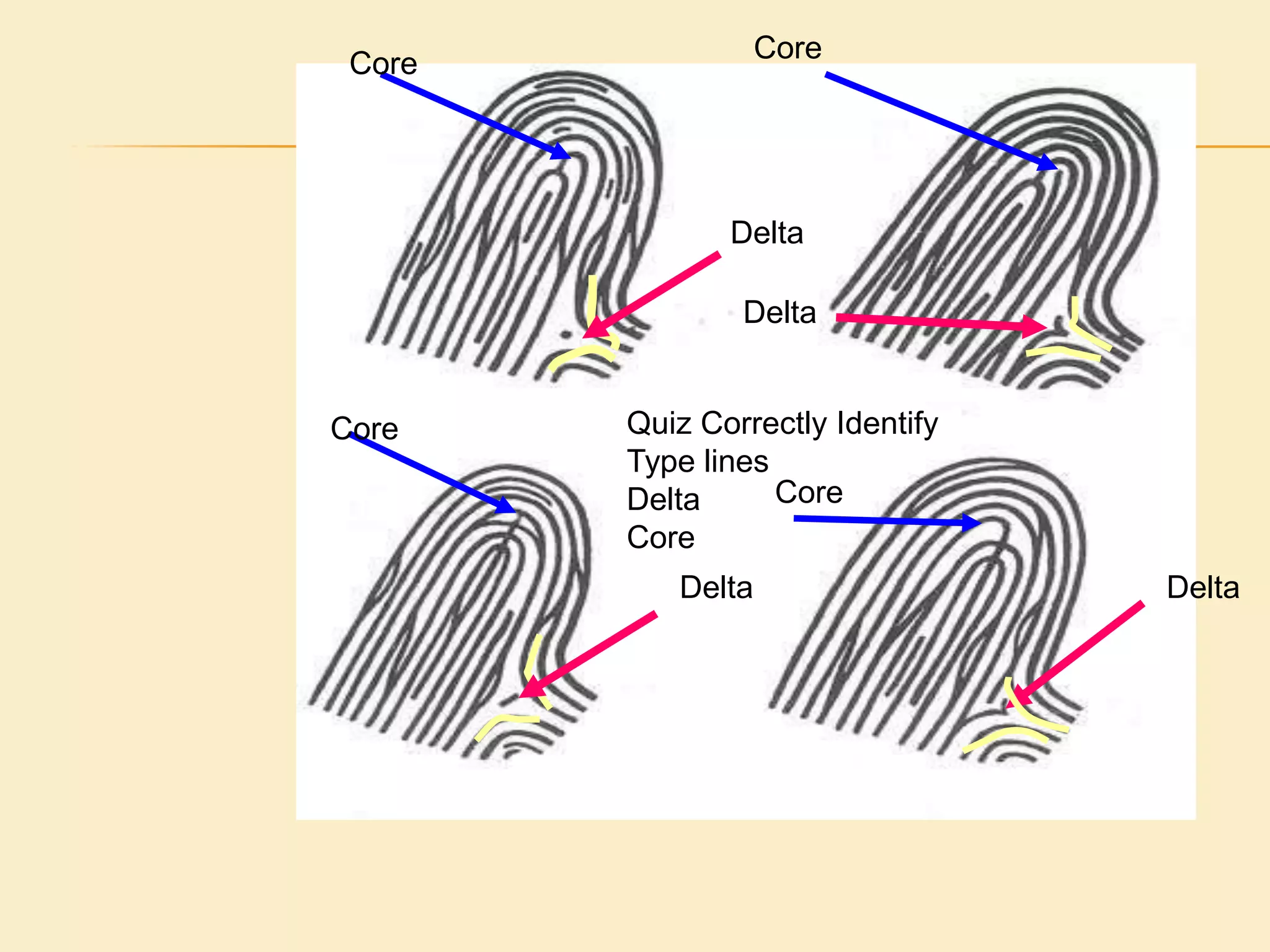
Continued quiz on recognizing fingerprint elements including cores and deltas.
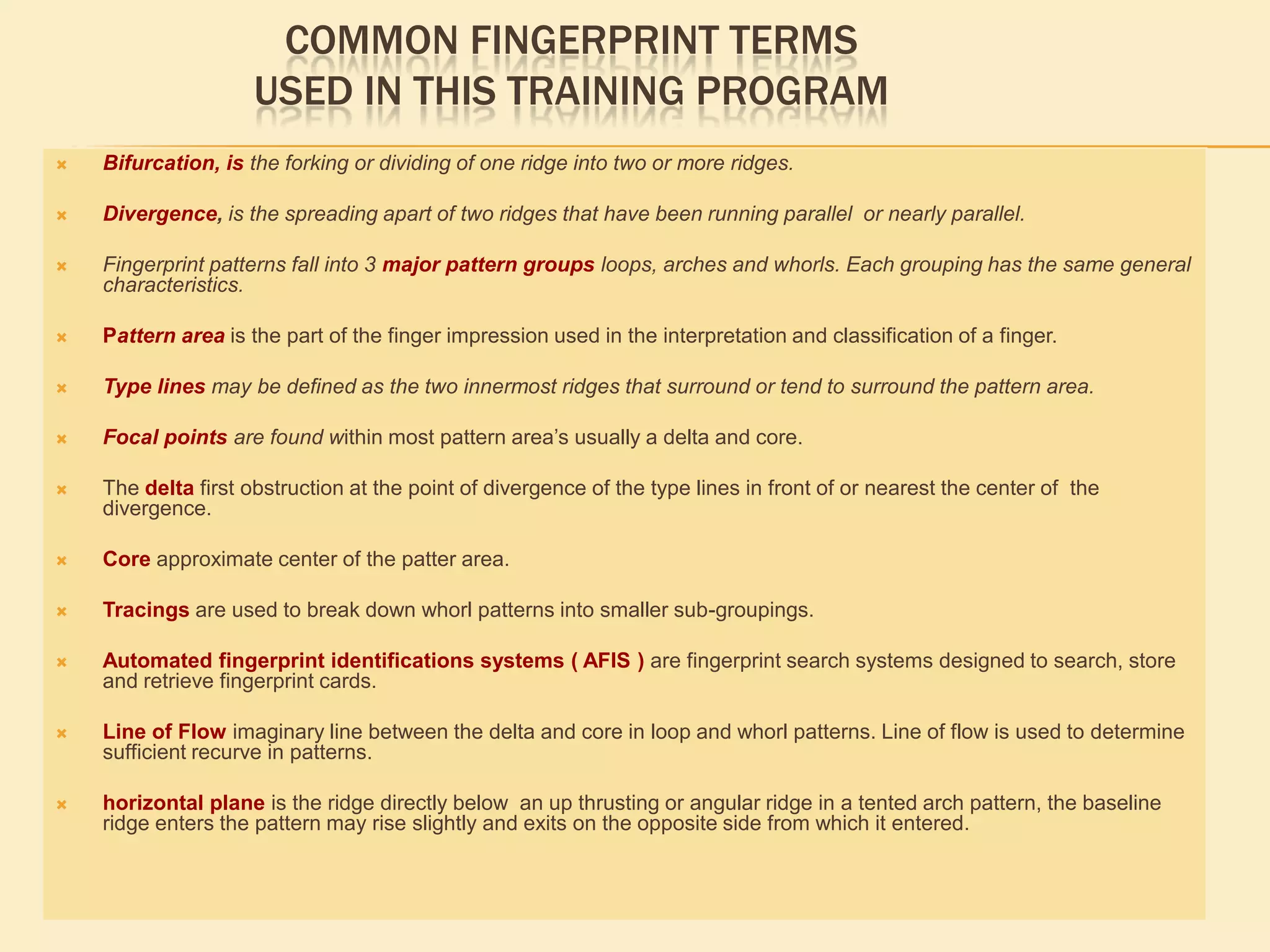
Line of Flowimaginary linebetween the delta and core in loop and whorl patterns. Line of flow is used to determine sufficient recurve in patterns.
13.
horizontal plane isthe ridge directly below an up thrusting or angular ridge in a tented arch pattern, the baseline ridge enters the pattern may rise slightly and exits on the opposite side from which it entered.Permanent & Unique to an IndividualFingerprints have been used as a means of identifications for more than 2000 years. In 1890 the first textbook published on fingerprints by Sir Francis Galton argued no two fingerprints are the same, and that fingerprints remain unchanged over time. Today, the American Institute of Applied Science states “ The basis of fingerprint identification is the premise that the configurations formed by the raised ridges of the palmar surface of the hands are unique and do not undergo any natural changes, except growth, from fetal life until decomposition”. The permanence and uniqueness of fingerprint ridge detail is an accepted fact in the scientific community as often demonstrated in terminology used by scientists; a chemist for example will often use the term "fingerprint region" to describe an area of a chemical that can be used to identify it. In addition to the scientific principles of the permanence and uniqueness of fingerprint ridge detail, it was found that based on the variations in the patterns formed by the ridges, the fingerprints could be grouped into a small number of pattern types. This ability to classify fingerprint pattern type has allowed fingerprints to replace previous Identification systems , today fingerprints account for more positive Identifications of individuals worldwide daily, than any other human identification procedure.
14.
Utilizing fingerprintsClassification systemswere developed to utilize the distinctive ridges that appear on the inside of the end joints of the fingers and thumbs. Fingerprints fall into three major pattern Groupings (loop, arch, whorl). Each pattern group has the same general characteristics or family resemblance. The three major pattern types may be further divided into subgroups by means of smaller differences existing between the patterns, in the same major group. The arch group includes the plain arch and the tented arch the loop group includes the radial and ulnar loops. The whorl group includes four types of whorl, the plain whorl, central pocket Loop whorl , double loop whorl, and accidental whorl. This ability to categorize each finger allowed agencies to store the fingerprint cards in small easy to mange bins of fingerprint cards allowing quick and accurate access to the fingerprint database. The Henry classification utilized both the major pattern grouping and the pattern subgroups in it’s classification formula which allowed agencies to store, search and retrieve fingerprint records quickly and accurately. The systems could be used by small agencies with hundreds of fingerprint cards as well as large state agencies housing millions of fingerprint records. In the early 90’s automated fingerprint identification system began to replace the manual fingerprint systems. The automated systems allowed classification rules to be relaxed utilizing computer technology to store, search and retrieve fingerprint records based more on minutiae detail than pattern type.
15.
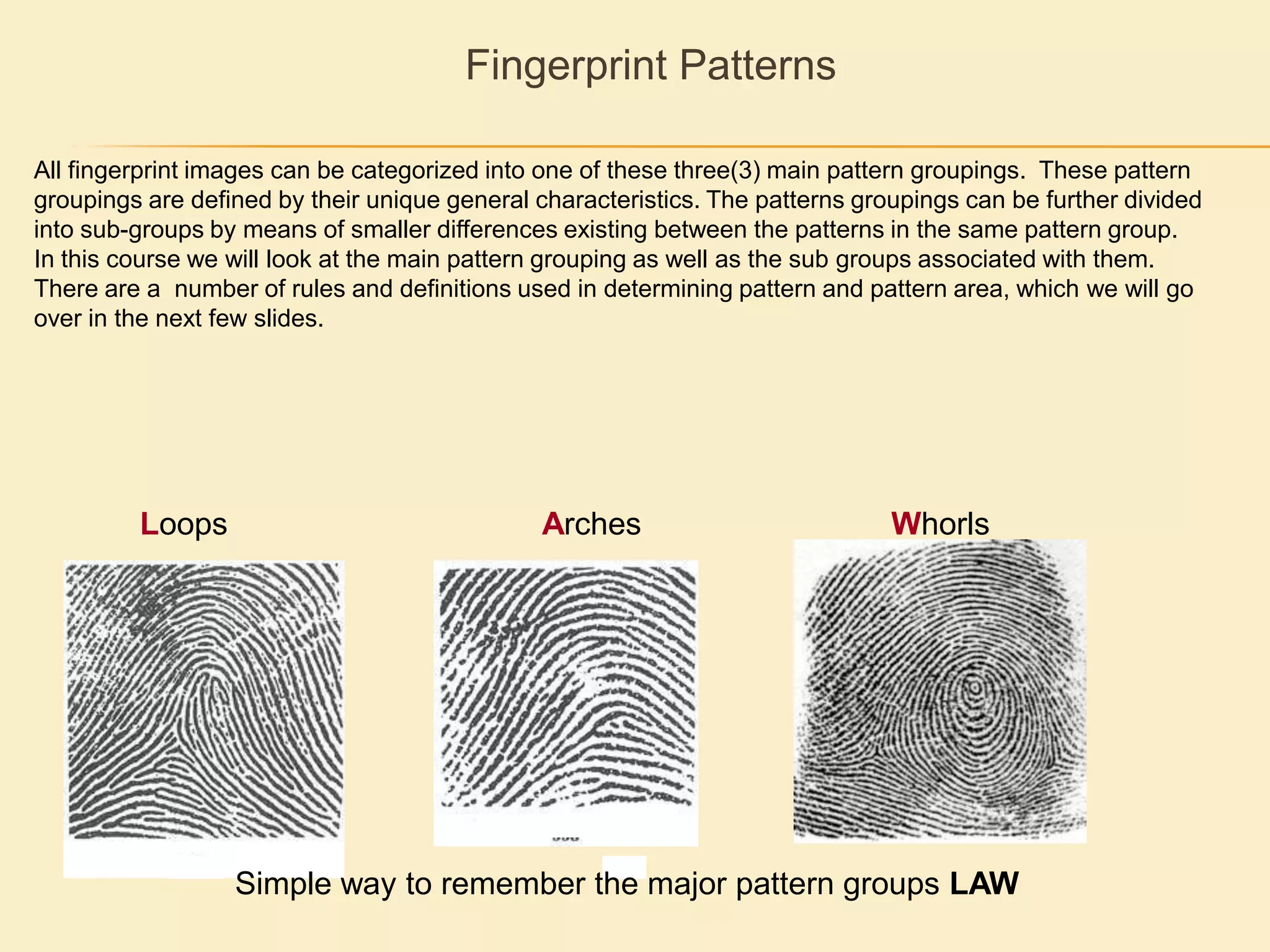
Fingerprint PatternsAll fingerprintimages can be categorized into one of these three(3) main pattern groupings. These pattern groupings are defined by their unique general characteristics. The patterns groupings can be further divided into sub-groups by means of smaller differences existing between the patterns in the same pattern group.In this course we will look at the main pattern grouping as well as the sub groups associated with them. There are a number of rules and definitions used in determining pattern and pattern area, which we will go over in the next few slides. LoopsArchesWhorlsSimple way to remember the major pattern groups LAW
16.
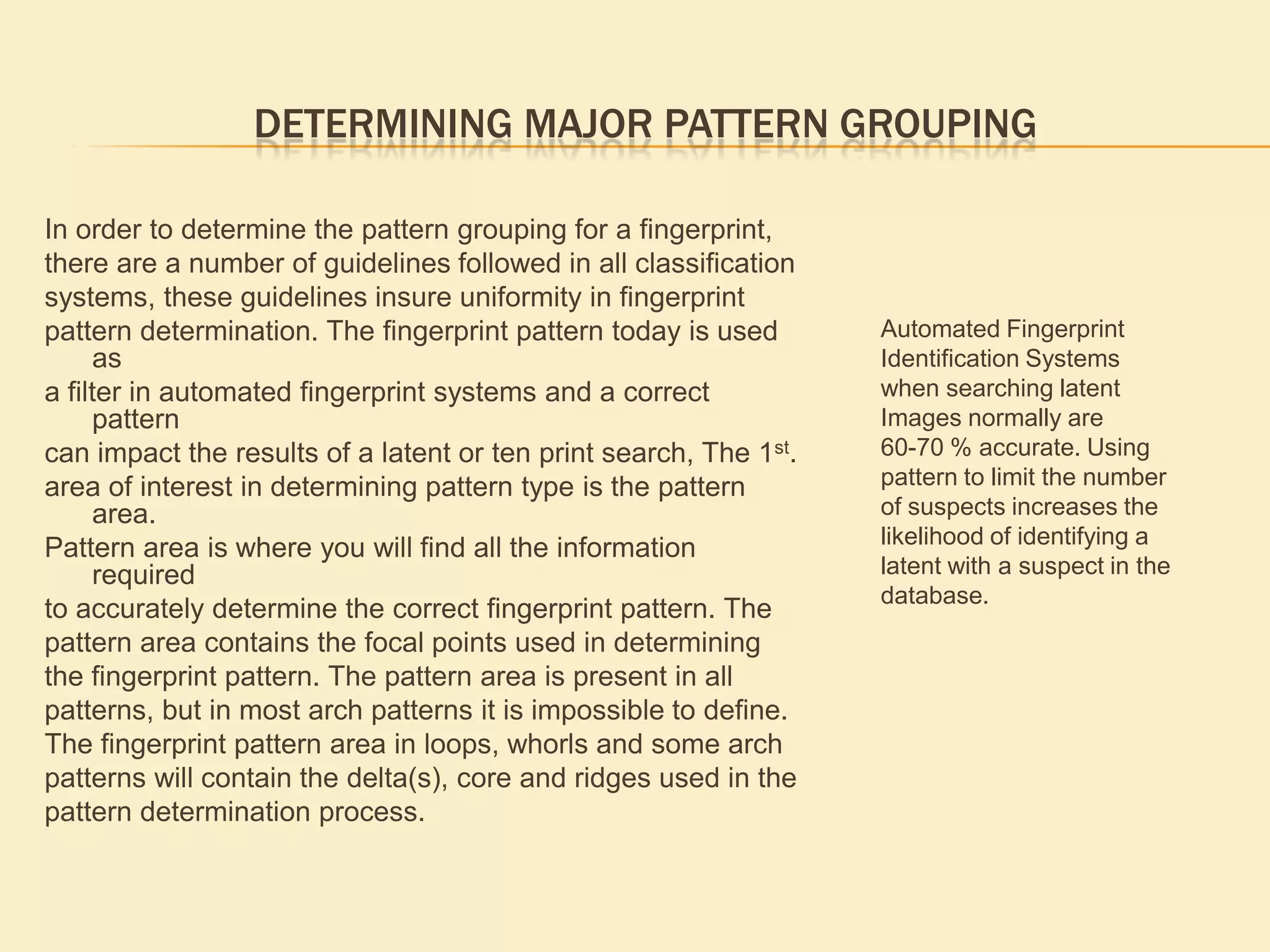
Determining Major PatternGroupingIn order to determine the pattern grouping for a fingerprint, there are a number of guidelines followed in all classification systems, these guidelines insure uniformity in fingerprint pattern determination. The fingerprint pattern today is used as a filter in automated fingerprint systems and a correct pattern can impact the results of a latent or ten print search, The 1st. area of interest in determining pattern type is the pattern area. Pattern area is where you will find all the information required to accurately determine the correct fingerprint pattern. The pattern area contains the focal points used in determining the fingerprint pattern. The pattern area is present in all patterns, but in most arch patterns it is impossible to define. The fingerprint pattern area in loops, whorls and some arch patterns will contain the delta(s), core and ridges used in the pattern determination process.Automated Fingerprint Identification Systems when searching latent Images normally are 60-70 % accurate. Usingpattern to limit the numberof suspects increases thelikelihood of identifying alatent with a suspect in the database.
17.
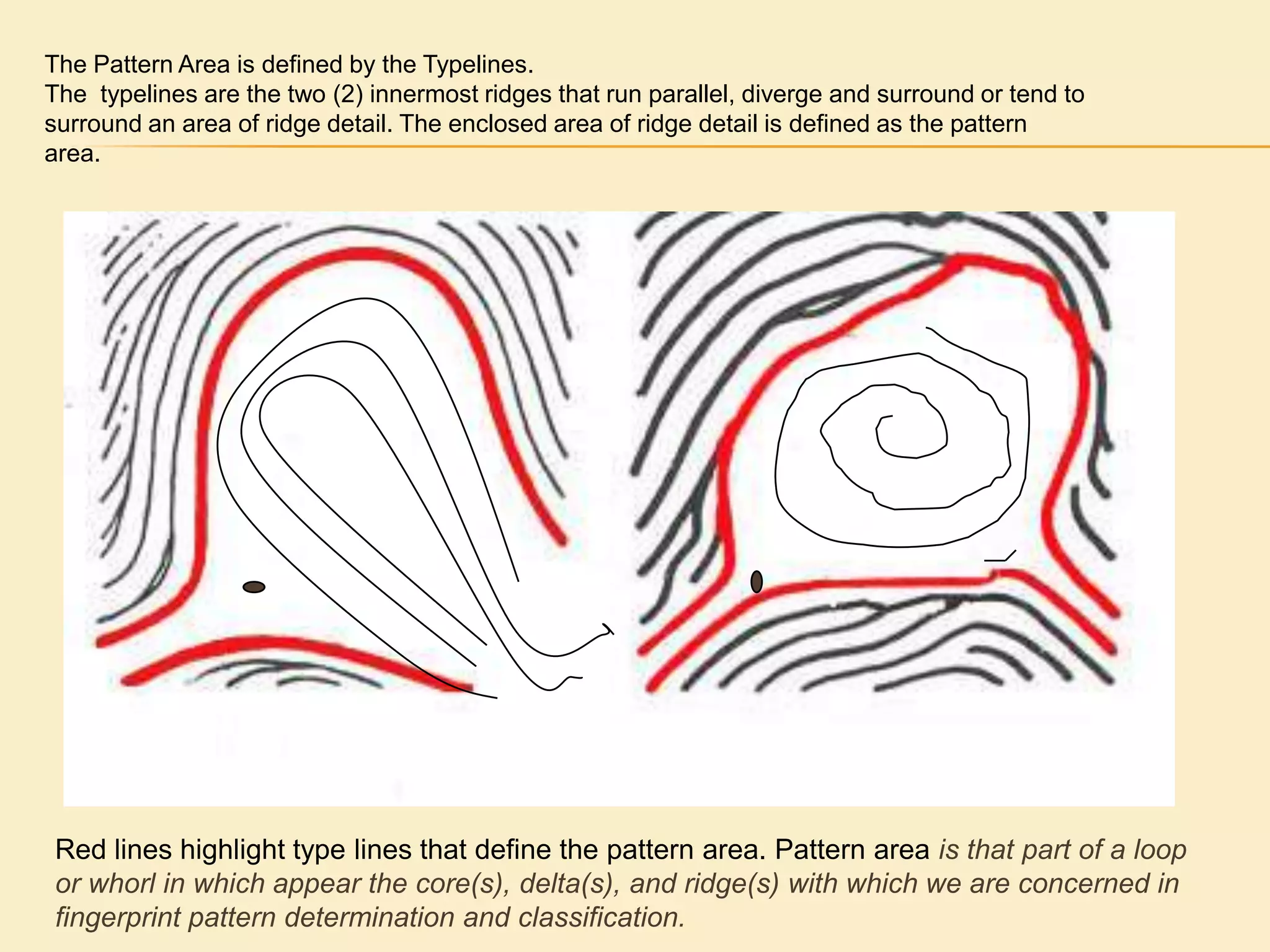
The Pattern Areais defined by the Typelines.The typelines are the two (2) innermost ridges that run parallel, diverge and surround or tend to surround an area of ridge detail. The enclosed area of ridge detail is defined as the pattern area.Red lines highlight type lines that define the pattern area. Pattern area is that part of a loop or whorl in which appear the core(s), delta(s), and ridge(s) with which we are concerned in fingerprint pattern determination and classification.
18.
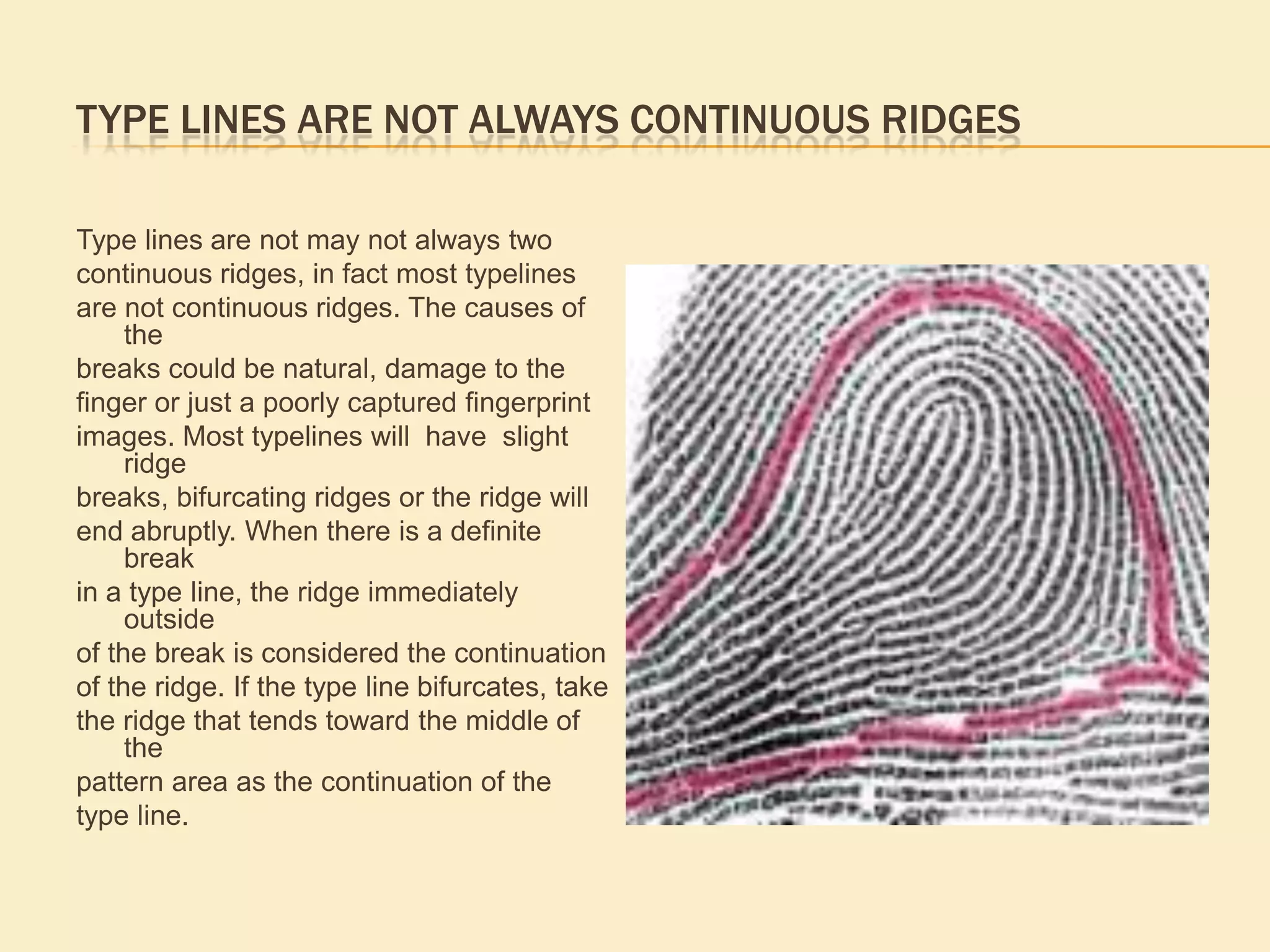
Type lines arenot always continuous ridgesType lines are not may not always two continuous ridges, in fact most typelines are not continuous ridges. The causes of the breaks could be natural, damage to the finger or just a poorly captured fingerprint images. Most typelines will have slight ridge breaks, bifurcating ridges or the ridge will end abruptly. When there is a definite break in a type line, the ridge immediately outside of the break is considered the continuation of the ridge. If the type line bifurcates, take the ridge that tends toward the middle of the pattern area as the continuation of the type line.
19.
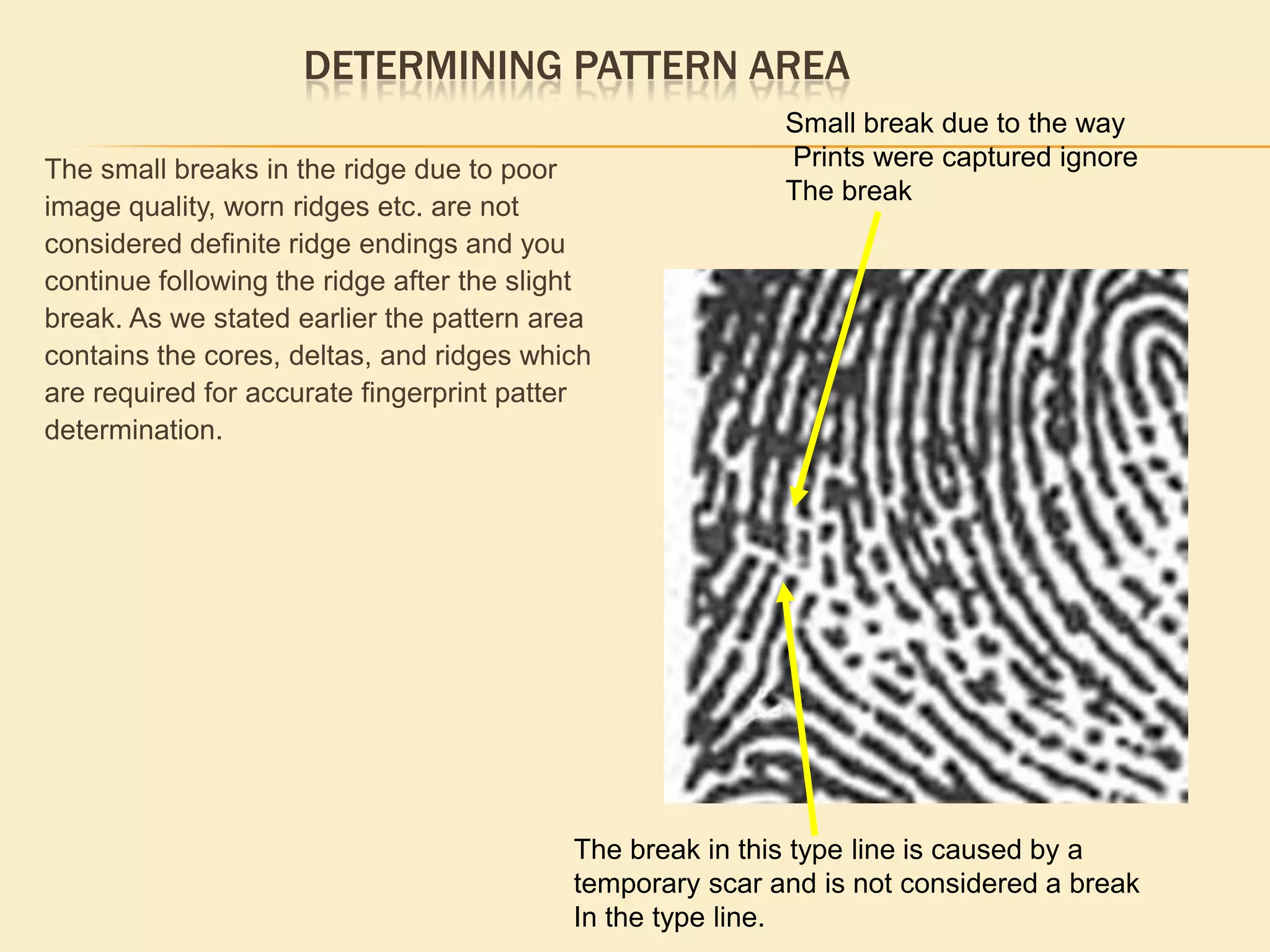
Determining Pattern AreaSmallbreak due to the way Prints were captured ignoreThe breakThe small breaks in the ridge due to poor image quality, worn ridges etc. are not considered definite ridge endings and you continue following the ridge after the slight break. As we stated earlier the pattern area contains the cores, deltas, and ridges which are required for accurate fingerprint patter determination.The break in this type line is caused by a temporary scar and is not considered a breakIn the type line.
20.
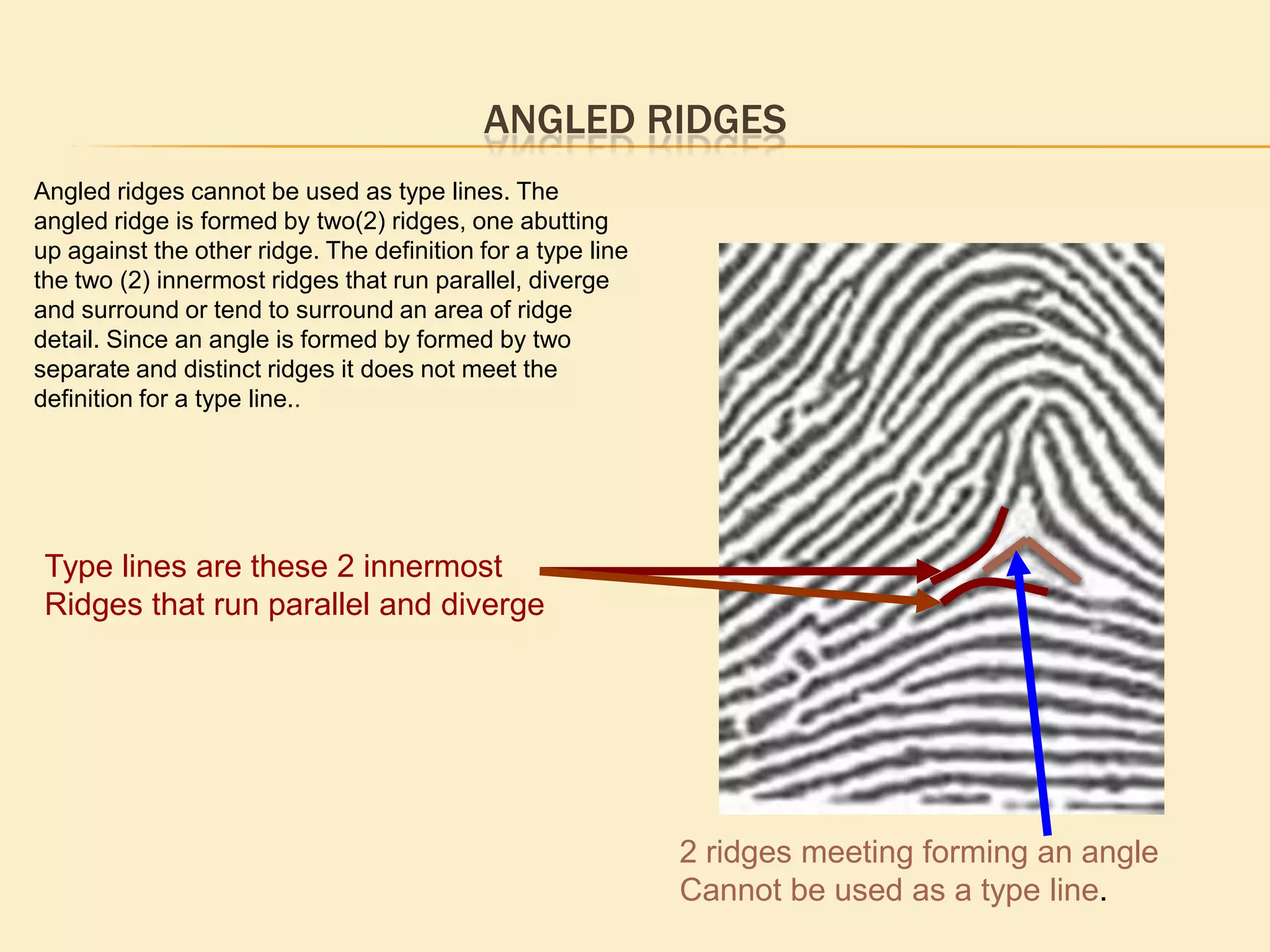
Angled Ridges Angledridges cannot be used as type lines. The angled ridge is formed by two(2) ridges, one abutting up against the other ridge. The definition for a type line the two (2) innermost ridges that run parallel, diverge and surround or tend to surround an area of ridge detail. Since an angle is formed by formed by two separate and distinct ridges it does not meet the definition for a type line.. Type lines are these 2 innermostRidges that run parallel and diverge2 ridges meeting forming an angleCannot be used as a type line.
21.
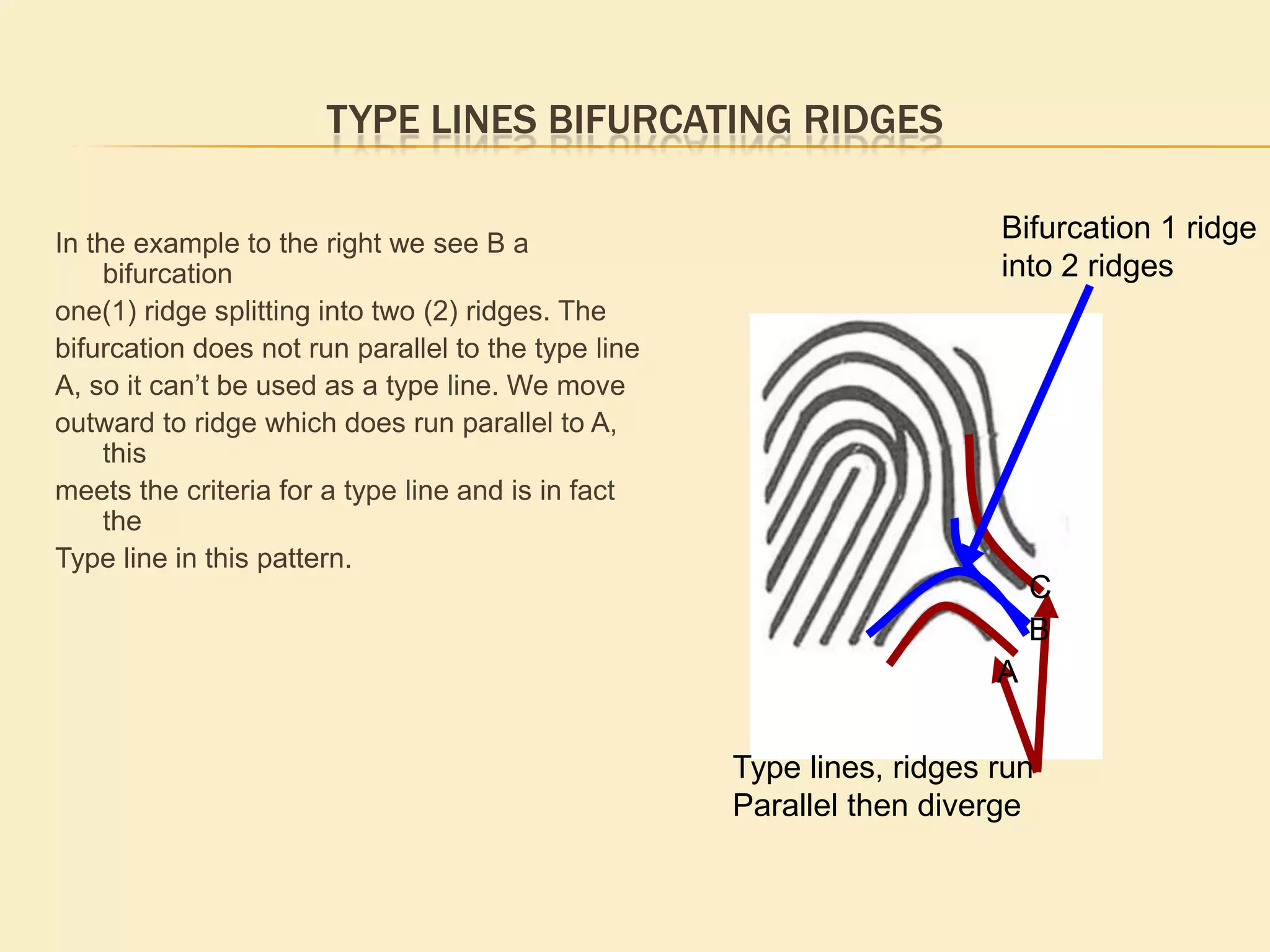
Type lines BifurcatingRidgesBifurcation 1 ridgeinto 2 ridgesIn the example to the right we see B a bifurcationone(1) ridge splitting into two (2) ridges. The bifurcation does not run parallel to the type line A, so it can’t be used as a type line. We move outward to ridge which does run parallel to A, this meets the criteria for a type line and is in fact the Type line in this pattern. CBAType lines, ridges run Parallel then diverge
22.
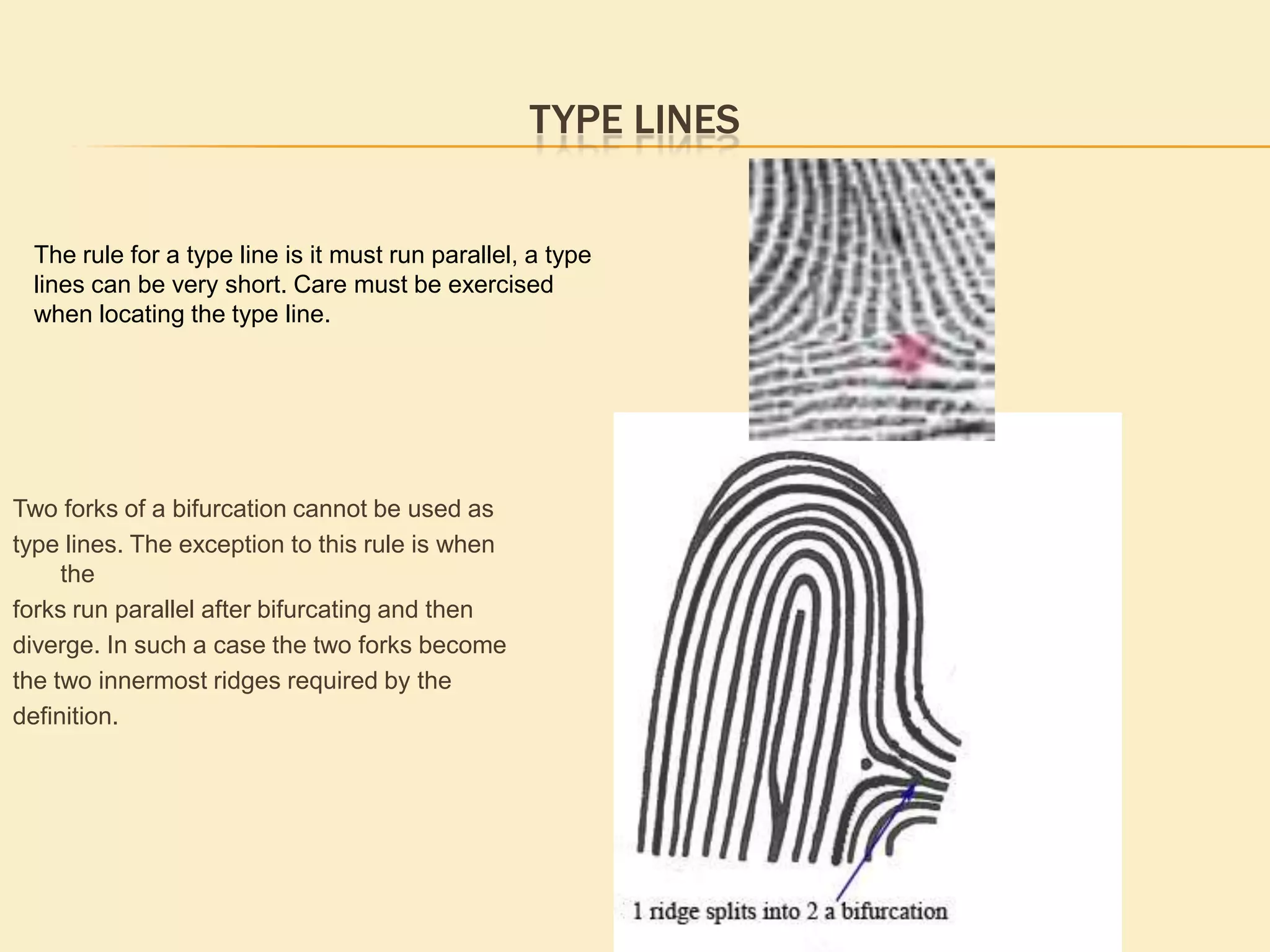
Type linesThe rulefor a type line is it must run parallel, a type lines can be very short. Care must be exercised when locating the type line. Two forks of a bifurcation cannot be used as type lines. The exception to this rule is when the forks run parallel after bifurcating and then diverge. In such a case the two forks become the two innermost ridges required by the definition.
23.
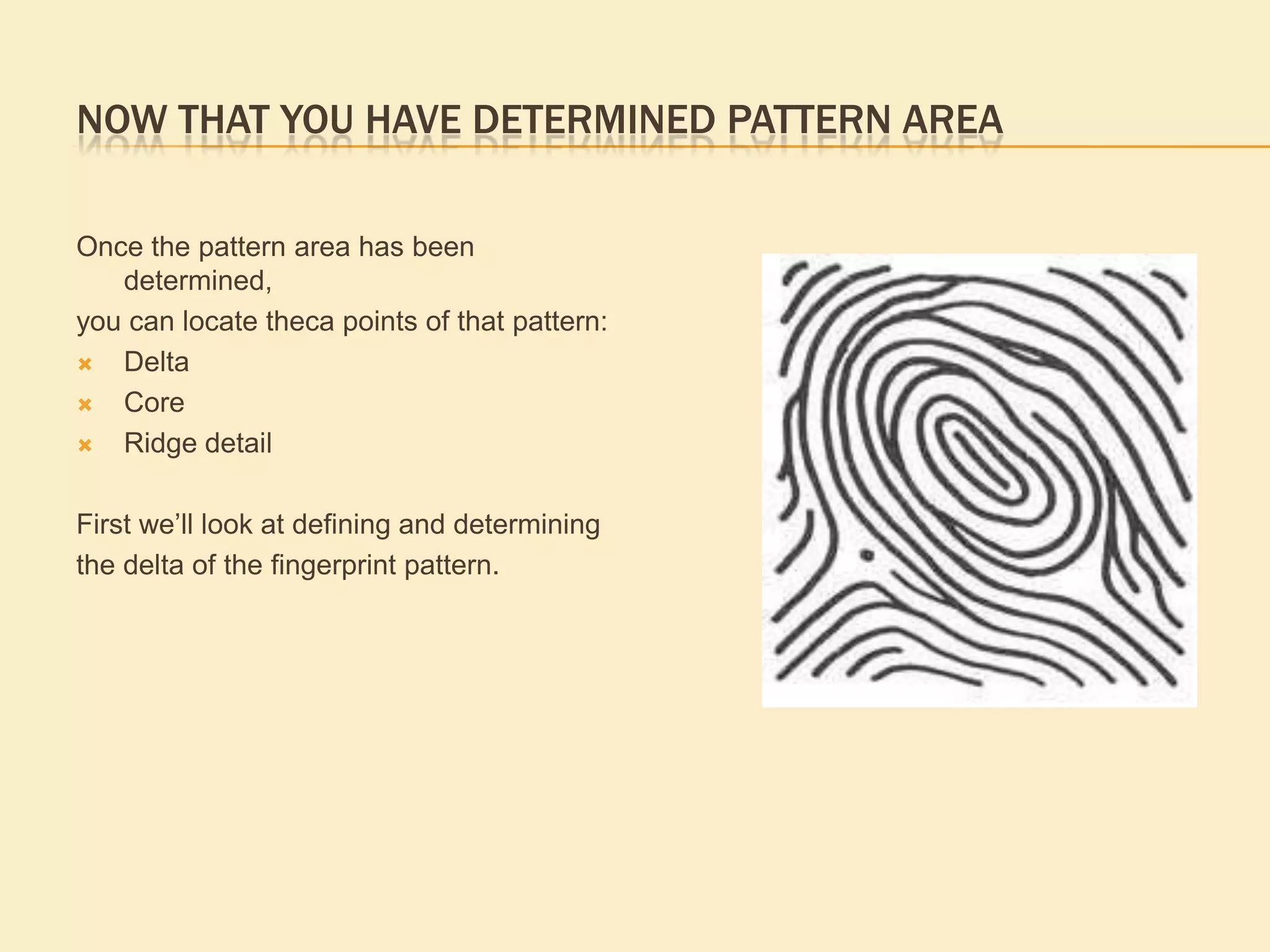
Now That Youhave determined Pattern AreaOnce the pattern area has been determined, you can locate theca points of that pattern:DeltaCoreRidge detailFirst we’ll look at defining and determining the delta of the fingerprint pattern.
24.
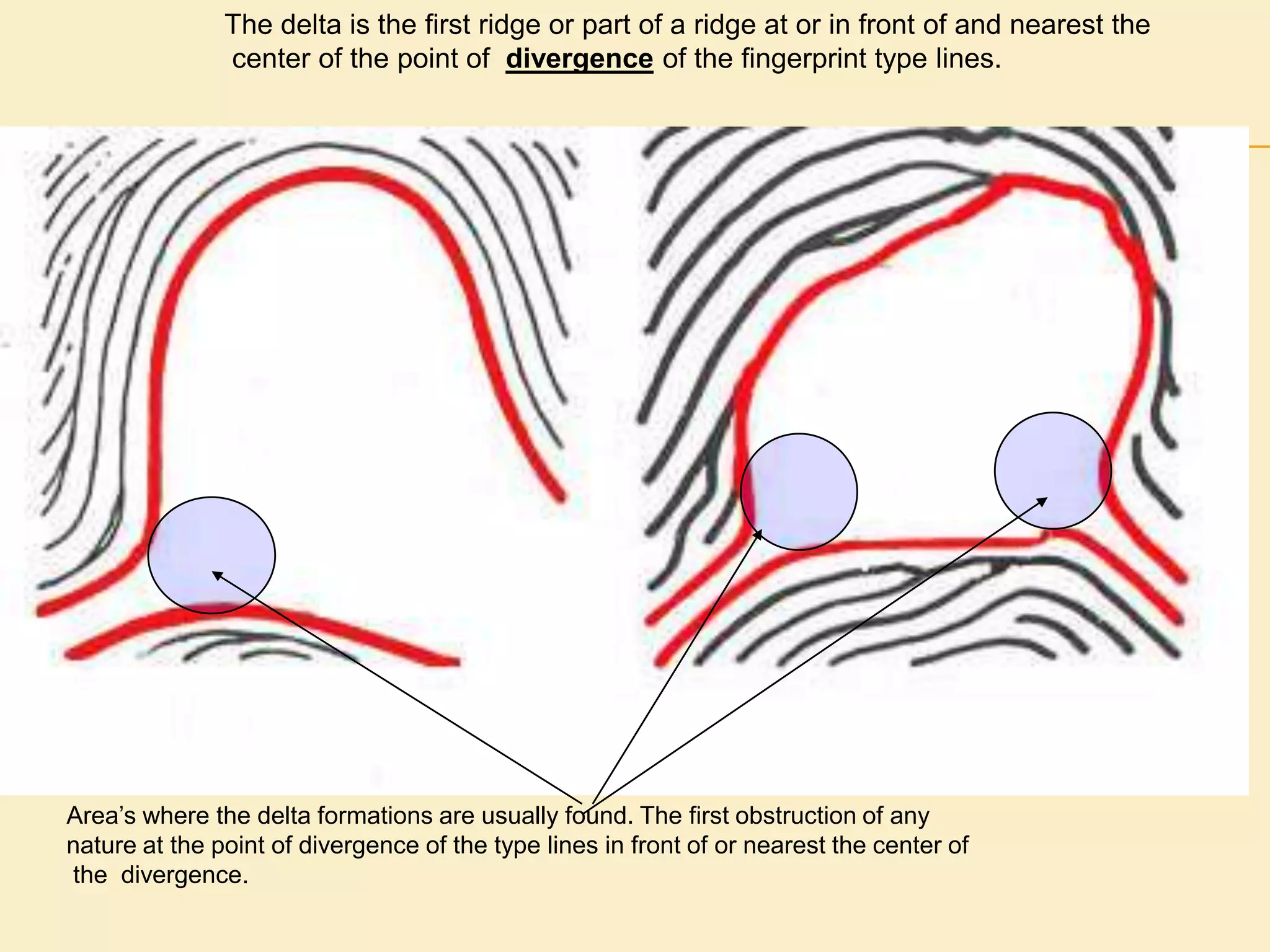
The delta isthe first ridge or part of a ridge at or in front of and nearest the center of the point of divergence of the fingerprint type lines.Area’s where the delta formations are usually found. The first obstruction of any nature at the point of divergence of the type lines in front of or nearest the center of the divergence.
25.
DeltaThe delta maybe:● A bifurcation● An abrupt ending ridge● A dot● A short ridge● A meeting of two ridges● A point on the first recurving ridge located nearest to the center and in front of the divergence of the type lines.
26.
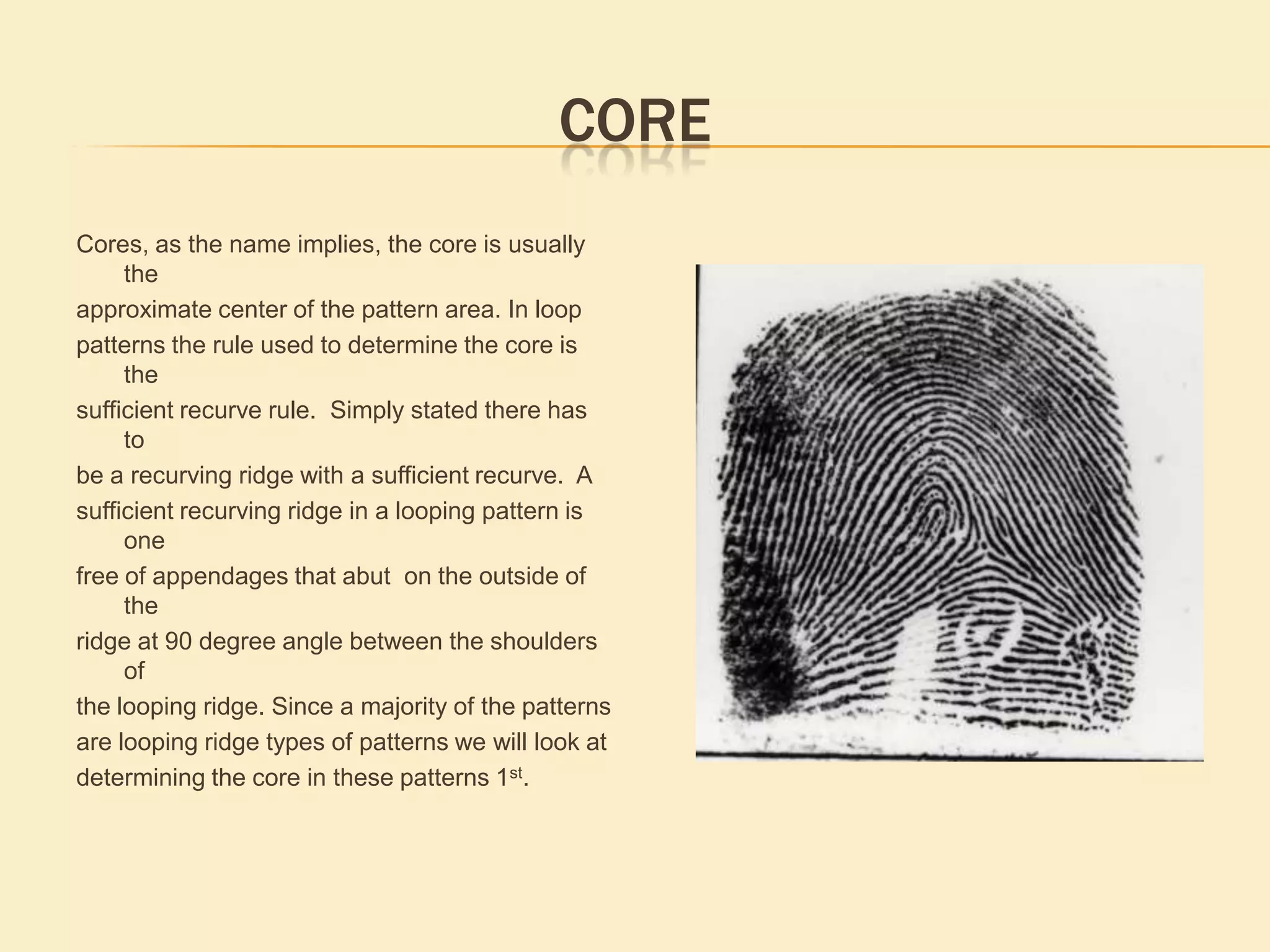
CoreCores, as thename implies, the core is usually the approximate center of the pattern area. In loop patterns the rule used to determine the core is the sufficient recurve rule. Simply stated there has to be a recurving ridge with a sufficient recurve. A sufficient recurving ridge in a looping pattern is one free of appendages that abut on the outside of the ridge at 90 degree angle between the shoulders of the looping ridge. Since a majority of the patterns are looping ridge types of patterns we will look at determining the core in these patterns 1st.
27.
Sufficient RecurveIn orderto determine core placement in a looping fingerprint pattern, you first need To determine if the pattern has a sufficient recurve. Sufficient recurve is defined as the innermost recurving ridge that enters the pattern area, recurves and exits or tends to exit on the same side as the ridge entered. The ridge must be free of Any ridge appendages abutting at rightangles on the outside of the recurve between the shoulders of the looping ridge.
28.
ShoulderThe shoulders onlooping ridges are considered the point at which the ridges begin to curve or turn inward.ShoulderShoulderRidge area that must be free of anyridge appendages abutting at rightangles on the outside of theRecurve.
29.
Sufficient RecurveWhat doyou do if the innermostlooping ridge is spoiled ? This does meet the requirement And is a sufficient recurve.You move to the next recurve and determine if it has a good recurve. This process is followed until you get a good recurve or you are out of the pattern area.Spoils the recurve look for a sufficient recurve in the nextinnermost looping ridge.
30.
Innermost sufficient recurveCoreCoreInnermostsufficient recurveExamples of the innermost recurving ridges being spoiled and dropping back to the next recurving ridge until you get a recurving ridge that is not spoiled. Once you have that you can determine the core placement.Innermost sufficient recurveCoreInnermost sufficient recurve
31.
Ridge CountingThe ridgecount is the number of ridges intervening between the delta and the core. The ridge count is usually determined utilizing a red line found on the reticule of the fingerprint glass. The line is lined up between the delta and core is used count to insure accuracy. Ridges that touch or cross the line become your ridge count, in the event there is a bifurcation of a ridge exactly at the point where the imaginary line would be drawn, two ridges are counted. Fragments and dots are counted as ridges only if they appear to be as thick and heavy as the other ridges In the immediate pattern. The delta and core are not counted. Ridge counting was used extensively in the Henry classification formula with the advent of automated fingerprint identification systems (AFIS) ridge counting is seldom used though a ridge count across a looping ridge is a required element of a loop pattern. CoreDeltaRidge Count of 3Ridge 3Ridge 2Ridge 1


![[I-TALENTS] - GIẢI MÃ VÂN TAY](https://cdn.slidesharecdn.com/ss_thumbnails/i-talents-giaimavntay-140303222331-phpapp01-thumbnail.jpg?width=640&height=640&fit=bounds)


